




Abstract
This paper examines the long-term consequences of tracking in middle school. Using longitudinal administrative data from a large, urban school district and regression and quasi-experimental matching methods, we find that students who had the opportunity to take advanced math earned higher math test scores, completed more rigorous high school coursework, and were more likely to attend a four-year college. These effects largely hold across student subgroups and are relatively robust to omitted confounders. We explore some mechanisms underlying the short-term effects of taking advanced math and conclude that differences in classroom composition, rather than differences in teachers, help explain these effects. We conclude by discussing the implications of these results for efforts to improve educational equity.
Educational outcomes in the United States continue to be highly stratified by social class and race/ethnicity (Duncan & Murnane, 2011; Kao & Thompson, 2003). For over a century, social scientists have studied the ways that educational institutions exacerbate or narrow these inequalities. Much of this literature has focused on how curriculum differentiation (i.e., tracking or ability grouping) affects academic stratification. Although curriculum differentiation has evolved over time, from a system of enrolling students in separate “tracks” of courses (e.g., academic or vocational) to an ostensibly more flexible system in which students can enroll in more or less advanced courses in different subject areas (Lucas, 1999), students from low-income families, and Latinx and Black students, are less likely to be enrolled in advanced courses than their higher-income and white and Asian American peers (Rees et al., 1996; Walston & McCarroll, 2010).
Social scientists’ interest in curricular differentiation stems largely from the concern that disparities in access to advanced coursework, both between and within schools, contribute to social stratification in adulthood (e.g., Persell, 1977; Rosenbaum, 1976). Policymakers have responded to this concern by taking two contrasting approaches to reducing disparities in advanced course-taking, particularly in math. One approach has been to expand access to advanced courses. Throughout the 1980s and 1990s, the percentages of students taking advanced math courses increased, which, in turn, reduced social class and ethnic disparities in advanced course-taking (Domina & Saldana, 2012). That trend continued during the first decade of the 2000s—with the percentage of U.S. eighth graders enrolled in Algebra I or higher, increasing from less than a third in 2000 to nearly half by 2011 (Loveless, 2013).
Over the last decade, however, enrollment in advanced middle school math courses has declined by about 10 percentage points nationally and by over 40 percentage points in the Los Angeles Unified School District (LAUSD), the focus of our study (see Appendix Table A1). These trends follow the adoption of new math standards in many states (known as the “Common Core”), which incorporated more algebra content throughout the grades and promoted a non-Algebra I eighth-grade math course for all students (Loveless, 2016).
A longstanding literature has examined inequities in access to advanced courses, differences in students’ educational experiences in those courses, and the effects of course differentiation on students’ educational outcomes (for a review, see Gamoran, 2009). Yet little research has investigated these topics during this recent period of reduced access to advanced middle school math, when students who may have benefited from advanced math had fewer opportunities to take it. In addition, scholars know too little about the longer-term educational impacts of enrolling in advanced math, the effects of advanced coursework on behavioral and socioemotional outcomes, and why students may benefit from taking advanced math.
We investigate these topics by studying the effects of taking advanced seventh-grade math in a school district where the course is a prerequisite to taking Algebra I in eighth grade and where most students come from low-income families and are of Latinx heritage. In this majority-minority context, any advantages of taking advanced middle school math will accrue mostly to low-income students of color, and thus, the results can inform scholarly and policy debates about how best to structure educational opportunity to achieve both equity and excellence.
Students are not randomly assigned to math courses, so the key methodological challenge in estimating the effect of advanced coursework is to approximate the causal effect using observational data. Moreover, because selection into advanced math is typically positive (i.e., students are more likely to take advanced math when they are higher achieving or have more involved parents), estimates that do not account for this selection process will be too large (i.e., what seem like effects of advanced math will instead, at least partially, reflect effects of the factors that lead some students to be more likely to take the course). Scholars generally take one of two approaches to approximating the causal effects of course-taking. One approach compares students who took different math courses yet were otherwise similar on observed variables prior to course placement, using regression models, propensity score matching, or both (e.g., Domina, 2014; Hoffer, 1992; Simzar et al., 2016). A second approach uses natural experiments (e.g., Clotfelter et al., 2015; Dougherty et al., 2017; McEachin et al., 2020).
We use a variety of approaches that equate students on observables prior to course placement, including regression, weighting, and matching. We do this because our data include a very large set of observables measured prior to course placement, and we lack a plausible natural experiment for most of the students in our sample. We do, however, incorporate two different types of natural experiments that apply to a subset of the schools or students in our sample. Specifically, we examine the middle school outcomes of students who differed in their course enrollment because their school did not always offer the advanced math course or who differed in their course enrollment yet lived in the same household. In addition, we assess how biased our estimated effects are likely to be, both by estimating the effects of taking advanced seventh-grade math on outcomes that should not be affected by the course and by using robustness tests to estimate the likelihood that unobserved confounders would invalidate our results. Although we use causal language in our exposition, we caution readers to remain attuned to the potential for upward bias in our estimates, a point we return to in our discussion.
Background
Scholarly research has focused on three main aspects of the link between curricular differentiation and educational inequality: 1) disparities in students’ access to advanced coursework; 2) disparities in students’ experiences in advanced versus general courses; and 3) the impact of advanced versus general courses on students’ academic outcomes.
Disparities in Access to Advanced Coursework
Black and Latinx students, and students from families with low incomes and less education, tend to be less likely than their higher-income, white, and Asian American peers to take advanced math courses (Attewell & Domina, 2008; Domina, 2014; Dougherty et al., 2015; Lucas, 1999). These disparities stem in part from differences in students’ academic preparation. However, even among students with similar academic performance prior to course placement, studies tend to find small social class disparities in course placement. Among students who have similar social class backgrounds and academic performance prior to course placement, studies tend to find that Black and Latinx students are equally or more likely than white students to be enrolled in advanced courses, but that Asian American students are more likely than students from other ethnic backgrounds to be enrolled in advanced courses (e.g., Attewell & Domina, 2008; Dauber et al., 1996; Domina, 2014).
Course-taking disparities also arise because schools that serve large percentages of minoritized and socioeconomically disadvantaged students offer fewer advanced courses (Wolfe et al., 2023). In 2017–18, for example, about 50 percent of high schools that served large percentages of low-income students or students of color did not offer a calculus course (Leung et al., 2021). Because course offerings and course placement disparities vary across contexts (Hanselman et al., 2022; Kelly & Price, 2011; Lucas & Berends, 2007), we begin this paper by describing ethnic and social class stratification in advanced seventh-grade math in our sample.
Differences Between Advanced and General Courses
Advanced and general courses tend to differ in the students they enroll, their educational practices, and their teaching quality (see Gamoran & Berends [1987] for a review). Because the rationale for offering both advanced and general math courses is that students need curricula and instruction tailored to their math skills, advanced math courses tend to serve higher-achieving students, on average, than general math courses (Dougherty et al., 2017). And because students’ math achievement tends to be correlated with their social background, effort in school, classroom behavior, and educational aspirations, students who take different math courses not only have classmates with higher math achievement but also tend to experience a different social environment in their math courses (Alexander et al., 1978; Carbonaro, 2005).
Advanced courses may also differ from general courses in their instructional quality. Early studies indicated that teachers of non-advanced courses taught a lower-quality curriculum (Oakes, 1985; Rosenbaum, 1976) and were less satisfied with their jobs. More recent work from Wake County Public Schools finds that advanced middle school math courses are larger, by about five students, than general middle school math courses but does not find statistically significant differences between advanced and general math courses in teachers’ experience, contribution to student test score gains (i.e., “value added”), or demographics (Dougherty et al., 2017). Students’ experiences in advanced and general courses may also differ because teachers’ expectations for students (Kelly & Carbonaro, 2012; Oakes, 1982, 1985), their instructional practices (e.g., Gamoran & Carbonaro, 2002; Mayer et al., 2018), and their responses to students’ behavior (e.g., Musto, 2019) vary across advanced and general courses. We add to this literature by exploring the extent to which differences between general and advanced math students’ end-of-seventh-grade math test scores and grades stem from differences in who teaches those courses, both in terms of aspects of teaching quality we can measure in our data, such as teachers’ experience or math credentials, and overall. We do this by focusing a subset of our analyses on a sample of seventh-grade students enrolled in either general or advanced math taught by the same teacher in the same year.
Effects of Advanced Courses
Many scholars have estimated the impact of taking advanced courses on students’ learning and educational attainment using nationally representative samples. For example, Gamoran (1987) found that students learned more math between 10th and 12th grade when they took more advanced math courses, and that this positive association held even for students with relatively weak math skills. Gamoran and Hannigan (2000) found similar results for 10th-grade math scores among students who took algebra in eighth grade, and Schneider et al. (1998) found that taking more advanced math courses in 12th grade improved students’ math scores and college enrollment. Attewell and Domina (2008) showed that taking more math courses (and more advanced math courses) in high school improved students’ chances of completing college.
Studies of the effects of middle school math course-taking are less common, and those using nationally representative data have been limited to looking at short-term effects on test scores. These studies find positive effects on middle school math test scores ranging in size from around half a standard deviation in the late 1980s (Hoffer, 1992) to about a tenth of a standard deviation in the mid-2000s (Domina, 2014).
To our knowledge, Simzar et al. (2016) is the only study to estimate the impact of advanced math course-taking in middle school on students’ behavioral or socioemotional outcomes. Studying a sample of middle schools from an urban district in California, they found that eighth graders enrolled in Algebra I reported lower self-efficacy in math by the end of the year (by about a quarter of a standard deviation) than otherwise similar eighth graders enrolled in general math, and that these effects were most pronounced among lower-achieving students.
Several studies have examined the longer-term effects of middle school math placement using data from specific school districts or states. Perhaps because of these contextual differences, these studies have yielded conflicting results. Clotfelter et al. (2015) studied the impact of school districts expanding access to eighth-grade algebra in the early 2000s in North Carolina. They found negative or null effects of eighth-grade algebra on students’ end-of-course algebra test scores, negative effects on passing geometry by the end of 11th grade, and negative or null effects on passing Algebra II by the end of 12th grade. Their results suggest that the effects of taking algebra in eighth grade are especially negative for low-achieving students. In contrast, McEachin et al. (2020) estimated the impact of taking algebra in eighth grade using a sample of students who were in middle school in California between 2007 and 2011. They found that enrolling in eighth-grade algebra improved math scores in 10th grade slightly and boosted enrollment in advanced high school math courses considerably.
Dougherty et al. (2017) is the most similar study to ours because they examine the impact of taking advanced math in seventh grade on both middle school and high school outcomes. Using a longitudinal sample of students from Wake County, NC, who were in seventh grade in 2011–2013, they found null effects of enrollment in advanced seventh-grade math on math and reading test scores at the end of seventh grade (their results are imprecise, however, so they are unable to rule out positive effects on math as large as .25 standard deviations), and they found large positive effects on high school course taking. Students who took advanced math in seventh grade were 33 percentage points more likely to pass geometry in ninth grade, 18 percentage points more likely to pass Algebra II in 10th grade, and possibly more likely to pass precalculus in 11th grade (their point estimate is positive but imprecise). They also found positive effects on the 10th grade PLAN ACT test (a composite of math, science, English, and reading), imprecise but positive estimates for the math ACT, and large positive effects, approximately 25 percentage points, on 10th graders’ plans to attend a four-year college. Their effects were largest for girls and for students from higher-income families. We add to this literature by using a recent, large, longitudinal sample to estimate the effects of taking advanced seventh-grade math on short- and long-term academic, behavioral, socioemotional, and college readiness outcomes, including college enrollment.
Data and Sample
Our primary data source is an administrative data set that includes the universe of students enrolled in the Los Angeles Unified School District during the 2009–10 through 2020–21 academic years. These data include measures of students’ demographic characteristics, academic achievement, school-related behavior, and course-taking. We link these administrative data to students’ responses to the district's annual school climate survey, National Student Clearinghouse (NSC) data on their college enrollment, and district human resources data about their math teachers’ demographic characteristics, educational background, and teaching credentials.
We construct longitudinal cohorts of students who were first-time seventh graders in 2015–16, 2016–17, 2017–18, or 2018–19. From these cohorts, we then create several analytic samples for each of our data sources and years. Our largest analytic sample includes all the first-time seventh graders who had not taken an advanced math course in sixth grade (only 3% of seventh graders took advanced math in sixth grade), took a full year of general or advanced math in seventh grade, had non-missing data for key predictors (including standardized test scores, academic grades, academic program [e.g., classified as gifted], gender, ethnicity, and English language learner status), and had non-missing data for key administrative outcomes from the end of seventh grade (including standardized test scores, grades, and attendance). This sample includes 108,413 seventh graders from 126 schools and 5,083 math classrooms. Most of these students were Latinx (78%), low income (89%), multilingual (64%), and scored below grade level on their sixth-grade standardized math test (74%).
Our other analytic samples are subsets of this sample. Those analytical samples are smaller, either because they follow students over a longer time period, use outcome measures derived from surveys (which are subject to nonresponse), or include only those cohorts that have aged enough for us to measure particular outcomes. We use these different samples to maximize statistical power and so that our results for the shorter-term outcomes are more generalizable (i.e., less affected by sample attrition that occurs as students progress through middle and high school). Appendix Table A2 shows the cohorts we include in each of the analytic samples and their Ns. Appendix Table A3 shows descriptive statistics for each analytic sample and indicates that our samples are somewhat more positively selected as students age.
Measures
Student Characteristics
We measure a large set of student characteristics prior to seventh-grade math course placement because our analytic approaches require that we account for as many important predictors of both math course placement and the outcomes as possible. These predictors include demographic characteristics (e.g., age, gender, and ethnicity); family background characteristics (e.g., eligibility for subsidized meals, parents’ education, and school mobility); academic program, including receiving special education services, being identified as gifted and talented, and English-language learner status; academic performance as measured by two years of standardized test scores and fifth and sixth grade grades; sixth-grade course-taking; school-related behavior including attendance, suspension, teacher-reported work effort, and student-reported work effort and classroom behavior; and students’ reports of their growth mindset, academic self-efficacy, and educational expectations (see Appendix Table A4 for more details).
Outcomes
We measure a number of middle school and high school academic outcomes, including students’ middle school standardized test scores, 10th-grade PSAT scores, and likelihood of passing an Advanced Placement (AP) exam; students’ middle and high school math and overall grades; and students’ high school course-taking, including whether they passed or earned a “B” or better in Algebra I by the end of ninth grade, took calculus or another higher-level math course in high school, and the number of semesters of honors, AP, International Baccalaureate (IB), or “advanced” academic, math, and science courses they passed in high school (see Long et al., 2012). We also measure students’ academic self-efficacy and school-related behavior, including their annual attendance rate, teacher-reported behavior grades, and self-reported behavior. Finally, we measure college-related outcomes including educational expectations, reports of receiving college-access support from school staff, four-year college eligibility, college math course eligibility, and college enrollment (see Appendix Table A4 for more details).
Potential Mechanisms for the Effects on Seventh-Grade Outcomes
We also measure peer and teacher characteristics of students’ seventh-grade math courses that may contribute to the effect of taking advanced math. We construct classroom-level measures of seventh-grade class size and classmate characteristics, including means and standard deviations of classmates’ sixth-grade standardized test scores, math GPAs, and self-reported sixth-grade classroom behavior and the percentages of classmates who, in sixth grade, expected to earn a bachelor's degree or higher.
For seventh-grade teachers, we construct indicators for whether they were novices (i.e., had two or fewer years of teaching experience), long-term substitutes, or National Board Certified; the type of math credential they held (i.e., a multisubject credential, which licenses them to teach general middle school math; a foundational math credential, which licenses them to teach math through Algebra II; or a full math credential, which licenses them to teach all secondary math courses [California Commission on Teacher Credentialing, n.d.]); and the type of math courses they taught in the prior year (i.e., elementary school; general sixth, seventh, or eighth grade; advanced sixth, seventh, or eighth grade; or Algebra I or higher).
Middle School Math Course-Taking in the Los Angeles Unified School District
During the period of our study, 2014–15 through 2020–21, most L.A. Unified students (75%) took general math throughout middle school, with the expectation that they would take Algebra I in ninth grade. Approximately one in six students (17%) took general math in sixth grade and advanced math in seventh grade, with the expectation that they would take Algebra I in eighth grade. A small percentage of students (3%) took an advanced math course in sixth grade, with the expectation that they would take Algebra I in seventh grade, and geometry in eighth grade. An additional five percent of students followed an alternative course sequence. 1 We focus on the opportunity to take advanced math in seventh grade, because that particular course served as students’ primary pathway to taking Algebra I in eighth grade and was the most common entry point into an advanced math curriculum (i.e., most students who took an advanced middle or high school math course took their first advanced course in seventh grade).
To be eligible to enroll in advanced seventh-grade math, district policy advised schools that students should have earned an “A” or “B” in the spring term of their sixth-grade math course and have met or exceeded grade-level standards on their sixth-grade math Smarter Balanced test (SBAC). 2 Table 1 shows that the students in our analytic sample who took advanced math in seventh grade had considerably higher average grades and test scores at the end of sixth grade than their peers in general math. For example, 85 percent of the students who took advanced math earned at least a “B” average in sixth-grade math compared to 35 percent of general math students. And nearly three-quarters (73%) of advanced math students scored in the top quartile of the district's sixth-grade standardized math test score distribution, compared to 13 percent of general math students.
General and Advanced Math Student, Classroom, and Teacher Characteristics
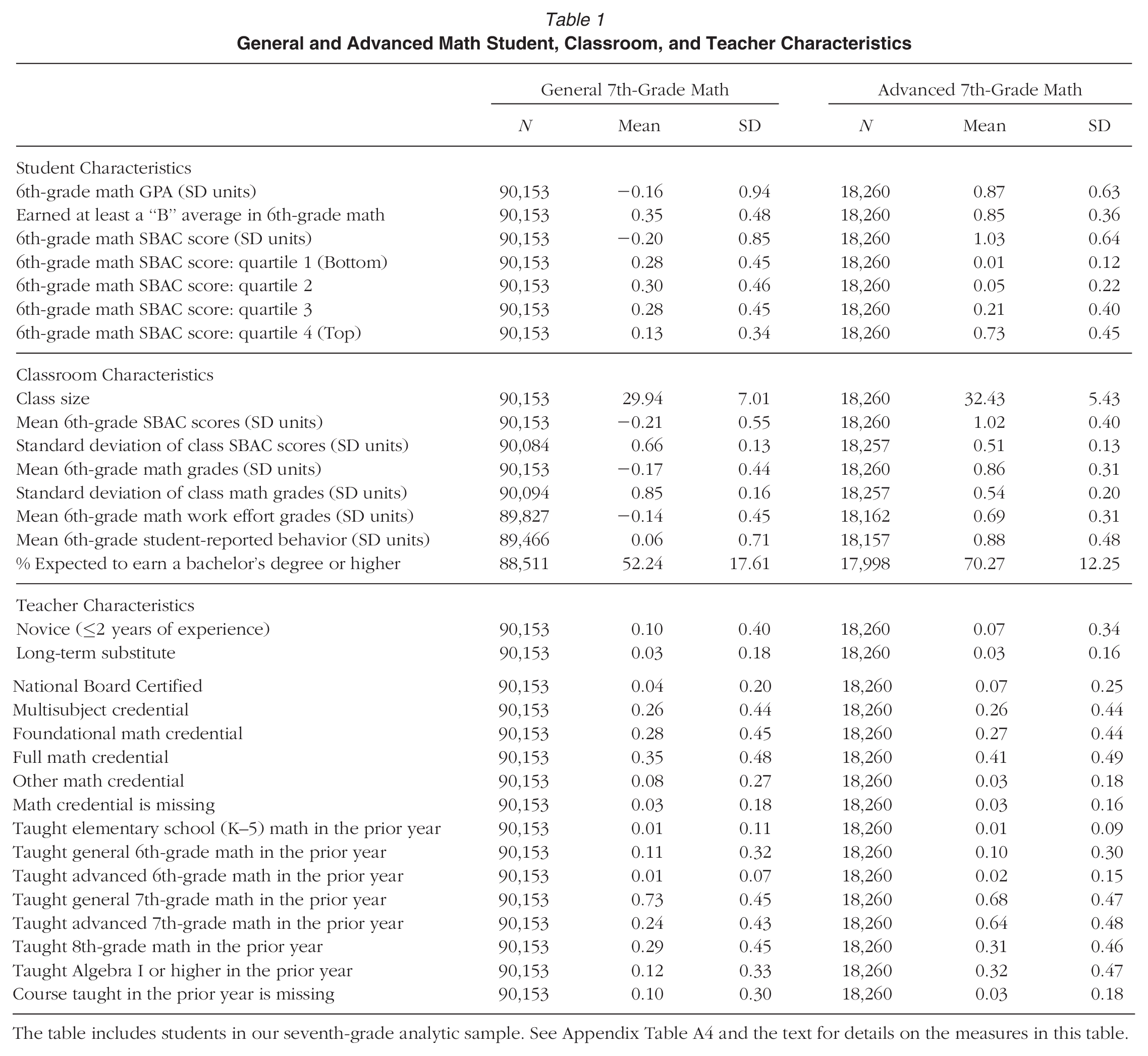
The table includes students in our seventh-grade analytic sample. See Appendix Table A4 and the text for details on the measures in this table.
Students in advanced math were also in somewhat larger classes than their general-math counterparts. In addition, students’ classmates in advanced courses began those courses with substantially higher work effort grades, self-reported behavior, and educational expectations than classmates in general math classrooms. The typical advanced math student was also more likely than the typical general math student to have a teacher with a full math credential and with recent experience teaching an advanced course (see Table 1).
Sixty-five percent of students in our analytic sample who were eligible to enroll in advanced math took the course. Of the eligible students who did not take the course, 31 percent attended a school that did not offer the course during their seventh-grade year, and 41 percent attended a school that did not offer enough sections of the course to accommodate all eligible students. Note that we classified schools as not offering advanced math if no students were enrolled in the course in a given academic year. We classified schools as not offering enough sections if the number of eligible students at the school exceeded the space in the course(s) calculated based on the maximum class size allowed by district policy. Eligible students who did not take the course yet attended schools that offered enough sections may not have taken the course because their parents did not sign the permission form, they were not interested in taking it, or it conflicted with another course they were interested in taking.
During the period of our study, schools that did not offer an advanced seventh-grade math course enrolled relatively few eligible students (9 percent of their seventh graders, on average) (see Appendix Table A5). Compared to the other schools in our sample, these schools enrolled fewer students who were white or Asian American and whose parents had completed at least some college and more students who were eligible for subsidized meals. Schools that did not offer enough sections of the course to accommodate all eligible students were demographically similar to schools that offered enough sections but had slightly higher achieving students—and thus a larger share of eligible students. 3
Among students who took advanced math, 65 percent met the district's course eligibility criteria and 35 percent did not (Appendix Table A6 describes these students). A large percentage (93%) of the ineligible students who enrolled in advanced math attended schools that had room in the course for additional students. Ineligible students who enrolled in the course may also have had sixth-grade teachers who recommended them for advanced math or had parents who requested they take it (see Useem, 1992). Because the cohorts we study include substantial percentages of students who were eligible for advanced seventh-grade math but did not take it and students who were ineligible but did take it, our sample contains many students who were similar academically at the start of seventh grade but took different math courses.
Analytic Approach
Estimating Enrollment Inequities in Advanced Seventh-Grade Math
We begin by examining whether students from different demographic backgrounds who were similar on other observed variables measured prior to seventh grade enrolled in advanced math at different rates. We do this by estimating logistic regression models—adjusting the standard errors to account for students being clustered in schools—where

We address missing data using dummy variable adjustment (Allison, 2010) but also estimate some of our models using multiple imputation methods and obtain qualitatively similar results. 4 We obtain predicted probabilities of taking advanced math for each student subgroup by computing the average marginal effects (AME) (Williams, 2012).
Estimating the Impact of Taking Advanced Seventh-Grade Math
Our second set of analyses aims to approximate the impact of taking advanced math. We use several different empirical strategies to compare the outcomes of advanced and general math students who were similar on a large set of characteristics prior to seventh grade.
5
We first estimate linear and logistic mixed effects (ME) models that nest students in schools (level 3) and classrooms (level 2). Our models for continuous outcomes take the following form, where

While the ME model includes a large set of controls, it is possible that it does not adequately equate students because of differences in the distribution of general and advanced math students’ pre-placement characteristics. To address this possibility, we estimate models using entropy balancing (EB) weights (Hainmueller, 2012). Entropy balancing reweights the data so that the means and variances of the covariates are equal, effectively making the average general math student equivalent to the average advanced math student on the covariates. Weights, unlike the other data preprocessing methods we use, have the advantage of retaining the full sample and balancing the distribution of covariates in addition to their means.
We then run a weighted OLS or logistic regression model—adjusting the standard errors to account for students being clustered in schools. (We refer to this model as the “entropy balancing weights” model in our tables.) Our models for continuous outcomes take the following form, where

While the EB weights model achieves covariate balance on students’ observed characteristics, it does not account for schools’ potential role in students’ math course placements. Thus, we also estimate linear and logistic regression models that include school fixed effects (FE). (We refer to this model as the “school fixed effects” model in our tables.)

These unweighted models extend the EB weights model (equation 3) by adding a school fixed effect (
Because the school FE model, like the ME model, may not adequately equate students, we use two different propensity score matching (PSM) approaches. We first estimate students’ propensity for taking advanced math, conditional on their pre-placement characteristics, cohort, and school. 6 We then match treated (i.e., advanced math) students to up to five other untreated (i.e., general math) students who attended the same school using caliper matching (Rosenbaum & Rubin, 1985) and estimate the school FE model (equation 4) with our matched samples (the “school fixed effects + PSM” models in our tables). 7
We then estimate an additional set of propensity score models that takes advantage of a subset of schools’ delayed adoption of advanced math in the years immediately following the district's transition to Common Core. These models address the potential concern that students who attend the same school and have similar propensities for taking advanced math but ultimately take different courses may differ in ways we cannot observe. If we assume that some proportion of seventh graders would opt to take advanced math if given the opportunity, then general math students who attended a school that did not offer the course may be a better pool of students to use as counterfactuals for advanced math students than those who had the possibility of taking advanced math but did not.
We implement this approach by matching treated students (i.e., advanced math) to up to five untreated students (i.e., general math) who attended the same school but in a year when advanced math was not offered. For example, school k was in operation from 2015–16 through 2017–18, which we can denote as T1, T2, and T3. In 2015–16 (T1), school k only offered general math (GM). In 2016–17 and 2017–18 (T2 and T3), school k offered general (GM) and advanced math (AM). For school k, our treatment group is composed of 2016–17 and 2017–18 advanced math students (
After matching, we estimate the school FE model (equation 4) with our matched samples, excluding the cohort fixed effect (we refer to this model as the “late adopters (fixed effects + PSM)” models in our tables). 8 Due to sample size limitations, we only estimate the late adopters model for our middle school outcomes.
While the late adopters model partially addresses concerns about unobserved differences in general and advanced math students, it cannot address the possibility that our results may be driven, in part, by unmeasured differences among students’ families, such as how much homework help families provide to their children or how much they encourage them to take advanced math. We address this concern by extending the school FE model (equation 4) by adding a household fixed effect (which we refer to as the “household fixed effects” model in our tables). These models compare children who lived in the same household and attended the same school but took different seventh-grade math courses. Due to relatively small sample sizes, we estimate these models only for the middle school outcomes.
Finally, we replicate the main analyses using our smallest analytic sample—the students we can follow into college—to show which of the results hold for students who remained in the school district through high school graduation (see Appendix Table A7).
Heterogeneous Effects
After estimating average effects, we examine whether the impact of taking advanced math varies by students’ gender, ethnicity, socioeconomic status, language background, sixth-grade math skills (i.e., SBAC score quartile), or eligibility to take advanced math. We do this by estimating the ME, EB weights, school FE, and school FE with PSM models for each subgroup. 9 Our sample sizes for the late adopters and household FE models are too small to estimate subgroup-specific models.
Potential Mechanisms During Seventh Grade
We then examine potential mechanisms for the effect of seventh-grade math, focusing on students’ seventh-grade math test scores and grades as the outcomes. We do this by adding a random coefficient for our advanced math indicator (
Because it is not possible to measure and adjust for all differences among teachers of general and advanced math courses, we also estimate an additional set of models that estimates the effect of taking advanced seventh-grade math for the subset of students whose teacher concurrently taught general seventh-grade math and advanced seventh-grade math. These models extend the ME, EB weight, school FE, and school FE with PSM models by including a teacher fixed effect (

For the school FE with PSM model, we match students within teacher and cohort.
Findings
Disparities in Academic Preparation and Advanced Math Course-Taking
Table 2 shows that by the end of sixth grade, boys, Latinx and Black students, students whose parents did not graduate from college, students eligible for subsidized meals, and students with fewer English language skills scored lower on the math SBAC and earned lower grades than their peers (see the first four columns). Given these academic disparities, it is not surprising that there are large disparities in which students enrolled in advanced seventh-grade math (see the “unconditional disparities” columns).
Disparities in 6th-Grade Math Achievement and 7th-Grade Advanced Math Course-Taking, by Student Group
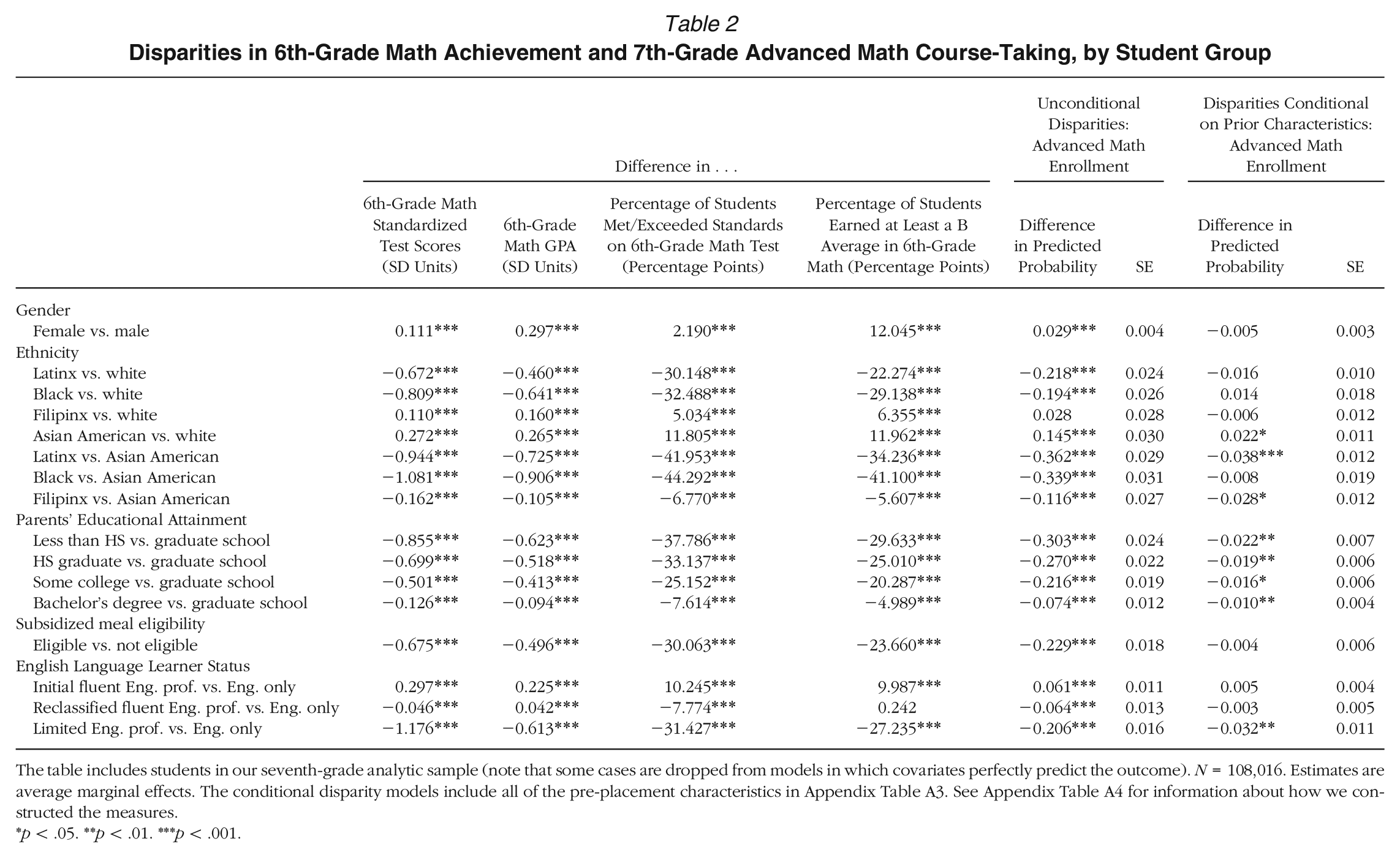
The table includes students in our seventh-grade analytic sample (note that some cases are dropped from models in which covariates perfectly predict the outcome). N = 108,016. Estimates are average marginal effects. The conditional disparity models include all of the pre-placement characteristics in Appendix Table A3. See Appendix Table A4 for information about how we constructed the measures.
*p < .05. **p < .01. ***p < .001.
Among students who had the same measured characteristics at the end of sixth grade, disparities in advanced seventh-grade math enrollment were much smaller but did not disappear (see the two rightmost columns). These results show that Asian American students were slightly more likely to enroll in advanced math than otherwise similar white, Latinx, and Filipinx peers, as were students whose parents attended graduate school. 11
The Impact of Taking Advanced Math in Seventh Grade
Next, we estimate the impact of taking advanced math in seventh grade. We find positive effects on students’ middle school and high school test scores; negative effects on students’ middle school math grades; inconsistent, mixed effects on students’ self-perceptions and behavior; and consistent positive effects on high school course-taking, college readiness, and four-year college enrollment.
Test Scores
Our smallest point estimates suggest that students who took advanced math scored .13, .15, and .15 standard deviations higher on their seventh-grade math SBAC, eighth-grade math SBAC, and 10th-grade math PSAT, respectively, than otherwise similar students who took general math (see Table 3). 12 The seventh-grade estimate is substantially smaller than Hoffer’s (1992) estimate but within the confidence interval of Dougherty et al.’s (2017) null effect. The eighth-grade estimate is slightly larger than Domina’s (2014) estimate for taking advanced math in eighth grade, perhaps in part because the ECLS-K eighth-grade exam may not measure advanced middle school mathematics well enough (Domina, 2014). The 10th-grade estimate is three times as large as McEachin et al.’s (2020) estimate of taking advanced math in eighth grade on a 10th-grade high school exit exam, probably because the PSAT measures more advanced math. Note that the effect of taking advanced seventh-grade math on test scores in eighth and 10th grade may be attributable to learning gains that persist after seventh grade, to additional advanced math course-taking in later grades, or both.
The Impact of Taking Advanced 7th-Grade Math on Students’ Test Scores
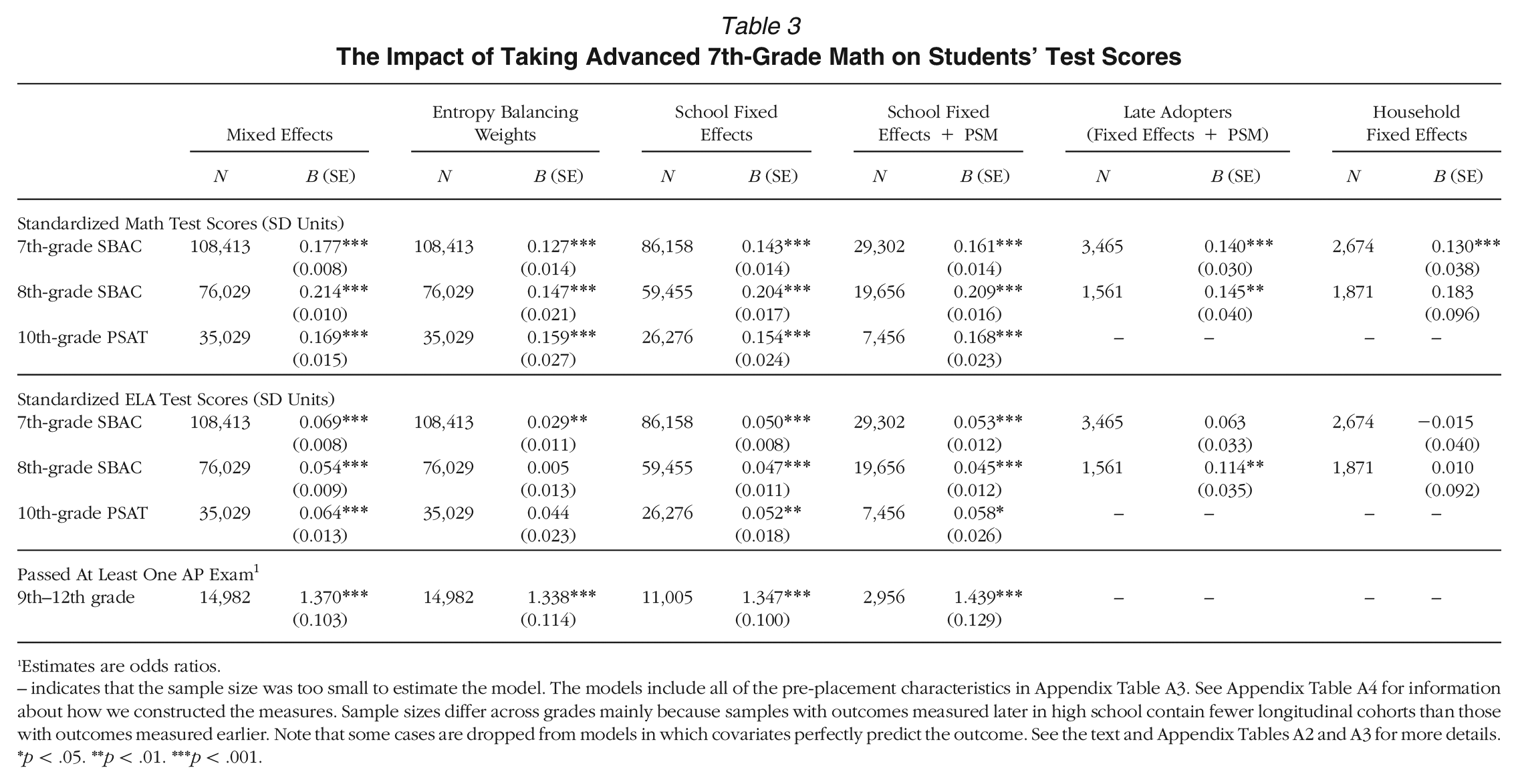
Estimates are odds ratios.
– indicates that the sample size was too small to estimate the model. The models include all of the pre-placement characteristics in Appendix Table A3. See Appendix Table A4 for information about how we constructed the measures. Sample sizes differ across grades mainly because samples with outcomes measured later in high school contain fewer longitudinal cohorts than those with outcomes measured earlier. Note that some cases are dropped from models in which covariates perfectly predict the outcome. See the text and Appendix Tables A2 and A3 for more details.
*p < .05. **p < .01. ***p < .001.
In addition to scoring higher in math, we find suggestive evidence that advanced math students also scored higher on the English language arts (ELA) SBAC and the verbal PSAT, though these coefficients are much smaller than for math. These results resemble McEachin et al.’s (2020) findings and may arise because advanced math students were more likely to take honors English courses in the seventh through 10th grades than similar peers, including those who took the same English and social sciences classes in sixth grade. It is also possible that these results indicate bias from unobserved heterogeneity, a point to which we return in our sensitivity analyses. Table 3 also shows that students who took advanced seventh-grade math were more likely to pass at least one AP exam in high school than similar peers who took general math (by as much as 6.4 percentage points). Note that we show odds ratios rather than predicted probabilities in the tables because we are not able to estimate average marginal effects (AME) for all of our model specifications. The percentage point estimates we report in the text are from the school fixed effect model with propensity score matching.
Grades
Although taking advanced math improved students’ test scores, it reduced their middle school math grades, especially in seventh grade (see Table 4). The point estimates vary across models, with smaller negative effects from the models that use balancing weights or matching, but all the models for seventh grade suggest that otherwise similar students got lower grades in advanced math than in general math (the estimates imply a difference between an “A” in a general course and an “A” minus or “B” plus in an advanced course). It is not surprising that relatively high-achieving students would earn better grades in a general math course than in an advanced math course where more of the students are also high-achieving (see also Nomi & Allensworth, 2009).
The Impact of Taking Advanced 7th-Grade Math on Students’ Grades
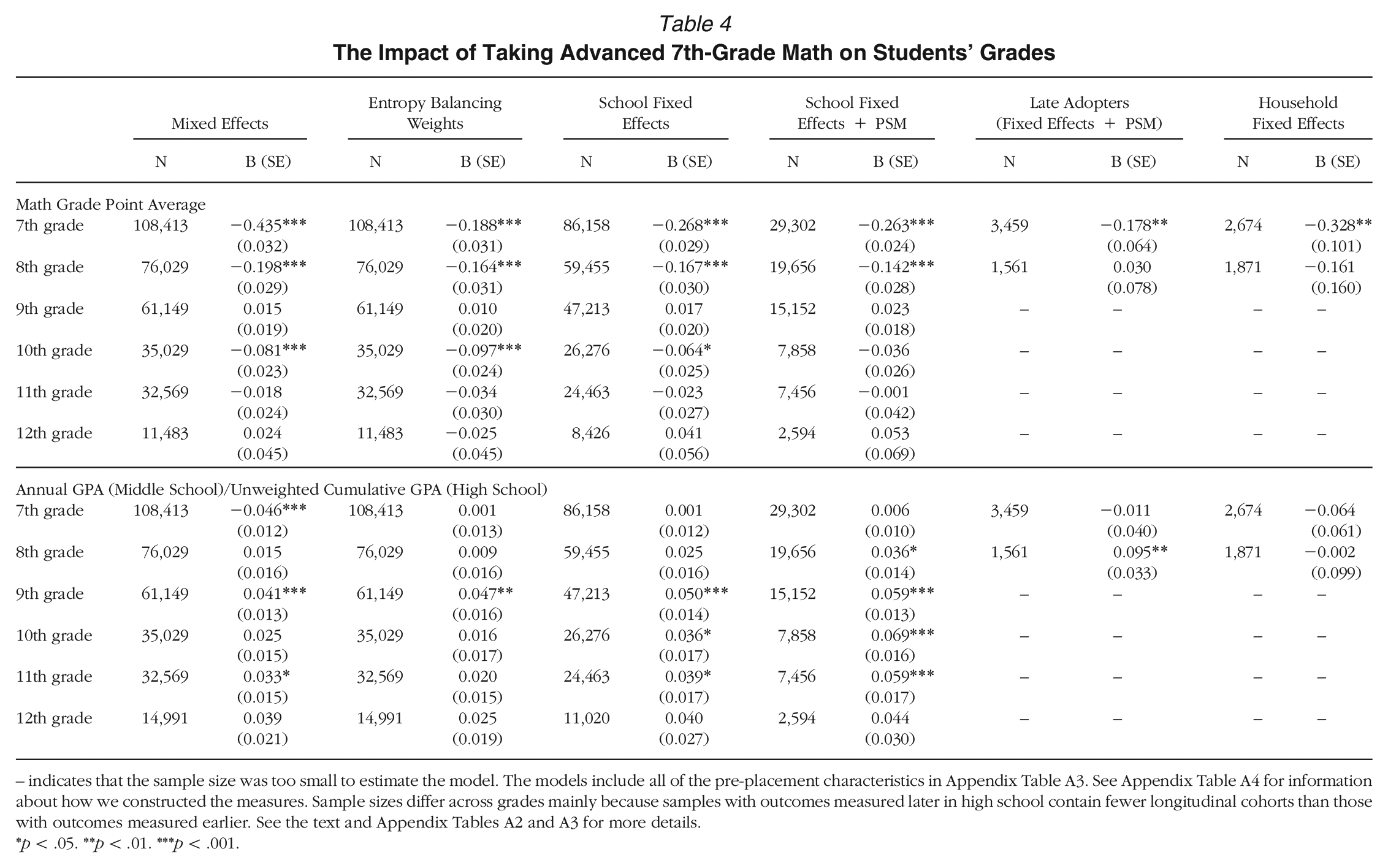
– indicates that the sample size was too small to estimate the model. The models include all of the pre-placement characteristics in Appendix Table A3. See Appendix Table A4 for information about how we constructed the measures. Sample sizes differ across grades mainly because samples with outcomes measured later in high school contain fewer longitudinal cohorts than those with outcomes measured earlier. See the text and Appendix Tables A2 and A3 for more details.
p < .05. **p < .01. ***p < .001.
We do not find consistent negative effects of taking advanced seventh-grade math on students’ overall GPAs in seventh or eighth grade, however, which suggests that higher grades in other subjects may offset lower math grades. In addition, the negative effects on middle school math grades do not seem to persist into high school (the estimates’ signs vary across models and the estimates are rarely statistically significant). We also find suggestive evidence that taking advanced math in seventh grade may improve students’ overall high school GPAs slightly.
Self-Perceptions and Behavior
We find suggestive, but inconsistent, evidence that students who took advanced seventh-grade math may have received slightly lower work effort grades from their math teachers than they would have had they taken general seventh-grade math (see Table 5). Students who took advanced seventh-grade math also reported slightly lower academic self-efficacy in seventh grade and possibly in eighth grade as well (though the coefficients are not consistently statistically significant nor consistently negative). In contrast, students who took advanced seventh-grade math received slightly higher cooperation grades from their middle school math teachers and may have had slightly better attendance in seventh grade. We find no consistent evidence that taking advanced seventh-grade math affected students’ perceptions of their own behavior or educational expectations. Nor do we find consistent positive or negative effects on students’ behavior or self-perceptions during high school (see Appendix Table A8).
The Impact of Taking Advanced 7th-Grade Math on Students’ Self-Perceptions and School-Related Behavior During Middle School
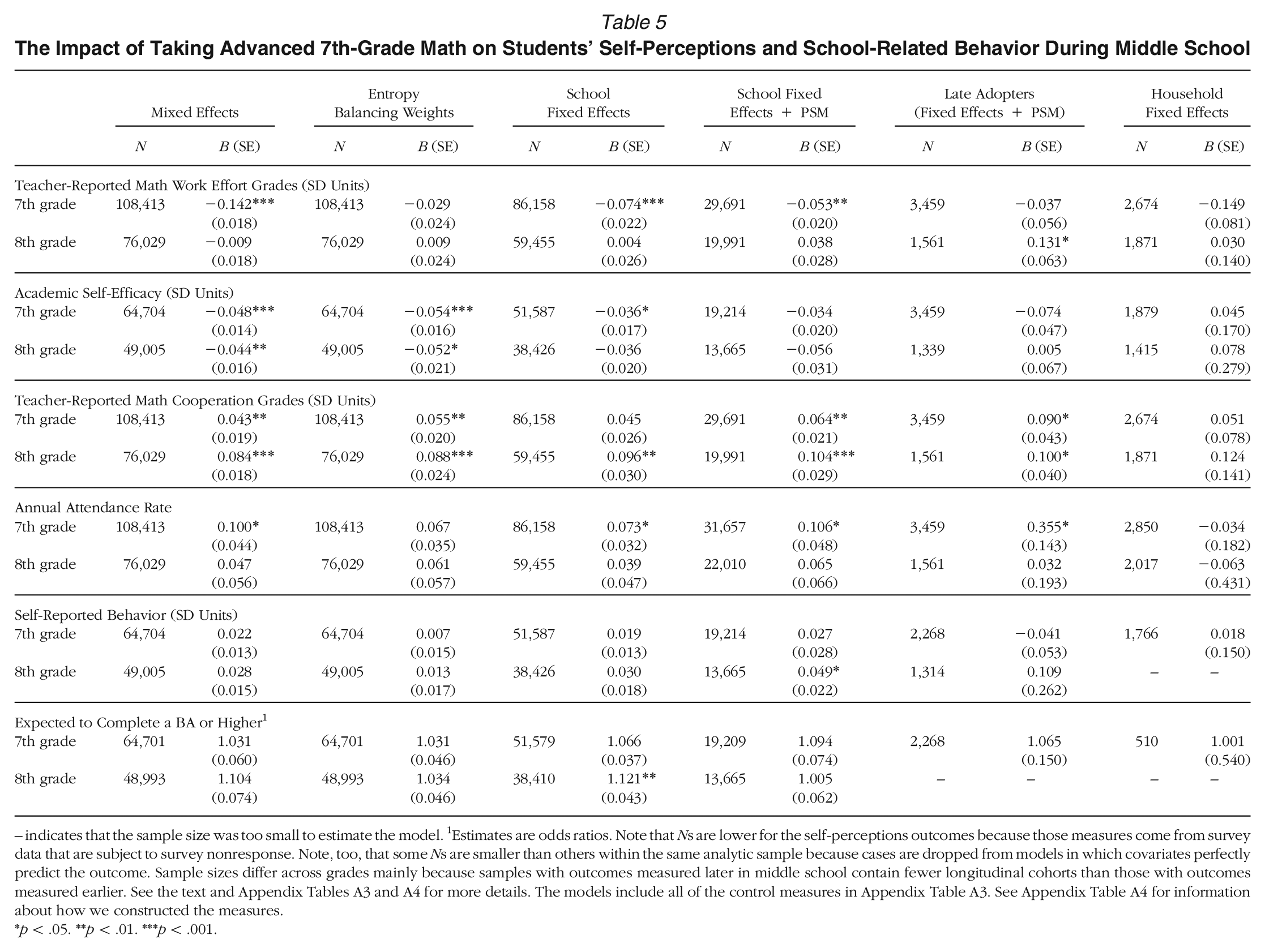
– indicates that the sample size was too small to estimate the model. 1Estimates are odds ratios. Note that Ns are lower for the self-perceptions outcomes because those measures come from survey data that are subject to survey nonresponse. Note, too, that some Ns are smaller than others within the same analytic sample because cases are dropped from models in which covariates perfectly predict the outcome. Sample sizes differ across grades mainly because samples with outcomes measured later in middle school contain fewer longitudinal cohorts than those with outcomes measured earlier. See the text and Appendix Tables A3 and A4 for more details. The models include all of the control measures in Appendix Table A3. See Appendix Table A4 for information about how we constructed the measures.
*p < .05.**p < .01. ***p < .001.
Course-Taking
Like Dougherty et al. (2017) and McEachin et al. (2020), we find consistently positive effects, across most models, of taking advanced math in middle school on students’ advanced course-taking in high school (see Table 6). Students who took advanced seventh-grade math were 3.6 percentage points more likely to pass Algebra I by the end of ninth grade and may have been more likely to earn at least a “B” in the course. Students who took advanced seventh-grade math also passed an additional semester of rigorous math and were about 10 percentage points more likely to take calculus or a higher-level math course in high school than otherwise similar peers who took general math. We also find positive effects on taking rigorous science courses and rigorous academic courses overall. These results strongly suggest that having the opportunity to take advanced math in seventh grade gave students an enduring positional advantage in the high school academic opportunity structure (see Schneider et al., 1998).
The Impact of Taking Advanced 7th-Grade Math on Students’ High School Course-Taking & College-Related Outcomes
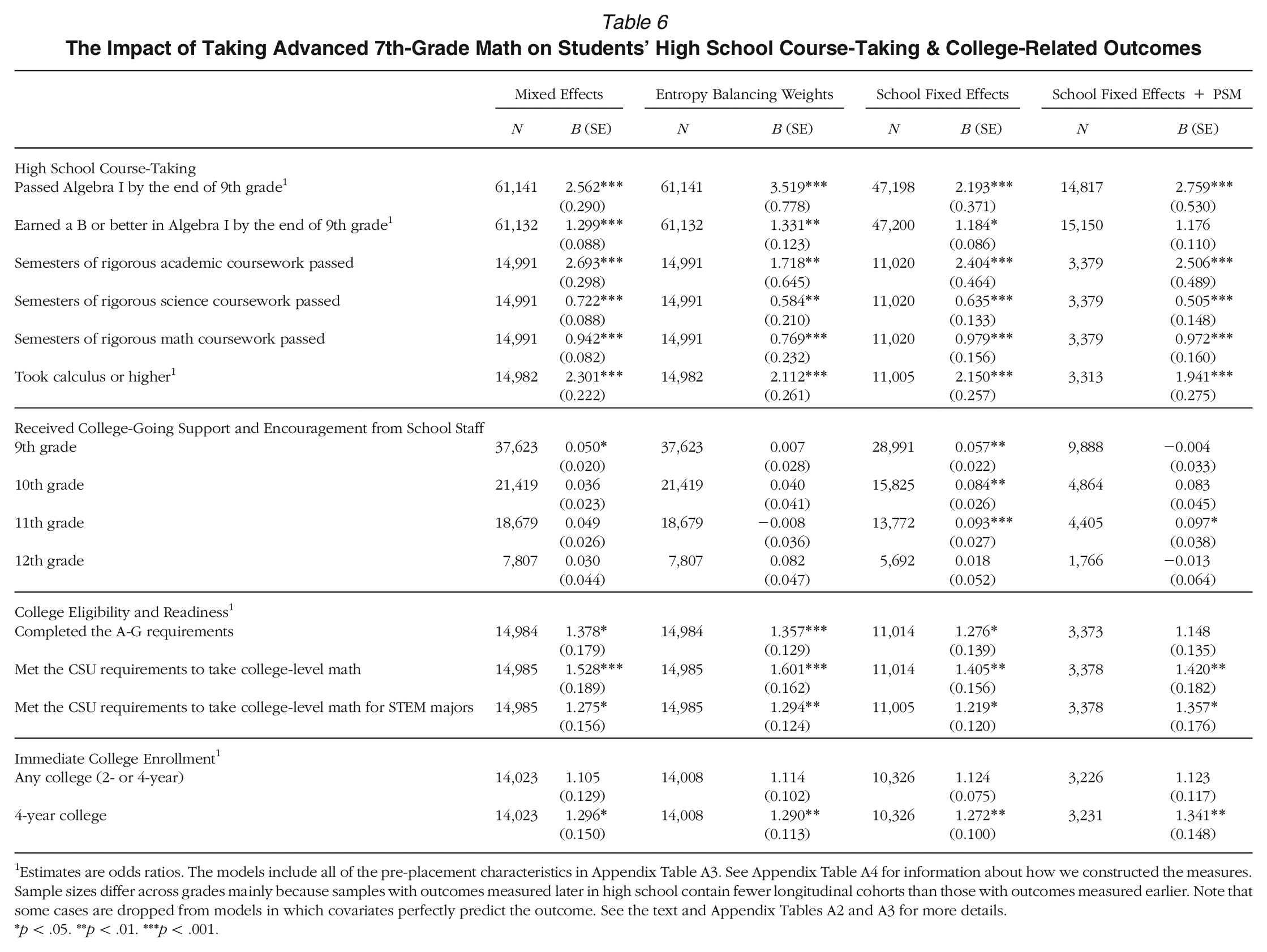
1Estimates are odds ratios. The models include all of the pre-placement characteristics in Appendix Table A3. See Appendix Table A4 for information about how we constructed the measures. Sample sizes differ across grades mainly because samples with outcomes measured later in high school contain fewer longitudinal cohorts than those with outcomes measured earlier. Note that some cases are dropped from models in which covariates perfectly predict the outcome. See the text and Appendix Tables A2 and A3 for more details.
*p < .05. **p < .01. ***p < .001.
College Access Support, Readiness, and Enrollment
Table 6 suggests that this positional advantage may also benefit students in terms of the college-access supports they receive at school, particularly in 11th grade (the 12th-grade estimates are imprecise), and in their likelihood of meeting the minimum eligibility requirements for admission to public four-year universities in California. In addition, students who took advanced seventh-grade math were about 7 percentage points more likely to meet the California State University (CSU) system's math course placement requirements for non-STEM and STEM majors. Students who meet those requirements move directly into courses that fulfill degree and major requirements, allowing them to make more timely progress toward their degrees.
Finally, students who took advanced math in seventh grade were as much as 6 percentage points more likely to enroll in a four-year college than otherwise similar peers who took general math. Note, however, that we only have outcomes for the year following high school graduation for our earliest cohort. The COVID-19 pandemic disrupted the spring of those students’ junior year in high school and their entire senior year. We do not know whether the effects of taking advanced seventh-grade math on four-year college enrollment would be larger or smaller in nonpandemic times. Future research should assess whether these seemingly positive effects replicate in other contexts and in nonpandemic years.
Results for Student Subgroups
We show subgroup results for two key outcomes, seventh-grade math scores and taking more rigorous math courses in high school, though the results generally hold for other outcomes. Figure 1 shows that all subgroups of advanced seventh-grade math students improved their math test scores relative to general math students, even ineligible students and students who began seventh grade with relatively low math test scores. These results resemble Rickles’s (2013) findings of fairly homogeneous effects of eighth-grade algebra on subsequent test scores.
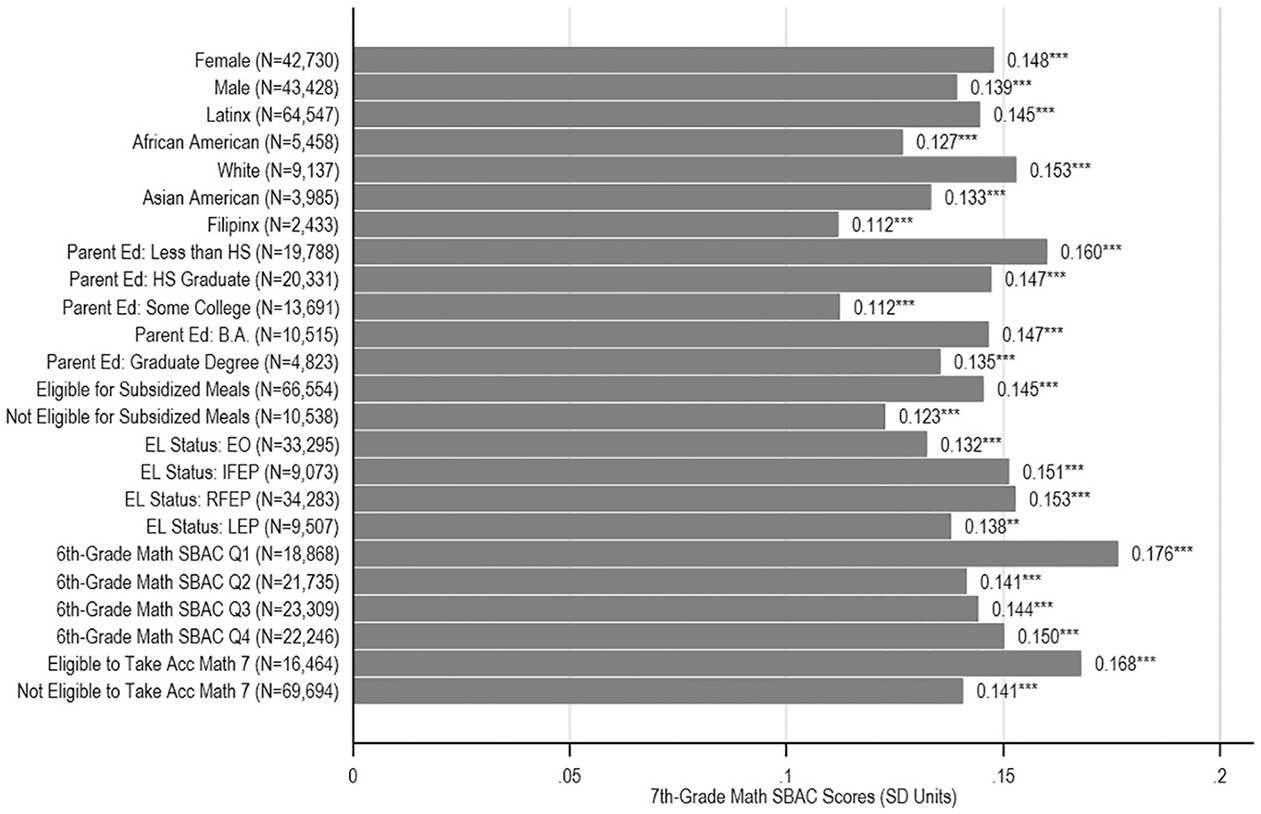
The Impact of Taking Advanced Seventh-Grade Math on Students’ Seventh-Grade Math Scores, by Subgroup
Figure 2 indicates that students from most subgroups also experienced a substantial positive impact of advanced seventh-grade math on the number of semesters of rigorous math they passed in high school, with the exception of Black students and students in the bottom quartile of the end-of-sixth-grade math test score distribution (their point estimates are positive but not statistically distinguishable from zero). These findings about ethnic disparities in advanced course pathway persistence resemble Irizarry’s (2021) results from a nationally representative sample of ninth graders.
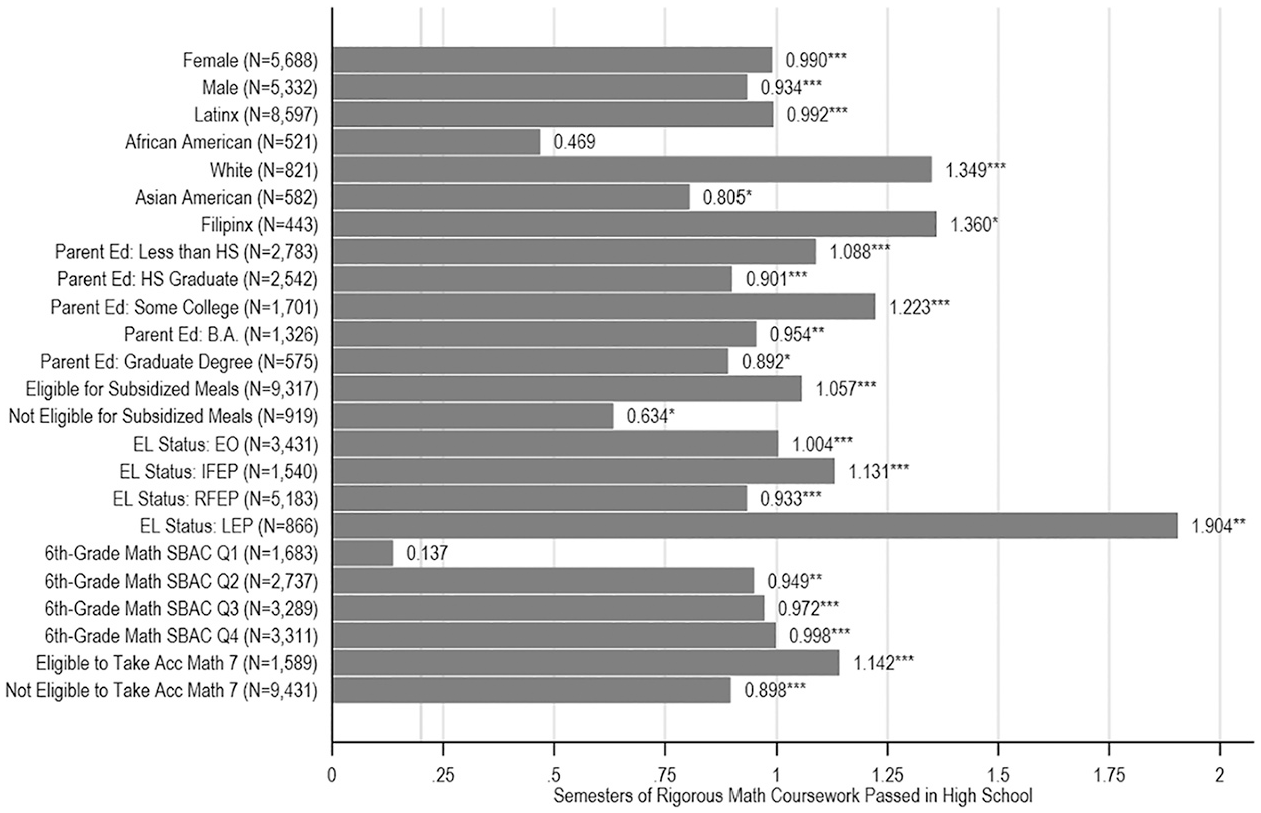
Impact of Taking Advanced Seventh-Grade Math on Students’ High School Math Course-Taking, by Subgroup
Mechanisms That Contribute to the Impact of Taking Advanced Math on Seventh-Grade Outcomes
In Appendix Tables A9 and A10, we explore the relative importance of peer and teacher characteristics in explaining the effects of being placed in advanced seventh-grade math on seventh-grade math test scores and math grades, respectively. The results show that measured classmate characteristics account for nearly two-thirds of the positive impact of taking an advanced math course on seventh-grade math test scores and nearly all of the negative impact on seventh-grade math grades. 13 Appendix Table A11, which shows how much each of the potential mediators, taken singly, reduces the size of the coefficient on taking advanced seventh-grade math, indicates that the most important mediator of both effects is classmates’ math test scores from the spring of the prior year, followed by their sixth-grade math grades. Note, however, that if having higher-achieving peers in a class contributed directly to student achievement through mechanisms of peer encouragement, role modeling, or assistance, we would expect to see a positive association of peer achievement with both test scores and grades. Instead, the results show that peer achievement is positively associated with test scores but negatively associated with grades. These results imply that classmates’ achievement may instead serve as a proxy for differences in how teachers tailor their instruction and grading practices to classrooms with different student compositions. Research suggests that teachers expose students to more rigorous curricular content in advanced courses (e.g., Gamoran & Carbonaro, 2002), but administrative data like ours lack information on what students are taught in their math courses. Thus, we are unable to explore the role of differential curricular exposure in producing learning differences across courses. Classmate characteristics may also proxy for differences in teachers’ expectations for students (Kelly & Carbonaro, 2012) or differences in responses to their behavior (Musto, 2019), neither of which we can measure in our data.
Differences in classmate characteristics seem to account for much of the effect of advanced seventh-grade math on test scores and grades, but the teacher characteristics we measure explain only 16 or 25 percent of the impact of taking an advanced math course on test scores or grades, respectively. Nonetheless, these characteristics are associated with students’ test scores and grades in both advanced and general math classrooms. The models imply that students improve their math test scores when their teachers have more than two years of experience, are national board certified (see also Cowan & Goldhaber, 2016), or have recently taught advanced math. They also imply that more experienced teachers and teachers who have recently taught advanced math tend to grade students more stringently. Because research suggests that commonly measured teacher characteristics like those in our models usually do not explain differences in student learning from classroom to classroom (Goldhaber & Brewer, 1997) and because teachers may self-select into teaching advanced courses in ways we cannot measure, we also estimate these models for a sample of teachers who concurrently taught both general math and advanced math, without and with teacher fixed effects (see Appendix Table A12). These estimates are somewhat smaller than those in Tables 3 and 4, suggesting that advanced and general courses differ less when taught by teachers who teach both types of courses. But these estimates are also not insubstantial and are statistically significant, indicating that the positive test score effects and negative grade effects of advanced seventh-grade math compared to general seventh-grade math arise even in classes taught by the same teachers.
Sensitivity Analyses
Unobserved Confounders
Although we match students on a large set of student characteristics prior to their seventh-grade math placement and control for those characteristics in our models, our estimates may still be biased upward by unobserved variables related to students’ math placements and outcomes. We conduct two sensitivity analyses to examine the extent of this bias.
Placebo Outcomes
First, we estimate the effect of taking advanced math on outcomes it cannot affect—third graders’ math standardized test scores and math achievement and work effort grades. We use these outcomes to examine possible bias from unmeasured academic and behavioral selection into advanced math courses. Appendix Table A13 shows that nearly all of these estimates are statistically insignificant and most are close to zero, which increases our confidence that we have adequately accounted for selection into advanced math (Imbens, 2004).
Robustness Estimates
To assess whether bias from unmeasured confounders would invalidate our conclusions about the positive impact of taking advanced math, we also estimate how strong an unobserved confounder would have to be relative to a set of benchmark variables to either reduce our point estimates to zero or to cause our estimates to lose statistical significance (Cinelli & Hazlett, 2020). 14 We use a large set of academic benchmark variables that are highly correlated with taking advanced math and students’ outcomes. These variables include two prior years of students’ standardized test scores, fifth- and sixth-grade math and ELA GPAs, sixth-grade math and overall work effort grades, type of sixth-grade math course students took, whether students were classified as gifted and talented as of the end of sixth grade, and whether students were eligible to take advanced math according to district policy.
Our results suggest that unobserved confounders would need to be relatively strong to invalidate most of our findings for the academic outcomes (see Appendix Table A14). For example, for the estimates of the effects on students’ seventh-grade math scores or four-year college enrollment to lose statistical significance, we would need to have omitted a variable nearly a quarter as strong as all the benchmark variables taken together. The estimates for course-taking are even more robust. For example, an omitted variable would need to be nearly three-quarters as strong as all the benchmark variables taken together to reduce the point estimate for additional semesters of rigorous math to statistical insignificance and more than three-quarters as strong to reduce the estimate to zero. Our findings for students’ self-perceptions and school-related behavior are far less robust than for the academic outcomes. For example, for the seventh-grade, teacher-reported math work effort grades and academic self-efficacy estimates to lose statistical significance, we would need to have omitted a variable slightly more than a tenth as strong as all of the benchmark variables taken together.
Censoring
Although we replicate our main analyses using our smallest analytic sample—students we can follow into college—and find that our results largely hold (see Appendix Table A7), it is possible that our estimates may be biased due to attrition. To assess the extent of this bias, we estimate our school fixed effects models using stabilized inverse probability censoring weights (IPCW) (Fewell et al., 2004; Willems et al., 2018). IPCWs give extra weight to students who remain in the sample (i.e., are uncensored) but who are demographically and academically similar to students who left the sample before we could observe their outcomes (i.e., were censored). The estimates from the models with censoring weights are not substantively different than the unweighted estimates, though the magnitude of the estimates varies slightly (see Appendix Table A15). 15 These results suggest that the estimates are robust to censoring.
Discussion
The results in this paper indicate that the students in the large, urban school district we study experienced both short- and long-term educational advantages when they had the opportunity to take advanced math in seventh grade. Although students received slightly lower middle school math grades when they took advanced seventh-grade math, taking this advanced course improved their test scores and set them on an academic path that exposed them to greater academic rigor in their high school courses, increased their college readiness, and improved their likelihood of enrolling in a four-year college. We find much smaller effects of taking advanced math on students’ self-perceptions and school-related behavior, with small negative effects on students’ seventh-grade work effort grades and middle school academic self-efficacy and small positive effects on seventh-grade attendance and middle school cooperation grades.
Although our impact estimates are probably somewhat overstated due to unobserved or poorly measured confounders, our robustness tests indicate that it is very unlikely that there is no positive impact of taking advanced math on students’ educational outcomes. This conclusion is bolstered by recent studies that use different causal designs and samples but also show substantial positive effects of taking advanced middle school math on students’ math course-taking in high school (Dougherty et al., 2017; McEachin et al., 2020).
Our results also suggest that the short-term effects of taking advanced seventh-grade math may arise from being taught alongside relatively high-achieving classmates (see also Imberman et al., 2012). Our teacher fixed effects models imply that the same teacher teaches and grades differently when their class has stronger math achievement. Although our data provide limited insight into differences in advanced and general math students’ classroom experiences, other research suggests that teachers of advanced courses have more positive perceptions of students’ abilities (Kelly & Carbonaro, 2012; Oakes, 1982, 1985), cover more rigorous material (Gamoran & Carbonaro, 2002), and respond more positively (Mayer et al., 2018), or with alternative ways of teaching, when “advanced” students do not understand new concepts. Additional research describing differences in teachers’ perceptions, instruction, and classroom climate between advanced and general middle school math courses is essential for understanding why students’ test scores improve more on average in advanced courses and what types of instructional changes might enhance students’ learning in general math courses.
Because advanced math courses exacerbate academic inequality in the school district we study, one strategy for reducing inequality would be to eliminate math course differentiation in middle school, as some school districts have done (Blume, 2021). But our results suggest that eliminating advanced seventh-grade math courses would exacerbate societal inequities by reducing social mobility for low-income students of color. In the school district we study, well over half of the students who take advanced seventh-grade math are Latinx, nearly two-thirds are eligible for subsidized school meals, and a third have parents who never attended college. In this context, eliminating advanced seventh-grade math would reduce opportunities for historically marginalized students to improve their math test scores, complete a rigorous high school program, and attend a four-year college.
An alternative strategy would be to offer advanced seventh-grade math to all or most students, an approach that appeals to principles of both equity and excellence and that Mehan et al. (1996) refer to as “untracking.” Our subgroup results provide some support for this strategy, showing that ineligible students (i.e., those who did not meet the achievement criteria for taking the course) improve their test scores more when they take advanced seventh-grade math than when they take general seventh-grade math, suggesting that the eligibility threshold for the course could potentially be lowered. However, our data cannot speak to the question of whether the very lowest-achieving students in this school district would benefit from taking advanced seventh-grade math because very few students who scored far below standards on their sixth-grade math test took the course. And other studies suggest that advanced middle school math may only benefit higher-achieving students (Clotfelter et al., 2015) or students in schools that set higher achievement thresholds for eligibility to take advanced math (McEachin et al., 2020).
Enrolling all or most students in advanced seventh-grade math raises other concerns as well. First, school districts would need many more teachers to teach advanced math, and our results suggest that teachers who are not currently teaching advanced math may initially be less effective at improving students’ math scores than those with current advanced-math teaching experience (see Appendix Table A9). More importantly, a potentially important mechanism for the positive effect of advanced math on students’ test scores is the much higher average level of math achievement in advanced classrooms. Thus, adding large numbers of low-achieving students to advanced math courses could potentially reduce the course's effectiveness (see also Nomi, 2012; Nomi et al., 2021). Therefore, it is possible that neither high- nor low-achieving students would experience the same benefits from advanced seventh-grade math that we describe in this paper if all students took the course.
A promising strategy in the school district we study would be to enroll all eligible students, regardless of the school they attend, in advanced seventh-grade math. Schools could offer enough sections of the course for all eligible students, and schools with too few eligible students to fill a class could allow nearly eligible students at that school to take the course. Offering enough courses to meet the needs of eligible students would begin to reverse the steep historical decline in advanced-math enrollment described in the introduction. District policymakers could also explore extending enrollment in advanced math to lower-achieving students, possibly with additional academic support (see Taylor, 2014). Over the longer-term, in the urban district we study and others like it, scholars, policymakers, and educators should also build more knowledge about effective ways to bolster lower-achieving students’ math achievement before they enter middle school so that more students can enroll in, and benefit from, advanced math in middle school and thus realize the long-lasting academic advantages that follow from early access to educational opportunity.
Supplemental Material
sj-pdf-1-aer-10.3102_00028312251331023 – Supplemental material for Long-Term Consequences of Early Access to Educational Opportunity
Supplemental material, sj-pdf-1-aer-10.3102_00028312251331023 for Long-Term Consequences of Early Access to Educational Opportunity by Carrie E. Miller and Meredith Phillips in American Educational Research Journal
Footnotes

Notes
C
M
References
Supplementary Material
Please find the following supplemental material available below.
For Open Access articles published under a Creative Commons License, all supplemental material carries the same license as the article it is associated with.
For non-Open Access articles published, all supplemental material carries a non-exclusive license, and permission requests for re-use of supplemental material or any part of supplemental material shall be sent directly to the copyright owner as specified in the copyright notice associated with the article.
