



Abstract
Understanding how marginalized students experience and perceive mathematics is critical to achieving the goal of inclusive and equitable math pedagogy. We report on 67 focus groups with 251 predominantly Black high schoolers experiencing economic marginalization in the Southern United States and attended to their achievement level and race-gender identities. Students often shared concerns about their teacher’s math knowledge for teaching and effectiveness in supporting academic success. Their self-perceptions of math identities varied, and students often did not value advanced math even when they expressed career interests that require advanced math. We discuss practical implications for supporting the math development of marginalized high schoolers, including centering the needs and strengths of Black girls, and propose an expanded inclusive and equitable pedagogical framework.
Keywords
“The teacher doesn’t come and help you [but] helps others besides you.” “He pushes you. He doesn’t let you give up. He’s probably the only teacher I’ve actually learned from.”
These quotes, the former by a Black boy enrolled in a general math course and the latter by a Black girl enrolled in an advanced math course, illustrate the range of students’ experiences in high school math classrooms drawn from focus groups conducted in a large, urban school district. Participants were predominantly Black and experiencing low income and economic marginalization; these student groups are often marginalized in schools and U.S. society. To achieve the goal of inclusive and equitable math pedagogy, we need to better understand how marginalized students experience and perceive school math. In this article, we elevate the voices of marginalized students about their experiences in math classrooms and key self-perceptions they developed surrounding math. We focus on math classrooms because they can be particularly exclusionary for students of color (Martin et al., 2017) and students experiencing low income and economic marginalization (Akiba et al., 2007), and because low achievement, limited course work, and negative math self-perceptions are barriers to college education and numerous career paths, especially for marginalized students (Jiang et al., 2020; Lee, 2012).
We focus on students’ perceptions because they have important implications for their math learning and identity (Dunleavy, 2018) and for efforts to improve the inclusivity and equitableness of math teaching. We utilize the definition of math identity from Martin: “the dispositions and deeply held beliefs that individuals develop about their ability to participate and perform effectively in mathematical contexts and to use mathematics to change the conditions of their lives” (Martin, 2009, p. 326). Our focus on students’ perceptions also complements the more common focus on teachers’ and researchers’ perceptions. Additionally, we examined students’ perceptions across a range of achievement levels given potential differences in teaching quality, content, and expectations in classes that consist of students with the same achievement level (e.g., Reed, 2008) and to complement research on the perspectives of high-achieving students of color (e.g., Walker, 2006). We also explored potential gender differences among Black students given evidence for potential race-gender differences in students’ math experiences, self-perceptions, and career goals (Hsieh et al., 2021; Wang, 2012) and research highlighting that Black girls are particularly underserved in math classrooms (e.g., Joseph et al., 2019).
Theoretical Perspectives
Our theoretical perspective asserts the need for inclusive and equitable math pedagogy that supports the positive development of all students’ math knowledge and math self-perceptions (e.g., math identity, perceived value of math for their future lives), including for racially diverse students. Race is a social construct, not a biological distinction, and a construct that has been used to perpetuate racism, including in schooling (Martin et al., 2017). The U.S. education system systematically advantages White students with resources and power, and discriminatory policies and practices have prevented Black, Latine, and Indigenous children from becoming equal participants in schools (Martin et al., 2017). This marginalization permeates the classroom—students of color attend schools on average with fewer resources and less qualified teachers (Aud et al., 2010). Black students, in particular, are often positioned as less capable in school and especially in math (Nasir & McKinney de Royston, 2013).
One goal of the current study is to explore and expand Tuitt’s (2003) framework for inclusive pedagogy in college classrooms to high school math classrooms, drawing on the experiences of hundreds of high-school students in an urban school district in the Southeastern United States. According to Tuitt, inclusive pedagogy encompasses teaching that embraces the whole student, valuing their experiences, voice, and ability to make their own choices, and is well-suited to address the needs of students from racially diverse backgrounds. It connects to students’ experiences, helps students see the value of what they are learning for their lives and futures, and empowers students to be active and critical participants in their classes and society. His framework was based on the ideas of a range of liberatory scholars working to present a better vision for how schools could meet the needs of racially and culturally diverse students (e.g., Freire, 2000; hooks, 1994; Ladson-Billings, 1995) as well as descriptions of the experiences of racially minoritized students on college campuses. Joseph et al. (2019) adapted Tuitt’s framework to capture the experiences of 10 Black girls who were in secondary math classrooms in one school district in New Jersey, motivating us to explore the applicability of Tuitt’s framework for inclusive pedagogy to understanding the experiences of a larger number and broader range of marginalized high-school students. We also expand the framework to include math knowledge for teaching, which we argue is an important feature of equitable pedagogy within high school math classrooms. Given our expansion of the framework and the importance of naming and working toward both inclusion and equity (also Estefan et al., 2023), we refer to “inclusive and equitable pedagogy” throughout the article except when citing Tuitt (2003), since he used the term “inclusive pedagogy.” See Figure S1, in the online version of the journal for a visual representation of key themes within the framework.
A second goal is to consider two critical student self-perceptions that are both influencers and consequences of math pedagogy: math identity and perceived value of math for future goals (i.e., utility value). Inclusive and equitable math pedagogy should promote a positive math identity for all students, combating the “brilliance myth”—that only brilliant people can be good at math (Chestnut et al., 2018)—and should help students see the utility value of the math they are learning. By learning from students about these critical self-perceptions, in conjunction with learning about their perceptions of inclusive and equitable pedagogy in their mathematics classrooms, we build a richer sense of the influences and consequences of math pedagogy. Across these goals, we were primarily grounded in psychological learning theories, with primary attention to individuals’ perspectives and narratives on their experiences and self-perceptions.
Review of Relevant Literature
The literatures on inclusive and equitable pedagogy, math identity, and utility value that we review next shaped our major categories for coding students’ discussions of their math experiences and self-perceptions.
Inclusive and Equitable Pedagogy
We briefly review relevant literature on the two components of inclusive pedagogy proposed by Tuitt (2003; i.e., teacher-student interaction and sharing power) and a third component that we argue is an important component of inclusive and equitable pedagogy (i.e., teachers’ math knowledge for teaching). We also describe how the current study aims to extend the existing body of literature.
Teacher–Student Interaction
Tuitt (2003) proposed that foundational to inclusive pedagogy in college classrooms is positive faculty–student interaction, which includes faculty being caring and enthusiastic and creating an open, welcoming environment. In interviews with 21 Black and Latine students at one high school, students named positive, caring interactions with teachers as a key contributor to their achievement (Walker, 2006). Similar themes focusing on teachers creating a welcoming environment including a safe space to ask questions, providing individualized help, and connecting with students’ lives beyond the classroom emerged in interviews with 8 to 10 Black girls in middle and high schools in two urban school districts (Booker & Lim, 2018; Joseph et al., 2019) and in interviews with 8 Black boys in middle schools in an urban school district (Berry, 2008). Thus, we attended to themes of teacher–student interactions in our analyses, looking to enrich our understanding of the prevalence and salience of these interactions across a large number of high school math classrooms, given that past research has focused on experiences reported by small numbers of students.
Sharing Power
Drawing on the writings of scholars such as hooks (1994), Tuitt (2003) proposed that inclusive classrooms must draw on all students’ contributions as important resources, especially those from marginalized groups, challenging the notion that only teachers possess power and knowledge. According to Tuitt, one critical component of sharing power is that “all students have a voice and that they should be encouraged to use it” (p. 380). Within high school math classrooms, collaboration in small groups and opportunities for students to help their peers are two noticeable ways that teachers can activate student voice based on a large-scale study done with students at three high schools and a small-scale study done with 10 Black girls (Boaler & Staples, 2008; Joseph et al., 2019). However, based on a Black girl’s experiences in an eighth-grade math class and media-captured instances of Black girls’ knowledge, effort (e.g., energy and time spent) to learn, and personhood being invalidated and abused by their math teachers, Gholson and Martin (2019) concluded that teachers in urban mathematics classrooms may not effectively share power with all students, and rather that, “for some [student] groups and in many contexts, the structures that shape mathematics in many urban classrooms can create feelings of oppression and being dominated” (p. 402). Thus, we attended to positive and negative examples of teachers sharing power with students, including group work and peer help, to identify the prevalence and salience of sharing power.
Teachers’ Math Knowledge for Teaching
Inclusive and equitable pedagogy also requires that all students have access to rigorous math teaching. Teachers’ math knowledge for teaching including their pedagogical content knowledge or “knowledge used to transform subject matter content into forms more comprehensible to students” (Park & Oliver, 2008, p. 262) impacts whether and how they facilitate rigorous math teaching (Campbell et al., 2014; Hill et al., 2005, 2008). Further, it is predictive of students’ math knowledge and achievement (Hill et al., 2005). Thus, we argue that math knowledge for teaching is an important component of inclusive and equitable math pedagogy in high school, although Tuitt (2003) did not include it in his model. Relatedly, Joseph et al. (2019) reported that a group of 10 Black girls “alluded to the necessity of a teacher having extensive math content knowledge and skillful delivery” during interviews. However, little is known about the qualities of math teachers perceived by marginalized students as having adequate math knowledge for teaching and being effective in supporting their math development. As such, we attended to whether and how groups of students discussed their perception of their teachers’ math knowledge for teaching and effectiveness in supporting their mathematical successes.
Overall, our literature review revealed that past research has done rich descriptions of the experiences of a small number of students in a few classrooms related to inclusive and equitable math pedagogy. We aimed to examine the experiences of a large number of marginalized students across 19 high schools in a large urban school district to provide a better sense of students’ perceptions of the norm and range of inclusive and equitable math experiences.
Math Identity
Inclusive and equitable pedagogy should also promote a positive math identity for all students. This can help combat the “brilliance myth” and stereotypes that women and racially minoritized students are not good at math (Chestnut et al., 2018). For example, in a study with eight Black high school students, the students were often observed doing math in distinct and more brilliant ways in the community than in their classrooms (Nasir & Hand, 2008). This suggests that many math classrooms may be unsupportive of Black students’ positive math identity development.
Math identity is defined in diverse ways (see Graven & Heyd-Metzuyanim, 2019, for a review), and we used a psychological perspective that focused on individuals’ self-perceptions, drawing primarily from Cribbs et al.’s (2015) framework for math identity development. Within their framework, students’ math identity is often inferred by four self-perceptions (Cribbs et al., 2015). Traditionally, performance (e.g., speed and accuracy while completing mathematics problems) is considered the hallmark of being good at math (Boaler & Staples, 2008; Cribbs et al., 2015). Importantly, survey research indicates that students’ perceptions of their competence (“ability to understand math”), interest (“desire or curiosity to think about and learn math”), and recognition (“how students perceive others to view them in relation to math”) also influence their math identity (Cribbs et al., 2015, p. 1051, 1052). Cribbs et al.’s framework was based on a survey of predominantly White college students enrolled in calculus, but it was informed by case studies of the science identity of women of color who succeeded in science coursework and careers which were grounded in social theories of learning (Carlone & Johnson, 2007). Recent work has emphasized the role of race, gender, and socioeconomic status in math identity development (Nasir & McKinney de Royston, 2013). This work has primarily focused on Black boys (Gholson & Wilkes, 2017). Thus, the current study provides critical information on the perceptions of marginalized high-school students more broadly, including a large number of Black girls, about their math identity and the factors they describe as important influencers of their math identity.
Utility Value of Math
Inclusive and equitable pedagogy should also help students see the value of what they are learning for their lives and futures. Utility value encompasses the perceived usefulness of a task or content for future goals and is a key factor that influences students’ achievement-related choices (Jiang et al., 2020). In turn, a positive perception of the utility value of math can influence the choices students make. For example, high school students’ math utility value was a stronger predictor of their math course enrollments and math-related career aspirations than their math grades and self-perceptions of their math ability in a large-scale study done with primarily White, middle-class students (Wang, 2012). However, in contrast to White students, high school students of colors’ rating of math utility value are not consistently predictive of their STEM (science, technology, engineering, and mathematics) career interest (Gottlieb, 2018) or concurrent math achievement (Kotok, 2017) in survey studies with nationally representative samples. Thus, we need to better understand students of color’s conceptualization and self-perceptions of the utility value of math for their future careers.
Current Study
The current study examined the experiences and self-perceptions of mathematics among more than 250 marginalized high school students. The goal was to evaluate and expand frameworks developed from research with college students and rich descriptions of the experiences of a small number of marginalized students in a few classrooms and/or surveys. In particular, it provided evidence for (a) the prevalence of student experience with inclusive and equitable high school math pedagogy and (b) students’ justifications for their math self-perceptions, including their math identity and the utility value of math for their future careers, which are both influencers and consequences of math pedagogy.
The study was conducted in Nashville, TN, which has denied resources and opportunities for Black students for many decades. It took nearly 30 years for Nashville to adopt a full-scale desegregation plan after Brown v. Board of Education; and after the ending of court-ordered desegregation and busing policies, schools have become segregated again (Gamoran & An, 2016). Many of the schools also continue to have a high concentration of students living in poverty. In the current study, a majority of the participating students were experiencing low-income and economic marginalization and were Black. Experiencing marginalization due to their race and/or socioeconomic status influences how students see themselves in relation to mathematics (see McGee, 2015).
Discussions were held in small focus groups at their schools because young people tend to feel more comfortable and share more about their attitudes in small groups than in individual interviews (Punch, 2002). By listening to marginalized students’ voicing of their mathematical experiences and self-perceptions we also make space to listen for and elevate their strengths and agency (e.g., Gholson & Wilkes, 2017; McGee, 2013). We acknowledge our positionalities as an intergenerational team of Black, White, and Latine researchers and students working to lift the voices of historically and systematically marginalized students and understand and advocate for systems that will better allow them to thrive academically. This study asked and answered the following research questions:
What is the prevalence of marginalized high-school students’ experiences with inclusive and equitable pedagogy? In particular, how did they experience (a) teacher math knowledge for teaching and support, (b) teacher-student interaction, and (c) sharing power?
How did these marginalized high school students perceive their math identity?
How did these marginalized high school students perceive the utility value of math in relation to their future careers?
For each of these research questions, how do the math experiences and self-perceptions vary for students in advanced versus general math courses and for Black girls versus Black boys?
We expected a mix of positive and negative experiences with inclusive and equitable pedagogy, a focus on performance as a key indicator of math identity, and mixed self-perceptions about the utility value of math across the sample.
Because students’ experiences in math classrooms, the salience of those experiences, and their implications for their self-perceptions are quite variable, we focused on two key factors that might lead to differences and developed hypotheses based on previous research. The first factor pertains to whether students were enrolled in an advanced versus general math class. Advanced math courses are more likely to incorporate higher-quality teaching and more rigorous content and be taught by teachers who have higher expectations of students (Oakes, 1986, 1990; Reed, 2008). Thus, compared to students in general math courses, we predicted students in advanced math courses would be more likely to report experiencing aspects of inclusive and equitable teaching that overlap with higher-quality teachers and teaching practices, especially their teachers sharing power and having adequate math knowledge for teaching. We also expected them to be more likely to have a positive math identity and to perceive greater utility value for advanced math in their future careers since classroom factors such as teacher expectations influence students’ math self-perceptions (Eccles & Wigfield, 1985).
The second factor is potential gender differences, specifically for Black girls compared to Black boys. Note, we acknowledge that gender is not binary and that gender identity and biological sex assigned at birth sometimes do not align (American Psychological Association, 2022). However, most prior research and our current research on gender differences has not provided adequate opportunities for participants, especially children, to make this distinction. Additionally, we have chosen to refer to Black students as Black boys and Black girls when we discuss their race-gender identity in light of the detrimental adultification bias that Black students have faced in schools and in society at large (e.g., Dumas & Nelson, 2016). Compared to Black boys, we expected that Black girls would be as likely to have a positive math identity (Seo et al., 2019) but would be less likely to perceive the utility value of math for their future careers (Gaspard et al., 2015) and to have negative experiences with their teachers’ knowledge for teaching (Fennema et al., 1990; Wang, 2012).
Method
Participants
Participants were 251 high-school students from a large urban school district in Nashville, TN (Southeastern United States) who were part of a larger longitudinal study focused on math knowledge development. Students had initially been recruited in 2006 from 57 prekindergarten classes at 20 public schools and four Head Start sites, all of which served children who qualified for free or reduced-price lunch (family income less than 1.85 times the U.S. federal income poverty guideline). Students, their teachers, and their parents participated at multiple timepoints throughout preK, elementary, middle, and high school to examine the development of students’ mathematics knowledge and self-perceptions (Fyfe et al., 2019; Hofer, et al., 2013; Rittle-Johnson et al., 2017, 2021). Key prior findings include that their middle-school teachers had miscalibrated expectations of their math abilities (Mowrey & Farran, 2016) and that in eighth grade, students liked student-focused instructional strategies, such as working in small groups, because they believed the strategies provided opportunities to learn, built their confidence, and/or increased their interest (Rittle-Johnson et al., 2021). Focus groups were conducted during school hours at students’ schools, so we only worked at schools with at least five participating students and with students who were able to attend a scheduled focus group time at their school.
Fifty-six percent of students were girls and 44% were boys, according to school records and verified by students the previous spring during one-on-one assessment sessions. Most participating students were in 11th grade, but 17% (n = 42) had been retained at some point and were in 10th grade, and one had skipped a grade and was in 12th grade. The average age was 16.6 years (SD = 0.31). Based on parent reports in 2019, most students continued to live in low-income households (78% lived in homes with a family income less than $50,000, with 27% living in homes with a family income less than $20,000, based on 190 responses). The highest education level of a caregiver in the home was as follows: 6% less than a high school diploma, 56% high school diploma or GED, 18% associate degree, 12% bachelor’s degree, and 7% graduate or professional degree, based on 203 responses. Most students were from marginalized racial groups, with 81% Black, 8% Hispanic, 6% White non-Hispanic, and 4% other non-White racial categories (based on school records), which was very similar to the overall sample. The high percentage of Black students in our sample of students originally recruited from preschool programs for economically disadvantaged children reflects the long history of anti-Black racism in housing, education, and economic opportunities in the American South. Because some of our analyses focus on the Black participating students, we further report on their demographics separately from non-Black students in acknowledgment of the diversity that exists among these students in Table S1 in the online version of the journal.
Students’ math course(s) for the school year were gathered from school records. A quarter of participating students were enrolled in an advanced math class, defined as enrollment in an honors-level math course or a course above the typical course for their grade level. The remaining students were enrolled in a general math course, defined as enrollment in the standard version of their grade-level math course or below, with only 5.6% of students enrolled in a math course below their grade level and/or a math course for students with disabilities.
The students attended 1 of 19 high schools, with an average of four focus groups per school (range = 1 to 10). Most of the schools were Title 1 schools (n = 16) and most served predominantly Black students and/or Hispanic students. Among the 55 teachers of participating students who completed our teacher background survey (63% response rate), 64% were women, 64% were White, 26% were Black, 10% were of another race, and 2% preferred not to answer. A majority had a mathematics licensure (95%), majored or minored in mathematics during undergraduate and/or graduate school (71%), and had at least 5 years of teaching experience (67%); only 7% were 1st-year teachers. It is possible that the teachers who did not respond to our survey were substantially different from other teachers.
Procedure
Focus groups were conducted in Fall 2019, with groups of three to five students participating at their school during regular school hours. Focus groups were created based on students’ enrollment in general (n = 50) versus advanced (n = 17) math courses and availability to meet at the same time. When possible, single-gender focus groups of Black students were created within schools so we could explore similarities and differences in experiences and perspectives at the interaction of race and gender. This resulted in seven Black girl and seven Black boy groups in general math courses, and five Black girl and two Black boy groups in advanced math courses. Our analyses focused on potential gender differences among Black students enrolled in general math courses since there were too few focus groups of Black boys in advanced math courses. We did not form exclusively White, Hispanic, or Asian focus groups because there were too few participants of these races and ethnicities at individual schools to form separate focus groups. A majority of focus groups (n = 46) had a mix of students of different races, ethnicities and genders, which we refer to as mixed focus groups for brevity.
Focus groups were conducted by one of five women, four of whom identified as White and one who identified as Black. Focus group leaders received training in recognizing bias and in making space for students to share their stories. Focus group sessions were conducted in a quiet space within students’ schools, lasting about 30 minutes. Each session was audio-recorded, which enabled exploration of focus group-level, but not student-level, perceptions. Relatedly, this restricted the extent to which we could attribute a quote to a specific student and identify that student’s demographic factors. Students received $20 for participating. Groups were asked to talk about (a) what they enjoy and do not enjoy about math class and what helps them learn math, (b) indicators of being good at math, and (c) the utility value of math for their future careers. See Table S2 in the online version of the journal for a complete list of questions.
Coding
Four of the authors coded students’ responses from the audio files. In addition, two focus group facilitators assisted with coding. Two coders self-identified as Black women, one as a Black man, one as a Latina woman, and two as White women. The two coders who were focus group facilitators did not have knowledge of the relevant research literature, and the other four authors had some knowledge of the literature. Three sets of codes were developed, one for each of the first three research questions, with key codes and sample quotes listed in Tables 1 to 3. Most codes were proposed based on the literature reviewed in the introduction, and one additional code about math utility was added based on the team listening to five to six focus groups and noticing it appeared to be a common theme, as marked in Table 3. We refined codes to add additional details if a coder had difficulty distinguishing it from other codes. We initially used a broader range of codes to capture students’ experiences related to inclusive and equitable math pedagogy (see Table S3 in the online version of the journal), but in the text, we primarily report on codes that were discussed by at least half of the focus groups for brevity and to highlight salience across students. We also report on codes that were particularly salient for one group type. We view these most salient codes as themes or patterns in the data.
Reflections on Inclusive and Equitable Pedagogy in High School Math Classrooms: Sample Quotes and Percentage of Groups Sharing Positive and Negative Experiences With the Most Common Codes
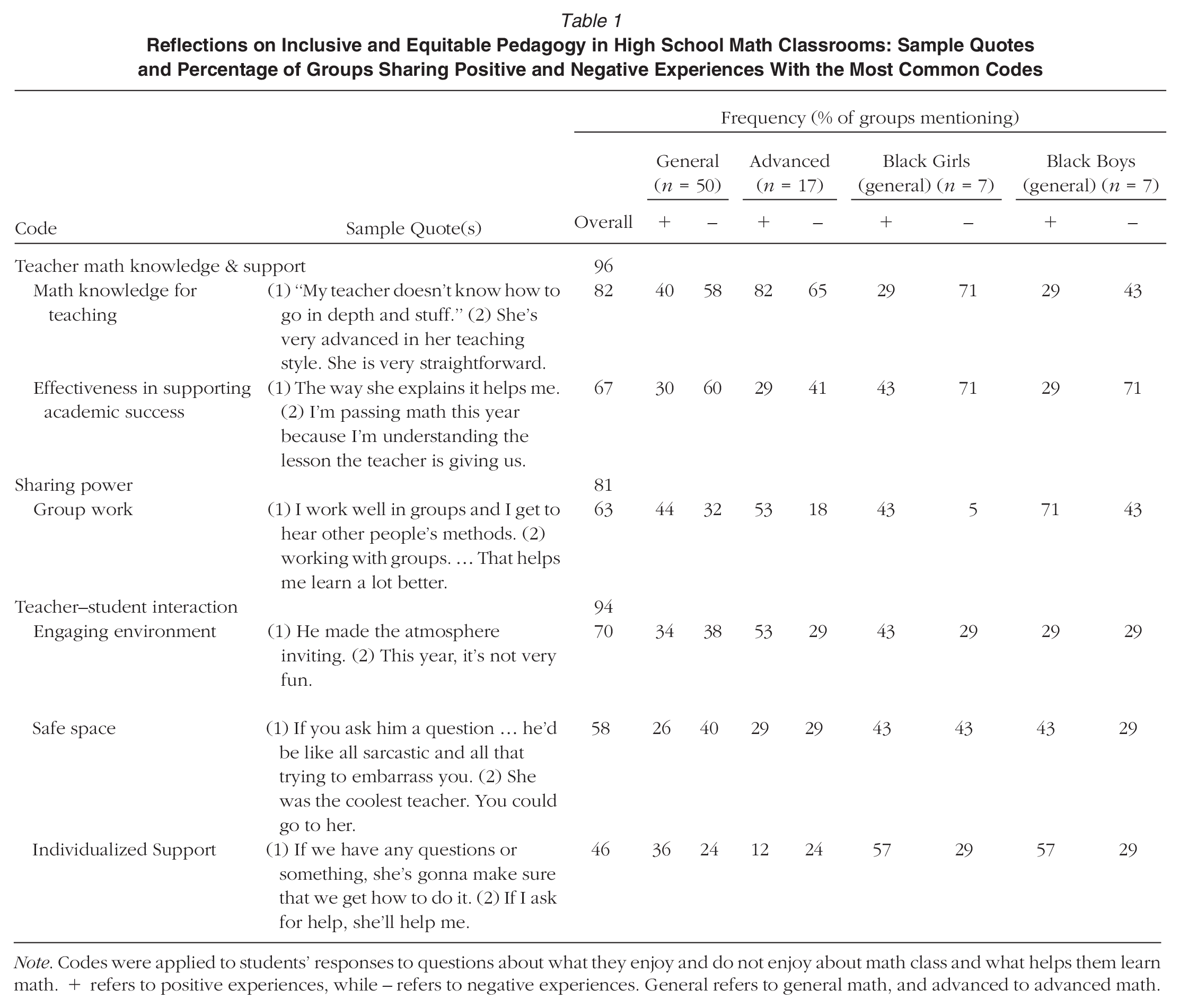
Note. Codes were applied to students’ responses to questions about what they enjoy and do not enjoy about math class and what helps them learn math. + refers to positive experiences, while – refers to negative experiences. General refers to general math, and advanced to advanced math.
Reflections on Math Identity Among High School Math Students: Sample Quotes and Percentage of Groups Discussing Most Common Codes
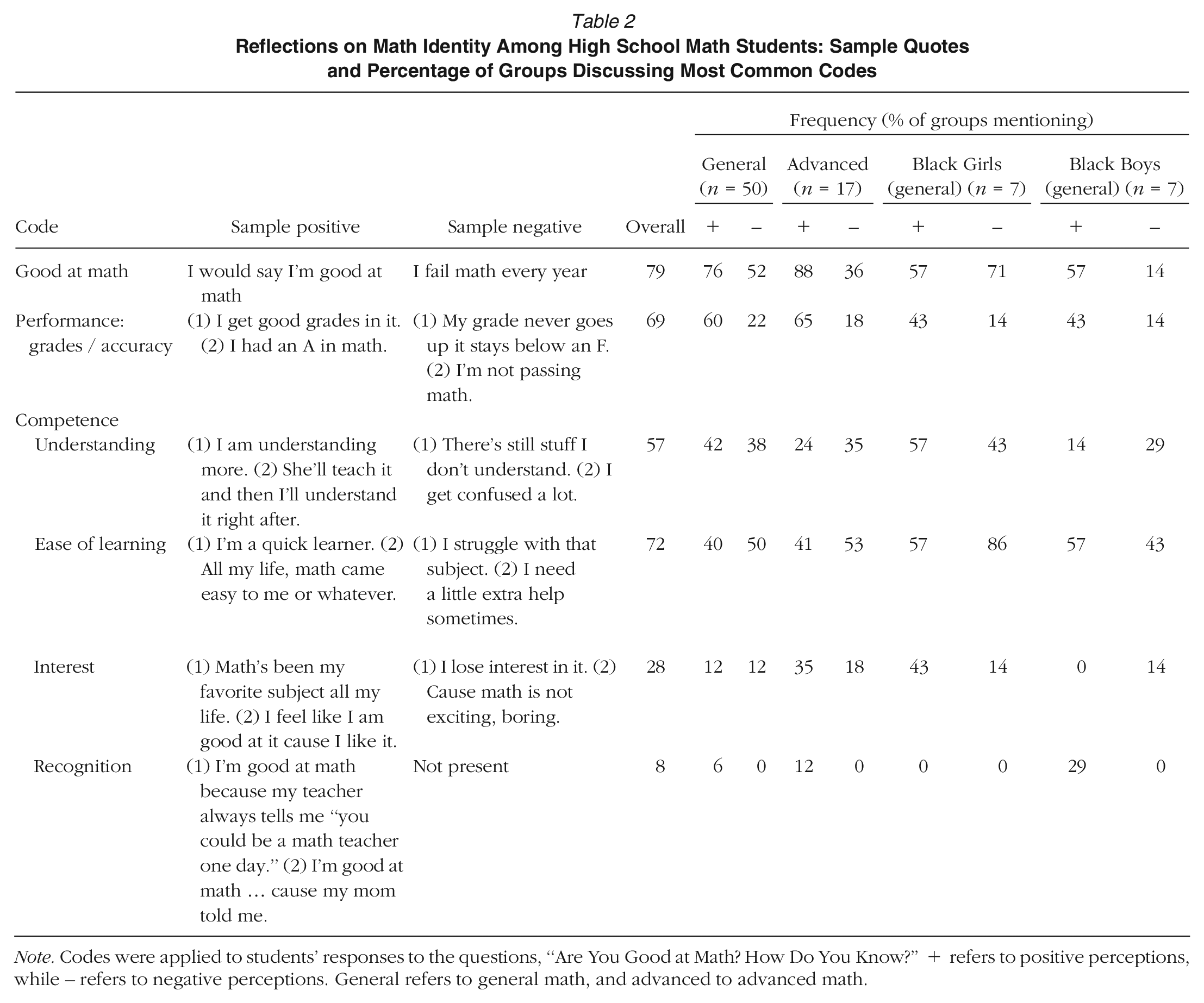
Note. Codes were applied to students’ responses to the questions, “Are You Good at Math? How Do You Know?”+ refers to positive perceptions, while – refers to negative perceptions. General refers to general math, and advanced to advanced math.
Reflections on Math Utility Value Among High School Math Students: Sample Quotes and Percentage of Groups Discussing Most Common Codes
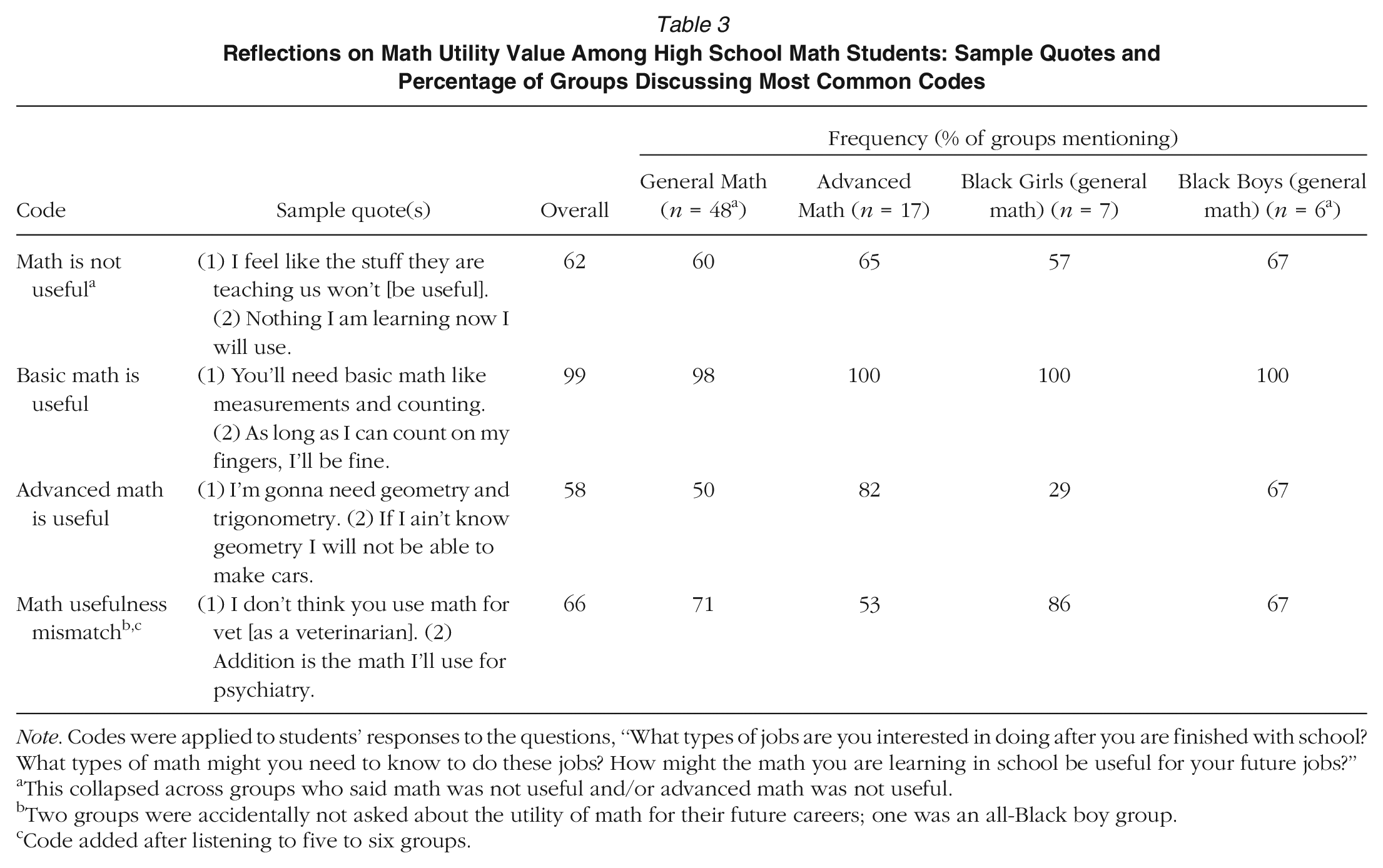
Note. Codes were applied to students’ responses to the questions, “What types of jobs are you interested in doing after you are finished with school? What types of math might you need to know to do these jobs? How might the math you are learning in school be useful for your future jobs?”
This collapsed across groups who said math was not useful and/or advanced math was not useful.
Two groups were accidentally not asked about the utility of math for their future careers; one was an all-Black boy group.
Code added after listening to five to six groups.
For many topics, both positive and negative comments arose, so separate codes were assigned for positive and negative comments. For example, a student in a focus group could use their grades as evidence of positive or negative self-perceptions of their math performance, an aspect of math identity (e.g., “I get good grades in it” vs. “My grade never goes up, it stays below an F”). A code was assigned when at least one student mentioned the topic. Thus, codes do not indicate consensus among all group members nor the prevalence of experiences or self-perceptions within groups. A positive and a negative code for the same topic could occur within the same group. Indeed, students often built off of one another’s ideas, sharing if they agreed or disagreed with the other students.
Two people independently coded every group, and discrepancies in codes were resolved via discussion among the group of coders of the question. This included each coder sharing their rationale for the code that they gave and the group coming to a consensus about the final code. The most common discrepancy was that one coder overlooked a relevant statement. We developed research claims and conclusions by looking across the themes (considering how the themes were related to each other) and examining past research (considering how the themes aligned with the existing research body and the inclusive and equitable pedagogical framework). Overall, our coding and analysis process aligns with Nowell et al.’ (2017) description of credible, transferable, dependable and trustworthy qualitative research given that we had multiple coders allowing for triangulation, documented our coding scheme, process, and decisions, provide thick descriptions of the context of participants’ focus group discussions, and report how our findings relate to the existing literature.
Results
Reflections on Inclusive and Equitable Pedagogy
First, consider students’ discussion of questions about what they enjoy and do not enjoy about math class and what helps them learn math. As shown in Table 1, all three high-level codes were mentioned by at least 80% of the focus groups. The themes that we describe in the text focus on the specific codes that were discussed by at least half of the groups of a particular type. See Table S4, in the online version of the journal, for the frequency of all 14 codes by group type.
Students’ Experiences in General Math Courses
For students enrolled in general math courses, negative experiences with a teacher with adequate math knowledge for teaching and a teacher effectively supporting their academic success were the only specific codes discussed by over half of the focus groups (58% and 60% of groups, respectively; see Table 1). Further, students were twice as likely to share negative experiences compared to positive experiences with their teacher effectively supporting their academic success. Analysis of students’ focus group discussions illustrated their experiences and concerns. For example, in a mixed focus group at a school with mostly Hispanic students, a student shared, “He doesn’t know how to teach in a way that people understand. He doesn’t know how to teach right.” This student goes on to describe the impact of the teacher’s inadequate math knowledge for teaching by stating, “I’m failing now. I never failed last year. I’m failing this year.” Notably, this student was expanding on and potentially challenging another student who was trying to explain away the teacher’s poor math knowledge for teaching as a result of stress. Members of this group also linked this teacher’s inadequate knowledge of “how to teach in a way that people understand” with poor classroom management and an “awkward” classroom environment: “When you see that he has kinda had enough, he like stops talking or stops teaching altogether. … It would be so quiet and kinda awkward in the room.” Notably, several students in the group described this teacher as “nice,” indicating that they had an issue with the teacher’s math knowledge for teaching, not who the teacher was as a person. Their lengthy analysis of this teacher’s math knowledge for teaching indicated that they desired high-quality, robust teaching.
A contrast in teachers’ knowledge and support arose in a focus group consisting of all Black boys at a school with mostly Black and Hispanic students when they were prompted to talk about the last time they enjoyed math. Specifically, a Black boy highlighted a former teacher’s race and gender as a reason he supported their math learning well in the past: “[Our] 8th-grade teacher was cool. He helped us learn. He was a Black man so [emphasis added] he helped us … real good.” Another student in the same focus group who had that teacher added, “We had competition inside each class. … It was simple but it led to bigger outcomes. Nobody was left behind. Everybody knew what they were doing.” This student’s comments including that “nobody was left behind” highlighted their former teacher’s effectiveness in facilitating a supportive and inclusive classroom environment in which all students’ math learning was individually and collectively supported. Unfortunately, their comments also suggested that this level of support was a rarity during their schooling given that they spontaneously singled out their 8th-grade teacher when prompted to talk about the last time they enjoyed math. This aligned with our finding about the large proportion of focus groups that reported negative experiences in high school.
Positive experiences with teachers’ math knowledge for teaching were occasionally reported. For instance, some students in mixed focus groups at predominantly Black schools made comments such as, “She is a good explainer”; “I like how we go through the problems, like she breaks it down, and then we understand it afterwards”; and “The way she teaches, she’s hands-on and she comes around to help you and she makes sure you understand before you take any tests or anything.” Overall, students’ positive and negative experiences highlighted their desire for responsive teachers with an ethic of care and effective pedagogical content knowledge.
Potential Gender Differences in Black Students’ Experiences
A major contribution of this study was the ability to consider similarities and differences in the experiences of Black girls and boys in general math classes. As with the full sample, negative experiences with teachers effectively supporting their academic success was a common concern shared by both groups of Black girls and boys (see Table 1). Another similarity was that both types of groups were more likely to discuss positive experiences with individualized support (57% of both types of groups) than negative ones (29%), which they predominantly conceptualized as their teachers’ responsiveness to their requests for additional help. For instance, a Black girl attending a predominantly Black school shared,
She helps us a lot. If we have any question or something, it doesn’t matter how much we don’t get it, she’s gonna make sure that we get how to do it … by answering your questions and keep doing problems with you, it could be on the board, it could be just you and her personally.
A notable difference was that focus groups of Black girls were more likely to share negative experiences with having a teacher with adequate math knowledge for teaching (71%) than focus groups of Black boys (43%). For instance, when asked “What are things you do not enjoy in your math class?” a Black girl attending a school with predominantly Black and Hispanic students stated, “My teacher goes too fast”; and another expounded,
Yeah, she goes too fast. She don’t know how to teach … she’ll switch the topic every other day and give us the test on everything that we don’t learn that prior week. She just—she goes too fast, and then we tell her “slow down,” she don’t … if she slow down and know how to teach and explain it better—like it ain’t hard for me to catch on.
These students not only highlighted their teachers’ inadequate knowledge about how to pace lessons to facilitate their math competence, but also their teachers’ dismissal of them voicing their learning needs. Relatedly another Black girl in a different group attending a predominantly Black school shared, “Our teacher is not that good and we learn it on our own. We might as well be the teachers.” Students in that group also shared that their previous teacher “taught us a way we can all understand and she had multiple students who couldn’t get one way” and that when they asked their current teacher about trying to solve the math problems in a different way, “He was like, no, let’s try it my way, so now it’s confusing; I mean nobody’s really getting it.”
A second notable difference was that focus groups of Black boys were more likely to discuss positive experiences with opportunities for group work than focus groups of Black girls (71% vs. 43% of groups). For instance, a Black boy at a predominantly Black and Hispanic school shared that their teacher would facilitate students working in groups to improve their understanding: “She’d do group work; if you didn’t understand, you’d go with the students that do understand.” Another Black boy at a different predominantly Black and Hispanic school further highlighted the opportunities that working in groups provide for students to teach and learn from each other: “We get to help each other out. They get a chance to hear what we think. [We] hear what they think. It’s us teaching each other stuff.” Black girls also shared a strong value for group work. For instance, a Black girl at a predominantly Black and Hispanic school stated,
In my class … is like a group of us, that like, actually do our work. It’ll just be us, and we’d be actually helping each other. I think that’s the best way to learn. Each person, they like know each part that you have to do and they put it together and then you know how to solve it.
Another Black girl in the same group shared that working in groups helped them identify gaps in their knowledge and seek help for each other: “sometimes somebody go up and ask and then she’ll come and help all of us.” Overall, findings about teachers sharing power suggested that Black girls would value increased opportunities to engage in collaborative learning.
Students’ Experiences in Advanced Math Courses
Advanced math focus groups tended to share more positive experiences and fewer negative experiences than general math focus groups (see Table 1). The most dramatic difference between group types was the frequency of sharing about their teachers’ math knowledge for teaching. Double the percentage of advanced math groups shared positive examples compared to general math groups. It was also the most commonly discussed code for advanced math groups, with over 80% of groups discussing this code. Two examples from students participating in mixed focus groups are “Ms. Beauty [pseudonym] explains to us the why and that helps us because I know why I’m doing it”; and “I like how she teaches it. When she teaches it, she give notes on the board. Give examples so you’re not confused with different type of word problems. You can go back to it and study that” (the former student was attending a predominantly White school, and the latter was attending a predominantly Black school). Despite these positive experiences, negative experiences with their teachers’ math knowledge for teaching were still a common theme in advanced math groups. For instance, a Black boy enrolled in an advanced math class at a predominantly Black school shared, “He can’t teach for anything. It’s like he doesn’t know what he’s getting ready to teach.” A Black boy from another group attending a predominantly Black school unpacked what he viewed as knowing “how to teach” and being “a good teacher” by emphasizing the way his previous math teacher would “make sure everyone understood. The way she set up her lessons. She gives multiple examples on how to do the work.” A similarly rich conversation about teachers’ math knowledge for teaching and support for students’ academic success took place in a group of Black girls at a predominantly Black school in which they problematized having to “do everything the exact way she wants us to do it … even if we got the right answer; we have to do it the exact way she wants it” and stated profoundly that “if the whole class fails, there’s a problem; it’s whoever is teaching us.” There were also substantial differences in experiences with an engaging environment and a safe space to ask for help, with students in advanced groups reporting more positive experiences.
Summary
When discussing their experiences in math classrooms, students shared both supportive and harmful experiences. One particularly important finding was how commonly students voiced negative experiences with a teacher whom they perceived as having inadequate math knowledge for teaching and effectiveness in supporting their academic success, particularly among students in general math groups. A second striking finding was that Black girls were particularly likely to express experiences with a teacher who had insufficient math knowledge for teaching as well as limited opportunities for group work compared to Black boys.
Reflections on Their Math Identity
Students’ mixed, and often limited, experiences with inclusive and equitable pedagogy in their high school math classrooms suggested that they would vary in their math identities, and the particularly negative experiences shared by Black girls suggested that a negative math identity might be more prevalent among Black girls. Students were categorized as having a positive or negative math identity based on their response to “Are you good at math?” The four self-perceptions identified by Cribbs et al. (2015) as indicators of math identity captured the topics expressed by students when discussing “how do you know [if you are good at math]?” and were used as codes. See Table 2 for sample quotes and frequency of the codes for each group type.
Students’ Experiences in General Math Courses
Three-fourths of the general math groups had at least one student who perceived themselves as good at math (i.e., a positive math identity), and half contained at least one student who perceived themselves as not good at math (see Table 2). When explaining why they viewed themselves as good at math, they most often mentioned their performance, focusing on their grades or accuracy (60% of groups), but they also considered their competence, commenting on both their understanding (42%) and ease of learning (40%). For example, a comment by a Black girl enrolled in a general math class at a majority Hispanic and Black school captured both performance and competence: “I’m doing good in my classes; I am understanding more. I am understanding it more, focusing in it more.” Interestingly, students who perceived themselves as not good at math focused more on competence and less on performance. In particular, they often mentioned their lack of ease of learning (50%) and/ or poor understanding (38%), whereas only 22% mentioned performance. For instance, a student in a mixed focus group at a predominantly Black school shared, “I’d say I’m average because there’s still some stuff I don’t understand even if we went over it last year because it doesn’t retain.” Notably, students rarely mentioned their interest or recognition when discussing their math identity.
Potential Gender Differences in Black Students’ Math Identity
Contrary to our expectations that Black girls and boys in general math classes would be as likely to have a positive math identity, most Black girl groups had a student who had a negative math identity (71%), while only one group of Black boys did (14%). For example, Black girls at two predominantly Black and Hispanic schools noted, “I’ve been trying to, like, help myself get better, but, like, it just won’t work”; and “I don’t think I’ll ever be good at math.” The first student’s comment highlights her commitment to improving her math knowledge and skills as well as an unmet need for support. As justification, most groups of Black girls mentioned poor ease of learning, such as “I have always struggled” (quote by a Black girl enrolled in a general math class at a predominantly Black and Hispanic school). A substantial percentage of Black girl groups also used poor understanding to justify their negative math identity. This finding is also in line with the higher prevalence of negative experiences with aspects of inclusive and equitable math pedagogy shared by Black girls than Black boys in this study. Overall, it is alarming that almost all groups of Black girls had at least one student who did not perceive herself as good at math and had a poor sense of math competence.
At the same time, groups of Black girls and groups of Black boys in general math classes were equally likely to have a student with a positive math identity (57%). For instance, a Black boy at a predominantly Black school stated, “I’ve always been good at math, but all you gotta do is pay attention.” When justifying their own positive math identity, students mentioned both their perceptions of their performance and competence, most often mentioning grades or accuracy and ease of learning. Notably, students often connected teaching and ease of learning. For instance, a Black girl at a predominantly Black and Hispanic school stated, “Even if she [the teacher] goes too fast, I’ll still catch on.” Black girls also frequently mentioned understanding (57% of groups) and interest (43%), which were infrequently mentioned by Black boys in justifying their positive math identity. For instance, a Black girl at a predominantly Black school said, “I like math. I actually want to be a math teacher”; while another Black girl at a predominantly Black and Hispanic school said, “I think you gotta enjoy it to be good.” Thus, math competence and interest appeared linked for some Black girls, in a way that was not apparent for Black boys.
Students’ Experiences in Advanced Math Courses
Students in advanced math groups were more likely than students in general math groups to hold positive self-perceptions of their math identity (see Table 2). Similar to students in general math groups, they most often mentioned their performance, focusing on their grades or accuracy (65% of groups), when discussing their positive math identity. Additionally, they were almost three times more likely than students in general math groups to discuss their interest, but were less likely to discuss their understanding when explaining why they perceived themselves as good at math. For instance, a student at a predominantly White school and participating in a mixed focus group shared that their interest in math informs their perception of their math ability: “I feel like I’m good at math only because I like math. Because I like math, I want to get it right; see how it’s supposed to be done and what I’m doing wrong and persevere.”
Reflections on the Utility Value of Math for Their Careers
Students’ self-perception of the utility value of math for their careers was gathered from their responses to the following questions: What types of jobs are you interested in doing after you are finished with school? What types of math might you need to know to do these jobs? How might the math you are learning in school be useful for your future jobs? (see Table 3). Noteworthy was that students rarely mentioned the utility value of math for access to advanced courses in high school or college that might be necessary for attaining their future career, suggesting this was not salient to students at least in the context of the questions we asked.
Students’ Experiences in General Math Courses
A prevalent theme was that math was not useful for their future careers. Further, students often distinguished between the usefulness of basic math versus advanced math. We defined basic math as number and operations skills like measurement, counting, and working with money and advanced math as algebra, functions, geometry, statistics, probability, and modeling. Almost all groups had a student report that basic math was useful. For example, a student in a mixed focus group attending a predominantly Black and Hispanic school shared, “the simple math, multiplying and stuff, quantity, seeing how much weight, how we’re going to get up there, amount of time. Basic math really is what will be relevant.” In contrast, only half of the groups had a student who perceived more advanced math as useful for their future careers. For instance, a student in a mixed focus group at a predominantly Black and Hispanic school shared, “I’m going to become a neurologist, so I’m going to need some ‘x’ and ‘y’ stuff.” Comments like “after middle school, the math we are learning now is unnecessary” were more common (quote by a student in a mixed focus group attending a predominantly Black school).
Notably, there were frequent mismatches between the level of math required for the student’s intended career and the level of math the student perceived that they would need, with 71% of general math groups having at least one student who demonstrated a mismatch. For instance, a student in a mixed focus group attending a predominantly Black and Hispanic school stated, “Addition is the math I’ll use for psychiatry.” This student’s response highlights a problematic mismatch given that individuals need to complete medical school and satisfy its advanced math prerequisites in order to become a psychiatrist. Relatedly, another student in a mixed focus group attending a predominantly Black and Hispanic school shared their desire to become an engineer and stated, “I probably won’t be using math in engineering. … The math in high school is probably not [relevant].”
In general math groups, 60% of groups had at least one student who did not perceive math as useful for their future careers (see Table 3). For instance, a student in a mixed focus group at a school with predominantly Black students commented, “I feel like the stuff they are teaching us won’t [be useful] and when we go out in the real world we are going to be stranded.” Further, some students mentioned that their math teachers explicitly stated that the math content that they were learning had little utility value. For instance, a Black boy at a school with predominantly Black students shared, “I have heard from teachers that they are just teaching us just to give us something … they even say we won’t use it for the real world.” Another student in this group chimed in and echoed this. Such teacher comments might reflect low expectations for students to pursue STEM education and careers.
Potential Gender Differences in Black Students’ Perceptions of Utility Value
Black boy and Black girl groups were similar in their perceptions of math not being useful or only basic math being useful (see Table 3). However, compared to Black boys, groups of Black girls were less likely to have a student who perceived advanced math as useful and were more likely to have a student who expressed a mismatch between math usefulness and their desired career. For instance, a Black girl enrolled in a general math class at a predominantly Black and Hispanic school stated, “It’s not useful. As you get higher, the grade, they don’t teach you nothing you’ll use.” Another Black girl in the same group added, “You are gonna need to count money, you need to know measurements and they don’t teach you that; they teach you the difficult stuff that you just don’t need.”
Students’ Experiences in Advanced Math Courses
Students in advanced math courses were more likely to say that advanced math would be useful for their future careers compared to students in general math courses (see Table 3). They were also less likely to express a mismatch between math usefulness and their future careers, although over half of them expressed a mismatch. For instance, one student in advanced math at a predominantly Black and Hispanic school who aspired to be a music producer stated, “When you’re a producer, you have to do a lot of math; you get graphs and stats and you need to change the vocals, it’s addition, subtraction, multiplication, algebra, it’s all types of math.” Relatedly, a student in a different advanced math, mixed focus group attending a predominantly Black school shared that
the math that we are learning now it’s like the basics of what we are going to be learning in college and in the future; it’s helping now cause we are understanding now and it’s not going to be nothing, but build from here.
Discussion
The current study highlights marginalized students’ experiences in high-school math classrooms, attending to students’ firsthand accounts, considering students’ math identity and perceptions of the utility value of math, and focusing on successes and not just failure. It illustrates the “power of interviews and narratives to illuminate people’s histories of lived experiences learning math” (Martin et al., 2017, p. 620). Far too many high school students in the current study shared experiences with math teaching that did not support positive math learning, identity, or utility value. Our study with hundreds of marginalized high school students supported our expansion of Truitt’s (2003) framework for inclusive pedagogy to high-school math classrooms. It confirmed that an inclusive and equitable pedagogical framework should consider teachers’ math knowledge for teaching and support of students’ academic success and suggests that the framework should be further expanded to include intentional ways to support students’ math identity and utility value. The updated framework is shown in Figure S1 in the online version of the journal.
Inclusive and Equitable Pedagogy
As predicted, teachers’ math knowledge for teaching and support of students’ academic success were common topics across focus group types. Notably, students in general math courses, including in the all-Black girl groups, were substantially more likely to share negative experiences than positive experiences. Students in advanced math groups mostly shared positive experiences with having a teacher with adequate math knowledge for teaching, but a substantial percentage also reported negative experiences.
A vast majority of the participating students’ teachers had a mathematics licensure, and many had majored or minored in mathematics during undergraduate and/or graduate school, suggesting they had adequate math content knowledge. However, students highlighted and problematized their teachers’ knowledge of “how to teach” or their pedagogical content knowledge. Pedagogical content knowledge is distinct from math content knowledge (Campbell et al., 2014) and develops through intentional reflection during and after teaching (Park & Oliver, 2008). Students’ focus group discussions highlighted a need to require and better support the development of strong math pedagogical content knowledge among math teachers in urban schools. Further, our findings about high-achieving marginalized students extend previous findings about the types of challenges that students of color face in their math classes even when they circumvent historically inequitable placement in advanced courses (Griffin & Allen, 2006; Martin et al., 2017; McGee, 2013). In particular, high-achieving math students in other studies highlighted the school-level factor of a hostile racial climate when asked to discuss their learning experiences (Griffin & Allen, 2006; McGee, 2013); high-achieving students in our study also highlighted classroom-level challenges (i.e. teachers’ math knowledge for teaching and teachers’ effectiveness in supporting their math success).
Second, groups of Black girls and Black boys shared many similar experiences with inclusive and equitable pedagogy. For example, most of the all-Black groups shared an appreciation or a desire for individualized support, which they predominantly conceptualized as their teachers being responsive to their requests for additional help. Meta-analyses of previous research have highlighted the positive effects of individualized approaches to math teaching on students’ math learning (Miller, 1976). Eliciting and responding positively to students’ questions may also facilitate math discourse which has been identified as a key process standard for ensuring the math learning of all students (National Council of Teachers [NCTM], 2014).
While Black girl groups and Black boy groups shared many similar experiences, Black girls were less likely to share positive experiences with opportunities for group work than Black boys. Black girls shared that they would value increased opportunities to engage in collaborative learning, providing robust evidence in alignment with conclusions from a previous small-scale study (Joseph et al., 2019). Notably, Black students valued both individualized support (i.e., in response to requests for help) as well as opportunities for them to work with other students. We contend that supporting collaborative learning is likely an effective way of facilitating Black students’ learning and academic persistence. Indeed, collaborative problem-solving opportunities are associated with greater student engagement and learning (e.g., Webb et al., 2014), and student interaction and collaboration are associated with higher math grades and valuing of math in middle and high school (Wang, 2012). Additionally, a collective approach to learning aligns with the learning preferences and cultural ethos of Black students in the United States (Ford, 2016). Thus, providing more opportunities for collaborative learning in high school math classrooms may be a practical way for teachers to practice culturally responsive teaching, make space for the cultural assets that students bring with them to school, and support students’ math learning.
While students highlighted several aspects of inclusive and equitable pedagogy during the focus group discussions, there were several other aspects of inclusive and equitable pedagogy that they rarely discussed. Most notably, students rarely discussed some aspects of teachers sharing power identified by other scholars as important, such as hearing from many students, allowing students to share with the whole class, and connecting students’ personal narratives to the math content (see Table S3 in the online version of the journal; hooks, 1994; Tuitt, 2003). Past research suggests students rarely experience these forms of sharing power in primary and secondary schools (Ladson-Billings, 1995), so it may be difficult for students to miss or desire something they have likely not experienced. Students may also be unaware of the potential benefit of these aspects of pedagogy. Additionally, our focus group protocol did not explicitly prompt students to reflect on sharing power, so students may have experiences or preferences that were not tapped. Despite this, 81% of groups discussed sharing power, indicating that at least some forms of sharing power were salient to students. Taken together, our findings highlight students’ strong desire and need for more inclusive and equitable math pedagogy in urban high schools.
Math Identity
By attending to students’ self-perceptions of their math identity, we elevated the need for inclusive and equitable math instruction to promote positive math identity. We found that many of the students not only considered their performance when justifying if they were good at math; they also considered their competence, as indicated by their level of understanding or ease of learning. This broad conceptualization by students suggests an awareness of the importance of understanding in math, which is an important pedagogical goal (NCTM, 2014). Further, both interest and recognition can play important roles in shaping math identity (Cribbs et al., 2015), but students in the current study rarely mentioned interest or recognition. Recognizing their students’ math competence is an opportunity for teachers to help them build a positive math identity. Indeed, students’ perceptions of how their teachers viewed them concerning math influenced their math self-perceptions as well as their achievement in math (e.g., Bouchey & Harter, 2005). Thus, we recommend an expanded inclusive and equitable teaching framework that includes “explicitly recognize and support all students’ abilities and efforts to learn math” within the teacher-student interaction lens.
We did not prompt students to directly connect their math identity to their classroom experiences, and we did not notice students frequently doing so explicitly. However, other researchers have highlighted how math identity is influenced by experiences in math classrooms (Martin, 2009). In the current study, despite reporting many negative experiences in high school math classrooms, many students perceived themselves as good at math, and many considered understanding math as part of a positive math identity. How may this have arisen? Students sometimes contrasted their current math classroom with more inclusive and equitable math classrooms in middle or elementary school. This suggests earlier experiences with inclusive and equitable instruction inside or outside of the classroom may have promoted a positive math identity that was resilient to less inclusive and equitable math instruction in future years. For example, opportunities to incorporate personal narratives into an afterschool science club helped marginalized girls see themselves as capable and valued students at school (Calabrese Barton et al., 2013). Further, we did not take on multidimensional or situated accounts of identity development, which has highlighted that math identities have multiple and often contradictory aspects (Darragh, 2016; Graven & Heyd-Metzuyanim, 2019).
Our findings indicate that Black girls are particularly vulnerable to negative math identity development. This may be related to the math gender stereotypes girls encounter in their classrooms and from their classmates (Nuamah, 2018). Groups of Black girls who were enrolled in general math courses in the current study were much more likely to have at least one student report not being good at math compared to groups of Black boys. This contradicts results from previous survey research that there were gender differences in self-perceptions of math ability for White students but not Black students (Seo et al., 2019). In addition, Black girls and boys in the current study described their performance similarly, whereas Black girls often mentioned their sense of competence with and interest in math when discussing their math identity. These findings warrant significant attention and action given the impact of students’ math self-perceptions on their math achievement and career choices (e.g., Lauermann et al., 2017). Notably, a substantial percent of Black girl groups mentioned their interest in math as an indicator of being good at math, while interest was rarely mentioned in other groups and never mentioned in groups of Black boys. Thus, our results suggest that math competence and interest are uniquely linked for Black girls in general math classes. A study done with 21 Black girls in middle school suggests that Black girls’ perceptions of their mathematics teachers as supporting their academic success had a substantial impact on their math interest (Hare, 2017). Relatedly, the Black girls in the current study often shared negative perceptions of their teachers’ math knowledge for teaching and support of their academic success. Thus, our findings align with other researchers’ conclusions based on two small-scale studies conducted with 1 to 10 Black girls that Black girls face unique, added barriers in their math classes (Gholson & Martin, 2019; Joseph et al., 2019). Taken together, our findings highlight the need for inclusive and equitable math pedagogy to support Black girls’ development of robust math competence and interest, and math identity more broadly.
Utility Value of Math
Students’ discussions of their experiences in their high school math classrooms rarely if ever mentioned connections to how the math being taught is used in different careers. Students also rarely mentioned how math knowledge or achievement might be needed to access college or college courses necessary for their desired careers. Given this, it was not surprising that a prevalent theme in focus group discussions was the low utility value of math for their future careers, especially the more advanced content they were learning in their high-school courses. At the same time, students had developed an appreciation of how basic math is needed for their futures. This distinction between advanced and basic math is lost in typical survey research that simply asks about the value of math without specifying the level of math in question. Further, students often demonstrated a mismatch between the level of math required for their intended career and the level of math they thought would be useful, a finding replicated by Carey (2024) with a sample of Black and Latine high school boys. This mismatch, or misunderstanding of the utility value of advanced math, may be a key barrier for marginalized students and may help explain why math utility value is sometimes not predictive of STEM career interest in marginalized samples (Adler et al., 2024; Gottlieb, 2018). For instance, if students do not know that certain math knowledge is required to be a doctor, they may not value it in relation to their future goal. Students who perceive course topics as having utility value tend to develop a greater interest in those topics and take more advanced coursework in those topics (Wang, 2012). Further, math utility value is a strong predictor of math-related career aspirations and attainment (although this work has been done with predominantly White samples; Lauermann et al., 2017; Wang, 2012), and math utility value interventions have boosted students’ math self-perceptions and achievement (Brisson et al., 2017). Thus, we argue that fostering high utility value of math, with specific attention to math that is needed for or applicable to students’ desired careers, may be an effective way of supporting marginalized students’ math learning and math identity development. Moreover, by increasing students’ knowledge of STEM careers, students may be more prepared for their desired careers, thus broadening their participation in STEM careers. Thus, we recommend expanding an inclusive and equitable teaching framework to include, “Knowledge of the utility value of the math they are teaching and how to build students’ awareness of it,” within the teacher’s math knowledge for teaching lens.
Practical Implications: Recommendations for Schools and Teachers
Next, we outline five practical strategies for working towards a goal of more inclusive and equitable high school math pedagogy while acknowledging that inclusive and equitable pedagogy is not an elixir for fixing oppressive systems which support marginalization and exclusion. We contend that intentional work is needed at multiple levels. First, students value teachers who take time to develop relationships with them and create a welcoming, engaging classroom environment. For example, students voiced desires for teachers to create classrooms with room for joyful learning and support rather than blame them when they do not understand.
Second, students value teachers who support a positive math identity in their teacher–student interactions by explicitly recognizing all students’ math abilities and efforts to learn, and soliciting and recognizing the contributions of all students. Battey (2013) concluded that teachers need to attend to how they frame math ability, acknowledge student contributions, and attend to culture in order to provide effective math teaching for students of color and those with limited financial resources. We argue that this is especially needed for Black girls, as Black girls were particularly likely to report not perceiving themselves as being good at math and not discuss being recognized in their math classes. For example, Black girls might benefit from the recognition a Black boy reported, who noted that “I’m good at math because my teacher always tells me ‘you could be a math teacher one day.’” Teachers must actively work to engage in positive racial-mathematical socialization with all students (see Covay Minor, 2014).
Third, students value teachers who use teaching practices that share power with students, especially those that facilitate a collaborative class culture. Participating students voiced numerous collaborative pedagogical activities that supported their learning of math (e.g., group work, peer help, and students sharing their work or ideas with the class). Teachers can make space for their students’ perspectives about how well their instructional practices are meeting their learning needs by asking students for “descriptive feedback” (see Rodgers, 2006, for additional details). Listening to students and promoting collaboration with and among students will likely help teachers demonstrate their recognition that students’ efforts to construct knowledge are important resources and aid learning (Tuitt, 2003).
Fourth, students would benefit from having math teachers with better math knowledge for teaching and support to facilitate all of their students’ math development. Large percentages of participating student groups in both general and advanced math classes reported negative perceptions of their teachers’ math knowledge for teaching. Teachers’ math knowledge for teaching develops with intentional reflection-in-action and reflection-on-action, awareness of students’ misunderstandings, and peer support (Park & Oliver, 2008). Thus, it requires more sustained and ongoing professional development.
Finally, this professional development should incorporate attention to the utility value of the mathematics they are teaching. Teachers need both the knowledge of its importance and how to build students’ awareness of the utility of advanced math for their futures. It may also be helpful for teachers to discuss with students the alignment between career goals and their envisioned futures (Carey, 2024). This utility value includes the importance of taking and passing advanced math classes for satisfying requirements for college acceptance and accessing certain major areas of study in college. It also includes preparedness for “economic access and full citizenship,” which, according to Bob Moses, creator of the Algebra Project, “depend crucially on math and science literacy” (Moses & Cobbs, 2002). Sharing how experts use math, such as via videos available on the “How Experts Use Math” YouTube channel, and asking students to imagine how they will use advanced math are promising ways to build their utility value of advanced math (Walkington et al., 2021). Notably, Black girls in general math classes were particularly unlikely to perceive advanced math as useful and were more likely to demonstrate a mismatch between the level of math required for their intended career and the level of math they thought would be useful. Black students and female students were more likely to contact their school counselor for college information than other students (Bryan et al., 2009), suggesting that guidance counselors have unique opportunities to support the development of Black girls’ understanding of the utility value of advanced math for their futures. Guidance counselors and math teachers learning about students’ career goals and aspirations and providing a trajectory of math courses or content that they will likely need to fulfill those goals will likely be useful in helping them develop informed plans for reaching their career goals.
Limitations
While the current study had several strengths, it also had limitations. First, most of the codes that we applied to the focus group data were proposed based on the literature reviewed in the introduction, and so different themes may have emerged if we were looking for other aspects of students’ experiences and perspectives. For example, we often used a psychological perspective focused on individual students’ perceptions and did not take on multidimensional or situated accounts of math identity development or math instruction. Relatedly, we used students’ responses to a single question, “Are you good at math?” as an indicator of whether they had a positive or negative math identity. While previous research has also used a single question to measure math identity (e.g., Cribbs et al., 2015), future research should utilize more robust measures. Second, while the focus group leaders received training in recognizing bias and making space for students to share their stories, if and how they probed for expansion and clarification of ideas was likely influenced by their own beliefs, biases, and experiences. Relatedly, what students were willing to share may have been skewed toward positive responses, especially because most of the students were Black, while most of the facilitators were White. Third, we did not have information on the ethnic identity and self-identified racial identity of students, which we could have utilized to further nuance the findings about the students. Fourth, we were only able to consider the male/female gender binary in our data analyses and reporting. Although students were given an opportunity to verify their gender during one-on-one assessment sessions, they may not have felt comfortable sharing if they did not identify with their sex assigned at birth. Finally, we were unable to explore similarities and differences in the math experiences and self-perceptions of Black students enrolled in advanced math courses because there were too few groups of Black boys in advanced math courses in our sample.
Conclusion
The current study expanded Tuitt’s (2003) framework for inclusive pedagogy in college classrooms to help understand the experiences of marginalized students in high school math classrooms. The expansion includes attention to ways teachers can explicitly promote two critical student self-perceptions—math identity and math utility value. In alignment with Tuitt’s framework, students shared experiences (both positive and negative) with teacher–student interactions and teachers sharing power with students. In alignment with our recommendation to expand the framework to include teachers’ math knowledge for teaching, students often shared concerns about their teacher’s math knowledge for teaching and support of their academic success when discussing their math experiences. Students’ mixed, and often limited, experiences with inclusive and equitable pedagogy in their high school math classrooms suggested that they would have varied math identities and self-perceptions of the utility value of math, and the particularly negative experiences shared by Black girls suggested that negative math self-perceptions might also be more prevalent among Black girls. Indeed, students varied in whether they had a positive or negative math identity, and many students had negative perceptions about the utility value of the more advanced math they were learning in high school, despite expressing career interests requiring advanced math. Black girls were particularly likely to have a negative math identity and to misunderstand the utility value of math. We conclude that math teachers, schools, and school districts need to intentionally listen to marginalized students, especially Black girls. Further, they need to demonstrate their commitment to and prioritization of inclusive and equitable math pedagogy to better support the development of historically and systematically marginalized students’ math knowledge and identity, which can be important tools for their future career options, empowerment, critical consciousness, and continued liberation.
Supplemental Material
sj-pdf-1-aer-10.3102_00028312241266242 – Supplemental material for “He’s Probably the Only Teacher I’ve Actually Learned From”: Marginalized Students’ Experiences With and Self-Perceptions of High School Mathematics
Supplemental material, sj-pdf-1-aer-10.3102_00028312241266242 for “He’s Probably the Only Teacher I’ve Actually Learned From”: Marginalized Students’ Experiences With and Self-Perceptions of High School Mathematics by Ashli-Ann Douglas, Bethany Rittle-Johnson, Rebecca Adler, Adriana P. Méndez-Fernández, Claudell Haymond, Jamila Brandon and Kelley Durkin in American Educational Research Journal
Footnotes

Notes
A
B
R
A
C
J
K
References
Supplementary Material
Please find the following supplemental material available below.
For Open Access articles published under a Creative Commons License, all supplemental material carries the same license as the article it is associated with.
For non-Open Access articles published, all supplemental material carries a non-exclusive license, and permission requests for re-use of supplemental material or any part of supplemental material shall be sent directly to the copyright owner as specified in the copyright notice associated with the article.
