




Abstract
This study reports high school Black girls' experiences in mathematics classrooms. Forty-eight Black girls participated in 12 focus groups. Findings showed that the girls experienced uncaring teachers, uninteresting curriculum, and unsupportive learning environments. We used a sociopolitical analytic approach to make sense of their narratives and theorized how these experiences could relate to discourses of intersectional harm. We argue that discourses of (1) silencing and dismissiveness and (2) erasure of intellect manifested in their mathematics classrooms and served as barriers to their positive mathematics identity development. We propose a vision for disrupting these discourses of intersectional harm.
Black girl Yeah, with our current math teacher it's like she doesn't know how to handle our class. She doesn't really teach good. And when she does actually teach, she only teaches to certain people.
Moderator Like who? Who would she teach to?
Black girl The people in front of the class.
Black girl The first table in front of her.
Black girl Like she will use the voice that we are using now in this classroom. She's got 30 students in a class and don't teach. Like this would be the group that she will teach through the whole class.
Black girl Like … like that classroom over there, that's kind of like how our classroom was, and she will just teach to this table and talk quietly.
Moderator Okay. So, she doesn't talk loud enough.
Black girl She'll always say everybody get quiet. Then when everybody be quiet. And she won't even talk loud.
Black girl Well, it don't be really just like loud-loud, but she be talking real low, like kind of whispering, like she's trying to be on some petty-type stuff.
Black girl So, we was like can you speak up? She was like no, they told me don't speak up. Why would they tell you not to speak up? Who's going to tell you how to use your voice? Like she really irks me.
Black girl And it's like now we're really trying to be quiet. Like people will get completely silent and she will still only teach the group at the front. So, people will start moving to the front, and then she tells everybody to go back and start speaking loud until she just goes quiet again. So, it's like it's just a back and forth.
These quotes from a group of Black girls enrolled in an advanced math high school class illustrate a “back and forth” conversation between a high school math teacher and some of her students (Black girls) about the teacher intentionally using a voice level that was too quiet for all students to hear (“teach[ing] certain people”) and ignoring students outside that purview even when students voiced their concerns. This is just one example of how Black girls experience neglect in classrooms. Neglect is a form of educational or intellectual harm. It is harmful for Black girls because not engaging in mathematics learning can produce many negative consequences both concurrently and, in their futures, including things like developing negative attitudes toward math, being pushed out of science, technology, engineering, and mathematics (STEM) majors and careers, and limiting overall mathematics literacy for life. Intentionally not teaching Black girls (or any student) is maltreatment and perpetuates inequalities, but what makes intentionally not teaching Black girls complex and qualitatively unique is that Black girls' schooling experiences are rooted in broader power issues, discourses, and ideologies of race and gender, a deep-seated reality in most U.S. schools and society (Jones & Adair, 2024).
The girls in this study attended urban low-income schools in the southeast and given issues associated with the urban schools, harm toward Black girls attending such schools is probable. There are different types of urban schools (Milner, 2012), and the urban education literature has illuminated issues such as limited resources and funding (Greer & Kressler, 2022), racial and socioeconomic inequalities (Ramlackhan & Wang, 2024), and low-quality teachers (Rodriguez et al., 2023) as salient. Because of the United States' history of segregation and racism, many Black students attending urban public schools do not receive a high-quality education. Urban education literature has shown that Black students are overexposed to novice or low-quality middle and high school math teachers, especially in large urban districts (Clotfelter et al., 2005; Rodriguez et al., 2023). Additionally, even when urban schools are pursuing equity agendas, Black students continue to face persistently low academic expectations from teachers (Liou & Rotheram-Fuller, 2019), with some teachers viewing Black students through deficit lenses and ideologies. The signifier “urban” is also important in mathematics education research (Martin & Larnell, 2013). For example, Martin (2013, 2019) has written about some of these same issues (i.e., teacher quality—who should teach Black children mathematics) in the mathematics teaching and learning contexts. One of his key contributions to the evolution of an urban mathematics education is that we should pay attention to the co-construction of students' mathematics identities; how those identities are developed and used to position students in mathematics teaching and learning spaces because racial hierarchies are real in mathematics learning. Therefore, the conversation that we join in the urban education literature is about barriers (intersectional harm) that Black girls in urban schools can face while learning math.
This study reports the narratives of 48 high school Black girls as they experience mathematics classrooms. This is a secondary analysis of a subset of data from a larger longitudinal study about the experiences and perceptions of school math among students of color and students with low household incomes (Douglas et al., 2024). Because we know that mathematics classrooms are exclusionary spaces (Martin, 2013), especially for Black girls (Butler-Barnes et al., 2021; Joseph, 2022), we used a sociopolitical approach to our data analysis as Black girls' experiences and stories are situated within broader social, political, ideological, and historical contexts. We argue that their experiences potentially point to intersectional harm that negatively affects their abilities to develop strong mathematics identities. Additionally, the authors have positionalities and ontological experiences that give them a standpoint (Harding, 1992) of understanding certain discourses and interactions as racialized, gendered, or antiblack within a mathematics teaching and learning context. For example, one Black girl described the teacher's move of talking low as “petty.” The word petty could have multiple meanings; however, in Black culture and communication, it often means being intentionally annoying, mean, unforgiving, and unkind. The way this young Black girl used the term probably meant that she perceived the math teacher as being intentionally annoying, mean, unforgiving, and unkind since she saw the teacher as capable of engaging in the simple act of elevating her voice to ensure that all of her students, including those in the back could access her teaching.
Overall, this study contributes to a better understanding of what a discourse of harm can look like in mathematics teaching and learning for Black girls and pushes the field forward in disrupting such harm. This research remains important because inequalities persist in the mathematics achievement of African American students and Black girls specifically. The latest National Assessment of Educational Progress (n.d.) math scores show that 91% of eighth-grade African American students are either below or at a basic level in mathematics (Hengtgen, 2024), and basic is defined as partial mastery of the knowledge and skills needed to perform proficiently at a given grade level. This trend is at its highest in the National Assessment of Educational Progress history and was exacerbated by the coronavirus disease 2019 pandemic, showing a 13-point decrease in math scores by Black students resulting in a widening of the White–Black score gap from 35 points in 2020 to 42 points in 2023 (Carrilo, 2023). These results are astounding and unacceptable; and because the federal government reports data through a single axis, race or gender, Black girls' outcomes remain invisible. As a nation, we do not understand how Black girls experience school mathematics.
Thus, our call is for education researchers, mathematics teachers, and other stakeholders to engage in mathematics teaching that can disrupt these outcomes. This includes shifting to a transformative experience whereby teachers see Black girls' brilliance using ambitious instruction, high-quality curriculum, and learning environments that are liberating and joyful. Creating these types of environments is one way that can contribute to Black girls experiencing more equitable learning experiences in their mathematics education trajectories. This study asked and answered the following research questions:
What learning experiences do high school Black girls enrolled in urban schools report having across their K-12 mathematics education? How might those learning experiences point to a discourse of harm specific to mathematics teaching and learning spaces and negatively shape their mathematics identities? What pedagogical interventions might better support their mathematics identity development and overall mathematics achievement?
Literature Review
First, we define educational harm. Next, we discuss literature that uses Parkin's conceptualization of harm to outline intersectional harm for Black girls in schools and society in general. Finally, we review Black girls' mathematics learning realities in K-12 settings and end with an argument for additional research to interrogate Black girls' mathematics learning experiences to better understand discourses of harm.
What is Educational Harm?
In a recent article by Parkin (2024), educational harm was defined and conceptualized in four ways, which he argued are present in mass formal schooling systems. Direct harm is manifested physically or psychologically and is noticeable because it disturbs what one considers normal. Student-on-student direct harm includes things like physical violence, threats, name-calling, teasing, bullying, and exclusion. Parkin points out that educator-on-student physical harm has been mostly eliminated, but that plenty of verbal harm remains. Parkin also discussed how schools engage in direct harm to students by omission, in the form of student hierarchical violence, initiation rituals, and normalized bullying.
But there are other forms of harm that are not so direct. Parkin points out that defining harm only as direct is too restrictive because it allows for the “harmless presence of highly unacceptable social orders” (p. 45); thus he includes three other types of indirect harm: structural, objective, and symbolic. He argues that most educational harm is indirect and, unlike direct harm, that most indirect harm goes unnoticed or ignored by educators and leaders because it is commonplace.
Structural indirect harm is caused by interrelated relationships that exist among various social systems, such as racism, sexism, homophobia, and ableism, and manifests as authoritarianism and exclusion. An example of structural indirect harm is institutional policies or practices associated with talent identification for gifted programs that have resulted in Gifted and Talented programs being 60% White with only 9% of participating students being African American even though they make up 15% of the overall student population in the United States (Dreilinger, 2020). Objective indirect harm is caused by hierarchical structures, systems, and inequality, and it manifests in social, political, and economic spaces. Parkin (2024) contends that mass schooling systems (their structures, norms, and values) reproduce and entrench capitalist inequalities by preparing students for working life in the capitalist economy via disciplinary processes, hierarchies, and hidden curricula. For example, Lee and colleagues (2024) lifted Black students' voices through focus groups and interviews to identify teacher practices that encouraged and discouraged STEM learning and are examples of objective indirect harm. Overall, their findings revealed characteristics that discouraged student engagement including (1) lack of racial representation, (2) differential treatment of students based on race, (3) condescension and assumed incompetence, and (4) technology as a replacement for instruction. Other examples of objective indirect harm that influence variation in outcomes from STEM initiatives include negative beliefs about students and their abilities (e.g., “my students can't do that”), limited resources, inadequate leadership, and unqualified math and science teachers (Holstein & Keene, 2013).
Symbolic indirect harm resides in thought, language, and ideology that manifest due to power imbalances between groups (Parkin, 2024). School systems produce symbolic harm through content and pedagogy. Parkin stated emphatically that: Pedagogical choices such as certification, testing, and ranking produce and entrench symbolic harm. Symbolic power imbalances are developed via enclosure, surveillance, rewards and punishments, hierarchy, and judgements on student achievement. Institutional communication—lessons, questions, orders, differentiation of student “value” and knowledge, and obedience—develops mindsets and behaviors that lead to oppressive power imbalances. Grading systems divide and rank students into succeeding and failing groups, imposing “a dull uniformity on curricula, reducing learning to rote memorization, routine, punctuality, and obedience” because they cause schools and educators to prioritize grading success over other educational goods. Content transfer and testing are prioritized over critical and creative thinking, intellectual freedom, self-realization, and well-being. (p. 47)
This quote highlights the activities and interactions in which teachers and students engage 180 days a year—grading, lessons, and testing. This suggests that symbolic harm is extremely common and wide-ranging especially since mass formal schooling dominates state-delivered education (Parkin, 2024).
Black Girls and Intersectional Harm in Society and Schools
Despite research that shows Black girls have higher rates of confidence and belief in their academic abilities, and leadership potential compared to their peers, they continue to face school officials, classrooms, schools, and worlds that fail and dehumanize them (Neal-Jackson, 2018; Patton et al., 2023). The dehumanization of Black girls in education is real, as seen in the numerous books, journal articles, blogs, and podcasts aimed at disrupting these realities. For example, Griffin and Sealy-Ruiz (2024) draw on theories of love as illustrated through love letters about Black girls because of the great need to counter the physical and mental damage and injury schools have perpetrated toward Black girls.
This “disruptive” scholarship is especially important because Black girls face both direct and indirect types of harm, as conceptualized by Parkin (2024), that urgently need to be addressed. Examples of this tapestry of harm include differential enforcement of dress code policies and school discipline (Annamma et al., 2019; Carder Andrews et al., 2019; Hines-Datiri and Carter Andrews, 2020), adultification bias (Epstein et al., 2017), police victimization (Perillo et al., 2023), being viewed as unintellectual and incompetent (Gadson & Lewis, 2022; Ray, 2022), and projected stereotypes (i.e., expectations of the Angry Black Girl, Ghetto Black Girl, and Jezebel; Gadson & Lewis, 2022). Black girl harm is intersectional because it represents examples of ways they are marginalized and oppressed in our social and educational institutions due to how their race, gender, and other identities converge and interface with various systems of power including anti-blackness, sexism, and White supremacy.
In a New York Times article entitled, A Battle for the Souls of Black Girls, Green and colleagues (2020) stated that Black girls are arguably the most at-risk student group in the United States. Black girls are more likely to face challenges in transitioning into adulthood especially when they are adultified by educators and society broadly. Findings from the Girlhood Interrupted: The Erasure of Black Girls' Childhood report showed when compared to White girls, adults perceived that Black girls need less nurturing, less protection, less support, and less comfort and these racialized and gendered biases begin at age five (Epstein et al., 2017). A follow-up study conducted 2 years later also found that (1) adultification is linked to harsher treatment and higher standards for Black girls in school, (2) negative stereotypes of Black women as angry, aggressive and hypersexualized are projected onto Black girls, (3) adults attempt to change Black girls' behavior to be more passive, (4) adultification bias can lead educators and other authorities to treat Black girls in developmentally inappropriate ways, (5) factors that contribute to adultification bias include racism, sexism, and poverty, and (6) adults have less empathy for Black girls than their White peers (Georgetown Law Center on Poverty and Inequality, 2019). This adultification bias includes structural, objective, and symbolic harm; it is intersectional and unique to Black girls.
Nationally Black girls are five and a half times more likely to be suspended than White girls, and more likely to receive multiple suspensions than any other gender or race of students (National Women’s Law Center, 2018). In the District of Columbia, where Black girls represent 73% of girls enrolled in school, but 94% of all girls suspended, they are an astounding 17.8 times more likely to be suspended than White girls. In preschools, Black girls make up 20% of girls enrolled but 54% of girls are suspended from preschool (Oneyeka-Crawford et al., 2017). Furthermore, Black girls get suspended for more subjective explanations (i.e., being disrespectful) in comparison to White girls who often get suspended for objective reasons (i.e., fighting; Annamma et al., 2019). This is thought to happen because of the adultification bias against Black girls and the overall disdain and devaluation of Black life and bodies (Dumas, 2014).
Prior studies have also explored microaggressions or subtle forms of gendered racism experienced by Black adolescent girls in their everyday lives. In their community sample of 33 high school Black girls who used focus groups to understand discriminatory experiences, Gadson and Lewis (2022) found that Black girls were silenced and marginalized via discipline and assumptions about their intelligence and communication styles. Overall, prior research shows that Black girls experience intersectional harm, and that harm is both direct and indirect.
Black Girls' Experiences in Mathematics Classrooms
The mathematics classroom is rarely a place for Black girls to experience robust learning. Pervasive barriers in mathematics learning contexts, coupled with traditional mathematics norms, values, power dimensions, and ways of teaching can obscure and discount assets that Black girls bring to mathematics learning (Battey & Leyva, 2016; Joseph, 2022; Marshall et al., 2022). For example, mathematics is touted as abstract and pure creating normative discourses that mathematics is therefore objective and neutral (Stinson, 2013). Critical education researchers have written extensively about how this translates into the discipline of mathematics being a White institutional space where little value is placed on understanding connections between social issues and mathematics (Martin, 2007, 2012). This also fosters perspectives such as “math ability is innate,” “math ability is about speed and accuracy,” and math learning needs to be a competition, individual, include rote repetition of procedures and formulas, and can only be demonstrated in specific, predetermined ways (Marshall et al., 2022). These norms and values are diametrically opposed to many Black girls' assets that they bring to the mathematics learning space, including valuing collectivism, joy, and more relaxed environments (Joseph, 2022; Joseph et al., 2019; Marshall et al., 2022). Research has shown that there is a cyclical experience between enjoyment of math and subsequent achievement (Putwain et al., 2018). However, because these traditional mathematics logics are embedded in the colonized system of U.S. schools, math classrooms often prevent equitable learning opportunities for Black girls to thrive.
Prior research shows that Black girls have limited opportunities to develop into strong mathematical thinkers and learners, while also simultaneously being fully human in their Black girlhood, fragmenting their identities (Butler-Barnes et al., 2021; Langer-Osuna, 2011; Lim, 2008; Jones, 2003). In their exploration of high school Black girls' racial and gendered experiences as mathematics learners, Butler-Barnes and colleagues (2021) found that Black girls believed they had to “act white” and use silence to get help from their mathematics teachers when they did not understand. Thus, these math teachers played a critical role in facilitating and perpetuating Black girls' invisibility.
Math teachers and Black girls' interactions also impact some Black girls' interest in learning mathematics (Hare, 2017; Booker & Lim, 2018). Hare (2017) used surveys, focus groups, and semi-structured interviews with 21 Black girls and found that regardless of the Black girl students' participation in the STEM program, the teacher appeared to have the greatest influence on Black girls' student interest in math content. For example, of the 115 comments related to the teacher, 40 were associated with the teaching style. The girls described responses that ranged from teachers being energetic and fun to teachers being boring, dull, and difficult to understand.
Black girls' positive self-perceptions of their math interests and aspirations can be challenged by teacher perceptions of their behavior (Butler-Barnes et al., 2021; Campbell, 2012; Francis, 2012). Campbell's (2012) quantitative study extrapolated the responses of 853 Black 10th-grade girls from a larger longitudinal data set to examine the extent to which Black girls' behaviors influenced teachers' decisions to place them in advanced courses. Results indicated that more than half of the girls thought that mathematics was important and 91% believed people could learn to be good at mathematics. Additionally, regression models showed that the Black girls' math interest, not their test scores, predicted their math teachers' recommendation decision for honors or advanced courses. Interest in this case meant the extent to which a student participated in class, and students who participated every day were more likely to be recommended for honors or advanced courses. Campbell noted that although confident Black girls participated every day through lots of questions for their mastery, their “participation” was interpreted by their math teachers as not fully understanding the material and not yet ready to progress to more challenging courses; thus, these Black girls were less likely to be recommended for advanced math courses. This finding gives insights into the mischaracterization of Black girlhood which can result in intersectional indirect harm.
Mathematics Identities
Mathematics teachers' interactions with students, especially through curriculum and pedagogy, shape students' mathematics identities. Having positive mathematics identities is critical because it has been shown to be strongly associated with persistence in mathematics in secondary, post-secondary, and workforce contexts (Boaler & Greeno, 2000; Cribbs et al., 2015). Mathematics identities are complex, dynamic, and negotiated narratives that individuals hold about who they are and who they are seen to be in relation to mathematics (Martin, 2000).
Statistical models of mathematics identity show that sub-constructs such as interest, recognition, competence, and performance contribute to an individual's long-term mathematics identity (Cribbs et al., 2015). The constructs of interest and recognition were found to have direct effects on math identity (Cribbs et al., 2015). However, while there are models for understanding mathematics identity, much of that work is void of Black girl theorization. One exception is a study that extended Martin's (2000) theory of racialization in the mathematics classroom to explore the relationships between socialization factors and mathematics identity among high school Black girls (Joseph et al., 2020). Data from the base-year and first follow-up of the High School Longitudinal Study (HSLS:09), a nationally representative study that started in 2009 with more than 23,000 ninth-grade students from 944 schools was used. In their analysis, they identified relationships between mathematics socialization measures (Martin, 2000) and mathematics identity for Black girls in their ninth-grade (n = 925) and eleventh-grade (n = 637) years of high school. In Martin's model, sociohistorical factors explain the historically based discriminatory policies and practices that have prevented African Americans from becoming equal participants in mathematics and other areas of society. Community and Family factors explain the beliefs and perspectives of African Americans about their motivations for obtaining mathematical knowledge, their relationships with school officials and teachers, and their socioeconomic goals and expectations for themselves and their children. The school and institutional measures explain the mathematical and social norms that Black students navigate as a result of teachers' beliefs and choices of content and practices, and students' beliefs about mathematics. Finally, the intrapersonal factors explain successful Black students' strengths, resilience, and agency despite the contextual forces they encounter.
Multiple regression models showed that sociohistorical, school and institutional, and intrapersonal constructs of the mathematics socialization measures were statistically significant positive predictors of the mathematics identity for ninth- and eleventh-grade Black girls. Items included across these subscales were HSLS variables such as “math teacher values/listens to students' ideas,” and “math teacher treats students with respect.” Thus, Black girls' perceptions that their mathematics teachers showed a sense of care and treated them with respect were strongly related to their mathematics identity. Notably, the strongest predictor in the ninth-grade year, the Intrapersonal subscale, was still a strong predictor of mathematics identity for Black girls in their 11th-grade year, B = 1.39, t(659) = 17.58, p < .000. Example HSLS variables in the Intrapersonal subscale included descriptions such as “sees himself/herself as a math person,” and “math teacher makes math easy to understand. This highlights the importance of Black girls perceiving themselves as math people and having teachers who make mathematics easy to understand.
Overall, Martin’s (2000) work for the last 20 years has shown that math identities are shaped by race and racism, communities and schools, and perspectives of agency and self-actualization. In his waterfall study of African American parents and adults, he showed that although these parents stressed the importance of mathematics as a school subject, their beliefs about the constraints and opportunities associated with mathematics learning for both themselves and their children revealed that mathematics learning and participation for Black people are racialized (Martin, 2006). This means that broader discriminatory experiences from racism can subjugate Black girls when they attempt to become doers of mathematics.
Becoming a doer of mathematics is a part of the process of developing strong math identities, and teachers play an important role in this process. Wilson and colleagues (2019) examined teacher practices that supported Black students' mathematics identities. Specifically, they explored two classrooms that engaged in conceptually oriented instruction and had African American middle school students, but one class had better than predicted state assessment scores for the African American students than the other class. Overall, Wilson and colleagues found that posing cognitively demanding tasks, maintaining the rigor of the tasks, and engaging in whole-class discussions that emphasized reasoning may not be enough for African American students because there were additional practices that teachers used that supported them to do well on the state exams. They found seven forms of practice in classrooms characterized by conceptually oriented teaching and African American students' success on standard measures of achievement—(1) attending to the classroom community, (2) attending to language, (3) attending to student's local context, (4) attributing mathematical authority to students, (5) coaching students, (6) making expectations explicit, and (7) positioning students as competent. By far, the most prevalent practice they observed across all the classrooms was “positioning students as competent.” Attending to the classroom community also supported African American students' mathematics learning because teachers shared personal stories, told jokes, and made remarks that suggested they related to the students and cared about them. So, the takeaway from this study is that African American students benefit greatly when teachers position them as competent and humanize math learning through care and respect. This directly supports Black girls in seeing themselves as competent and legit doers of mathematics which then builds their confidence and positive math identities.
In summary, a Black girl's intersectional harm in U.S. schools can extend into mathematics classrooms (Joseph et al., 2019) because the mathematics classroom is one of many schooling spaces where she is silenced and dehumanized (Dumas, 2014; Jones, 2003), making it difficult to develop positive mathematics identities whereby she masters mathematics content and knows herself as a whole learner. While some prior research has taken intersectional approaches to analyzing of Black girls' experiences in mathematics classrooms, identifying and naming discourses of harm in mathematics teaching and learning contexts was not the focus, even in the authors’ own prior studies. Identifying and naming discourses of harm may support mathematics teachers in better understanding how certain interactions and instructional communications with Black girls can incite harm.
Theoretical Framework
This study drew upon sociopolitical theory as an analytic tool to understand high school Black girls' stories of their mathematics experiences across their K-12 trajectories. Scholars who take a sociopolitical approach seek not just to better comprehend mathematics education in all of its social forms but to transform mathematics education in ways that privilege more socially just practices.
Sociopolitical theory does not have clear tenets such as those associated with Critical Race Theory; however, the idea of this approach is that equity is not only concerned with access and achievement but also power and identity. Sociopolitical theory in math education examines how social, cultural, and political contexts influence mathematical teaching and learning. A sociopolitical approach to data analysis sees these things as interwoven and arising from and within social discourses (Gutiérrez, 2013, p. 40). Discourses mean much more than talking and words. Discourses include institutions, actions, and taken-for-granted ways of interacting and operating. Thus, Black girls illuminating their experiences with learning mathematics, including how they interact with teachers and other students, their perspectives and attitudes about liking or disliking mathematics, and what they enjoy about mathematics should be viewed through a sociopolitical lens. This lens is important because of the broader discourses, ideologies, systems, and institutional inequalities that serve as barriers to their mathematics learning, identities, and overall life outcomes.
Sociopolitical theory in mathematics education examines power dynamics and equity, critical pedagogy and agency, curriculum and instruction, language and discourse, assessment and accountability, and policy and reform (Gutiérrez, 2013). Specific to this analysis, our sociopolitical approach examined power dynamics and equity—how did power relations and social hierarchies influence Black girls' access to and success in mathematics education? Sociopolitical theory was also used to critique instructional practices that may perpetuate inequities toward Black girls, such as negatively shaping their math identities and causing intersectional harm. Overall, sociopolitical analysis seeks to address issues of equity and social justice, ensuring that all students, regardless of their background, have equal opportunities to learn and excel in mathematics.
Methodology
Research Team Positionality
We are a group of intergenerational Black Girl Cartographers (Butler, 2018) because we have deep concern and advocacy for Black girls in every area of their lives. We are Black women researchers and members of the Joseph Mathematics Education Research lab. This article was conceptualized in JMEL; thus, our own biases and assumptions are that all Black girls deserve boundless possibilities in mathematics spaces whereby their intersectional identities are affirmed, their ways of being and knowing mathematics are valued, and their mathematics development is a solidarity project with their teachers and families. Our biases shaped the research questions, guided our coding and analysis, and influenced our interpretations. Researchers have shown that there is no such thing as purely objective research, thus we aimed for strong objectivity (Harding, 1992) in which the authors substantiate who they are and their assumptions. At the same time, we bring a standpoint (Harding, 1992) as Black women, living in Black bodies, experiencing our own mathematics education in the United States and the Caribbean educational systems. We acknowledge that we live with and embody tensions. On the one hand, the mathematics education system in the United States is broken and does not care about Black girls' lives. On the other hand, because we know that Black girls will show up for math class, we work to support them, their families, and the mathematics teachers who teach them. We see this work as an ongoing quest for Black girls' mathematics learning to become more humanizing and liberatory.
Research Questions and Rationale
This qualitative study was guided by the following research questions: (1) What learning experiences do high school Black girls enrolled in urban schools report having across their K-12 mathematics education? (2) How might those learning experiences point to a discourse of harm specific to mathematics teaching and learning spaces and negatively shape their mathematics identities? and (3) What pedagogical interventions might better support their mathematics identity development and overall mathematics achievement? To answer these questions, we conducted a secondary analysis of focus group data that included 48 high school Black girls. The participating Black girls were part of a larger longitudinal study that began when they were in pre-kindergarten at 20 public schools and four Head Start sites serving children who qualified for free or reduced-price lunch (n = 771 students). The longitudinal study followed these children through high school to understand the development of their mathematics knowledge and identities. The longitudinal study also aimed to identify pathways and predictors of postsecondary readiness in math for low-income and minoritized students to inform future interventions on broadening participation in STEM fields (Fyfe et al., 2018). Students' mathematics knowledge was assessed several times throughout pre-kindergarten, elementary, middle, and high school. In addition to the mathematics knowledge assessments, students participated in focus groups during their middle and high school years. Specifically, while most of the students were enrolled in the 11th grade during the Fall of 2019, 251 of them participated in one of 67 focus groups about their math experiences and their career interests after high school. Twelve of the 67 focus groups consisted of Black girls only to meet the goals of this study in understanding the experiences and beliefs of Black girls since they have historically been underserved and understudied in high school mathematics classes.
Research Setting: An Urban Context
Forty-eight Black girls (M = 16.6 years old, SD = 0.29) enrolled in high schools in a southeastern U.S. state participated in the study. Parent reports from the previous school year showed that most students were living in low-income households (62% in homes with a family income less than $50,000, with 21% of students living in homes with a family income less than $20,000, based on 42 responses). The highest education level of a caregiver in the home was as follows: 5% less than a high school diploma; 55% high school diploma or General Education Development; 17% associate degree; 10% bachelor's degree; and 14% graduate or professional degree, based on 42 responses.
Most participating Black girls were in the 11th grade, but 19% (n = 9) had been retained at some point and were in 10th grade. They attended urban emergent high schools, including eight Title I schools, two academic magnet schools, and two charter schools, in a single school district. Six of these schools had a majority Black student body (50% or more) and only two had less than 40% of Black students. Students in the school district consistently underperform in mathematics, with only 30% of third through eighth graders performing at or above the “on track” level in mathematics in the 2018–2019 school year. However, the district has undertaken several initiatives to improve mathematics teaching and learning in secondary schools, including the adoption of the Integrated Mathematics sequence (Houghton Mifflin Harcourt Integrated Math textbooks), professional development, block scheduling, team planning, and math coaches. Based on reports of 58% of the teachers of the Black girls, most teachers were White (82%), women (68%), had majored or minored in mathematics during undergraduate and/or graduate school (79%), and had at least 5 years of teaching experience (76%).
Data Collection Procedures
This analysis was secondary, meaning we did not collect the data. Data was originally collected in the larger study. In the larger study, three to five Black girls participated in one of 12 focus groups in a quiet location at their school and each received $20 for their contributions. Five of the 12 groups of Black girls (42% of the Black girls) were enrolled in an advanced mathematics class according to school records (see Appendix), defined as enrollment in a course above the typical course for their grade level and/or in an honors level math course. The remaining seven groups of students were enrolled in a general mathematics course, defined as enrollment in the standard version of their grade-level math course, with very few girls enrolled in a math course below their grade level. The girls discussed their math experiences during a 30- to 45-min audio recorded, semi-structured focus group discussion. They were prompted with questions such as, “Let's talk about the last time you enjoyed math.” We had these audio files professionally transcribed to conduct our secondary analysis and interpretations.
Data Analysis
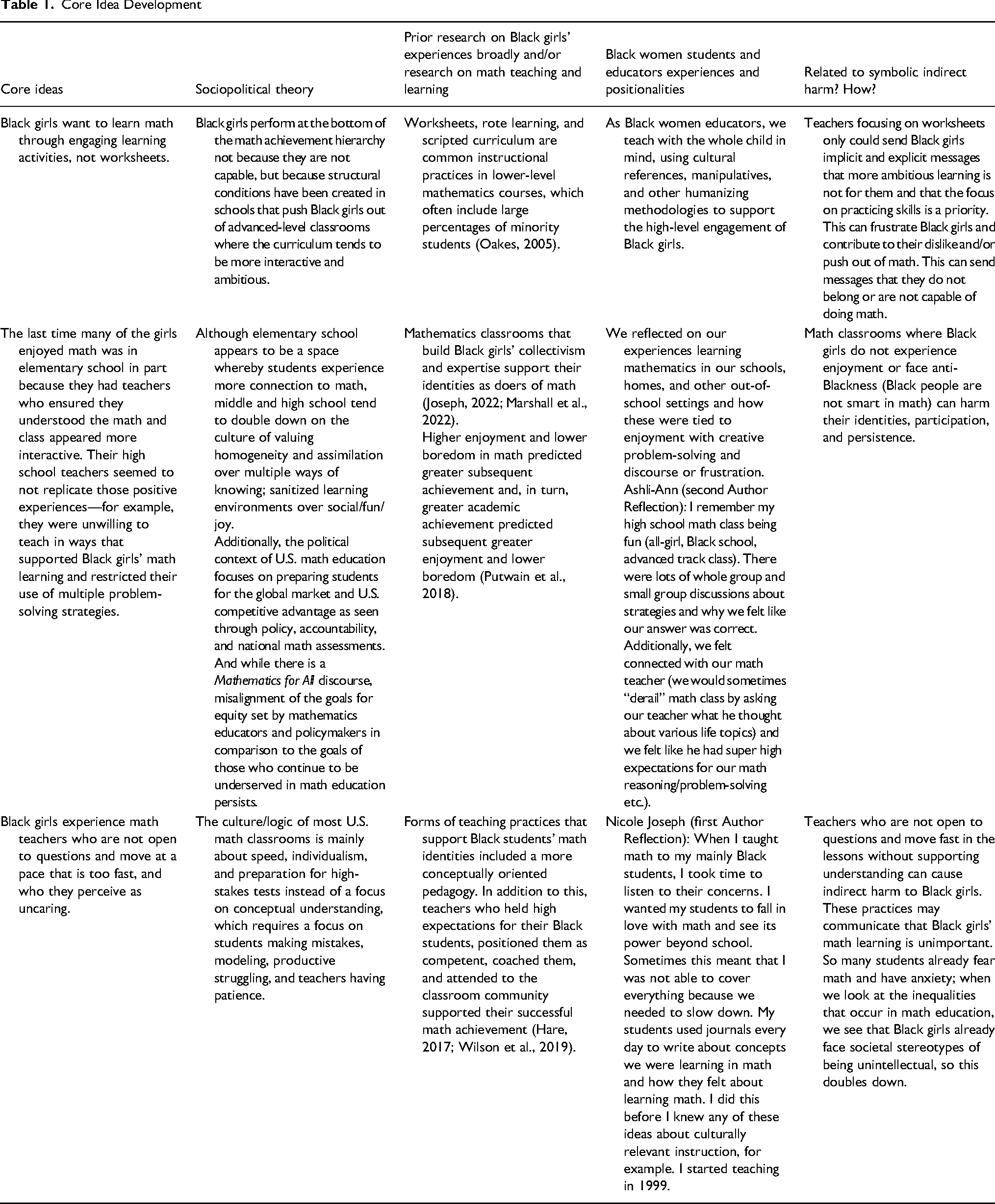
Data analysis included multiple iterations of open and closed coding and discussions for consensus. Each author did line-by-line readings of three to four focus group transcripts, making notes that stayed close to the students' actual responses. We then used our notes and discussions to create a codebook that included 18 broad domains (i.e., “topics used to group or cluster data”; Hill et al., 2005) derived from the focus group questions. An example of a domain was “Last time I enjoyed math.” Each author then re-read their subset of focus group transcripts using the domains and identified quotes, words, and phrases to support those domains. The team reconvened for additional discussion of our individual coding and as we examined our quotes across our transcripts, we engaged sociopolitical theory—power, discourses, pedagogy, and instruction—to consider our lived experiences and prior research on how schools treat Black girls and the culture of mathematics teaching and learning. We hypothesized that there could be connections between the participating Black girls' experiences, harm, and their mathematical identities. The second phase of our analysis included discussions to come to consensus around the core ideas that were common across all 12 focus groups and consider how these core ideas related to aspects of our theoretical framework, previous research on Black girls' mathematics experiences in K-12 classrooms, and our own experiences and positionalities as Black women students and educators. Table 1 includes three examples of how we developed our core ideas in relationship to theory, prior research, our positionalities, and initial thoughts on connections to symbolic indirect harm.
Core Idea Development
Limitations
An important limitation of this secondary analysis is that the girls did not speak directly about issues of race and gender. This was something that the authors had not anticipated, especially since prior research (including the authors) has shown that when many Black girls discuss their experiences in mathematics, they tend to elevate some aspects of being Black and/or a girl (Butler-Barnes et al., 2021). One reason for this could be because the focus group protocol did not include explicit questions about race or gender; another might be because each focus group session was facilitated by one of five research assistants from the larger, longitudinal study, most of whom were middle-aged White women. Even though some were part of the schools or communities where the research was conducted, the girls' responses could have been shaped by the fact that the interviewers were mainly White individuals. Nonetheless, this limitation required the team to think innovatively about how we might make sense of the girls' narratives within a larger context of educational equity in mathematics classrooms through the use of a sociopolitical theoretical frame.
Findings
The findings highlight two themes that emerged from the data analysis of the 48 Black girls' experiences: (1) Black girls experienced mathematics teachers as uncaring and (2) Black girls were often not provided relevant and engaging opportunities to learn in mathematics. Both of these themes directly connect to the instructional practices implemented by their teachers. After each theme, we provide a summary of their experiences and theorize how they might be related to symbolic indirect harm in the mathematics classrooms as well as how their mathematics identities could be impacted. We focus on two constructs of mathematics identity, interest, and recognition, since prior research from the literature showed that they have a direct effect on math identity. We identify the focus groups with an A for those with Black girls in advanced mathematics courses and a G for the focus groups with girls in general mathematics courses. Finally, while we cannot identify the individual girl speaking in each focus group, we included pseudonyms when identifying the collective focus group to honor their humanity and contributions.
Black Girls Experienced Uncaring Math Teachers and Perceived Them as Not Open to Questions, Moving at a Fast Pace, and Not Cool
Black girls in our study reported instances where they believed their teachers did not care about their academic development or even about them as people. They overwhelmingly shared stories of their teachers delivering content in one way and not listening to them when they asked for further support which shaped their math learning and perspectives of enjoyment of mathematics. Several girls shared their views about liking or not liking mathematics as well as what they enjoy about mathematics. Keisha, Alexis, Imani, and Shannon's group were asked what they liked about mathematics class this year, and one of the girls noted: It's not really anything that I like about it this year, mainly because if I don't understand something, I'll ask her to explain it in a different way, and she doesn't. She just keeps trying to make me do it the same way. So, it's like I can't really—if I don't understand how you're saying it, then I obviously need a new way, but you're not giving me that. (A-FG)
This statement points to these Black girls not liking their mathematics class because of limited comprehension of the new math ideas their teacher was teaching. The limitation is not because they do not have the capacity since this is a group of girls who are in an advanced course, but appears to be the restriction of the instructor, who only teaches concepts in one way. Teaching mathematics using only one way, even after students ask for alternatives, can shape students' motivation, interest, and participation.
One girl from Selina, Trauna, Jessie, Sabrina, and Jamia's focus group shared a heartbreaking perspective when the group was asked about joy in mathematics: I really don't have anything that I enjoy about my math class because I just really don't understand. I feel like the way he explains the problem I just don't understand. If he like, explained it in a different way then I probably could understand. And like I'm scared to ask for help. Cause if I ask for help … when I did ask for help he just looked and walked away, shaking his head. Like I'm steady asking questions. (G-FG)
This quote suggests that Black girls enjoy mathematics when they understand the concepts. It is one thing to like mathematics; enjoying math appears to have another level of motivation. Again, we see agreement with the girls from the prior group in that the teacher explains the problem in one way and may not be open to other approaches. Yet, it is well-known that one way to deepen one's understanding is to ask questions. Unfortunately, this narrative points to fear getting in the way of this girl asking questions, especially since it appears that she has had prior negative experiences of being ignored when she did ask questions.
A girl from Tammy, Rhiana, and Keke's focus group commented about her teacher's pacing as something that gets in the way of her enjoyment of mathematics: Yeah, she goes too fast. She don't know how to teach. And she gives us -she'll switch the topic every other day and give us the test on everything that we don't learn that prior week. She just -she goes too fast, and then we tell her to slow down, she don't. Like she don't. If she knows how to -if she slow down and know how to teach and explain it better then -like it ain't hard for me to catch on. It's just like … Like I have to go back to her and be like oh, I missed this, what was this, and she'll be like we went over it in class. And I was like I know. You was going too fast. And then she's like you don't ever say anything. I do say stuff. But it is what it is. (G-FG)
Black girls enjoying mathematics also appeared to be shaped by math teachers' pacing of the lessons. This young lady perceived that because her teacher goes too fast while teaching math ideas, the teacher does not know how to teach. The teacher slowing down and ensuring that she understands the math concepts seems to be a desire for this young lady since slowing down would make it easier for her when she said, “it ain't hard for me to catch on.” This narrative of going to the teacher for help and the teacher-student interaction suggests a subtext of friction between the two of them. When the young lady said, “it is what it is,” after she and the teacher disagreed about if and when she asked for help, this young lady probably concluded that her situation would not change and chose to give up. The term “it is what it is” is often used to signal an individual's acceptance of their situation regardless of the negative outcome.
A focus group with Davina, Nia, Rocky, and Katy, included thoughts that compared and contrasted math enjoyment across their elementary, middle, and high school experiences: Like middle school, elementary school, they make sure everybody gets it. Now, they don't care if you get it. It's just you've got to ask questions, but they really don't answer. Like my teacher, I ask a question. He's like 'look at the board’. (G-FG)
Again, this statement points to Black girls asking questions, but being ignored in some fashion and not receiving support. The teacher telling this young lady to “look at the board” suggests that he does not want to engage her in a discussion. There could also be a subtext of frustration by the math teacher especially if he has prior evidence that she seldomly pays attention during his lessons and perceives this Black girl as unfocused in class. The Black girl also compared and contrasted this interaction with her elementary and middle school experiences where her teachers were proactive and made sure that all of the students comprehended the math ideas, which she perceived as the teacher caring for the students.
A different girl from this same group shed light on her enjoyment of mathematics when she was in the eighth grade: Moderator: Eighth grade? What was good about eighth grade? Black Girl: The teacher. She just had so much excitement. Moderator: Okay. She brought a lot of energy. What's the reference to excitement? What did she do? Black Girl: She was always one of the coolest teachers. You could go to her, talk to her. Like if you didn't understand, she would explain it in a different way that you will probably understand it.
This young lady introduced the term “cool” when narrating the characteristics of one of her middle-school mathematics teachers. The term cool as a descriptor for people has origins in African American Vernacular English and originally meant someone who was interesting, admirable, and relatable. This young lady's use of the word “cool” suggests that the teacher was approachable and connected well with students. It also indicates that this teacher created a learning environment where this Black girl felt comfortable asking questions without being ignored or penalized.
Christina, Raven, and Alyssa's focus group also talked about this idea of “cool” mathematics teachers: Ms. J, yeah, she's cool. She'll help you if you have any questions about your math. Like she will really go in deep with like what you want to know, and I like that. She's the type to be -she don't want to leave your desk unless you understand completely. She'll be like are you sure? Are you sure you understand? That's how my teacher is, too. Like Mr. C, being a senior teacher, he understands that a lot of seniors don't really care or they're falling off, because they realize they have enough credits to graduate. So, he pushes you and he doesn't let you give up. And he's probably the only teacher I've actually learned from, like math, and comprehend it. (A-FG)
This statement provides additional insights into what it means for a mathematics teacher to be cool, as defined by a Black girl. It details the idea of high expectations, challenge, and a teacher never giving up on her. This young lady went so far as to say that Mr. C was the only teacher who helped her learn any math, like math, and have a deep understanding of math.
Theorizing A Discourse of Silencing and Dismissiveness as a Manifestation of Symbolic Indirect Harm
Overwhelmingly, Black girls reported that their mathematics teachers did not listen or flat-out ignored them when they asked for help to understand concepts, which communicated to them that the teachers did not care. Their questions were disregarded suggesting that their voices were diminished in these mathematics classrooms; the teachers refused to slow down the pacing of the lessons when more time was needed; and the teachers were not approachable for Black girls to talk to them about things related to and beyond math. Some experienced ridicule and fear which can breed anxiety and feed stagnation. Telling a Black girl in a condescending way to “look at the board” after she asked a question is a form of dismissal and disrespect. These interactions show the mathematics teachers' passivity, indifference, and disregard. Thus, in the context of these mathematics classrooms and interactions, coupled with Black girls' dehumanization and oppression in schools broadly, this is a discourse of silencing and dismissiveness. This discourse is illustrative of symbolic indirect harm toward Black girls because it is manifested through institutional communication such as the teachers' lessons. In those moments of teachers ignoring Black girls, they are experiencing some form of punishment and being shown that they do not have value in that mathematics classroom.
If Black girls do not feel valued in their mathematics classrooms it stands to reason that they are probably not being recognized by their teachers and peers as strong math students. The pedagogical choices of the teachers in their narratives would also not nurture a Black girls' curiosity and desire to think and learn about math because of rejection and psychologically unsafe learning environments. Consequently, this discourse of silencing and dismissiveness can negatively impact Black girls' positive mathematics identity development.
High School Black Girls Want More Than Worksheets, They Want Active, Relevant, and Rigorous Mathematics Curriculum
The girls reported many instances of math learning activities that focused on worksheets, tests, and an overall uninteresting and non-rigorous curriculum. Rigor refers to a deep, authentic command of mathematical concepts. Many of them reminisced on times when they had captivating teachers and the type of things those prior teachers did in elementary school and occasionally middle school that supported their learning, but these experiences had not been replicated in their high school classrooms. In describing what they did not like about their mathematics courses, one girl from Molly, Drea, Jenny, and Markisha's group, remarked: Oh, the fact that she gives us tests. Like we don't even get - she be like teaching us one day, we get a worksheet, and the next day we've got to take a test. Like she'll just give us tests back to back to back. And sometimes we don't be understanding. I'll be failing my tests. I can't even remember. She gives - my teacher gives us so many worksheets, I don't remember half of it. (G-FG)
This narrative provides some insight into the teaching practices of this Black girl's mathematics class. Tests and worksheets appear to be a central focus of her experience, not ambitious instruction where teachers leverage students' strengths. Getting tests back-to-back without providing additional instruction for students could mean an environment that is not set up for conceptually oriented learning, but more procedural and rote. She stated that she often failed her tests, but there did not appear to be a way for her to work on the areas that she did not understand because another worksheet or exam was coming. While it is not clear if these worksheets focus on the same topic or different topics, students not having the time and space to correct and revise their thinking, and internalize math concepts is problematic and can lead to them feeling that they are incompetent.
One girl in Sara, Jackie, Nene, and Julene's group spoke about how she enjoyed a more interactive learning environment, rather than completing worksheets: It wasn't even the work. It was the teacher. She made it fun for us. We wasn't just like sitting down doing worksheets and stuff. Like we actually went out and did different exercises. We went to the baseball field, and she had some stuff set up that incorporated what we was learning with. And so, every class we was always somewhere doing some type of activity. We was never like just in the classroom doing a worksheet. (G-FG)
This statement illustrates that this Black girl had previous experiences where worksheets were not a key learning strategy and she appreciated that. Sitting down and doing worksheets appeared to be boring and unchallenging. We learn from this girl's narrative that she considered her math teacher fun because the teacher used hands-on activities that incorporated mathematical ideas and required them to engage in more interactive learning activities.
Teyanna, Lacie, and Trish talked about what they would like to see more of in their math classes: A little bit more hands-on things. Because we get Delta math and worksheets [the adopted mathematics intervention curriculum, see https://www.deltamath.com/], and she explains it to us, but I wish we were more like doing activities and group stuff than just like you doing it by yourself. (G-FG)
Again, we see a Black girl suggesting a more hands-on type of mathematics curriculum, rather than worksheets or online practice websites, to increase her engagement and participation. It appears that this teacher does provide explanations that she understands, but there is still a desire by this Black girl to do more, to be challenged. She wants to work with others to share the learning load.
A similar statement from Shanice, Aliyah, Precious, Deja, and Jada's group was about how interesting math is when it is relevant to the real world: I enjoyed sixth grade math because of the concept, and I actually indulged myself in math, even though I really don't like math. But that was the last time I just like really enjoyed the concept of math. I enjoyed how I could apply it to real life. I think it was more like the teacher explaining what the concept was going to help me - would be in real life with career choices and if I wanted to go. (A-FG)
This quote suggests that some Black girls enjoy learning mathematics when it is connected to the real world. In fact, this young Black girl stated that even though she does not like math, having a learning experience that showed the relevance of math for careers pushed her to “indulge” in mathematics. Again, there is a reference to the teacher explaining the concepts in ways that increased her understanding, but also noting how the concept could help her in the future.
These illustrative quotes shed light on some Black girls' perspectives about worksheets and learning environments. The girls were less than enthusiastic about worksheets as a curricular activity that contributes to learning and joy in mathematics. Their narratives also reveal that hands-on learning, relevance, and working as a collective to share, talk, and support each other contributed to their liking and enjoyment of mathematics.
Theorizing A Discourse of Erasure of Black Girls' Intellect as a Manifestation of Symbolic Indirect Harm
Black girls' narration of their experiences in urban mathematics classrooms suggested a desire for pedagogical activities and a curriculum that provided hands-on learning and highlighted real-world relevance. The girls were clear about learning experiences they wished they had more of beyond worksheets—group work, math games, sharing ideas with peers, teaching others, and connections to the real world were a few ideas they identified. Across all 12 focus groups, worksheets came up 35 times. Our interpretation of the girls' descriptions of worksheets pointed to a traditional piece of paper that is given to students during a math lesson to provide opportunities for practice. Skills practice through worksheets or technology is generally designed to be individually completed by students, discourages productive socialization, and has limited opportunities for drawing on students' resources of knowledge. Additionally, since worksheets are often used to practice skills, there is no creativity, imagination, relevant applications, or design. These classroom activities suggest that Black girls seldom get to engage in problem-solving, reasoning, and mathematical modeling- experiences that provide opportunities for them to show their intellectual contributions in various forms. Just focusing on tests and skills practice presumes that the girls are not capable of more rigorous instruction which could point to a discourse of erasure of their intellect. Worksheets do not make room for the girls' knowledge, thinking, and dispositions. This discourse of erasure of their intellect is a magnification of symbolic indirect harm toward Black girls because such experiences are elucidative of deficit ideologies about their competencies in mathematics that show up in the content and teacher pedagogical choices.
Mathematics teachers holding deficit ideologies about Black girls' mathematical competencies would surely impact the girls' abilities to be situated or recognized as competent and creative doers of mathematics. Consequently, this type of intersectional harm can negatively impact their mathematics identities.
Discussion and Implications
This study provided insights into how 48 high school Black girls experienced the mathematics classroom in urban schools and represents one of the largest samples in a qualitative study focused specifically on Black girl narratives of school mathematics teaching and learning. Overall, the findings showed that the girls perceived their mathematics teachers as uncaring, were forced to contend with unsupportive learning environments, and they desired pedagogies and curricula that were more hands-on and challenging. The girls reported in their narratives that if only math teachers would do things like answer their questions, challenge them, slow the pacing, be open to making connections to talk about anything, and be caring, they would like, enjoy, and understand mathematics more. These findings are directly connected to instructional practices implemented by mathematics teachers, which supports prior research that showed the types of instructional practices matter significantly for Black girls. Previous research shows that mathematics teachers who did the opposite of what the girls experienced in this study—taught conceptually, created authentic connections with students, attended to the students' context for relevance, and positioned them as competent—supported mathematics achievement and robust identity development for Black students (Wilson et al., 2019) and Black girls specifically (Marshall et al., 2022).
Through the lens of sociopolitical theory, the negative experiences faced by the Black girls in this study may be illustrative of intersectional harm that is symbolically indirect (ideologies and discourse) since social, cultural, and political contexts (discourse, practices, and policies) influence mathematical teaching and learning (Gutiérrez, 2013). Prior research revealed that Black girls experience harm through a variety of ways, such as being viewed as unintellectual and presumed incompetent (Gadson & Lewis, 2022; Ray, 2022), but that research did not name the harm intersectional. Additionally, prior scholarship has not interrogated how what appears to be the basic experiences of any high school student might reflect intersectional harm for Black girls. Finally, through a sociopolitical lens, theorizing how these negative experiences might relate to a discourse of harm specifically in mathematics, and how that harm hurts Black girls' positive mathematics identity development (interest and recognition) expands prior research.
We discuss three of the many implications of this research. First, as other mathematics educational equity scholars have contended, it is important for researchers to name the problem because when we do not identify and name it, it is difficult to address it. Second, mathematics teachers and educators generally should examine their social interactions with Black girls in the classroom to determine if intersectional indirect harm is present. This is critical work for teachers because symbolic indirect harm is commonplace, ignored, and easy to miss; it also creates power imbalances during instructional communication. Remember that symbolic indirect harm is about ideologies and discourse and shows up through curriculum and pedagogy. Thus, mathematics teachers who intentionally look more deeply and consider how broader sociopolitical contexts have shaped Black girls' mathematics learning are more likely to use curriculum and design learning experiences and activities that disrupt silencing, dismissiveness, and erasure.
Thus, as we think about implications through our third research question of a vision for disrupting discourses of harm and supporting positive interactions and strong mathematics identities for Black girls, one intervention that is promising is Joseph's (2021) Black Feminist Mathematics Pedagogies model (see Figure 1). This model is grounded in intersectionality and Black girlhood theories and orientations. It includes four dimensions: (1) ambitious math teaching, (2) critical consciousness, and reclamation, (3) academic and social integration, and (4) robust mathematics identities, and can be used in professional development with mathematics teachers. The dimensions are interdependent and work together.
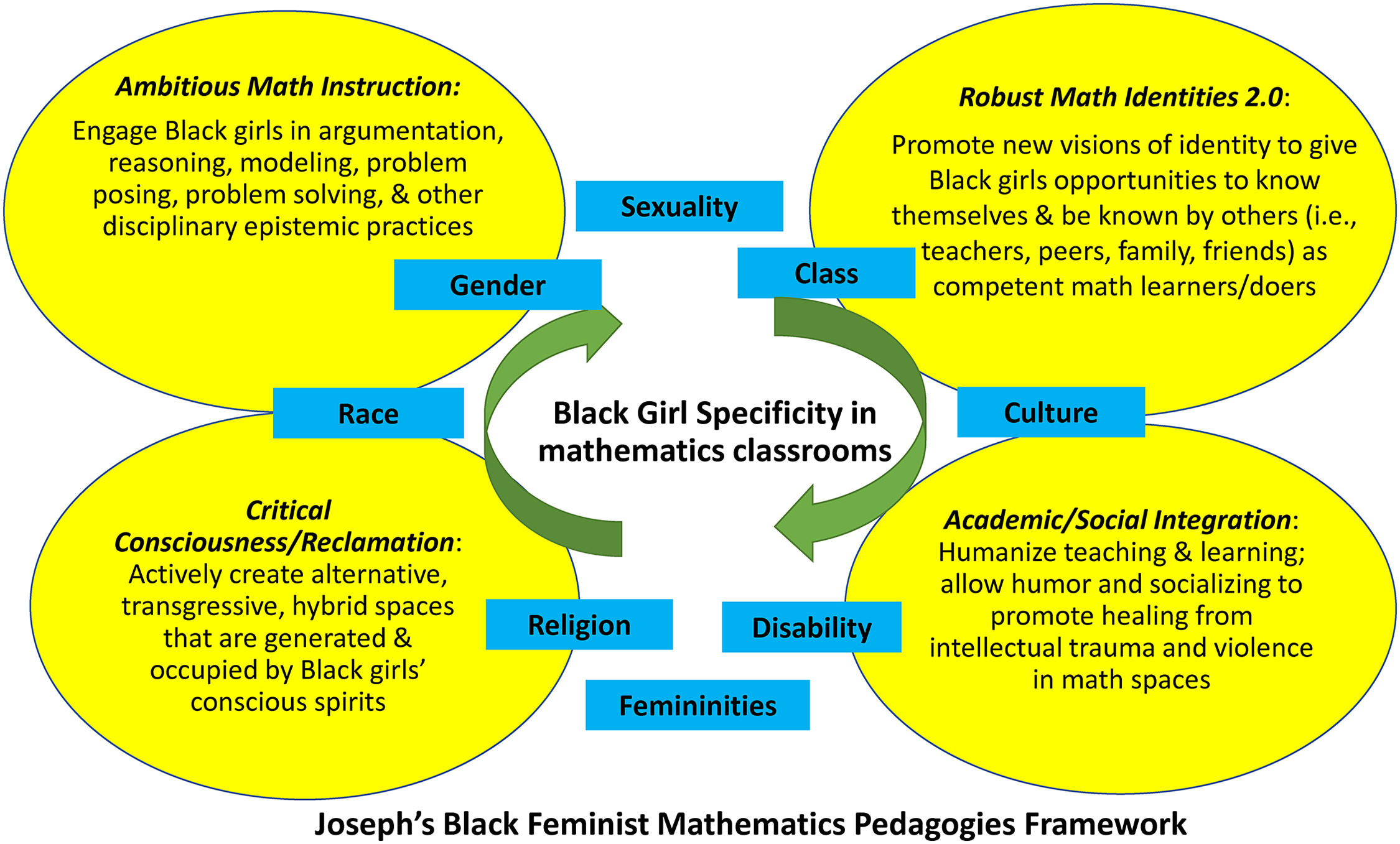
Joseph's (2021) Black feminist mathematics pedagogies framework.
The first dimension is ambitious teaching. Ambitious math teaching can afford Black girls' genuine ways to develop into strong mathematicians. A rigorous math curriculum can promote higher-order thinking, engage students, and build Black girls' capacity to take intellectual risks; however, doing this alone may not disrupt discourses of silencing and erasure. Critical consciousness is a second component of this framework. Black girls' critical consciousness is ideally co-developed between Black girls and their mathematics teachers. Engaging in this pedagogical practice can disrupt a discourse of erasure of their intellect and silence by inviting their voices and facilitating metacognitive discussions about inequalities and promises in their mathematics education. This solidarity work can help Black girls claim agency and space to speak out because they might better see that their ways of knowing and engaging are welcomed in math classrooms. This can open opportunities for Black girls to question, critique, analyze, and act in pushing back on negative discursive narratives about their math abilities. The third component is academic and social integration. Academic and social integration elevates humanizing the teaching and learning of mathematics with the aim of healing, which is a prerequisite for a Black girl to learn. Affirming the whole child in this way disrupts symbolic harm and can be transformative for Black girls because humanizing learning pushes back on the traditional logics of teaching and learning mathematics. The last dimension is robust mathematics identities. Oftentimes young people of color struggle to see or use their own agency and resistance in mathematics because it is not a part of their normative experience as we saw in this study. Black girls may perceive that performing well on mathematics tests, getting good grades, or understanding mathematical concepts without help are authentic indicators of a good math student. Developing robust math identities pushes back on these traditional mathematics logics to consider new visions of Black girl identities, all of which can disrupt intersectional harm toward Black girls in the teaching and learning of mathematics.
Finally, the findings from this study have implications for administrators, policymakers, and other community stakeholders. Discourses of silencing and dismissiveness, and erasure of Black girls' intellect in mathematics teaching and learning contexts should inform professional development at the local school and national contexts, including national organizations such as the National Council of Teachers of Mathematics and the Association of Mathematics Teacher Educators. Public schools in states that have some of the largest enrollments of Black girls (e.g., District of Columbia, Mississippi, Louisiana, Georgia, and Maryland) should consider these findings relevant to their equity initiatives around improving mathematics achievement. Even developers and directors of more community-based informal learning spaces that support mathematics learning should know and understand these issues that relate to Black girls.
Future Research
Future research could explore this idea of discourses of silencing, dismissiveness, and erasure further by using Wilson et al. (2019) instructional practices with teachers and a cohort of Black girls. Specifically, researchers could use the illustrative quotes as stimuli for conversations with teachers as they think about and implement effective practices with Black girls. Other studies could use the findings to inform interview or focus group protocols with both teachers and Black girls to further investigate if and how these discourses impact Black girls’ curiosity and recognition in mathematics.
Conclusion
Black girls continue to be one of the most vulnerable groups in our educational system as validated through direct intersectional harm. This study showed that harm can find its way into mathematics classrooms, often in a hidden or symbolic manner that manifests through teachers' instructional communications and interactions with Black girls. Teachers being aware of these issues and using them to develop a more justice-oriented stance that informs their curriculum and pedagogy is important. This should include holding high expectations for and celebrating Black girls' efforts to learn and do math. Black girls deserve our time and labor to improve their mathematics learning and overall life outcomes.
Footnotes
Acknowledgement
The authors thank the staff, teachers, and students that participated in this research. We also thank Claudell Haymond and Jessica Sommer for their help with implementing the focus group protocol.
Declaration of Conflicting Interests
The authors declared no potential conflicts of interest with respect to the research, authorship, and/or publication of this article.
Funding
The author(s) disclosed receipt of the following financial support for the research, authorship, and/or publication of this article: This research was supported by a Heising-Simons Foundation grant (#2013-26), Institute of Education Sciences U.S. Department of Education grants (R305K050157 and R305A140126), and a National Science Foundation grant (#1760225) to Kelley Durkin, Bethany Rittle-Johnson, and Dale C. Farran.

Author Biographies
Appendix
Black Girls' Math Course Enrollment