




Abstract
The World Bank’s (WB) growing emphasis on decentralizing educational systems has sparked widespread discussion in the literature. This study examines whether WB reforms are indeed associated with decentralizing educational systems in low- and middle-income countries (LMICs), as commonly assumed. Using unique, untapped country-level panel data on 30 LMICs from 1990 to 2019, I do not find a significant association between the WB’s actions and changes observed in educational systems. Employing the institutional logics perspective, I argue that the WB’s diffusion of “homogeneous” educational reforms may clash with “heterogeneous” socioeconomic, political, and cultural contexts, thus hindering the direct translation of reforms into tangible outcomes on the ground.
A considerable body of literature has studied how international organizations (IOs) promote reforms in political and social institutions in low- and middle-income countries (LMICs). The scale of reforms by IOs, especially by the World Bank (WB) and the International Monetary Fund (IMF), has been well-researched with empirical data (e.g., Hossain, 2022; Kentikelenis et al., 2016; Steiner-Khamsi, 2006; Wong & Guggenheim, 2005). This is also known as policy diffusion by IOs from the global North to the South (Steiner-Khamsi & Quist, 2000). One of the reforms frequently promoted by the WB involves implementing projects aimed at decentralizing educational responsibilities to the subnational (e.g., regions and districts) and school levels. This phenomenon can also be defined as destandardization. As past literature suggests, by providing local institutions more managerial autonomy, transferring responsibilities, and establishing or strengthening the capacity of local institutions, educational systems in LMICs are less likely to maintain the same standards across a country (Hossain, 2022; Kerckhoff, 2001). This means the standards of educational systems may vary across schools and subnational entities. However, in this article, I opt to utilize the term “decentralization” instead. This is more commonly used in the context of education and international development, and it helps engage readers and maintain clarity throughout the paper.
Existing research claims that decentralization reforms have been diffused across LMICs primarily led by the WB (Geo-Jaja, 2004; Kristiansen, 2006; Meade & Gershberg, 2008; Naidoo, 2005; Pritchett, 2014). An independent evaluation of the WB’s decentralization initiatives in 20 countries, involving 203 lending activities, found that out of a total commitment of 20 billion USD (U.S. dollars), 7.4 billion USD was financed in decentralization activities in different sectors. The report further suggests that these WB initiatives aimed to bring about de facto or real changes in the institutions of LMICs (World Bank, 2008). The WB has also been identified as the largest source of development financing in international education since the 1960s (Heyneman, 2003). Considering these factors, the WB provides a compelling case for analyzing the decentralization reforms of this influential IO and their association with changes in nation-states.
While the available literature on the subject is limited, research suggests a steep increase in the decentralization of education reforms in LMICs, especially from the late 1980s onward. Hossain (2022) finds that 63% of WB project components in primary and secondary education have focused on devolving educational systems to school and subnational levels. A strand of research in this area is typically concerned with assessing the impact of decentralization-like reforms on certain outcomes, such as learning outcomes or school quality (Elacqua et al., 2021; Faguet & Sanchez, 2008; Hanushek et al., 2013; Hossain, 2023b; Maslowski et al., 2007). Nevertheless, there is limited research enquiring whether IO-led projects have resulted in decentralizing the educational systems in the first place. This study is the first to examine the relationship between the implementation of WB reforms and the decentralization process in educational systems across 30 LMICs.
By countries’ decentralization process, I mean changes in de jure or by-policy decentralization over time. I am not able to observe the actual or de facto state of the decentralization process, as that would require surveying subnational and school entities. Hence, I use countries’ education policy documents to measure the de jure or by-policy decentralization process. Unlike previous research, I define decentralization at the subnational and school levels separately since the actors involved at both levels can be quite different and can impose varying levels of social constraints to receive changes from external actors or the environment (e.g., Pfeffer & Salancik, 2003). For instance, decentralization at the subnational level may involve public officials, local policymakers, civil society organizations, teachers, and representatives from subnational-level parents’ associations, if there are any. The subnational level refers to any entity between the central government and schools, such as districts, regions, and subdistricts. Since the study analyzes 30 countries with considerable variations in administrative structures, I could not further subdivide the subnational level. At the school level, the actors may primarily involve teachers, parents, and local community members. The nature of responsibilities, demand, and services at both levels is quite different. Hence, I treat both levels separately.
To address the research puzzle, I utilize the institutional logics perspective from new institutional theory to elucidate the obstacles faced by a single IO, the WB, in effecting changes in educational systems. New institutionalism characterizes institutions not only as a set of formal and informal procedures and regulations within an organization but also as systems of significance and normative structures that guide, incentivize, constrain, and facilitate the actions and interactions of individuals and organizations (March & Olsen, 1983; Scott, 1994). In other words, its attention centers around the interaction between an organization and its wider surroundings, such as socially embedded norms (DiMaggio & Powell, 1983). In the next section, I explain the theoretical gap between the WB’s decentralization initiatives as a homogeneous set of reforms in the education sector and the unmatching norms and values of multiple competing actors in nation-states, such as at the subnational and school levels.
There is a limited theoretical framework in the field of comparative and international education that adequately captures the challenges associated with implementing educational system reforms by IOs in LMICs. The policy diffusion literature considers these reforms as an outcome of the coercive approach adopted by IOs. Even if the reforms take place through coercion, for instance, conditional aid (Owen, 2002), it is not clear how they get implemented. Ho and Im (2015) argue that IO-backed reforms, such as performance-based management in the administrative systems of LMICs, fail due to a mismatch between the logics of implementing these reforms by IOs, often drawn from Western liberal institutions, and the institutional context of LMICs.
To examine the link between WB projects and the de jure decentralization of educational systems, I leverage country-level unique panel data spanning from 1990 to 2019. I further examine whether school- and subnational-level decentralization reforms by the WB are correspondingly associated with de jure decentralization at the school and subnational levels.
In brief, I contribute to the current literature in four unique and original ways. First, this is the first study to investigate how WB projects may be linked to decentralizing educational systems in LMICs. Second, the study contains 30 LMICs from all major developing regions of the world with over-time data between 1990 and 2019. Existing research lacks cross-country analysis using such a sizable sample. Third, I employ the institutional logics approach to examine the association between WB projects and de jure decentralization, which remains less explored in this context. Fourth and most importantly, I utilize two unique, untapped datasets that I built through extensive archival research over a year. Specifically, the measures of the de jure decentralization of educational systems are new and very comprehensive compared to what past research from high-income countries has mostly used. The measures of WB’s decentralization reforms are also unique and required half a year of coding historical WB project documents.
Mechanisms Linking World Bank Projects to De Jure Decentralization of Educational Systems in LMICs
There is a strand of research criticizing the role of foreign aid and how it may not have helped LMICs bring about actual changes or better socioeconomic outcomes (Crawford, 2000; Dollar & Svensson, 2000; Heckelman & Knack, 2008; Svensson, 2003). As noted, the theoretical framework to understand some of the reforms, especially regarding the decentralization of the education sector, remains less developed. In this section, I discuss how the institutional logics perspective can help understand the challenges of WB projects from a single IO to implement and bring changes in the educational systems of LMICs with wide variations in sociopolitical, economic, and cultural characteristics. I first show the logics of the WB in implementing decentralization reforms. Then, I present the logics of LMICs and their multilayered stakeholders to embrace WB projects or reforms.
WB Logics: Homogenizing Educational Systems
In this section, I illustrate the logics of the WB to diffuse decentralization reforms in the education sector in LMICs. I also show how these reforms maintain homogeneity across countries.
The decentralization of educational systems aligns with the broader shift in the IOs’ focus from simply providing financial assistance to actively promoting policy reforms since the late 1980s. Before that, development aid and grants were mainly geared toward the reconstruction and development of infrastructure after the Second World War (Dollar & Svensson, 2000). Centralization of institutions and limited democratic space in sharing responsibilities with local governments and communities have been identified as some of the key factors contributing to the slow development progress across LMICs. Hence, decentralization reforms aim to make the public service delivery systems more efficient, accountable, and participatory (Dollar & Easterly, 1999). This is also referred to as the new public management (NPM) paradigm of administrative reforms, advocating for the application of private enterprise principles in running the public sector to maximize efficiency and enhance results (Ferlie et al., 1996). In the 1990s, around 80% of developing economies were experimenting with decentralization in different regions promoted by IOs (Manor, 1999).
Decentralizing educational systems involves advocating for “transferring decision-making power in basic education from the administrative center of a country (such as the central ministry of education) to authorities closer to the users (such as countries, municipalities, or individual schools)” (Florestal & Cooper, 1997, p. viii). Its goal is to establish autonomous local governments and school governance aiming to foster greater accountability, participation in decision-making processes, and nurturing of result-oriented organizational culture (Ball & Youdell, 2009; Jütting et al., 2005; Leithwood & Menzies, 1998; Robinson, 2007). The decentralization initiatives have mainly affected the primary and secondary levels (Channa & Faguet, 2012). This is partially because, despite a notable rise in enrollment rates in basic education in LMICs in response to the Education for All (EFA) movement and the millennium development goals (MDGs) of the United Nations (UN), the learning crisis has become an alarming issue (Schweisfurth, 2023). Decentralization has emerged as a prevalent policy recommendation to address this crisis (e.g., Barrera-Osorio et al., 2009; Pritchett, 2013).
This push for decentralizing the education sector has met with criticisms for appearing as a one-size-fits-all strategy not only across regions but also political spectrums. For instance, Williamson (1993) argues that “there is no inherent reason” (p. 1334) why the political left would not endorse these reforms as much as the right. Thus, the WB has been diffusing these consistent reforms arguably to homogenize educational systems across LMICs (Hossain, 2022). This worldwide isomorphism of institutional systems by IOs, including the WB, is part of a larger trend where national education policymakers choose reforms from a “world menu” (Boli & Ramirez, 1986; Meyer et al., 1997; Mundy & Read, 2017). Research highlights the importance of incorporating local perspectives in education policymaking, as the growing donor-central ministry nexus has narrowed the scope for the involvement of other national actors (Bhatta, 2011). I provide two familiar examples of such attempts to decentralize educational systems. First, school-based management (SBM) has become a buzzword in international and comparative education literature. The WB has been promoting SBM across the developing world to create more autonomy in schools so that decisions can be more participatory by involving parents and local communities, supposedly leading to better learning outcomes (Barrera-Osorio et al., 2009). The term “SBM” itself, along with its goals and instruments, has remained remarkably similar when diffused to countries with vastly different institutional and cultural contexts, for instance, from Cambodia, Indonesia, and Thailand in Southeast Asia (Bandur, 2012; Shoraku, 2009) to Honduras, Guatemala, and Mexico in South America (Ganimian, 2016; Reimers & Cárdenas, 2007). Among the small number of countries I mentioned here, cultural and institutional variations, even within each region, are nonnegligible.
Second, the WB has been promoting the education management information system (EMIS) in every region of the world. The EMIS aims to create a decentralized network between schools and subnational entities to enhance data infrastructure at these levels. Among many objectives, the WB invests in EMIS to create more operational autonomy in schools and districts for improved and efficient use of financial and human resources (Abdul-Hamid, 2017; Hossain, 2023a). Again, similar to SBM, the name, strategies, and goals of the EMIS scheme are very similar or the same across LMICs, regardless of their cultures and institutions.
The SBM and EMIS programs aim to create more efficient, result-oriented, measurable, and participatory educational systems to improve learning (Barrera-Osorio et al., 2009). To achieve this goal, these reforms would need to change the existing organizational design and processes as decentralization, an NPM component, intends to “reculture” institutions (Hossain, 2018). However, new institutional theory suggests that organizational changes do not merely institutionalize technical tasks such as SBM and EMIS. For the changes to occur, they need to be infused with values beyond formal rules and requirements and embedded with cultural norms and rituals (Selznick, 1996). Hence, it is paramount to consider an organization’s cognitive and normative aspects as values instead of merely the rational calculation of the cost and benefit of certain initiatives like decentralization. For instance, the rational calculation for SBM is that once schools are more autonomous, it would enable parents to contribute to decision-making processes, regardless of their socioeconomic background. This argument disregards the fact that in many developing societies, parents may be discriminated against based on their sex, age, and socioeconomic backgrounds, barring them from participating in school decisions. Values, thus, can dominate how individuals make decisions in an organization (March & Olsen, 1983), as also evident in empirical research (Anh Vu et al., 2022). When the WB promotes decentralization to make educational systems more efficient by enhancing learning achievement, it introduces certain new values such as “technical rationality.” This aims to make educational administration more productive with fewer resources through innovation, participatory management, flexibility in leadership, transparency, local resource mobilization (e.g., donations), and empowerment of the local community.
These reforms, borrowed from high-income contexts (Steiner-Khamsi, 2006), might be better suited for implementation in liberal democratic institutions, as they likely align with the organizational values prevalent in such systems. However, when these new norms are diffused in many LMICs, they can challenge the traditional values present in their educational administration. In these contexts, existing educational practices may be more oriented toward strict adherence to rules, risk aversion, and low adaptability. Factors such as secrecy and seniority could hold greater importance in schools’ decision-making.
Moreover, traditional values would exhibit significant variation across societies, given that no countries share the same history, culture, and socioeconomic settings (Lounsbury et al., 2021; Thornton et al., 2012). For instance, ethnic composition, the size of the territory, and the population of LMICs widely vary, which may influence how they share power with subnational entities. The WB’s provision of technical assistance to nation-states to implement its projects may not compensate for a limited understanding of the social context. Attributes of implementers or administrators of reforms can account for negligible variance in organizational performance (Pfeffer & Salancik, 2003; Salancik & Pfeffer, 1977). Hence, the WB’s decentralization reforms with homogenous strategies may potentially lead to conflicts with the organizational culture of nation-states as they attempt to introduce a new reality. Organizational changes do not occur in isolation from their context. The rational and technocratic approach to decentralization requires careful attention to potential conflicts and interactions between macro-level institutions, such as different ministries (e.g., education and finance), as well as between central and local governments, and how these dynamics can impact the behaviors of organizations and individuals (Friedland & Alford, 1991). The decentralization initiatives by the WB may have encountered challenges due to these multiple layers of complexities and conflicts between institutions horizontally (e.g., ministries) and vertically (e.g., central and local governments) and how these factors influence the actions of individuals (Thornton et al., 2012). In the next section, I elaborate more on the logics of nation-states.
This is to note that past literature considered institutional reforms in LMICs as a coercive mechanism. Great powers expand their influence by propagating their institutions globally and ensuring that the incumbent regimes conform to their ideological views (Owen, 2002). This is partly due to their reliance on aid and foreign direct investment (Kentikelenis & Babb, 2019; Mosley et al., 1995). Donors have expressed their intention to withdraw aid if recipient countries do not adhere to certain conditions, such as instituting reforms (Robinson, 1993). Examining the extent to which the decentralization of educational systems is a coercive mechanism is beyond the scope of this paper. My primary objective in the study is to examine the extent to which WB reforms are associated with decentralizing educational systems, despite efforts made in the past few decades.
Nation-States Logics: Heterogeneous Settings
In the preceding section, I argued that the WB adopts a homogenous set of decentralization reforms in the educational systems of LMICs worldwide, despite these countries possessing significantly diverse institutional and cultural contexts. In this section, I illustrate the heterogeneity of logics among nation-states in implementing WB reforms and how such heterogeneity can manifest among actors in subnational administration and schools due to differences in cultures and power dynamics within institutional leadership (Campbell, 2004).
The heterogeneous or multiple logics of nation-states may emerge from their multilayered stakeholders involved at the central, subnational, and school levels. I provide a few instances of different logics from these levels, illustrating how implementing WB reforms can become challenging. Organizational actions at each level may be constrained by the social context (Pfeffer & Salancik, 2003). Disregarding these constraints could potentially lead to the nonimplementation of WB projects.
First, the WB requires the central government’s agreement in a nation-state to implement decentralization reforms, which has become a regular part of aid conditioned on improving “good governance” in LMICs (Santiso, 2001). However, in many LMICs, the administrative structure is highly centralized, with a limited willingness to delegate power to regional and district administrations. This concentration of power often becomes personalized in the hands of a select few individuals or offices (e.g., Mauceri, 1997). Such deeply ingrained organizational culture is unlikely to be easily altered by external reforms. Moreover, the principles of the rule of law, impersonality, and checks and balances, commonly observed in liberal democracies, might be perceived as foreign in many LMICs (Ho & Im, 2015). This situation may also vary among LMICs, as some are more democratic than others, and countries like Brazil, India, and Mexico, with their federal systems, share educational responsibilities with states, albeit in different ways (Wallner et al., 2020). Implementing similar decentralization tools in these federal systems and more centralized countries like Jordan and Morocco (Clark, 2018) may not yield comparable outcomes.
Second, decentralizing educational systems requires cooperation between different ministries or divisions. For instance, in many countries, the finance ministry controls education budgeting, and the distribution of funds can be highly centralized. This can also challenge the WB’s decentralization initiatives.
Third, as mentioned in the previous section, the lack of transparency and limited accessibility to data in many LMICs can pose challenges to WB’s initiatives, such as EMIS. Besides, the bottom-up accountability approach in WB’s decentralized initiatives may encounter resistance within the bureaucracy, where the government’s legitimacy often hinges on the dominance of the incumbent regime and the personal charisma of the political leadership (Laking & Norman, 2007).
Fourth, past research expresses skepticism about the effective implementation of decentralization projects in LMICs due to the pervasive presence of clientelism and corruption in the public sector. Clientelism involves exchanging material goods or services for political support (Hicken, 2011), while corruption refers to using government properties or offices for personal gain (Shleifer & Vishny, 1993). To exemplify, in Ghana, decentralization reforms at the school level, like SBM and increased autonomy, were introduced by IOs. However, local political actors have retained control over school governance instead of transferring it to local communities and stakeholders, hindering the true implementation of these projects (Essuman & Akyeampong, 2011). Hence, the successful implementation of decentralization reforms may be in peril without fully grasping contextual issues. Similarly, in Nepal, excessive power exercised by local political elites in the newly reined “school management committees” has led parents to opt for private schools if they can afford to (Joshi, 2014). Hossain (2021) also finds that decentralization elements, such as increased community participation in managing school affairs promoted across LMICs, may not yield the expected changes.
Fifth, discrimination based on the sex and age of parents, especially mothers, in many LMICs may hinder their involvement in decision-making processes through SBM or other school autonomy initiatives. The technical instruments of the WB’s decentralization initiatives may overlook cultural norms.
As previously argued, the WB brings a homogeneous set of technocratic decentralization reforms based on rational calculations, disregarding the social context. This approach differs from the logics of nation-states as per the new institutional theory. Considering the theoretical mismatch between the WB’s homogeneous strategies and the heterogeneous logics of nation-states, the WB’s decentralization projects may not effectively lead to the decentralization of educational systems. One might question whether technical experts from the WB could exhibit exceptional leadership in certain countries by understanding the social context and the interrelationship between the context and the embedded educational systems. While not impossible, such examples are rare. IOs have increasingly focused on countries taking ownership of adopting and implementing reforms in a contextualized manner, as highlighted in the Paris Agreement of 2005, reaffirmed in Busan in 2008 and Accra in 2011 (Booth, 2012). Despite this increasing emphasis, country ownership and cooperation between IOs and nation-states to implement reforms have not seen the expected progress (Chandy & Kharas, 2011).
An Alternative Explanation
The above discussion means that countries may implement educational decentralization reforms based on their cultural values and institutional contexts. As a large body of literature suggests (Barrera-Osorio et al., 2009; Channa & Faguet, 2012; Florestal & Cooper, 1997; Manor, 1999; Naidoo, 2005), we may see a rise in de jure decentralization in educational systems across LMICs, but not necessarily as an impact of the WB projects. This phenomenon can be explained by the institutional logics perspective, particularly through the lens of constructivism.
In simple terms, constructivism suggests that when nation-states assume certain reforms to be beneficial for their institutions and suitable for their cultural context, the nation-states willingly adopt such reforms. This approach goes beyond pure technocratic reasoning, acknowledging that norms, identity, culture, and local knowledge play a significant role in guiding organizational and individual behaviors (Finnemore & Sikkink, 2001). Constructivists contend that policy diffusion is a socially constructed process within a globally agreed-upon culture shared by a set of actors (Berger & Luckmann, 1966; Meyer et al., 1997). Proponents of this view suggest that receiving countries inherently accept diffused reforms because the models might have demonstrated success in some other countries. This creates a “follow-the-leader” approach (Dobbin et al., 2007). However, in doing so, countries may customize the reforms, considering what will work best for them. Dobbin et al. (2007) suggest that policy models can diffuse for learning purposes, as countries learn from each other about the best practices, which may not necessarily involve interventions by the WB or other IOs. Countries can engage in this process to enhance economic competition with peer economies (Sinn & Ochel, 2003). In summary, this mechanism considers that the diffusion of reforms across nation-states is an inevitable constructivist phenomenon, inherent in the character of the globalized world.
Methods
Data and Variables
To examine the relationship between WB reforms and changes in de jure decentralization, I utilize two distinct datasets: the first on decentralization projects implemented by the WB and the second on de jure decentralization in 30 LMICs.
The outcome variables are the de jure state of decentralization in educational systems at the (1) subnational and (2) school levels. These measures are time-varying and span 30 years from 1990 to 2019. The data for these variables were carefully compiled through extensive archival research and coding of documents from three different sources, resulting in an original country-level panel dataset.
The key explanatory variables are WB projects aimed at decentralizing educational systems across LMICs at the (1) subnational and (2) school levels. This dataset was also constructed through archival research, covering approximately 900 WB projects related to primary and secondary education in 99 historical and present LMICs. However, for this paper, the sample is limited to 30 countries, corresponding to the period of 1990 to 2019, due to the lack of available data on the outcome variables, de jure decentralization, from more countries. Nonetheless, the study sample represents countries from all major developing regions where the WB has implemented decentralization reforms. The observation units in the study are country-years.
De Jure Decentralization
I conducted extensive archival research in two phases, during 2021 and 2022, to construct measures on the de jure state of decentralization in educational systems. These variables capture the changes in decentralization processes within countries from 1990 until 2019, with the observation units being country-years. I coded documents from three consistent sources: (1) the UNESCO Bureau of Education (IBE) (International Bureau of Education, 2007, 2011), (2) the UNESCO Right to Education (RTE) database (UNESCO, n.d.), and (3) national laws and policy documents. Approximately 75% of the data were coded from the IBE, which provided comprehensive and standardized information on educational systems worldwide in a uniform format for each country. Specifically, the IBE prepared country reports on educational systems in 2007 and 2011. The reports have detailed information about historical changes in educational systems within each country. This allowed me to construct these measures over time since 1990 from a systematically organized source (International Bureau of Education, 2007, 2011). However, I did not go beyond this time as the information is not detailed before 1990.
For the time points after 2011, when the IBE published the latest reports, I relied on the UNESCO RTE database and national education law or policy documents, the second and third sources listed above. I also used these two sources to code data before 2011 if some information was not available from the IBE reports. The UNESCO RTE database has gathered a comprehensive list of country-specific national education laws and policies, including those on educational systems over time. The collection includes countries’ relevant and available historical and present education documents (UNESCO, n.d.). If some information was not available in this source, I searched on Google or visited the website of the ministry of education of the specific country to look at the national education laws or policies. The use of multiple and extensive sources over time makes the dataset rigorous and the most comprehensive one to date in this field. I recoded most of the data to ensure reliability. Furthermore, I double-checked the indicators derived from sources 1 and 2 with national policy documents for triangulation and consistency.
I coded nine indicators of de jure decentralization for both school and subnational levels. The indicators are the decentralization of educational systems in deciding (1) curriculum, (2) textbook, (3) assessment or exit exam, (4) teacher recruitment, (5) teacher initial and (6) in-service training, (7) budget source and (8) implementation, and (9) inspection or supervision. I argue that the selected responsibilities can be decentralized at both the subnational and school levels. For instance, educational budget provision and allocation can largely be the responsibilities of the central and subnational agencies. However, some of these tasks can also be devolved to the school level, including, but not limited to, the collection of different fees and donations and autonomy on how to spend them. To the best of my knowledge, these are the most comprehensive measures up to now in a single study to capture the process of decentralization in LMICs, which existing literature lacks (e.g., Gamoran, 1996; Van de Werfhorst & Mijs, 2010). The resulting indicators are consistent with the relevant literature. One or more of the indicators, including curriculum, assessment, teacher recruitment, and budget management, have been used in past studies to measure how standardized or uniform educational systems are, although mainly from high-income contexts (Bishop, 1997; Bukodi et al., 2018; Chmielewski & Reardon, 2016; van Hek et al., 2019). I followed a two-step process to construct the measure of de jure decentralization at both levels.
First, I created a binary measure for each of the nine indicators at the subnational and school levels. The indicators signify whether the respective level partly or fully performs a particular responsibility. To create these nine indicators for the subnational level, I coded 1 when the selected responsibilities are either (a) solely performed by subnational entities (districts, regions, or other entities between schools and the central government); (b) shared by subnational entities and the central government; or (c) shared by schools, subnational entities, and/or the central government. These conditions correspond to points 2, 3, and 4 in Table S1 in the online version of the journal. 1 The remaining points (1, 5, and 6) were coded 0, meaning there is no decentralization at the subnational level.
Similarly, to create the nine binary indicators at the school level, I coded 1 for school-level decentralization when responsibilities are either (a) decided solely by school actors such as the school management committee (SMC), principals, or teachers; (b) shared between schools and the central government; or (c) shared between school actors, local governments, and/or the central government. These conditions correspond to points 4, 5, and 6 in Table S1 in the online version of the journal. The other three conditions were coded 0 for school-level decentralization or no decentralization at the school level.
In the second step, to simplify the information from nine binary indicators, I took their sum for both subnational and school levels and created two indices. For instance, if four of the nine educational responsibilities considered in this study are managed by the subnational level in a country and a particular year, the value for the final index becomes 4. The same rule applies to the school level. I coded all these indicators separately for the primary, lower-secondary, and upper-secondary levels. Given the strong correlations among the indicators across all three educational levels (with correlation coefficients ranging from .90 to around 1, as shown in Table S2 in the online version of the journal), I derived the average of all three levels.
Furthermore, I standardized both indices with an overall mean of 0 and a standard deviation of 1. This is to ease the interpretation of the results as I also standardized the main independent variables, as explained below. Finally, to avoid masking the various aspects of decentralization at each level, separate indices were constructed for three areas: (a) academic (1. curriculum, 2. textbook, 3. school supervision, and 4. summative exit exam), (b) budgeting (1. budget source and 2. allocation), and (c) personnel management (1. teacher recruitment, 2. initial training, and 3. in-service training), at both the subnational and school levels. Consequently, a total of six indices were constructed at both levels. Previous literature employs this approach to capture the multifaceted nature of decentralization in education (Hanushek et al., 2013; Hossain, 2023b; van Hek et al., 2019). As I illustrate in the next variable, WB projects have focused on decentralizing the overall educational system of a country, instead of specific aspects or areas in isolation. A disaggregated analysis examining the relationship between WB projects and multiple indices of de jure decentralization will further clarify whether the association varies by specific area.
I also created the same indices for de jure decentralization (only for the overall measure of the subnational and school levels) using the item response theory (IRT) method, as explained in Appendix S1 (in the online version of the journal). I found a high correlation between the indices constructed using simple aggregate sum and those constructed using the IRT method, as illustrated in Figure S1 in the online version of the journal. Since the sum of indicators requires fewer assumptions compared to the complex IRT method, and the final indices remain similar, I considered the former indices for the study.
WB Decentralization Reforms
The main independent variables in this study are WB projects to decentralize education at the (1) subnational and (2) school levels. These two continuous variables were originally coded in percentages ranging between 0 and 1, denoting the proportion of WB project components implemented to decentralize educational systems. I standardized these measures with a mean of 0 and a standard deviation of 1 to compare the scales with those in the dependent variables. Below, I describe the process of coding them in percentages before standardizing.
To construct the variables, I analyzed 910 WB projects on primary and secondary education in 99 low- and middle-income countries (LMICs) from the WB website (World Bank, n.d.-c). These projects were sorted by “primary education,”“secondary education,” and “public administration: education” to select those directly related to education, resulting in 897 projects. 2 This study focuses on 30 LMICs corresponding to the countries used in constructing the dependent variables.
Subnational-level WB reforms
Each WB project has one or more components, as illustrated in Box S1 in the online version of the journal. If a project component transfers educational responsibilities from the central government to subnational levels (entities between the central government and schools), I coded it accordingly. For example, the Honduras project in Box S1 has four components, and the third component is about transferring responsibilities to subnational levels, so the value of the variable is one fourth or 25% of all components that deal with this topic. The remaining components are not related to transferring responsibilities to subnational levels. Additional examples of coding both subnational and school-level transfers of responsibilities can be found in Table S3 in the online version of the journal. A list of countries included in the study can be found in Table S4, available online.
School-level WB reforms
I categorized the proportion of project components that deal with decentralizing educational responsibilities at the school level. For example, component 2 in the project in Box S1 (available online) focuses on increasing school autonomy and community involvement, so the value for this variable would be one fourth or 25%. I display data for both indicators together with de jure decentralization in the Findings section. The trend indicates that overall, decentralization at the school level experienced a steep growth at the school level after 1990. However, there was a rise at the subnational level at the beginning of the 1990s, but it did not continue afterward.
The unit of analysis is the country-project year, rather than just the starting date of projects. The project in Box S1 in the online version of the journal was active for 5 years, from 2008 until 2013. Hence, there are five observations for this project. I analyzed each project by considering the entire duration of the project, rather than just the starting date. This is because it is not possible to understand the full impact of WB operations without considering the entire time frame of a project. Additionally, the WB conducts multiple projects in a country simultaneously, so I cannot accurately capture the total length of each project by considering only the starting or ending year. Furthermore, the initial value of the measures does not remain constant throughout the entire project, as multiple projects are being implemented simultaneously in the same country.
I also considered the possibility that WB project components may change over time, which typically occurs during the early stages of a project. To capture these changes, I reviewed project design documents (before the project started) and evaluation documents (after the project had been implemented). This allowed me to include all WB project components in the analyses. It is worth noting that subnational decentralization and school-level decentralization are defined distinctively and, therefore, do not add up to 100% of a project. Both types can appear in the same project, meaning that the presence of one does not indicate the absence of the other.
I considered the percentage of project components, not the number of decentralization projects, to better capture the magnitude of reforms. For example, in Indonesia, the WB implemented a 5-year project from 2008 to 2012 to decentralize the educational system, costing 2.6 billion USD, with the WB contributing 600 million USD (World Bank, 2013). If I considered this not as a percentage (or 100%) but rather as a binary yes/no count, it would create a biased measurement. This is because many projects had decentralization reform as one of the project components accompanying other elements, such as building school infrastructure. Nonetheless, the equitable weighting of all projects is subject to questioning due to variations in their budgets and time frames. As mentioned earlier, I have already accounted for project length to address this concern. Additionally, I address budget differences between projects by controlling for the total project cost. Unfortunately, I could not further account for the amount invested solely in decentralization as this information is unavailable in many projects.
Most WB projects examined in this study emphasize broad, comprehensive decentralization reforms rather than targeting specific areas. At the subnational level, around 33% of the projects (including components for school-level decentralization) have focused on capacity building for subnational entities. This includes activities such as training education officials, providing additional financial resources and technical assistance to support the design and implementation of decentralized responsibilities, sharing knowledge and best practices between regions, defining roles between central and local governments, promoting transparent decision-making processes based on evidence, involving local stakeholders in decision-making, and assessing the progress of decentralized initiatives. Moreover, approximately 11% of the projects have partially concentrated on decentralizing educational systems. This involves the establishment of subnational educational administration, granting more autonomy to local entities for tasks like developing school improvement plans, financial planning for schools, school inspection, teacher recruitment, and teacher training. Furthermore, about 9% of the projects have focused on capacity building through EMIS activities to enhance decision-making processes using data at the subnational and school levels. Prior literature acknowledges these elements as the components of decentralization (Abdul-Hamid, 2017; Ball & Youdell, 2009; Barrera-Osorio et al., 2009; Channa & Faguet, 2012; Kristiansen, 2006; Manor, 1999; Naidoo, 2005).
The initiatives for school-level decentralization have primarily aimed to strengthen SBM by encouraging parents to participate in decision-making processes, ensuring parents’ and local stakeholders’ participation in school committees, providing training for principals and teachers to enhance leadership skills, and mobilizing resources from local communities. Past literature has referred to these elements as school-level decentralization (e.g., Ball & Youdell, 2009; Barrera-Osorio et al., 2009). These can also be considered as the elements of capacity building at the school level. As shown in Figure S2 in the online version of the journal, 35% of the projects did not focus on decentralization.
I conducted robustness checks on both measures to mitigate potential bias from manual coding. These checks involved the use of two techniques: automated coding through text analysis methods and recoding a portion of the data with a time-lapse. The automated coding utilized web scraping of relevant WB project documents and text analysis with specific keywords, aligning with existing literature in the field. The results of automated coding were then compared with manual coding results, demonstrating a high level of similarity. Additionally, recoding the data with a time-lapse further supports the reliability of the data, as detailed in Appendix S2 (Reliability) in the online version of the journal.
Other Explanatory Variables
Similar to the dependent and independent variables, the control variables in the analyses are also at the country-year level. First, “global goals about education” is a categorical variable indicating (1) the period before which the MDGs were declared, or between 1990 and 1999; (2) the time between the declaration of the MDGs and the sustainable development goals (SDGs), that is, 2000–2015; and (3) the declaration of the SDGs in 2015 and onward. Decentralizing educational systems may have partly been steered by these global goals as countries learn from the technical expertise of IOs resulting from global goals.
Second, the log of gross domestic product (GDP) per capita is a time-varying continuous variable (World Bank, n.d.-a). I include this as a control variable, considering economic resources that may influence the extent to which a country can decentralize its educational system.
Third, the share of ethnic groups is a time-varying percentage variable, which means politically relevant ethnic groups that have access to central state power (Vogt et al., 2015). Ethnic groups having access to power to raise their voice may demand the decentralization of educational systems. In particular, existing literature suggests that countries with higher diversity may require decentralization of educational systems to accommodate the needs of heterogeneous populations (Clune, 1993; Waks, 2006).
Fourth, the population size is a time-varying continuous indicator (World Bank, n.d.-b). The population size may drive countries to decentralize educational systems to serve a large population effectively.
Fifth, “electoral decentralization of local governments” is a composite index taken from the Varieties of Democracy (V-Dem) project (Coppedge et al., 2021), where the lowest score means no elected local government bodies. A higher score in the variable means that local governments are elected and can operate without being restricted by unelected local actors except for judicial bodies. This is a proxy to how autonomous local governments are, which may influence a country’s approach to decentralizing the educational system.
Sixth, I control for two variables—clientelism and public sector corruption—indicating informal governance and institutional weaknesses. These factors may hinder the implementation of decentralization reforms suggested by IOs, as indicated in the theoretical framework at the beginning of this article. Even if countries implement reforms, these may not change the degree of decentralization due to institutional weaknesses. This means that the relationship between WB projects and de jure decentralization may partly be captured by these two variables.
Here, clientelism is a continuous measure, which means clientelistic relationships for the targeted and contingent distribution of resources such as goods, services, jobs, and money in exchange for political support. Corruption is also a continuous measure, referring to the extent to which public sector employees grant favors in exchange for bribes, kickbacks, or other material inducements and their propensity to steal, embezzle, or misappropriate public funds or other state resources for personal use or gain. Both variables come from V-Dem (Coppedge et al., 2021).
Seventh, the log of project costs in USD represents the costs associated with each WB project in the study. This helps account for the variation in the budget sizes of the projects. Table S8 in the online version of the journal provides summary statistics for all the variables.
Modeling
To investigate the association between changes in WB decentralization reforms and changes in de jure decentralization of educational systems in LMICs, I employ two-way country and year fixed effects models. The year fixed effects help account for any secular trends in de jure decentralization across years. The country fixed effects help eliminate time-invariant country-specific unobservable characteristics. Since the sample includes LMICs from around the world, country heterogeneity due to unobserved factors would be a concern. As shown in Equation 1,

However, one may contend that the effects of WB’s actions may not be immediate to notice changes in the process of decentralization. It may take a considerable time to bring changes in educational systems. To account for this factor, I fit Equation 2, in which

I lag the independent variables, including the key variables—the WB’s decentralization reforms at the subnational and school levels. Equation 2 is quite similar to Equation 1, except that the explanatory variables are lagged in the model. This model demonstrates the effects of WB reforms on changing the educational systems after a few years. I employ 5 years of lag in the explanatory variables since there are elections at the national and local levels every 4 to 5 years in most countries that are constitutionally democratic (Scartascini et al., 2020). To note a caveat, having an election does not necessarily indicate a country’s true state of democracy. I lag based on political aspects since the national-level adoption of large-scale public policies, such as decentralization reforms, largely depends on the incumbent regime. Hence, the 5-year lag would capture significant political events given that elections in LMICs, especially in fragile democracies, are often marked by controversies, such as repression of opposition forces (Bhasin & Gandhi, 2013). These events likely influence the formulation and implementation of new public policies and reforms such as decentralization. I also present results from other lags, including 6, 8, and 10 years, assuming that WB projects may take longer to decentralize educational systems.
Finally, WB reforms may more likely lead to changes in countries with a lower level of decentralization at the starting point. To account for this, I run the same models separately on countries with lower and higher levels of decentralization in 1990, as discussed in the Robustness Checks section.
Findings
Descriptive Overview of De Jure Decentralization and WB Reforms
Before delving into the regression results, I present a descriptive overview of the trend in de jure decentralization using its three disaggregated indices and WB reforms at the subnational and school levels in Figure 1. Since the WB data are available from 1965, the figure also showcases the long-term progression of decentralization reforms in LMICs by the WB. The graph illustrates a rise in de jure decentralization at both levels and all three indices, with a more pronounced rise at the school level. A steep growth can also be observed in WB reforms, which slowed in the early 1990s at the subnational level. The diffusion of reforms continued at the school level, maintaining an upward trend. However, there appears to be a mismatch between the trend in WB reforms and de jure decentralization at both levels, as they do not correspondingly increase. In Figure 2, I also present the trend and variation in de jure decentralization and WB reforms by region. The mismatch is also evident in most of the regions at the subnational and school levels.
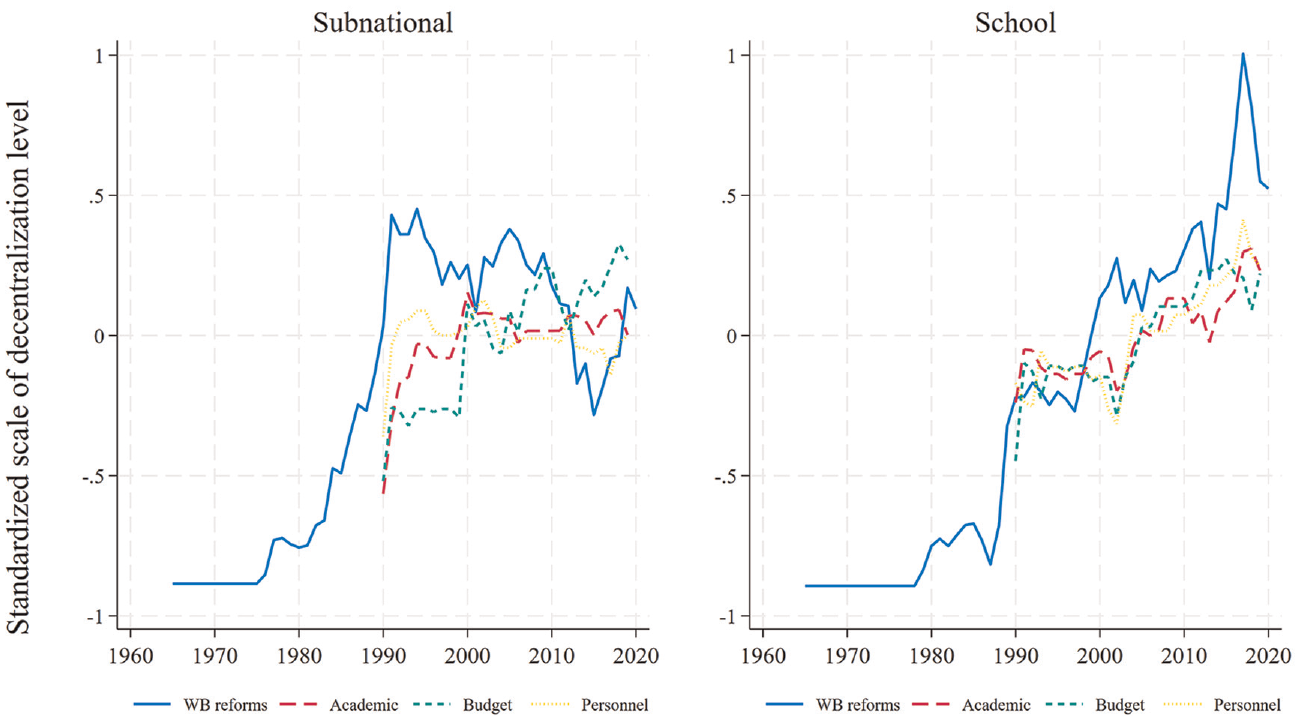
Descriptive trends in WB reforms and de jure decentralization by disaggregated indices at the subnational and school levels.
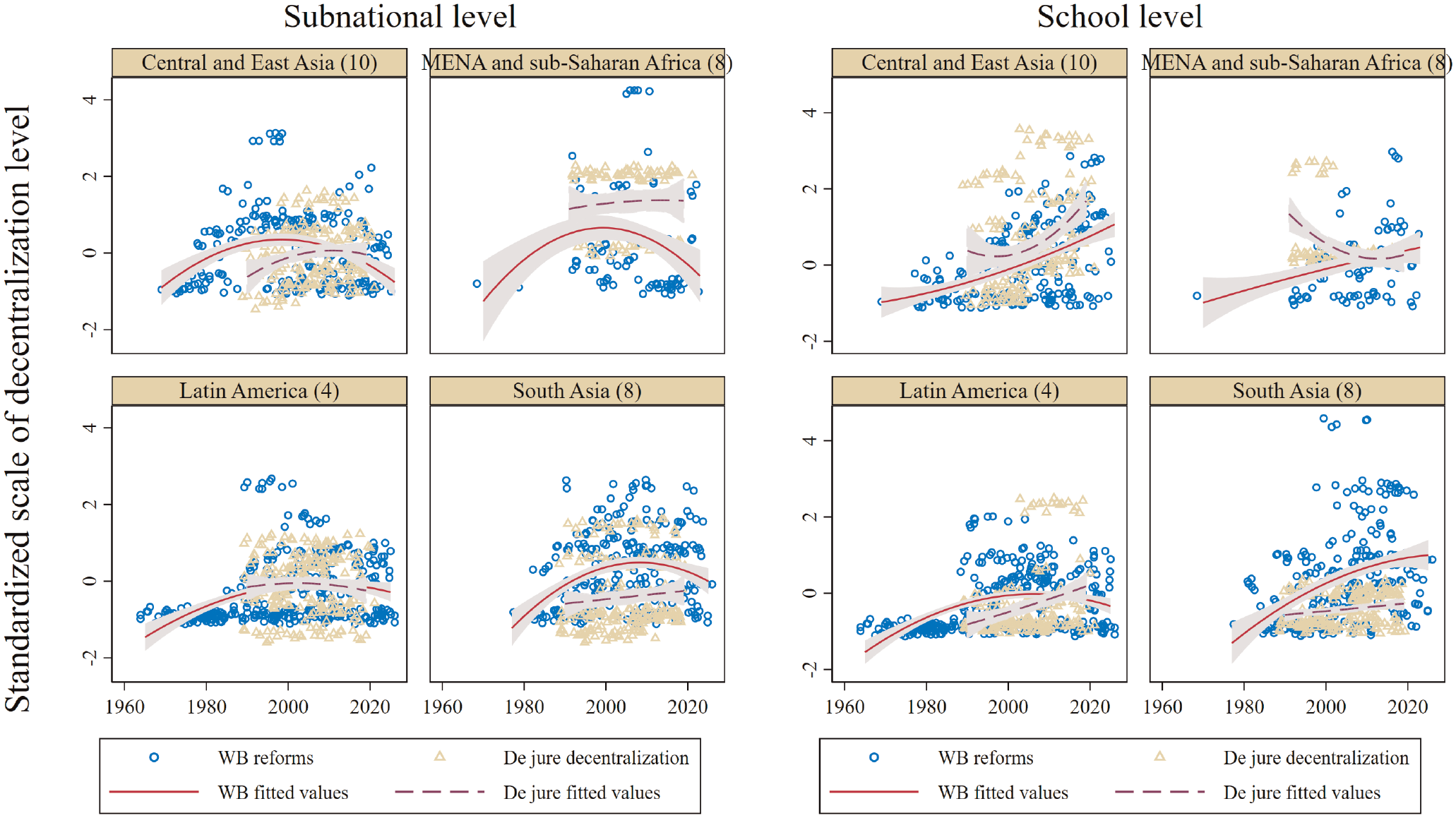
WB reforms and the de jure state of decentralization in education over time, by region.
As further illustrated in Figures S8 and S9 in the online version of the journal, most of the nine components of de jure decentralization have experienced some changes in growth, with some of them showing a noticeable rise, especially at the school level. Budget allocation has experienced the largest growth at both levels. Subnational entities and schools have also been assigned more responsibilities, such as school supervision, acting as the funding source, preparing curriculum, and recruiting teachers. Furthermore, most other responsibilities at the school level in all areas have increasingly experienced de jure decentralization. However, the responsibility for exit exams has predominantly remained with the central government, which is a common practice in LMICs (Furuta, 2020). While there is a slight decrease in subnational entities’ involvement in teachers’ in-service training, these entities still predominantly manage the training in 60% to 80% of the sample countries. These descriptive findings suggest that LMICs have undergone decentralization in their educational systems, as expected in the theoretical framework discussed at the beginning of the paper. The next part of the paper explores whether these changes are associated with WB reforms. It is worth noting that 28 countries have experienced a change in de jure decentralization at the school level for at least one of the nine components, while this is the case for 23 countries at the subnational level. To further ensure robustness, regression analyses are conducted, excluding countries that have not experienced any change.
Unfortunately, the trend in de jure decentralization before 1990 cannot be observed due to a lack of data. This prevents an examination of the extent to which countries changed their educational systems before 1990 compared to WB reforms. However, the efforts of the WB in implementing these reforms at the subnational level have not been absent. The trend remained static after 1990, which could be partly attributed to some countries reaching a maximum point in receiving reforms from the WB. As I have the WB data from pre-1990, I can test the association between its long-term reforms and changes in de jure decentralization with different lag components, as explained in the Methods section.
The Association Between De Jure Decentralization and WB Reforms
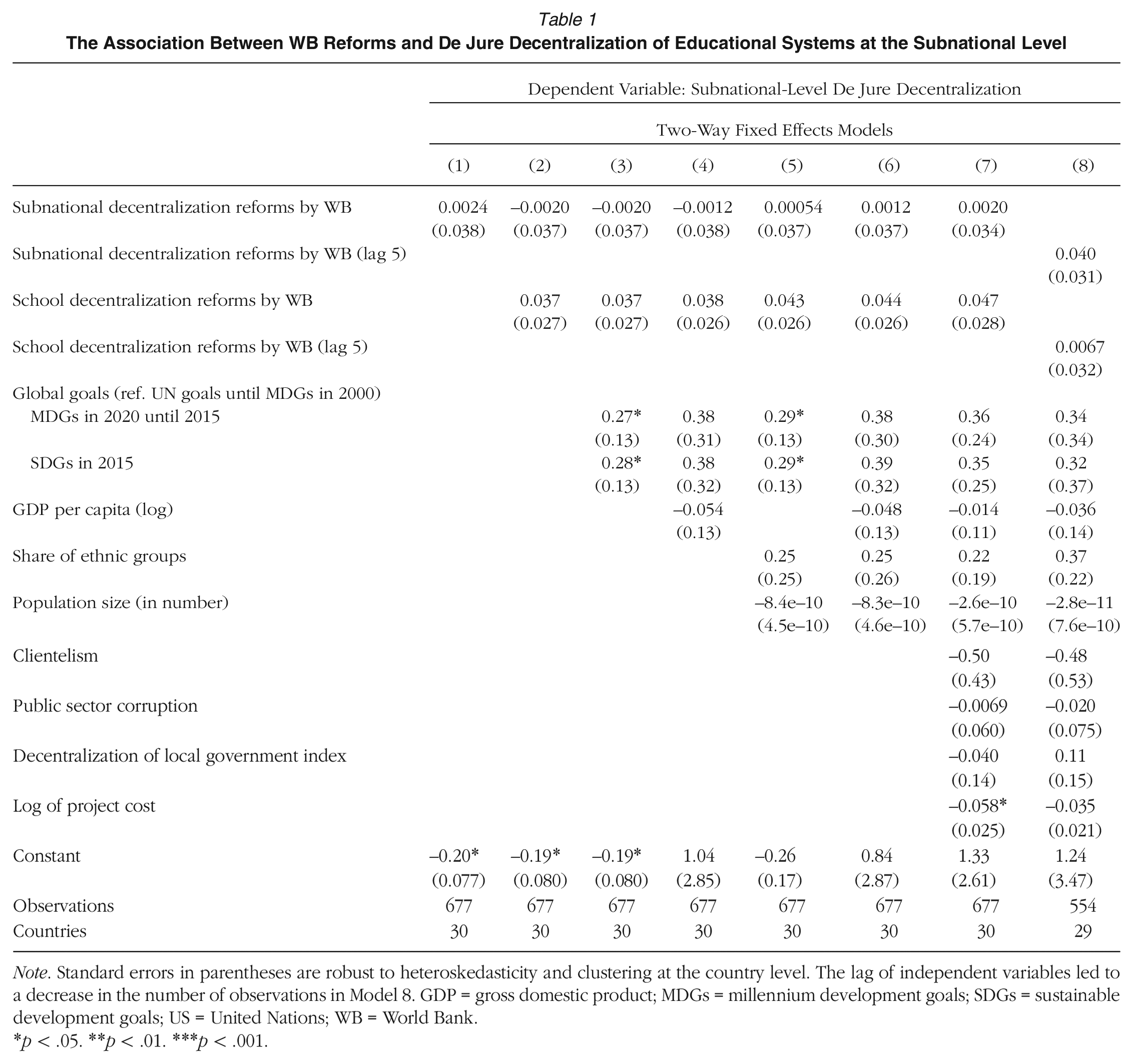
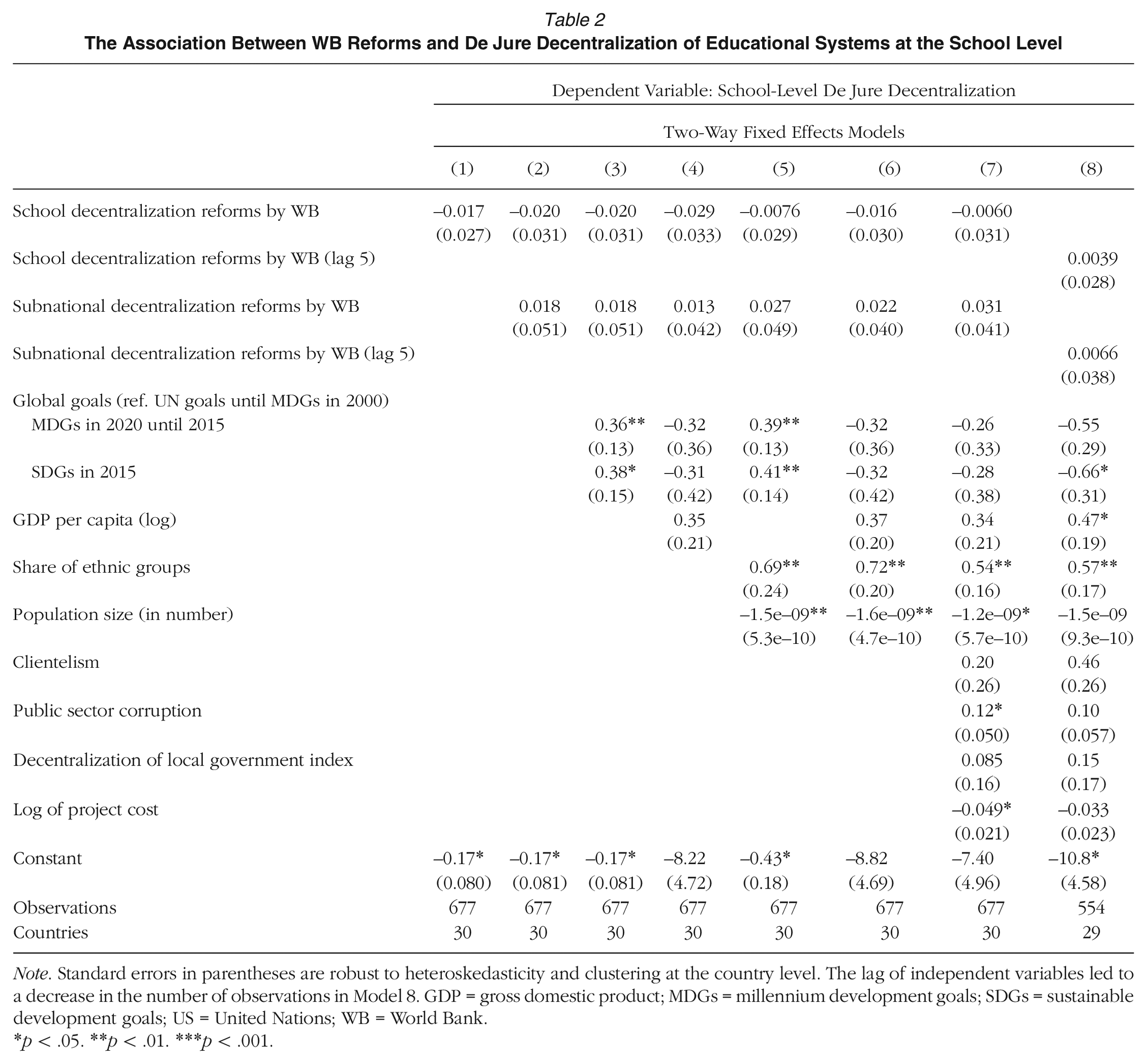
Results from the regression models in Tables 1 and 2 demonstrate no significant association between WB decentralization reforms and changes in the de jure decentralization of educational systems. This holds the same for the subnational (Table 1) and school levels (Table 2). To elaborate, I employ Equation 1 to estimate Models 1 through 7 in Tables 1 and 2 using two-way country and year fixed effects. Model 8 in both tables is estimated using Equation 2 by lagging the independent variables in addition to two-way fixed effects. As illustrated in Model 1 in Table 1, the association between changes in WB’s decentralization reforms at the subnational level and changes in de jure decentralization at the corresponding level is not significant. In addition to lacking statistical significance, the coefficient is also notably small. Specifically, with an increase of one standard deviation in WB reforms, the change to de jure decentralization amounts to just .0024 standard deviations (p > .05).
The Association Between WB Reforms and De Jure Decentralization of Educational Systems at the Subnational Level
Note. Standard errors in parentheses are robust to heteroskedasticity and clustering at the country level. The lag of independent variables led to a decrease in the number of observations in Model 8. GDP = gross domestic product; MDGs = millennium development goals; SDGs = sustainable development goals; US = United Nations; WB = World Bank.
p < .05. **p < .01. ***p < .001.
The Association Between WB Reforms and De Jure Decentralization of Educational Systems at the School Level
Note. Standard errors in parentheses are robust to heteroskedasticity and clustering at the country level. The lag of independent variables led to a decrease in the number of observations in Model 8. GDP = gross domestic product; MDGs = millennium development goals; SDGs = sustainable development goals; US = United Nations; WB = World Bank.
p < .05. **p < .01. ***p < .001.
The results remain quite similar when I add controls to the models in Table 1. These specifically include WB reforms at the school level in Model 2, global goals by the UN in Model 3, the log of GDP per capita in Model 4, and the remaining controls in the subsequent models. I also find similar results in Model 8 in Table 1, where I lag the independent variables. This further means that even when I consider that WB projects would take substantial time to influence educational systems, it does not seem to be the case in the analyses. Nonetheless, I observe that the adoption of the UN global goals, such as the MDGs in 2000 and the SDGs in 2015, is significantly associated with increases in de jure decentralization at the subnational level in Model 3 when I do not control for any country characteristics. Once the UN sets some global goals, countries tend to adopt more reforms to enhance educational outcomes aligning with those goals. For instance, education goals in the MDGs and the SDGs emphasize increasing enrollment rates in education and ensuring equity and equality by closing the gaps in attainment and achievement between children from different socioeconomic groups, gender, and ethnic backgrounds (Jolly, 2004; United Nations, 2016). Advocates for implementing decentralization reforms suggest that such reforms can contribute to higher enrollment, attainment, and achievement rates while addressing some equity and inequality-related issues (Barrera-Osorio et al., 2009).
Nonetheless, the statistical significance for global goals disappears when I control for GDP per capita, as shown in Model 4 in Table 1. The significance reappears when I remove GDP per capita from Model 5 but again disappears in Model 6 when I add the variable along with other country characteristics. This probably indicates that GDP per capita captures some effects of how global goals influence the changes in the decentralization of educational systems at the subnational level. These results correspond to my theoretical assumption that de jure decentralization may not be associated with WB reforms, given the mismatch between the logics of the two actors. Even when I add clientelism and corruption in Model 7 in Table 1, proxying for institutional weaknesses, the nonsignificant relationship remains stable.
I find similar results in the case of changing de jure decentralization at the school level in Table 2. As Models 1 through 7 in the table suggest, an increase in WB’s decentralization reforms at the school level is not significantly associated with changes in de jure decentralization at the same level. Findings remain null in Model 8 in Table 2 when the lag of independent variables is added. Besides, even when I control for the variables referring to institutional weaknesses (clientelism and corruption), the results remain akin.
Unlike the results regarding subnational-level decentralization, I find a strong association between the share of ethnic groups and an increase in de jure decentralization at the school level after adding controls to Models 5 through 8. This may indicate that in a more diverse society, educational systems need to be more decentralized, as past literature suggests (Clune, 1993; Scheerens, 2013; Waks, 2006). These results may mean that schools aim to be more accommodating to the needs of diverse populations by decentralizing educational responsibilities and policies to the school level.
In Table 2, similar to Table 1, global goals by the UN seem to be significantly associated with increasing the process of de jure decentralization at the school level in Models 3 and 5 when I do not add GDP per capita. Once this variable is controlled for in Model 4, the coefficients for the global goals variable do not appear significant. These scenarios suggest that global goals may influence changes in countries’ educational systems.
Table 3 displays the regression results using Equation 1, but this table examines the three disaggregated indices as the outcome variables at the subnational and school levels. This approach is taken because some may argue that certain components, such as budget allocation and funding sources, have witnessed a particularly noticeable increase at both levels, along with some other components with variation. Hence, it is possible that the association between these indices and WB reforms may differ. However, as the results in Table 3 indicate, the association between WB reforms and de jure decentralization is not statistically significant for any of the disaggregated indices at both levels.
The Association Between WB Reforms and De Jure Decentralization in Educational Systems by Separate Indices
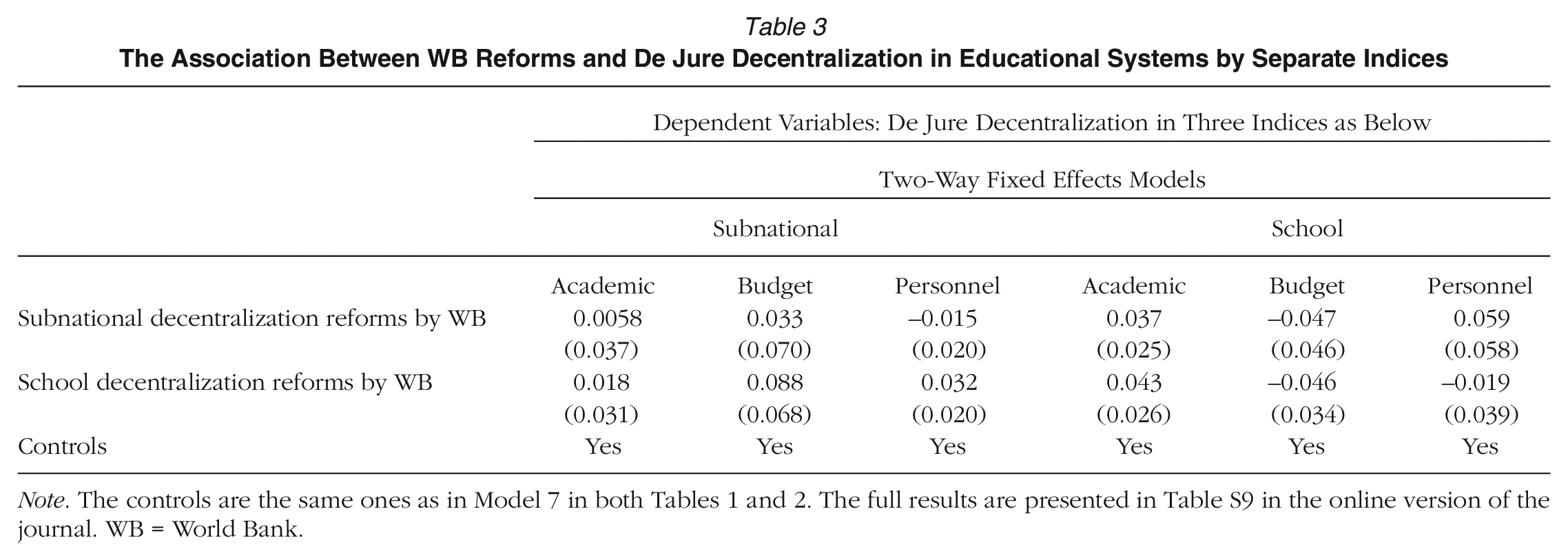
Based on the study’s theoretical framework, as elaborated in the Conclusion section, I argue that the absence of a significant association between WB reforms and the de jure decentralization of educational systems could stem from a misalignment between the logics of the WB and nation-states. Meanwhile, the observed rise in de jure decentralization across LMICs may suggest that policies diffuse through channels beyond the influence of a single IO, which may encompass social construction based on global education goals, as some results also suggest.
Robustness Checks
I run three robustness checks to see if the findings are sensitive to other specifications. First, one possible argument is that de jure decentralization at the outset or in 1990 could influence how far WB reforms bring about changes. Specifically, countries with a lower level of de jure decentralization might experience more substantial changes in their educational systems due to WB reforms. To tackle this concern, I conduct separate regression analyses on countries with higher and lower levels of de jure decentralization in 1990. The reason for conducting separate regressions is that the initial de jure decentralization variable is time-invariant, created based on the decentralization measures in 1990. As a result, running pooled regression on all countries simultaneously would not allow the inclusion of two-way fixed effects to examine the effect of this time-invariant variable. As presented in Table S10 in the online version of the journal, even when I run models separately on both sets of countries, the results remain very similar to the ones presented in Tables 1 and 2.
Second, regarding the concern of the lag of WB reforms, I extend the analysis by running regression models using lags of 6, 8, and 10 years to examine the long-term relationship between WB reforms and de jure decentralization. The results in Table S11 in the online version of the journal remain consistent with the findings in Model 8 in Tables 1 and 2.
Third, I examine the possibility of nonlinearity in the relationship between WB projects and de jure decentralization. As demonstrated in Table S12 in the online version of the journal, the coefficients for the main and squared terms of the WB-reform variables are not significant. Finally, as stated earlier in this section, the de jure decentralization of educational systems has not changed in a few countries over the observed 30-year period. I run additional models excluding those countries to examine whether those specific cases influence the results. As shown in Table S13 in the online version of the journal, findings remain almost identical, supporting the main results.
Conclusion
In this study, I provide evidence about whether WB reforms to decentralize the educational systems in LMICs are associated with changes in the de jure state of decentralization at the subnational and school levels. Using two original and unique datasets, I do not find any significant association between these two factors. The results remain similar for different domains of de jure decentralization—academic, budget, and personnel management—as the outcome variables.
An overwhelming body of literature in the field of international development and comparative education suggests how decentralization reforms by IOs, especially the WB, might have changed the education sector in LMICs (Bandur, 2012; Kristiansen, 2006; Manor, 1999; Naidoo, 2005; Shoraku, 2009; Wong & Guggenheim, 2005). Findings in this study do not suggest so, as there is no significant association between WB reforms and de jure changes.
The diffusion of decentralization and other institutional reforms by IOs has been considered a coercive mechanism through which wealthier nations influence the institutions of LMICs (Owen, 2002). This happens by providing aid conditional on implementing the reforms proposed by IOs since these reforms are considered best practices (Kentikelenis & Babb, 2019; Kentikelenis et al., 2016). However, despite this vigorous diffusion, there is limited evidence that these reforms have brought fruitful changes, which has been fiercely criticized for increasing the debt burden of LMICs (Easterly, 2001). Criticizing this trend, Stiglitz (2002) argues that “reforms that are imposed on a country through conditionality may very well fail to produce lasting change” (p.163). While it is beyond the scope of the current study to determine whether the rise in de jure decentralization of educational systems results from the WB’s coercive approach, one thing we cannot rule out is that coercive diffusion is still at play, as explained using the previous literature.
Instead of evaluating the “impact” of WB reforms, I focus on a more immediate question about whether these reforms are associated with educational systems being more decentralized, which the WB aimed to change. I ascribe the lack of association between WB reforms and changes in the de jure decentralization of educational systems to a conflict in the logics of the WB and LMICs, as proposed in the theoretical framework of this article. The imposition of a set of homogeneous, supposedly “what works” tools on nation-states with very different sociocultural and political orientations may not translate into actual changes (Ho & Im, 2015; Stiglitz, 2002). As Ho and Im (2015) argue, IOs often fail to consider heterogeneity in the sociocultural and political traits of LMICs as the reforms they bring are taken from countries with liberal democratic institutions. The heterogeneity may stem from political leadership and different actors involved at the school, subnational, and central levels.
Although it cannot be empirically tested, I further contend that the rise in de jure decentralization across LMICs could be partly explained by constructivism. As explained in the theoretical framework, IOs have promoted these reforms globally, including nonfunders such as UNESCO, theoretically illustrating how decentralization can improve educational outcomes (Naidoo, 2005). These factors may have encouraged nation-states to adopt decentralization reforms by customizing them to their institutional history, culture, and the demands of the education stakeholders. In other words, the heterogeneous logics of nation-states may receive priority when implementing a globally agreed reform.
Findings partly suggest that adopting UN goals, such as the MDGs and the SDGs, is associated with more de jure decentralization reforms. Moreover, regarding socioeconomic demands and needs, countries with more ethnic groups tend to experience more de jure decentralization at the school level, although the same is not observed at the subnational level. This may indicate that educational responsibilities may need to be more decentralized to fit the needs of populations with different ethnic backgrounds.
The usual caveats apply to this study. I emphasize that the results are specific to the decentralization of educational systems in LMICs, and their applicability to other reforms in LMICs by the WB or other IOs may differ. To further test the generalizability of the findings, future research could explore this question in the context of reforms in other sectors, such as childcare, health, and social safety nets. Furthermore, the focus in this study is on the WB, given its significant role in education aid (Heyneman, 2003) and unmatched emphasis on decentralization (World Bank, 2008) compared with other IOs. It is also essential to recognize the potential implementation of similar reforms by other IOs, warranting investigation in future research. Besides, this study could not explore the contribution of heterogeneous sociocultural and political norms that might contribute to the nonalignment of WB reforms within the context of nation-states. Additionally, the study did not explore the potential unintended consequences of WB reforms (Easterly, 2001). Due to weaknesses in existing institutions in many LMICs, such as resource constraints, and corruption in the forms of patron-client relations and the presence of informal governance (Hossain, 2018), IOs’ projects do not often lead to targeted changes. Results from many countries in sub-Saharan Africa, East Asia, and Latin America suggest how existing institutional challenges impede WB projects to shape educational systems (Essuman & Akyeampong, 2011; Kristiansen, 2006; Meade & Gershberg, 2008).
Finally, this article provides an overview of how decentralization reforms spread across LMICs and the role played by the WB as a powerful IO. However, this cross-national approach to studying educational reforms might not provide deeper insight into the mechanisms underlying the relationship between IOs and nation-states. Case studies of a single or small number of educational systems could be instrumental in revealing the historical dynamics of an IO’s presence in a country and how changes in the sociocultural and political landscape influence the diffusion of reforms. Similarly, investigating how changes in a prominent IO’s policies impact a country’s implementation of education reforms could be insightful. For instance, the WB might alter its direction of implementing a specific project due to shifts in a country’s political leadership. Such studies may require evidence from multiple sources, including interviews with relevant stakeholders and archival research of newspapers and project documents, while closely understanding the country’s institutional culture. Future research could employ qualitative methods to address these unresolved and significant issues, potentially studying a single project or education system over time. This approach would complement the findings from quantitative analysis in the study.
Supplemental Material
sj-pdf-1-aer-10.3102_00028312241229027 – Supplemental material for The Mismatch Between World Bank Actions and the Decentralization of Educational Systems in LMICs
Supplemental material, sj-pdf-1-aer-10.3102_00028312241229027 for The Mismatch Between World Bank Actions and the Decentralization of Educational Systems in LMICs by Mobarak Hossain in American Educational Research Journal
Footnotes
Correction (March 2024):
Article updated to correct data in the text and in Tables 1 and 2.

Notes
M
References
Supplementary Material
Please find the following supplemental material available below.
For Open Access articles published under a Creative Commons License, all supplemental material carries the same license as the article it is associated with.
For non-Open Access articles published, all supplemental material carries a non-exclusive license, and permission requests for re-use of supplemental material or any part of supplemental material shall be sent directly to the copyright owner as specified in the copyright notice associated with the article.
