




Abstract
A number of urban U.S. cities that were traditionally Black and underinvested are now becoming enclaves to whites and upper-middle-class people. Consequently, a growing body of research on schools and gentrification is emerging. While most of this research has focused on the shifts that neighborhoods and schools undergo due to gentrification, we know less about how school leaders make meaning of these impacts. This study draws on interviews with 26 principals in two gentrifying cities to examine the impacts of gentrification on schools. We find that school leaders understand gentrification's impacts on schools materially, epistemically, and affectively, and at the same time, these shifts complicate the work of school leaders. This study concludes with implications for future research.
A number of U.S. cities are experiencing neighborhood gentrification. Cities that were traditionally Black and underinvested are now becoming sites of fiscal investments and enclaves for white and upper-middle-class people (Summers, 2019). Due to these racial and economic shifts, scholars have very usefully framed gentrification according to the neoliberal policies that seek to attract white and middle-class families back to central cities through capital reinvestment in historically segregated neighborhoods (Cucchiara, 2013; Lipman, 2013; Moskowitz, 2017; Smith, 1996). While gentrification is rooted in the neoliberal logics of free market capitalism, it can also be understood as an enduring manifestation of settler colonialism 1 and anti-Blackness 2 that includes the erasure of Native Peoples, the replacement of poor and working-class Black people and other non-Black persons of color with middle- and upper-middle-class residents, who are often, but not exclusively, white (Bonds & Inwood, 2015; Green et al., 2022a; Kent-Stoll, 2020; Quizar, 2019; Summers, 2019; Tuck & Yang, 2012). The enduring anti-Black, racial, colonial, and economic dynamics that gentrification brings to communities have profound implications on the local schools, youth, and families in these communities.
As a result, a growing body of scholarship has analyzed the relationship between neighborhood schools and gentrification (e.g., Candipan, 2020; Cucchiara, 2013; Freidus, 2020a, 2020b; Green et al., 2022a, 2022b; McGhee & Haynes, 2022; Pearman, 2019; Posey-Maddox et al., 2014). This scholarship illustrates that neighborhood gentrification has mixed academic effects on students (Keels et al., 2013; Pearman, 2019), impacts the enrollment of neighborhood public schools (Pearman & Swain, 2017), impacts student demographics shifts in various ways through the implementation of language programs (Heiman, 2021; Heiman & Murakami, 2019; Valdez et al., 2016), and impacts how parent and family organizers can intervene on gentrification (Syeed, 2018). Gentrification can also deepen racial, economic, and social oppression in schools (Pearman & Swain, 2017; Posey-Maddox et al., 2014), especially through the ways that racialized discourses get attached to Black and white gendered bodies (Freidus, 2020b). Importantly, this body of research also emphasizes that school-based actors are key personnel to examine within the context of gentrification and schools. However, we know little specifically about how school leaders 3 make meaning of gentrification and its impacts on schools. This is a critical gap in the literature for several reasons.
First, understanding the perspectives of school leaders (i.e., principals) is pivotal because they have the greatest influence on school policies and organizational culture and can offer unique insight into the impacts of racial and economic demographic changes due to gentrification (Evans, 2007; Leithwood et al., 2004; Posey-Maddox et al., 2014). Second, their perspectives are also important because the institutional scripts, logic, and sensemaking that school leaders draw from about race and racial demographic changes in schools inform their actions and leadership (Cooper, 2009; Ishimaru, 2019). Third, school leaders are important liaisons that help mediate power dynamics and foster partnerships between school and community actors (Green, 2017a; Ishimaru, 2019; Khalifa, 2020). Yet, principals are understudied within the schools and gentrification literature (McGhee and Anderson, 2019; for exceptions, see Freidus, 2020a; Heiman and Murakami, 2019; McGhee & Haynes, 2022; Roda, 2020).
The purpose of this study is to examine how school leaders describe the impacts of gentrification on schools. We specifically ask: How do principals narrate the impacts of gentrification on the schools where they work and the neighborhood communities in which the schools are located? We analyze these impacts across schools in two gentrified cities: Heathville and New Town. 4 Based on interviews with 26 principals from schools in gentrified neighborhoods across both research sites, our findings suggest that neighborhood gentrification impacts schools in three disparate yet interrelated ways: materially, epistemically, and affectively. By epistemic we mean whose knowledge counts, is valued, and is considered during gentrification and anti-gentrification efforts, which is an invisible, nonmaterial, and less tangible impact of gentrification (Thurber, 2018) (we discuss this in detail later in the paper).
Findings from this study extend the existing literature and provide new insights into some of the specific and multidimensional challenges that gentrification creates for school leaders. This includes the affective or emotional impacts on Black and other people of color, which are often left unexamined in large-scale quantitative analyses about gentrification and schools. In addition, this study describes other macro- and microlevel, nonmaterial impacts of gentrification on schools. These understandings are important because they can inform the work of district and school leaders, policymakers, and researchers, particularly as gentrification continues to be a growing phenomenon across cities in the United States.
Gentrification and Education Research
In 1964, Ruth Glass, a British and urban sociologist first coined the term “gentrification” in the introduction of the book Aspects of Change. For Glass, gentrification was a process that described the “invasion by the middle class” into working-class neighborhoods that displaced people and transformed the social character of neighborhoods (p. xviii). The original framing of gentrification as a primarily class-based phenomenon persists across multiple fields such as education, urban planning, geography, political science, and sociology (e.g., Ball et al., 1995; Boyd, 2005; Bridge, 2005; Butler & Robson, 2003; Lees et al., 2013; Pattillo, 2010). Yet, over the years, scholars have continued to complicate and deepen their understandings of gentrification, how it manifests, and how it is perceived by various stakeholders.
More recently, scholars have described gentrification as an ongoing structure of colonization and invasion (Bonds & Inwood, 2015; Quizar, 2019; Kent-Stoll, 2020), racism and white supremacy (Boyd, 2005; Fallon, 2021; Smith & Stovall, 2008), racial capitalism and restructuring (Green et al., 2022a; Moskowitz, 2017; Lipman, 2013; Pattillo, 2010; Rucks-Ahidiana, 2021), and a symbiotic relationship between capital investment, disinvestment, and reinvestment (Lees et al., 2013; Smith, 1996; Stein, 2019). With an understanding of the various framings of gentrification in the literature, for this paper, we, however, define gentrification in line with Rucks-Ahidiana (2021) as “a racialized process of class change” that places value on space and the people within it (p. 2). We draw on this definition because it accounts for the racialization processes of space and the people within that space while acknowledging class change.
Despite it not being central to the analysis that we take up in this paper, another strand of more critical gentrification scholarship centers on the ongoing manifestations of settler colonialism and challenges gentrification researchers to seriously grapple with the “land theft or genocide that undergirds the space of all US cities” (Quizar, 2019, p. 113; see also Tuck & Yang, 2012). By settler colonialism we mean a type of colonization that as Tuck and Yang (2012) assert, “settlers come with the intention of making a new home on the land, a homemaking that insists on settler sovereignty over all things in their new domain” (p. 5).
However, settler colonialism is not limited to the United States; therefore, gentrification plays out in multiple contexts, 5 and its actors are widespread. That is, a range of racial actors—both individuals and institutions—are implicated in gentrification beyond white people (Green et al., 2022b). While often working from a different set of assumptions, motivations, and histories, 6 scholars have contended that people of color, specifically Blacks, Latina/o/x, Pacific Islanders, and Asians, can also perpetuate gentrification (Boyd, 2005; Moore, 2009; Pattillo, 2010; Smith & Stovall, 2008), which further complicates traditional narratives of gentrification at the intersections of race and class.
Neighborhood Gentrification's Impacts on Schools
Due to the various impacts of neighborhood gentrification on local institutions like schools, there is growing research on schools and gentrification globally. In the United States, this research more recently dates back (at least) to scholarship that identified noticeable student racial demographic shifts during the late 1990s and early to mid-2000s into central cities and suburbs (Cooper, 2009; Evans, 2007). Yet, as we have noted elsewhere (Green et al., 2022a), research that documented population changes in schools developed refreshed prominence as scholars like Posey-Maddox et al. (2014), Lipman (2013), and Cucchiara (2013) 7 wrote books that connected gentrification to observable patterns of student racial and socioeconomic demographic shifts. Specifically, these scholars link gentrification to white families who previously left inner cities for the suburbs and then returned to central cities and schools located in majority Black, Native, Latino/a/x, and Asian American neighborhoods.
Schools located in gentrifying or gentrified neighborhoods can be impacted in a myriad of ways. Based on metrics used in prior research to track neighborhood gentrification (e.g., Bates, 2013; Freeman, 2005, 2016; Maciag, 2015), Green and colleagues’ (2022a) research indicates that schools located in gentrifying neighborhoods can be categorized based on how they are affected in terms of students’ racial and class demographics. Categories include Non-Gentrifying Schools, Early Gentrifying Schools, Destabilizing Gentrifying Schools, Emerging Gentrifying Schools, Tipping Point Gentrifying Schools, and School Gentrification, each of which has implications for how school leaders understand the impacts of gentrification. 8
Schools can also be directly impacted by gentrification when gentrified families move into a catchment area but do not have school-aged children (Keels et al., 2013). Additionally, the impacts of neighborhood gentrification on schools are influenced by the racial and class identities of families who gentrify neighborhoods (i.e., gentry families) and the choices they make about where their children attend school (Butler et al., 2013). In addition, according to Snyder and colleagues (2019), almost 30% of families across the United States enroll their children in schools that are not in their local catchment area. When families choose not to enroll their children in the neighborhood school it can contribute to racial and income mismatch between neighborhoods and schools, especially in gentrifying neighborhoods (Candipan, 2020).
In fact, gentrifying neighborhoods have the largest mismatch between neighborhood and school demographics (Bischoff & Tach, 2018; Candipan, 2019, 2020; Pearman & Swain, 2017). These dynamics are even further exacerbated when school choice options (e.g., charter schools, magnet programs, private schools, etc.) are available. Pearman and Swain's (2017) research indicates that white college-educated families are “far more likely to gentrify communities of color when school choice options expand” (p. 213), increasing the chances of gentrification by up to 22% percent in the most racially segregated contexts. Bypassing local traditional public-school options for private or charter schools creates a type of spatial inequality or what Ball and colleagues (1995) refer to as a “circuit of schooling” that exacerbates exclusion (Green et al., 2022a).
Moreover, some research suggests that gentrification may offer some nuanced benefits to schools and children. Additional resources typically come along with gentry families that can influence the social ecology of students’ lives (Pearman, 2019). In turn, this may help to improve overall neighborhood conditions such as reductions in crime and violence 9 (if a neighborhood is experiencing this), which have been linked to improved academic outcomes (Pearman, 2019). Gentrification can also bring material benefits to schools (Pearman, 2019). Although schools may sometimes accrue additional resources from middle-class families such as financial resources, infrastructure updates, and material resources (Posey-Maddox et al., 2014), these resources are often not equitably distributed by race and class and are hoarded by white and middle-class families (Cucchiara, 2013; Pattillo et al., 2014).
Moreover, some empirical evidence documents how lower-income and Black youth experience marginalization and exclusion when gentry families enroll their children in the schools, despite these schools’ newfound resources (Cucchiara, 2013). Yet, some research suggests that the majority of schools in gentrifying districts do not experience increased resources (Green et al., 2022a). In fact, some schools—especially those that are majority Black—experience closure because of the myriad of impacts that gentrification can have on student enrollment, school perception, and other factors (Ewing & Green, 2022; Pearman & Marie Greene, 2022).
School Leaders’ Sensemaking and Gentrification
A small body of scholarship on schools and gentrification has focused on principals (e.g., McGhee & Haynes, 2022). McGhee and Anderson (2019) outline three key reasons why empirical attention should be given to their role. First, for schools located in gentrifying neighborhoods, principals are the main liaisons and negotiators between the school and gentry families (Cucchiara, 2013; Freidus, 2020a; Heiman and Murakami, 2019; Roda, 2020; Siegel-Hawley et al., 2017; Stillman, 2012). Second, principals are critical boundary-spanning actors that mediate school and community partnerships, relationships, and collaborations (Green, 2017a; Cucchiara, 2013; Ishimaru et al., 2019; Khalifa, 2012). Third, principals are the primary school-based actors that deal with the larger intersectional district dynamics of race, class, gender, power, and privilege as gentrified families contend for schools.
Taken together, principals are key to the sensemaking about gentrification that happens at their school and do so by drawing from various social, individual, and institutional contexts to make interpretations about gentrification (Evans, 2007). By sensemaking, we mean “the process through which people work to understand issues or events that are novel, ambiguous, confusing, or in some other way violate expectations” (Maitlis & Christianson, 2014, p. 57). However, sensemaking is not neutral but is shaped by race, racism, and racialization (Evans, 2007).
As an actor who influences sensemaking about gentrification within schools, principals can face certain contextual pressures and respond to them differently (Jabbar, 2016; McGhee & Anderson, 2019; McGhee & Haynes, 2022; Roda, 2020; Turner, 2018). One of these pressures stems from working within a larger racialized neoliberal system where district and city leaders urge principals to gentrify their schools by attracting middle-class families to them (Cucchiara, 2013; see also Heiman & Murakami, 2019). To respond to the pressures of gentrification, research suggests that some principals might yield to the demands of gentrifier families and deter Black and Latinx/a/o families from enrolling in schools (The Center for Immigrant Families, 2004). On the other hand, some principals deliberately partner with Black and Brown families, implement anti-racist curricula, and aim to center on Black and Brown communities (McGhee & Haynes, 2022).
Cucchiara’s (2013) work also highlights how efforts to revitalize a Philadelphia neighborhood subsequently changed how principals made sense of their roles in gentrifying contexts. Principals shifted from school leaders and community liaisons by adopting roles as “entrepreneurial leaders” responsible for “selling” the school to new residents. Through this repositioning, school leaders emphasized material and visible upgrades such as technology labs, language programs, new or improved playgrounds, or afterschool programming to appeal to gentry parents (e.g., Heiman & Murakami, 2019). Although these material upgrades can potentially improve school climate and schools’ instructional capacity, gentrification engenders new demands on principals’ workloads whereby their multiple roles as school leaders, cultural workers, and community liaisons can complicate how they understand the impacts of gentrification on schools.
Still, other studies suggest that in some cases school leaders, especially Black principals and other principals of color, are less willing to accommodate gentry families (McGhee & Anderson, 2019; Siegel-Hawley et al., 2017). Roda’s (2020) study of school principals in New York's gentrifying context demonstrates the sensemaking processes associated with boundary spanning. Principals engaged in cultural work by “holding the line” to offset white parents’ opportunity-hoarding attempts to protect their schools’ diversity and foster integration. Furthermore, as schools experience gentrification, they have to constantly renegotiate their identity, which is not static but is an ongoing, discursive process that is complicated by the social, historical, and political implications tied to issues of race (Evans, 2007).
In sum, the limited research on school leaders and gentrification often analyzes the pressures, tensions, and actions of principals in gentrifying contexts. Understanding the complexities and how school leaders navigate gentrifying contexts is important, particularly when demographic change is perceived as a shock that disrupts organizational and leadership functioning. The instability and flux that results from demographic change can engender threats to schools’ cultural and organizational identity and can drive principals to search for appropriate courses of action that may be misaligned with the needs and desires of existing and new students and families (Evans, 2007; Maitlis & Christianson, 2014). Given this, it necessitates that before we can understand how principals are navigating and responding to gentrification, we first need a clear and more nuanced understanding of what they are actually navigating (McGhee & Anderson, 2019). Our study thus builds on the existing literature on schools and gentrification and aims to extend it by heeding the call to better understand what gentrification's impacts are on schools from principals’ perspectives.
Theoretical Framework
To frame this study, we draw on Thurber's (2018) conceptual framework that describes the multidimensional impacts of gentrification, specifically on neighborhoods. We use this framework because it accounts for the material and nonmaterial ways—which are often dismissed—that gentrification can impact neighborhoods and the institutions (e.g., schools) and people within them. Thurber (2018) argues: neighborhoods cannot be reduced to “the built environment:” they are imbued with meaning, history, affect and agency. The material dimension of a neighborhood is always already more than material: being physically displaced has epistemic and affective consequences, just as a lost sense of place is intimately connected to the materiality of the land and one's knowledge of it. (p. 37)
According to Thurber (2018), gentrification impacts neighborhoods materially, epistemically, and affectively, which we describe in the following sections.
Material Impact
As neighborhoods gentrify, the influx of higher-income households and businesses seeking to reinvest in underinvested neighborhoods produce material impacts that change its economic landscape. According to Thurber (2018), material impacts relate to the visible disruption of residential and commercial life due to exclusion from or the inability to access affordable housing. As a result of this changing environment, low-income residents and residents of color may experience displacement and housing instability. Within this context, residential displacement negatively affects children's places in community-based institutions such as schools. Residential displacement also shapes how children form and cultivate bonds between individuals and places and the emotional value tied to their sense of belonging (Thurber, 2018). This loss of place attachment due to gentrification can manifest as school closures, which are known to have varied effects on student achievement (Ewing & Green, 2022; Green, 2017b; Pearman & Marie Greene, 2022). Given the ramifications of place dis-attachment, Thurber (2018) thus contends that displacement is “the most obvious form of material injustice” (p. 30) given the compounding generational effects it has on educational opportunity, employment, household income, and wealth inequalities.
Moreover, while residential displacement is often at the center of analysis in gentrification research, there too is a large body of research focusing on the material changes that occur as a result of gentrification. Material changes, or “neighborhood upgrades,” have often been framed as positive, but in reality the implications are more complex. Contestations often arise between new and existing residents over who can or should have access to new resources and related material improvements (Keels et al., 2013; Posey-Maddox et al., 2014). Complicating things further, it is often assumed that these material upgrades will improve living conditions and quality of life indicators for those in gentrifying contexts, but evidence remains mixed on the relationship between gentrification and changes in aggregate life outcomes. To this end, attention to the built environment within gentrification research can mask the hidden effects of displacement. For this reason, Thurber (2018) positions epistemic and affective impacts to address these concerns.
Epistemic Impact
Epistemic effects account for the invisible, nonmaterial, and less tangible ways that gentrification reshapes neighborhoods. Thurber (2018) defines the epistemic impact of gentrifying neighborhoods as that which “is shaped by inequalities of who is known and knowable, whose knowledge counts and is considered in shaping the neighborhood, and what histories are remembered” (p. 31). Thus, epistemic concerns underscore differing perspectives and meanings of space and signal competing values, priorities, and/or knowledge. In relation to schools, epistemic concerns call attention to school identity and school culture. Indeed, epistemic harm parallels a process of social and cultural displacement or “the replacement of one group by another, in some relatively bounded geographic area, in terms of prestige and power” (Chernoff, 1980, p. 204). The concept of political displacement (Brown-Saracino, 2019) is also relevant as existing residents’ loss of position or voice on school committees; exclusion from school activities; and an overall sense of estrangement, rejection, or up-rootedness results from new residents’ gain of control over school identity (Cucchiara, 2013; Fullilove, 2016).
Since gentrification can be an ongoing and incremental process, these epistemic changes may be difficult to detect. Indeed, studies show that epistemic impacts in neighborhoods are often subtle and marked by a slow reconfiguration of institutional identity and culture (Summers, 2019). Within the epistemic domain, Thurber (2018) also draws on the notion of spatial imaginary (Lipsitz, 2011), which emphasizes “the meanings, histories, hopes and values ascribed to place” (Thurber, 2018, p. 33) to argue that place and institutions are viewed, understood, and experienced differently by different people. Schools are significant figures within this imaginary, given the ways schools have historically operated as sites for collective action and local control, cultivators of cultural and intellectual life, as well as a refuge from and, at times, instigators of violence and oppression (Khalifa, 2012; Walker, 1996). For some Black and other residents of color, then, neighborhood schools are critical places of survival (Thurber, 2018). Taken together, epistemic shifts highlight how residents come to know their schools and neighborhoods and the knowledge and values embedded within them. When these are contested, it is likely that “epistemic friction” emerges (Medina, 2013) as collective forms of displacement (i.e., social, cultural, and political displacement) impact residents’ relationship with their schools and neighborhoods.
Affective Impact
Affective concerns relate to and interact with material and epistemic dimensions. Because neighborhoods are influenced by the interactions in a neighborhood, gentrification can also result in affective injustices that impact “the contexts in which people enact caring relationships with other people and with the place itself, both of which are central to individual and collective well-being” (Thurber, 2018, p. 34). By emphasizing exclusionary mechanisms as well as the physical and social displacement associated with gentrification, scholars identify various types of affective outcomes such as diminished social bonds, disruption of social ties, community resentment and conflict, sense of belonging, and loss of place (Hyra, 2014; Thurber, 2018).
Prior research has consistently identified the significance of social networks as critical sources of emotional support (Borgatti & Foster, 2003) and, in particular, schools as key sites where social ties are formed (Roda & Wells, 2013). However, when neighborhoods gentrify and residents are forced to relocate, social networks and bonds become fragmented and access to these connections is more easily frayed or lost. Although new and old residents in gentrifying contexts could form new relationships, research suggests this is often not the case. Social ties and the use of formal or informal networks seldom develop beyond racial and class lines in or outside of schools (Roda & Wells, 2013; Thurber et al., 2017) and are further hampered by underlying perceptions from gentrifiers that the source of city or school problems are communities of color (Cucchiara, 2013; Friedus, 2019; Stillman 2012). Such perceptions can lead new residents to form tight networks among themselves, for example, choosing alternative schooling options by opting out of neighborhood schools (Hankins, 2007)—further diminishing opportunities for social relations—while intensifying friction between longtime residents.
Thurber’s (2018) concept about the material, epistemic, and affective impacts is a useful lens/heuristic/analytic tool for understanding how gentrification might indeed impact schools for several reasons. First, it can help explain how schools are impacted by gentrification, both in tangible and less tangible ways. While existing research in education has identified some material, affective, and epistemic considerations of gentrification on schools more broadly (e.g., Lipman, 2013), as previously mentioned, a dearth of this scholarship centers school leaders as key actors in the school gentrification process. Second, Thurber's concept underscores compounding ways that gentrification can shape neighborhoods but also accounts for the ways that it affects neighborhood institutions like schools. Third, it illustrates how important the affective, nonmaterial, and tangible ways that gentrification can impact schools. To this end, we apply Thurber's notions of gentrification impacts with an acknowledgment of the complex ways that settler colonialism, anti-Blackness, racism, and white supremacy play in gentrification even though they are not squarely taken up in our analysis. In using Thurber's work, our goal is to account for how principals understand and frame gentrification by attending to how they describe these dynamic impacts unfolding in their school setting.
Research Design and Methods
This study is part of a larger cross-case project that examined the impacts of neighborhood gentrification on urban schools. Here, we discuss the study contexts, sampling procedures, data collection and analysis, limitations, researcher positionalities, and trustworthiness.
Research Site Descriptions
We purposively sampled Heathville and New Town based on three criteria: (1) located in a mid-sized and/or small U.S. urban city, (2) one of the most gentrified cities in the United States based on the share of eligible census tracts that have experienced gentrification since 2000 (Brummet & Reed, 2019), and (3) the school district acknowledges that gentrification is influencing the district (e.g., through board minutes, district announcements, district billboards, etc.). By “urban” and “urbanicity” we mean spatial location (such as a central city) and a population size of 250,000 people (Council of Great City Schools; Milner, 2012). 10 Brief descriptions of each site follow.
Heathville
Heathville is a mid-sized, yet rapidly growing, city in the central part of its state with a population of approximately 978,000 people. Racially, the city is 72.8% white, 33.9% Latinx, 7.8% Black, 7.6% Asian, 3.5% two or more races, 0.7% Native American, and 0.1% Pacific Islander. The city is racially and socioeconomically segregated, which dates back to a 1932 City Plan that racially segregated the city by requiring Black people to live east of the main expressway in order to receive city services. While gentrification is happening in various parts of the city, a large portion of it is occurring in East Heathville (although not exclusively), the same part of the city that was intentionally racially segregated.
There are approximately 113 schools and 74,000 students in the Heathville Public School District (HPSD), making it the fifth largest district in its state. HPSD serves majority students of color, with 55% Latino/a/x; 30% white; 6% African American students; and approximately 9% of students comprising Asian, Native, and mixed-raced identities. Between 2011–2017, the district had lost enrollment for seven straight years, which was the result of gentrification, massive investment in the city, and a growing charter school footprint, especially in Black and Latino/a/x neighborhoods. Approximately 16% of school-aged children in Heathville are enrolled in charter schools and about 15% attend private schools (Green et al., 2022a). To deal with the declining enrollment and other impacts that gentrification has brought to the city, the district's board voted to close four schools in 2017 and passed a 1 billion dollar bond to upgrade and modernize existing schools. Gentrification has seemingly had the largest impact on Black families and youth as the district lost nearly 60% of its Black student population in the last 30 years.
New Town
New Town is a northwestern mid-sized city with a population of 654,000 people 11 . The city's racial demographics are 77% white, 9.7% Latino/a/x, 8.2% Asian, 5.8% Black/African American, and 5.3% two or more races (U.S. Census Bureau, 2019). In many instances, New Town is considered one of the most gentrified cities in the United States, as over half of its census tracts have been gentrified (Brummet & Reed, 2019; Maciag, 2015). The racial history of New Town shapes the current racialized gentrification in the city. For example, Newport was a city built outside of New Town proper to segregate Black people after World War II. However, Newport flooded out in the late 1940s, thereby displacing many Black residents and segregating them into certain parts of New Town.
The New Town Public Schools (NTPS) is the central district, although there are several other districts within the city's limits. In 2019–2020, PPS served slightly over 46,000 students across 81 schools. Racial demographics of the district include: 56.5% white, 16.5% Latino/a/x, 8.7% Black, 6.5% Asian, 6.2% multiracial and other ancestries, 4.3% multiracial Asian/white, 0.7% Pacific Islander, and 0.6% Native American/Alaskan Native.
Sampling Procedures and Design
Within the two cities, we examined school districts that were experiencing gentrification to account for similarities and differential effects across research sites. Our goal was not to generalize our findings but rather to richly understand how patterns of neighborhood gentrification impact schools in both cities. To identify gentrified neighborhoods in each school district, we created Geographic Information Systems (GIS) maps to identify neighborhoods that had gentrified between 2000 and 2017. The year 2000 marked an inflection point in which neighborhood gentrification expanded in scope and size (Hwang & Lin, 2016; Pearman, 2019). Therefore, we located neighborhoods in both cities that were eligible for gentrification in 2000 and that were gentrified by 2016 (Green et al., 2022a), allowing us to account for gentrification overtime. We used several metrics to identify gentrified neighborhoods.
The degree to which the neighborhoods were gentrified included the following metrics. 12 First, we used census tracts because they have been used in previous studies as a proxy to categorize “gentrified neighborhoods” (e.g., Bates, 2013; Choi et al., 2018; Freeman, 2005; see Green et al., 2022a, for more details). To be included in our sample, census tracts had to have at least 500 people between 2000 and 2016. We then examined indicators that prior research identified as constituting “gentrified neighborhoods,” including (a) median household income, (b) net changes in population, (c) racial demographics shifts, (d) median household values, (e) percentage of individuals with a bachelor's degree, and (f) population to identify gentrification-eligible tracts (i.e., those that fall in the bottom 40th percentile compared to the metropolitan statistical area) (Bates, 2013; Maciag, 2015; see Green et al., 2022a, for details).
If an eligible census tract had changed in all of the aforementioned categories to the top 1/3 percentile of the Metropolitan Statistical Area (MSA) between 2010 and 2016, we considered them gentrified (Green et al., 2022a; see also Maciag, 2015). Within each gentrified neighborhood that emerged from this analysis, we identified each district's public. Based on our analysis, there were 27 schools in Heathville and 28 in New Town located in gentrified neighborhoods, for a total of 55 schools. Within these districts, we contacted the principals of schools that were located in gentrified neighborhoods. Twenty-six principals agreed to participate in our study across both sites.
To this end, we used cross-case study design for several reasons. First, cross-case design is useful when examining “how” questions, and this approach allowed us to center on our research question about how school leaders narrate gentrification's impacts. Second, we used this design because cross-case analysis is useful for identifying different and similar themes across cases (Creswell, 2012). This approach allowed us to richly analyze the contexts and varying impacts of gentrification across both sites.
Data Collection
Interviews
Interviews served as our primary data source for this study. To understand how principals described the impacts of gentrification on the schools where they worked, we interviewed 26 principals across both research sites. We originally identified 55 public (non-charter schools) located in gentrified census tracts and contacted the principals at all of those schools via email. However, only 26 agreed to participate in the study. There were 12 principals from Heathville and 14 from New Town. Of the 26 participants, 6 identified as Latinx, 14 as White, 5 as Black, and 1 participant did not racially identify themself. Twenty-two of the participants identified as women, while four identified as men. Most principals worked at the elementary level (83%) and the rest were at middle (8%) and high schools (4%) (see Table 1) and had between 3 and 20 years of experience as administrators.
Aggregate Participants’ Demographics
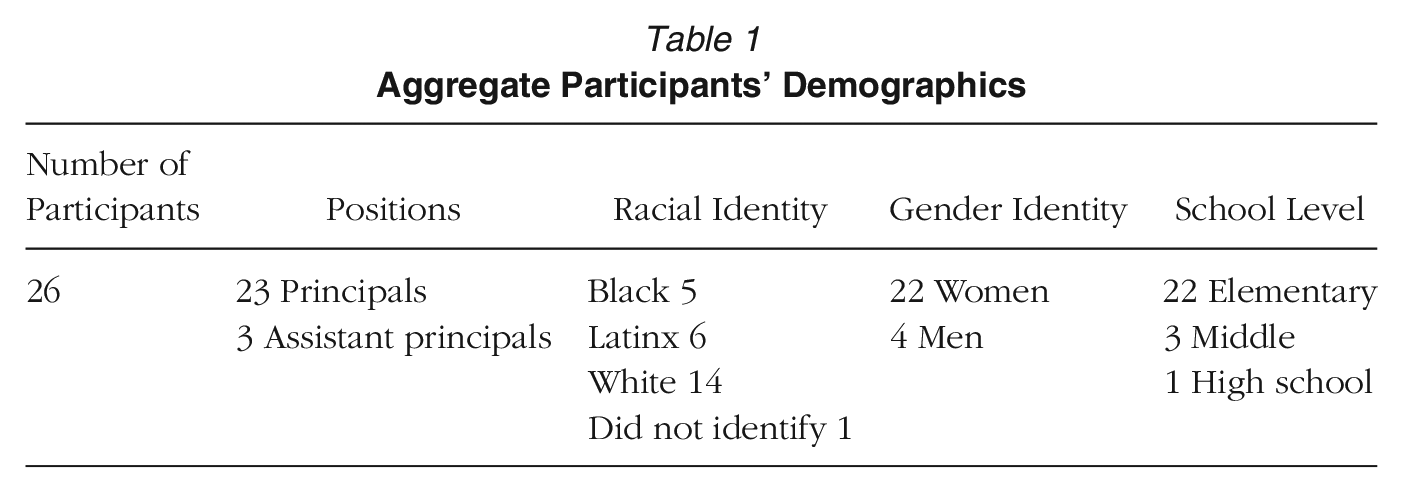
All interviews were semistructured with open-ended informal questions that lasted between 30 and 90 minutes each and were conducted in-person at each principal's school (Creswell, 2012). Interview questions reflected principals’ understanding of gentrification, how they perceived schools were impacted by neighborhood gentrification, their descriptions of how the school and neighborhood had changed over time, and who and what group of students and communities were most impacted. Importantly, our goal was not to make causal claims about gentrification's impacts but rather to richly describe principals’ perceptions of those impacts. We also drew on field notes from the first author's visit to school sites and analytic memos about each interview participant written by all members of the research team.
Administrative Data
We examined de-identified student data from both school districts on student enrollment, demographic changes, and within-district transfer trends by race, socioeconomic status, language status, and gifted and talented status. These data provided insight into some of the enrollment changes that schools experienced by race and class across the districts.
Data Analysis
Our research team analyzed all interviews. To develop inter-rater reliability, we first coded two transcripts independently and met to discuss, compare, and resolve discrepancies in our coding.
After establishing agreement on our coding, we coded the remaining interviews in Dedoose, employing a hybrid method. Our first round of coding focused on broad themes (e.g., change in resources, shifts in demographics, etc.), and throughout we added additional inductive codes (e.g., racial-political contexts, principals’ sentiments, etc.) after several conversations with each other and re-examining the research literature and data. These initial codes provided a frame to identify common themes and patterns across districts as well as unique contradictions emerging in the data.
Next, we created qualitative matrices for each participant, including their demographics, years at their school and as a principal, previous job experience, and their responses to the main research questions for this study. We then wrote detailed memos for each participant to thematically understand how they described the impacts of neighborhood gentrification on the schools where they worked. We then examined our emerging findings alongside Thurber's (2018) framework, organizing participants’ comments by each dimension (material, epistemic, and affective) within and across each research site. For example, comments about the loss of Title I funding were classified as material, or comments emphasizing cultural changes in the school were organized under epistemic impacts. Although principals’ perception of impact did not always reflect a singular dimension, we highlighted overlapping comments, paying close attention to school contextual factors for additional insight (e.g., how the loss of teachers overlapped with affective and material losses). Using the constant comparative method, our research team met regularly to discuss the emerging themes and to look for disconfirming evidence in the data to develop our major findings (Miles et al., 2014).
Our research team is comprised of two faculty members, a postdoctoral fellow, a graduate student, and two policy advocates. Three of us are former K–12 educators, and we all anchor our work on a deep commitment to education and racial justice. Racially, three of us are Black (the two lead authors are Black), one is Latina, and two are white. Two of us are men and four are women. To enhance the trustworthiness of the findings, we employed triangulation and debriefing with the principals.
Limitations
Like all research, this study has limitations. First, since the study was voluntary, we were not able to interview principals at every school that was located in a neighborhood that has gentrified. Second, given the purpose of this study, our interviews only focused on school leaders (i.e., principals). While their perspective is important, it does not include the perspectives of teachers, students, families, caregivers, or community members. Another limitation of this study is the self-selection bias of the participants who decided to be part of this research. However, this study aims to provide a rich and thick description of principals’ sensemaking around gentrification rather than generalizable findings for every school in the United States that is experiencing the effects of gentrification.
The Impacts of Gentrification on Schools
In this section, we discuss our findings about how principals in Heathville and New Town described the impacts of neighborhood gentrification on schools. Our findings suggest that how participants defined gentrification and interpreted its manifestations in schools and neighborhoods was influenced by their narrated sense of rootedness and connection to students, families, and communities (especially Black and Latinx). We also find in some instances that the impacts of gentrification on schools are similar to the impacts of gentrification on neighborhoods. As a result, at times, participants described the material, affective, and epistemic as overlapping and intricately connected impacts of neighborhood gentrification on schools. In what follows, we organize our findings around the research questions and the theoretical framing of this study to discuss how the findings emerged across both sites.
Material Impacts of Gentrification on Schools
Enrollment Changes
Across both research sites, some principals discussed how neighborhood gentrification had material impacts on the schools where they worked. In the context of this study, the principals described two major material impacts of gentrification on schools: changes or disruptions to student enrollment and changes to school resources, which is consistent with prior research (Cucchiara, 2013; Freidus, 2020a; Pearman & Swain, 2017; Posey-Maddox et al., 2014).
In both New Town and Heathville, many of the school leaders attributed enrollment shifts to affordability and displacement of housing in local neighborhoods. With new, costlier housing and businesses emerging in schools’ catchment areas, families experienced greater economic challenges. For example, a principal in Heathville described: When I came [5 years ago], we had about 400 students the first year I was here. We were at 276 last year, so we've been losing students quite a bit. A lot of it is just the cost of living. People think that they left to charter schools, and we've had a few students go to charters, but most of them have left and just moved out of the city.
Although enrollment decline occurred across the district for the past seven years, the loss of students, especially students of color, was particularly acute. Specifically, there was a 15% and 14% decline in Black and Latinx student enrollment, respectively. However, the unstable nature of gentrification is such that district enrollment in New Town was stabilizing, and in some places, data indicate enrollment was increasing over the past two decades.
With enrollment shifts disproportionately affecting Black and Latinx students in both districts, principals described these shifts as a form of visible disruption. For example, a principal in Heathville stated: “We had more African Americans scholars here at the school [but] they're leaving the community. They can't afford it.” Another Heathville principal indicated that “we’ve been losing Black students quite a bit . . . most of them have left and just moved out of Heathville. They've gone into [names nearby cities] because they are just less expensive.”
Similarly, many of the principals in New Town described how Black families were being displaced from their housing because of gentrification. One principal stated, “many of our Black families have been pushed out of this neighborhood . . . so a lot of these families have moved either to [name of surrounding city], or to an area that we call The Letters, which is West County.” The Letters, West of 28 Avenue, is more racially and economically diverse and has more affordable housing than New Town. One principal described the changes in the neighborhood from personal experience: I lived in a house, not even that far away from here. When I moved in in the [19]80s, all of our neighbors were Black, every single one. Now, there's only two neighbors in a two square block range that are Black.
Like other school leaders, a New Town principal described how changes in neighborhood demographics were felt in school demographics. The principal said, “we used to be 12, 14 years ago, like 70%, 75% almost 80% African American and that's dropped today, closer to 30%, so it's been a significant change.”
The enrollment impacts created precarious situations for principals as some wrestled with the reality that their schools might be closed or consolidated because of declining enrollment. As a result, in some cases, it shifted the actual practices of school leaders. One principal noted: 90% of my job is marketing. Yeah, I would say about 90% of my job is marketing, so I have to deal with instructional support with my AP . . . I'm marketing, I'm selling; I'm selling this school trying to bring in partnerships from businesses . . . I want to find ways to market to people to bring them in.
Instead of focusing on what was happening in classrooms, this principal's role has shifted to one of marking in order to bring students into under-enrolled buildings.
Another principal considered this a serious concern: “And so as enrollment declines, the question is, why should we keep a campus that has a declining enrollment when we could just use this space for something else that's flashier, more attractive?” Principals understood that closing schools would be disproportionately felt by students of color. A principal in Heathville explained, “Brown and Black children are going to be shuffled around. And the thing is that when you look at our demographics, they are mostly ELLs or Sped or 504. These are children that require very specific instructional strategies.” In other words, the principal was aiming to relay that student groups who could benefit from targeted resources would end up losing them if gentrification continues to impact their school materially. Other principals, mostly in Heathville, described school-level changes such as reducing the number of classes at certain grade levels to accommodate enrollment decline. Although the principal wanted to keep the school open, she, like several of the principals in Heathville that we interviewed, felt varying degrees of pressure to increase enrollment.
School-Aged Children in Catchment Areas and Transfers
The material impact of enrollment changes was shaped by several factors, such as the number of school-aged children in catchment areas or if gentry families had school-aged children. One principal referred to these gentrifiers without children as “TINKs, Two Income, No Kids,” while a New Town principal suggested those with children were mostly “white parents who don't want to send their kids to the local school.” Several Heathville principals specifically described incoming residents as “young people moving into the neighborhoods,” but as one Heathville principal recalled, “the folks that are moving in those different houses, don't have children, and then if they do, they don't necessarily move before their kids are of a certain age, or they think the public school isn't necessarily the place to go, even though we're right here.” Another Heathville principal echoed this sentiment and described that “I’ll see people that live in the neighborhood but I don't see their children at my school.” Ultimately, some residents moved into the neighborhood but chose not to send their children to the local schools. Principals commonly described this as a sort of neighborhood and school enrollment mismatch.
Principals also discussed the impacts on schools when families in the community decide to transfer their children to different schools or decide not to send them to schools in their catchment area. Thus, some principals attributed parents’ enrollment decisions to the increase of private and charter school options. With the concentration of charter schools in certain areas, one principal in New Town explained that charter schools were “code for white parents that don’t want to send their kids to the neighborhood school.” Another New Town principal described a form of white flight as “some white parents who were here all through elementary school and everything choose to leave the school because they felt uncomfortable and unsafe in that environment.” A similar sentiment was shared by a principal in Heathville who related families’ transfer decision to their perceptions that “our school is not good enough.” Though our data did not capture parents’ perceptions about the school, with new charter schools in both cities (more in Heathville than New Town), many principals suggested that a growing number of families found charter and private schools as alternatives. Consistent with prior research, we found that the transfer activity contributed to lower catchment area enrollment and created additional impacts on the school (Keels et al., 2013).
Similarly, some principals explained that parents’ use of transfers produced a disruptive insider-outsider dynamic among families within schools and neighborhoods. To explain this dynamic, one principal commented that “you’re not going to get rid of racism [when] you don't even want the kids to go to school. You live in a community that you can live in, but you can't support.” For many principals, a clear disconnect emerged between families who lived in the neighborhood but chose to “establish community somewhere else,” as one principal noted. More specifically, some families were not just using transfers to leave local schools; they also used them to transfer into specific schools to take advantage of existing programs at schools such as dual language, early childhood learning, or other unique programmatic offerings that parents perceived were important material resources. However, a group of principals were reluctant to have white and middle-class families transfer into their schools to take advantage of programs that were meant for the children of the neighborhood. Other principals, nonetheless, were open to cross-district transfers to offset declining enrollment. One principal in Heathville recalled the shifts in enrollment when dual language was introduced in the school: The parents that come are really wanting to know about dual language. That's the number one reason why they're interested in looking at their neighborhood school. . . . Dual language is the thing that sells the more affluent parents that can afford the neighborhood.
Another principal shared a similar sentiment, noting the shift in demographics and a noticeable trend in transfers as “more white middle-class students and families [are] at the school” due to dual-language programs and fine arts, which were attractive to these new parents. One New Town principal believed that Spanish immersion programs did initially work to “attract some neighborhood families who might've been on the fence who really wanted that Spanish immersion,” but these effects were not sustained, as some principals reported that these programs had minimal effects on enrollment or parents later opted into charters.
Shifting Resources and Uncertain Funding
Another material impact of gentrification on schools related to shifts in varying resources, which was tied to school enrollment. Indeed, shifts in resources were not static or one-directional but rather very dynamic, tenuous, and often fluctuated from year-to-year. We identified shifts in the following school resources: funding and specialized school programs. These fluctuations challenged principals’ sense of school identity, organizational stability, and routines, because the loss of school funding, introduction of specialized school programs, and loss of teachers of color were material factors that shifted how they conceptualized gentrification.
The shifts in funding were salient in both Heathville and New Town. The increase of middle- and upper-class students in some schools, coupled with the rising cost of living, contributed to the displacement of students with economic needs, which, in turn, resulted in a loss of federal Title I funding. As one principal noted that they had lost Title I status “because more and more of my incoming families don't meet the free reduced lunch,” which meant “less resources” to offer a range of programming, hire teachers, and provide additional instructional support for students who need it. The shift in resources, according to a principal in Heathville, created a type of downgrade resulting in loss of “money for extra tutoring next year” and “money for the halftime parents support specialist.” A principal in New Town noted, “This community used to be hands down Title I school-wide. That was 10 years ago, we don't qualify for it now.”
However, the shift in resources caused some schools to fluctuate between Title I and non–Title I designations between school years, further exacerbating principals’ sense of school identity and stability amid significant enrollment changes. Principals indicated such fluctuations led them to be more proactive about securing needed resources for their schools. One principal in New Town noted the inconsistency forced her to “really fight for particular communities to have that access to after-school programming, or technology, or different experiential things.” Principals also described the fluctuation of Title I funding as a type of teetering or seesaw effect. As evidence, one principal in New Town recalled: When I started here five years ago, I believe our free and reduced lunch was about 78%, and we dipped down to 58% for this school year, and we lost our Title I funding. We just bumped back over to about 61% free and reduced lunch students, so we’re getting our Title I funding back for a year. I think we're going to kind of teeter on having services and not having services.
The loss of Title I funds also created an in-between space for schools. A principal in New Town noted, “It is tricky . . . I came in and technically we did not have Title I status anymore, but we're in parachute mode, where they are supporting and covering some stuff that Title schools were getting.”
Nonetheless, the immediate impact of these losses was felt most acutely in schools newly designated as non–Title I but still had a sizable population of students with economic need. These schools often lacked the financial infrastructure and economic capital from families and community members to rapidly offset declining funding. The principals who had recently lost Title I funding described the challenges that it created for their schools and elaborated on an assumption that people have about schools’ ability to raise the lost funds. The principal stated, “I think what people forget is that you don't go from being a Title I school to a school that can raise that money. There is this gap, and we're in that gap right now.”
Only a handful of schools in our sample were able to develop the infrastructure to offset declining budgets. For example, one New Town principal indicated there was “a super strong fundraising [effort] that goes on through the PTA and foundation . . . I mean like $150,000 a year that they're putting down.” Although the principal went on to explain that these funds were used to help augment staffing, implement STEAM or gardening programs, and support lower-income students unable to pay for field trips and classroom supplies, the shift in Title I status ultimately placed the onus on school leaders and families to raise money to offset the cost of losing resources. While some schools benefited from what one principal described as, “more families who have the ability to raise funds for the school and a stronger financial involvement,” others did not. These impacts contributed to differential effects on the schools and were also linked to epistemic impacts.
Epistemic Impacts of Gentrification on Schools
Our findings also indicate that principals described more complex, less tangible epistemic impacts of gentrification on the schools where they worked. According to Thurber (2018), epistemic impacts highlight “whose knowledge counts and is considered in shaping the neighborhood” and how knowledge shapes the reputation of neighborhoods (p. 32). As such, our findings suggest that epistemic impacts manifested most prominently as creating a type of “estranged space” in some schools, which contributed to the social and cultural conditions of the schools. These impacts frequently produced tensions between students, families, and educators, along the lines of race, power, and privilege.
Estranged Space
With the increase in enrollment of white and/or middle-class students in some schools that were mainly Black and other racially minoritized student groups, principals consistently highlighted the ways that gentrifier families took up space. Gentry families took up space physically and mentally through ways of knowing that shifted school culture. Some principals described slight, implicit changes like the frequency at which more students were bringing lunch to school rather than eating lunch from the school cafeteria or a decline in the number of students riding buses to school. Other principals detected more discernible changes that started to forge a new school identity altogether. For example, one principal described the impact of gentrification on her school as “people taking spaces,” and she constantly referred to the idea of “estrangement” to capture the erasure and takeover of Black spaces. A principal in New Town explained: You have estrangement. It's a real thing that no one's talking about. We definitely saw here. There are communities that say, “Oh, that [school] no longer belongs to me. That's not for me.” We have other communities saying, “That [school] is for me, I'm taking it.”
Here the principal is highlighting the competing narratives and knowledge that were at play in the school where they led. Recognizing that gentrification is amorphous, it was common for principals to define gentrification's epistemic impact as “changes in the kids” or as one principal observed, “as the neighborhood changes, we're getting different kids.” With regard to gentrification's epistemic impacts, however, different groups of students brought different sets of expectations. Whether principals resisted or embraced their schools’ newly emerging identities, our data suggested that the shifting school culture was largely informed by gentrifier parents’ expectations about the school.
As the school spaces began to change epistemically, white gentrifier parents often expected their perspectives to dominate even if they were not the numeric majority in the school. One principal described it as: This used to be basically a People of Color school. And now just a few middle class families have moved in. And I think I said it's like 12 or 13% is white, and they have a certain perspective about what is best. It's super linear. So, they do try to drive things, and there's like three of them and they're like heading everything.
The principal describes how the middle-class families, who were overwhelmingly white, epistemically impacted the school by trying to set the parameters of what is deemed “best.” Moreover, new parents’ expectations about what the school should be and do often diminish the needs and expectations of the school's Black, immigrant, or Latinx students and families. These expectations also undermined the effort principals and teachers put forth in maintaining academic excellence at their schools. Explaining how these changes affected all stakeholders within the school (e.g., students, existing families, and teachers), one principal said: But now the parents are coming in the door, and there sometimes is a little bit of rub between the teachers and the parents because the teachers are working from an old model, or their own paradigm of how to work with families because they didn't have to work with families. Now what they were doing doesn't match up with what our new parents are coming in with. They want to know what their kids are doing. They want a response. They want it right away.
The principal here describes another instance in which there are competing forms of knowledge between teachers and families about how things should be done in the school. This is not to say long-time families and residents did not have their own expectations for teachers and school leaders, but their existing relationships with educators in the school allowed them greater flexibility to call for changes. Instead, the principal's comment illustrates the failure of the incoming parents to build trust with existing teachers and to fully grasp the school setting and dynamics before demanding changes.
According to participants, the epistemic impact also felt like a sense of entitlement that some gentrifier families exuded in schools. Comments from principals about gentry parents, who were often older, well-educated, and professionals, also emphasized that some parents “have entered with a very high sense of entitlement, which has caused our staff to react differently.” This underlying sense of entitlement and privilege on the part of some incoming parents disrupted relational dynamics across families as well. Sensing hesitancy from new white families in her school to engage with the longtime residents, one New Town principal attributed the disconnect to how gentry “parents advocate and step in and just want stuff done.” Stepping in and demanding immediate action for change not only demonstrated gentry parents’ attempt to dominate the school space, but it produced tensions within the schools by undermining the existing efforts of longtime residents and staff who cultivated the school's culture.
Perhaps the site most illustrative of these epistemic impacts, tensions, and shifts was the Parent-Teacher Association (PTA). One principal noted about the PTA that it is “a classic place for these tensions to play out.” Another principal outlined the opportunities, challenges, and limitations of gentrification's impact on parent and family relationships: You have a lot of our more affluent families who want the auction, and all these very high money making activities and fundraisers to happen, where they can participate comfortably. Then we have a large sector of the school who can't, but are sure appreciative of the funds and the experiences that it gets us, and the resources. The families who do that work don't mind doing it, they enjoy it playing out into the school how it does, but we have to be very careful that they also don't then get into every leadership role, get a voice on how things run on policy and practice. I'm really mindful of that.
The principal explains various logics are at play in PTA. What this principal describes are the negotiations and potential struggles for space and domination that are often associated with gentry families and the erasure of long-time residents’ knowledge, contributions, and desires. Though fewer Heathville principals shared these experiences, one Heathville principal raised concerns about the impact of these tensions on teachers. Admitting that gentry parents’ expectations and concerns about teaching quality were largely directed at teachers of color, the principal believed these racialized assumptions may affect their ability to retain teachers of color given parents’ negative perceptions of their teaching ability. Relatedly, another principal considering the collective power gentry parents had accumulated in a relatively short amount of time, questioned whether such power would diminish teachers’ voices in school-based committees. Although gentry parents were adept at acquiring new material resources that benefited the entire school, the principal still wondered the extent to which they might hinder teachers’ ability to determine what resources were needed and how to allocate PTA funds to support student or instructional needs.
Additionally, the estranged space manifested because gentrification made it easier for gentry families to take up physical and cognitive space within schools. This was in part because the displacement of low-income residents from the neighborhood allowed gentry families to take advantage of their proximity to the school. This afforded them easier access to be more involved in school activities and greater opportunities to shape school culture and manage how their expectations were being met. Indeed, one principal made clear connections to the process of displacement and the ways white gentry parents were taking up space in the schools: They live in the neighborhood and they can walk over at 5:30 [p.m.]. Many of my families of color don't live in the neighborhood, they can't stay another hour and a half for math night because they won't get home till 9:30 and they're in school the next day, and everybody has to go to work the next day, that sort of thing.
This points to the ways that families who lived in the community were afforded physical access to the school but also worked from a particular form of knowledge that informed their practices of coming to the school later in the evening.
For the schools that experienced increases in gentry families, it was common for principals to express gentry families’ constant presence in the school. The gentrification in the neighborhood created another epistemic impact for principals, which was worrying about the future of their school and how it might become estranged for certain students. Several principals described how they worried that their schools would be taken over. For example, one principal said: I’m worried about our boundary. I'm worried about who this building will serve. It's intended to serve a particular population here, thus we have a really neat set of resources here. I'm worried that gentrification has meant as a particular population will get to this critical point where they have so much power that they determine who goes here and who doesn't. I’m worried about their kind of political capital.
This principal narrates how political capital could shift as the school experiences more impacts of gentrification. Worrying about people who could accrue enough political capital to take the school over is an added layer of stress with which some principals grappled. Additionally, a principal in New Town summed up the epistemic impact and its estrangement and uprootedness on the community as it meaning: that the preferences of middle-class people take the day. They invest in their communities in traditionally white middle-class ways that then push out other groups that have traditionally been and still are being economically oppressed by racism.
The principal was worried about how traditional white middle-class families could impact the school in the future. As the two previous principals illustrate, the material and epistemic impacts of displacement were entangled and were viewed as a processes of spatial advantage (Soja, 2013) and, in some ways, oppressive. Finally, as noted throughout this section, epistemic and affective impacts of gentrification can overlap (like all of the impacts do) because whoever's knowledge, ways of knowing and being are centered can inform how they feel (e.g., white middle-class families) and experience the school. Conversely, the people whose knowledge is discounted can feel and experience the school in a completely different way (e.g., Black families and other families of color).
Affective Impacts of Gentrification on Schools
While we found that schools were impacted by gentrification materially and epistemically, we also found that principals described affective impacts that often manifested in the ways that people—including students, staff, and families—experienced, felt, and emotionally responded to gentrification. These emotional impacts were described as a burden because they started to take a toll on people. Our findings suggest that these burdens were disproportionately experienced by Black and other students and families of color.
Emotional Burden on Black Students, Families, and Teachers
Despite the massive exodus of Black, Latinx, and other families of color in Heathville and New Town due to gentrification, departing families sought to maintain the deep ties they cultivated in neighborhood schools by remaining involved in community activities. In some cases, these families sought transfers to stay enrolled in their former neighborhood school even though they lived in another nearby city. However, principals explained that these efforts took a strong emotional and physical toll on Black and other families of color, which often manifested as frustration and uncomfortableness. This was evident in New Town as several principals noted that families of color drove nearly an hour (round trip) to bring their kids back to the neighborhood schools since they had been displaced. Explaining that families viewed these schools as “a legacy school,” one principal noted that the stress and economic burden displacement brought to families was not light: Aunties and grandmas and uncles and moms and dads that came to this school and they want their kids to come here too. They [Black families] drive them from all over; it is quite a burden that the families take on but it's important and they bring their students here.
This affective burden was also felt among the families who remained within the neighborhood. One principal in New Town described, “I think the families [of color] who still live here are definitely frustrated. They, I don't think, feel like this feels like home anymore, and yet they still want to have ties particularly to this school because it's been such a generational school.” Our findings also suggest in some schools that Black students no longer felt comfortable in the school. For example, one principal explained: I think a lot of how it [gentrification] impacted the school is like comfort, comfortability for families. Do families of color still feel comfortable? For some people the answer is yes and for some people the answer is no. Not like it was when there was the majority of us. This was a black school and we had this comfort because we saw a larger number and representation.
The declining numbers of Black students and students of color in some schools contributed to a feeling of discomfort and not belonging.
Moreover, the feeling of discomfort that students and families of color experienced extended beyond schools and into the community. A principal explained: People are just taking spaces. They're ripping out homes, they're putting in doubles. People cannot literally afford to live in these places. Then as more of the white communities . . . it's this idea of estrangement again. Our black communities are not feeling comfortable in their spaces [because] They walk down streets that historically had been places of color, with restaurants, and stores, entertainment, and their friends, and family, filled with white people who are not really from the state. They don't feel like this is their place anymore, and they leave. It's a massive push out.
Some teachers also experienced feelings of discomfort, frustration, and worry because they could no longer live in the neighborhood. Across both sites, about half of the principals discussed losing teachers, especially Black teachers in New Town, which they associated with two main factors. The principals linked high living costs in New Town and Heathville to this loss, which inhibited teachers from living in the neighborhoods where they worked. One principal in New Town said because of neighborhood gentrification, “My teachers can't afford to live in this neighborhood and some of them grew up here.” Explaining the impact of affordability for teachers, another New Town principal described her challenges with recruiting and retaining teachers because “they can't afford to live anywhere near this school with the wage that this school district pays.”
Principals’ ability to recruit teachers of color who reflected the diversity of their school's student population was also a concern in New Town. As a result of New Town's gentrifying context, a Heathville principal drew parallels between the loss of racially diverse teachers and staff members and the shifting population within the school community. The principal noted, “This school was literally an African American school . . . I mean it was a lot more African American staff members. And then as the population changed in these neighborhoods the population of the staff changed.” A principal in New Town also described how a change in the student population has impacted the teachers, especially teachers of color, who are attracted to teach at their school. The principal said: Gentrification changed our kids, who our kids are that come in. It's changed our challenges. Never really had mental health challenges and autism. Autism seems anecdotally to be more prevalent in white people in this area. . . . It has changed who I am able to recruit, because a lot of people of color don't want to teach at a school like this when they could teach at a school that's more diverse.
Additionally, principals suggested teachers experienced certain feelings and tensions about their role and how they viewed their work. As one principal explained, “I’m losing two teachers this year because they want to work with students of color. They're really good teachers. I think people with mission in their heart around that, they won't work here anymore.” Similarly, recalling the sentiment of several teachers of color at her school, another principal shared conversations she had with some teachers of color who said, “This may not be the place for me in a few years. I want to go where I can serve kids that look like me, and I can empower kids that look like me.” Other teachers had to leave their campuses as enrollment continued to drop because there was no longer funding to support their positions. Maintaining a racially diverse teaching staff became an even greater concern amid the deep material impacts associated with enrollment patterns and gentrification.
Discussion
By examining the ways that principals understand the impacts of neighborhood gentrification on schools, this study makes an important contribution to the existing research. By employing concepts from Thurber's (2018) notion of gentrification's impacts, we add to the understanding of gentrification's visible and invisible impacts on schools, revealing insights that were less articulated in prior work. According to our findings, principals described the impacts of gentrification as (1) multidimensional and (2) impacting the emotional, material, and organizational conditions of a school community. Our findings also illuminate and align with prior research about how gentrification can create precarity for school leaders through enrollment shifts, rapidly changing neighborhood dynamics, and fluctuating resources (Cucchiara, 2013). Indeed, gentrification, in some cases, has multiplied principals’ responsibilities to not only include improving student outcomes and teacher development but also “selling” and marketing the school. This aligns with prior research that documents how racial demographic shifts can reorient school leaders’ work and create pressures for them to “sell the benefits” of the school (e.g., its racial diversity, specialized programs), often to middle and upper-middle-class white families (Cucchiara, 2013; Jabbar, 2016; Turner, 2018).
Additionally, our findings about changes in enrollment and demographics align with prior research on schools and gentrification (Cucchiara, 2013; Pearman & Swain, 2017; Posey-Maddox et al., 2014). However, while our findings align with existing research that highlights how schools in gentrifying neighborhoods can lose Title I funding (Cucchiara, 2013; Posey-Maddox et al., 2014), our study contributes to this literature by describing how principals experience the uncertainty of Title I funding due to gentrification. For example, the threat of or the actual loss of Title I funds presented many challenges for school leaders that position them to be constantly leading within their current reality and be attuned to what this means for their future realities. Principals’ description of gentrification's material impact emphasized how gentrification structures inequalities in school resources. Although some of these resource disparities existed between schools, findings illuminate that gentrification's material impacts influenced principals’ capacity and ability to respond to shifting resources, for example, by impacting school fundraising or managing school budgets.
In turn, these contexts advance racial disparities that Black and other students of color experience in schools. That is, the loss of material resources typically reduces resources for students who are minoritized by race and class and creates a situation where schools have to seek external funding sources to support their specific educational needs. The loss of actual Black youth, educators, and families levies another loss against schools in that they lose the cultural, experiential, intellectual, and racial knowledge and brilliance that Black and other groups of color bring to school. Additionally, material changes brought on by gentrification can shift the work of school leaders from instruction to marketing. Findings, therefore, suggest that school districts and schools need to better understand the nuanced, complex, and unique ways that schools are impacted by the loss of Title I funding. It also suggests that school leaders must be cautious of how they allocate attention to material concerns at the cost of diminishing learning experiences for existing students of color.
Moreover, this study also highlights some of the hidden or less discussed ways that gentrification impacts schools through affective and epistemic impacts that shifted schools’ cultures in gentrified contexts. For example, this was demonstrated in how some principals described their schools and the local communities as sites of estrangement. The sense of estrangement moves beyond just white and/or middle- to upper-class people coming into a school and into a larger epistemic and affective institutional reality of whose ways of knowing and being count as valid. Understanding that gentrification can engender a sense of estrangement in schools is critical for school and district leaders to understand because it can inform their practices and policies to intervene in these conditions (see also the work of Cucchiara, Posey-Maddox, Syeed, and Freidus).
Additionally, our work highlights an important epistemic impact, which is the role that housing displacement places in interrupting students’ sense of belonging at their school. For example, while students can be displaced from their former neighborhood in terms of housing, they can still attend the same school. However, this places additional stress on families to get them to and from school; it also uproots children from participating in after-school activities because of the long distances between their homes and schools.
Additionally, while scholars have noted the multiple ways that schools are impacted by gentrification (e.g., Freidus, 2020a; Keels et al., 2013; Pearman, 2020), our study extends the existing body of research by paying particular attention to the emotional impacts that gentrification has on students, families, and communities, especially Black families. It also highlights the emotional impact that gentrification can have on principals in that some worry about their schools being taken over or even closed. Although these impacts are more subtle, less discussed, and intangible, we contend that they could potentially be more insidious as they are compounded with material and epistemic impacts. This has important implications on, for example, efforts for racially diverse schools, especially within the context of gentrification. It complicates arguments for racially diverse schools and makes salient the need to not just integrate physical bodies but to attend to the epistemic and affective dimensions when schools shift demographically. This is important to note because schools in the United States, since their inception, have always inflicted violence on Black, Native, and other non-Black people of color and continue to do so.
Additionally, our findings align with previous research that suggests that neighborhood gentrification impacts schools’ enrollment patterns and created a mismatch between the demographics in schools and those in surrounding communities (e.g., Candipan, 2020; Pearman, 2019). Many of the principals in our study discussed shifts in their enrollments even though dramatic enrollment shifts seemed to be something of the past in New Town and something currently happening in New Town. While we are not sure why this is the case, we surmise based on previous research (Green et al., 2022a) that these districts are in different parts of the gentrification continuum based on their context-specific factors (e.g., local education policy contexts, racial history, rate of investment in the cities, etc.). Highlighting these larger racial, economic, and social contextual factors are critical because they can buffer or exacerbate the impacts of gentrification and shape how principals make sense of and narrate their understandings of those impacts.
Hence, if a principal is in a district that frames gentrification only through a material lens as enrollment changes, for example, this type of sensemaking might preclude them from accounting for the nonmaterial ways that gentrification impacts schools affectively and epistemically. A narrow understanding of the impacts of gentrification can obscure some of the ways that each overlaps with the other. This was evident in how some principals discussed the loss of teachers of color as both material and affective impacts due to housing affordability and pushout as well as their sense of displacement in connecting with students of color. This implication or hidden aspect of gentrification is essential to note because the material loss of Black and other teachers of color can in turn have an impact on the epistemic and affective realities of schools that are located in gentrified neighborhoods. Attending to this reality is important, especially with Black teachers being underrepresented in schools across the nation; our findings suggest that gentrification could possibly be exacerbating this underrepresentation.
Finally, we see the impacts material, affective, and epistemic impacts of gentrification on schools and communities as being tightly integrated. In other words, a shift in one of these aspects can have a profound or even minor impact on the other areas. This is important for district leaders, school leaders, and policymakers to consider as they work to confront the negative impacts of gentrification on schools. Thus, it is not enough to just provide schools with more fiscal or material resources (which is important) and not attend to the other ways that gentrification can impact schools.
Conclusion
This study offers implications for future research, policy, and practice. As such, this study illuminates the need for additional research on schools and gentrification. Future studies might examine the larger policy context at both the local and the state levels that contribute to the conditions that foster or mitigate school gentrification. Questions remain about how local education policy decisions, both historical and contemporary, shape the environment for school gentrification. Within this context, less is known about how principals make sense of that environment and respond to the dynamics in which they experience with schools and gentrification. Specifically, the field could benefit from a better understanding of how principals respond to the broader impacts of gentrification on schools by modifying leadership behaviors or practices. It would also help the field if future studies examined principals’ responses based on the degree to which their schools experienced gentrification. This line of inquiry would help put forward some concrete things that school leaders could and should do within gentrifying contexts.
More research is needed to understand how principals navigate losing Title I funding in gentrifying and non-gentrifying neighborhoods, beyond the fundraising that some schools can do. We need to know more about how schools respond to these dynamics, the impacts on students, and the equity implications. This also has policy implications for how districts respond to schools that lose or vacillate between losing and maintaining Title I funds. Such policies will need to be context-specific and targeted to ensure equitable resource allocation for schools and students who need the most financial and instructional support.
Similarly, a better understanding of how districts can support principals leading in uncertain and highly dynamic environments can offer better policy prescriptions. This may include how districts collaborate intra-organizationally to communicate the metropolitan impacts of gentrification on schools or devise policy strategies to sustain teachers of color in gentrifying contexts. This may include housing policies, tenant protections, and targeted support services to counter gentrification and its impacts on youth, families, and educators of color that desire to live in the communities where they work (Holme, 2022; Pearman, 2019). Additional research is also needed to unpack the racial dynamics of gentrification in schools that move beyond traditional political economy analyses of gentrification, which largely focus on the flow of resources and capital. However, more research needs to explicitly examine how racism functions and plays out within the context of schools and gentrification.
Interestingly, our data suggest that what principals shared about how gentrification impacted their schools and the neighborhood communities that surround them was similar, regardless of the length of their tenure as a principal. Indeed, research is needed to understand how district organizational conditions as well as city, state, and regional dynamics might shape how school leaders make sense of gentrification. Finally, it is our critical hope that district and school leaders will better understand how gentrification continues to shape schooling for black youth and youth of color and what can be done to confront the negative impacts that it continues to wreak on youth, families, and communities.
Footnotes

Notes
T
A
E
J
C
J