




Abstract
Given today’s crisis-laden context filled with educational challenges,
“There is light in darkness, you just have to find it.” “Everything done in the world is done by hope.”
Introduction
We live in a world where it is easy to lose hope. In today’s climate, crises overlap consistently and never seem to end. Leaders still face recovery from the COVID-19 pandemic, experience high rates of school shootings, and address inequitable attacks on marginalized populations through policies (Tintoré et al., 2022). Nevertheless, leaders are expected to increase achievement while determining if they want to stay in the profession. With all these compounding factors, hope is often overlooked. However, the power of hope in leadership, as discussed by Snyder (2002) and critical scholars such as Freire (2021), can potentially deepen our understanding of crisis leadership in schools.
Hope is an essential component of effective leadership, particularly during times of crisis. I apply Snyder’s (2000) definition of hope as believing that one can succeed and make a positive impact despite adversity. Research suggests that emotionally intelligent school leaders, who can regulate their own emotions and provide emotional support to staff, are better equipped to promote the well-being of educators during crises such as the COVID-19 pandemic (Floman et al., 2024; Petriglieri, 2020). By cultivating hope, these leaders help their teams navigate challenges and uncertainty rather than succumbing to fear and despair. Effective crisis leaders also take personal responsibility for difficult decisions, show empathy for those affected, and ensure everyone is on the same page before moving forward. These actions help foster trust and a shared sense of purpose, which is crucial for maintaining hope and resilience. In the education sector, the need for hopeful and emotionally supportive leadership has never been greater as schools face the ongoing mental health impacts of the pandemic, political pressures, and staffing shortages. Investing in developing these leadership skills can help reduce the harmful effects of educator burnout and turnover.
Despite being employed across a range of disciplines, including economics (Al Guindy, 2022), activism (Kleres & Wettergren, 2017), and politics (Condit, n.d.), hope is seldom explored in the realm of education. Instead, education is most often framed as a system needing reformation. The field of education still needs to address the vital role that hope and a sense of optimism can play in how leaders navigate challenging circumstances. The concept of hope must be integrated into the study of educational leadership to provide valuable insights currently lacking. Freire (2021) asserted, “Without a minimum of hope, we cannot so much as start the struggle. But without struggle, hope, as an ontological need, dissipates, loses its bearings, and turns into hopelessness. Hence the need for a kind of education in hope” (p. 3).
On the one hand, the extant literature on school crisis leadership has explained how leaders respond to a crisis. On the other, a complete understanding of how leaders use certain dispositions and psychological traits, such as hope, provides an opportunity to examine how leaders marshal their leadership post-disastrous events. Crisis literature has explained that leaders must engender hope during a crisis (Smith & Riley, 2012; Virella 2023, 2024). Further, Miller et al. (2011) argued that hope has the potential to transform schools through a new lens in educational leadership. However, how leaders express hope and move within a continuum of hopeful, less hopeful, or even hopeless leadership actions has yet to be studied. This study begins the scholarly conversation on how principals’ express elements of hope and hopelessness during a crisis.
In today’s world, crises and challenges are all too common, especially in education. School principals must lead with hope and understand how their school context influences their ability to lead through and after a crisis. The role of hope in school leadership during hard times is critical. Leaders who inspire hope in their students and teachers who communicate hope are better equipped to navigate difficult situations (Maitlis & Sonenshein, 2010). On the other hand, when individuals lose hope, they may feel powerless and lose trust in their school community and stakeholders. Effective school leaders take personal accountability, make tough decisions, and create a culture of flexibility and resilience (Boin & Hart, 2003). This is essential to counter feelings of powerlessness, and they leverage storytelling and emotional connection to instill optimism and purpose, even in the face of significant challenges (Maitlis & Sonenshein, 2010). School leaders need to understand the importance of hope in inspiring their stakeholders (Virella, 2024). Aspirational educational leaders who can communicate hope and a plan for a better tomorrow are necessary (Snyder, 2002). Leaders who cannot do this may need help to motivate their team during a crisis (Miller et al., 2011; Virella, 2024;). Moreover, sustaining hope is a critical leadership competency for school administrators. Leaders can drive real, lasting change by focusing on meaningful goals, identifying pathways to achieve them, and inspiring others to contribute their efforts (Snyder, 2002).
Through an extensive qualitative research study conducted in 2019–2022, I examined how 50 principals expressed and used hope in varying degrees to hinder or facilitate inclusivity and stable recovery post-crisis to design a better future for their school communities. This research study addressed the following practical and theoretical questions: (a) How, if at all, do principals’ express hopefulness and hopelessness in their leadership during times of crisis? (b) How, if at all, do principals describe expressions of hope in their leadership during times of crisis? I describe the principals’ expressions of hopeful and hopeless leadership during and post-crisis.
In times of crisis, the role of hope in leadership becomes pivotal. Leaders who can instill hope in their teams and organizations tend to be more effective in navigating challenging circumstances. Leaders play two key roles—the front-stage role of inspiring and assuring their teams and the backstage role of gathering information, analyzing threats, and developing realistic plans. One of the most critical aspects of the front-stage role is conveying a message of hope and sharing a compelling vision for the future. Leaders who can genuinely express empathy, compassion, and a commitment to overcoming adversity are better equipped to keep their people motivated and engaged (McLeod & Dulsky, 2021). School leaders also counter this by taking personal accountability, making tough decisions, and creating a culture of flexibility and resilience. They also leverage the power of storytelling and emotional connection to instill a sense of purpose and optimism, even in the face of significant challenges (Potosky & Azan, 2023).
In conclusion, sustaining hope emerges as a critical leadership competency. Hopeful leaders are better equipped to guide their organizations and communities through crises and emerge stronger on the other side. By focusing on meaningful goals, identifying pathways to achieve them, and inspiring others to contribute their efforts, hopeful leaders can turn the tide of negativity and drive real, lasting change (Snyder 2000, 2004).
Educational and Crisis Leadership
Principals are tasked with solving technical challenges (e.g., school budgets) and complex and adaptive challenges (e.g., navigating novel events). Recent research has confirmed a large body of evidence showing principals’ influence, value, and impact on their schools (Grissom et al., 2021). Moreover, principals’ jobs and roles have also changed. For example, principals face increased pressure and accountability in personnel evaluations, policy compliance, and site-based decision-making for student performance, leading to a more complex and demanding role (Corrigan & Merry, 2022). However, a significant gap remains in hope leadership through a crisis (Miller et al., 2011; Virella, 2024).
In the United States, over the past four years, principals have been confronted with an unparalleled string of crises—the COVID-19 pandemic, racial unrest, police shootings, and influxes of migrating populations and refugees. Leaders face a variety of crises throughout their careers. In their practical guidebook on the nature of organizational crises and their impact on schools, Smith and Riley (2012) identified five categories of crises: short-term, cathartic, long-term, one-off, and infectious. They further elucidated the definitions of these crises: a short-term crisis happens suddenly and has a quick resolution; a cathartic crisis is slow to build, then resolves quickly; a long-term crisis also builds slowly but with no apparent or fast resolution; a one-off crisis is an isolated event unlikely to recur; and an infectious crisis acts like a short-term crisis yet adds the layer of lingering repercussions. However, principals are expected to conduct business as usual and often struggle to make sense of and lead through a crisis (Dasborough & Scandura, 2022).
Heifetz (2020) posited that crises have two phases: emergency and adaptive. In the emergency phase, the leader’s goal would be to “stabilize the situation and buy time” (p. 12). In the adaptive phase, the leader recognizes the need to “build the capacity to thrive in a new reality” (p. 12). Crises also signal a situation’s urgency with the leader’s immediate, decisive actions; thus, chaos may ensue if leaders fail to act (Smith & Riley, 2012). Yet, crisis leadership is typically studied as a reaction to a disastrous event. For example, Anderson et al. (2020) described how school leaders might navigate a crisis, incur stressors when responding to it, and become caretakers for their communities through advocacy, empathy, and compassion while combatting being overwhelmed themselves. Similarly, Thornton (2021) found themes rising from school lockdowns, such as addressing immediate challenges and prioritizing staff and student safety and well-being.
These articles and others (Byrne-Jiménez & Yoon, 2019; McLeod & Dulsky, 2021; Urick et al., 2021; Virella 2023, 2024; Virella & Cobb, 2021) have established a more robust body of literature on school leaders in crisis. However, scholarship has typically focused on adaptive or technical challenges and resolutions principals deploy to respond to crises (Byrne-Jimenez & Yoon, 2019; Stone-Johnson & Weiner, 2020). Thus, a gap in the literature remains in the dispositions, mannerisms, and emotions behind principals’ choices. Significantly, few studies have tackled this research area, but this study attempts to fill this gap and break ground with a new perspective on how principals respond to crises.
Hope and Educational Leadership: A Theoretical Framework
Due to the limited corpus of hope-based literature in the educational leadership field, I drew from the fields of nursing and psychology. Here, the concept of hope is characterized by the action-based definition offered by the field of positive psychology (Sieben, 2021). According to researchers, hope is located at the individual level and influenced by their experiences and the context in which they are displaying hopeful or hopelessness, such as work or their personal lives (Snyder 2002, 2004).
The core foundation of positive and hopeful leadership in schools is built on care, trust, and respect (Lopez et al., 2004). These qualities go beyond interacting with those who are easy to lead or self-sufficient in their classrooms; they must also include those who challenge or resist the organization’s forward movement. Moreover, Duncan-Andrade (2009) suggested that hope is crucial to sustained resistance against inequality. Similarly, Rivera-McCutchen (2021) described how one school leader used hope to guard against despair during challenging times. She argued that hope allowed this school leader to be bold in tying his vision setting to equity. From these scholarly works emerges the notion that hope is an active and potentially transformative foundation of crisis leadership—a notion this present study uses to fill the gap.
Hope involves more than a set of beliefs. The differences between high-hopers relate to their self-referential beliefs. As a result of their experiences, high-hope people believe they can adapt to potential difficulties and losses (Snyder, 2000). They have ongoing, positive, internal dialogues of self-statements such as “I can,” “I will make it,” and “I won’t give up” (Snyder et al., 1998). As a result, they tend to establish goals for themselves, view obstacles as challenges, and focus on successes rather than failures (Snyder, 2004); other differences between the hopeful and the hopeless concern emotional reactivity. Although researchers using correlational and causal designs have shown that goal blockages result in negative emotional responses for everyone (Snyder et al., 1996), high-hope people experience less adverse emotional reactions when their goals are blocked than their low-hope counterparts (Snyder, 2004). One reason is that high- compared to low-hope individuals are skilled at finding alternative paths to their original goals (Snyder et al., 1991a,b). In contrast, low-hope persons need clarification about reaching their goals and also need help to know what to do when encountering a blocked goal (Snyder, 2004).
Another manifestation of high-hope person use is considering alternative goals when the original goal no longer exists (Snyder, 2004). Similarly, high-hope people establish several goals in each role (e.g., relationships, career, recreation). Using both strategies, high-hope persons can be flexible and switch to another goal or rely on another life role when encountering a blockage to one of their goals. Thus, the psychological benefits of high-hopers’ multifaceted, hopeful approaches contribute to successfully handling goal blockages. In summary, the high-hope person remains hopeful through an energetic self-referential attitude and spirit (i.e., agency thinking) and the perceived ability to find an alternate course when blocked (i.e., pathways thinking). Whether one progresses from hope to apathy depends on the dispositional hope level and the nature of the goal being blocked (Snyder, 2004). For instance, when perceiving that an important goal is blocked, goals are being impeded repeatedly, or the magnitude of the impediment is too great, the person shuts down any goal determination. Additionally, persons’ perceived goal difficulties relate to their attitudes and subsequent behaviors toward attaining their goals.
Despite the significant contributions of hope theory to the study of leadership, important criticisms and limitations have also been identified. One such criticism is that hope theory may oversimplify the multifaceted nature of leadership and goal pursuit. Some researchers have argued that hope alone is inadequate for effective leadership and that other factors, such as emotional intelligence, resilience, and contextual awareness, are also vital (Helland & Winston, 2005; Luthans & Avolio, 2003). Furthermore, scholars have cautioned that an excessive emphasis on hope may lead to unrealistic expectations or a disregard for the challenges leaders encounter (Gallagher & Lopez, 2018).
Another limitation of the existing research on hope and leadership is that most of it has been conducted in Western contexts, casting doubts about the generalizability of the theory across cultures (Henrich et al., 2010). As a result, researchers have called for more diverse samples and settings to gain a more comprehensive understanding of how hope operates in different cultural and organizational contexts (Medvide, 2020).
Lastly, some studies have identified potential downsides or maladaptive aspects of hope, such as the tendency of highly hopeful individuals to set excessively ambitious goals or to become excessively invested in specific outcomes (Snyder, 2002). This points to the need for a more nuanced comprehension of how hope interacts with other psychological constructs and how it can be fostered in a balanced and sustainable manner (Gallagher & Lopez, 2018). Despite the identified limitations, hope theory can help us understand how principals experience crisis and educational leadership as support to imagining a better future; this has profound potential to shift the field toward more holistic approaches toward leadership. For example, Helland and Winston (2005) argue that hope theory can help explain how leaders maintain motivation and find alternative pathways to achieve goals, especially in the face of challenges and setbacks. Moreover, researchers argue that hope theory can shift educational leadership toward more holistic approaches that support principals in imagining working toward a better future, even in times of crisis (Helland & Winston, 2005; Luthans & Avolio, 2003).
Methodological Approach
For this study, I employed a qualitative methodological approach that focused on understanding the lived experiences of principals through interviews (Glaser & Strauss, 2017). I proceed to describe my positionality, data collection, and analysis procedures.
Positionality
My positionality as a Black Puerto Rican, cis-gender female, and daughter of Puerto Rican parents influenced my methodological choice and lens. As a critical researcher and previous elementary school principal, I often use my sense of hope, imagination for a better future, and collaboration to learn from those around me to reimagine public education for all. Additionally, as a former school principal who led during the 2016 presidential election—a time of swift inequitable policy changes such as ICE raids and little guidance on how to navigate such crises—I am particularly interested in how principals lead through crises, given our current context and climate in the United States.
Data Collection
With the approval of my university’s Institutional Review Board (IRB), I conducted a study involving interviews with 50 public school principals from various regions of the United States. These individuals responded to a recruitment flyer sent through institutional and social media networks where principals volunteered for interviews. Due to the complexity of the research questions, theoretical framework, and heterogeneity of the sample (principals tend to have varied backgrounds, work in different contexts, and have experienced different types of crises), a sample of 50 principals would help ensure the identification of both common and nuanced themes across the diverse participant pool (Clarke & Braun, 2013). To respond to my research questions, I selected principals who experienced a crisis during their tenure as principals—natural disaster, medical trauma, criminal violence, racial harm, and the COVID-19 pandemic, to name a few. To ensure that the selected principals fulfilled the criteria of experiencing a crisis during the tenure of their principalship, I administered a Google form to collect their demographic data. Once interviews were scheduled, I commenced each interview with a definition of “crisis” derived from Coombs (2007) and Pearson and Clair (1998). I selected these definitions to begin the interviews because there is an opportunity for comparison. Coombs, Pearson, and Clair are well-respected scholars in the field of crisis management and leadership, and they provide comprehensive definitions. By adopting these established definitions as a foundation, I can facilitate a comprehensive exploration of the intricate facets of crisis leadership. Principals interviewed ranged in years of experience, age, and ethnicity (Table 1).
Participant Demographics

Data were collected from 2019–2022. All 50 principals participated in virtual, semi-structured interviews consisting of 18 questions that addressed how they experienced (Weick, 1988) and navigated a crisis (Smith & Riley, 2012), such as “How, if at all, did you feel successful during the crisis?” and “How would you describe your leadership during times of crisis?” Each interview was 50–65 minutes long, resulting in over 50 hours of data. Also included in the interview were questions about hope, which were partly derived from Snyder’s (2002) Hope Scale, such as “How, if at all, did you feel hope during the crisis?” Moreover, the interview protocol included questions about goal setting and professional pursuits post-crisis.
Data Analysis
To gain theoretical insight into the problem, I used qualitative methods based on grounded theory to enable working with emerging phenomena, concepts, and theories (Clarke & Braun, 2013). Data analysis was supported by Atlas.ti qualitative analysis software while I employed an iterative process of open and axial coding to identify themes and patterns across interviews (Boeije, 2002; Saldaña, 2014). The interviews were the data source for this study; I compared and interpreted them in several steps to develop a new perspective on the problem (Jabareen, 2009).
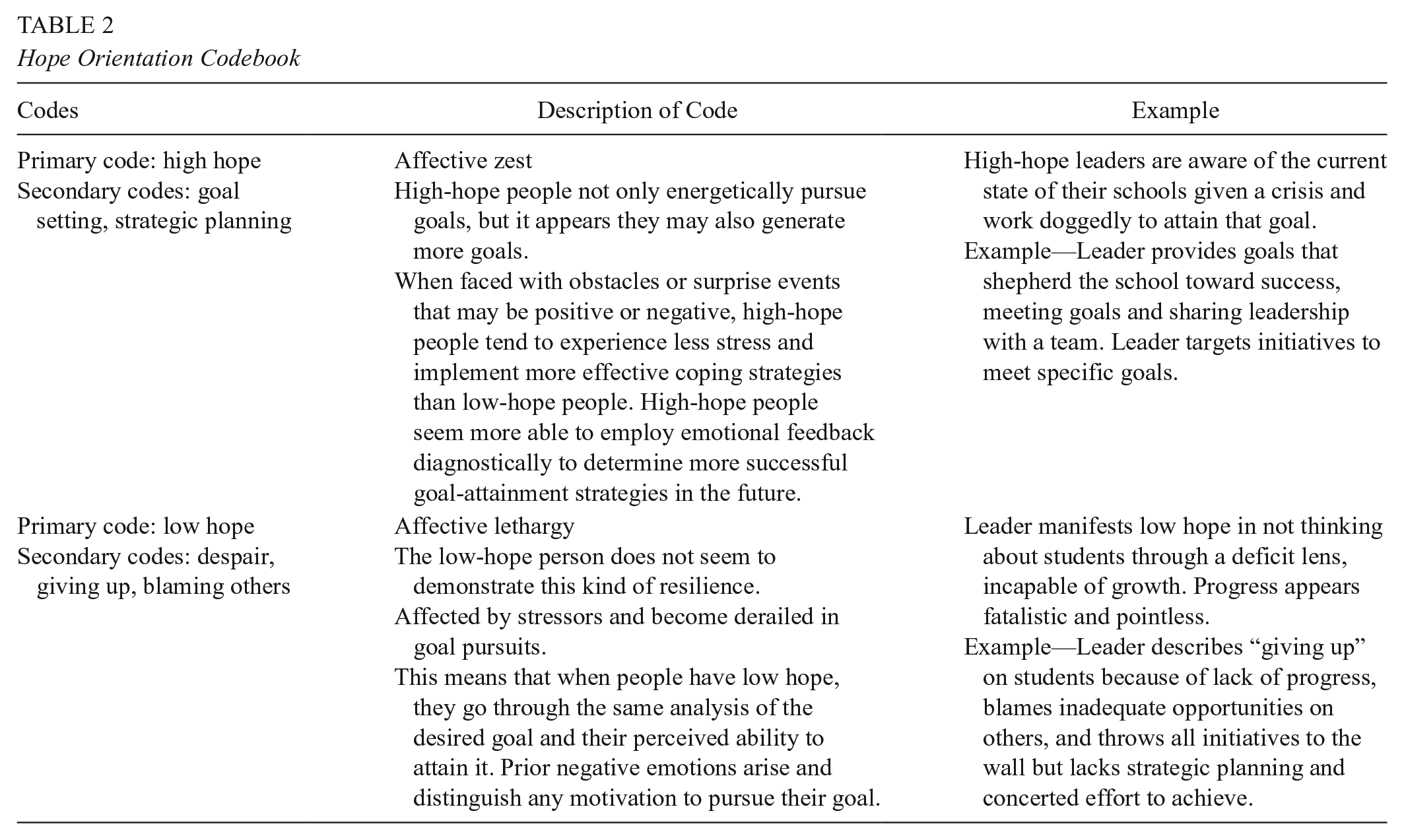
Data analysis was an iterative process that began with data collection. After each interview, I recorded initial thoughts and impressions in memo format, guided by Boeije’s (2002) constant comparative framework, such as “What is the core message of the interview? Is the interview consistent? Are there contradictions?” (p. 396). These recordings were later transcribed into Word files and imported into Atlas.ti. Once imported, the transcribed interviews and memos were coded using deductive and inductive strategies (Ngulube, 2015). In this study, I synthesized the domains of crisis and educational leadership with the theoretical framework of hope theory to comprehensively examine the feasibility of incorporating hope into school leadership practices. I methodically employed the goals, motivation, and planning constructs in hope theory, which are also pertinent to school leadership. My analysis centered on how leaders could establish a clear vision and overarching goals that were grounded in hope, stimulate motivation and agency by capitalizing on individuals’ strengths and purpose, facilitate adaptive planning to navigate crises, and ultimately, model and cultivate hopeful mindsets and behaviors within their schools and district in the aftermath of crises. As a result, some codes, such as “high hope,” “goal setting,” “low hope,” and “despair,” were created prior to the categorizing stage of data analysis based on the relevant literature and the study’s primary research foci. A total of 10 codes were generated. They were then organized into two primary codes (high hope, low hope) and secondary codes (“bouncing back,” “confidence,” “goal,” “optimism,” “apathy,” “care,” “trust,” and “respect”). Table 2 shows an excerpt from my codebook. Results are reported below using pseudonyms for all participants.
Hope Orientation Codebook
The Power of Hope in School Crisis Recovery: Findings
School leadership is critical for navigating the challenges of a crisis, such as a global pandemic or a natural disaster. Research suggests that a principal’s level of hope significantly shapes their approach to crisis recovery (Virella, 2024). Leaders with high hope tend to be more optimistic, resilient, and resourceful, ultimately leading to positive outcomes for students, staff, and the school community. Conversely, leaders who lack hope can struggle with feelings of despair and disengagement, hindering their ability to lead during a crisis effectively. This section presents findings from the data collected about hope theory in school leadership during a crisis. I examined the characteristics of high-hope and low-hope leaders and how their hope levels are expressed during and after school recovery efforts.
The data revealed that contextual factors such as trust within and among school and district leaders, state policies, and support from colleagues and staff played a significant role in shaping leader hopefulness and hopelessness as they navigated the challenges of crisis recovery. For example, most leaders who expressed hopeful leadership often had access to supportive contexts. My findings also suggested that contextual factors mattered because they reified trust across the fabric of the space and elevated principals who had low reserves of hope. For example, Finn shared: My district mentor is somebody that I rely on and can trust, and she’s my confidant, but at the same time, she’s also the leader. That has been a saving grace for me. I’ll bounce some just initial ideas off her and say, “What do you think?” She’s bluntly honest but in a good way, not in a “Fuck this. We’re going to make this a contract issue.” It’s more like, “I think if you take it in this direction a little bit more, it’ll be more palatable, and we’ll get more people to rally around it.” That has been so exceptionally helpful for me.
Finn shared how having trust in his mentor allowed him to engage with multiple stakeholders and respond to the crisis. Thus, he was allowed to move away from traditionally complex bureaucratic roles such as a union head and instead foster high-hope leadership on his school’s behalf.
By contrast, a lack of trust within a context could lead to low-hope leadership expressions. For example, Jude shared, “I don’t trust them [school teachers and staff] because of that experience that I had in another district. I don’t think I ever can or will, so I think I will forever maintain a certain level of distance from all teachers.” Leaders like Jude, who lacked trust due to past experiences, struggled to express hope in their current leadership roles. This suggests that contextual factors have the ability to solidify trust and raise the status of leaders who have lower levels of hope reserves. Furthermore, my findings indicate that high-hope leadership expressions, often fostered by supportive contexts, are associated with positive outcomes such as improved student achievement, higher staff retention, and increased leader self-efficacy, aligning to current research on the import of the principal (Grissom et al., 2021; Houchens et al., 2012; Lopez et al., 2004).
Research suggests that developing high levels of hope is essential for effective leadership (Goethals et al., 2004; Shorey & Snyder, 2004). This is particularly true when navigating a crisis. Table 3 summarizes key characteristics that differentiate high-hope and low-hope leaders during a school crisis. This table also showcases examples from this study to illustrate these characteristics in action.
Key Characteristics of High-Hope and Low-Hope Leaders During School Crisis and Recovery

High-Hope Leaders and School Recovery
I found 28 principals who demonstrated high-hope leadership during a crisis. Despite having different goals based on their specific school setting, these leaders all used their hope to drive recovery efforts and prepare for future challenges. My analysis revealed specific behaviors aligned to hope theories’ characterization of high- and low-hope leadership expressions. High-hope leaders displayed an “affective zest” characteristic when discussing their leadership during a crisis (Snyder, 2002). They firmly believed in their ability to overcome challenges and create positive change. For example, Caleb described his optimistic approach to leadership during two crises: Oh, my gosh, I would say in my entire career, I have never felt more hopeful because, my gosh, we can make it through this [student medical emergency]. We can accomplish anything. And it’s the same thing with this pandemic. It’s not something that any of us could have possibly prepared for, but we reflect on what we’ve accomplished and were able to do. It just makes me feel more hopeful than ever.
This sense of hope can be a powerful catalyst for school recovery.
In contrast, low-hope leaders displayed characteristics of “affective lethargy” (Snyder, 2000). Their feelings of negativity and doubt about their ability to achieve goals hampered their motivation and engagement in recovery efforts. Research suggests that goal-oriented thinking fueled by optimism is a key factor in achieving desired outcomes (Snyder et al., 1998). While high-hope leaders serve as catalysts for recovery, low-hope leadership can impede a school leader’s ability to navigate a crisis. These leaders often display distinct behaviors that restrict progress. For example, Rowan described the domino effect of unpreparedness for online learning during a crisis: “I have realized, after being in other districts, that we were not ready for online learning. It was like dominoes: one thing, then another, then another, and yet you tackle the most pressing one, then off to the next one. I couldn’t shoulder it all.” Rowan’s metaphor highlights how low hope can lead to a reactive approach, where leaders address immediate issues but fail to plan for long-term recovery.
Goal-Oriented Focus
High-hope leaders maintained a strong goal orientation despite the challenges presented by the crisis. All who described this goal relayed how they implemented systems or structures to achieve it. For example, Ethan explained that when his school closed at the pandemic’s onset, his focus was on academics: So, we did have a couple of staff meetings to talk about, “All right, what are we doing here? What is our goal? Where are we in the school year?” Most people, at that point, were either almost done or were in heavy-duty review (of content), which made it a little bit easier on our older students in terms of the workload, and a lot of the conversation was, again, “How do we get from here to spring break?”
Similarly, Aurelia emphasized the importance of addressing curriculum gaps: I really began measuring it (academic achievement), and that’s how we’ve been able to maintain student achievement. There is my success story! We had a very interesting way of addressing curriculum gaps. I don’t say learning loss. We don’t say learning loss. We do not say anything; instead, we identify that they have curriculum gaps because we’ve had this crisis. We have had a lot of hiccups, so one of the things I’m most proud of is the way we look at how we’re progressing now. I told my teachers; it took us three years to get here. It’s going to take us at least three or four to get out.
Aurelia’s sentiments illustrated not only the affective zest Snyder (2000) characterized as high hope but also showed how expressions of high hope reframe challenges as an asset. High-hope leaders know challenges arise when experiencing a crisis, but they do not let that stop their intended goals or the functions of their jobs—in this case, student achievement. There was a sense among the participants that the challenges incurred by the crisis might affect long-term academic achievement (pandemic) or short-term interruptions (school violence). However, all participants discussed their academic program and meeting the students where they would be successful. Elodie explained: I hope we’ll get through these next couple of years with more hiccups and challenges. I had a lot of fear there for a while, with some of our younger students being online. You can only do so much with technology, but I am hopeful because we’ve worked really hard this year to improve.
Most high-hope principals, such as Elodie, made similar statements describing how they worked with their teachers to reduce the fear of learning loss or curriculum gaps but provided new ways for students to succeed. Asher stated, “I was very hopeful that this [crisis] was going to be the tipping point that would allow us to be far more flexible in our support for kids and teachers.” High-hope leaders were open to the potential for new ideas. Instead, they marshaled forward ways to increase student achievement despite the challenges spurred by the crisis.
Similarly, Jude explained how his school’s academic achievement was boosted post-crisis: “My school board was like, what happened that you got these results? So, we’re now in a place where we were being recognized and acknowledged, not just about the climate that we had created but also the shifting outcomes.” Oliver commented, “I’m hopeful now that we’ve been in person all this school year. So that’s a sign of recovery. I’m seeing some of the learning loss being recovered, I think, is another sign of hopefulness.” Together, these results provide important insights into how hopeful principals who focus on improving or maintaining academic achievement during or after a crisis can influence positive outcomes.
This finding connects to the literature by acknowledging that high-hope leaders are goal-oriented (Snyder, 2000). Leaders who experience a crisis while maintaining a high-hope orientation do not allow challenges to tear them down. Instead, they seek improvements and are unwavering in believing they can succeed. Grissom et al. (2021) showed that the impact of principal effectiveness on student achievement has statistical significance. Thus, the data suggest that as principals increase their hope orientation, they have the potential to increase student achievement.
Low-hope leaders, in contrast, struggled to maintain a goal orientation. Some, like August, expressed feeling “stuck” and disengaged, focusing on future possibilities rather than current goals. “I have to put all my eggs in Pre-K. I can’t think about the nonsense happening in seventh and eighth grade. I see hope a little bit in Pre-K. I’m learning not to trust my team, not to trust everyone’s work ethic. I have to ask these people if they really care about these kids or if it’s a show.” This disengagement from current goals, as described by Edwards et al. (2007), can hinder student growth.
Similarly, Eloise described feeling overwhelmed by the challenges presented by the crisis. She reflected, “I really felt very stuck and very like we can’t do this. This is not working, and I cannot support my teachers enough.” Eloise continued to explain how she felt low confidence, unable to support her teachers during crisis recovery: “It goes back to how we focus on data. I’m asking teachers to have great data, but some of our students struggled with attendance. Teachers would tell me that this (improving student outcomes) is hard, but teachers kept saying at least they’re in person, and it was fine.” This disengagement, as described by Bryk and Schneider (2002), can prevent leaders from creating a thriving environment for student growth. Silas expressed a similar lack of engagement with student learning during the pandemic: “Last year we did like a hybrid plan, where kids could come to school with masks, or they can learn online, and that was an utter failure. I made numerous calls begging the students to return because there’s just no learning done; there was no structure at home.” The data suggests that placing the blame on others gives low-hope leaders permission to disengage and drop efforts made at crisis recovery by simply declaring failures without seeking an additional pathway toward success. By contrast, high-hope leaders used challenges as opportunities to reevaluate goals and find alternative pathways to success (Snyder, 2002).
Envision a Positive Future After Crisis
High-hope leaders used the crisis to envision a positive future for their schools. This future often involved advocating for new programs and resources. For example, Clara saw the pandemic as an opportunity to address a longstanding need for algebra courses.
I’ve been fighting for algebra courses in my school for over a year. The district has denied me this, but I found out that my math teacher has a certification in algebra. They permitted me to host the program when I told the district this. We didn’t have pre-algebra before the pandemic. And my students took the test and scored the highest in algebra, outscoring the district.
High-hope leaders also leveraged the crisis to build stronger partnerships with families and communities. They used the crisis to make necessary changes in their schools. For example, some principals who experienced a medical emergency advocated changing protocols and adding materials to their schools to support students. In contrast, principals who experienced students attempting self-harm championed social-emotional curricula that were not in the school before.
Similarly, Daphne explained, “Pre-pandemic, we didn’t really have a focus on social-emotional learning. During the pandemic, we really had to start thinking about our students’ emotional needs at home. We were opened to the window of students’ homes because of online learning.” Jude described efforts to create innovative programs through collaboration.
Recognizing there was limited participation from the parent community and we didn’t have the staff to do that kind of work, I focused on that. And I was able to build some really strong partnerships with the other principals and with other central office administrators to launch some really cool and innovative programming.
Finally, high-hope leaders envisioned a future with a more flexible learning environment. Caleb implemented remote Fridays to benefit both students and staff. He shared: We made it a priority to support our families to support our staff, and so one of the things that we’ve implemented is remote Fridays. After returning to the building, we maintained our nimbleness, so to speak, by being in the building Monday through Thursday. On Fridays, our students work online with their teachers. It’s a win-win situation because it allowed our janitors to deep clean the building and allowed our students to keep their online skills sharpened. We also encourage our teachers to catch up with grading, planning, and collaborating on Friday afternoons. We intentionally wanted to reduce the time they needed to dedicate to work in the evenings or weekends. We want our teachers to be able to access that time and make good use of it.
These stories of high-hope leaders illustrate the transformative power of hope during a crisis. Beyond simply maintaining metrics or adhering to policies, these leaders used their optimism to create lasting positive change. Their belief in themselves and supportive context allowed them to tap into their humanity and drive innovation (Freire, 2021). Clara’s advocacy for new programs exemplifies this by leveraging the crisis to address a need for algebra courses; she improved student opportunities and demonstrated the power of a hopeful leader to overcome obstacles. Similarly, Jude’s focus on building partnerships expanded access to resources for his school community. Finally, Caleb’s implementation of remote Fridays highlights the ability of hopeful leaders to create flexible and responsive learning environments. These examples demonstrate hope is not just about weathering a crisis but also using it as a springboard for positive transformation.
Negativity, Inflexibility, and Missed Opportunities During A Crisis
Low-hope leaders also displayed inflexibility in their approach to crisis leadership. For example, Silas expressed frustration with teachers who used the pandemic as a reason for absences: “People are still using the pandemic for cover. They might say, ‘Oh, I might have a cold. I can’t come in.’ And that tries my flexibility because I’m like, you don’t have to go to the doctor. It tries my patience and my flexibility.” This inflexibility, as described by Snyder (2002), can hinder collaboration and adaptation during a crisis. On the other hand, high-hope leaders viewed challenges as puzzles to be solved, requiring flexibility and adaptation (Snyder, 2002). Moreover, leaders who lacked hope often fell into cycles of despair, impacting their motivation and effectiveness. Asher describes the emotional toll of leading during a crisis: Right now, feels impossible and thankless. I have to be strong, positive, and brave for everyone, but I’m exhausted, and I just have to tell someone the principal is not okay. And you know, it feels like we spent a great deal of time talking about the social-emotional needs of kids and the social-emotional needs of families and teachers. But we rarely stopped to think about how the school leader was doing.
This hopelessness, as described by Lopez (2013), can create a sense of loneliness and thwart a leader’s ability to cope with challenges (Snyder et al., 1991a,b). High-hope leaders, in contrast, had more robust support networks that helped them maintain their motivation (Dor-Haim & Oplatka, 2021). For example, Charlotte described feeling unsupported by the district after a student’s suicide attempt on school grounds: “I was just angry for the rest of the year. . . . That was very disheartening, and it almost felt like they didn’t know what I just went through. Even the superintendent, I understand, has 57 schools, but he never once came in to talk to me about it.” This lack of support can exacerbate despair and ultimately lead to burnout (Högberg, 2021).
These principals’ interactions with their teachers and school administration shed light in two ways. First, low-hope school leaders allowed negative emotions to color their experiences of leading through a crisis. Second, their insights shed light on the notion of despair and its potential impact on the longevity of a principal’s tenure. Harlow reflected, “I do think there is a serious crisis going on right now with a shortage of teachers, and I will say I feel like I don’t know what help I want, but I feel very alone, and I’m just like I don’t know what we’re going to do.” Hope is a vital coping mechanism against despair. When leaders experience despair, they lose agency and think of little to improve a crisis (Potosky & Azan, 2023). For school leaders charged with recovery efforts (allocating resources, diffusing assets, and communicating with families) while adhering to student achievement improvement, teacher retention, and other technical manifestations of the principalship, despair impedes most progress that can be attained during post-crisis recovery. Nevertheless, despite being in a very dark place, the opportunity to be hopeful must be cultivated to ensure school leaders are supported and goal-oriented and marshal a vision of educational excellence.
Discussion and Implications
Hope is not a new topic. It traverses global myths, religion, and folklore. Hope has been the object of artistic, philosophical, and religious explorations and reflections throughout the centuries, such as the Greek myth of Pandora, the first human woman created by the gods, who opened a jar of human evils that dispersed all over the world, except for hope, which stayed in the jar (Grimal, 1990 ). Yet, in the social sciences, particularly educational leadership, hope is often omitted from scholarship. Moreover, the crises today’s school leaders face requires researchers to look at diverse phenomena to understand how principals navigate these crises. The data in this study reveals that hope is a concretized set of actions that can support a leader’s efficacy, potentially improving the school community. Moreover, in focusing on the myriad crises’ principals face, my research revealed that there is more to crisis response and leadership than operational aspects or resource allocation. This study extends the work of Miller et al. (2011) and Snyder (2000) by applying theoretical ideas to school crisis leadership practices to support leader development and illuminating the kinds of support and challenges that facilitate growth for leaders experiencing myriad crises. For example, in this study, I found that principals who instilled hope in themselves and their teams appear more effective in navigating challenging circumstances. This finding is consistent with previous research on the importance of hope in leadership because it illustrates how leaders are conscious of their hopefulness or hopelessness and how it operates in their lives and leadership (Avolio, 1999). The findings illuminate that hope is an important leadership competency that can help leaders motivate and engage their faculty and staff during times of crisis. Further, the findings suggest that hope fosters positivity and resilience, allowing for better problem-solving through increased creativity and risk-taking (Freire, 1970).
Hope as a Leadership Practice
Hope theory enlightens the critical distinction between leadership practices that aim to transform and those that aim to inform. Transformational leadership considers setting directions, developing people, and redesigning an organization to improve an educational organization (Leithwood & Jantzi, 2006). Menon (2021) found that transformational educational leaders in Greece used transformational leadership practices to advance recovery and stabilize school environments during the COVID-19 pandemic. Specifically, Menon’s research found that participant leaders highlighted a positive attitude toward change in areas of encouragement toward teachers and engendering trust with students and families; this potentially promotes positive interactions between home and school, collaboration among teachers, and opportunity for open communication. Menon’s research dovetails with this study because unveiling hope and its manifestations in a crisis helps us understand more in nuanced detail than an overarching positive stance and provides us with a language to discuss leadership through a crisis. Moreover, it helps us to relinquish the notion that leaders should respond to a crisis solely through an operational or management lens (Boin et al., 2016) and shift to the promise that redesigning school’s post-crisis can lead to transformation.
While each leader adapts their leadership style toward hopefulness or hopelessness for many reasons, principals should consider how their level of hope has impacted their leadership. As the data suggested, low-hope leaders were going through the motions of leadership, feeling they were not making a difference to their schools or students. Simply put, low-hope leaders do not attend their schools as leaders; they only manage from day to day. This presents challenges when a crisis has been resolved or structures established because what remains is how students achieve academically. Thus, the low-hope leaders here did not differentiate between low hope only during the crisis; it was a mainstay of their leadership. By contrast, high-hope leaders aided recovery and redirected attention to student achievement and learning by adjusting post-crisis and allowing students to continue learning. In short, hopeful leaders aid in students’ academic recovery and manage their daily duties, and the schools become sites of progress. This has particular implications for students in urban settings who experience crises on top of educational debt (Ladson-Billings, 2006) and high poverty. Given the high turnover rates in urban schools, low-hope leaders can exacerbate already inequitable conditions.
Implications for Practice
Across all school types, resource levels, and years of experience, these leaders of diverse populations experienced low or high levels of hope that impacted their leadership. Individual school context and leadership orientations matter when discussing hope and how it shows up in leaders’ actions and responses toward crisis resolution. While all principals described having some hope, most principals expressed high hope, but a significant number also expressed low hope. Everyone emphasized the need for hope, but some were full enough of hopelessness that they were on the verge of giving up. Most principals recognized that their role as leaders was more critical during crisis recovery than in a “normal” state. However, some found it easy to dismiss hope and its potential to influence leadership.
This research offers practices that will help principals and other school leaders better understand how to respond to a crisis, establish goals, and reinvigorate their leadership orientations so that hope provides a pathway toward a hopeful future. To enhance schools as learning centers where children and adults thrive, principals must assess their hope or hopelessness to seek support or rally stakeholders. While I suggest that principals self-assess their level of hope, I also urge principals to continue attending to their intuition of what they believe is in the school’s best interest. Principals should draw on their strengths and seek mentorship that permits vulnerability and innovation. Helping principals become more effective leaders during crisis recovery requires support and encouragement of where they are.
The hopeful/hopeless practices, strategies, and case examples discussed here combine to provide principals and other school leaders with a new way to enact their roles during crises and as recovery leaders. As principals, they need to operationalize their school back to a stable state with collaboration and create a school and community vision to follow by using hope as a central lens by which to recover. All the hopeful or high-hope leaders in this study created a vision of recovery and support for their students while envisioning a better future. They modeled empathy and goal setting despite a crisis event and success by directly engaging in their hopeful orientation. Encouraging principals to tether this hopefulness to goal setting will help them manage ever-changing events because of a crisis and potentially provide a trickle-down effect to their community.
Implications for Principal Preparation Programs
Principal preparation programs have the opportunity, if not an obligation, to enhance their curricula by including hope theory. During their coursework, principal preparation programs can lean on hope theory to help their students become aware of the impact of hope on leaders. Thus, they can show how hope is critical to leadership while tethering it to academic outcomes and staff retention. The notion of hopefulness, as presented in this study, shows the essential nature of this disposition in creating student success. In a country where schools have experienced record-breaking school shootings and natural disasters that have leveled communities, hope becomes not only a disposition but a necessary component of leadership toward improvement.
Implications for Future Research
This study lays the groundwork for new avenues of research in understanding hope and its role in educational leadership. Future studies could investigate the systemic factors influencing principal hope, like funding disparities and chronic inequities. Longitudinal studies tracking hope levels in principals over time could also provide valuable insights. Additionally, researchers could explore how hope theory intersects with other areas of educational leadership research, potentially leading to a more comprehensive understanding of effective leadership practices. Finally, developing tools for principals to self-assess their hope levels would be crucial in empowering them to harness hope as a leadership tool. By continuing to explore the multifaceted nature of hope, researchers can equip school leaders with the knowledge and tools they need to navigate challenges, inspire their communities, and create brighter futures.
Limitations
A significant strength of this study was the use of diverse principal participants to understand how hope is galvanized in leadership. However, the study had some limitations. First, verifying claims of outside efforts or district partnerships was beyond the study’s scope. Second, this study was based on self-reporting. For example, future research using direct observation could complement the principals’ self-reporting with more objective data on the knowledge utilized for crisis response. Interviewing various stakeholders in and out of schools about relationships related to hope and crisis educational leadership may complement the principals’ self-reports. Furthermore, interactions between the principals’ perceptions of relationships related to hope and variables such as gender, experience, education, and school level were insignificant in this sample. However, such interactions may be found in a future study using more participants.
Conclusion
The study suggests that hope is not a binary state (always hopeful or hopeless) but rather a dynamic characteristic that can fluctuate based on context. While some leaders exhibited a more inherent disposition toward hope, others’ hope levels seemed more contextual, potentially depleted by crisis or renewed through support. The research portrays hope as a multifaceted concept, acting as a personal quality (hopeful/hopeless), a temporary mood (feeling optimistic), and a resource that can be cultivated (high hopes). This complexity can feel like unstable grounding because it highlights the interplay between individual psychology and social contexts in shaping hope levels.
Footnotes
Open Practices

Author
PATRICIA M. VIRELLA is an assistant professor in the Department of Educational Leadership at Montclair State University. Virella’s research focuses on implementing equity-oriented leadership through leader responses, organizational transformation, and preparation. Virella also studies equity-oriented crisis leadership, examining how school leaders can respond to crises without further harming marginalized communities.