




Abstract
Land acknowledgments are an evolving practice to recognize local Indigenous Peoples as traditional stewards of their homelands. Using a content and discourse analysis, we conduct the first empirical study of U.S. land acknowledgment statements focusing on the 47 land-grab universities created under the 1862 Morrill Act. We find that LGUs tend to adopt statements in urban areas, where federally recognized tribes are present, and at institutions with over 100 enrolled Native American students. Land acknowledgment statements also commonly name local Indigenous Peoples yet often fail to articulate their responsibilities to them, include superficial gestures, and center multicultural language. We offer “rhetorical removal” to describe the tendency of land-grab universities to deploy language that selectively erases Indigenous Peoples and, thus, argue that statements must directly address settler colonial legacies of violence and redistribute material support for Indigenous students and partnerships with Native nations.
Land acknowledgments are an evolving practice intended to recognize Indigenous Peoples as the traditional stewards of their homelands and the lands occupied by an organization or a particular gathering (Goeman, 2020; Janzen, 2019; Keefe, 2019; Keeptwo, 2021; Kowal, 2015; Laurier Students’ Public Interest Research Group [LSPIRG], 2020; Merlan, 2014; Stewart-Ambo & Yang, 2021). This naming practice is commonly heard orally at the opening of public events or found in print on organizational websites (Stewart-Ambo & Yang, 2021). Indigenous Peoples, nonsettlers, and settlers alike have adopted land acknowledgments and often articulate that choice as a decolonial, anticolonial, and social justice practice that centers Indigenous relationships with ancestral territories suppressed by settler colonialism. 1 Acknowledgment practices vary in name—including Indigenous or territorial acknowledgments, Welcome to Country, Welcome of Country, Acknowledgment of Country, and land introduction—depending on the social location of the individual offering the acknowledgment and the audience present to receive it.
Land acknowledgments have gained popularity in equity-minded spaces, including U.S. institutions of higher education. Universities and professional associations, for example, have drafted formal land acknowledgment statements, making them available to the public and encouraging their use at annual gatherings (e.g., see Northwestern University, the University of California, Los Angeles, the American Educational Research Association, Association for the Study of Higher Education, American College Personnel Association, National Association of Student Personnel Administrators). Despite this uptake in social and professional settings, land acknowledgments remain understudied and undertheorized. Indigenous Peoples, however, have been vocal with their critique about the superficiality and performativity of land acknowledgments (Mills, 2018; D. Robinson et al., 2019; R. Robinson, 2016; Vowel, 2016). Critics point out that statements often place Indigenous People in the past, suggest that Indigenous Peoples no longer live with us and among us, and obfuscate historical injustices by inferring Indigenous lands were given willingly.
In this study, we take up these tensions and analyze the adoption of land acknowledgment practices at U.S. land-grant universities and their stakes as a decolonial, anticolonial, and social justice practice. While there are several types of land acknowledgments and voices who provide them, we are specifically interested in the linguistic and material commitments that settler institutions employ at land-grant universities and what they communicate about the land-grant mission. Thus, our present investigation is not a comparative study of the relationship between land acknowledgments and other types of institutional responses to histories of exploitation. Instead, we introduce the concept of rhetorical removal—the use of language to selectively erase non-settlers from the rights and benefits that settlers accrue on behalf of their assertions to place—to consider how language is operationalized across land-grant universities with land acknowledgment statements. 2
While rhetorical removal can and does affect all nonsettler groups, we examine how public institutions are answering the call to examine and redistribute the material benefits they enjoy as a result of past and present anti-Indigenous violence (Rocha Beardall, 2022). Land-grants universities are an ideal case for this inquiry because many were explicitly created from the violent physical removal of Indigenous Peoples (Lee & Ahtone, 2020; Nash, 2019). To proceed, we ask the following research questions: What formal and informal land acknowledgment practices exist at U.S. land-grab universities? What relationships, responsibilities, and material commitments to Indigenous Peoples past, present, and future do acknowledgment statements communicate? How can the land acknowledgment practice reimagine the land-grant mission and foster more equitable institutions of higher education? We address these questions by providing a brief overview of the historical relationship between U.S. higher education and Indigenous Peoples. Next, we examine the political origins of land-grant universities and then turn to the current uptake of land acknowledgment practices. Then, we detail our methodological approach using both a content and discourse analysis and a novel dataset that merges land acknowledgments with geographic and institutional characteristics, including the physical and financial footprint of all 47 land-grant institutions created under the 1862 Morrill Act.
We find that while land acknowledgment statements commonly name local Indigenous Peoples, they often fail to articulate responsibilities to the named communities or indicate a desire to share the institutional benefits these institutions accrued from settler assertions to place. Land acknowledgments also tend to include superficial gestures toward collaboration and center multicultural language over and above Indigenous-specific issues such as tribal sovereignty and self-determination. These findings illustrate the intertwining power of rhetorical removal to harm Indigenous Peoples and exacerbate the violence of physical removal. Our findings challenge institutions to situate land acknowledgments as an opportunity to reject anti-Indigenous violence, address the particular social and historical context of each university’s relationship with dispossessed Indigenous nations, and offer material campus resources to Indigenous students and tribal nations associated with the institution. Without measurable reform to redistribute resources and mobilize Indigenous educational equity, access, opportunity, inclusion, achievement, and connections to one’s homelands, land-grant universities will continue to materially benefit from Indigenous dispossession. Our findings also motivate future research on the consequences of rhetorical removal as an institutional practice for other nonsettler social groups. We contend that institutions that make this turn are well positioned to move beyond performative allyship and into real change. Without conscientious framing, proper attention to social and historical context, and the commitment of material resources, however, these statements may retrench existing inequities and reify settler move towards innocence attempting to absolve institutions and individuals of their responsibilities to the Native nations they claim to recognize.
Linking Land Acknowledgments With Indigenous Dispossession
The performance of land acknowledgment statements is an evolving practice and, when situated within the context of postsecondary education, can shed important, productive light on the inherent link between Indigenous dispossession and higher education as a social institution. To demonstrate these connections, we ground this study in an overview of the establishment of U.S. institutions of higher education and Indigenous Peoples’ place within them, the emergence of land-grant universities, and the current uptake of land acknowledgment practices.
Indigenous Peoples and U.S. Higher Education
The historical relationship between U.S. higher education and Indigenous Peoples has long been shaped by exclusion, elimination, and exploitation. Settler universities in the colonies, for example, functioned primarily as finishing schools for affluent White settlers and excluded the enrollment of Indigenous students (Cohen & Kisker, 2009). This privileged function shifted for Indigenous Peoples in two significantly interrelated ways: cultural assimilation and financial incentives. Beginning with the violence of assimilation, institutional records indicate that Harvard College, College of William and Mary, and Dartmouth College all have origins in serving Indigenous youth with the publicly professed motivation of assimilation. The current operating charter for Harvard College, revised in 1650, expresses a commitment to “the education of the English & Indian Youth of this Country in knowledge and godliness” (Harvard University, ca. 1650). In 1693, a royal charter established the College of William and Mary, which had aims “that the Christian faith may propagate amongst the Western Indians” (Mary II & William II, 1693). Similarly, the 1769 charter of Dartmouth College expressed a commitment to
the education and instruction of Youth of Indian Native nations in this Land in reading wrighting [sic] and all parts of Learning which shall appear necessary and expedient for civilizing and christianizing Children of Pagans as well as in all liberal Arts and Sciences; and also of English Youth and any others. (Calloway, 2002, p. 17)
Such origins frame education as one tool used by settlers to prioritize Indigenous elimination through the implementation of an assimilationist curriculum (Carney, 1999; Reyhner & Eder, 2017; Wright, 1991).
Indigenous Peoples also became integral to the financial operations of early colleges. For example, when faced with challenges to finance institutional operations, university founders sought support from charitable organizations and physically and emotionally exploited Indigenous Peoples in order to solicit money from donors. After falling into financial hardship, Harvard revised its charter in 1650 to include Indigenous students to access funding from the English Society for the Promoting and Propagation of the Gospel in New England (Graham & Golia, 2002; Peabody Essex Museum, 2007). Similarly, Dartmouth College was built with charitable funds collected with the assistance of Samson Occom, a Mohegan student. Eleazar Wheelock, Dartmouth’s founder, and Occom collected 12,000 pounds from Great Britain for Indigenous education—the largest endowment of any college at the time (Calloway, 2002, 2010, 2021). Very few Indigenous students graduated from these three colleges in the 17th and into the 18th centuries (Calloway, 2010, 2021; Carney, 1999). As an example, just before the Revolutionary War, approximately 240 years after their establishment, Harvard, William and Mary, and Dartmouth only enrolled 47 Indigenous students, of whom only 4 graduated (Carney, 1999). Educational historian Cary Carney (1999) asserts that “virtually every instance of professed devotion to Indian higher education by the colleges during the colonial period was an exercise in fundraising or access to funds requiring an Indian mission” (p. 3). Recent research on colonial colleges also sheds an important light on higher education’s relationship with the violence of U.S. chattel slavery; many colonial colleges were financed and constructed as a result of the colonial slave trade (Fuentes & White, 2016; Harris et al., 2019; Wilder, 2014). Taken together, these histories pose a set of parallel and intersecting exploitation histories salient to future analysis of institutional practices and inequalities, including land acknowledgment statements.
The Morrill Act of 1862 and the Legacy of Land-Grant Universities
As the Colonial Era waned, the U.S. government continued to engage in Indigenous elimination including genocidal campaigns, treaty-making, relocation, and assimilation tactics. Goeman (2020) points out that these events “took place at the same time as what historians term the reservation era … a time when the U.S. government herded Native peoples onto contained reservations” (p. 45). During this time, President Abraham Lincoln signed the Morrill Act of 1862, otherwise known as Land-Grant Agricultural and Mechanical College Act, which redistributed “public domain lands” to raise funds for new colleges across the nation. As a result, land expropriated from tribal nations became the seed money for higher education institutions in the U.S. In total, 52 universities were established under the original Morrill Act of 1862. 3
The modality of land transfer varied across states although the amount of land was calculated relative to a state’s population. Specifically, 30,000 acres were granted to states for each member of Congress (e.g., California 150,000 acres and Virginia 300,000 acres). States in the east, who did not have land to acquire because lands were already populated by settler communities, were given scrip to exchange for land in the west (Sternberg, 2014). Land scrip was essentially a “voucher” entitling the holder of the scrip to a discrete amount of public lands. For example, many scrips were exchanged for land in California, Minnesota, Michigan, North Dakota, South Dakota, and Nebraska (Lee & Ahtone, 2020). Most eastern states sold their scrip to land speculators, whereas states in the west were able to obtain land within their state to sell or use (Lee & Ahtone, 2020). In the same year, Lincoln also signed the Homestead Act and the Pacific Railway Act, which also distributed Indigenous lands to homesteaders and allowed for the construction of the Pacific Railroad (Gavazzi & Gee, 2018).
As the historical and financial records show, land-grant universities would not have been possible without the violent and genocidal removal of Indigenous Peoples from their lands. Only recently have critiques connected land-grant universities to the U.S. settler colonial state (Goeman, 2020; la paperson, 2017; Mack & Stolarick, 2014; Nash, 2019; Rocha Beardall, 2022; Wilder, 2014) despite the longstanding study of land-grant universities in history and education studies (Cohen & Kisker, 2009; Gavazzi & Gee, 2018; Geiger, 2016; Thelin, 2017). This context of limited critique changed among academic researchers in March 2020, when historian Robert Lee and High Country News journalist Tristan Ahtone published findings linking approximately 10.7 million acres of expropriated land under the 1862 Morrill Act with the violence of Indian removal. These findings traveled widely and shifted the historical and financial reality that land-grant universities are perhaps better understood as “land-grab universities.”Lee and Ahtone (2020) located over 99% of the acreage used to fund the Morrill Act. Their study monetized Indigenous dispossession to show that less than $400,000 was “paid” for Native lands, which raised upwards of $17.7 million for university endowments. Moreover, the research identified 500,000 acres that remain in trust to universities and institutions allocated land with mineral rights that continue to generate revenue for land-grab universities (Lee & Ahtone, 2020). We take up Lee and Ahtone’s use of “land-grab” the duration of this article to explicate the history of U.S. institutions, including colleges and universities, benefiting from Indigenous dispossession.
While our emphasis is on the explicit relationship between Indigenous Peoples and institutions of higher education, we also note that Indigenous dispossession and settler land expropriation extend well beyond the context of universities before and after the creation of land-grab universities beginning in 1862. Several key legal moments illustrate this violence, including the federal government’s push to control Native bodies and lands using outright theft, the Indian Removal Act of 1830, and the Pacific Railroads Act of 1862 (Rocha Beardall, 2022). Together, these exploitative and assimilationist practices enriched a variety of noneducational beneficiaries including lawyers, surveyors, real estate developers, bankers, miners, and timber and construction barons (Blackhawk et al., 2014). Many of these individuals worked directly to create universities after the passage of the Morrill Act, whereas others such as local doctors, salesmen, and insurance agents indirectly benefited from the building of land-grab institutions (Rocha Beardall, 2022). Some professionals were able to use their accumulated land and capital to donate back to institutions of higher education, thus enriching the cycle of settler colonial dispossession and exploitation (Blackhawk et al., 2014; Madley, 2016).
Offering a material link between historical events, universities, and Indigenous dispossession, Lee and Ahtone’s (2020) research makes apparent how universities profited, and in some cases continue to profit, from these events. We build on their critique of land-grab universities, not only by utilizing their dataset but also through our examination of existing land acknowledgment practices that link or erase institutions to Indigenous dispossession.
Uptake of Land Acknowledgment Practices
Finally, to contextualize our examination of land acknowledgment statements at land-grab universities, we offer some grounding in the emerging literature and practices related to this social phenomenon. It is difficult to pinpoint the precise moment that land acknowledgment practices emerged in the United States; however, it seems likely that these practices were imported from Australia and Canada, where they were initiated in public settings following decades of social and political activism around historical truth telling, reconciliation, and national apologies (Keefe, 2019; Keeptwo, 2021; Kowal, 2015; Merlan, 2014). Arguably, the uptake of this practice by educational institutions globally can best be understood as institutional isomorphism, which reflects the propensity of institutions to adopt similar processes and structures of other institutions (DiMaggio & Powell, 1983).
In Australia, acknowledgments gained traction in the 1990s as part of institutionalized reconciliation efforts, including a public apology by then Prime Minister Keating to Australia’s aboriginal communities (Merlan, 2014). Likewise, acknowledgment practices in Canada followed the Indian Residential School Settlement Agreement, which established the Truth and Reconciliation Commission of Canada in 2007. Between 2007 and 2015, the Truth and Reconciliation Commission of Canada collected accounts from those impacted by the legacy of the Indian Residential School system, in which over 6,500 individuals participated. The final Truth and Reconciliation Report contains 94 “calls to action” to address reconciliation between Canada and Indigenous Peoples and inspired the adoption of acknowledgments by federally funded organizations (Daigle, 2019). In Australia and Canada, land acknowledgments are not legally mandated, and no consensus exists on how the practice should be engaged (Keeptwo, 2021; D. Robinson et al., 2019). We observed this practice being imported into the United States around 2015, possibly due to elevated awareness of Indigenous-led social movements such as Idle No More, Mni Wiconi (i.e., Water Is Life), and land return (i.e., #LandBack) (Eagle Shield et al., 2020; Grande, 2018; Stewart-Ambo & Yang, 2021).
Globally, land acknowledgments take on a variety of names, including Indigenous or territorial acknowledgments, Welcome to Country, Welcome of Country, Acknowledgment of Country, and land introduction (Goeman, 2020; Janzen, 2019; Keefe, 2019; Keeptwo, 2021; Kowal, 2015; Merlan, 2014). Land acknowledgments are also understood to be an evolving decolonial, anticolonial, and social justice practice, adopted by both Indigenous Peoples, nonsettlers, and settlers, to recognize the lands occupied by a university or where a gathering takes place by naming lands and peoples in Indigenous relationship to that place. There are numerous intentions, all valid but not without issue, by speakers reciting acknowledgments, including recognizing the enduring relationship that exists between Indigenous Peoples and their traditional territories, correcting and disrupting colonial narratives that have been suppressed, creating discomfort around settler privilege and complacency. For some, land acknowledgments are performed to show respect, honor, express gratitude and appreciation, or pay tribute. In higher education institutions, students, staff, and faculty may use acknowledgments as an anticolonial and/or decolonial practice to disrupt the settler colonial environment while also educating and advocating with the hope of transforming their institutions (Asher et al., 2018). In contrast, the language deployed in statements can also place Indigenous Peoples in the past, suggesting that they no longer live with and among us. Likewise, some expressions of gratitude seem to infer that Indigenous lands were given willingly and obfuscate historical injustices.
Empirical research is currently limited to two publications that focus on Canadian content and pedagogy (Asher et al., 2018; Wilkes et al., 2017). Wilkes et al.’s (2017) survey of Canadian university land acknowledgments found the prominence of five types of acknowledgment practices: (a) land/unceded territory, (b) people, (c) treaties and political relationships, (d) multiculturalism and heterogeneity, and (c) no practice. Specifically, they find the use of terminology explicating “land and title” to describe lands, the use “of people and territory” to relate an “openness to doing more,” and the use of “treaties” to reflect the unique legal and political situation of First Nations people in the country (p. 95). Additionally, the study finds that the type of acknowledgment practice is tightly correlated to geography. For example, lands were often named in statements in British Columbia, people and territory were present in statements along the Atlantic, and the identification of treaties tended to appear in statements in the Prairies of Canada. Likewise, statements that emphasize multiculturalism and heterogeneity tend to be found in Ontario, and “no practice” or a lack of statements tend to be found throughout Quebec (Wilkes et al., 2017). Asher et al. (2018) examined the use of statements by student activists at the University of Toronto. While impactful, they concluded these interventions to have “failed as a decolonial pedagogy” (p. 317).
As mentioned, isomorphic tendencies to uncritically adopt land acknowledgment statements bring to light critiques by Indigenous activists and scholars residing primarily in public discourse. Canadian scholar-activists in particular caution that the uncritical adoption of statements move us toward entropic conditions, compromising the original intent of this practice, and point out tensions, superficiality, performativity, and political shortcomings that are often not grounded in reciprocal relationships or material resources (Mills, 2018; D. Robinson et al., 2019; R. Robinson, 2016; Vowel, 2016). For example, statements often preface events, speakers, or presentations only to fade into the background following recitation. Critiques point out how the careless insertion of statements has, in fact, become a multicultural or social justice practice, a part of a “checklist,” if you will, that is void of real or meaningful political, legal, or structural change impacting local Indigenous Peoples, faculty, staff, or students. There has been an express desire by Indigenous Peoples to “move beyond” empty and rote gestures—that land acknowledgments can be intervening and open conversations that (with hope) reduce harm and repair relationships between Indigenous communities and institutions (Red Shirt-Shaw, 2020; Stewart-Ambo & Yang, 2021). Simultaneously, we recognize that land acknowledgments are often written by Indigenous Peoples in academia—often in meaningful collaboration with local communities and/or under institutional pressures to perform inclusivity—all of which offer insights on how and why material resources for Indigenous students and communities are integral to the future of land acknowledgment practices.
Theorizing Indigenous Removal and Spatial Control
Our research design draws heavily from settler colonial theory to unravel how, and to what extent, land acknowledgments emerge from existing power hierarchies in society and how institutions of higher education reinscribe such hierarchies. As a distinct form of colonialism, settler colonialism is a social process that describes both the logics and actions of political groups that seek to influence and control lands, peoples, and resources. Historically, settlers used force to achieve their explicit goal of replacing Indigenous Peoples and communities with settler communities and societies (Glenn, 2015; Rocha Beardall, 2022). Settler colonial theory provides a lens by which to understand the “logic of elimination,” a guiding settler ideology that extracts human and material resources to benefit settlers and incorporates Indigenous Peoples into settler society as a sociocultural subordinate (Wolfe, 2006). Additionally, settlers manage spatial relationships using laws, borders, land titles, and land scrip to protect their investment in territorial sovereignty. Throughout, settler sovereigns formally and informally inscribe the land as property in order to dispossess Native Peoples of their homelands and ensure that this dispossession has material consequences in everyday life (e.g., access to higher education, social services, mobility, etc.) (Rocha Beardall, 2022). Nations commonly framed as settler colonies include the United States, Canada, Australia, and New Zealand.
Social and spatial control in settler colonial states is manifested in the creation of social institutions, including government, education, religion, and the family. These institutions operationalized the logic of elimination using forced removals, assimilation programs, and the subordination of Native Peoples in law and society. In this study, we are attentive to the ways that institutions of higher education reinscribe power hierarchies through bureaucratic means, speech practices, and relationships to land and place, among others. More specifically, we suggest that universities reproduce and reinforce settler social control and spatial control in ways that benefit white supremacist power hierarchies. As settler colonial social institutions, universities actively participate in reproducing social inequality by controlling enrollment, funding, and the allocation of goods and services that promote broad social divisions by race and class. From a settler colonial perspective, both social control and spatial control are understood as necessary and important to nation-building. In institutions of higher education, the settler imagination uses a discourse of inclusion to effectively manage who, when, and how certain populations can enter the university community (Rocha Beardall, 2022). As a result, we consider how the inclusion of Indigenous Peoples into university spaces intersect with gestures toward multiculturalism and multicultural inclusion. That is, we consider what role land acknowledgment practices might play in how such institutions conceptualize their responsibilities to non-White peoples, places, and perspectives and how such inclusion frameworks limit settler colonial institutions from thinking clearly about their role in reparations.
Our study builds on these histories by conceptualizing elimination to account for the physical and figurative removal of Indigenous Peoples from their homelands. In the following sections, we analyze how settler logics operate within contemporary multicultural practices in higher education in order to understand whether and how the use of language in land acknowledgments engages settler logics materially and symbolically. Throughout our data collection, coding, and analysis, we are attentive to the use of language to describe the physical removal of Indigenous Peoples from their homelands as well as the potential for that language to position Indigenous Peoples in the social hierarchy in ways that participate in the erasure of Indigenous Peoples and settler violence (Rocha Beardall, 2022). To understand how institutional iterations of Indigenous removals in land acknowledgment statements have the potential to erase and obfuscate that violence, we introduce and theorize the concept of “rhetorical removal” to describe the longstanding practice of silencing Native Peoples and the history of Indigenous dispossession in the U.S. More specifically, we define “rhetorical removal” as the use of language to erase nonsettlers from the rights and benefits that settlers accrue on behalf of their assertions to place. While rhetorical removal can and does affect all nonsettler groups, we are interested in how public institutions are recognizing the call to examine the material benefits they enjoy as a result of past and present anti-Indigenous violence (Rocha Beardall, 2022). This attention to language is all the more salient given the possibility that higher education institutions attempting to perform some form of redress may, in fact, be reinscribing harm.
Methodology
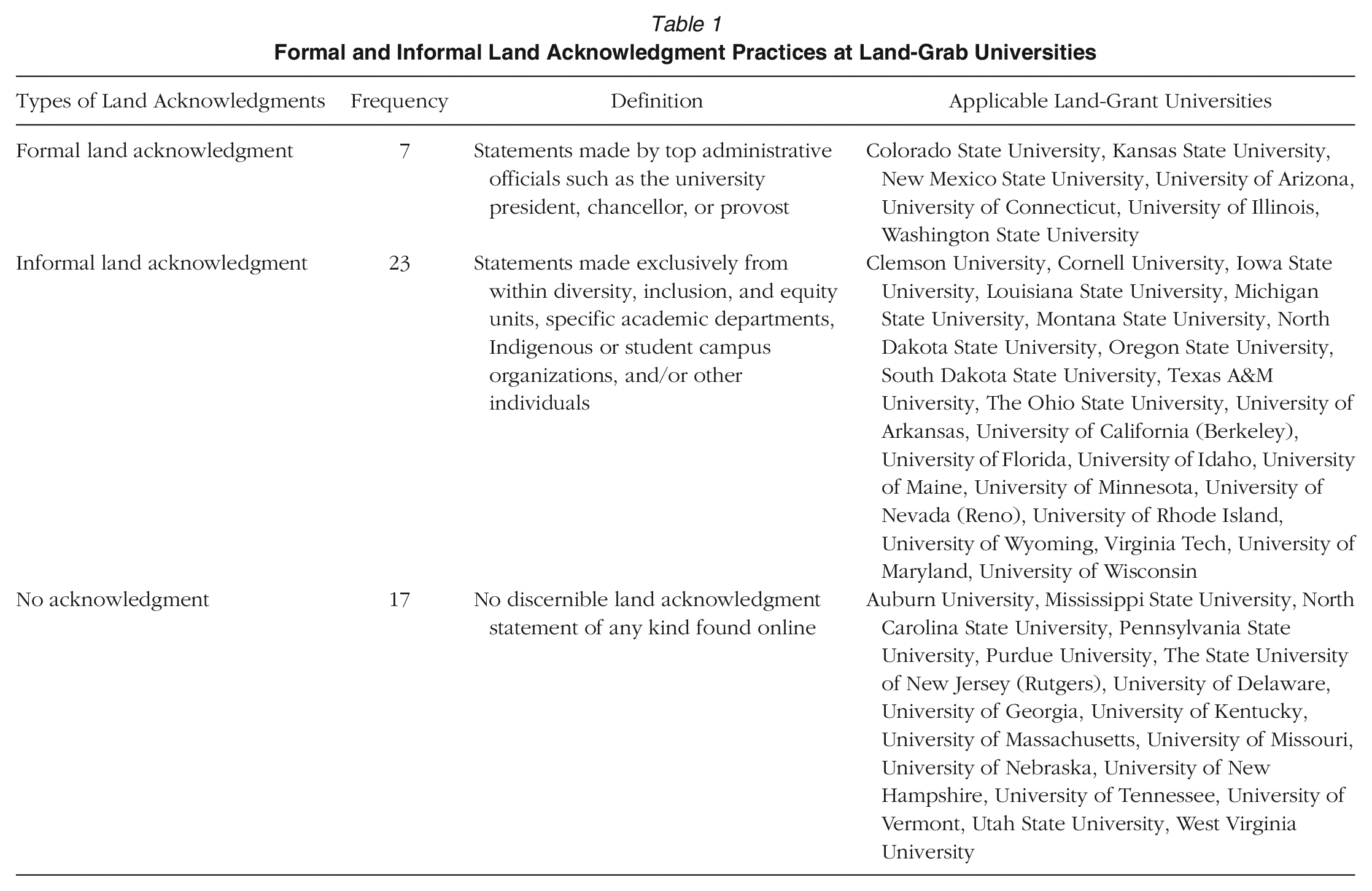
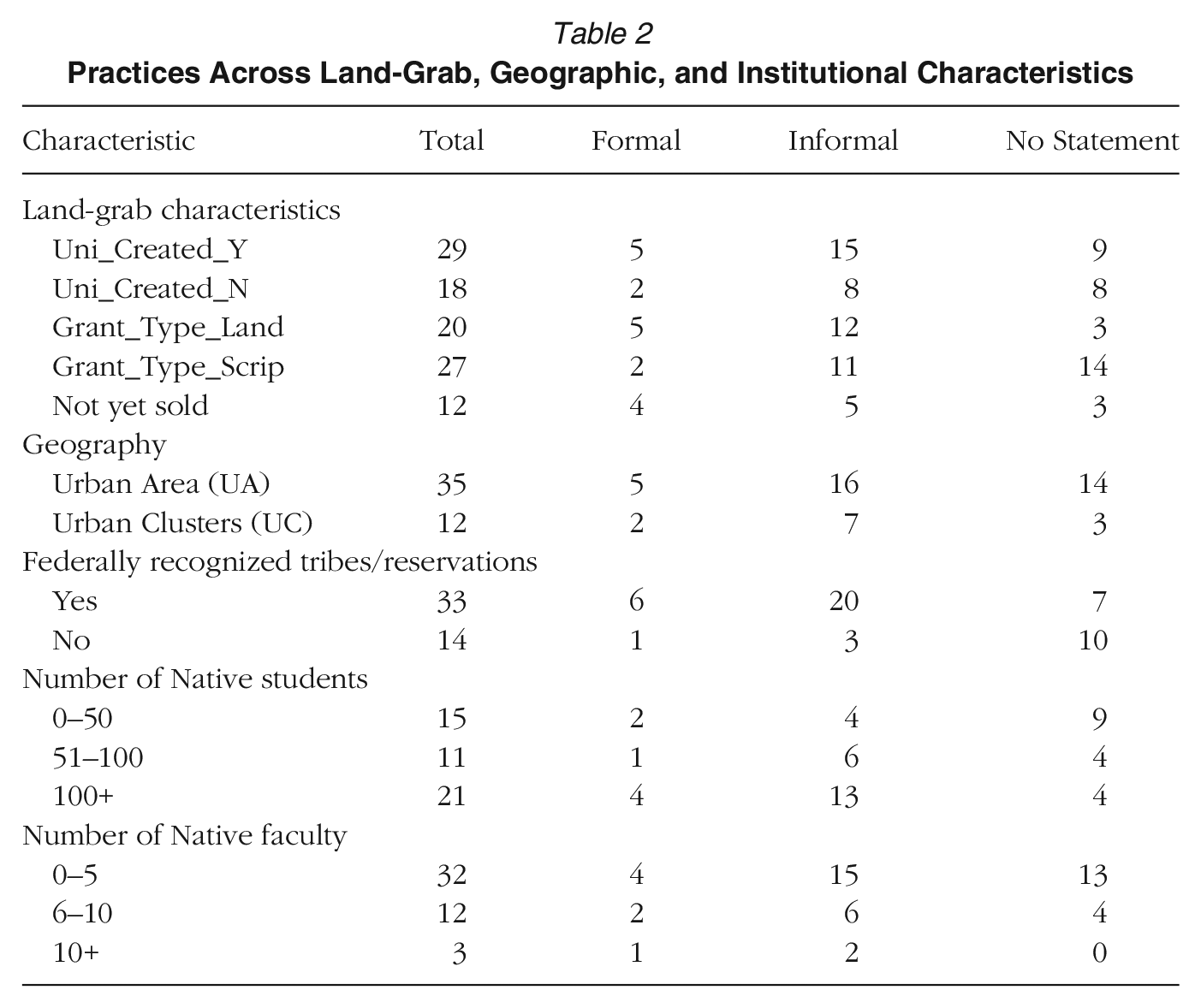
Using both a content and discourse analysis to understand the relationships between language and behavior (Bazeley, 2013), our study identifies and analyzes patterns within and across current land acknowledgment statements. Our full database includes land-grab institutions created under the 1862 Morrill Act (N = 47) (National Research Council, 1995) and proceeds in three phases: land-grab characteristics, institutional characteristics (geographic and population), and copies of all formal and informal land acknowledgments associated with each university as of October 2020. In this approach, we are able to identify both internal (e.g., number and percentage of self-identified Native students) and external university characteristics (e.g., the presence and number of state and federally recognized tribes) that are attentive to the possibility of institutional isomorphism (DiMaggio & Powell, 1983). We focus on this set of institutions to explain the uptake of this practice because (a) these universities are known today as leaders in efforts to “democratize higher education,” (b) the tone and intentions of these land acknowledgments are explicitly shaped by the democratizing mission of the Morrill Acts, and (c) these institutions provide an explicit nexus between the violence of settler colonialism and the development of higher education as a public good. Table 1 organizes these differing institutional practices, whereas Table 2 organizes observations by preceding variables.
Formal and Informal Land Acknowledgment Practices at Land-Grab Universities
Practices Across Land-Grab, Geographic, and Institutional Characteristics
Land-Grab Characteristics
Using data from the High Country News public database (Lee & Ahtone, 2020), we gathered variables related to the year established, land or scrip allocation, number of land cessions under the land grant, acreage granted, years disposed of (if ever), and percentage of the university’s share of the endowment income. The database was derived using “primary source materials including land patent records, congressional documents, historical bulletins, archival and print resources at the National Archives, state repositories, and special collections at universities, digitized historical maps and more” (Lee & Ahtone, 2020). The variable, Uni_Created, noted whether the university was created to take advantage of the Morrill Act, as some universities were created before the Morrill Act and later received land-grab status, while other universities were explicitly established to reap the benefits of the Morrill Act funding. Grant_Type identified whether the land was public domain parcels from within the state’s boundaries or scrip for parcels elsewhere. Year Acres Disposed provides the year that the state’s land-grab had completely been sold, whereas Not all sold yet indicated whether the university continues to retain any acreage from the land grab. These variables present observable points of analysis that link acknowledgment practices to land-grab history through material and territorial resources. Descriptively, of the institutions benefiting from the 1862 Morrill Act, 29 institutions were established to take advantage of the new law, while 18 were previously established institutions. The majority of universities (N = 27) were issued scrip, whereas less than half were issued land (N = 20). According to data obtained from High Country News, 12 institutions still retain land parcels granted under the Morrill Act.
Geographic Characteristics
Once all institutions were identified, publicly available geographic characteristics were gathered, such as city, state, county, and the number of federally and state-recognized tribes within the state. We classified all university geographic locations according to the Census Bureau’s urban-rural classification system (U.S. Census Bureau, 2020), which uses three descriptors: (a) urbanized area (urban areas with 50,000 or more people), (b) urban cluster (population of at least 2,500 and less than 50,000), and (c) rural (all geographic areas that are not included in an urban area according to the U.S. Census). Considering the geographic distribution of the 47 land-grab institutions, we found 75% of universities are located in urbanized areas with 50,000 or more people (N = 35); 25% (N = 12) of institutions are located in urban clusters, with populations of at least 2,500 and less than 50,000; and no land-grab institutions are located in rural areas (N = 0).
Indigenous or tribal nations that reside within the state where the university is located were then identified using the National Conference of State Legislatures (NCLS) (2020) database of Federal and State Recognized Tribes. 4 This data offered observable patterns in the deployment of land acknowledgment statements by geography and in relation to Native nations. Next, we examined the presence of federally recognized tribes and reservations. We observed that nearly three quarters of institutions (N = 33) are located in states with federally recognized tribes and/or reservations, and the remaining quarter (N = 14) are located in states without any recognized Native nations. States without federally recognized tribes include Arkansas, Delaware, Georgia, Illinois, Kentucky, Maryland, Missouri, New Hampshire, New Jersey, Ohio, Pennsylvania, Tennessee, Vermont, and West Virginia. Broadly speaking, these states are clustered to the east of the Mississippi River, a region known for its early and violent removal of Indigenous Peoples. This finding also correlates with behaviors of Northeastern settlers, who are well known for inscribing their own modernity into local histories while promoting the myth of “the vanishing Indian” (O’Brien 2010).
Institutional Population Characteristics
Using the Integrated Postsecondary Education Data System (IPEDS) (2018), the number and percentage of self-identified Native American students and instructional staff were recorded for each university in 2018. The number and percentages of students and instructional faculty are numerically low at these land-grab universities; over half of the universities have less than 100 Native American students enrolled, and 95% of the universities have less 10 ten Native American instructional staff. Proportionally, both populations represent less than 2% across all the institutions in the dataset, most often less than 1%. Montana State University, University of Arizona, Utah State University, and the University of Arkansas are the few exceptions, with over 250 Native students per institution. Michigan State University, University of Arkansas, and the University of Minnesota are also exceptions with regard to institutional staff, with over 15 (yet under 20) Native American persons represented. While numerically higher compared to the other universities, the number of students and instructional staff represent no more than 1.6% and less than 1% of the campus’ overall student and instructional staff population, respectively. We recognize the significant limitations of national datasets to document demographic data on Indigenous students and faculty appropriately (Lopez & Marley 2018; Marroquín, 2020); however, we decidedly draw from this data to observe any patterns in the adoption in relation to the presence of Indigenous students and instructional staff. In our analysis, we are especially mindful of the raw numbers of students and instructional staff.
Land Acknowledgment Statements
Finally, formal and informal land acknowledgment statements were gathered from publicly accessible university websites in October 2020. Statements were first identified through a cursory Google search that used the search terms “[University] land acknowledgment.” Additionally, university websites were searched to ensure any use of land acknowledgment was captured. Formal land acknowledgment includes only those statements made by top administrative officials such as the university regents, president, chancellor, or provost; informal land acknowledgment includes statements made within equity, diversity and inclusion (EDI) units, specific academic departments, Indigenous and/or student campus organizations, or other individuals such as a faculty member or staff member; no acknowledgment means that no discernible land acknowledgment statement could be found online. Of the 47 total institutions examined, roughly 15% of universities have a formal statement (N = 7), 49% have an informal statement (N = 23), and 36% have no such statement (N = 17).
Where statements were not explicitly located in the university regents, president, chancellor, or provost’s office, as is the case with the University of Illinois, we searched for indicators of formal campus adoption. New Mexico State University’s statement, for example, was approved by the faculty senate in January 2020 and awaits approval from the university president. At the time of data collection, Iowa State University had publicly announced its adoption of a statement indicating that the university passed legislation about a formal land acknowledgment. In our search, we also note a unique university commitment at the University of Arizona that acknowledges the state of Arizona’s sovereign nations using a physical monument. Where no formal statements were identified, we searched for the presence in less official areas. We find, for example, that student governments at Oregon State University and the University of Wyoming adopted statements. The University of Idaho and the University of Maine did not have official land acknowledgment statements but did have Memorandums of Understanding (MOU) with local Native nations. These agreements exist between and were initiated by Native students and academic programs yet do not reflect a formal institutional commitment. All statements, websites, university units, and dates of adoption (when provided) were recorded in the database.
Notable Limitations
Throughout, we recognize three limitations of studying land acknowledgments present on university websites only and doing so with caution among EDI units. University community members use a variety of acknowledgments, including spoken acknowledgments; language that recognizes Indigenous Peoples in email signature lines and course syllabi; and longstanding honor practices within Native studies departments, programs, and student-led programs. Thus, what we found on university websites represents only a surface and curated indication of the collaboration, tension, and potential for positive tribal-university partnerships and investment in Native students, faculty, staff, and curriculum. We also recognize that many formal and informal land acknowledgment statements emerged after our thorough data collection and that robust conversation may have been happening at land-grab universities that cannot be captured in the data set. Moreover, only some statements included dates describing when they were drafted or released. Thus, the present data cannot speak to the broader contextual factors that may influence the uptake of land acknowledgment statements (e.g., Indigenous-led movements that challenge settler state policies such as Idle No More and Standing Rock).
Intentionally and relatedly, we did not count statements located in EDI units as formal land acknowledgments because such efforts can be perceived as specifically focused on efforts within the unit and may not amount to institution-wide change. Moreover, while EDI units have important campus responsibilities to address educational inequities, we recognize that such efforts are not often concerned with tribal sovereignty and self-determination; the aims of EDI initiatives can and often do subvert Indigenous futures (Smith et al., 2018; Tuck & Yang, 2018). We intentionally do not take up the campus-by-campus differences in the organizational location and influence of EDI units in this study and recognize that future research is needed to understand how the presence of these statements across EDI units can relay a formal adoption.
Data Analysis
Two forms of analysis were employed in this study: content analysis to understand the language deployed and discourse analysis to understand how language either upholds or upends Indigenous erasure and removal. First, institutions were sorted by geography (e.g., state and county specifically) and institutional characteristics to examine patterns in whether, where, and how such factors contribute to the adoption of formal and informal statements. Second, a content analysis was used to examine language patterns across all statements using MAXQDA. This approach consisted of “systematically identifying specified characteristics of messages” and allowed the researchers to identify the fundamental components of statements (Holsti, 1969, p. 14). The codes developed during this phase included people, land, treaties, multiculturalism, and no practice. Third, informed by the technologies of settler colonialism and social control as an analytic framework, we conducted a discourse analysis to understand the breadth of existing language patterns found within land acknowledgments statements (Bazeley, 2013).
The discourse analysis focused on the “relationship between language and behavior … [to] explore issues associated with power and control as they are expressed through language within the wider context of society and culture” (Bazeley, 2013, p. 216). The discourse analysis generated new theories concerning the adoption of land acknowledgments, and the powerful role rhetoric plays in Indigenous dispossession (Moore et al., 2012). The codes developed during this phase focused on the gestures, commitments, actions, and responsibilities reflected in statements. The coding processes involved iterative rounds of independent and collaborative inductive and deductive coding in MAXQDA to develop the final coding scheme, resolve discrepancies, and obtain reliability.
First, both researchers independently conducted deductive coding on statements using Wilkes et al. (2017) typology as a guiding framework to identify patterns, structure, and word choice in land acknowledgment statements. Both researchers then conducted a round of inductive coding to attend to content not offered by Wilkes et al. Following, the researchers met to develop the coding scheme for the content analysis. An iterative coding process was then engaged by the team for the discourse analysis, specifically focusing on discursive language concerning territoriality, spatial control, and rhetorical removal of Indigenous Peoples from their homelands. After multiple rounds of open coding, the researchers met to compare codes, consolidating similar codes and comparing dissimilar observations to create a coding scheme for discourse analysis. Multiple rounds of coding were engaged until the researchers established a final coding scheme. Thereafter, the researchers used the final coding scheme to code all of the land acknowledgment statements in the data set. Given the relatively small number of institutions as a part of the dataset, the researchers collaboratively reviewed coding to find reliability.
Positionality
Before proceeding with findings, we briefly offer our positionality to this work and commitments to decolonization, anticolonialism, tribal sovereignty, and social equity as two Indigenous women who are alumni of land-grab universities. Ambo is Tongva and Luiseño and writes from her ancestral homelands that are shared with the Kumeyaay Nation. Before migrating to San Diego, she lived in Tovaangar (contemporarily known as Los Angeles), the homelands of her Tongva ancestors. Rocha Beardall is Mexican, Oneida, and Sault Ste. Marie and writes from the ancestral homelands of the Duwamish, Suquamish, and other Coast Salish Peoples. She was born in San Diego and raised among Mexican and Kumeyaay relatives where she was taught to walk lightly and be in good relations with local Indigenous Peoples. As scholars teaching and researching at public universities, we both embrace reparative work that supports the wishes and interests of Indigenous Peoples.
Findings
Critiques suggest that land-grab universities are adopting land acknowledgment practices with little consideration of the relationship between higher education and Indigenous dispossession. The following presents two sets of findings relevant to this critique: (a) we show the current distribution of the practice and (b) the extent to which land acknowledgments account for the social and historical relationship between institutions of higher education and Indigenous Peoples in the past, present, and future. Throughout, we report both the frequency and type of statements that currently exist across U.S. land-grab universities using three categories: formal land acknowledgment statement (N = 7), informal land acknowledgment statement (N = 23), and no discernible or forward-facing land acknowledgment statement (N = 17).
Land-Grab Characteristics
The spatial analysis of land-grab characteristics focused on observable patterns of land acknowledgments by Uni_Created, Grant_Type, and Year Acres Disposed. Broadly speaking, across all variables, we observed a propensity of institutions to have informal or no statements. As mentioned, we found that 29 of 47 institutions were established to take advantage of the Act, whereas 18 of the institutions were already established. Among these 29 land-grab institutions established to take advantage of the Act, five had formal statements, 15 had informal statements, and 9 had no adopted statements. Similarly, of the 18 institutions established preceding the 1862 Morrill Act, two institutions had formal statements, eight institutions had informal statements, and eight had no adopted statement.
Regarding the type of land grant awarded (i.e., scrip vs. land) to states, the majority of universities (N = 27) were issued scrip of land, whereas less than half were issued land (N = 20). Of the states issued scrip, two institutions had formal statements, 11 institutions had informal statements, and 14 had no statements. On the other hand, of the 20 institutions issued land under the act, five had formal statements, 12 had informal statements, and three had no statements. We find a marginal increase in the adoption of formal statements by institutions receiving land versus scrip, which may be attributed to the physical proximity of universities to Indigenous communities, namely, reservation lands. Specifically, we find that land-grab universities issued scrip to be physically distant from those Indigenous Peoples who were/are dispossessed and separate from the social, economic, and political consequences of erasure. This distance lessens the need to formally acknowledge institutional complacency with, and benefit from, settler violence and erasure in a localized land acknowledgment.
Finally, High Country News data revealed that 12 institutions still retain land parcels granted under the Morrill Act. Of these institutions, four have formally adopted statements, whereas five have adopted informal statements. The institutions with formal statements include New Mexico State University, Colorado State University, Washington State University, and the University of Arizona. This finding is particularly insightful to our focus on the relationship between Indigenous dispossession, institutional responsibility, and forward-thinking programs that link material resources with the land acknowledgment practice.
Geographic Characteristics
Our examination of geographic characteristics found that of the 47 land-grab institutions, 75% are located in Urbanized Areas with 50,000 or more people (N = 35). Of these institutions, five have formal acknowledgments, 16 have informal, and 14 have no statements. The remaining 25% (N = 12) of institutions are located in urban clusters, with populations of at least 2,500 and less than 50,000. Of the institutions situated in urban clusters, two have formally adopted statements, seven have informal, and three have no drafted statements. As mentioned, no land-grab institutions are located in rural areas (N = 0). We find that land-grab universities in urban clusters are less likely to have adopted statements at the time of data collection. Regionally speaking, universities in the West and Midwest were also more likely to adopt formal and informal land acknowledgments with greater frequency than those in the South and Northeast.
Deploying our analytical frameworks, we find the relationship between urbanity, regionality, erasure and the uptake of acknowledgment statements to illustrate how social institutions operationalize the logic of elimination. Here the physical removal and psychological erasure of Indigenous Peoples in urbanized areas—as a consequence of regional histories of violence, removal and displacement—correlate with the adoption of formal and informal statements. The adoption of statements by institutions in urbanized areas functions similar to the physical distancing (mentioned above), wherein institutions are separated from the social, economic, and political consequences of erasure from which they directly benefit. We are conscious of the influence of local constituencies, interests, and commitments in the uptake in this practice, which we attend to in recommendations for future research.
Next, we examined the presence of federally recognized tribes and reservations within each state. We found that 33 institutions are located in states with federally recognized tribes and/or reservations, and the remaining 14 are located in states without any recognized Native nations. We observe a tendency by institutions to adopt formal or informal statements where federally recognized tribes are present. Specifically, in states with federally recognized tribes and reservations we found six institutions with formal statements, 20 institutions with informal statements, and seven institutions without statements. In contrast, we found institutions located in states without federally recognized tribes were less likely to adopt statements. Of the 14 institutions in states without federally recognized tribes or reservations, we found one institution with formal statements, three institutions with informal statements, and 10 without any statements. Again, this observation reenforces our previous finding related to urbanity, regionality, erasure and adopted of statements. We find the absence of formal statements to relate to the assumed absence of Indigenous Peoples in the state.
Institutional Characteristics
We also examined the presence of land acknowledgment statements in relation to student and instructional staff demographics. As seen in Table 2, formal (N = 4) and informal (N = 13) statements tend to appear at institutions with over 100 enrolled Native American students, irrespective of their geographic location. In contrast, there was a tendency for institutions with less than 50 Native American students to have no apparent engagement with the practice (N = 9). Interestingly, we observed a correlation between the number of enrolled Indigenous students and presence of formal and informal land acknowledgments. While institutional contexts differ significantly, the presence of Indigenous students and Native student organizations increase a sense of belonging among Native students and provides a campus platform to advocate for Native issues in cocurricular and curricular spaces (Collins 2015; McMillan 2020). Future research can show whether or not this advocacy involves the passage of land acknowledgment statements (e.g., see Virginia Tech Native student organization commitments to advancing campus initiatives).
With regard to Native American instructional staff, we observed a relationship between the adoption of statements and the number of employed personnel; formal (N = 4) and informal (N = 15) adoption of statements are more prevalent at institutions with five or fewer Native American instructional staff. We did not find a significant relationship between land acknowledgment statements and a greater presence of Indigenous instructional staff. We find that regionality better illustrates land acknowledgment patterns across institutions, yet future research can examine the extent to which regional political dynamics or appealing to local constituent groups, including the desires of Indigenous students and instructional staff, influence the uptake of a land acknowledgment practice.
Land Acknowledgment Statements
Last, we report the relationships, commitments, and responsibilities communicated in land acknowledgment statements across land-grab universities. Broadly speaking, informal land acknowledgments utilized more explicit language and contained greater nuance in naming Indigenous Peoples, identifying places and waterways, and tying dispossession to treaty making or violence. These details also speak to the extended length of these statements in comparison to formal statements. Formal statements, conversely, tended to deploy past tense and multicultural phrasing to obfuscate continued Indigenous presence and expropriation of lands. In Table 3, we note whether those relationships emerge with differing frequencies across institutions with formal and informal land acknowledgment statements. While the descriptive analysis alone offers a rich understanding on how institutions adopt land acknowledgments, our content and discourse analysis provides readers with a deeper examination of how rhetoric is deployed within statements across institutions. In some instances below, we provide land-grab, institutional, and geographic characteristics for readers to contextualize the content and discourse analysis.
Expression of Relationships, Commitments, and Responsibilities Across Statements
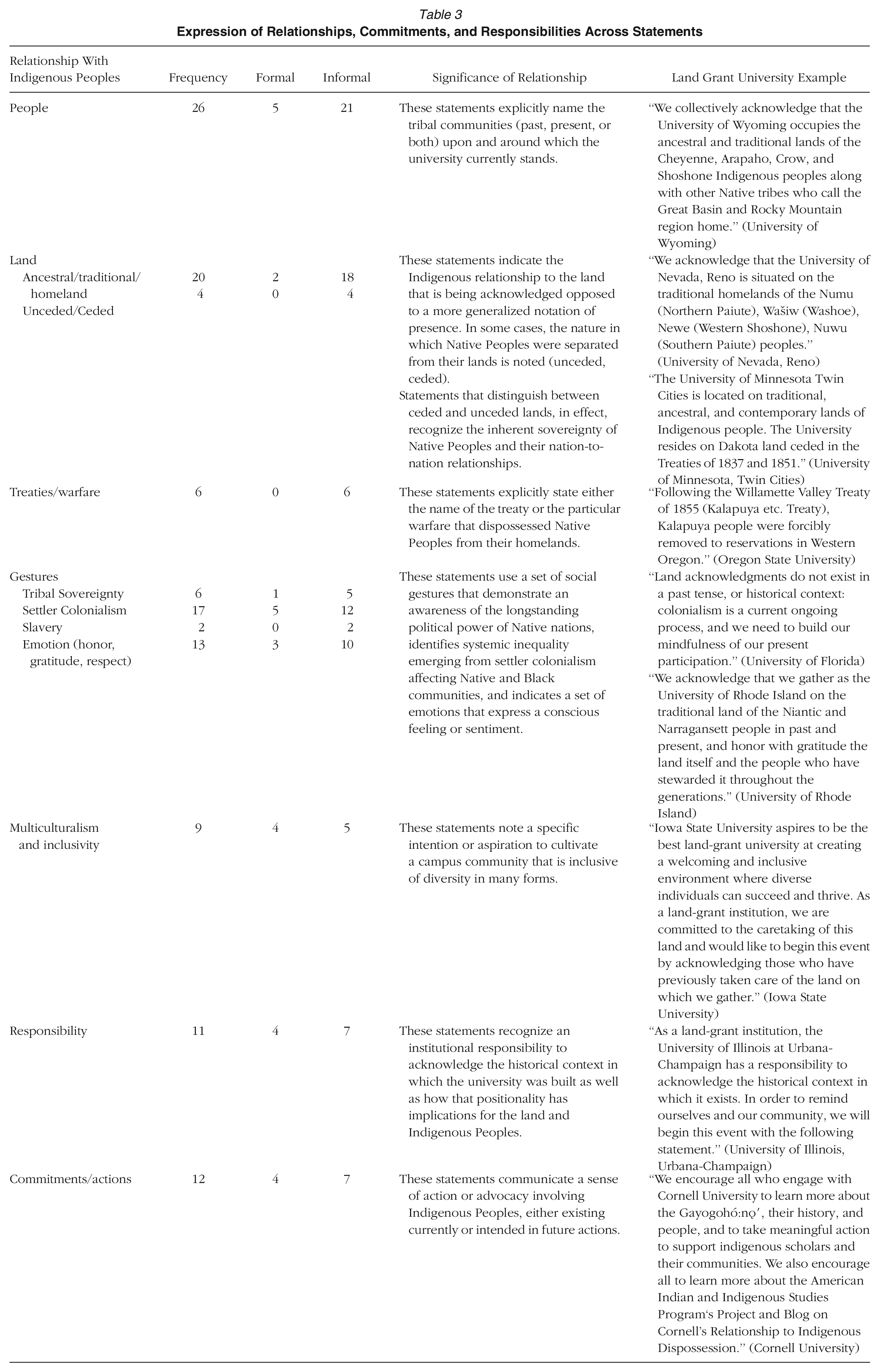
Content analysis shows that nearly all statements explicitly name the tribal communities (past, present, or both) upon and around which the university currently stands (N = 26), two-thirds of statements acknowledge an Indigenous relationship to the land (ancestral/ traditional/homeland) as opposed to a more generalized notation of presence (N = 20), and roughly 10% of statements situate the nature in which Native Peoples were separated from their lands as ceded or unceded (N = 4). As an example, the University of Wyoming’s informal statement reads, “We collectively acknowledge that the University of Wyoming occupies the ancestral and traditional lands of the Cheyenne, Arapaho, Crow, and Shoshone Indigenous peoples along with other Native tribes who call the Great Basin and Rocky Mountain region home,” gesturing both to identifying “ancestral and traditional lands” as well as naming Indigenous Peoples. The University of Wyoming was established in 1886 and not explicitly for the purpose of taking advantage of the 1862 Morrill Act. A total of 29 institutions were established for this reason and only 5 of those universities have a formal statement.
Relatedly, we find that recognition of lands and peoples is also associated with historical dissociation on matters of law and state violence. Several statements disassociate land-grab institutions from historical events by avoiding the unique legal and historical context of Indigenous dispossession, both locally and as a national settler colonial phenomenon. Multiple institutions state “the responsibility to acknowledge the historical contexts in which the institution exists” using nondescript language. North Dakota State University, for example, acknowledges the “painful history of forced removal from this territory,” yet fails to account for how their distinct land-grab mission will address this loss by either tribal relationship building or commitments to Native student recruitment and retention.
Treaties
Additionally, we coded all statements to account for those that explicitly state either the name of the treaty or the particular warfare that dispossessed Native Peoples from their homelands (N = 6). These discussions of peoples, land, and treaties, and/or warfare appeared in informal statements only. The University of Wisconsin–Madison’s informal statement stands out because it goes beyond mere acknowledgment and identifies itself as occupier of Ho-Chunk homelands and acknowledges that the ongoing occupation disrupts lands known as Teejop by the Ho-Chunk. This full informal statement reads,
The University of Wisconsin-Madison occupies ancestral Ho-Chunk land, a place their nation has called Teejop since time immemorial. In an 1832 treaty, the Ho-Chunk were forced to cede this territory. Decades of ethnic cleansing followed when both the federal and state government repeatedly, but unsuccessfully, sought to forcibly remove the Ho-Chunk from Wisconsin. This history of colonization informs our shared future of collaboration and innovation. Today, UW-Madison respects the inherent sovereignty of the Ho-Chunk Nation, along with the eleven other First Nations of Wisconsin.
Wisconsin-Madison’s specificity also makes explicit that their institution was made possible by an 1832 treaty in which the tribe was forced to cede their lands. Notably, Wisconsin-Madison’s informal statement also calls out “decades of ethnic cleansing followed when both the federal and state government repeatedly, but unsuccessfully, sought to forcibly remove the Ho-Chunk from Wisconsin” as an important testament to the violence and national reach of settler colonialism across the lands that are now known as the United States.
We note that the University of Wisconsin–Madison’s statement is informal because it does not demonstrate the use of formal institutional and legislative processes to recognize the university’s role in Indigenous dispossession. We also note that Wisconsin was established in 1836, and subsequently provided public domain parcels from within the state, instead of scrip to purchase land parcels elsewhere, to help finance the school. Wisconsin is currently home to 11 federally recognized tribes and 11 tribal reservations, making it one of the eight schools that received land to have 10 or more tribal nations residing within that state. Of those eight universities, three have formal statements and five have informal statements including Wisconsin.
Gestures
Next, inductive coding revealed a set of social gestures embedded within both formal and informal land acknowledgment statements. These gestures demonstrate an awareness of the longstanding political power of Native nations, including specific notations of tribal sovereignty (N = 6); identify systemic inequality emerging from settler colonialism affecting Native (N = 16) and Black communities (N = 2), including Clemson and Virginia Tech; and indicate a set of emotions that express a conscious feeling or sentiment such as honor, gratitude, and respect (N = 13). These gestures vary widely across institutional types, revealing that informal statements are more likely to recognize tribal sovereignty and note the enduring presence and/or effects of settler colonialism and slavery. However, this recognition is not uniformly critical of White supremacy or its legacies; acknowledgment of emotion, inclusivity, institutional responsibility, and advocacy differed across formal and informal statements.
At the time of data collection, Clemson University had a digital brochure buried in the list of the university’s historic properties (three plantations owned by the university) that lists the treaties signed by the Cherokee Nation. The brochure indicated that treaties “ceded” the land on which Clemson now stands. The brochure also gestures toward an awareness of tribal nations, their homelands, and regional politics by explaining that
the northwestern area of South Carolina that now includes Clemson was once the land of the Cherokee where the Lower Towns were located. On May 20, 1777, after the Cherokee War of 1776, the Cherokee ceded over all their land in western South Carolina except for a narrow western strip.
This statement names tribal nations explicitly but makes no mention of the coercive treatment and the violence of forced removal they endured. As of 2018, Clemson University employed zero Native faculty and enrolled 50 Native students (0.002%).
Multiculturalism and Inclusivity
In addition to social gestures, roughly 30% of universities with a land acknowledgment statement linked their statements with a specific intention or aspiration to cultivate a multicultural campus community that is inclusive of diversity in many forms (N = 9). These intentions are more likely to occur in formal statements (N = 4) than informal statements (N = 5). The University of Maryland’s Performing Arts Center’s informal land acknowledgment statement, however, demonstrates some tensions in moves for multicultural inclusion. This statement erases Native presence and context by referring to the “generations from around the world who contributed their hopes, dreams, and energy to making the history that led to this moment.” The statement reinforces this erasure and that of enslaved Black ancestors in the remark, “Some were brought here against their will, some were drawn to leave their distant homes in hope of a better life, and some have lived on this land for more generations than can be counted.” It is not until the final section of the statement that the center acknowledges a specific nation. Later, we will revisit how the framing of Indigenous Peoples in the past tense (more than half of the statements) effectively erases Indigenous Peoples from their homelands, working in tandem with the institutions’ historical disassociation. We note that Maryland does not have any federally recognized tribes or tribal reservations in their state. As of 2018, the University of Maryland employed four Native faculty (0.002%) and enrolled 42 Native students (0.001%).
Responsibility
Approximately 40% of universities with a land acknowledgment statement recognized an institutional responsibility to acknowledge the historical context in which the university was built as well as how that positionality has implications for the land and Indigenous Peoples (N = 11). This function highlights the opportunity for a convergence of institutional mission and Native nation-building. We are wary of these relationships when they are framed as mutually beneficial and reciprocal partnerships without substantive evidence to support this assertion. Deeper analysis illustrates how mutuality may, in fact, be more appropriately defined as interest convergence—social and economic changes in institutional protocols as the result of a dominant group’s interests converging with a subordinate group’s interests, namely, because the dominant group is invested in how such changes benefit their bottom line (Bell, 1980). For example, the University of Arizona, one of 29 universities founded to take advantage of the Morrill Act, writes, “Aligning with the University’s core value of a diverse and inclusive community, it is an institutional responsibility to recognize and acknowledge the People, culture, and history that make up the Wildcat community.” This statement foregrounds institutional responsibilities in accordance with the mission yet fails to offer a written commitment to Indigenous Peoples beyond recognition. As a result, the institution simultaneously subverts any desires or needs of local Native nations while maintaining their institutional responsibilities—a discord that is common across land acknowledgment statements. 5
Commitments
Last, we find three quarters of universities with a land acknowledgment statement communicates a sense of action or advocacy involving Indigenous Peoples, either existing currently or intended in future actions (N = 12). Relatedly, we find the potential function for land acknowledgment statements to function as relationship-building tools to be promising. In fact, more than half of these statements are framed as initial steps toward cooperative and collaborative institutional futures in partnership with tribal communities. Washington State University, for example, articulates a commitment to establish and maintain relationships with Native nations by connecting tribal sovereignty to the land-grab mission. The University of Illinois at Urbana-Champaign geographically situates itself upon the homelands of 13 distinct tribal nations, including the Peoria, Kaskaskia, and Piankashaw, and suggests the need “to work with them as we move forward,” yet leaves the details of that collaboration to the reader’s imagination. We note that Washington State was offered public lands in the state to fund the institution’s endowment while Urbana-Champaign was offered scrip for parcels outside of Illinois. Washington State has 29 federally recognized tribes and Illinois has 0 recognized tribes.
Discussion and Conclusion
We examined the language, tone, and intention of land acknowledgments at land-grab institutions to understand if these statements offer material, measurable, and tangible reform, and whether such reforms are tailored to the particular social and historical context of each university. Our findings across 47 land-grab universities indicate that institutions may be engaging in rhetorical removal when adopting a land acknowledgment practice. In short, we find that institutions’ use of language selectively erases nonsettlers from the rights and benefits that settlers accrue on behalf of their assertions to place. We identify three key modalities of rhetorical removal including language that continues the erasure of Indigenous Peoples and places; a lack of language regarding institutional accountability for the enduring effects of settler colonialism; and a need for language about meaningful, resource-centered partnerships with tribal communities and Native students. Institutions that appropriately address these gaps, among others, can move land acknowledgments beyond their performative aspects and into tangible social change by reversing inequities that disadvantage Native students and communities. In our research and our professional settings, scholars can likewise examine how and why we import social practices, whether such practices hold us accountable to anti-Indigenous violence in the United States, and how they move us toward reconciliation.
The first instance of rhetorical removal involves the use of language to erase Indigenous Peoples and places, thus exacerbating the violence of physical removal. Our institutional and geographic findings suggest that land grabs are more likely to adopt formal or informal statements in urban areas or where federally recognized tribes are present. In urban areas where Indigenous communities are less visible, we argue that the adoption of statements reflects a relatively low-risk practice by institutions with limited accountability to the named Native communities. Likewise, the adoption of statements, and language written into these statements, illustrate settler colonialism’s enduring erasure of Indigenous Peoples through the use of past tense language, found in nearly half of all land acknowledgments. They also fail to acknowledge the role of U.S. law and institutions in Indigenous dispossession. Land-grab universities can refuse rhetorical removal by explicitly naming lands and peoples in present tense and recognizing a tribal community’s continued sovereign relationship with their homelands. When statements are overly broad, these relationships are made abstract to the detriment of the very peoples the statements purport to honor. The significance of these changes cannot be overstated, both in terms of how this legacy of dispossession impacts Indigenous students and how land-grab universities might reimagine the reach of their founding mission.
The second illustration of rhetorical removal involves a lack of institutional accountability for the existence and persistence of settler colonialism. Our findings show that land-grab universities often fail to publicly accept their responsibilities as beneficiaries of Indigenous dispossession. This omission is aligned with a long history of Indigenous exploitation in service of the financial and social efficacy of higher education institutions. The historical record shows that when faced with challenges to finance institutional operations, university founders physically and emotionally exploited Indigenous Peoples in order to solicit money from donors. Thus, in addition to being another form of erasure, removal, and separation, a lack of public accountability allows settlers to keep the rights and benefits that their institutions accrue out of the public eye. Moving forward, land-grab universities must mobilize their moral responsibility and atone for their complacency in the Morrill Act’s traumatic history—a phenomenon that we call the “Morrill/Moral Responsibility.” While land acknowledgments themselves do not redistribute resources, statements can commit institutions to actionable steps such as allocating material resources and responsibly challenging settler ideologies of extraction and territoriality. Resource redistribution can be used to invest in current campus communities and remedy low numbers of Native students and instructional staff. We situate this institutional responsibility in the historical reality that land-grab budgets were endowed by monies derived from the sale of dispossessed Indigenous, profiteering that remains ongoing from growing endowments and mineral and resource extraction more than a century later.
A third and final modality of rhetorical removal involves a need for explicit language and formal programming that reduces inequities through meaningful, resource-centered partnerships with tribal communities and Native students (Stewart-Ambo, 2021). In the data, we find little evidence of settler accountability to local Indigenous Peoples, either by using material resources tied to formal administrative relationships or by concrete recruitment partnerships. While such resources may exist elsewhere on campus, we argue that the intentions of current land acknowledgment statements should be reflected in a series of measurable improvements. These improvements include student enrollment, retention, graduation, the number of institutional student support or academic programs, and external relationships with Native nations (Mills, 2018; R. Robinson 2016; Vowel, 2016), all of which must be as public and easy to communicate as the land acknowledgment statement itself. Likewise, MOUs/MOAs, transfer agreements, and tuition and fee remission, among other targeted programs, must be implemented and publicly accessible for all campus constituents to access. Without material resources tied to the proliferation of land acknowledgment statements, there is a warrant for concern that the adoption of statements may be a settler move towards innocence that functions to absolve institutions and individuals of responsibilities to the Native nations they purport to recognize (Tuck & Yang, 2012). In other words, land acknowledgments must challenge existing power hierarchies in institutions of higher education, lest they join a long list of other diversity and inclusion practices that fall flat of measurable change.
Moving forward, our findings suggest a series of critical interventions necessary for policy, practice, and research innovations at the university level. Some interventions are linked directly with the land acknowledgment practice while others concern the ongoing and active participation in reproducing social and economic inequality by land-grab universities in the United States. Together, these interventions are concerned with issues of transparency and accountability and emerge from our thinking on the rights and benefits that settler universities enjoy as a result of their violent assertion to place. To begin, we recommend that land-grab universities create a landing page to house their formal land acknowledgment statements. Such a page should be easily identifiable on the campus’s main website and include clear time stamps for when the statement was drafted and adopted. Institutions can center transparency and accountability about their intentions and accomplishments by making prior dated iterations of their land acknowledgments available at these same digital locations.
Second, land-grab universities must zealously evaluate and, in turn rematriate, Indigenous lands and land rights held in trust originating under the Morrill Act. Rematriation is an emerging decolonial and social justice practice that connects private and public landholders with their Indigenous stewards in recognition that Indigenous Peoples were violently dispossessed and removed from their homelands and lifeways as a result of settler colonialism. The explicit goal is to transfer Indigenous lands back to tribal nations. Recent examples include the return of ancestral homelands to the Lower Sioux Indian Community from the State of Minnesota and the Minnesota Historical Society in 2021 (WCCO-TV Staff, 2021) and the federal government transfer of nearly 12,000 acres of forest service lands to the Leech Lake Band of Ojibwe in 2020 (Sneve, 2021). Collectively, these practices are organized under the trending use of the hashtag #LandBack. 6 From our reading of the High Country News data, there are 500,000 acres ripe for rematriation to Indigenous Peoples. While this recommendation is not explicit to the revision of statement, this is a powerful way to move beyond mere gestures and toward tangible repair for land-grab universities inheritance of settler colonial violence.
Universities are settler colonial institutions and, thus, not excluded from the ideologies and intentions of Indigenous elimination. Embracing tangible, reparative action to honor and support Indigenous Peoples can ensure that land acknowledgments account for the anti-Indigenous violence that continue to make land-grab universities possible. And yet, to ensure that land-grab universities’ commitment toward social justice is unequivocal, much more must be done. An important step is recognition that material resource redistribution is in itself deeply entangled within shared histories of colonization that affect all aspects of contemporary social life. This reality requires a more intimate language and agenda about what reparative action might entail.
For example, curricular and programmatic innovation are ideal sites to envision, and enact, what is at stake across and within campus communities and to develop a shared language about what it means to take responsibility for the violence of settler colonialism that undergirds American higher education. This curricular and linguistic labor must also include the perspectives of several voices including tribal communities, state legislatures, students, employees, alumni, and donors, among others if we are ever to arrive at a different university design than the one we have inherited. Understandably, this labor will operate and look different across the various types of land-grab institutions and among differently racialized peoples. Our hope is that open communication about university experiences can empower transformative sensitivity around this work. Without this action plan, land acknowledgments will read as an addendum to the problem of settler institutions’ institutionalizing multicultural and inclusion practices, as opposed to radical reshifting how higher education mobilizes their responsibilities toward society—including Indigenous societies, peoples, and place.
By establishing an empirical baseline about current land acknowledgment statements, this study opens up several critical opportunities for future research to expand this study to include all designated land-grab universities, as well as Historically Black Colleges and Universities and Tribal Colleges and Universities incorporated under 1890 and 1994 land-grant legislation. 7 Our analysis of institutional characteristics also suggests that future studies should include data on the presence of academic programming and cultural resources on campus as well as expanded qualitative data collection such as video testimony from student and community groups on the issue of land acknowledgment and Indigenous dispossession. A recognition of the violent legacy of slavery in land acknowledgment statements also reflects a set of parallel and intersecting inequalities that remain salient to future analysis of land acknowledgment statements. Future research may include comparative analysis on universities that owned or benefited (directly or indirectly) from slavery. Relatedly, additional research comparing the presence of statements at assimilation schools for Indigenous students (e.g., Harvard, Dartmouth, William and Mary) will reveal much about the relationship between Indigenous dispossession and higher education. These schools did not benefit from the 1862 Morrill Act and therefore were not a part of this study; however, their institutional history constitutes a meaningful area to explore further.
Finally, we also encourage future empirical research on the study of all public institutions in the United States, as well as interviews with individuals who led or participated in the drafting of land acknowledgment statements and coding of academic senate meeting transcripts regarding the uptake of land acknowledgments. This in-depth qualitative data will provide a more nuanced understanding of the development and adoption of land acknowledgments, an approach that will augment our investigation of university websites that cannot reflect the organizing and contestation around Indigenous dispossession on a college campus. Our focus did not allow for inquiry into the decolonial and anticolonial intentions and desires of the author(s) of land acknowledgment statements, which merits further investigation.
In closing, we recognize that land acknowledgment statements and practices are not new. Indigenous Peoples across the globe have long sustained practices and protocols of recognizing, acknowledging, announcing, welcoming, and inviting each other, as well as non-Indigenous people, into their territories since time immemorial (Stewart-Ambo & Yang, 2021). We appreciate that many of these statements are written by Indigenous Peoples and allies working and studying within these institutions. Additionally, we recognize that it is possible that an institution could make extensive redistributive decisions regarding land and resources in cooperation with Indigenous Peoples without formally adopting a land acknowledgment. Our findings and policy recommendations about settler land acknowledgments are not a criticism of any hardworking efforts to improve these institutional spaces. Instead, we speak to the impression that land acknowledgments are being picked up as a common social justice practice and offer insights on the tensions and limitations of existing statements at land-grab universities. Our findings reveal that it is more common that land-grab institutions do not have formal land acknowledgment statements. If these institutions represent a microcosm of higher education, then there is much work to be done. Indeed, as acknowledgment practices continue to permeate U.S. institutions due to legislation and social norms, we argue that statements must serve a critical role in addressing the historical legacy that U.S. higher education plays in manufacturing educational inequities and continuing Indigenous dispossession. Without this conscientious framing, statements have the unfortunate potential to retrench existing inequities.
Footnotes

Notes
T
T