




Abstract
Purpose
This commentary aims to echo Wilkinson, Bailey, and Maher's (this volume) arguments about the affordances of videos and video databases in studying learning and teaching.
Design/Approach/Methods
This article illustrates a multivocal approach to the videos from the Video Mosaic Collaborative (VMC). In particular, three mathematics teachers in Shanghai were invited to watch and discuss a set of VMC videos. Two recurring themes concerning mathematics learning and teaching were identified in this video-cued interview and discussed in relation to the VMC Analytics.
Findings
The VMC videos played a mediating and facilitating role in the interview, helping the teachers notice and reflect on the mundane, implicit culture practices. Based upon this analysis, I argue that to tap into the potential of video in educational research, we need to see videos as more than data and look for more possibilities of using them.
Originality/Value
To open and further research dialogues, this article discusses future directions of using videos in educational research and serves as an invitation to creative explorations, in-depth conversations, ethical reflections, and cross-cultural collaborations on the use of videos in education.
Our everyday lives are now permeated with videos. Over four decades, videos have become an important source of data in social and educational research (Erickson, 2011). Wilkinson, Bailey, and Maher (this volume) introduce Video Mosaic Collaborative (VMC), an open database that collects over 400 hours (and more forthcoming) of videos capturing mathematical teaching and learning. They also present the VMC Analytics, a collection of video-based narratives from researchers, associated with video clips, analyses, and relevant resources such as transcripts and student work. Drawing on two examples from VMC, Wilkinson, Bailey, and Maher's article shows how this rich, fully accessible database of videos fosters interdisciplinary collaborative research on mathematics learning and language development.
This commentary echoes Wilkinson, Bailey, and Maher's arguments about the affordances of videos and video databases such as VMC in studying learning and teaching by analyzing an interview with three educators centered on videos that invited diverse perspectives and voices. In particular, I invited three mathematics teachers in Shanghai to watch a set of videos used as one of the examples in the original article and to make comments, reflections, and conversation in general. I then analyzed the interview transcript in relation to the original article and the VMC Analytics. My goal is not to present a full-scale empirical study, but to illustrate a way of using videos as more than data and to open a research dialogue for readers. I first describe the methodology of video-cued interview I used, followed by a two-part analysis of the interview data, and a discussion of how videos facilitate the interview. Finally, I conclude this article by suggesting several directions for future research.
Video-Cued Interview with Mathematics Teachers in Shanghai
Video-cued interview as a research method was developed primarily by cultural anthropologists who filmed the people and communities they studied and used the videos to assist their ethnographic interviews (e.g., Connor, Asch, & Asch, 1986; Spindler & Spindler, 1987). In these studies, videos served not as data, but as interviewing cues to provoke informants’ reflections and to facilitate conversations. Tobin and his colleagues, in their classic “Preschools in Three Cultures” studies, refined this method (Tobin, Hsueh, & Karasawa, 2009; Tobin, Wu, & Davidson, 1989). They videotaped the everyday routines of preschools in the U.S., China, and Japan, edited the footage into a film of “a typical day” for each, and used them as cues to stimulate interviews with different parties: the teachers watching themselves in the film, the director and other teachers at the same preschool, directors and teachers from other cities in the same country, early childhood educators in the other two countries, and finally, professors in early childhood education in the three countries (Tobin et al., 2009). In doing so, the researchers “collect and then present a series of voices all talking about the same set of videotapes” (2009, p. 15) which helped them get at “implicit cultural practices” (2009, p. 18) of teachers, hence their method being termed “video-cued multivocal ethnography” (for a more detailed overview, see Tobin, in press).
I have no ambition to conduct an equivalent study. Nevertheless, I find this method informative here for two reasons. First, as the VMC videos are accessible online, they can well cue interviews with mathematics teachers, teacher educators, and mathematics education researchers, both within and outside the U.S. More importantly, the VMC Analytics has inscribed the voices of insider researchers. The interviews—and the analysis of the interviews—can then, as different voices, be compared. Because mathematics learning and teaching, just like early childhood education, is inherently cultural practice, the multivocality in video-cued interviews will enrich our understanding of the implicit.
I invited three elementary mathematics teachers to participate in the interview. Teacher Lin (male), who I have been acquainted with for a decade, holds a master's degree in education and has 8 years of teaching experience. After 5 years teaching mathematics in a public school in Shanghai, he currently works in a Chinese-English bilingual international school. The other two teachers were Teacher Lin's colleagues: Teacher Tian (female) has a bachelor's degree in elementary education and has taught for 23 years; Teacher Guo (female) holds a bachelor's degree in Chinese literature and has 12 years of teaching experience. In addition, these teachers all taught elementary mathematics in the United Kingdom for an exchange program in 2014–2015.
During the interview, I first introduced the teachers to VMC, and then had them watch the videos for events 1 to 11 of “Stephanie's Journey with the Towers (Grades 3–8): A Metaphor for Making Connections” (https://rucore.libraries.rutgers.edu/rutgers-lib/46895/EMAP/1/play/). For event 3, instead of using the short version (nearly two-minute long), I chose to have the teachers watch a longer version (nearly 14-minute long) (https://rucore.libraries.rutgers.edu/rutgers-lib/36949/#playback/MP4–1) because this was the event on which Wilkinson, Bailey, and Maher's analysis focused. Transcripts and student work downloaded from the website were provided. I skipped the embedded narrations, which could be distracting. During the screening, we paused the videos from time to time to let the teachers make comments and discuss what they found interesting or concerning. Whenever necessary, videos were played back for a closer look. In the end, I asked the teachers to share how they felt about the interview per se, particularly how videos made the conversation different from the interviews they experienced before. The interview took 2 hours and was videotaped by a camera set up on a fixed tripod. Two themes recurring in the conversation were identified as I reviewed and transcribed the interview.
Task Contexts as a Support for Learning
The teachers were keen, in particular, at the beginning of watching each clip, to make sense of what Stephanie and her peers were doing. Often, they raised questions, such as “are they building towers of the same height this time” and “is this what our kids usually do in third grade” to each other. Sometimes I posed questions such as “what do you think Stephanie means by saying this” to them as a conversation starter. They also made comments such as “she is starting to have principled thinking” or “we would no longer ask students to draw tables here”, and then discussed their explanations. By pointing out something in the video and discussing what was going on, the four of us gained a better understanding of what challenges Stephanie faced and how her learning took place.
In our discussion, what mostly confused the teachers was the very task of building towers. Watching “Stephanie's journey with the towers” in her 4th, 5th, and 8th grades, the teachers frequently asked, “Why is she still working on these towers?” Teacher Guo commented, “The teacher gave students this one task, and asked them to solve it again and again, at different grade levels.” In China, as they told me, students face the same counting problem when asked to “color a bunny”, “choose an outfit” or “take a route to school”. They emphasized that the coloring task should be only for preschoolers or lower-elementary students, while getting oneself appropriately dressed and navigating for the best route were for mid-elementary students. When I asked about the differences they saw between these tasks and the towers task that Stephanie was engaged, Teacher Tian said:
Actually [our tasks] focus on a core idea of the content knowledge—the same thinking, combination, right? But we put it in a variety of contexts, then the problem becomes deeper and deeper, and students’ thinking becomes increasingly clear. Also, they will develop a greater ability to ju-yi-fan-san.
Ju-yi-fan-san ( ) is a common Chinese idiom meaning “to infer” (literally, “to draw inferences about three other cases from one instance”). Later, Teacher Lin and Guo elaborated on this point and discussed their understandings of how ju-yi-fan-san works:
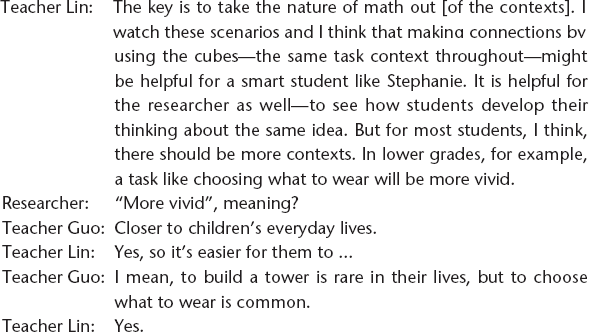
The teachers frequently mentioned “the nature of mathematics” in their discussion. I thus asked, after viewing the last clip of “Connecting Everything: The Towers as an Assimilation Paradigm”, what they meant by this term. The teachers responded:
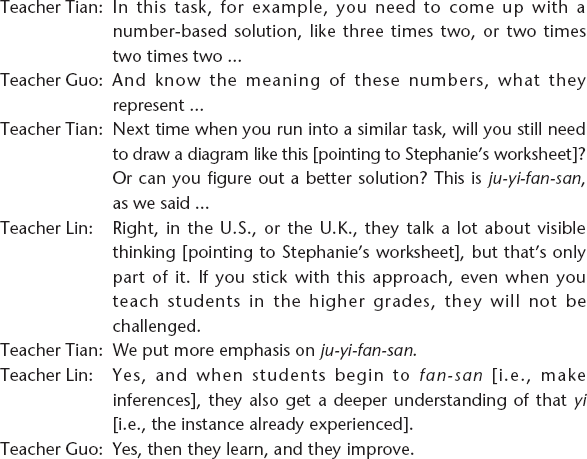
These discussions construct a different narrative than the VMC Analytics (Ortiz, 2014) cited in Wilkinson, Bailey, and Maher's article. Based upon Davis’ theory of assimilation paradigm, Ortiz argues that Stephanie's early experience with the task of building towers, which served as a metaphor, supported her later exploration with the combinatoric notation and Pascal's triangle. According to Maher's narration in the video, moreover, the consistent reference to the towers helped Stephanie “see” the triangle, which, otherwise, would have been difficult for her to visualize. The teachers in Shanghai, however, preferred the approach of challenging students with a wide range of task contexts in early grades, rather than a consistent use of one context across time. This view is in line with existing research that has identified teaching with varied problems as a key feature of mathematics education in China (e.g., Gu, Huang, & Marton, 2004). Although such difference about what counts as meaningful learning seems to map onto the long-standing “contextualization vs. decontextualization” debate (Boaler, 2000), the underlying cultural beliefs worth further study (Cai, 2005; Ma, 1999; Wang & Cai, 2007).
Small Group Interactions and Egalitarian Teaching
The teachers were impressed—not surprised, though, as they have experienced classrooms in the U.K.—by the dyadic interactions between Stephanie and Dana when they were 3rd- and 4th-graders, and by the small group interactions in the “Gang of Four” interview. All three teachers described these interactions as “good for learning” and, more importantly, “showing respect for individual students”. As they discussed the “Gang of Four” interview:
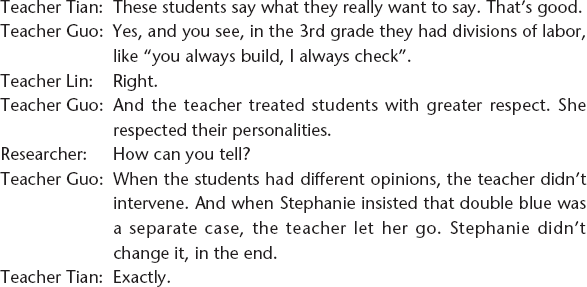
The teachers’ observations did not stop at making stereotypes (“classrooms in the U.S. are full of interactions”) or expressing clichés (“classroom interactions are great”). Rather, as they carefully examined the video, they noticed details, reflected on their own practice, and tried to interpret the differences. In the “Gang of Four” interview, all the teachers noticed not just Stephanie, who was the focal child of the study and was notably marked by “clear thinking” and “nice articulation”, but other students who were also contributing to the discussion. For instance, they showed great interest in Jeff, a student who “hasn't been with us” (as Maher noted in the video). When Jeff argued against Stephanie's idea that “blue-red-blue” was not a case of “two blues”, Teacher Tian laughed:
Although Jeff must have learned that Stephanie is better at math than he is, he still argues with her in a serious manner. He still challenges her.
The teachers were worried about Jeff, who might not learn as much as Stephanie did in this work. They shared the same concern with Maher, who narrated in the video that she had “always wondered if when [Jeff] says, ‘Why do you have to have a pattern” if he doesn't mean that in frustration”. The teachers also noticed Jeff's frustration, and wondered if he truly bought, or even understood, Stephanie's argument, or he just pretended to be convinced due to peer pressure. Teacher Lin said:
It is likely that there is a small group of students who always talk, leading the discussion, and there're those who are always listening. It depends on the teacher. Some teachers, if they are concerned, they will intervene, “This time it's your turn to say something”. Otherwise, those who talk will be more and more clear [about the knowledge], while others just get lost.
Teacher Guo compared her experiences in Shanghai and in the U.K., then added:
In Shanghai, we must set an instructional goal for each lesson, and we expect every student to achieve it. But in the U.K., they don't have an explicit goal, so some students seem to get a sense during the interaction yet forget what they learn right after school.
When I asked what happens if a student does not achieve the goal, Teacher Tian pointed to the first two clips and said:
That's why we said it is important to go back to the nature of mathematics after a task, whatever task it may be. In lower grades, who will really be left behind? As long as the teacher teaches them—just a little bit—those low achievers will all catch up. But if they always explore by themselves, or join interactions without particular guidance, they will certainly be out of the game by 9th grade.
An egalitarian view of teaching emerges from these comments. These teachers not only paid close attention to all the students in a group but also believed that every one of them, no matter how they currently perform, could learn well once the teacher taught them “on time”. In short, everyone is teachable, and teachers are responsible for teaching every one of their students (On, 1996; Li, 2012). The teachers stressed to me as I paused the video at a cover shot of the seven persons around the table (i.e., the three researchers on one side and the “gang of four” around the table), interactions are indeed necessary for learning, yet “it is the teacher's responsibility to make sure that the interaction engages every student in a group”.
These ideas complement the original analyses in Wilkinson, Bailey, and Maher (this volume) and Ortiz (2014). As researchers in language development and mathematics education, Wilkinson and her colleagues focused mainly on Stephanie's use of language in the small group discussion and, in particular, her developing use of mathematics registers at a microgenetic level (Saxe, 2004). Ortiz's analytic also followed Stephanie's developing understanding of combinatorics from 3rd to 8th grade. The three teachers in the interview, however, were more interested in group members other than Stephanie, and in how teaching supports all students. Their culture-laden views contribute to theories of mathematics achievement and democratic teaching.
Affordance of Videos in Teacher Interview
The previous two sections touch on but two themes in the interview out of many others. For example, the teachers made comments about how artifacts (e.g., cubes) and inscriptions (e.g., tables and diagrams) function in Stephanie's learning, and shared their understanding of what counts as proof and the role of argumentation in mathematics. Yet again, I do not intend to present a systematic analysis here. Nor do I try to provide any new insights into mathematics education or language development. Instead, my focus is on how the VMC videos played a role in the interview.
The most obvious influence was that videos mediated our conversation. When the teachers started to talk, they always talked about something in the video. They often pointed to the screen at specific times and used such phrases as “like Stephanie said just now” or “you see, this student here looks surprised” to orient others’ attention. The joint attention, then, not only kept their talk focused but also made their ideas more understandable to the group. If not, we re-watched the video and talked more. Consequently, our conversation went deep in both directions: concrete, detailed comments on moment-to-moment events in the videos, and abstract reflections on the teachers’ long-standing beliefs and practice.
Videos also help teachers notice mundane practices that are often dismissed as too normal (Putnam & Borko, 2000). For example, teaching with tasks of various contexts is a highly routinized practice in math classrooms in Shanghai. As a result, “we do this from the beginning of [students’] learning mathematics”, as Teacher Tian said, and there may not be much to say about it. Closely observing how Stephanie worked through a single task context, however, offered them an opportunity to reflect on their teaching. They were thus able to realize that teaching with tasks of various contexts, particularly in early grades, is not too normal, and to highlight doing so as critical to their students’ learning through discussing the videos with each other (Goodwin, 1994; van Es & Sherin, 2008).
Finally, videos heighten their awareness of the logic underlying their practice or, more specifically, the “implicit cultural logic” reflected in the practice (Tobin et al., 2009, p. 19). Ju-yi-fan-san, for example, is not a mathematical concept nor a pedagogical strategy per se. The belief of how it works—that is, the belief of how the yi is related to the san—is fundamentally cultural (Cai & Ding, 2017). As it is taken for granted in a community, the teachers had not deliberated it over. Explaining themselves to me vis-à-vis the teaching practice from the U.S. fostered such deliberation. As Teacher Lin told me at the end of the interview:
We teach this way from the beginning … It is a major feature of mathematics textbooks in Shanghai actually, that we implant some ideas in the students very early on, which then work naturally later on, like in 5th- or 6th-grades. I didn't realize this is exactly why we need to teach [these ideas] so early until now.
Envisioning Future Research
By using a series of VMC videos to facilitate a focus group interview with teachers and analyzing the transcript in relation to the original analytic, this article explores a different approach into the VMC database. I argue that to tap into the potential of video in educational research, we need to see videos as more than data and look for more possibilities. Thus, I conclude my commentary with five directions, interrelated in nature, for future research.
First, closer attention needs to be paid to the multimodality in the videos. Learning and teaching are never just verbal acts, but interactions of eye gaze, gestures, bodily movements, and the material world (Goodwin & Goodwin, 1996; Kress, Jewitt, Ogborn, & Tsatsarelis, 2001). Teachers can substantially benefit from multimodal interaction analysis (e.g., Jordan & Henderson, 1995), linking the cognitive with the sociocultural and noticing the workings of their classroom.
Second, and related to the first direction, videos can foster professional development. Although not designed as such, this study provides a glimmer of this idea by showing how videos facilitated teachers’ discussion and reflection about their everyday practice. Sherin and her colleagues have shown how video clubs, in which groups of teachers videotape and discuss their own teaching, deepen teachers’ understandings of student thinking (e.g., Sherin & Han, 2004; Sherin & van Es, 2009). It is reasonable to expect that a multivocal approach is at least equally productive.
Third, we should reflect on the power and privilege embedded in studying learning and teaching via videos (Esmonde & Booker, 2017). In particular, we need to be aware of the power relations in making, editing, analyzing, and interpreting of videos. Who has the camera and how is the camera set up? Who is being filmed and who is not? Who gets the access to watch them? Who has the power to make comments, or to write about them, with whom, and for whom (see Philip, Bang, & Jackson, 2018)? Engaging with these inquiries heightens our ethical awareness.
Fourth, to be more aware of one's own voice entails engaging more voices. That is, the video-cued interview can be more multivocal. For this article, I invited only three teachers with similar backgrounds to watch VMC videos from the U.S. Future studies can invite teachers with different backgrounds—such as those from rural schools or school principals—to watch the same videos, or invite U.S. teachers to watch videos from Shanghai and other areas in China, or elicit thoughts and conversations from mathematics teacher educators and professors across cultures, to name just a few possibilities. The more voices involved and appreciated, the more we understand and learn from each other (see Anderson-Levitt, 2002).
To pave ways for the fourth direction, finally, international, cross-cultural, and long-term collaborations are needed. Of immense value is the accessibility of VMC resources, thanks to which this commentary written in Shanghai was possible. Other projects or institutes, such as the TalkBank Project at Carnegie Mellon University (MacWhinney, 2007), the Global Video Library of the Organization for Economic Co-operation and Development (OECD, 2017), and the newly established Classroom Analysis Lab at the ECNU Faculty of Education, are making the same endeavor. What we need next is to explore ways in which these videos are not just data for researchers but resources for educators across regions, countries, and cultures (cf. National Research Council [NRC], 2001). Thus, I hope the readers of ECNU Review of Education take this commentary as an invitation to in-depth conversations and cross-cultural collaborations on the use of videos in education.
Funding
This study was funded by Peak Discipline Construction Project of Education at East China Normal University.
Footnotes
Acknowledgement
I am grateful to Chang Liu for her insightful comments, to Joe Tobin for sharing his forthcoming article, and to the three teachers (who appear in pseudonyms in this article) for their participation.
Note on Contributor
Sihan Xiao is an Associate Professor at the Institute of Curriculum and Instruction, East China Normal University (ECNU), and the executive director of the Classroom Analysis Lab at the ECNU Faculty of Education. His research interests include epistemological development of children, science learning and teaching, and methodologies of video research.