




Abstract
Purpose
Learning mathematics is a complex process, requiring many conceptual lenses and rich data sources to document and understand students’ construction of knowledge. The purpose of this article is both to introduce a unique database on students’ mathematical learning and to describe analytical techniques used to study students’ growth of the knowledge of mathematics and language.
Design/Approach/Methods
Our approach includes the following aspects: First, we describe a unique collection of video-taped recordings of longitudinal and cross-sectional studies of diverse, U.S. students, learning mathematics (Video Mosaic Collaborative, VMC). Second, we introduce our analytical methods, which utilize the database for collaborative study of students’ learning. These methods include video-narrative analyses that display fine-grained examinations of interactions among students who are solving engaging problems that require them to reason mathematically and to represent their understandings with language and non-language forms. These analyses, referenced as VMCAnalytics, demonstrate the accessibility and flexibility of the database to study relationships among students’ mathematics and language learning.
Findings
The findings generated are illustrated by two examples demonstrating the accessibility and flexibility of the database to study relationships between mathematics and language learning (mathematics register).
Originality/Value
The contribution of our work is illustrated by describing the rich database; employing a collaborative research approach; and signifying our understanding of relationships among students’ mathematical and language learning.
Introduction and Overview
Learning mathematics is a complex process that requires a multiplicity of conceptual lenses and a rich data set to attempt to fully understand this process. Too often, however, the benefits of mathematics education research are limited to the community of mathematics education researchers and their students. Furthermore, many relevant conceptual perspectives include those generated by mathematics education researchers, mathematicians, applied linguists, discourse analysts, developmental psychologists, learning scientists, among others. In addition, the data that are available, often are insufficiently robust to support sophisticated, multidisciplinary, multi-layered, fine-grained analyses.
Close examination of students’ learning processes requires a rich set of data that affords opportunities to identify and clarify details. In order to make records of students’ learning behaviors more accessible and permanent, education researchers have, for decades, used video recordings of learning within classroom contexts and outside of school. Careful examination of video recordings supports the study of how ideas are built by students, and also how best to reveal the subtleties of students’ thought processes. These include tracing students’ cognitive growth and their use of the specialized language of mathematics in various social settings. Such examinations may provide some insights into how social processes influence students’ personal cognitive development (Goldman, Pea, Barron, & Derry, 2014). These records permit both researchers and educational practitioners to collaborate in their efforts to develop new knowledge.
Digital tools allow researchers to explore individually or collaboratively, both within and across disciplines, students’ and teachers’ interactional processes in new ways; including tracing interactions on video records, excavating massive amounts of data, and capturing classroom learning processes. Digitally-enhanced tools for data collection and analyses generate large amounts of data in various modalities, offering opportunities to explore, combine, examine, and share data. Fine-grained examination offers opportunities to discover subtleties of students’ thought processes, such as tracing students’ cognitive growth, thus providing insights into how social and language processes influence students’ cognitive development (e.g., Wilkinson, in press a).
In the case of students’ mathematics learning, careful analysis of interactions among students, and between students and teachers, supports a close examination of how students build mathematical ideas and communicate them via language; this process of discovery can be used in both instruction and assessment (e.g., Vanderhye & Zmijewski Demers, 2008; Powell, Francisco, & Maher, 2003). Furthermore, videos serve as a powerful tool for tracing students’ development of mathematical ideas and ways of reasoning over time (McDuffie et al., 2014), as well as of their acquisition and regulation of the oral language that supports this learning (e.g., Bailey & Heritage, 2018).
A major database of students’ learning mathematics is highlighted in this article. The database was developed over three decades by Rutgers University Library, with support from the National Science Foundation: The Video Mosaic Collaborative (VMC). This digital repository, housed at Rutgers University, stores over 400 hours of video-data, metadata, and other research materials such as transcriptions, student artifacts, and references to publications. The VMC is searchable by several factors including a student's grade, mathematical strand, and mathematical problem; and it is available worldwide. Four thousand additional hours from research studies are in the process of being added. Colleagues are welcome to join and participate in the VMC; the process for participation is detailed on the VMC: https://videomosaic.org/.
The VMC also stores selected analyses of elements of the database: The VMCAnalytics, which are video narratives describing and analyzing students’ learning processes. The VMCAnalytics consist of a series of annotated video events created from and linked to their original video-taped recordings of teaching and learning mathematics. These published video narratives, available worldwide as open source, have been used for research, instruction, and as an assessment tool; they are linked to scholarly publications.
As demonstrated by researchers in the learning sciences, collaborative design with computer tools can foster productive collaborative learning processes (Hmelo-Silver, 2012; Kafai, Ching, & Marshall, 1997; Kolodner et al., 2003). Thus, the VMCAnalytics display a researcher's (or team of researchers’) selection segments of video-taped learning events; a definition of them; the annotation of each element of the event; and linkages among them (Agnew, Mills, & Maher, 2010). VMCAnalytics are constructed to serve particular purposes, such as showing the variety of notations, representations (including language and non-language forms), strategies and/or models used by students in mathematical problem solving. These video narratives can be supported by other resources (e.g., transcripts of the language used; student artifacts; participants’ commentary) and may be linked to the dissemination of research findings, such as via presentations at both research conferences and research publications. After the VMCAnalytics are published on the VMC, they can be shared and analyzed further.
We present, as examples, two VMCAnalytics, with corresponding, detailed, language analyses. These examples reveal students’ mathematical reasoning as linked to mathematical language knowledge—the mathematics register, which is both interconnected and integrated in students’ interactive learning activities.
The first example focuses on an event with Ariel, a bilingual student, and illustrates the process of transitioning from the everyday oral English to the more specific language used in learning of an aspect of algebra (Sigley & Wilkinson, 2015). In contrast with everyday oral English, the more specific language of the mathematics register certainly follows expected conventions and may even be considered more precise. This may present some obstacles for students to transcend if they are acquiring the English as a new language and are not given adequate support (Chan, 2015; Moschkovich, 2018; Wilkinson, in press a).
The academic language register more generally refers to “the specialized language, both oral and written, of academic settings that facilitate communication and thinking about disciplinary content” (Nagy & Townsend, 2012, p. 92). This register of school language frequently consists of highly technical and precise language that is densely structured through unique grammatical patterns, specialized vocabulary, and text organization (Sigley & Wilkinson, 2015). Academic uses of language enable student to access and engage with the school curriculum (Bailey & Heritage, 2008). The focus of this analysis is on the process of transitioning from Ariel's use of everyday conversational language to the discipline-specific language of mathematics. Ariel was a 13-year-old student in 7th grade at the beginning of this study; his home language was Spanish. He participated, for more than a year and a half in an after-school, informal-mathematics experience as he formed algebraic concepts to solve problems, using the required oral and written language.
For the second example, we present Stephanie, a nine-year old 4th grade student who explored and constructed her justification for a general solution to a counting problem (Bailey, Maher, & Wilkinson, manuscript in preparation). The event presented in this paper represents Stephanie's proof-like reasoning and was extracted from a longitudinal study following the students’ reasoning from elementary through secondary school (Maher, Powell, & Uptegrove, 2010). The students investigated a counting task that involved justifying their solution to finding all possible towers of a certain height when selecting from two colors. With her small-group classmates, Stephanie used her own invented notation and produced a justification by cases. Our analysis identifies elements of everyday and academic language, including a detailed description of her use of elements of the mathematics register. Stephanie incorporated subordinating language devices, revealing complex language. Combined with her contextualizing of details, Stephanie mixed elements of everyday conversational language with the oral mathematics register for her expression of mathematical ideas and symbols to present her argument by cases.
Learning Mathematics: Students’ Construction of Mathematical Ideas by Engaging with Challenging Tasks
Students learn mathematics as a result of their efforts to make sense of mathematical concepts and procedures during their problem solving. Evidence shows that students create their own meanings for themselves and reason thoughtfully by providing convincing arguments for their solutions (Mueller & Maher, 2009; Mueller, Yankelewitz, & Maher, 2012; Lindow, Wilkinson, & Peterson 1985; Wilkinson, Martino, & Camilli, 1994).
Learning mathematics requires students to coordinate multiple efforts, including: building representations of knowledge (language and non-language based); accessing and/or constructing their own relevant mathematical knowledge; and mapping representations to that knowledge. At the same time, students must engage all of these efforts to establish a basis for action toward problem solving, which includes oral language and communication (Davis & Maher, 1990). Students’ constructing mathematical knowledge proceeds best by connecting students’ curiosity with their spontaneous recognition of patterns and relationships (Baroody & Ginsburg, 1990).
Research has established that even young children, prior to formal schooling formulate and use the concept of mathematical proof in justifying solutions to problems (Maher & Martino, 1996). The research of Maher and Yankelewitz (2017) provides an example of this complex process of reasoning. Their research has established that children, both primary and middle-school aged, can verbally articulate arguments in the form of proof by cases; induction; upper/lower bound and contradiction (Maher & Martino, 1996; Maher & Davis, 1995). The justifications that students produce may result from their coordinated efforts to make sense of the problem, notice patterns, and pose hypotheses (Mueller et al., 2012; Maher & Martino, 2000). Research has established that students continue in their efforts to refine their solutions through discussions, as they negotiate meaning with other students and structure their own investigations (Weber, Maher, Powell, & Lee, 2008; Maher, 2005). Finally, there is evidence that when students articulate convincing mathematical justifications (with language and non-language representations), these students, in turn, further refine their own understandings of mathematical reasoning, which can then assist their efforts to validate mathematical statements for themselves and others (Yackel & Hanna, 2003).
The research cited above, as well as the work of others, has firmly established that the design of tasks is an essential element to create the optimal conditions for students’ building mathematical ideas and their language and non-language representations (Sullivan et al., 2014). Tasks should engage students and encourage them to deploy all of their relevant resources and personal knowledge to problem solving. Mathematics is defined by a combination of natural language, symbolism, models, and visual displays for expressing ideas; and as such, the discipline is multisemiotic (O'Halloran, 2015). Consequently, during problem-solving, students draw from these resources, as they move between oral and written modes of communication. Students must make connections among these three semiotic systems; importantly, they must use and understand language that is highly technical, dense and specific (Wilkinson, 2015).
From this perspective, language and other forms of communication support students’ refinement of representations, that are fundamental to their building mathematical knowledge (Moschkovich, 2018; Wilkinson, in press b). As Schoenfeld (1992) has noted, communication, including both oral and written language is by itself “an act of sense-making that is socially constructed and socially transmitted” (Schoenfeld, 1992, p. 339). Mathematical situations are communicated through statements of problems or tasks, and students use this information to construct their mental representations (Davis & Maher, 1990).
In sum, students express and refine their mental representations by creating external representations in the forms of language (both oral and written), drawings, symbols, written texts, etc. that can be communicated to others; this process, in turn, has the potential to interact and impact students’ learning (O'Halloran, 2015).
Learning Mathematics: The Mathematics Register and Communication during Problem Solving
Central to our perspective is the view that learning mathematics is a socially-mediated process that encourages students to deploy their resources—language and non-language-based—to the problem-solving tasks at hand.
This perspective aligns with U.S. national practice standards for mathematical learning. For example, the Common Core State Standards for Mathematics (Common Core State Standards Initiative, 2010) define optimal mathematical practices which must include those that stimulate students to “make sense of problems and persevere in solving them”, “construct viable arguments and critique the reasoning of others”, “model with mathematics”, and “conjecture”. Thus, from the U.S. standards standpoint, the mathematical processes of thinking, discovery, and problem solving are central to discovering mathematical patterns, gaining mathematical insight, and applying mathematics to real-world situations. Through communication with others—orally and in writing, students explore, offer conjectures, find patterns students build conceptual and procedural understandings of mathematical knowledge.
Thus, communication, both oral and written language, is central to success in having all students meet the standards of mathematical practice. The relationships among learning and teaching mathematics, and language and literacy are complex and require both students and teachers to know and use a variety of types of knowledge, including knowledge of the language (both oral and written), as well as non-linguistic representations of mathematical ideas such as symbols; visual representations such as charts and graphic; and gestures. Moschkovich (2008) has characterized these multiple sources as students’ use of “multiple material, linguistic, and social resources” (p. 556). Her prior research has described in a detailed manner resources such as the multiple meanings expressed by students, the information displayed in graphs, gestures, charts, metaphors, and code-switching between two or more languages (Moschkovich, 2008, 2015, 2018).
Students’ language practices, including both oral and written, support their building mathematical understanding by interacting with others during the problem-solving processes (Wilkinson, in press a). Consequently, learning mathematics is a process of socialization into mathematical discourses (Barwell, 2018; Sfard, 2008; O'Halloran, 2015).
The Mathematics Register
Similar to other disciplines, mathematics employs its own way of speaking and writing the discipline (Halliday, 1975; Wilkinson, 2015, in press a). Mathematics is dependent to a significant extent on language, both oral and written, and thus is not a non-verbal subject (Barwell, 2018; Moschkovich, 2015; Avalos, Medina, & Secada, 2018). As Ní Ríordáin & O'Donoghue (2009) summed up: “mathematics is not ‘language free’” (p. 47). There are language challenges that are inherent to mathematics learning.
What makes an instructional language specialized, such as mathematics, is how lexical choices and syntactic constructions combine in specific ways to make language more or less linguistically dense or “complex” (Ravid, Dromi, & Kotler, 2010, p. 126).
A register refers to any language variation that is socially shaped by the participants’ interactional engagement and is distinguished by the cooccurrence of particular linguistic features in that situation. Consequently, a register serves a singular interactional purpose in a particular context. As Biber & Conrad (2001) note: “Register variation is inherent in human language: a single speaker will make systematic choices in pronunciation, morphology, word choice and grammar reflecting a range of non-linguistic factors” (p. 4).
The mathematics register references the language of the discipline characterized by both lexical and syntactic characteristics: a highly technical vocabulary, semi-technical terms, dense noun phrases, complex subordinated clauses, conjunctions with precise meanings, and implicit logical relationships (Schleppregrell, 2007); as well as discourse level organization argumentation and proof (Uptegrove, 2015; Barwell, 2018; Moschkovich, 2018). The relationships among linguistic, symbolic, and visual forms of representation of mathematical knowledge are quite complex. They are related in multiple and intricate ways, and they evolve throughout schooling and beyond. For schooling, students are required, and sometimes encouraged and supported directly in their efforts to learn to speak, read, and write mathematics in the more specific register of the discipline (Herbel-Eisenmann, Johnson, Otten, Cirillo, & Steele, 2015; Avalos et al., 2018). The importance of language—both oral and written—is not limited to mathematical learning and teaching. For students to succeed in school, they must also display what they know on standardized tests, which often consist of assessments embedded in dense texts, such as complex word problems (Bailey, 2000/5; Frantz, Starr, & Bailey, 2015; Frantz, Bailey, Starr, & Perea, 2014; Martiniello, 2009; Cheuk, Daro, & Daro, 2018; Wylie, Bauer, Bailey, & Heritage, 2018).
Regarding mastery of this register, research has shown that at first, and also continuing throughout the school years, students often do not express their mathematical understandings by employing the mathematics register (Barwell, 2018). In contrast, students express ideas with representations that are personally meaningful but often idiosyncratic (Sigley & Wilkinson, 2015). Over time, students acquire the mathematics register and are able to apply that knowledge, as appropriate, in the variety of tasks as required by schooling (Uptegrove, 2015).
A Rich Database of Students’ Mathematical Problem Solving and Video-Narrative Analyses
In an effort to understand the complexity of the process of learning mathematics, multiple conceptual lenses and a rich data source are required. One major database of students’ learning mathematics was built by Rutgers Libraries: the Video Mosaic Collaborative (VMC) (https://videomosaic.org). The data originated from the research program of Professor Carolyn Maher with support from the National Science Foundation (Maher, 2005; Maher & Davis, 1995; Maher & Martino, 1996, 2000; Maher et al., 2010; Maher & Yanekelewitz, 2017; Mueller & Maher, 2009; Wilkinson & Martino, 1993; Wilkinson et al., 1994). The database was developed by Rutgers University Library, with support from the National Science Foundation. The process of development is referenced in a series of research reports of students’ learning of mathematics (Maher et al., 2010; Maher et al., 2014; Palius & Maher, 2013; Mueller & Maher, 2009; Maher & Yankelewitz, 2017). The types of data that are available to be searched include the following chacteristics: United States grade level of the student; mathematics strand (e.g., algebra, geometry); mathematics problem (e.g., binomial expansion, equivalent fractions, division of fractions); mathematics tool employed (e.g., graph paper, unifix cubes, calculator); a variety of artifacts (e.g., video-taped interactions; audio-taped interactions; transcriptions; the National Council of Mathematics Grade Range; the National Council of Mathematics Process Standard; the National Council of Mathematics Content Standard; forms of reasoning, strategies, and heuristics (e.g., recognize a pattern, recursive reasoning, direct reasoning); participants; mediators (adults); gender of participants; ethnicity of participants; setting (e.g., classroom, work area); location (the name of the school or other venue); video-camera views (e.g., student work view; teacher view; student view); date captured; related publications; and related elements of the VMC. Detailed examples of the kinds of data available in the VMC and their prior usage for studies are available in published, research reports (e.g., Maher et al., 2010; Maher et al., 2014; Maher & Yanekelwitz, 2017; Mueller & Maher, 2009; Palius & Maher, 2013; Powell et al., 2003; Sigley & Wilkinson, 2013, 2015; Wilkinson & Martino, 1993; Wilkinson et al., 1994).
The VMC also stores selected analyses of elements of the database and offers users the opportunity to create video narratives describing and analyzing students’ learning processes. These stored video-narratives have been used for research, instruction, and as an assessment tool; and are linked to scholarly publications (Agnew et al., 2010; Maher & Yankelewitz, 2017). Two examples of VMCAnalytics are described in the next section of this report.
Students’ Mathematical Reasoning, Communication and Language Representation: Two Examples of Video-Narrative Analyses
The following two examples reveal how students’ knowledge of mathematics and use of the mathematics register are both interconnected and integrated in a small-group interactive learning activity.
Ariel
The first example provides an analysis of one student's reasoning process and illustrates how knowledge of both mathematics and mathematical language are interconnected and integrated in a dyadic learning activity. The theme of this example is the distinction between the everyday, conversational language and the academic language register of mathematics. The detailed framework for analysis and the results of the prior studies are described in published research reports (Sigley & Wilkinson, 2013, 2015; Wilkinson, in press a, in press b).
The focus is upon the process of transitioning from the former to the latter in the context of the discipline-specific language of mathematics (Sigley & Wilkinson, 2015). Ariel is an adolescent bilingual, whose home language is Spanish. He participated, for over 18 months, in an after-school, informal-mathematics experience as he formed algebraic concepts to solve the Building Ladders Problem using the required oral and written language Tracing Ariel's Algebraic Problem Solving: A Case Study of Cognitive and Language Growth (Sigley & Wilkinson, 2013).
The VMCAnalytic (video-narrative analysis) is given in Figure 1 and can be accessed directly: http://dx.doi.org/doi:10.7282/T3N0186C.

Tracing Ariel's algebraic problem solving: A case study of cognitive and language growth.
The following analysis shows the progression of Ariel's mathematical understanding of the Building Ladders Problem, including his increasing sophistication in using the mathematics register as linked to his mathematical understanding. Ariel was fluent in everyday English and did not receive English as a second language support services. However, initially, when expressing his solutions using everyday language, Ariel revealed that he did not understand the standard way one talks and writes mathematical discourse (Ravid et al., 2010).
At an early point during his problem-solving process, Ariel formulated a composite rule for his solution; he constructed two separate rules, one for the odd number of rungs of a ladder, and one for the even number. Ariel stated: For odd numbers, I go to the nearest even number and take one-half of that even number, count the rods for a ladder with that many steps, multiply by 2, subtract 2 and add 3. After Ariel stated that odd number rule and wrote it down, he justified his work with the statement: Because for every new thingy it is 3 rods and it will give me 29. Ariel made progress on his construction of his mathematical understanding, and he expressed his justification by including an invented unconventional or slang term, thingy, to indicate the precise mathematical referent.
A year and a half later, when Ariel was presented with the same problem, he responded as follows:
Because, I just looked at it and if you multiply each by 3, it's gonna be, m plus the y intercept, which is gonna be 2, cause if it's adding 3 each time, if you reverse this to when it was at zero, it would be a 2 right there. Wait, yeah, it'd be a 2 right there. And then, this [pointing to 3] would be your slope of 3, and your y intercept of 2 [indicating the value of (0,2)]. And then it's a linear equation.
Ariel's later solution to the problem included greater specificity in mathematical language, revealing an understanding of how mathematical symbolism is used in representing a solution. He incorporated some linguistic complexity in his expression. Additionally, he revealed his metalinguistic awareness of the procedural aspects of the process. Many of Ariel's vocabulary choices with his first problem-solving encounter as a 7th grade student employed everyday language (it's gonna be). In contrast, in 8th grade, his precise use of the technical term linear equation, exemplified the mathematics register. Ariel used the syntactic patterns of the conditional (if), nominal (which), and adverbial (because, when) subordinators. These patterns rendered his explanation linguistically dense, which is a defining characteristic of the mathematics register. His pathway to providing an elegant solution to the Building Ladders Problem, over an extended period of time, revealed his efforts to coordinate greater conceptual complexity with greater linguistic complexity and precision. Ariel's everyday language, including subordinating devices, combined with his contextualizing of details (i.e., non-specific referents, such as it, this and there, and his use of gestures), demonstrated that he adopted some elements of the mathematics register for expression.
This example suggests that mathematical teaching should have a focus beyond vocabulary learning. The perspective on teaching and learning through problem solving that is taken here emphasizes the complexity of simultaneously learning mathematics and the broad domains of the language of mathematics. Problem solving is one way that students are accorded opportunities to develop deep understandings of mathematical concepts; to acquire the language of mathematics (the mathematics register); and to adopt multiple ways of representing mathematical solutions.
In sum: Students should be provided with opportunities to forge ideas through thought, and test them in discourse with other students and teachers. These opportunities create the optimal circumstances for students to construct their own mathematical understandings, and then they may then build a more complete knowledge of the mathematics register. The analysis of Ariel's problem solving illustrates how mathematical knowledge, and language knowledge are both interconnected and integrated in an interactive learning activity.
Stephanie
The second example focuses on a 4th-grade student's exploration and construction of a justification for a general solution to a counting problem in the context of a small group interaction. The theme of this example is Stephanie's use of language throughout this event, in which she displayed complex patterns of specific, linguistically dense formulations, which are the defining characteristics of the mathematics register. During the group problem solving, all four members attended to each other's comments, thus sustaining their engagement with the mathematical problem. The detailed framework for analysis and the results of the prior studies are described in published research reports (Ortiz, 2014; Krupnik, 2014; Bailey et al., manuscript in preparation).
The source for this event is the combinatorics strand of students’ mathematical reasoning (https://rucore.libraries.rutgers.edu/rutgers-lib/52147/emap/1/standalone). The event was extracted from the Rutgers-Kenilworth longitudinal study of children's reasoning: Stephanie's Journey with the Towers (Grades 3–8): A Metaphor for Making Connections (Ortiz, 2014). Four students (Stephanie, Milin, Jeff, Michelle) were asked to convince the adult facilitator (Professor Carolyn Maher) and each other of their solutions to a counting task of building all possible Unifix-cube towers, 3 cubes tall, selecting from two colors. Counting tasks that investigated variations of tower problems were introduced to these students in 3rd grade, and continued throughout their secondary years. In the counting tasks used for this strand, their work together revolved around the task of sharing justifications (Krupnik, 2014, 2017).
The duration of the event is approximately 4 minutes and 30 seconds and is taken 18 minutes into the 38-minute session (https://doi.org/doi:10.7282/T3BV7JDG).
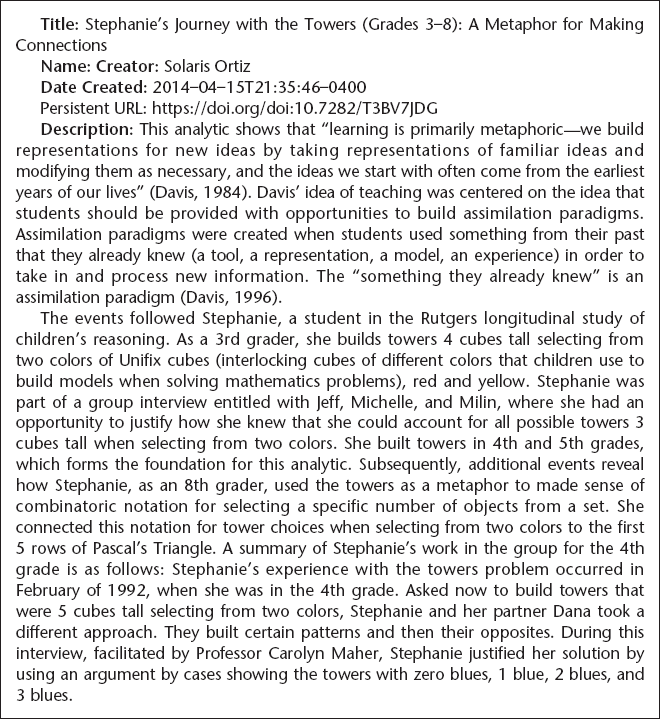
Stephanie's journey with the towers (grades 3–8): A metaphor for making connections.
Initially, the students were asked by Professor Maher: You gotta convince me that there are 8 and only 8 and no more or fewer. In an attempt to convince her classmate Jeff that she had attempted to account for all possibilities, Stephanie used a “modified proof by cases” approach to organize the towers as follows: towers with no blue cubes, towers with exactly 1 blue cube, towers with exactly 2 blue cubes stuck together (adjacent to each other), towers with exactly 3 blue cubes, and towers with exactly 2 blue cubes separated (by a red cube). Jeff interjected at this point with his statement: I have a question. Responding to the request to justify her solution path, Stephanie and her classmates engaged in a dialogue, rich with her responses to queries and challenges. She and her classmates expressed their ideas through representations, including written notations and verbal explanations. They constructed a table using symbols to represent the different possibilities for towers, which were arranged as cases. Examination of the close links between language and reasoning revealed Stephanie used her own invented notation and revealed informal “proof-like” reasoning. She used both everyday and academic language, including some aspects of the mathematics register and subordinating language devices, revealing complex language.
Stephanie's justification for finding all possible towers, 3 cubes tall, when selecting from two colors reveals her ultimate success in offering a clear justification for her solution. She offered an argument by cases with symbols to represent the cube colors by showing the towers with no blues, 1 blue, 2 blues together, 3 blues, and 2 blues separated. The discussion centered around understanding of her argument with two classmates suggesting that she organize by four cases (none, one color, 2 colors, and 3 colors). Stephanie was adamant in explaining how she did it, presenting a valid case organization but one that was less elegant (splitting the 2 blue case into 2 blue together and 2 blue separated), thus providing some insight into her mathematical understanding. Importantly, one member (Jeff) who was absent in recent days, raised a question; an initial comment stimulates the rich mathematical dialogue among group members: I have a question. Do you have to make a pattern? Consequently, the remaining three group members (Stephanie, Milin, and Michelle) dedicated a process of explaining to him why or why not it was necessary to discover patterns to complete the counting task.
A closer examination of the content of Stephanie's turns at talking also is revealing, since she was the student who took on the role of explaining to Jeff: it's just easier to work with a pattern to participate effectively in the process. Importantly, Stephanie justified her solution by using an argument by cases showing the towers with zero blues, 1 blue, 2 blues (together and separated), and 3 blues. Her statements revealed her understanding of using mathematical symbolism to represent the physical model with cubes and thus apply an elegant representation to her problem solving. She incorporated some linguistic complexity for expression, via subordination. Additionally, she showed some metalinguistic awareness of the procedural aspects of the process.
Regarding her language more specifically, in the first cycle, most of Stephanie's vocabulary choices employed everyday language (stuck together, that means, like okay I took). In contrast, in the second cycle, the term argument exemplified adoption of the more specific usage of the mathematics register. Stephanie included syntactic patterns of the conditional (if), nominal (that and which), and adverbial (because) subordinators; and modal verbs (could); thus, displaying linguistically dense language, a defining characteristic of the mathematics register. Her pathway to providing an acceptable solution to the problem provides evidence of her efforts to coordinate greater conceptual complexity with greater linguistic complexity and specificity. However, Stephanie's use of everyday language, including some subordinating devices, combined with her contextualizing of details (i.e., non-specific referents, such as it, this, and there, and her use of gestures and idiomatic English), demonstrated that she mixed elements of both everyday conversational language and the academic language mathematics register for expression of mathematical ideas.
This event demonstrates a small group working together well. The students were cooperative and showed their pragmatic abilities to take turns, rarely overlapping and rarely interrupting each other. They attended to each other's comments and sustained their engagement with the mathematical problem presented throughout this event, and also throughout the entire session. For example, in responding to Jeff's initial question about the need for patterns, Stephanie explained her organization of using two blue cubes separated by a red cube in a separate category. Michelle and Milin argued that she could classify this tower into the category of exactly two blue cubes. Stephanie conceded that this was a possibility but reported the way she solved it; that is, by her original organization of five cases.
VMCAnalyatics: In Sum
Both of these examples of the VMCAnalytics with the associated language analyses demonstrate the potential value of a rich database for collaborative research. These insights may not have been possible to obtain without the video-taped interactions, which render the data permanent and accessible. Transcriptions derived solely from audio recordings and observational notes may not fully capture the fleeting but significant moments of students’ learning. Videotaped interactions that are available on the VMC allow researchers individually or jointly to attend, in detail, to the linguistic and mathematical behaviors of the students, enabling the discovery and documentation in fine detail of the learning process. Additionally, the VMC offers the possibility for researchers throughout the world to join the community and make use of the tools to build their own video narratives to accompany their work (https://videomosaic.org/vmc_community).
Conclusion
The U.S. Common Core State Standards for Mathematics emphasize the importance of students’ mathematical reasoning and the conditions of the learning environment. These include highly interactive problem-solving groups that offer students opportunities to convey their understandings with multi-modal representations including language. One of the primary implications of this work is a demonstration of the benefits of a permanent, fully accessible database on children's mathematical learning for the greater research community, so that members can explore their research foci with robust data. The examples provided in this article demonstrate how collaboration from multiple disciplinary lenses is facilitated by the availability of a rich database.
Finally, the analyses offered by the VMCAnalytics may be applied to preparing teachers who should be capable of facilitating conditions that invite student collaboration, meaning seeking, justification, and the use of language—both oral written. Prior research has investigated the extent to which teachers are able to recognize forms of reasoning that children express and whether it is possible to improve their ability to recognize various forms of mathematical reasoning through an instructional intervention (Maher et al., 2014; Mueller et al., 2012; Palius & Maher, 2013). The dissemination of this research has the potential to inform the members of principal disciplines about the potential for shifting teachers’ beliefs about students’ learning to focus on what they really know about mathematical understanding, so that they can communicate effectively those understandings with language and non-language representations. It is crucial for teachers world-wide to recognize and sustain children's mathematical knowledge and knowledge of the mathematics register, so that they may best support their students’ mathematical learning and the acquisition of the language that supports this learning (Bailey, Maher, & Wilkinson, 2018; Maher, Sullivan, & Wilkinson, in press).
Footnotes
Notes on Contributors
Louise C. Wilkinson is a Distinguished Professor of Education, Psychology, and Communication Sciences at Syracuse University. She is an educational psychologist who has focused her research on language and literacy learning among young and school-age children, in particular those for whom English is an additional language. Professor Wilkinson's recent research addresses the relationship between mathematics and language learning and students’ acquiring the mathematics register, the more specific language of academic disciplines. An internationally recognized leader in education, she is best known for her extensive research on children's language and literacy learning and has published in more than 150 articles, chapters and volumes.
Alison L. Bailey is a Professor of Human Development and Psychology in the Department of Education at the University of California, Los Angeles. She is a developmental psycholinguist whose work began with an exploration of children's multilingual home language and literacy environments and subsequently included the more formal setting of school. Her expertise includes the developmentally appropriate assessment of language and literacy and the pedagogical practices of teachers for supporting language and content learning. Professor Bailey is a member of The National Assessment of Educational Progress Committee on Reading and a Faculty Research Partner of the National Center for Research on Evaluation, Standards, and Student Testing (CRESST).
Carolyn A. Maher is a Distinguished Professor of Mathematics Education, at Rutgers University. She directs the Robert B. Davis Institute for Learning, and is Editor of the Journal of Mathematical Behavior. She conducted seminal research with longitudinal studies on the development of mathematical ideas and reasoning. Her research generated a unique video collection of students doing mathematics, which is available publicly on the Video Mosaic Collaborative (VMC:  ). These videos are used for ongoing research on student learning mathematics and for study in teacher education. Professor Maher directs research to conduct design studies on mathematics learning, involving the use of video in teacher education contexts.