






Abstract
Although elusive due to their mostly nocturnal behavior, bats have fascinated humans for millennia. From their ubiquitous presence in Mayan mythology to being regarded as symbols of good fortune in the Middle-to-Late Qing Dynasty of China, bats have been both feared and celebrated across cultures from all over the world. The research articles included in this collection illustrate the myriad ways in which bats and humans have interacted over time, highlighting how these airborne mammals have been associated with death, witchcraft, vampires, malevolent spirits, and evil in some cultures, while, in other places—particularly across the Asia-Pacific region—they have been largely linked to luck and good fortune and used as spiritual totems. This collection also showcases how multiple cultural groups, particularly across the tropics, have traditionally hunted bats for human consumption and traditional medicine, and used their guano as a fertilizer. In times of rapid global change and when bats are often associated with zoonotic disease risks, a trend that has been magnified by the COVID-19 pandemic, this special issue constitutes one significant step towards a richer understanding of bat-human inter-relationships. The lives of humans and bats have been closely intertwined over time and our collection celebrates how bat diversity supports the biocultural richness of our planet.
Bat-Human Inter-Relationships across Space and Time
The storyline of bat-human interrelationships is probably as old as humanity itself. Our understanding of bat evolution is still incipient, but the oldest bat fossils found to date (e.g.,
With over 1400 species world wide, bats are the second largest mammalian order (Simmons and Cirranello 2021). Roughly one in each five extant mammals is a bat and, collectively, they have spread across most of the planet, reaching many of the most isolated islands (Conenna et al. 2017) and even spreading beyond the Arctic circle (Rydell et al. 1994). As humans followed, people and bats came to share landscapes throughout the world, and this age-old coexistence translated in a vast body of historical and contemporary cultural representations of bats in local folklore (Lawrence 1993; Low et al. 2021; Mathews 1908; Rocha et al. 2021b). This ancient connection, marvelously celebrated in abundant reddish-terracotta rock paintings of bats made by hunter-gatherer colonizers of the northwest Amazon during the Late Pleistocene/Early Holocene transition (∼13,000–8000 cal BP; Morcote-Ríos et al. 2021), has been the focus of a substantial amount of ethnobiological research. Such rich scholarly work brings into focus the multiple social-ecological complexities of human-bat inter-relationships.
Ethnobiology of Bats—A Rapidly Growing Research Field
Studies on the cultural, symbolic, and spiritual values of bats have investigated, for instance, the myriad of cultural ecosystem services (e.g., aesthetic, spiritual, educational, and recreational) they provide to communities from all corners of the world (e.g., Low et al. 2021; Muñoz 2006). Bats have long been identified as key providers of considerable benefits that increase human well-being—e.g., they are significant suppressors of agricultural pests (Maas et al. 2016; Puig-Montserrat et al. 2015, 2020; Wanger et al. 2014), consume important disease vectors, such as malaria-bearing mosquitos (Kemp et al. 2019), and pollinate culturally and economically important fruit crops, such as agave (
Different studies have assessed customary institutions and traditional management practices for the conservation of bats, their habitats, and roosting sites. For instance, a recent assessment of bat diversity governed under Indigenous stewardship in the Amazon rainforest identified that at least 22 bat species have more than 25% of their global distribution range within Indigenous Territories, emphasizing the important role of areas customarily maintained, owned, used, and/or occupied by Indigenous Peoples in safeguarding bat diversity (Fernández-Llamazares et al. 2021). Similarly, across much of Africa, several community forests and sacred groves provide habitat for the fruit bat (
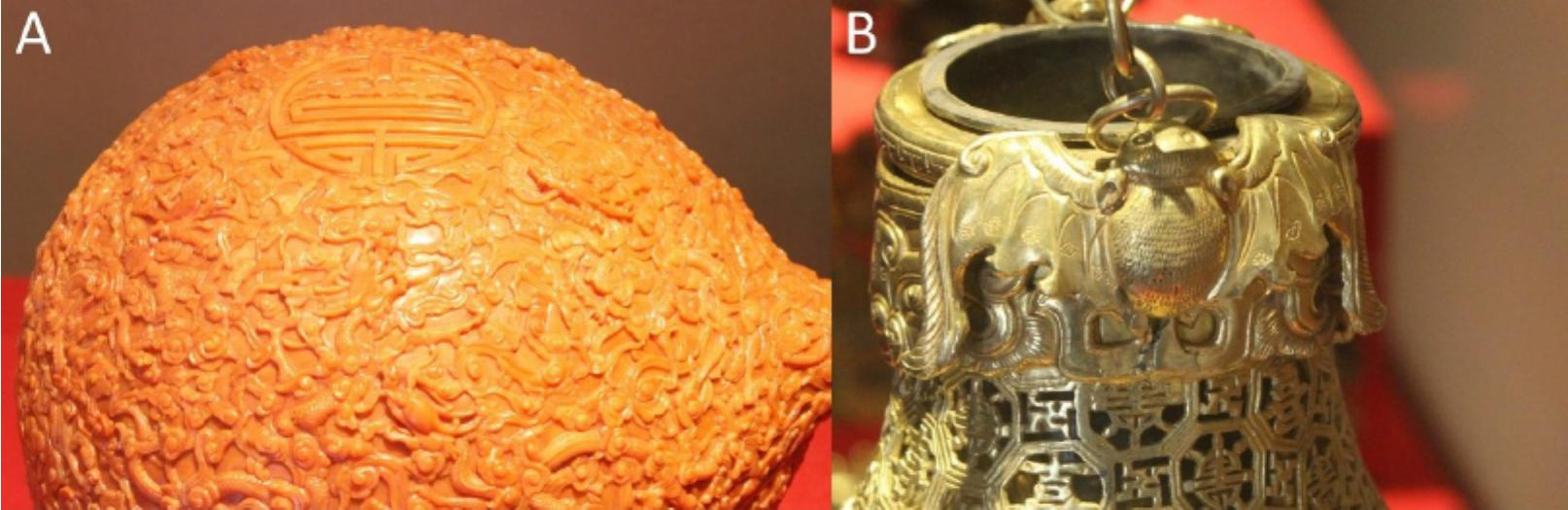
Chinese artifacts with carved bat designs. A) Coral peach-shaped and gold-bodied from the Qing dynasty (1723–1735), carved with cloud, dragon, and bat designs; and B) Detail of a bat carved in a gold gourd-shaped openwork censer from the Qing dynasty (1644–1911). Photos by Ricardo Rocha.
The inherent spiritual respect that caves evoke in many different cultural traditions around the world (e.g., Hobbs 2001; Sponsel 2015) has conferred protection for many cave-dwelling bats. As a result, the recognition and protection of sacred caves is largely considered as important for bat conservation (Schachenmann 2006). Some authors have shown that numerous bat species of conservation concern can roost safely in sacred caves, with well-documented examples from Kenya (Metcalfe et al. 2010), Ghana (Hens 2006), and Thailand (Robinson and Smith 1997). However, some studies suggest that the cultural values underpinning these sacred sites could be rapidly eroding (Golden and Comaroff 2015; Kingston 2016). In south-western Madagascar, sacred caves that were traditionally protected through complex customary regulations and locally enforced taboos have been found to offer limited conservation benefits for cave-dwelling bats, given that rapid cultural changes—associated with conflicts between utilitarian and cultural uses of caves—are taking place in the region (Fernández-Llamazares et al. 2018). Still, the latter study uncovered that local people still believed bats to “roam at the junction between the physical and spiritual realms, protecting treasures out of human reach” (Fernández-Llamazares et al. 2018).
Ethnobiologists have examined traditional ecological knowledge in relation to bats, including their position in local ethno-taxonomies (Forth 2004, 2009, 2016, 2021; Low et al. 2021). Some of these studies suggest that the ethnobiological knowledge regarding the diversity, conservation situation, and natural history of bats is often modest (e.g., Aziz et al. 2017b; Bhattacharjee et al. 2018; Castilla et al. 2020; Cousins and Compton 2005; da Costa Rego et al. 2015; Laverty et al. 2021; Sexton and Stewart 2007; Sheherazade and Tsang 2015; but see e.g., Taylor and Butler 2007). That folk lexicon used to refer to bats, at least across much of the Paleotropics, categorizes bats according to two groups, largely aligned with small, mainly insectivorous (suborder Microchiroptera) and larger and mostly frugivorous (family Pteropodidae) bats (e.g., Cox 1983; Forth 2021; Rocha et al. 2021b; Tanalgo et al. 2016). However, an important ethnobiological contribution by Fleck et al. (2002) has identified that the Matses Indians of Amazonian Peru associated a single lexicalized name to various bats, which they regarded as morphologically and behaviorally different. This suggests that studies assessing traditional ecological knowledge in relation to bat diversity without the use of specimens or photographs might be underestimating local people's capacity to discriminate between different bat species. As a case in point, Ziembicki et al. (2013) decided to exclude bats from a study on Indigenous knowledge about the native mammal fauna of Northern Australia, arguing that there is limited discrimination between bat species in Indigenous knowledge systems. Such a claim is largely consistent with a rich body of ethnobiological scholarship from Northern Australia (e.g., Davis 1981; Liddy et al. 2006; Raymond et al. 1999; Waddy 1988).
A wide diversity of studies have explored the different ways in which bats have been used across cultures, including how they have traditionally been hunted for human consumption (e.g., Anti et al. 2015; Carvalho et al. 2015; Epstein et al. 2009; Goodman 2006; Kamins et al. 2011; Randrianandrianina et al. 2010; Raymundo and Caballes 2016; Sheherazade and Tsang 2015; Tanalgo 2017; Figure 2) and traditional medicine (Riccucci 2012; Tuladhar-Douglas 2008). These studies revealed that bat hunting is widespread across Africa, Asia, Oceania, and in parts of Central and South America, as well as in multiple islands across the Atlantic, Indian, and Pacific Oceans, affecting over one in each ten species of extant bats (Mildenstein et al. 2016; Figure 1). Large-bodied (> 100 g body mass) Old-World fruit bats (family Pteropodidae) are disproportionately targeted (> half of all known pteropodids are known to be hunted for bushmeat; Frick et al. 2019) and, in many instances, current harvesting rates seem unsustainable and are believed to be causing significant population declines (Mildenstein et al. 2016). While not as frequent as hunting for human consumption, several ethnobiological studies have identified hunting of bats for the souvenir trade (Lee et al. 2015) and for several medicinal uses (Mildenstein et al. 2016). Examples of bat-associated ethnomedicinal practices include the use of oil infused with small bats to cure multiple illnesses by the Newar people of the Himalayas (Tuladhar-Douglas 2008), the use of vampire bats (
Addressing Bats' Negative Stigma
Although bats contribute to human well-being in myriad ways, they are often disliked and feared (Polák et al. 2020; Todd 2016; but see e.g., Deshpande and Kelkar 2015; Fagan et al. 2018; Lim and Wilson 2019; Shapiro et al. 2021). Underlying these negative sentiments are relatively widespread associations between bats and death (Fernández-Llamazares et al. 2018; Kingston 2016), witchcraft (Lunney and Moon 2011; Musila et al. 2018; Tuttle 2018), vampires (Prokop and Tunnicliffe 2008; Prokop et al. 2009; Rydell et al. 2018), malevolent spirits (Tanalgo 2017; Tanalgo et al. 2016; Tatai 2006), and evil (Allen 1939; Charro 1999; Frembgen 2006). Across much of Europe, disdain and fear of bats is largely embroiled in the Church doctrine, where bats are often used to symbolize the Devil (Eklöf and Rydell 2021). Yet, in other places (particularly throughout Southeast Asia, China, and Japan), bats are also associated with luck and good fortune (e.g., Eberhard 1986; Low et al. 2021; Pham and Lee 2008) and used as spiritual totems (see Hall and Richards [2000] for an example from Australia, and Hadnes and Schumacher [2012] for another from the Mossi people in Burkina Faso). Among several Indigenous groups in Mexico (e.g., Mizteco, Zapoteco), bats were considered to be messengers from the underworld and important symbols of fertility (Retana-Guiascón and Navarijo-Ornelas 2012). Fortunately, as more is learned about the value of bats to human societies and regarding their astonishing biological feats and complex social structures—e.g., European free-tailed bats (
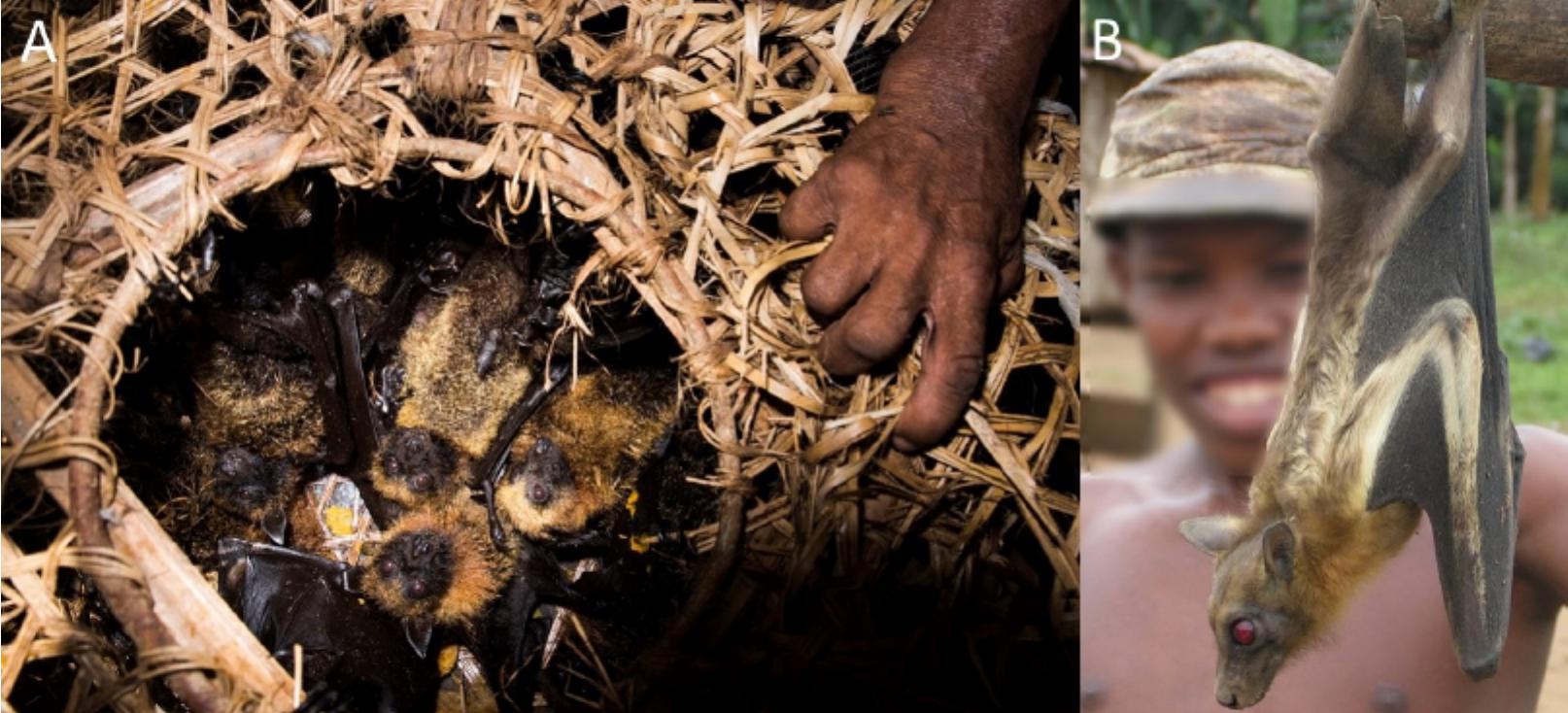
A) Madagascan flying fox
Bats exhibit a considerable variation in their sensitivity to human disturbance (Farneda et al. 2015; Huang et al. 2019; Fraixedas Núñez et al. 2019; Rocha et al. 2018; Yoh et al. 2020). While many species avoid humanized landscapes, numerous others are relatively common living near and benefiting from humans and can even be characterized as synanthropic (López-Baucells et al. 2017; Razafindrakoto et al. 2010; Russo and Ancillotto 2015; Voigt et al. 2016; Figure 4). Furthermore, as human numbers increase and people encroach deeper into remaining natural habitats, human-bat interactions are becoming more frequent, with often undesirable consequences to both humans and bats. Problems related with infectious diseases are an infamous example. The white-nose syndrome, a severe condition caused by a pathogenetic fungus introduced to North America by human travel, has severely hit several hibernating North American bat species, inducing steep population declines (Frick et al. 2016). On the other hand, several high-profile zoonotic diseases, the most notorious of which being COVID-19, have directly or indirectly been associated with bats and have caused enormous impact on global human health and national economies (Rocha et al. 2021a; Schneeberger and Voigt 2016; Zhou et al. 2020). Even prior to the COVID-19 pandemic, increasing evidence suggested that perceived zoonotic risks towards humans and livestock were already a leading reason for negative attitudes towards bats (da Costa Rego et al. 2015; Laverty et al. 2021; López-Baucells et al. 2018; Lu et al. 2021; Reid 2016; Rocha et al. 2021b; Sasse and Gramza 2021; Shapiro et al. 2020). As bat-associated zoonotic spillover events are largely rooted in human activities (Brierley et al. 2016; White and Razgour 2020), ethnobiology, with its inherent focus on how human communities interact with the natural world, will have a key role to play in the development of culturally appropriate strategies that minimize zoonotic health risks and support bat diversity and its associated ecosystem services (MacFarlane and Rocha 2020).

Soprano pipistrelles
Human-bat conflicts often arise from damage to buildings or as a result of noise/ bad smell caused by synanthropic species (Rocha et al. 2021b; Voigt et al. 2016) or due to fruit crop raiding by frugivorous species (Aziz et al. 2016, 2017b; Shapiro et al. 2021). These are other key areas in which ethnobiological work can vastly contribute to support evidence-based and culturally sensitive strategies aimed at reducing negative feelings towards bats. With around one third of the extant bat species classified as either data deficient or threatened by the IUCN Red List (Frick et al. 2019), ethnobiology can help leverage cultural values in support of bat conservation. For instance, work in the Tanzanian island of Pemba built upon local pre-Islamic animist religious values that associated spirit bats with particular woodland areas to encourage village elders to establish bylaws to limit disturbance and hunting pressure of the endemic Pemba flying fox (
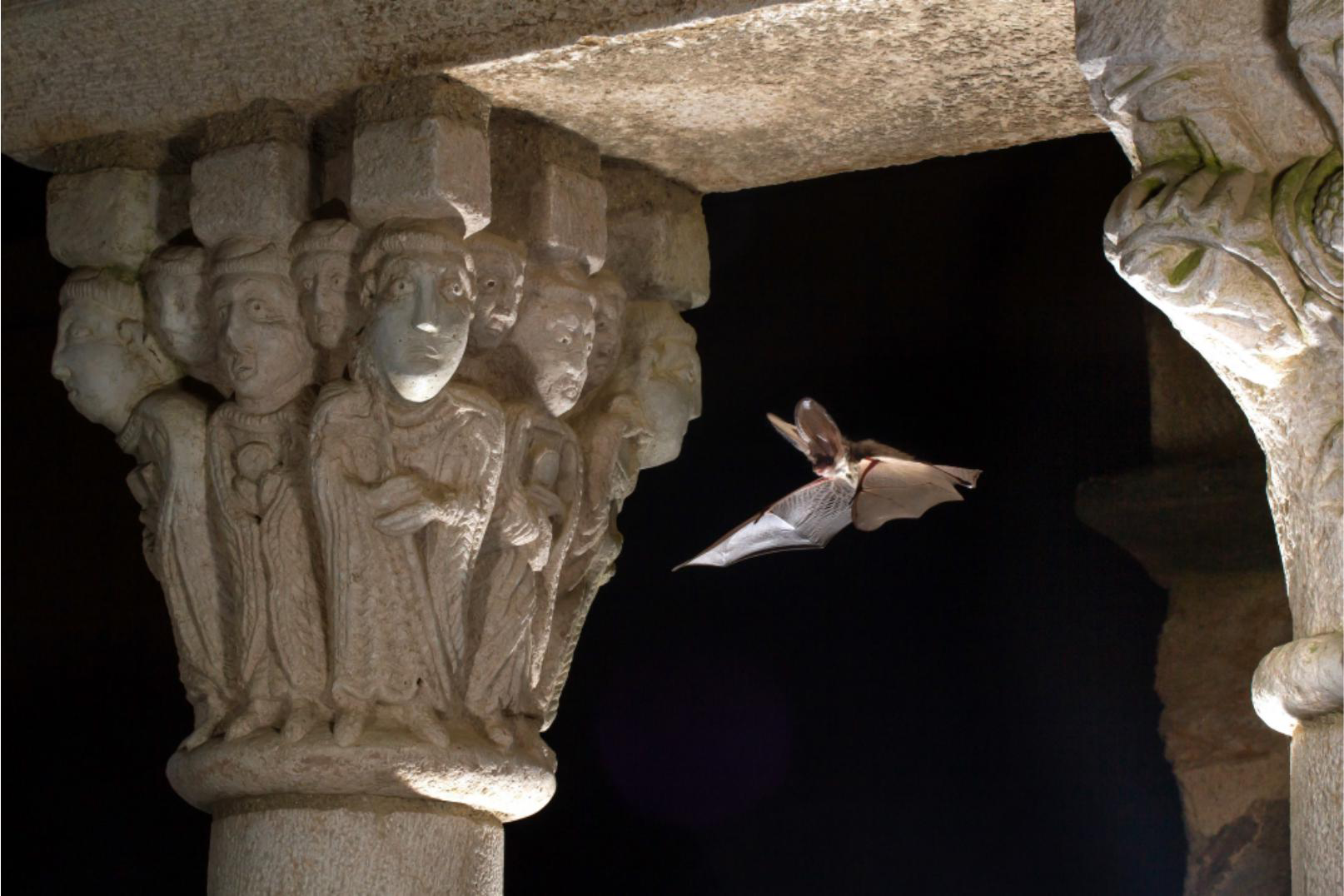
Great long-eared bat
Bat Conservation through an Ethnobiological Lens
Conservation scientists increasingly realize that the delineation of effective conservation interventions largely depends on a robust understanding of the multidimensional inter-relations between people and wildlife (Bennett et al. 2017; Gavin et al. 2015). Ethnobiologists and other scientists working at the interface between social and ecological sciences have used multiple methods of inquiry to unveil the intricate and complex relations between humans, nonhumans, and their biological worlds (e.g., Fernández-Llamazares and Cabeza 2018; Lyver et al. 2019; Nabhan et al. 2011; Vandebroek et al. 2020). Yet, despite a substantial body of literature dedicated to the intersection between bat conservation and human culture, studies targeting many important dimensions of human-bat interaction—e.g., how bat imagery affects emotions and attitude towards bats (Straka et al. 2021)—are still relatively scarce and geographically biased (Kingston 2016). This severely undermines our understanding of society's interlinkages with bats, which in turn has multiple implications for conservation policy and practice.
This collection aims to further our understanding of human-bat inter-relationships in all their complexity. The manuscripts included in this special issue explore bat-human inter-relationships through an ethnobiological lens across the Asia-Pacific Region (Low et al. 2021), Fennoscandia (Eklöf and Rydell 2021), Madagascar (Rocha et al. 2021b), Namibia (Laverty et al. 2021), Cambodia (Shapiro et al. 2021), and in the eastern Indonesian island of Flores (Forth 2021). Collectively, these contributions exemplify many of the different ways in which bats have been present in human cultures across time and space and provide crucial insights into how ethnobiology can improve and optimize long-term bat conservation efforts from local to global scales. We hope that this collection can help to build synergies between international scientific knowledge, conservation priorities, and local cultural values, which together can promote a better world for humans and their long-term nocturnal companions, bats.
Footnotes
Acknowledgments
We thank the