



Abstract

French President Nicolas Sarkozy delivered a speech on French nuclear policy on March 21, 2008 that had major implications for the French arsenal. 1 The speech was given at the ballistic missile submarine shipyard at Cherbourg while presenting France's latest nuclear-powered ballistic missile submarine (SSBN), Le Terrible, which will join the fleet in 2010. He announced a planned reduction of the nuclear arsenal to fewer than 300 warheads, committed France to several disarmament measures, and reported that a complete defense and security policy review, the first major defense policy overhaul since 1994, would soon be finished. 2
SNAPSHOT
France announced further reductions in its nuclear arsenal; weapons modernization continues.
President Nicolas Sarkozy provided additional information about France's nuclear posture and targeting strategies.
Fourth new nuclear missile submarine nears operation.
Sarkozy unveiled the new defense strategy in a June 17 speech, which was timed with the release of a 350-page white paper. 3 The plans, which will now be submitted to Parliament for approval, are wide-reaching. They include reducing French military and civilian personnel from 320,000 to 266,000, closing bases over the next six or seven years, replacing outdated equipment, and reintegrating France into NATO's military command after a 42-year hiatus. They also include the elimination of one land-based squadron of nuclear-capable fighter-bombers.
Sarkozy said that France's nuclear reductions will bring its arsenal to its lowest possible number while still meeting strategic requirements. He added that the country's deterrent would remain independent and under strict national control. As such, we estimate that France has reduced its arsenal to approximately 300 warheads as a consequence of reductions initiated in 2006 by then-president Jacques Chirac, and that about 290 warheads will remain after Sarkozy's cut has been implemented. 4
In his two speeches, Sarkozy honored the long-standing tradition of French leaders talking about their country's nuclear weapons and policies in a clear and forthright manner. He indicated his intent to go even further than previous French leaders: “I have also decided that France could and should be more transparent with respect to its nuclear arsenal than anyone ever has been.” Yet, he also stressed the continued importance of nuclear weapons to France's security and confirmed that none of France's nuclear weapons is targeted. He added, “[The president] must be able to count on them at all times in order to respond to any surprise,” implying that they can be quickly targeted against anyone if necessary. 5
Sarkozy singled out the aggression of states “wherever it may come from and whatever form it may take” as the type of threat that French nuclear weapons could be used against, as opposed to independent non-state actors. Part of the justification for French nuclear forces, Sarkozy added, is that “certain nuclear stockpiles keep on growing,” a description that only fits China, India, and Pakistan, though others are being improved. Sarkozy explicitly mentioned Iran as “increasing the range of its missiles, while grave suspicions surround its nuclear program.” 6 Within these states, Sarkozy said, the French military is prepared to target political, economic, and military “centers of power,” which probably include facilities used by the national leadership, military and civilian industries, and nuclear and other military facilities. Strike plans must be sufficiently diverse to provide the president with “a wide range of options,” he added.
In his June speech, Sarkozy also reaffirmed France's close strategic ties with Britain. He described French “vital interests” as “the elements that constitute our identity and our existence as a nation-state, as well as the free exercise of our sovereignty.” If such interests were attacked, then nuclear retaliation could be in order. Observers believe that this vague language refers to French interests, but could also coincide with the interests of other countries, particularly Britain. For instance, Sarkozy reaffirmed official French statements from 1995 and 2003 about France's nuclear ties with Britain: “There can be no situation in which the vital interests of either of our nations could be threatened without the vital interests of the other also being threatened.” He also restated France's commitment to Article V of NATO's charter, which states, “An armed attack against one or more [NATO members] in Europe or North America shall be considered an attack against them all,” and to the belief that France's nuclear weapons, by their very existence, “are a key element in Europe's security.” Sarkozy invited international experts to observe the dismantlement of its nuclear facilities at Pierrelatte and Marcoule and called on all nations to ratify the Comprehensive Test Ban Treaty and launch negotiations for a treaty to ban fissile material production.
THE FRENCH ARSENAL
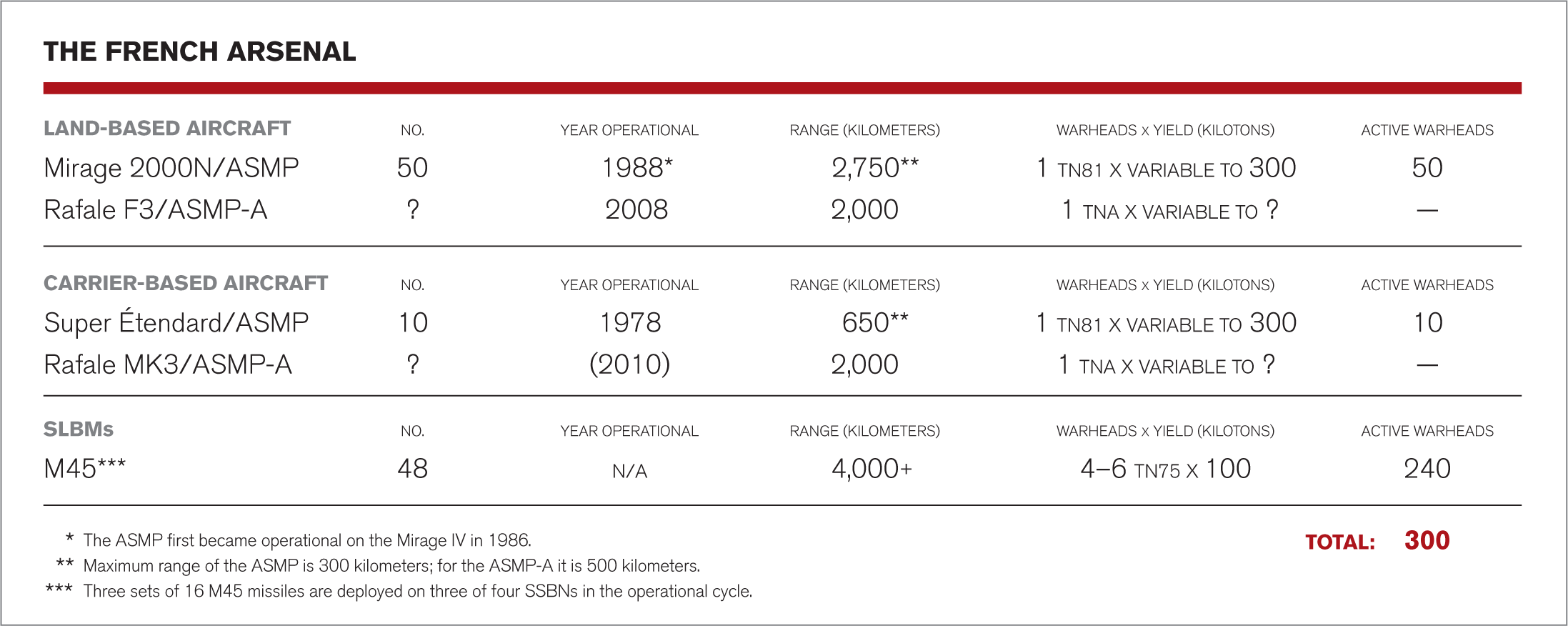
The ASMP first became operational on the Mirage IV in 1986.
Maximum range of the ASMP is 300 kilometers; for the ASMP-A it is 500 kilometers.
Three sets of 16 M45 missiles are deployed on three of four SSBNs in the operational cycle.
FRENCH SSBNs
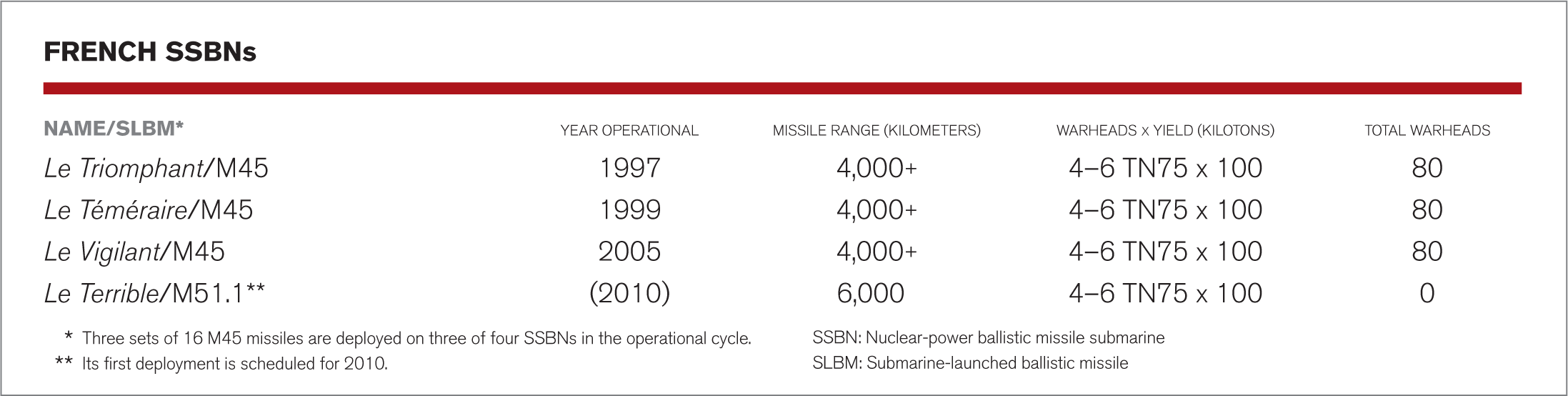
Three sets of 16 M45 missiles are deployed on three of four SSBNs in the operational cycle.
Its first deployment is scheduled for 2010.
SSBN: Nuclear-power ballistic missile submarine
SLBM: Submarine-launched ballistic missile
Le Triomphant (hull number S616) entered service in March 1997; Le Téméraire (S617) was commissioned in December 1999, some six months behind schedule; and Le Vigilant (S618), was commissioned on November 30, 2004. The fourth and final Le Triomphant-class SSBN, Le Terrible (S619), is scheduled to deploy on its first patrol in 2010. French defense contractor DCNS, which built all Le Triomphant-class subs reports that the boats are “quieter than the ocean's background noise” and “1,000 times” quieter than Le Redoutable-class subs. One estimate has put the cost of the Le Triomphant-class SSBN program at nearly ¤16 billion ($24 billion). This includes construction of the submarines, maintenance, personnel, and 25 years of operations. Adding the costs of the missiles and warheads would bring the total to €32 billion ($48 billion).
Le Triomphant-class SSBNs can carry up to 16 M45 submarine-launched ballistic missiles (SLBMs), but since one boat will always be in overhaul, France has only produced enough missiles to arm three boats. This practice is not new. When there were five submarines in the fleet, the Defense Ministry procured only four sets of M4 SLBMs. The M45 has a range of at least 4,000 kilometers (2,485 miles) and can be armed with a maximum of six TN75 warheads. Former president Jacques Chirac announced in January 2006, “The number of nuclear warheads has been reduced on some of the missiles” to increase the targeting flexibility. 8 We estimate that each missile carries between four and six warheads, depending on its mission, although some could carry fewer.
Final assembly of the warheads takes place at the French Atomic Energy Commission's Valduc Center near Dijon, the Pantex of France. Warheads are stored at a Ministry of Defense facility contiguous to the Valduc Center, pending delivery to the military or if they have been retired and await disassembly. 9 We estimate that France produced its current stock of TN75 warheads between 1996 and 2003. A comparable number of TN70/71 warheads, which previously armed French SLBMs, were retired beginning in the late 1990s and presumably disassembled at Valduc.
Starting in 2010 with the deployment of Le Terrible, the M45 will gradually be replaced with a new SLBM, known as the M51. The M51.1, which was last test-launched in June 2007, is expected to have a range of 6,000 kilometers (3,730 miles) and carry up to six warheads and penetration aids. In light of Chirac's 2006 comments, we estimate that the missile will carry fewer warheads (perhaps four to six), extending the missile's range. The M51.1 initially will carry the same payload as the M45 (TN75 warheads plus penetration aides), but starting in 2015, the missile will be modified to carry a more robust new warhead, known as the Tête Nucléaire Océanique (TNO), which was evaluated during France's last test series conducted from September 1995 to January 1996. The upgraded missile will be known as the M51.2.
Of the current fleet of three operational submarines, one or two are normally “on station” in designated patrol areas at any given time. The SSBN force is organized under France's Strategic Oceanic Force and homeported at the Île Longue base near Brest, which includes a unique facility with what appears to be 24 vertical missile storage silos for storage of missiles not loaded on submarines. When not mated to missiles, the SLBM warheads are stored in igloos at a weapon storage facility a few kilometers south of the base.
France relocated its SSBN command center from Houilles (Yvelines) to the Île Longue base in 2000, while communication facilities continue to operate from Rosnay (Indre). Communication with SSBNs on patrol is also maintained with four C-160H Astarté communication relay aircraft. French SSBNs are protected during their operations by nuclear attack submarines (SSNs), maritime patrol aircraft (such as Atlantique 2s), antisubmarine frigates, and minesweepers. SSBN protection will be an important mission for the new Barracuda-class SSN, which is scheduled to launch in 2010. Like French SSBNs, each attack submarine has two crews to optimize its operational availability.
SLBM tests are coordinated from the Test Center of the Landes. The missiles are fired from down-range SSBNs toward an impact zone near the Azores.
The land-based force consists of approximately 50 Mirage 2000N aircraft based at Luxeuil-les-Bains (squadrons Dauphiné and La Fayette) 130 kilometers (80 miles) southwest of Strasbourg, and at Istres (squadron Limousin) some 40 kilometers (25 miles) northwest of Marseille. The Mirage 2000N is equipped with the 300-kilometer (186-mile) range, liquid-fueled ASMP, which has armed French aircraft since 1986 when the weapon first entered service on Mirage IVP aircraft. The missile carries a single TN81 warhead.
France initially produced 80 TN81 warheads and 90 ASMP missiles, according to a 1991 French Senate report. In May 1994, when 15 Mirage IVPs (plus three spares) still had nuclear roles and only 45 Mirage 2000Ns were operational, President François Mitterrand identified 60 ASMP missiles for use by both air force and navy aircraft, but did not disclose the number of warheads. Since then an additional Mirage 2000Ns have become operational, presumably inheriting the weapons from the Mirage IVPs that have been retired.
Beginning in 2009, the advanced Rafale F3 aircraft will begin taking over the nuclear strike mission from the Mirage 2000N. The first nuclear Rafale F3 squadron will be based at Saint-Dizier approximately 200 kilometers (125 miles) east of Paris. 10 The Rafale F3s and the remaining Mirage 2000Ns will be equipped with the new ASMP-A (Amélioré) missiles in 2009. (This upgraded Mirage configuration is known as the Mirage 2000NK3.) Initially, the Mirage 2000N squadron at Istres will be upgraded to carry ASMP-As, but this unit will eventually be replaced with Rafale F3s.
The ASMP-A, which has improved maneuverability, enhanced accuracy, and an increased range of 500 kilometers (310 miles), will be equipped with a new warhead designated the Tête Nucléaire Aero-portée (TNA). All ASMPs and their TN81 warheads will be retired. As a result of Sarkozy's announcement in June to reduce the land-based nuclear force by one third, one squadron (either Saint Dizier or Luxeuil-les-Bains) will eventually lose its nuclear mission.
France also deploys approximately 10 ASMPs on board the 40,500-ton aircraft carrier Charles de Gaulle, for delivery by two squadrons of Super Étendard strike aircraft. Starting in around 2010, the nuclear strike mission on the carrier will be taken over by the Rafale MK3 aircraft, a carrier-based version of the Rafale, equipped with the ASMP-A. Non-nuclear versions of the Rafale first deployed with the Charles de Gaulle in December 2001, when the first Rafale M-equipped squadron, Flotille 12, stood up at Landivisiau. This squadron was declared operational on June 25, 2004. The Rafale M flew sorties from the Charles de Gaulle with a model of the ASMP-A on its centerline in December 2002.
Footnotes
1.
Nicolas Sarkozy, president of the French Republic, speech given at the presentation of Le Terrible, Cherbourg, March 21, 2008.
2.
We are grateful for valuable editorial comments provided by Bruno Tertrais at the Fondation pour la Recherche Stratégique.
3.

4.
Sarkozy also declared that France “has no other weapons beside those in its operational stockpile,” a statement that excludes the existence of a reserve of warheads like the United States and Russia. We estimate, however, that France has a small inventory of spare warheads.
5.
Sarkozy, speech given at the presentation of Le Terrible, Cherbourg, March 21, 2008.
6.
On January 19, 2006, on the occasion of his visit to the Strategic Forces, former French president Jacques Chirac stated: “As I emphasized immediately after the attacks of 11 September 2001, nuclear deterrence is not intended to deter fanatical terrorists. Yet, the leaders of states who would use terrorist means against us, as well as those who would consider using, in one way or another, weapons of mass destruction, must understand that they would lay themselves open to a firm and adapted response on our part. This response could be a conventional one. It could also be of a different kind.” Although the language used by President Sarkozy does not mention terrorists, the phrase “whatever form it may take” could be interpreted as including a state using terrorist means as well.
7.
French government, “Fighting Proliferation, Promoting Arms Control and Disarmament: France's Contribution,” 2005, p. 64.
8.
Jacques Chirac, speech given during his visit to the Strategic Forces, January 19, 2006.
9.
Bruno Barrillot, France and Nuclear Proliferation (Lyon: CDRPC, 2001), p. 16.