




Abstract
After visiting the Yongbyon nuclear complex, the former head of Los Alamos National Laboratory judges that North Korean officials are working in “good faith” to disable the facilities. But he warns that complete denuclearization presents formidable obstacles.
North Korea has the bomb, but not much of a nuclear arsenal.
Pyongyang agreed to the denuclearization of the Korean Peninsula in the September 19, 2005, Six-Party Joint Statement, but elimination of its nuclear weapons program remains elusive. 1 The Six-Party Talks have called for North Korea to shut down the Yongbyon nuclear production complex; disable its facilities; declare its entire nuclear program; dismantle its facilities; and eliminate all nuclear weapons, materials, and weapons infrastructure–all in concert with compensating measures from the other five parties–South Korea, China, Japan, Russia, and the United States. Yet the process is at an impasse, primarily regarding North Korea's declaration of its entire nuclear program.
During the past four years, I've visited North Korea's Yongbyon nuclear complex three times with nongovernmental teams of scientists and observers. My visits to the complex and my meetings with North Korean officials have convinced me that the elimination of North Korea's plutonium production capacity is within reach. It's vital not to let this opportunity slip away over disagreements about the North's declaration. With its plutonium production halted, North Korea will not be able to make more bombs nor make better bombs, and is also less likely to export fissile material.
North Korea's October 9, 2006 test of a nuclear device demonstrated its ability to produce a nuclear yield, but the test fell short of the success necessary to field a credible nuclear arsenal. The network of seismic stations around the world indicated an explosive yield of between 0.2 and 1 kiloton. The Chinese reported that the North Korean government advised them that the test would be approximately 4 kilotons. Chinese nuclear specialists interpreted the test results as “North Korea aimed for 4 kilotons and got close to 1–not perfect, but not bad for a first try.” 2 1 believe this is a good assessment.
There is little hard evidence about the nature of the device tested. It was most likely a relatively simple design along the lines of the plutonium bomb dropped at Nagasaki, though the device's yield was scaled back from the 21-kilo-ton yield of the Nagasaki weapon, perhaps to ensure containment in the underground test tunnel. Regardless of the type of device tested, it is highly unlikely that North Korea has the confidence to field a nuclear device on a missile. Hence, the sophistication of its arsenal is limited without further testing, and delivery of its weapons is most likely limited to a plane, boat, or van.
The size of the North's nuclear arsenal is constrained by plutonium production at Yongbyon. In 2007,1 estimated that in 20 years of on-again, off-again operation, North Korea produced an inventory of between 40 and 50 kilograms of plutonium, which would be sufficient for six to eight bombs. 3 A January 2008 estimate from the Institute for Science and International Security concluded that North Korea has an inventory of between 28 and 50 kilograms. 4 The North Koreans stopped plutonium production on July 15, 2007 and shut down their three major production facilities at Yongbyon–a fuel fabrication facility, a 5-megawatt-electric reactor, and a reprocessing facility–in accordance with the February 13,2007 Six-Party initial actions agreement. 5
North Korea cannot improve its arsenal of a few primitive nuclear devices without restarting the Yongbyon production complex and resuming nuclear testing. The Yongbyon nuclear complex houses all three phases of the fuel cycle: the front end–fabrication of fuel rods from uranium ore; the middle–reactor operation; and the back end–reprocessing to extract plutonium. North Korea possessed this entire spectrum of capabilities by the early 1990s; however, it was set back by the Agreed Framework, which aimed to resolve the 1994 nuclear crisis. 6 From 1994 to December 2002, International Atomic Energy Agency (IAEA) inspectors monitored the freeze of production facilities, while Yongbyon technical specialists were allowed to conduct periodic maintenance of the facilities. After the United States accused North Korea of operating a clandestine uranium enrichment program in October 2002, Pyongyang expelled the IAEA inspectors, withdrew from the Nuclear Non-Proliferation Treaty (NPT), and restarted its nuclear facilities.
Yongbyon's fuel fabrication facility (top to bottom): an empty machine shop; contaminated bricks from uranium furnaces; and disabled dissolver tanks.
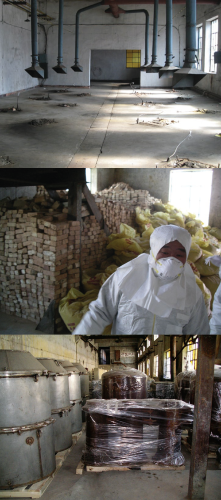
North Korean scientists loaded the 5-megawatt-electric reactor with fresh fuel and restarted it without much difficulty. They also restarted the reprocessing facility to reprocess the spent fuel rods that had been sitting in the cooling pool since 1994. In the intervening years, the fluorination part of the fuel fabrication facility had corroded so badly that the building was abandoned, and a makeshift alternative capability to make uranium tetrafluoride was constructed. Yet, no new fuel has been fabricated since 1994. Fresh fuel fabricated prior to 1994 for the 5-megawatt-electric reactor and the under-construction5o-megawatt-electric reactor at Yongbyon has been stored in plastic and appears to be in good shape. (Construction of the 50-megawatt-electric reactor, which North Korea claimed was within one year of completion in 1994, and an additional 200-megawatt-electric reactor, which was several years from completion, has been halted, and the facilities have not been maintained.)
Since the recent shutdown of the Yongbyon facilities, restarting them was made more difficult because North Korea disabled key equipment in each of three major facilities under U.S. technical supervision, in accordance with the October 3, 2007 second-phase actions agreement. 7 During my February 14 visit to Yongbyon, I was shown that 10 of 12 disablement actions (four at each of the three main facilities) as identified by North Korea had been completed. 8 The two remaining actions are completing the discharge of the spent fuel and removing the reactor's control rod drive mechanisms, which will not be done until all fuel rods are discharged. The United States has apparently defined II disablement actions that are essentially the same as the North Korean list, although the U.S. list combines a few of the North Korean actions, and it includes one additional action–the disablement of fresh fuel rods fabricated prior to 1994 and stored at the fuel fabrication facility. By the U.S. count, the North Koreans had completed 8 out of n actions as of February 2008. Yongbyon officials also stated that they are not able to do any equipment maintenance because the facilities are under IAEA seal and monitoring.
Based on my February visit, I judge the disablement actions to be serious and in good faith. I believe that Pyongyang has made the decision to permanently shut down plutonium production if the other parties do their part. However, they have retained a hedge to be able to restart the facilities if the agreement falls through. All of the equipment removed as part of disablement is being stored. At this point, all actions could be reversed and the facilities restarted. With approximately one-third of the reactor fuel having been discharged as of the end of March, it may take 6 to 12 months to restart all facilities. If the reactor fuel discharge is completed and the fresh fuel in storage is disabled or otherwise eliminated, perhaps by being sold to one of the five parties, the time for restart would most likely increase to 12 to 18 months. In any case, none of these actions can be taken without the knowledge of the U.S. disablement team and IAEA technical monitoring team, both of which have a continuous presence in Yongbyon. Also, since no maintenance is allowed, the longer the facilities remain disabled, the more difficult it will be to restart them.
Even if Pyongyang decides to break out of the Six-Party agreement and restart operations, it will have limited capacity for plutonium production. The reactor could be reloaded with a partial or full core of fresh fuel. Consequently, North Korea could continue to produce approximately 6 kilograms of plutonium (or roughly one bomb's worth of material) per year for the next four to six years. If it reconstitutes all of its fuel fabrication facilities, then it could produce additional fuel for future reloading and continue to produce that much plutonium into the foreseeable future. Although the 5-megawatt-electric reactor had some operational difficulties before the recent shutdown, it can most likely be kept operational for quite a few years.
North Korea would not be able to scale up its plutonium production beyond this level any time soon. Based on discussions and observations from my previous visits, I believe that the larger North Korean reactors are not salvageable. 9 North Korea would have to start over with these reactors, and it has limited industrial capacity to do so in the near future. Therefore, the most that a restarted Yongbyon plutonium production complex could produce over the next 5 to 10 years is one bomb's worth of plutonium per year.
The Six-Party process has put with-in reach the possibility of permanently shutting down the entire Yongbyon plutonium production complex; it is highly unlikely that North Korea has clandestine plutonium production facilities. Eliminating Yongbyon's plutonium production is the highest technical priority for the parties negotiating with North Korea because doing so would dramatically reduce the risk posed by the North Korean nuclear program. To do so, these countries should put the burden on North Korea to finish disabling the Yongbyon complex and to begin dismantling it. During my February visit, North Korean Ministry of Foreign Affairs officials said that they have slowed the discharge of fuel from the reactor (one of the last disablement actions) because the other five parties had not lived up to their October 3, 2007 commitments. Specifically, as of February 14, 2008, only 200,000 tons of the promised 500,000 tons of heavy fuel oil had been delivered, and South Korea and China had provided very little of the promised 500,000 tons of heavy fuel oil equivalent. In addition, the United States had not removed North Korea from the states sponsoring terrorism list and had not terminated application of the Trading with the Enemy Act–two other conditions of the October agreement.
The second phase of the October agreement calls for North Korea to declare all of its nuclear activities. This declaration is important to assess the entirety of North Korea's nuclear program and the risk it poses. As part of the declaration, Pyongyang must disclose its weapons and plutonium stockpiles, as well as its weaponization facilities (such as those in which the plutonium weapon cores are cast and machined, the explosives are produced and assembled, and the weapons or components are assembled and housed). To date, North Korea has been willing to disclose only the plutonium production facilities at Yongbyon. The small size and primitive nature of the plutonium laboratories at Yongbyon lead me to conclude that the weaponization facilities are outside Yongbyon. Pyongyang must also address the lingering suspicion that it pursued a second path to building a nuclear bomb, namely uranium enrichment. As important as it is to know what is in North Korea, it is even more important to ascertain if nuclear weapons, materials, technology, or know-how have been exported to places where they pose an even more immediate danger.
The United States insists on a “complete and correct” declaration, but this will be difficult to obtain from a country that continues to be closed, secretive, and concerned about its own survival. Moreover, the basis of trust required for such a declaration does not exist among the parties involved; hence, verification will be crucial. During our discussions in February, Ministry of Foreign Affairs officials stated that they made their declaration to the U.S. government in November 2007. They said that they reported an inventory of 30 kilograms of reprocessed plutonium, which is lower than our estimates and, consequently, will require substantial cooperation and transparency to verify. Verification will require access to reactor production records, reactor components and products, reprocessing plant records and facilities, and waste products and sites. Ministry of Foreign Affairs officials said they are prepared to provide such access once they move to the dismantlement stage and added that they are not prepared to declare the weaponization facilities until the other five parties meet their respective October obligations.
With regard to the uranium enrichment question, Ministry of Foreign Affairs officials said that they resolved this issue with the United States by clearing up the fate of aluminum tubes that the United States believes were purchased to be used in centrifuges. Over the objections of its military officials, North Korea gave U.S. experts access to and samples from the aluminum tubes at a missile factory to demonstrate that they were not used for enrichment purposes. However, this exercise created more suspicion because traces of highly enriched uranium were apparently detected on the aluminum tubes. 10 In response to my question about reports of A. Q. Khan having sold them centrifuges, officials said, “That's your story.” I told them that Pakistani President Pervez Musharraf made this claim in his memoir. 11 They responded that they have no uranium enrichment connections to Pakistan. Hence, the uranium enrichment issue remains unresolved. In my estimation, it is highly likely that North Korea had a research and development uranium enrichment effort, but there is little indication that they were able to bring it to industrial scale.
Nuclear skeletons (top to bottom): empty uranium furnace pits; stored machining lathes; and a view beneath the dissembled Yongbyon cooling tower.
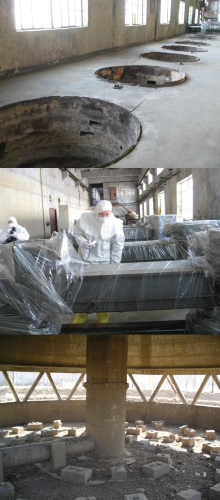
The potential of North Korea exporting nuclear materials or know-how remains a serious risk. It is imperative that Pyongyang understands that any previous or future export of fissile materials (or of nuclear weapons) represents a red line and cannot be tolerated by the United States or the other parties. All parties must work together to determine and assess the consequences of potential nuclear exports and cooperate to prevent them. Such exports are especially worrisome if they were to involve states, such as Iran, that are developing a robust nuclear infrastructure under a civilian umbrella. Ministry of Foreign Affairs officials told me they understand the sensitivity of nuclear exports to states like Iran.
During the February visit, I also raised the concern about potential collaboration between North Korea and Syria at the site in the Syrian desert that Israel bombed on September 6, 2007. 12 Ministry of Foreign Affairs officials denied such collaboration and focused their remarks on the future, stating that they will abide by the October agreement not to transfer nuclear materials, technologies, or know-how. However, a reconciliation of past activities must be included as part of the denuclearization agreement not only to assess matters in North Korea, but also to understand the nature of the threat posed by such exports.
The North Korean facilities are extensive, and because of the war-like environment in which they have been operated, some of the facilities are seriously contaminated. Eliminating the facilities and cleaning up will take years and will require substantial sums of money.
As difficult as the declaration is proving to be, the denuclearization of the Korean Peninsula presents an even more daunting technical and diplomatic challenge. If denuclearization is meant to end the threat posed by North Korea's nuclear program, then it must result in the elimination and verification of the entire program, including weapons, fissile materials, production facilities, potential uranium enrichment efforts, and the cessation of any nuclear exports. This, in turn, requires a complete and accurate declaration. Denuclearization also requires the safe decontamination and decommissioning of nuclear facilities, the redirection of thousands of nuclear workers, and decisions about what, if any, civilian nuclear program will remain–and under what kind of safeguards. Once the program ends, North Korea must also rejoin the NPT and the IAEA.
The principles of denuclearization are stipulated in the September 19, 2005 Joint Statement, but the specific steps of the process have yet to be negotiated. Although many of the steps will be difficult and contentious, eliminating the Yong-byon plutonium production facilities is technically doable and verifiable. North Korea's past plutonium production is also verifiable if the North Korean government makes the strategic decision to allow the Yongbyon technical specialists to cooperate in an open and transparent manner, as they have in the disablement stage. A thorough nuclear materials balance analysis may also help to address the question of potential past exports of plutonium. Future exports may be deterred if other states work closely with the United States to help prevent them. That North Korean plutonium carries a distinctive fingerprint could serve as a deterrent to its export. Detecting past nuclear technology cooperation or exports will be more difficult, but such activities typically come to light eventually. Again, an accurate assessment requires North Korean cooperation.
Getting to the bottom of the accusation about a uranium enrichment facility is difficult and will also require North Korean cooperation. Locating clandestine uranium enrichment facilities in North Korea is especially difficult because it has a legitimate use for most of the uranium fuel cycle for its reactor program. It will be especially difficult if there is little or no access to North Korea by outside technical experts.
Elimination of the nuclear weapons program also requires that nuclear facilities and sites are decontaminated and decommissioned in a safe and environmentally acceptable manner. Although the burden to do so must fall on North Korea, it is in the interest of all of the negotiating parties, particularly North Korea's neighbors, to help. The North Korean facilities are extensive, and because of the war-like environment in which they have been operated, some of the facilities (at least the ones I have visited) are seriously contaminated. Eliminating the facilities and cleaning up will take years and will require substantial sums of money. Several of the negotiating parties and some European countries could provide technical assistance since they have extensive experience in this area.
Likewise, North Korea must redirect the thousands of workers engaged in its nuclear program. Beyond humanitarian considerations, many of these workers have skills that may be quite useful to potential proliferators or terrorists. A specifically tailored Nunn-Lugar cooperative threat reduction program, similar to the program that helped former Soviet nuclear workers, may be appropriate. During my February visit, I discussed the potential of redirecting nuclear workers to other scientific or industrial work. The official North Korean government position is that such discussions are premature because the process is still stuck on disablement, but when asked, North Korean technical personnel engaged in productive discussions about potential programs. One possibility was redirecting some of the Yongbyon personnel to work on North Korea's small IRT-2000 research reactor, which could be used for research and medical isotope production. 13 North Korean officials also indicated that they are prepared to retrain some of their workforce to work on a light water reactor, should that opportunity avail itself. In the shorter term, a substantial number of the Yongbyon specialists should be involved in dismantlement, decontamination, decommissioning, and clean up of the Yongbyon site. In addition, some of the scientists could help to build stronger radiation health physics programs to help Yongbyon deal with the potential radiation health consequences from its past operations.
The diplomatic goal of a denuclearized Korean Peninsula, first declared in the 1992 Korean North-South agreement and reaffirmed within the Six-Party framework in September 2005, has eluded policy makers for nearly 16 years. 14 During this time, North Korea has continued to enhance its nuclear weapons capabilities, albeit with some long pauses. During the past year, bilateral North Korean-U.S. talks conducted under the Six-Party umbrella have brought the elimination of plutonium production within reach. Technically, this is a giant step that helps contain the threat posed by North Korea's program. It means no more bombs, no better bombs, and a reduced threat of nuclear export. The immediate focus of diplomacy should be to finish disabling and dismantling the Yongbyon nuclear facilities before turning to the painstaking process of complete denuclearization.
The elimination of nuclear weapons requires that we understand why North Korea chose to go nuclear in the first place. The September 2005 Joint Statement addresses many of these concerns, promising mutual respect of national sovereignty, peaceful coexistence, and the commitment to stability and a lasting peace in Northeast Asia, as well as the normalization of relations with the United States and Japan. These steps will require a transformation in the relationship between North Korea and the United States, which will first require the building of trust–step by step.
In addition, the United States and its partners will have to address North Korea's insistence on building a light water reactor. North Korean officials insist that such a reactor is necessary to provide much-needed electricity. But North Korean officials told me that it also has great symbolic value and is important to North Korea's internal politics. The proliferation risk of a light water reactor in North Korea is technically manageable, especially because North Korean officials told me that they are prepared to forgo enrichment and reprocessing. Nonetheless, North Korea will have to give up its weapons before it can receive help from the outside.
Diplomacy is complex, especially in the context of six nations' varied priorities. But the six nations must not let the current pause in progress turn into regression. Every diplomatic effort should be made to eliminate plutonium production at Yongbyon while the opportunity is within reach.
A Diplomatic and Technological Cocktail
When diplomacy yields to technological considerations
It was diplomatically desirable to disable the North Korean reprocessing facility's hot cells, in which the chemical extraction of the plutonium bomb fuel took place. Yet, it was not technically feasible to safely disable the highly radioactive hot cells in the two-month political window. Moreover, 80 cubic meters of high-level waste from previous reprocessing campaigns remain in storage tanks on the site. The U.S. technical team consulting on disablement convinced the diplomats to restrict actions to the front end of the facility–namely, the part of the facility where spent fuel is loaded into the hot cells. North Korea will have to restart its waste treatment facilities and the secondary purification units in the hot cells sometime in the next year or so to allow for the safe disposal of the high-level radioactive waste and the remaining low-level uranium waste. The technical team also persuaded the diplomats to allow Yongbyon specialists to run the uranium oxide production process at the fuel fabrication facility one more time after the initial shutdown to flush out solutions and materials that would have made the follow-on dismantlement steps more difficult and much more hazardous to execute.
When diplomatic expediency trumps the best technological decisions.
The spent-fuel rods from Yongbyon's 5-megawatt-electric reactor are being discharged and placed in the spent fuel pool to cool thermally and radioactively. The diplomats have not yet agreed on what to do with the spent fuel rods once they have cooled sufficiently. The United States hopes to convince North Korea to ship the fuel rods, which contain nearly 50 metric tons of uranium laced with highly penetrating radioactive fission products and approximately 12 kilograms of plutonium, to a third party.
Recanning and shipping the fuel rods will be a technically challenging job. The third party would eventually have to reprocess the spent fuel because the magnesium alloy clad is not stable over the long term. This raises the problem of what to do with the high-level radioactive waste. Few countries have the capability to reprocess the North Korean spent fuel, and none to my knowledge are willing to keep the nuclear waste.
Diplomats should instead consider allowing North Korea to reprocess the spent fuel and extract the plutonium under IAEA monitoring. Shipping 12 kilograms of plutonium to a third-party is considerably easier than shipping 50 metric tons of highly radioactive spent fuel. However, allowing North Korea to reopen the reprocessing facility to extract more plutonium would be a diplomatic challenge.
Rendering existing fresh fuel rods unfit for reactor operation would be another important disablement step. Once all reactor fuel is discharged, North Korea could conceivably field one more reactor load of fuel rods from the partial load of fuel for the 5-megawatt-electric reactor and the uranium cores prepared for the 50-megawatt-electric reactor.
If the existing fresh fuel were disabled, for example, by bending the rods, then the bent rods would have to be remelted, cast, and remachined if they were to be reused–delaying the reactor restart If the fuel rods were sold to South Korea for its nuclear energy program, then to make new fuel rods North Korea would have to start with uranium ore concentrate or oxide powder, make uranium metal, and machine and clad the fuel rods–all of which would delay the restart. North Korea has for the time being rejected this neat technical solution on diplomatic grounds.
SIEGFRIEDS. HECKER
Supplementary Material
Joint Statement of the Fourth Round of the Six-Party Talks
Supplementary Material
North Korea's Nuclear Weapons Program
Footnotes
1.

2.
Personal communications with Chinese nuclear specialists, November 2006.
3.
Siegfried S. Hecker and William Liou, “Dangerous Dealings: North Korea's Nuclear Capabilities and the Threat of Export to Iran,” Arms Control Today, vol. 37, no. 2, pp. 6-11.
4.
5.
6.
David Albright and Kevin O'Neill, eds., Solving the North Korean Nuclear Puzzle (Washington, D.C.: Institute for Science and International Security, 2000).
7.
8.
A detailed description of the disablement steps and photos of the disabled equipment was posted by Siegfried S. Hecker at cisac. Stanford.edu/news/hecker.
9.
All three reactors are gas-graphite reactors patterned after the British reactor first built at Calder Hall, Britain. However, design and construction of all three was done indigenously. These reactors are able to burn natural uranium fuel, thus not requiring uranium enrichment, which was beyond the Democratic People's Republic of Korea's technical means in the 1980s. Only the 200-megawatt-electric reactor would have had substantial electricity generating capacity, but all three of them would make very good bomb-grade plutonium if the reactor burn cycle is kept to less than approximately four years.
10.
Larry A. Niksch, “North Korea's Nuclear Weapons Development and Diplomacy,” Congressional Research Service, January 21, 2008.
11.
Pervez Musharraf, In the Line of Fire: A Memoir (New York: Free Press, 2006).
13.
The IRT-2000 research reactor is a light water cooled and moderated pool-type reactor supplied by the Soviet Union in the 1960s. The reactor's fuel was gradually upgraded from low-enriched uranium to highly enriched uranium over the years. The reactor has only operated sparingly in the past 16 years because North Korea has not been able to obtain new fuel. The reactor is not part of the current negotiations process, although it had been monitored by the International Atomic Energy Agency in the past.
14.
Under the January 19,1992 Joint Declaration, the Democratic People's Republic of Korea and the Republic of Korea agreed not to test, manufacture, produce, receive, possess, store, deploy, or use nuclear weapons; to use nuclear energy solely for peaceful purposes; and not to possess facilities for nuclear reprocessing and uranium enrichment.