



Abstract

To this day, nobody knows who mailed the envelopes laced with anthrax that infected 22 people and killed five in 2001. Well-aware that such an attack could happen again, the federal government poured money into research on “priority” biological weapons agents–pathogens categorized as posing the greatest threat to national security. The number of grants to study these bugs ballooned, as did the number of facilities and researchers conducting bio-defense work.
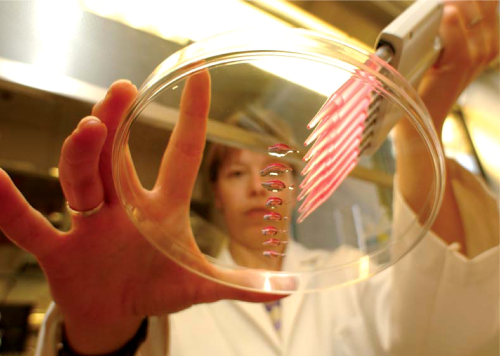
Culture of fear: A researcher prepares cells sensitive to anthrax as part of a study to find a treatment for the disease.
From one perspective, this is good news: More research on bioweapons agents, in theory, will lead to a better biodefense. But critics argue that putting this work in the hands of inexperienced researchers–so-called bug jockeys–not only increases the risk of bioterrorism and of accidental release of deadly pathogens, but also shortchanges public health.
More than 300 institutes and 12,000 individuals now have access to bioweapons pathogens, according to Richard H. Ebright, a molecular biologist at Rutgers University who has been critical of the biodefense expansion, and the numbers continue to grow. The Sunshine Project, a biodefense watchdog group, found that 97 percent of the “principal investigators” who received National Institute for Allergy and Infectious Diseases (NIAID) grants from 2001-2005 to study six priority pathogens (anthrax, brucellosis, glanders, plague, melioidosis, or tularemia) are newcomers to such research (see “The Bug Jockeys Saddle Up,” opposite page). Edward Hammond, director of the Sunshine Project's U.S. office, worries that the lack of pathogen-handling experience among “NIAID newbies” may make accidents more likely. Aerosolization, animal testing, and other biodefense research activities are dangerous to begin with, Hammond says, and increasing the number of people and sites performing them compounds the risk.
Before 2001, all anthrax researchers “knew each other by first name,” Martin Hugh-Jones, a veteran anthrax researcher at Louisiana State University, told the Baltimore Sun (June 27, 2004). “[Now] I see a lot of names I've never heard of…. On a probabilistic basis, there's more of a risk of accidents or attacks.”
And accidents have occurred. On February 11, a scientist at Rocky Mountain Laboratories, a NIAID research facility in Hamilton, Montana, was exposed to the bacterium that causes Q fever while working in a Biosafety Level 3 (BSL-3) lab. (Labs are categorized by the level of biological containment necessary to maintain safety; at BSL-4 labs, the most dangerous pathogens, for which there are no known cures, are studied.) While only rarely fatal, Q fever is a weaponizable pathogen that causes flu-like symptoms. According to NIAID, early detection of Q fever infection is difficult, and the Centers for Disease Control and Prevention says that Q fever “probably presents the greatest risk of laboratory infection” among its family of diseases. The Q fever accident, which NIAID characterized as a “small spill,” ultimately did not result in an infection.
The bug jockeys saddle up
The expanding number of researchers involved in U.S. biodefense work:

SOURCE: THE SUNSHINE PROJECT, CRISP-ER, WWW.CBWTRANSPARENCY.ORG/CRISPER/
Last year, three researchers at a Boston University BSL-2 lab were infected with a virulent strain of tu-laremia, a disease that can cause severe respiratory illness and is highly infectious when aerosolized. The researchers mistakenly thought they were handling a non-infectious strain of the bacterium. The university and the city waited two weeks before notifying public health authorities about the accident, and the public did not find out until the Boston Globe broke the story in January 2005.
“Things like that [the tularemia infections] happen when people are not trained well,” explained NIAID Director Anthony Fauci on February 23, 2005. “‘They’ in this case is an investigator who did not follow protocol, who did not go under the training, who was not working in a BSL-4.” Fauci, who was speaking about the BSL-2 where the accidents occurred, also endorsed Boston University's plans to build a BSL-4 lab.
Hammond believes that the recent accidents are “indicative of what's to come,” a belief shared by molecular biologist Ebright. “The influx of large numbers of institutions and individuals with no prior experience into bioweapons agents research” was partly to blame for the accidents, he said.
NIAID disagrees. Although most NIAID researchers have never before worked with bioweapons agents, they are still qualified to do so, according to Rona Hirschberg, NIAID senior program officer. More biodefense research is needed because scientists “can't learn about anthrax by studying E. coli,” she argues. “It is important that people work on these [bioweapons] organisms” to defend against their possible use.
Such statements do little to reassure Jeanne Guillemin, senior fellow at the Security Studies Program at the Massachusetts Institute of Technology and author of a history of biowarfare. In her view, as more researchers acquire the skills to handle and weaponize these biological agents, the greater the possibility that rogue researchers could make lethal use of their federally funded on-the-job training. (Many suspect that the perpetrator of the anthrax mailing was such a rogue researcher.) “What [Fauci] and others haven't thought through is the particular kind of expertise, from basic bench work to aerosolization, that comes with defensive biological weapons programs,” Guillemin says. Hirschberg counters that the “insider” bioterrorist threat is unlikely, thanks to thorough background checks conducted by NIAID. Yet even the U.S. intelligence community, which has extremely rigorous background checks, still has its share of moles and saboteurs.
The biodefense funding jump could have other deleterious side effects. As money pours into research on the “bad bugs” of potential biowarfare, it may be draining funds from research on more widespread diseases that affect many more people than those caused by bioweapons agents. From 2002 through 2004, NIAID funding for research on priority bacteria (anthrax, glanders, plague, melioidosis, brucella) shot up to more than $185 million–an increase of 2,400 percent. Funding for priority viruses (smallpox and viral hemorrhagic fevers such as Ebola and Marburg) increased nearly 2,000 percent to $120 million. During that same time, funding for studies of HIV, malaria, hepatitis, tuberculosis, chlamydia, Chagas disease, gonorrhea, and other illnesses decreased significantly. For example, NIAID funding for HIV research dropped from $535 million to $426 million.
As such, many worry that the biodefense boom is leading to a public health bust. On February 28, more than 750 scientists, including Ebright, sent a signed petition to National Institutes of Health (NIH) Director Elias Zerhouni, charging that NIH biodefense priorities have led to a “crisis for microbiological research.” The letter argues that there has been a “diversion of research funds from projects of high public health importance” to biodefense projects.
Again, NIAID insists that this is not the case; Hirschberg says that biodefense funding is “new money appropriated for biodefense research …in addition to [NIAID's] normal budget.” And Fauci was quoted as saying in a March 1 New Scientist article that NIAID funding for non-biodefense research has been steady from 2000 to 2004–a statement that the Sunshine Project disputes. Hammond says that NIAID is “mixing up the numbers and definitions of different kinds of research” to produce more acceptable statistics. Hammond believes the way to solve this confusion is for NIAID to publicize both the dollar value of the grants it hands out as well as a description of the research.
The specter of bioterrorism still looms large–witness the recent anthrax false alarm in Washington, D.C., in March. Given the arguments and the stakes, the debate on biodefense is unlikely to dissipate anytime soon. And the ones caught in the middle are the tens of thousands of Americans who contract diseases such as HIV and tuberculosis each year. As Guillemin observes, “We have to ask ourselves whether we are increasing health risks nationally and globally by ignoring actual mortality statistics and concentrating on doomsday scenarios of bioterrorist attacks.”