



Abstract

How does one paint a balanced portrait of a man generally perceived as a great villain of the twentieth century? British author and television producer Peter Goodchild takes on this challenge in The Real Dr. Strangelove, a biography of controversial physicist and nuclear weaponeer Edward Teller.
Goodchild approaches his task without bias; his political views (whatever they might be) do not overwhelm and betray his attempt to deconstruct Teller's life. Like any good biographer, Goodchild strives to illustrate the gray areas of Teller's life, not embellish a polarizing figure's reputation. If anything, his desire to color well-trodden territory with an original hue could cause some to label him a Teller apologist.
Unfortunately, armchair psychology consumes Goodchild. He casts seemingly ordinary events in Teller's life as seminal, life-changing catalysts. In Goodchild's version, nearly every anecdote from Teller's youth results in an epiphany. “Psychological wounds gained in childhood and adolescence do leave sensitivities” is the sort of explanation he offers time and again as a rationale for Teller's behavior.
However clumsily, Goodchild does soften the Teller legacy. He portrays Teller not as a cunning mastermind but as a tragic character, a man whose stubbornness and compulsion for science's bright lights led him to one thickheaded, misguided pursuit after another.
At times, Goodchild's Teller becomes a sympathetic character. When his testimony against J. Robert Oppenheimer during Oppenheimer's security hearings causes a mutiny among his colleagues, Teller is devastated. He never meant to topple Oppenheimer, Goodchild surmises; Teller's paranoia and zeal for the hydrogen bomb got the better of him.
Here the breadth of Goodchild's reporting and knowledge of the atomic age–he also wrote the 1985 biography J. Robert Oppenheimer: Shatterer of Worlds–provide The Real Dr. Strangelove with its strongest passages. Goodchild captures what no other observer–impartial or otherwise–ever has: Teller's humanity.
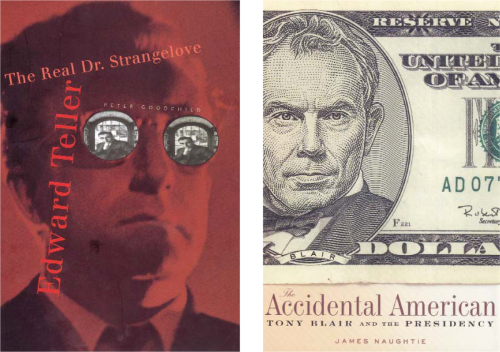
Could British Prime Minister Tony Blair have headed off President George W. Bush's push to war with Iraq? Perhaps, but the point is that he didn't want to, according to James Naughtie's The Accidental American.
Personal and political conviction told Blair that he needed to confront Saddam Hussein and his alleged weapons programs, even preemptively. Blair was not “enticed” into war, he was a true believer, independent of the neocon project, Naughtie writes.
Naughtie's emphasis on Blair's post-9/11 transformation might lead one to believe that Blair would have wanted to confront Iraq even if Bill Clinton had still been in office in 2002. This is where Naughtie goes slightly astray. What could the big-thinking Blair have done without the cover of more than 125,000 American troops?
The Bush administration's aggressive policy toward Iraq allowed Blair to redefine British foreign policy, which deepened the prime minister's dependency on the United States. In the Iraq War, Blair needed Bush both militarily and politically, but Bush proved to be an enormous liability, a point Naughtie touches on only briefly.
Blair was ultimately left isolated domestically and within the European community, a fate that Bush avoided and disregarded, respectively. Despite his divisiveness, Bush won reelection by a popular majority, while Blair has been in a near-constant battle for his political life since 2002. And Blair failed to draw Washington into a more active role in the Mideast peace process as he hoped his support for Bush would allow, Naughtie says.
If there is a “next time,” the very presidential prime minister, as Naughtie describes him, might think twice before pulling on his cowboy boots and joining Bush in battle.