




Abstract
The United States said it would restrict its activities at Manta to anti-drug efforts–so why is it messing with migrants and more?
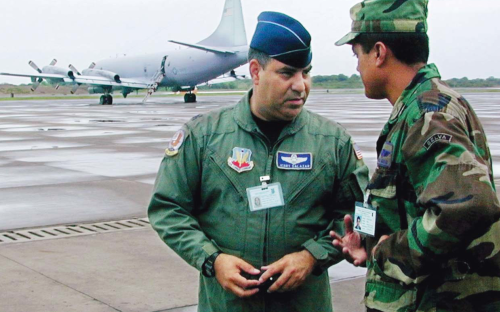
A U.S. Air Force officer talks to his Ecuadorian counterpart on the U.S.-rebuilt runway at Manta.
Located in a rundown barrio in the Ecuadorian port city of Manta, the Santa Margarita daycare center is indistinguishable from the other unpainted cement block buildings that surround it. Its roof is composed of the ubiquitous rusting zinc sheets that serve as shelter for most Latin Americans, it has bare cement floors, and its rooms are overcrowded with undernourished children.
But on this sweltering summer day, the children at Santa Margarita have something to celebrate. They are receiving handouts–in the form of used clothing and miscellaneous school supplies–from U.S. military personnel based at a nearby “Forward Operating Location” (FOL), one of three located in Latin America that are meant to replace the Howard Air Force Base in Panama, which was shuttered in 1999. (The other two FOLs are in El Salvador and the Dutch Antilles–Aruba-Curaçao.)
As the small caravan of cars from the base pulls up to the school, several children scamper out the front door, teachers rush to corral the kids, and neighbors look on with curiosity as tall, fair-skinned airmen–dressed in civvies for the occasion–emerge carrying cardboard boxes filled with goodies.
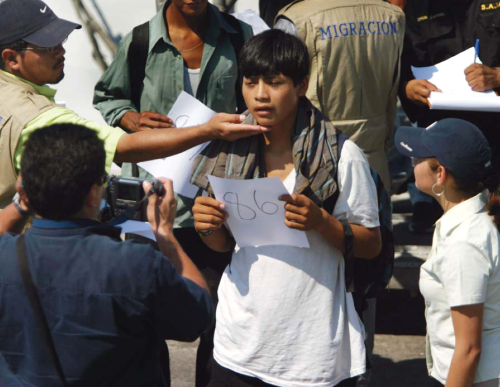
March 26, 2004: A repatriated Ecuadorian arrives in Puerto Quetzal after the U.S. Coast Guard discovered him and 91 others aboard a vessel off the Ecuadorian coast.
“We are always looking for ways to help out,” says Lt. Matthew Mountcastle, a public affairs officer at Manta who served as my chaperon during a tour of the base early last year. As part of the tour, Mountcastle invited me to accompany the few base personnel going on the school trip, which happened to coincide with my visit. He says that arriving flight crews often “stow away” a few extra pieces of clothing in their luggage to give to the children. “This is an extra mission we have at the FOL–to help the poor children here and to reach out to the community.”
Not everyone in Manta, however, sees the charity–or the base–as benign. “Remember how Columbus gave glass beads to the Indians?” asks Miguel Moran, a local labor attorney who heads an anti-base group called Movimiento Tohalli. “They just want to placate us. But we don't want them here.”
Listening to Moran's invective, one would think Che Guevara had just been killed in Bolivia or that Augusto Pinochet was busy rounding up leftists in Chile. “All of Ecuador is being used as a base for U.S. military operations in Latin America,” says Moran. He claims Manta is part of a broader U.S. imperialist strategy aimed at exploiting the continent's natural resources, suppressing popular movements, and ultimately invading neighboring Colombia.
Moran is not alone. Observers from Latin America to Europe regard the base as an integral part of the U.S. counterinsurgency strategy in Colombia–and potentially as a staging ground for direct American involvement in the conflict there. Ecuadorians worry that the U.S. presence here could ultimately pull their country into such a conflict, or possibly make Ecuador a target of Colombian guerrilla or paramilitary groups.
The base is also at the center of a growing controversy regarding U.S. efforts to block mass emigration from Ecuador, which during the last five years has seen several million of its citizens leave for Europe or North America. Furor over U.S. interdiction efforts in the region erupted in early October when the U.S.S. Curts–a guided missile frigate armed with anti-submarine warfare systems, torpedoes, and twin 76-millimeter cannons–intercepted an Ecuadorian fishing vessel carrying some 80 migrants 240 miles northeast of the Galapagos Islands. When the migrants arrived in Manta, they immediately denounced the abuses they had suffered at the hands of U.S. sailors who, they said, had mistreated several detainees in an effort to identify the crew. One of the detainees told reporters that sailors had beaten a polio victim with an iron bar “because he didn't get up fast enough.” The migrants also claimed that the navy frigate sank the fishing vessel.
Responding to the allegations, Glenn Warren, U.S. embassy spokesperson, said, “This is the first time that we have had a problem of this kind. We respect human rights and we have a humanitarian policy that has saved thousands of lives which were in danger on the high seas.”
The incident came on the heels of a highly publicized report released last July by the Quito-based Latin American Association for Human Rights (ALDHU) accusing U.S. Navy ships based at Manta of having sunk eight Ecuadorian fishing boats in the country's territorial waters since 2001. (Ecuador defines its territory as extending 200 nautical miles from its coast, as opposed to the 12 nautical miles established by the Law of the Seas.) Five of the boats, according to ALDHU, were carrying undocumented migrants, all of whom were detained and repatriated. Crews on the other boats were simply fishing.
Although U.S. officials have denied sinking or interdicting vessels in Ecuadorian waters, Ecuador's government has been unable to diffuse the controversy. A coalition of social and labor organizations has called for the termination of the U.S. lease in Manta on the grounds that the United States has violated both the terms of the agreement and Ecuadorian law. The coalition also lodged complaints with the Organization of American States and the United Nations, and has asked the U.S. Congress to solicit a report on U.S. interdiction practices in the region from the Government Accountability Office.
Mission creep
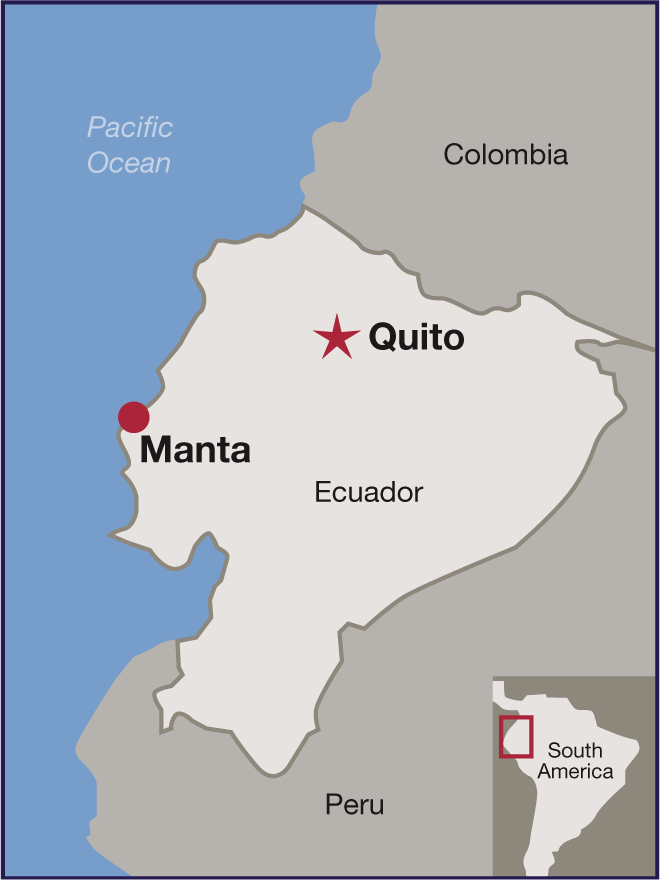
The Manta FOL is located at Ecuador's Eloy Alfaro Air Force Base, which until 1999 was a partially dilapidated facility hugging the coastline just north of the city. According to a 1999 pre-arrival assessment completed by U.S. Southern Command, the airfield's runway was so decrepit that military aircraft were unable to use it. “Tennis-ball-size bits of concrete [are] lying about in places,” the assessment stated, and “an eroded ditch over 3-feet deep runs just along the runway edge.” Cats and dogs routinely roamed the airfield, base water was contaminated, lighting inefficient, power erratic and rationed during dry seasons, and fire-fighting capabilities nonexistent.
Today, after pumping $80 million in construction costs into the base, U.S. officials boast that “the runway is one of the best in Latin America.”
And that is just one of the many perks of the U.S. presence here, says Lt. Col. Mario Garcia, the U.S. second in command at the time of my visit. Other perks include a new four-lane road connecting the base to the port, a new hangar, a set of state-of-the-art emergency vehicles and fire engines manned by DynCorp employees (who joked with me about “all the work” they had to do, which in 2003 included attending to some two dozen minor emergencies), and a set of dormitory-style buildings used to house base personnel (typically numbering from 100 to 300) and offices.
Serendipitous layover?
In their efforts to block the migrant-smuggling route originating in Ecuador, U.S. officials seem to have come up with some unusual techniques. In one case in 2002, the U.S. Coast Guard and Navy interdicted an Ecuadorian vessel, the San Jacinto, off the coast of Guatemala and towed it to southern Mexico, where the 270 migrants on board were briefly questioned and then repatriated.
Although nominally in the custody of Mexican officials, the five alleged smugglers–identified by passengers as the crew–were questioned by U.S. Immigration and Naturalization Service (INS) officials, who advised them of their rights under the U.S. Constitution. Although the crew had little or no understanding of U.S. laws, the INS officials asked them if they would waive their Miranda rights, which they did. (But as one immigration specialist told me: “What does it mean to tell someone they have a right to an attorney when that attorney is located a thousand miles away in a foreign country?”)
According to court documents filed in federal court in Washington, D.C., INS officials then contacted the Justice Department about the case, and the decision was made to file an arrest warrant against the crew. According to one document from the U.S. Attorney's office, “After being expelled from Mexico, the defendants were arrested in Houston, where their flight landed, and taken into custody by federal authorities.”
The documents fail to explain how the crew ended up on that flight, or whether they had any idea they were heading to the United States. According to Elita Amato, an attorney who represented the crew members, when they boarded their flight in Mexico, “Their understanding was that they were going to Ecuador.”
Speaking on background, a U.S. immigration official in Ecuador solved the mystery, explaining: “Mexico would be the country that deported [the crew], and if they choose to deport them by way of the United States, where the plane has a layover, what can we do about it?”
After waiting more than a year for their case to come to trial, the crew members decided in late 2003 to plead guilty to conspiracy to encourage illegal immigration.
“When we leave here,” says Garcia, “all of this will be left for the Ecuadorians.”
Despite the perks, the Manta base was the subject of dispute even before it was established. When Ecuador's then-President Jamil Mahuad announced in early 1999 that he would allow the base, religious and indigenous groups, human rights organizations, opposition politicians, and a small but vocal minority of Manta's citizens reacted angrily, arguing that the base would be “an enormous affront to our freedom, our autonomy, and, above all, our sovereignty,” as an influential Ecuadorian bishop said at the time.
In early 2000, just a few months after a 10-year lease agreement was finalized, Mahuad was overthrown in a military coup, which further fueled the dispute over the base. Base opponents have argued that because neither Mahuad–nor his successors–ever put the agreement to a vote in Congress, it is unconstitutional.
More important to critics have been the often contradictory views about the purpose of the base expressed by U.S. officials, as well as its perceived mission creep. According to the lease agreement, U.S. activities at the base are to be limited to counter-narcotics surveillance flights (the agreements for the other two Latin American FOLs contain similar limitations). Human rights groups in Ecuador and elsewhere, however, have repeatedly charged that the surveillance planes based at the FOLs–which in Ecuador typically include three or four navy P-3s or air force C-130s–have been involved in everything from immigration interdiction to the coup d'état against Venezuelan President Hugo Chavez in 2002.
Summarizing these concerns, the Amsterdam-based Transnational Institute, which has paid close attention to the FOLs in part because of the base in Aruba-Curaçao, concluded in a 2003 report: “It is very likely that the agencies that use the FOLs [including Customs, the Coast Guard, the navy, and the air force] have other priorities besides combating drugs…. Counterinsurgency efforts in Colombia, control of arms trafficking in the region, control of migration, and possible support for the coup in Venezuela are indications of other uses of the FOLs that are not laid down in the agreements. Nor should the possible implications be underestimated of military protection–whether official or contracted–for the petroleum interests of transnational companies operating in the region.”
U.S. officials have seemed indifferent to public sentiment in Ecuador. Asked by the daily El Universo if the base might prompt attacks by Colombian guerillas, former U.S. Amb. Gwen Clare quipped in mid-2000: “You'd have to ask them.”
Despite local protests, former Ecuadorian President Jamil Mahuad approved the U.S. base at Manta. Mahuad was overthrown in a coup soon after, and his successors never took the issue to the legislature for a vote.

The Pentagon's decision to give DynCorp–a company that many Latin Americans closely associate with U.S. activities in Colombia–the contract to administer the base reinforced fears that the United States had more than drug interdiction in mind when it set up shop in Manta. After the contract was finalized in early 2002, public outcry helped spur the Ecuadorian Congress to request the minister of defense to testify on the matter.
Although Ecuadorian officials have repeatedly insisted that DynCorp is involved in only non-military activities, the company's presence is a touchy issue. In November 2003, Ecuador's air force announced that it was suspending a contract with Dyn-Corp because of the company's reputation, which according to El Universo included allegations of people-smuggling, narco-trafficking, and child prostitution.
As Gustavo Larrea, an ALDHU director, summed up: “Here we have a company of mercenaries that has been accused of human rights abuses across the globe operating an illegal American base on Ecuadorian territory.”
At the same time that base officials like Lieutenant Colonel Garcia insist that the FOL is being used exclusively for “ocean air surveillance for counter-narcotics,” other U.S. officials have been pressing Ecuador to allow expanded use of the base, especially since September 11, 2001.
In early 2002, Undersecretary of State Richard Armitage claimed that Al Qaeda cells were operating near Ecuador's borders with Peru and Colombia: “We have got in the tri-border area a bit of a problem with Al Qaeda itself and some Hezbollah elements,” he told a House Foreign Operations Subcommittee. “We do need cooperation.”
Ecuador has balked at any suggestion that the Manta base be used for U.S. anti-terror activities, angering some U.S. congressmen, including Alabama Republican Sonny Callahan, who argued that aid to Ecuador should be cut off unless Ecuador changes its position. The United States spent millions on the Manta base, said Callahan, “And yet they're telling us they're not going to allow us to use it for anything that has to do with Operation Enduring Freedom.”
In early 2003, Gen. James Hill, head of U.S. Southern Command, announced that the United States was attempting to negotiate an agreement to allow U.S. warships to remain in Ecuadorian waters to detain and board suspicious vessels. Although such an agreement would conflict with the Manta lease agreement–which expressly prohibits the United States from undertaking interdiction activity in Ecuadorian territory–Hill argued that it was “vital to hemispheric security.” It was a familiar theme for Hill, who previously had argued that “narcoterrorism” was not just a U.S. problem, but one shared by all the countries of the region.
Hill's announcement, which came on the heels of his visit to military installations on the Ecuador-Colombia border, prompted public outcry. Said one Ecuadorian writer: “The U.S. invasion of Iraq and the pressure on Ecuador to sign the interdiction agreement form part of a policy aimed at consolidating a unipolar world with one hegemonic superpower.”
Although no new agreement has been reached, many observers are convinced that the United States continues to put pressure on Ecuador to allow for expanded use of the base.
In its report on the FOLs, the Transnational Institute points to a number of U.S. policy documents and military studies that outline the potential U.S. long-term strategy. One study, published by the Naval War College in 1998, argued that despite the increasing importance of South American petroleum, U.S. forward basing to protect this “vital interest” was “woefully lacking.” According to the study, “Laying the political groundwork and obtaining initial approval [for forward bases] is the first half of the process…. In times of crisis, the armed forces can further improve possibilities for access by helping to ‘sell’ the idea of a threat in the host nation.”
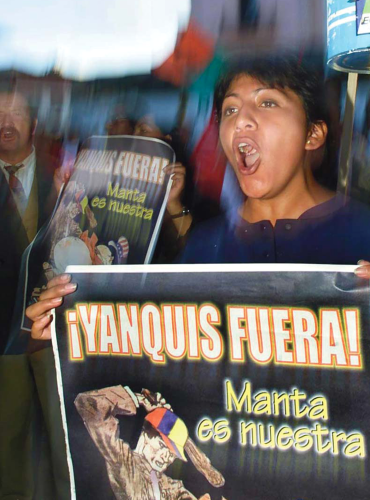
The people's voice: A student protester's sign reads “Yankees out! Manta is ours.”
Virtual frontier
In the main office building of the Manta FOL, just down the hall from the reinforced door guarding the entrance to the super-secret Sensitive Compartmented Information Facility (“None of us really know what goes on inside there,” quipped my Manta tour guide, Lieutenant Mountcastle), is the office of Immigration Customs and Enforcement (ICE), the Department of Homeland Security agency “responsible for identifying and shutting down vulnerabilities in the nation's border, economic, transportation, and infrastructure security.”
When I queried a U.S. immigration official in Quito, who would only speak to me on background, why ICE was active in Manta, he said he was unaware of the agency's office there and suggested it could simply be a result of the confusion surrounding the creation of the Department of Homeland Security, where he said “all the roles have not been defined yet.”
Lily pads
Although the turmoil surrounding the Pentagon's “Forward Operating Location” (FOL) at Manta, Ecuador, would seem to belie their assertions, U.S. officials claim that sites like Manta reflect a kinder, gentler global presence–one in which the U.S. “footprint” is dramatically softened. Instead of expanding its presence through traditional military bases like those in Germany and South Korea, the Pentagon is establishing dozens of FOL-type bases, or “lily pads,” across the globe.
The goal of the new “global posture,” Undersecretary of Defense Douglas Feith told the House Armed Services Committee in June 2004, “is to update our defense posture so it looks forward, not back toward the Cold War. We want our posture to enable more effective military operations in the future–greater flexibility for our forces, their ability to deploy powerful capabilities rapidly anywhere in the world where they are needed. We want our posture to enrich our ties with our defense partners around the world
In a June 2003 interview with the Washington Post, Deputy Assistant Secretary of Defense Andy Hoehn, an architect of the realignment, explained that the new forward bases are a necessary element in the global war on terrorism: “The strategic issue that is big and profound is the unprecedented destructive power of terrorism and what that means. You just can't ignore it, and you can't deal with it regionally. This is running across regions, across continents. If you're going to deal with this, you're going to deal with it on a global scale.”
The Pentagon plans to establish lily pads across the broad swath of the planet that defense officials term the “arc of instability,” which stretches from the Andes to Africa and from the Middle East to Southeast Asia. It is an area, writes historian Chalmers Johnson, that is “more or less identical with what used to be called the Third World–and perhaps no less crucially it covers the world's key oil reserves.”
Military analyst William Arkin agrees. He told the Associated Press that the lily pads' main purpose is to protect the global oil supply: “It's empire, pure and simple” (September 22, 2004). According to various news reports, countries where forward operating bases have already been established–besides those in Latin America–include Senegal, Uganda, Singapore, Djibouti, Kyrgyzstan, Qatar, Bahrain, Oman, Kuwait, and the United Arab Emirates. Other sites under consideration include the island nation of Sao Tome and Principe off the coast of West Africa, Australia, Bulgaria, and Romania.
Confusion or not, ICE plays a key role supporting–when not fighting turf wars with–the U.S. Border Patrol in detaining undocumented migrants in the United States. The agency's presence at Manta would seem to lend credence to Ecuadorian concerns regarding the base–that it is playing a role in aiding the interdiction of migrant-smuggling vessels leaving Ecuadorian shores.
Ecuador, where nearly everyone has a neighbor or relative living abroad and whose second source of hard currency is remittances, takes immigration issues and other countries' efforts to block access for its citizens very seriously. Not surprisingly, since the Manta FOL was established, Ecuadorian newspapers have run countless stories on U.S. interdiction practices and alleged collaboration between surveillance planes and warships operating out of Manta.
U.S. officials are quick to deny any connection. In mid-2000, just a few months after the Manta FOL went operational, then-Ambassador Clare was put on the defensive when a navy boat steamed into port carrying 190 detained migrants. After a former defense minister denounced the action, arguing that Ecuador should present a complaint to the United Nations on the grounds that the United States was violating the country's maritime rights, Clare told journalists: “All of sudden there is this debate over whether we use Manta to interdict immigrants. This has nothing to do with the base. Our forces aren't going to spend so much money just to find a few boats carrying some poor victims of coyotes.”
Pinning down exactly what role the base is playing in interdiction is exceedingly difficult, in part because no one–not even the “host nation riders,” as U.S. officials term the Ecuadorian officers who fly on board the surveillance flights leaving Manta–is privy to the intelligence gathered by the planes or the eventual use of the information. As the Washington Office on Latin America stated in a 2002 report on Manta: “It would be impossible for the Ecuadorian military to monitor the kind of surveillance being done by U.S. planes on their reconnaissance flights and therefore almost impossible to enforce strict adherence to the terms of the [lease agreement].”
What is clear is that since the base was set up, a constant stream of U.S. warships and Coast Guard vessels have gone through the port, typically staying for just a few days before moving on. Local newspapers keep a running tally of which boats are present at any given time. The United States justifies the boats' presence by arguing that they support the work of the air base, transporting materiel and personnel.
Critics also point to the growing number of interdictions since the FOL was set up as proof of its involvement in migration control. According to U.S. Coast Guard statistics, the number of Ecuadorians interdicted yearly rose from zero in 1998 to nearly 1,300 in 2000.
FOL officials, however, are tight-lipped when it comes to discussing the activities of the boats. When I asked Lieutenant Colonel Garcia about the Daiki Maru, a fishing vessel seriously damaged during a U.S. Navy and Coast Guard operation in early 2002, he said that he had “never heard of it.” The air base and the port, he said, having nothing to do with each other.
The Daiki Maru case is the most notorious of a growing list of alleged interdictions in Ecuadorian waters. Over a period of several months, the boat was boarded and seized by the U.S. Navy and Coast Guard three times while trolling coastal areas. In their search for drugs, Coast Guard officers allegedly drilled holes in the boat's hull and spoiled the fish that were stored there. After inspecting the boat, Ecuadorian judicial officials estimated that total damages to the captain's business totaled more than $2 million. The boat's owner has filed a case in a federal court in Florida, which also has a case pending regarding the alleged sinking of another Ecuadorian fishing vessel by the U.S. Navy.
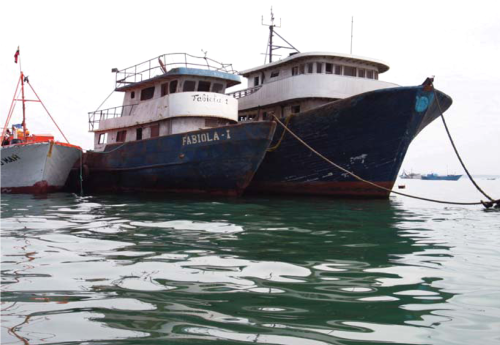
Two fishing boats, the Fabiola (center) and the Viviana (right) intercepted in 2003 for carrying migrants en route to the United States, moored in the harbor at Manta.
A sign of increasing sensitivity to the interdiction issue has been the enormous uproar the ALDHU report about the alleged boat sinkings has caused in Ecuador, as well as the contradictory explanations offered by government officials.
In late June, two weeks after ALDHU announced its findings, U.S. Amb. Kristie Kenney issued a press release explaining that boats too crippled to return to port can present serious dangers to other vessels navigating international sea lanes. “It is standard international practice to eliminate the dangers by sinking the boats,” the statement said.
At about the same time, Vice-Adm. Victor Hugo Rosero, head of Ecuador's navy, announced that the armed forces “had no evidence of the sinkings,” saying that in any case Ecuador does not have the resources to control all the activities in its waters. Two weeks later, however, when Rosero presented to Ecuador's Congress a report from a special commission created by the navy to investigate ALDHU's charges, the report confirmed several of the sinkings. The report, based in part on information turned over to Ecuador by the U.S. embassy, concluded that “10 boats were intercepted by the U.S. Navy, of which seven were towed to port and three were sunk.” Only one of the sinkings occurred in Ecuadorian waters; nine of the boats carried undocumented migrants.
In mid-August, with the public debate over the sinkings still heated, President Lucio Gutierrez–a strong proponent of the base–announced that Rosero was being promoted to head of joint command. Although the move was explained as simply an institutional decision, some pundits saw a darker, more conspiratorial motive. Mauricio Gandara, a former Ecuadorian ambassador to Britain, told El Univers: “This demonstrates that both Gutierrez and the ex-commander of the navy [Rosero] have turned over defense of Ecuador's sea to the United States, which will use a secret interdiction agreement to interdict Ecuadorian boats in national and international waters.”