




Abstract

Stockpiles of fissile material–the key ingredient in nuclear weapons–remain huge. At the end of 2003 there were more than 3,700 metric tons of plutonium and highly enriched uranium (uranium enriched to 20 percent or more uranium 235), enough for hundreds of thousands of nuclear weapons, in about 60 countries. Although some fissile material is disposed of, more material is produced, causing the total to grow each year.
This is worrisome not only because the world has yet to come up with an accepted method of plutonium disposition, but also from a security standpoint–how safe is that plutonium and highly enriched uranium (HEU)? That military stocks in India, Pakistan, and Israel are continuing to grow is an important indicator of the need for an international ban on the production of fissile material for nuclear weapons.
Since its founding in 1993, the Institute for Science and International Security (ISIS) has gathered hard-to-find information about the production and stockpiling of fissile material and nuclear weapons programs, capabilities, and policies. ISIS's most current findings about global stocks of fissile material are presented below and in the accompanying tables. Considerably more information about these estimates and their uncertainties is available on the ISIS web site at www.isis-online.org.
“Global Stocks” (above) attempts to realistically assign fissile material to civil or military stocks based on current use, intended future use, and other factors. The stocks of plutonium and HEU are roughly equal, as are stocks of civil and military fissile material. However, most plutonium is in civil stocks and most HEU is in military stocks. (Russia's declared HEU excess is included under military stocks in “Global Stocks” because of a lack of information about its location and whether it remains in active nuclear weapons.)
Global stocks (in metric tons)∗
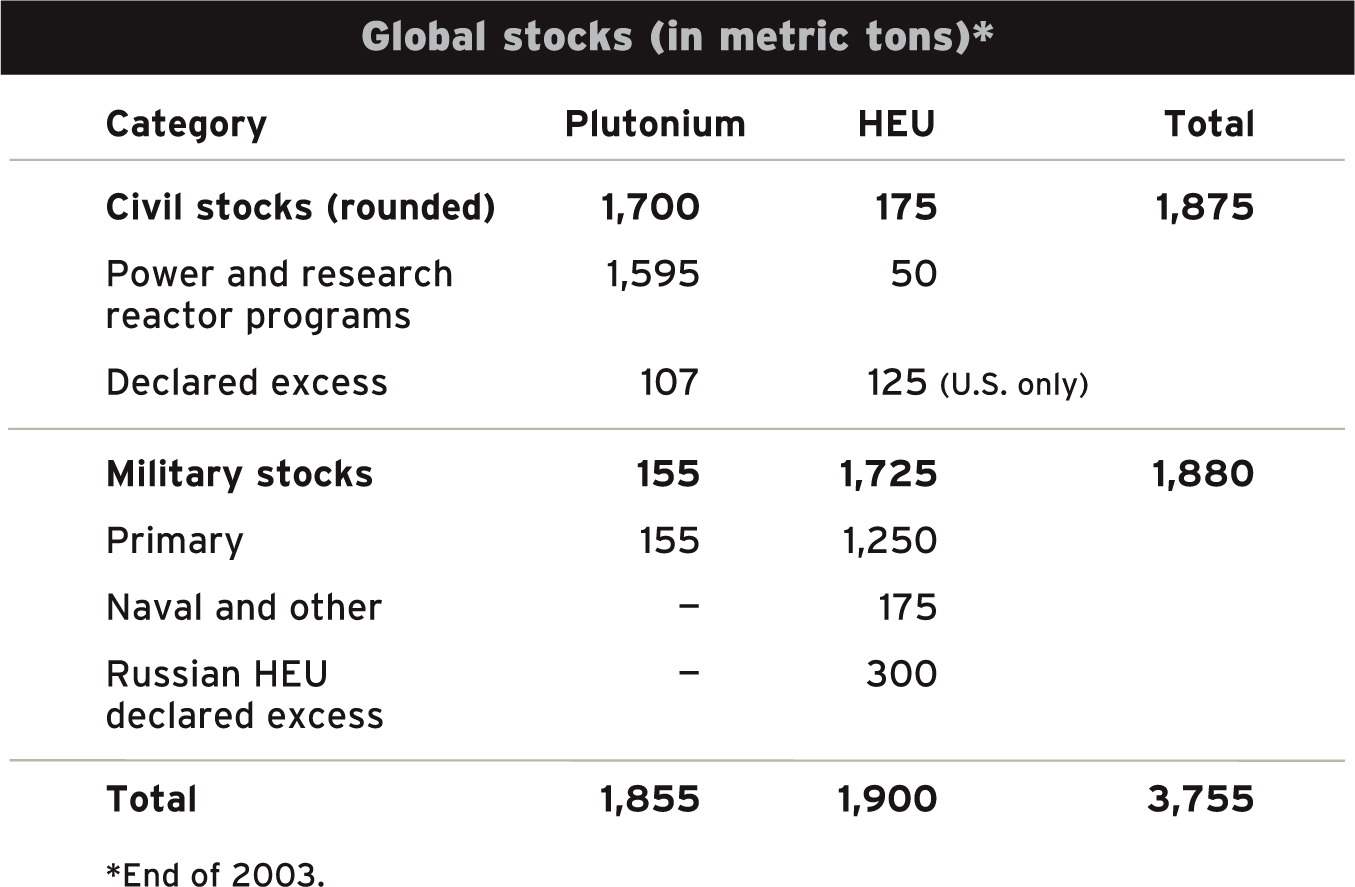
End of 2003.
The world's acknowledged nuclear weapon states hold considerable stocks of military HEU and plutonium. The amounts listed in the table “Military and Excess Fissile Material” (opposite page) account for national military stocks as of the end of 2003. Most of the plutonium and HEU in military stocks is in nuclear weapons, reserves, dismantled weapons, and naval and production reactor programs.
Some military fissile material is being transferred to civil stocks and disposed of in civil programs. Russia, Britain, and the United States have all declared a portion of their military plutonium excess to military requirements. This excess plutonium, about 107 metric tons in all, has been dedicated to peaceful purposes, but its disposition as fuel in power reactors continues to be delayed. Russia and the United States have also declared excess HEU. This excess HEU is to be downblended into low-enriched uranium (LEU), which is less of a proliferation risk. By the end of 2003, Russia had downblended 200 metric tons of military HEU into LEU to be used as fuel in nuclear power reactors. The United States had downblended about 50 metric tons of its declared excess HEU stock of about 170 metric tons. Each year, roughly 30 to 40 metric tons of military HEU are downblended to low-enriched uranium.
Plutonium
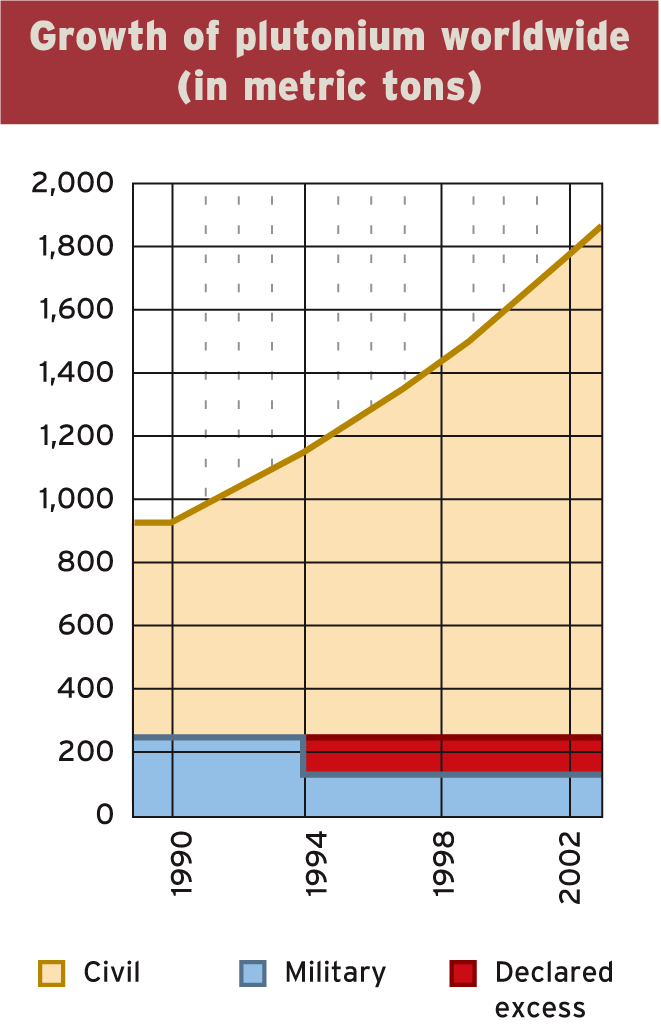
Every year, the global stock of civil plutonium grows by 70-75 metric tons, as seen in the table “Growth of Plutonium Worldwide” (above). The growth is in irradiated fuel discharged from nuclear power reactors. As of the end of 2003, about 1,370 metric tons of civil plutonium stocks were in irradiated fuel. About 330 metric tons of civil plutonium were in unirradiated form. The unirradiated plutonium has either been separated in civil power reactor programs or is military material that has been declared excess to defense needs.
Unirradiated plutonium from civil power reactors∗
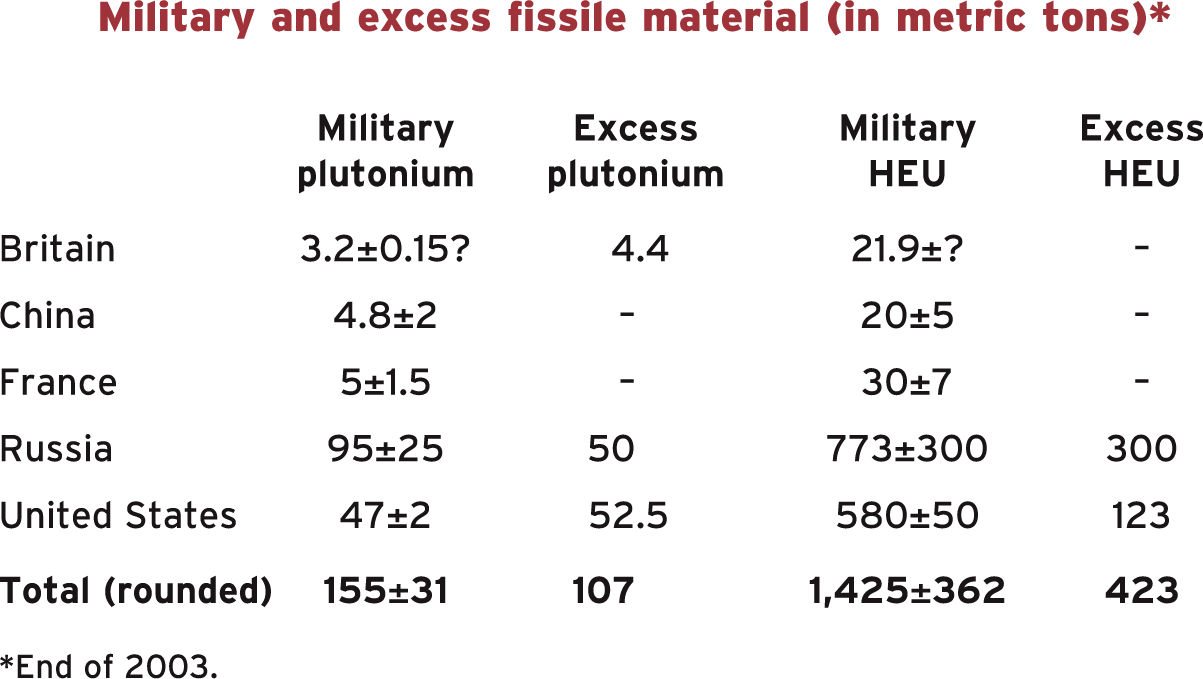
End of 2002.
Unirradiated plutonium, because it is less contaminated with other radioactive constituents, is more of a proliferation risk than plutonium remaining in irradiated fuel. The table “Unirradiated Plutonium from Civil Power Reactors” (right) shows the amount of unirradiated plutonium produced in civil power reactor programs, and held and owned by 12 key countries at the end of 2002. (Some countries have declared their unirradiated civil plutonium; other amounts are estimates.) Most declarations of stocks as of the end of 2003 were not yet available from the International Atomic Energy Agency (IAEA) at publication time. However, based on an assessment of the amount of spent fuel reprocessed and the amount of plutonium used in mixed oxide (MOX) fuel, ISIS estimates that roughly 235 metric tons of plutonium from power reactors remained in unirradiated form at the end of 2003.
Roughly 15-20 metric tons of plutonium are separated from irradiated power reactor fuel each year, while only 10-15 metric tons of this unirradiated plutonium are fabricated into MOX fuel for use in light-water reactors. As the rate of fabrication and use of MOX fuel has fallen behind the rate of separation, the amount of unirradiated plutonium continues to grow.
A sobering conclusion is that under a wide variety of reasonable assumptions, total unirradiated civil plutonium stocks are not expected to decrease in the next 15 years. A positive sign is that Belgium, Sweden, Switzerland, and likely Germany will reduce their inventories to zero or near zero. Stocks in Britain, Japan, Russia, and France are projected to remain large, even though France and Japan expect to use a considerable amount of plutonium as MOX fuel.
Military and excess fissile material (in metric tons)∗
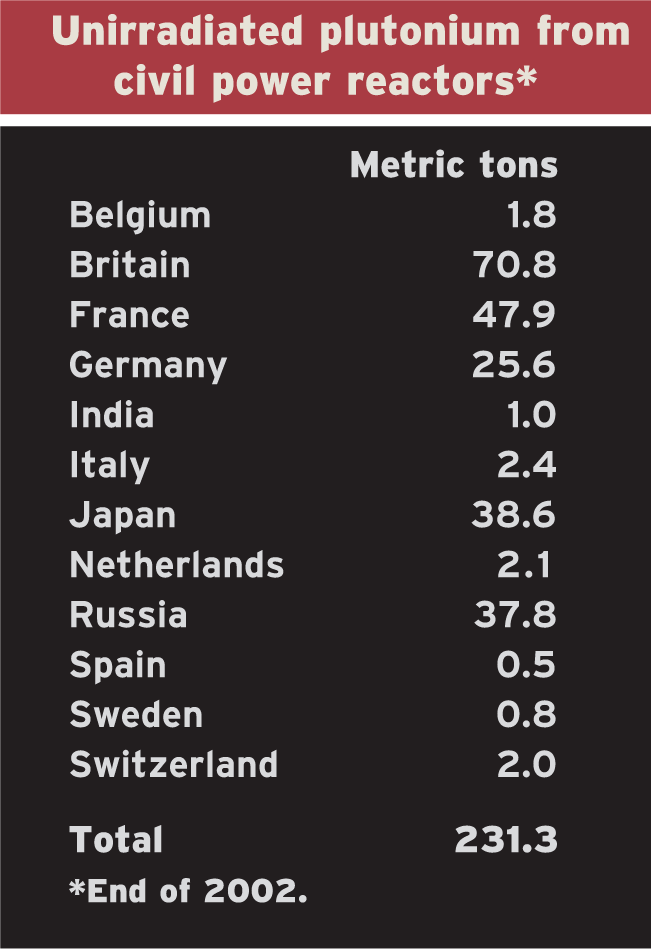
End of 2003.
A complete country-by-country breakdown of current and projected holdings of military and civil plutonium is available on the ISIS web site.
HEU
About 50 metric tons of HEU were in worldwide civil research and power reactor programs as of the end of 2003. The use of HEU fuel in research reactors has diminished as a result of extensive cooperative efforts between the U.S. Reduced Enrichment for Research and Test Reactor (RERTR) program and many other governments. RERTR focuses on developing suitable low-enriched uranium fuels to replace HEU fuel in research reactors.
It is difficult to estimate civil HEU stocks in many countries because few nations reveal how much they have. The IAEA publishes the total amount of HEU that it safeguards, but its totals do not include the civil stocks of the acknowledged nuclear weapon states. They are therefore incomplete. In addition, the IAEA does not reveal the size of any individual country's stocks. Only a few countries, notably Britain, France, and Germany, publicly declare their civil HEU stocks, but their declarations do not account for stocks held overseas at fuel fabrication plants, for example, or the fraction of their declared stocks owned by other countries. A country-by-country breakdown of civil HEU inventories remains elusive, although ISIS is working to develop one.
Current and former de facto states
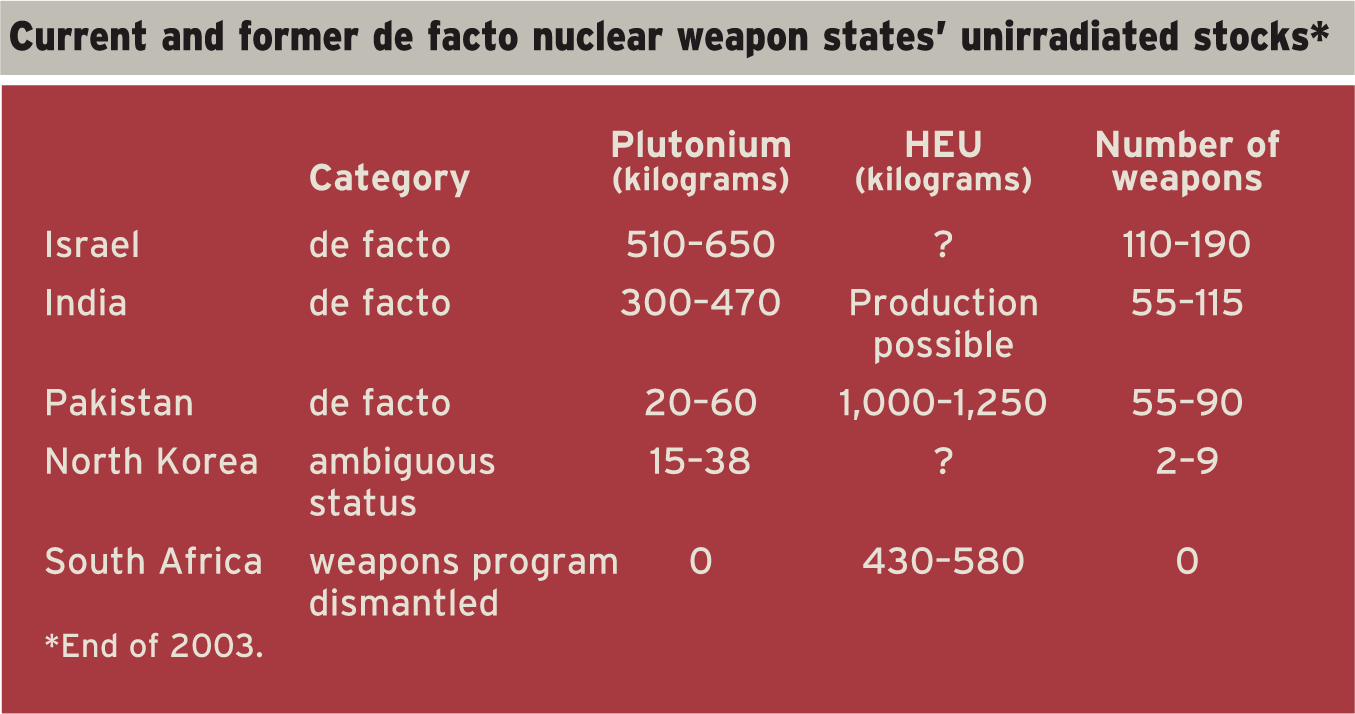
A special category includes the five countries listed in the table “Current and Former De Facto Nuclear Weapon States' Unirradiated Stocks” (above). Israel's plutonium and HEU stocks remain difficult to estimate. India may now be producing HEU in significant quantities in a gas centrifuge plant it has been working on for many years. Pakistan's fissile material stockpile has always been difficult to assess, but its stock now appears to be large enough to rival that of India. North Korea has produced separated plutonium in unknown quantities during two periods and may now be enriching uranium. And South Africa, although it dismantled its nuclear programs in the early 1990s, still has a large stock of unirradiated HEU.
Current and former de facto nuclear weapon states' unirradiated stocks∗
End of 2003.