




Abstract
Highly qualified but strangely inattentive, Condoleezza Rice has missed the signs of the Soviet collapse, the importance of terrorism before 9/11, and more.

Presidents rely on their national security advisers for a host of services. Although the position of adviser is not specified in the law that created the National Security Council (NSC), the needs of presidents in formulating policies, considering options, and then implementing decisions led Dwight D. Eisenhower to create the position and his successors to endow it with steadily broadening powers.
Eisenhower's “special assistant for national security affairs” shepherded policy papers through the bureaucracy, monitored implementation, and warned the president of upcoming or problematic issues. John Kennedy's man, McGeorge Bundy, added the role of traffic cop, controlling access to the president–and greatly expanded the security adviser's function of giving actual advice. Bundy was also the first to make a formal foreign visit on the president's business (Averell Harriman and Andrew Goodpaster had done so informally for Presidents Truman and Eisenhower). Working for President Lyndon B. Johnson, Walt Rostow substantially strengthened the security adviser's advisory role and his grip on the president's schedule.
In the Nixon administration, Henry Kissinger took the job to a new level, actually concentrating the reins of national security power in the White House. Suddenly, the real negotiations conducted with foreign powers–Russia, North Vietnam, and others–were run by the security adviser, not the secretary of state. Gen. Brent Scowcroft under Gerald Ford cut back the role to a degree, but under Jimmy Carter, Zbigniew Brzezinski restored the power of the security adviser to that of Nixon's day. During the Reagan administration, the national security adviser gained new functions as congressional lobbyist and public spokesperson (it was the first time that the NSC staff employed a press secretary and the adviser held public press conferences). The excesses of the Iran-contra affair forced President Reagan to curtail operational activities by the NSC staff, however.
Scowcroft returned for a second run as national security adviser during the administration of the current president's father, George H. W. Bush. Scowcroft added a fresh dimension to the role, that of personal confidant to the president. Bill Clinton's security advisers, Anthony Lake and Sandy Berger, lost some of the confidant role, but added to the role of public spokesperson. That was the situation in 2001 when George W. Bush came to office. 1
As national security adviser to George W. Bush, Condoleezza Rice fulfills all the functions of her predecessors. And she pushes the envelope.
A meteoric rise
As a child standing in front of the White House on a family visit to Washington, Condoleezza Rice told her father, “One day I'll be in that house.” 2 The thought was not preposterous, except that at the time Rice aspired to be a concert pianist.
Born in Birmingham, Alabama, on November 14, 1954, Rice had every advantage that her affluent, well-educated parents could give her–French, piano lessons, and more. She lived in Titusville among Birmingham's African-American elite. The family moved to Tuscaloosa in 1965 when her father became president of Stillman College and then to Denver when he was appointed vice chancellor of the University of Denver.
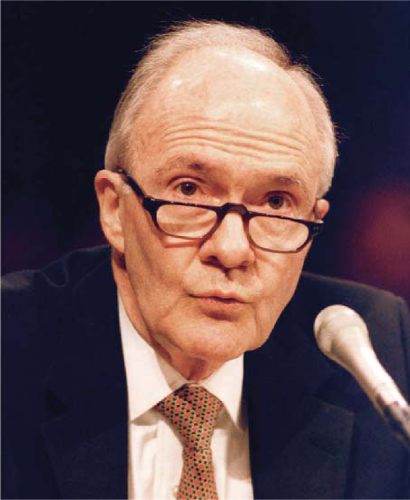
Brent Scowcroft.
A prodigy, Rice gave her first piano recital at age four, finished eighth grade at 11, entered the University of Denver at 15, and graduated cum laude in political science in 1973. After obtaining a master's degree from Notre Dame, she dropped plans to attend law school and returned to the University of Denver to complete a PhD in international studies.
Rice traces her interest in international affairs to Josef Korbel, whom she first met when taking a political science class as a junior majoring in music. His lecture on Joseph Stalin's tactics in solidifying his control of communist Russia was a eureka moment for Rice.
Korbel had been the Czech ambassador to Yugoslavia in 1948 when his country's government was overthrown by the Russians and a communist regime installed. He served briefly as the Czech representative on a U.N. commission in Kashmir, then booked passage to the United States aboard the ocean liner America in 1949. He attained citizenship seven years later. Philip Mosely of the Russian Institute at Columbia University, always on the lookout for talent, arranged an offer for Korbel to teach at the University of Denver. In 1959 he was appointed dean of its graduate school of international studies, and he worked hard to make it a first-class department. Korbel developed a view of American power as a force for morality in the world and retained the staunch anti-communism of the disillusioned. He wrote books on Czechoslovakia, Yugoslavia, Kashmir, and détente in Europe.
Rice danced gracefully into Korbel's orbit, absorbing the Korbelian world view. Though she wrote her dissertation under Catherine Kelleher–Korbel died in 1977–it concerned the political control of Czech armed forces and was dedicated to Korbel. Rice earned her doctorate in 1981, was immediately invited to teach at Stanford University, and appointed assistant professor the following year. She was by all accounts a stellar teacher.
Rice made key connections at Stanford. In 1984, friend and colleague Coit Blacker introduced her to Colorado's Sen. Gary Hart, who was at the time in the midst of a bid for the Democratic presidential nomination. Hart's position on military reform appealed to her, but his politics were too liberal for Rice. Her dissertation was published that year as The Soviet Union and the Czechoslovak Army, 1948-1983: Uncertain Allegiance.
At around the same time, Rice met Brent Scowcroft at the Center for International Security and Cooperation. Scowcroft–who had either chaired or been a member of key Reagan administration presidential commissions dealing with nuclear force development–came to Stanford to address those issues at an event. At dinner, Rice dazzled the general with a probing question, and he decided to get to know her better. Scowcroft was then co-director of the Aspen Strategy Group, a high-powered seminar of movers and shakers sponsored by the Aspen Institute, and he invited Rice to attend its sessions.
When the first Bush won the election in 1988, he appointed Brent Scowcroft his national security adviser. Scowcroft recommended, and Bush selected, Condoleezza Rice as NSC staff director for Soviet and East European affairs. It was Rice's first shot at a key inside job and she succeeded brilliantly.
Bush senior wrote: “I had chosen Condi because she had extensive knowledge of Soviet history and politics, great objective balance … and a penetrating mind.”
In A World Transformed, a reflection on his presidency that Bush wrote together with Scowcroft in 1998, he says of Rice: “I had chosen Condi because she had extensive knowledge of Soviet history and politics, great objective balance in evaluating what was going on, and a penetrating mind with an affinity for strategy and conceptualization…. She was charming and affable, but could be tough as nails when the situation required.” Bush's style as president also played to Rice's strengths.
Robert Gates spent the first couple of years of the Bush administration as deputy national security adviser under Scowcroft and recounts that on really serious issues Bush relied on quiet and constant convocations among small groups of top advisers, including Paul Wolfowitz and Stephen Hadley at the Defense Department, Robert Zoellick and Dennis Ross at the State Department, and Robert Blackwill, Richard Haass, and Rice at the NSC. 3
As it turned out, Rice was in the catbird seat–the Soviet Union collapsed and the Cold War ended on Bush's watch, and these key events were in her area of responsibility. The Soviet retreat had been signaled before Bush took office, in a speech Mikhail Gorbachev gave to the United Nations in December 1988. In it, the Soviet leader announced unilateral reductions in Russia's armed forces and withdrawals from East Germany, along with what amounted to the abandonment of the Brezhnev doctrine (a policy that promised direct intervention should any East European nation seek to break away). The question for the United States was how best to respond. Years later, Rice admitted that by focusing exclusively on the Soviet troop reductions, “I missed completely, really, the revocation of the Brezhnev doctrine.” 4
The administration was so at odds about how to respond that in February 1989 Bush ordered a pause in Soviet-American diplomacy that became a freeze of many months. 5 Rice's failure to focus on this critical change is important to note because the same curious inattention was to arise after Rice became national security adviser.
Inside the Bush administration, two factions engaged in struggle. One viewed Gorbachev's initiatives as a sign of weakness and favored pressing Moscow to extract every possible ounce of flesh. The other wished to respond by matching concessions to help defuse the Cold War. For those coming late to this history, it is vital to realize that the Soviet Union's demise was not a foregone conclusion–desperate Soviet leaders might just as well have decided to lash out. Rice sided with the hardliners; her memos argued that the Soviets needed to do more to prove their good faith.
Before long, though, events overtook the debate. One after another, Moscow's Warsaw Pact allies dropped away. Gorbachev's failure to respond as the Soviet hold over Eastern Europe disappeared could not have been a clearer signal. On November 9, 1989, the Berlin Wall opened, and crowds began tearing it down. Just how fast events were moving could be seen the very next day, when the communist leader of Bulgaria resigned. Robert Hutchings, NSC staff director for European affairs, recalls the moment: “Rice and I looked at each other in utter bemusement. We had been so totally preoccupied with Germany … that we had not even thought of Bulgaria for weeks and certainly had no premonition of impending change.” 6
Although Scowcroft worried about expectations rising from a premature summit, Bush, who was under domestic and European pressure, decided to meet Gorbachev in Malta in early December. After Malta, the attitude changed to one of increasingly explicit support for Gorbachev–even as evidence emerged of his growing political isolation. This policy extended to keeping at arm's length Gorbachev's major competitor, Boris Yeltsin, who had been elected to the Duma in March 1989.
President George W. Bush and Condoleezza Rice on the South Lawn of the White House.

In the U.S. government, the faction that sought to crush the Soviet Union supported Yeltsin as the best hope to challenge the existing government. That group included Dick Cheney (then secretary of defense), his deputy Paul Wolfowitz, and his chief of staff I. Lewis “Scooter” Libby. Bush stuck to his policy of backing Gorbachev, which Rice strongly supported. In an often-recollected incident (including by Rice herself), the NSC staff director for the Soviet Union would have an unfortunate face-off with Yeltsin when the Russian politician visited the White House in 1989. Furious that he was being admitted to the White House by what he thought a side entrance, and by not being taken immediately to see the president, Yeltsin threatened to storm out, and Rice spoke sharply to the Russian leader. Different versions of how Yeltsin had been treated broke down along the lines of the different policies officials had been advocating, creating a certain grudge against Rice. The internal cleavages on this matter during the first Bush administration would have reverberations in the second.
Rice saw the problem of ending the Cold War as one of securing the reunification of Germany under the Western umbrella without triggering a response from Moscow. And Rice certainly understood the possible dangers. Describing Soviet characterizations of the threat posed by the West, in her dissertation on the Czech military, Rice had written: “This specter of an imminent threat from the West was bolstered by the claim that NATO would not be satisfied until Germany was reunited under an imperialist West German leadership.” 7 That, of course, except for the “imperialist” part, was Rice's goal, and it would be achieved before the end of the Bush administration, mostly before she left the NSC staff in March 1991. In 1995, Rice and another staffer, Philip Zelikow, wrote a book, Germany Unified and Europe Restored, describing this diplomatic feat.
Rice returned to Stanford as provost, the youngest in its history. There she demonstrated her “tough as nails” side in abundance. Stanford faced a budget deficit, problems with inadequate university housing, and questions about the core curriculum and faculty hiring practices. Rice slashed the budget and made progress on the curriculum. She handled firings and layoffs with minimal faculty consultation, which Rice explained by saying, “I don't do committees.” 8
Housing and hiring remained intractable, and the federal government launched an investigation of Stanford's practices on minority hiring during Rice's tenure, though that did not preclude her serving on a federal advisory committee on gender-integrated training in the military. She left in 1997 for the Hoover Institution, where she acquired a new mentor, the former secretary of state in the Reagan administration, George P. Schultz.
When Gov. George W. Bush of Texas began his campaign for the presidency, Schultz arranged private briefings for him on world affairs. Rice participated in these briefings and impressed the younger Bush so much that she emerged as the head of his foreign policy advisory staff. Eventually Rice would address the Republican National Convention that nominated Bush in 2000. Rice was a natural choice for national security adviser, and her appointment was made early in the transition period.
The illusion of process
One lesson Rice absorbed during the first Bush administration was that a personal relationship with the president mattered a great deal, and she forged her relationship with George W. early on. She and the candidate could talk sports–Rice was a big football fan and Bush a former owner of the Texas Rangers baseball team–and Rice could tell stories of baseball great Willie Mays, who had once been her mother's student in high school. George Bush was a fitness buff and Rice, who used more than one personal trainer, worked out with him. Among the “Vulcans,” the self-styled coterie of Bush foreign policy advisers, Rice was the one who could explain issues in a way the candidate understood easily. “I like to be around her,” Bush was quoted as saying, “Besides, she's really smart!” 9
The other Vulcans, whom Bush also brought into his administration, included many of the same people who had fought over policy during the first Bush administration. Cheney became vice president, Scooter Libby his chief of staff. Paul Wolfowitz would be deputy secretary of defense, Stephen Hadley, deputy national security adviser, and Colin Powell, secretary of state. Among the few new faces was Donald H. Rumsfeld, the secretary of defense, but he had been Cheney's mentor in the Ford and Nixon administrations.
Rice had learned that a personal relationship with the president mattered a great deal, and she forged her relationship with George W. early on.
The first question about Rice's role as security adviser is, how was she able to stay out of the line of fire of the neocons who had fought her over Russia policy in the first Bush administration, and the evident answer is, only by staying close to the president. That, in turn, carried implications for Rice's ability to speak truth to power.
The basic lineup in the administration acquired increasing importance as cleavages developed between State and Defense. By the summer of 2001 it was already clear that the State Department had much greater regard for U.S. alliance and treaty relationships than the Rumsfeld Pentagon, which was intent on overriding the Anti-Ballistic Missile (ABM) Treaty in order to move up the deployment of missile defenses (which remain technically immature three years later, even as they go into the ground).
Rice aligned herself with the Pentagon neocons. It was Rice, not Powell, who made the first official visit to Russia as the president's emissary in August 2001, and Rice, not the Cabinet officials along on that trip, who was treated to a private weekend at Russian President Vladimir Putin's dacha. (Rice has since made numerous foreign trips at Bush's behest and is now the most traveled national security adviser since Henry Kissinger.) Bob Woodward's accounts of U.S. planning for the invasions of Afghanistan and Iraq, based on detailed interviews with the president and other senior officials, make it abundantly clear that the division between State and the Pentagon persists. 10
Deciding what matters
Every presidency begins with the new chief executive and his National Security Council initiating a wide range of policy reviews that enable the new administration to put its stamp on U.S. policies. As they proceed, these reviews are discussed at the NSC Deputies Committee and then rise to the level of the NSC Principals Committee. Under Bush, the process of orderly review leads to National Security Presidential Directives (NSPDs) that specify decisions taken. Aside from any of its other consequences, Rice's testimony before the 9/11 Commission revealed that NSPD-9, the basic counterterrorism directive and authorization for the military campaign against Afghanistan, approved on September 17, 2001, was the first substantive policy directive approved by President George W. Bush during his term in office. 11
That no directive had been approved earlier does not mean that the Bush administration had not acted on foreign policy. The abrogation of the ABM Treaty, the U.S. withdrawal from the Kyoto environmental protocols and the International Criminal Court agreement, and other measures, all took place during this early period. What the revelation about NSPD-9 does mean, however, is that all of those early Bush actions were carried out without interagency policy review.
Conversely, the policy review on intelligence was carried out at the president's request by a group headed by Scowcroft. That review was completed around the time of September 11, 2001, but its conclusions had yet to be acted upon at the time of Rice's testimony to the 9/11 commission, more than two years later. This indicates that the policy process in the Bush administration functions much differently from the standard established earlier. The current system might be broadly characterized as a “personality-based policy.”
An examination of particular policy areas and of the role of Rice and the NSC staff in those matters confirms this view. One more point needs to be made about Rice's 9/11 testimony. The testimony of senior Clinton and Bush administration officials, including Rice, establishes that Clinton administration officials very consciously made certain to indicate to Rice, Bush, and others, their view that terrorism would be the major foreign policy preoccupation in the immediate future.
Rice's record looks like nothing so much as a program of fixed ideas, and that is before examining the case of Iraq or the development of a pre-9/11 anti-terrorism plan.
Rice, Bush, and others proceeded to act as if these concerns had not been enunciated. It may be hindsight to point it out, but the Clinton officials were correct in their concerns, and the way Bush administration officials treated the issue is exactly analogous to the way the first Bush administration responded to Gorbachev's speech in December 1988. In each case, no response was made and crucial time was lost while the matter was subjected to formal policy review. In fact, the point is even sharper in the case of terrorism; current Bush administration officials acted quickly in many other areas while holding back on counterterrorism before conducting a lengthy review. As cited earlier, Rice had thought about the earlier failure and personally conceded her own blindness in the waning days of the Cold War. It is regrettable that a similar incident occurred when Rice returned to the White House.
And in other areas?
From that moment on, Bush began giving Rice an increasing share of Mideast action. Rice had first visited Israel in 2000 as a private citizen. During that trip, she told the Israeli press it felt like returning home, though she had never before been there. 12 Whatever Rice knew of the situation was, unfortunately, of recent vintage and from quick study. As the Middle East became the epicenter of the foreign policy dilemmas of the Bush administration, in spring 2002, Rice was telling Bush that the basic reason why peace talks never seemed to progress was Yasser Arafat. 13 That May, in one of her increasingly frequent speeches, she described racism in the American South as “homegrown terrorism,” which she equated to the overall problem of international terrorism. 14
Bush responded to Rice's advice by tilting toward Israel in the Palestinian political crisis, and the tilt led essentially to immobility. For its own reasons, the Sharon government postponed peace talks, posed impossible conditions for their resumption, backed away from previous commitments, and relied on what amounts to a military strategy to counter the Palestinians. Bush has focused on the Palestinians and demanded that they shut down the groups responsible for political violence, essentially offering unconditional support for the Israeli position. Years have now been spent attempting to force a change in Palestinian leadership as a condition for progress in talks, yet the Palestinians know full well that the identity of their leaders is not the factor that will determine Tel Aviv's stance on the West Bank, Jerusalem, or any of the key issues separating the sides. Bush's favoritism, shown to high relief this spring when he publicly supported Ariel Sharon's bid to substitute partial and conditional withdrawals for an overall settlement, removed any possibility that the administration would act as an honest broker in the area.
The tiny amount of progress that was made from direct U.S. efforts came from the CIA–through quiet meetings at which the agency's station chief in Tel Aviv brought together Palestinian and Israeli security officials to agree on confidence-building measures. Another Tenet trip offered some temporary hope of relief. Meanwhile, the grand U.S. scheme, the so-called Roadmap, which was crafted over the opposition of Europeans active in Mideast peace efforts, installed by a Rice mission to the area in spring 2003, and blessed by a presidential visit and summit at Sharm el Sheik that June, was swept away by the Sharon plan.
The United States could have been expected to resist the Sharon plan, and that was indeed the early bidding. But a succession of trips to Tel Aviv were made by Rice's subordinates–several by Elliott Abrams, staff director for the Middle East since December 2002, and the last by Stephen Hadley, deputy national security adviser. The Israelis apparently got their interlocutors to give up opposing the Sharon maneuver, not the other way around. When Sharon came to Washington in April it was to have his withdrawal gambit consecrated by Bush. Then, only days after Bush stood by Sharon's side to back the Israeli policy, Tel Aviv cashed in the chip, blindsiding Bush by launching new strikes that killed key Palestinian leaders, triggering a fresh wave of anti-Israeli violence. In one of her television appearances Rice dismissed the strikes, remarking: “We don't get a heads-up on Israeli military operations.” 15 The Israeli government had played Bush and his national security advisers for everything they could get. There is effectively no longer a peace process.
The Bush people regarded Clinton-era policies as deeply flawed, but their approach led North Korea to threaten fresh nuclear initiatives, claim to have nuclear weapons, carry out new tests of medium-range ballistic missiles, and announce the resumption of plutonium production. This was a far cry from the Agreed Framework, which was supposed to lead in its third stage to Pyongyang's dismantling of its nuclear facilities. In 2002, when Bush put North Korea on his “axis of evil” list, the administration policy of no negotiations had created a cycle of escalating rhetoric from both sides.
In July 2002, Powell briefly spoke to a senior North Korean official for the first time, even as U.S. intelligence concluded that Pyongyang might have begun the clandestine enrichment of uranium. In October 2002, Assistant Secretary of State for East Asia John Kelly went to North Korea, but he had scripted instructions from the NSC to demand Pyongyang reveal its nuclear activities. When the North Koreans did just that, Kelly had nowhere to go. 17
The United States halted famine relief aid to North Korea and tried to get the other Framework states to end fuel deliveries as well. South Korea's president-elect asserted in January 2003 that the United States had considered military attacks on North Korean nuclear facilities. 18 Rumsfeld, NSC counterproliferation director Robert Joseph, and John L. Bolton, undersecretary of state for arms control, were known to favor a hard line, and in March 2003 the Pentagon ostentatiously deployed two dozen B-1 and B-52 heavy bombers to Guam, within range of North Korea.
When China sponsored a regional meeting in Beijing a month later, dangling before Pyongyang the prospect of a private session with the United States, Kelly was again crippled by narrowly drawn instructions that permitted no side meetings. The North Koreans walked out of the conference. A direct Chinese appeal to Rice had no effect. During a July 2003 trip to Africa, Colin Powell got the president to agree to a direct meeting with the North Koreans, which took place in late August at a regional conference in Beijing. This time Kelly not only bore strict instructions, he was monitored by Michael Green of the NSC staff and Richard Lawless, standing in for Rumsfeld. Even Chinese officials said the main problem was not North Korea, but U.S. policy. 19
A further session of regional talks on North Korea was tentatively set for Beijing in December. In preparation for that negotiation the NSC, including Dick Cheney, rejected a Chinese draft because it did not provide for verifiable, irreversible dismantling of North Korean facilities. The United States refused to provide incentives for North Korean action. 20 This round of talks was eventually held in late February 2004. Suddenly the Bush administration resumed food aid to North Korea, and acquiesced in a South Korean offer of economic incentives for Pyongyang's efforts at disarmament.
Another working-level meeting was set for Beijing in May. Depending on the discussion there, a higher-level meeting may occur this summer. Thus, after more than three years, the Bush administration has just about returned North Korea policy to where it stood in December 2000.
Obsession?
All of this looks like nothing so much as a policy of fixed ideas, and that is before examining the administration record on Iraq or the slow development of a policy against terrorism before September 11. In the months before the war, Rice actively worked toward another fixed idea–that the United States should carry out a war against Iraq–including the taking of measures to avoid effective arms inspections by the United Nations. 21 Aside from Rice's private advice on the war, her efforts to build public support, and her stage managing of the war plan, Rice's NSC staff had the lead role in post-war planning. 22 On January 20, 2003, after numerous White House sessions on the subject, Bush signed a presidential directive making the NSC Deputies Committee under Stephen Hadley the lead authority for post-war issues. Hadley even took credit for the effort in a speech to the Council on Foreign Relations on February 12: “There has been a tremendous inter-agency effort, led by the National Security Council and the Office of Management and Budget, to think through reconstruction needs and objectives.” The original scheme for the occupation was approved at a White House national security meeting on February 28.
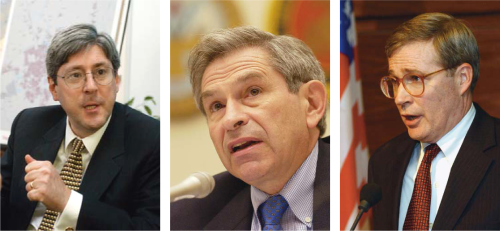
Douglas Feith, Paul Wolfowitz, and Stephen Hadley (left to right).
Yet in a major review of U.S. planning for post-war Iraq, James Fallows found two names missing from accounts officials gave him of the process. One was that of the president, which he never once heard, and “the other conspicuously absent figure was Condoleezza Rice.” 23 Rumsfeld, on the other hand, was a major presence. He had edged out a State Department-sponsored post-war planning project to substitute a Pentagon-based unit. Just weeks into the occupation, Hadley's NSC committee recalled that group and replaced it with the Coalition Provisional Authority. Throughout this time of low-balled cost estimates, exclusive contract awards, and exclusion of participation by nations that had opposed the war, Hadley's interagency committee retained the formal authority at the Washington level.
Faced with continued instability and a barely functional reconstruction effort, in October 2003 Bush created yet another Washington entity to run the occupation, the Iraq Stabilization Group, and put Rice in direct charge. Rice's memorandum describing the revamp, sent out on October 2, was the first Rumsfeld (by his own account) had ever heard of the move. The reorganization was interpreted as a slap at Rumsfeld and a measure to introduce efficiency. Eight months later, though, with Rice in command, the occupation is still a disaster and U.S. credibility has been crippled by revelations regarding the treatment of Iraqi detainees at U.S. interrogation centers. Rice, who brought in as point man on Iraq Robert Blackwill, former ambassador to India and an NSC staff colleague from the first Bush administration, has been singularly ineffective.
Rice has also been directly implicated in the shenanigans leading up to the war. The controversy over the misleading language in Bush's 2003 State of the Union speech revealed that Rice had been a direct recipient of CIA memos objecting to similar language in a previous text. Answering this charge, Rice confused one incident with another. Her comments on the Iraq national intelligence estimate led many to question whether she had actually read it. She also made strenuous efforts to coordinate the administration's lobbying efforts through the White House Information Group, including frequent speeches and interviews in which she crafted verbiage suggesting that Iraq posed the threat of mushroom clouds over American cities. In 1997, when Rice was out of government and commenting on the end of the Soviet Union, she said of her first stint on the NSC staff: “You tend very much to focus on what you can know; because a government, unlike academics or the press, cannot focus on what might be Soviet policy, but really on what Soviet policy is.” 24 On Iraq, Rice presided over a process that made up its own vision of what Baghdad was about and then fought a war based on that hypothetical.
Back in the heady days of the campaign, Rice authored an overview of her candidate's world views and intentions that appeared in Foreign Affairs. Referring to the Clinton administration's resort to force in Kosovo, she wrote: “The Kosovo war was conducted incompetently, in part because the administration's political goals kept shifting and in part because it was not, at the start, committed to the decisive use of military force.” 25 Substitute “Iraq” for the name of the country, understand Rumsfeld's “lite” invasion plan for what it was, and that observation applies exactly to Bush's war in Iraq as stage-managed by Rice.
Stage management is a matter of process, and it is the process of Rice's NSC that needs examining. Two factors greatly complicated the possibility of a smoothly running system. One is the deep chasm between Colin Powell's State Department and Donald Rumsfeld's Pentagon. The second complication is Dick Cheney, a vice president with unprecedented sway on national security issues, who forged an underground policy structure of his own with connections to Rumsfeld and links to key officials elsewhere such as Hadley on the NSC staff and Bolton at State. Cheney not only has the president's ear, he has the ability to create and push paper in the bureaucracy. Previous national security advisers, faced with State-Defense Department competition, have played traffic cop outside the Oval Office (in Kissinger's case, he moved to supplant both agencies and pull the reins of power into the White House). Rice has chosen instead to cultivate her direct relationship with the president, essentially getting out of the way of the policy war. Rice's ideological predilections, more attuned to those of the CheneyRumsfeld alliance, help assure that the NSC process is more a matter of ideology than of issues, evidence, and attainable objectives.
Finally, a word about Rice's role as public persona. During the Clinton administration, Tony Lake and Sandy Berger made the national security adviser more of a public person through their speeches and television appearances. Rice has taken this effort to an entirely new level. Frequently appearing on multiple news shows on a single day, spending hours in successions of interviews, presenting speeches in tandem with other officials in coordinated public relations offensives, making many speeches on her own, Rice has acquired unprecedented visibility as a spokesperson. I have not taken a systematic survey, but an estimate of her appearances would include speeches in the dozens and news contacts in the hundreds. The wide variety of public positions Rice has taken on substantive issues restricts her ability to act impartially in the policy process. And the sheer effort required to sustain her public appearances may seriously curtail the time Rice has available to actually manage the Bush administration policy process, such as it is.
A report card
During the 2000 presidential campaign, when Rice was auditioning for her current position as national security adviser, she offered two statements that make perfect points of departure for an evaluation of the Bush administration's national security record. One is her January 2000 article in Foreign Affairs. The other is Rice's speech, accompanied by a discussion with the audience and host Charlie Rose, before the Council on Foreign Relations on October 12, 2000.
Rice argued in Foreign Affairs that “multilateral agreements and institutions should not be ends in themselves.” 26 She objected specifically to the Kyoto Treaty and the Comprehensive Test Ban Treaty, on which the Bush administration has been as good as its word. Both of these agreements, as well as the ABM Treaty, are history. As mentioned earlier, U.S. actions opting out of these treaties were taken without reference to process. Whether the United States is better off as a result is disputable.
Rice also maintained that “the Clinton administration's attachment to largely symbolic agreements and pursuit of, at best, illusory ‘norms’ of international behavior [has] become an epidemic.” One may easily make an identical comment with regard to the Bush administration's Roadmap in the Middle East.
Rice went on, “There is work to do with the Europeans too,” pointing to the enlargement of NATO and defining what holds the transatlantic alliance together. The Bush administration has succeeded in enlarging NATO by incorporating East European nations. At the same time it has substantially undermined relations with key partners, leaving the overall NATO relationship shakier than ever before.
Rice saw China as “a potential threat to stability in the Asia-Pacific region,” to be countered by deepening U.S. cooperation with Japan and South Korea. Today the United States is actually dependent on China, both as a source of imports and as a diplomatic intermediary with North Korea. Rice wrote that China was not a status quo power and thus was “a strategic competitor, not the ‘strategic partner’ the Clinton administration once called it.” In fact, the Bush administration now relies on China as a strategic partner. Meanwhile, U.S. relations with South Korea are worse than before, and important differences have emerged with both South Korea and Japan regarding North Korea.
The United States, wrote Rice, needed to pay “immediate attention to the safety and security of Moscow's nuclear forces and stockpile. The Nunn-Lugar program should be funded fully and pursued aggressively.” Today these nuclear safety programs are in a virtual state of suspended animation.
The “rogue regimes” in Iraq, Iran, and North Korea, Rice explained, “are living on borrowed time, so there need be no sense of panic about them.” This statement speaks for itself.
Most important, Rice insisted, “Foreign policy in a Republican administration will most certainly be internationalist.” That statement clearly conflicts with the Bush administration's unilateral abrogation of treaties, its unilateral push toward ballistic missile defenses, its flouting of the United Nations in the war with Iraq, and its treatment of alliance relationships. It has virtually ignored Latin America and conditioned foreign aid on performance norms.
On the Middle East, Rice told the Council on Foreign Relations, “The circumstances that created the opening for direct Palestinian/Israeli dialogue really goes [sic] back to a significant change in the circumstances in the Middle East coming out of the [1991] Persian Gulf War.” 27 A bit of overdetermined analysis that clearly foreshadows the miscalculation that led to the Iraq war?
Speaking the night after candidate Bush said in a presidential debate that the United States needed to be “humble” on the international stage. Rice told the Council, “Ever since I first talked to Governor Bush about foreign policy, this has been something that has been on his mind.”
Once in power, however, the Bush administration has acted in the exact opposite fashion, as if it could sweep the board clear on the international plane. Rice also described Bush's view of U.N. peacekeeping: “I think he's somewhat skeptical of the idea that the United Nations could become a major force.” In power, the Bush administration initiated a war with Iraq, ostensibly to strengthen the United Nations by enforcing a U.N. resolution.
With regard to ballistic missile defense, Rice said the system would be deployed when “it is capable of protecting our allies.” Yet the Bush administration is now in the process of deploying a system with no such capability (and which may not work).
Asked for her greatest criticism of the departing administration, Rice accused it of having no strategy: “If you look around the world and you look at what has happened to the American military while it has been engaged in operations that … are 300 percent greater that at any time during the Cold War, and you ask to what purpose, you look at some of these operations and you think, what were we doing?”
Needless to say, the Bush administration has deployed even more forces than the Clinton administration, and “what were we doing?” is the question everyone is now asking about Iraq. Moreover, in spite of massive increases in military spending in every year of the administration, combat readiness is no better (and may be worse) than during the 2000 election, when faults in military readiness were a major charge leveled at the Democrats by the Bush campaign.
There is much more, but the particulars are similar. All of the issues were ones to be dealt with by the NSC process captained by Condoleezza Rice. Certainly, Rice believed that all these issues were important. Certainly, she had the capacity to affect all of them. In some people's eyes, she was a magician. If issues were avoided because Rice shied away from bureaucratic infighting, that is an indictment of process and person. If matters got worse because of single-minded ideological focus, that is a failure of vision. September 11, 2001, is no excuse. What was she doing?
Footnotes
1.
For a more complete account see John Prados, Keepers of the Keys: A History of the National Security Council from Truman to Bush (New York: William Morrow, 1991).
2.
Evan Thomas, “The Quiet Power of Condi Rice,” Newsweek, Dec. 16, 2002, p. 34.
3.
Robert Gates, From the Shadows: The Ultimate Insider's Story of Five Presidents and How They Won the Cold War (New York: Simon & Schuster, 1996), p. 454.
4.

5.
George Bush and Brent Scowcroft, A World Transformed (New York: William Morrow, 1998). See also Don Oberdorfer, From the Cold War to a New Era: The United States and the Soviet Union, 1983-1991 (Baltimore: Johns Hopkins University Press, 1998) and Michael R. Beschloss and Strobe Talbott, At the Highest Levels: The Inside Story of the End of the Cold War (Boston: Little, Brown & Co., 1993).
6.
Robert L. Hutchings, American Diplomacy and the End of the Cold War: An Insider's Account of U.S. Policy in Europe, 1989-1992 (Washington, D.C.: Woodrow Wilson Center Press, 1997), p. 81.
7.
Condoleezza Rice, The Soviet Union and the Czechoslovak Army: Uncertain Allegiance (Princeton: Princeton University Press, 1984), p. 136.
8.
Elaine Sciolino, “Compulsion to Achieve: Condoleezza Rice,” New York Times, Dec. 18, 2000, p. A21.
9.
Elaine Sciolino, “Bush's Foreign Policy Tutor: An Academic in the Public Eye,” New York Times, June 16, 2000, p. A26.
10.
Bob Woodward, Bush At War (New York: Simon & Schuster, 2002), Plan of Attack (New York: Simon & Schuster, 2004).
11.
National Commission on Terrorist Attacks Upon the United States (9/11 Commission), Condoleezza Rice Testimony, April 8, 2004.
12.
13.
Elizabeth Bumiller, “A Partner in Shaping an Assertive Foreign Policy,” New York Times, Jan. 7, 2004, p. A6.
14.
15.
John Mintz, “No ‘Heads Up’ on Israeli Attack, Rice Says,” Washington Post, April 19, 2004, p. A13.
16.
Don Oberdorfer, The Two Koreas: A Contemporary History (New York: Basic Books, 2002). See also Robert Gallucci, Joel S. Wit, and Daniel Poneman, Going Critical: The First North Korean Nuclear Crisis, an insider account of the Clinton administration's North Korea policy (Washington, D.C.: Brookings Institution, 2004).
17.
Glenn Kessler, “U.S. Has a Shifting Script on North Korea,” Washington Post, Dec. 7, 2003, pp. A1, A31.
18.
Doug Struck, “S. Korean Says U.S. Considered Attack on North,” Washington Post, Jan. 19, 2003, p. A18.
19.
Kessler, “U.S. Has a Shifting Script.”
20.
Glenn Kessler, “U.S. Won't Offer Incentives at N. Korea Talks,” Washington Post, Dec. 19, 2003, p. A45.
21.
John Prados, Hoodwinked: The Documents That Reveal How Bush Sold Us a War (New York: The New Press, 2004), pp. 156-174.
22.
Bob Woodward, Plan of Attack.
23.
James Fallows, “Blind Into Baghdad,” Atlantic Monthly, January-February 2004, p. 72.
24.
CNN Interview: Rice.
25.
Condoleezza Rice, “Life After the Cold War,” Foreign Affairs, January 2000.
26.
Ibid.
27.
Council on Foreign Relations transcript, “Condoleezza Rice on the Foreign Policy of Governor George W. Bush,” October 12, 2000.