



Abstract
Pakistan lied, stole, and conned its way to becoming a nuclear weapons power. Now it's doing the same as a nuclear broker. Will the United States do anything about it?
Yogi Berra's famous quote can certainly be applied to recent revelations about nuclear weapon-related transfers to Iran and Libya from a Pakistani-generated, worldwide nuclear-materials black market. The current story also includes a remarkable display of public insouciance by the current U.S. government to the worst case of conscious proliferation in history. 1
But the larger story is no surprise to those of us who have followed Pakistan's nuclear activities for the past 25 years. There is a long history to Pakistan's nuclear mendacity and the U.S. abandonment of nonproliferation goals in South Asia for short-term advantage in other policy areas.
Pakistani nuclear assistance to Iran and Libya is nothing new. News reports in 1988 revealed that Pakistan was assisting Iran on nuclear enrichment technology; reports of a Pakistan-Libya nuclear connection appeared as early as 1979. 2 In 1987, a BBC documentary film revealed that Libya had provided financing for the Pakistani bomb project in 1973. The Saudis were also involved as bankrollers in those early days. 3
Despite President Pervez Musharraf's claim that the nuclear transfers to Iran and Libya (and North Korea) are the result of personal greed on the part of “the father of the Pakistani bomb,” Abdul Qadeer (A. Q.) Khan, who “confessed” and was immediately pardoned, no serious observer believes that Khan's was a “rogue” operation unknown to the highest levels of the Pakistani military. While the complete story is yet to be told, it is well to remember the words of Musharraf's predecessor, the late Gen. Mohammed Zia ul-Haq, who said: “It is our right to obtain [nuclear] technology. And when we acquire this technology, the entire Islamic world will possess it with us.” 4 (Zia failed to mention that Pakistan would also be sharing its nuclear secrets with North Korea, but that was before North Korea could help Pakistan with missile technology as a quid pro quo.)
Zia's bold statement was itself a paraphrase of a statement by his predecessor, Zulfikar Ali Bhutto, who wrote in his 1979 memoirs: “We know that Israel and South Africa have full nuclear capability. The Christian, Jewish, and Hindu civilization have this capability. The Communist powers also possess it. Only the Islamic civilization was without it, but that position was about to change.” 5
Khan's early network
Khan's illicit nuclear trading activities are merely an extension of his activities in the 1970s and 1980s. He began by stealing blueprints for uranium-enrichment centrifuges from Urenco, a European consortium, and then set about buying the materials and components needed for manufacturing highly enriched uranium. Here is some of what Khan was able to purchase in the 1980s: 6
2001: An illustration on the back of a gas tanker truck in Sindh shows the pride many Pakistanis take in their country's nuclear weapons program.

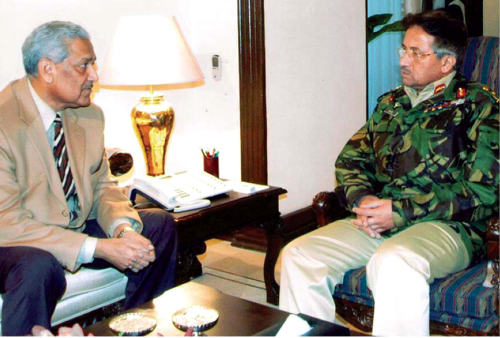
February 4: A. Q. Khan meets with Pervez Musharraf, who pardoned Khan for his role in Pakistan's nuclear transfers.
6,200 tubes of maraging steel, used to construct centrifuges, from a firm in the Netherlands;
vacuum valves and a gas feed system to regulate streams of uranium hexafluoride gas into and out of the centrifuge system from a company in Switzerland;
inverters from companies in Britain, Germany, and the United States;
other electronic equipment for centrifuges from firms in the United States by way of Canada and Turkey;
a metal-finishing plant from Britain;
special measuring equipment from the Netherlands;
a tritium extraction plant, special steel and aluminum, optical equipment, and other sensitive goods from Germany;
vessels and tanks for Pakistan's fledgling reprocessing plant from Italy; and
precision equipment for a reprocessing plant from Switzerland.
These acquisitions enabled Pakistan to get maximum benefit from the nuclear weapon design and supplies of uranium it received from China in 1983. 7
In the ongoing investigation of how Libya was able to obtain sophisticated sensitive components for its nuclear program from Malaysia and other countries, the Malaysian police's inspector general reported that “the supply of components by middlemen … involved suppliers from other countries to blur the source of the components. Some of the suppliers were believed to be aware that these components could be for uranium enrichment centrifuges. Generally, these suppliers, mostly from Europe, were those who had had dealings with [A. Q. Khan] since the 1980s, at a time when Pakistan was developing its nuclear technology.” 8 Der Stern reported on March 21, 1989 that more than 70 German firms helped Pakistan get materials and equipment needed to manufacture the bomb.
Some of the firms from which Khan made his purchases in the 1980s may no longer be involved in the trade, but the ease with which Khan was able to find so many suppliers to satisfy his more recent nuclear demands shows that an international black market was readily created and has been sustained. This is the legacy of the many years during which the United States turned a blind eye to Pakistan's nuclear activities.
Pakistan's brazenness during the 1980s is illustrated by its attempts to purchase and export materials from the United States–5,000 pounds of zirconium metal in 1981, and electronic parts known as krytrons for use in nuclear triggers in 1984. In July 1984 a man named Nazir Ahmed Vaid was arrested for the latter crime, but despite the fact that the government was in possession, on the day of his arrest, of information showing clearly that the intended recipient of the krytrons was the Pakistani Atomic Energy Commission, Vaid's indictment was rewritten to exclude any mention of the nuclear use of krytrons. He was then permitted to plea bargain to a reduced offense, thus avoiding a jury trial, and a gag order was placed on the case. He was found guilty of one count of export violation and quietly deported less than three weeks later. As in the current case with A. Q. Khan, the Pakistani government insisted that Vaid acted on his own, with no government authorization. 9 It was one of many denials of the obvious during the period.
No nuclear ambitions here
During the 1970s and 1980s, when all this illicit nuclear activity was going on, Pakistan denied to the West that it was developing nuclear weapons or had any interest in nuclear weapons. As President Zia told the Foreign Policy Association on December 9, 1982:
“I would like to state once again … that our ongoing nuclear program has an exclusively peaceful dimension and that Pakistan has neither the means nor, indeed, any desire to manufacture a nuclear device. I trust that this distinguished gathering will take note of my assurance, which is given in all sincerity and with a full sense of responsibility.”
A. Q. Khan himself weighed in two years later in an interview on February 10, 1984, saying that “the ‘Islamic bomb’ is a figment of the Zionist mind.”
Starting in the late 1970s, when the U.S. government became aware of Pakistan's nuclear weapon-related activities, I was engaged in seeking to stop or slow the program through congressional investigations and legislative action. My boss at the time was Ohio Democratic Sen. John Glenn, who gave me free rein to work on the issue and became the Senate's voice of protest against Pakistan's nuclear activities. Frustration was more often than not the end result of much of our work.
I either crafted or was otherwise involved in numerous legislative actions designed to stop the Pakistanis through the threat of sanctions. These actions were passed by Congress and dutifully signed into law by three presidents, but their implementation was nearly always blocked because of other foreign policy considerations.
It didn't start off that way. Pakistan had been cut off from economic and military assistance in 1979 under the Symington and Glenn amendments to the Foreign Assistance Act, after it imported unsafe-guarded nuclear enrichment technology and equipment. (The Pakistanis said the cutoff stemmed from the influence of “Zionist circles” seeking to protect Israel from the Muslim world.) 10 The Soviet invasion of Afghanistan later that year changed U.S. priorities.
Cold War considerations
When Ronald Reagan arrived in the White House in 1981, his administration came with a desire to send arms to the Afghani mujahideen. They could only be delivered through Pakistan, and nonproliferation took a back seat to Cold War politics. The new administration was so intent on sending arms that as then-Assistant Secretary of State Robin Raphel later admitted, “There was no explicit agreement … no explicit quid pro quo” that in return for U.S. assistance Pakistan would not develop nuclear weapons. 11
The Pakistanis got the message when there was no adverse U.S. reaction to a tough position articulated by Agha Shahi, then-foreign minister of Pakistan, in a meeting with James Buckley, then-U.S. undersecretary of state. On December 14, 1981, Shahi described the meeting to the Council of Pakistani Editors:
“We told Mr. Buckley that our program is only for peaceful purposes … and we are fully aware of the concerns of the United States over our atomic energy program, which we think to be baseless, unwarranted, unjustified. But we understand and we have taken note of this concern. So if we decide to carry out an explosion, then we would be prepared to forgo this [U.S. aid] program. That is a matter for our judgment, but we have given no undertaking to Mr. Buckley about explosions.”
Despite Shahi's “in-your-face” position, James Buckley subsequently told Congress: “We believe that a program of support which provides Pakistan with a continuing relationship with a significant security partner and enhances its sense of security may help remove the principal underlying incentive for the acquisition of a nuclear weapons capability. With such a relationship in place we are hopeful that over time we will be able to persuade Pakistan that the pursuit of a weapons capability is neither necessary to its security nor in its broader interest as an important member of the world community.” 12
Sanctions lifted
One month after Buckley's testimony, Congress passed the first of a series of legislated waivers of penalties under the Symington Amendment that lasted until the Soviets left Afghanistan in 1990. Although the legislation stipulated that a cutoff could still occur if Pakistan were to explode a nuclear device, the Pakistanis did not act worried that U.S. opposition to nuclear proliferation would put their bomb program in jeopardy.
During the U.S. presidential election season in 1984, President Zia told the Wall Street Journal on July 10 that he was “confident that U.S. politics won't disrupt the flow of American weaponry to Pakistan.” His confidence was not misplaced. Indeed, it must have been reinforced by the contemporaneous Vaid case, whose lesson to the Pakistanis could only be that the United States would bend over backwards to keep the arms flowing, even in the case of overt nuclear smuggling attempts by Pakistan from within the United States. It must also have satisfied him to read that Richard Kennedy, then-ambassador at large for nonproliferation, had said: “We accept President Zia ul-Haq's statement that Pakistan's nuclear program is devoted entirely to power generation.” 13 Ironically, the State Department had written a secret memorandum the year before stating that the United States had “unambiguous evidence that Pakistan is actively pursuing a nuclear weapons development program…. We believe the ultimate application of the enriched uranium produced at Kahuta, which is unsafeguarded, is clearly nuclear weapons.” 14
Zulfikar Ali Bhutto, president of Pakistan from 1970 to 1977.

George H. W. Bush failed to mention Pakistan's nuclear program when Benazir Bhutto came calling on June 6, 1989.

The Solarz and Pressler amendments
As a result of the outrageous outcome of the Vaid case, Congress passed a law, known as the Solarz Amendment to the Foreign Assistance Act, prohibiting military and economic assistance to any non-weapon state that illegally exports or attempts to export U.S. items that would contribute significantly to the ability of that country to make a nuclear explosive device.
The Solarz and Pressler amendments were signed into law on August 8, 1985. The Pressler Amendment made continued military assistance to Pakistan contingent on an annual presidential certification that Pakistan did not possess a nuclear explosive device and that U.S. assistance would significantly reduce the risk that Pakistan would possess a nuclear explosive device. The Pressler Amendment was the last barrier to Pakistan's construction of a device, but the Pakistanis treated it with the same contempt they showed other efforts to condition U.S. assistance on nuclear restraint.
On September 12, 1984, a year before the Pressler Amendment was passed, President Reagan sent a letter to Zia warning the Pakistanis not to “cross the red line” of enriching uranium beyond 5 percent or face “grave consequences.” 15 In response, President Zia pledged not to do so, and high-level officials kept repeating that pledge, which was itself repeated by administration spokesmen in congressional hearings. 16
It was revealed some months later that the Pakistanis had already passed the 5 percent level at the time of Reagan's letter. But crossing the “red line” resulted in no action by the administration, and when Prime Minister Benazir Bhutto visited President George H. W. Bush in June 1989, the subject was not even mentioned. 17
This undoubtedly reinforced the Pakistanis' feeling that they were under no limits by the administration save possibly for testing, and that Congress was equally feckless, with few exceptions. Attempts at smuggling materials from the United States continued, and another smuggler was caught in 1987. A Canadian citizen of Pakistani extraction named Arshad Pervez was arrested for illegally trying to buy and export a quantity of beryllium, along with 25 tons of maraging steel for centrifuges from an American manufacturer. He was ultimately convicted of the beryllium charge and of lying to investigators, but escaped conviction on the remaining charges on the grounds of entrapment, even though American intelligence officials found evidence that the Pakistani embassy in London was directly involved. 18 Pervez, who went to prison, admitted that he was working for a retired Pakistani brigadier general and that the final customer was the Pakistani nuclear program, thereby establishing a violation of the Solarz Amendment. But the U.S. government once again refused to sanction Pakistan, and the Pakistani nuclear program rolled on.
Pakistan gets the bomb
In an interview with Indian journalist Kuldip Nayar, A. Q. Khan admitted that Pakistan had enriched uranium to weapons grade, and added that Pakistan could build nuclear weap-ons. 19 In March 1987, Senator Glenn testified before the Senate Foreign Relations Committee, arguing that “Pakistani nuclear weapons production will, sooner or later, whether by design or by espionage, result in the wider transfer of nuclear weapons technology to countries in the Middle East.” Despite such warnings, and clear evidence that U.S. assistance was not reducing the risk that Pakistan would possess a nuclear explosive device, presidential certifications were issued in 1988 by Reagan and in 1989 by Bush. On November 26, 1987, a United Press International story by Richard Sale quoted unnamed intelligence sources as saying that Pakistan had a workable nuclear device, although it was deemed too big “by those who have seen the new bomb” to be delivered by an F-16.
Too little and too late
By 1990, the fiction that Pakistan might not possess the bomb was completely unsustainable. The Soviets had left Afghanistan, so no certification was issued by President Bush and assistance was cut off. Having been the recipient of extreme indulgence for so long, the Pakistanis were surprised by the action, which halted a shipment of F-16s that they had already paid for. Nonetheless, 40 F-16s had already been delivered, at least some of which were being modified to carry nuclear warheads in contravention of the conditions under which the planes were originally transferred. Thus, in service to the Cold War, the United States suffered more than a decade of Pakistani lies and false promises about their nuclear activities, did not enforce its own laws or restrictions on Pakistan's nuclear program when it counted, and left Pakistan with a U.S.-made nuclear weapons delivery system.
Senator Glenn's response to this outrageous history was encapsulated in an op-ed: “The Reagan and Bush administrations have practiced a nuclear nonproliferation policy bordering on lawlessness. In so doing, they have undermined the respect of other countries for U.S. law and have done great damage to the nuclear nonproliferation effort. Keep this in mind the next time someone in the administration extols the need for military action to deal with some power hungry dictator who is seeking to acquire nuclear weapons in the Middle East or elsewhere.” 20
After 9/11
Unfortunately, the story did not end with the cutoff of 1990. Pakistan had the bomb, but it still had not tested a nuclear weapon. So, in a triumph of hope over experience, legislation was passed in 1994 requiring the imposition of draconian sanctions in the event of a test, in the hope of deterring both Pakistan and India.
When both countries exploded nuclear test devices in 1998, the severe economic sanctions in the law were automatically triggered. But once again, Congress removed them, in part because of domestic considerations involving agricultural exports. The prohibition on military assistance continued, however, until after 9/11, when the current Bush administration issued a waiver ending the implementation of nearly all other sanctions because of the perceived need for Pakistani assistance in the fight against Al Qaeda and the Taliban in Afghanistan. This was the height of irony–it was U.S. support for Pakistan and the mujahideen in the 1980s that helped bring the Taliban and Al Qaeda to prominence in Afghanistan in the first place.
We are essentially back where we were with Pakistan in the 1980s. It is apparent that it has engaged in dangerous nuclear mischief with North Korea, Iran, and Libya (and perhaps others), but thus far without consequences to its relationship with the United States because of other, overriding foreign policy considerations–not the Cold War this time, but the war on terrorism.
Sen. John Glenn was a staunch opponent of Pakistan's nuclear program.

March 23: A truckload of Pakistani soldiers in Wana, near where an anti-Al Qaeda operation was in progress.

But now there is a major political difference. It was one thing for Pakistan, a country with which the United States has had good relations generally, to follow India and produce the bomb for itself. It is quite another for Pakistan to help two-thirds of the “axis of evil,” and the perpetrators of Pan Am 103, all of whom have, at one time or another, been accused of being sponsors of terrorism, to get the bomb as well.
The president's dilemma
The waivers given to Pakistan after 9/11 are only good with respect to past behavior. Anything the Pakistanis have done since the waivers were issued that is proscribed by law require new waivers to be issued. If the reports about the timing of Pakistan's exports are true–that some of the transfers occurred after the date of the most recent waivers–and the Pakistani government authorized the exports directly or indirectly, then Pakistan is in violation of U.S. laws and unprotected by past waivers. The same would be true if the Pakistani government was, as is likely, behind the recent incident of an Israeli businessman, operating out of South Africa, attempting illegally to buy and export nuclear trigger components for the Pakistani weapons program. 21
No cutoff of the generous assistance that is being given and has been promised will occur unless and until the president makes a determination as to Pakistan's guilt. As in the 1980s with the Pressler Amendment, turning a blind eye means not having to make a difficult decision. And so far, the Bush administration appears to be pretending that Musharraf's claim of being the victim of a rogue operation headed by A. Q. Khan is the truth. It is reported that, in return, Musharraf has made some concessions facilitating the hunt for Osama bin Laden in northwest Pakistan. 22 But if the only concessions Pakistan makes because of the Khan case have to do with some immediate tactical advantage in the war on terror, and the nuclear program remains untouched, it is questionable whether U.S. national security has been enhanced in the longer term.
The president wants to be seen as not only a president fighting terrorism, but also as a staunch proponent of nonproliferation. Having gone to war with Iraq ostensibly to stop Iraq's possible proliferation, the president is now faced with a more serious violation of nonproliferation norms.
If the president does issue a new waiver for Pakistan, presumably on the grounds of the need for its support in the war on terror, he risks being accused of conducting business as usual. And, as indicated earlier, some will see this as a wholesale retreat from the nonproliferation rhetoric that fueled public support for the war in Iraq, and it will once again raise issues of U.S. credibility. A frequently voiced opinion abroad is that the United States does not oppose proliferation by its friends.
If, on the other hand, the president doesn't issue a waiver and pretends that no violation by the government of Pakistan has occurred, he risks being accused of misfeasance for having failed to carry out U.S. laws.
If the president wants to preserve U.S. credibility on nonproliferation, he can tell the Pakistanis that he is prepared to declare them in violation and impose sanctions unless they agree to a set of conditions that would cap their nuclear program and ensure the end of their illegal and immoral trade in nuclear weapons technology.
Among these conditions should be a demand that Pakistan sign a verifiable agreement to end its production of fissile material and make its nuclear trading records transparent to the International Atomic Energy Agency (IAEA) so the world can know what it is doing and with whom it has been dealing. An interrogation of A. Q. Khan by the IAEA should also be part of the deal. These conditions, if met, could enable the United States, in concert with its allies, to roll up much of the current black market in nuclear materials and equipment.
The president should also announce that greater intelligence resources will be devoted to Pakistan's export activities, with interdiction ready to be carried out under the administration's new Proliferation Security Initiative whenever indicated. In return for Pakistan's cooperation, the United States should be willing to help the Pakistanis improve their own security in ways that do not exacerbate the tensions in the area and are not perceived as assisting their nuclear weapons program.
It's Santayana all over again
Some will argue that national pride would prevent Pakistan from accepting such terms and that the United States would lose a valuable ally in the fight against Al Qaeda if sanctions were imposed. Moreover, they will argue, sanctions could plunge Pakistan into economic and political chaos, with the possibility of takeover by a radical Islamic contingent that would then inherit Pakistan's nuclear weapons.
These arguments (just replace “Al Qaeda” with “communism”) have been used for two decades in defense of a weak nonproliferation policy in South Asia that has brought nothing but grief. They do not take into account American credibility and the effect on other real or potential proliferators. It is true that Pakistan may be more prone to destabilization in response to economic stress than some other countries in the region, but it should be Pakistan's choice as to whether it wishes to belong to the community of responsible nations and receive the benefits it needs from that community. In any case, there needs to be an effective contingency plan for preventing Pakistan's weapons from falling into the hands of radical undemocratic elements in the country, something that could happen regardless of U.S. policy.
Pakistan presents a real and ongoing test of the seriousness of the Bush administration on the issue of nonproliferation. The choice between fighting proliferation or fighting terrorism is ultimately a false one. Sacrificing one for the other would have disastrous consequences for national security. George Santayana once wrote that those who forget the past are doomed to repeat it. In the case of Pakistan, we haven't forgotten, but the Bush administration insists on repeating it anyway.
Footnotes
1.
Seymour Hersh, “The Deal,” New Yorker, March 8, 2004.
2.
O. Gozani, “Pakistan ‘Aiding Iran’ in Nuclear Weapons Venture,” Daily Telegraph, Nov. 26, 1988. See also Farzad Bazoft, “Iran Signs Secret Atom Deal,” London Observer, June 12, 1988, p. 1; John Fialka, “West Concerned by Signs of Libyan-Pakistan A-Effort,” Washington Star, Nov. 25, 1979.
3.
E. Lenhart, “Saudis Offer to Help Zia Build H-Bomb,” Sunday Times (London), Jan. 18, 1981.
4.
Interview in Akhbar al-Khalij, March 13, 1986, p. F4. Translated by Foreign Broadcast Information Service, FBIS-SAS-86-053, March 19, 1986.
5.
See F. Hassan, “An Analysis of Propaganda Against Pakistan's Peaceful Nuclear Program,” Nawa-I-Waqt (Lahore), March 16, 1984. See also Robert Windrem, “Pakistan: ‘The Crazy Soup,’” MSNBC, February 8, 2004; Steve Weissman and Herbert Krosny, “Pakistan,” in The Islamic Bomb (New York: New York Times Books, 1981), pp. 161-226.
6.
Congressional Record, October 20, 1981, p. 24505; Mark Hibbs, “German Firms Exported Tritium Purification Plant to Pakistan,” Nuclear Fuel, February 6, 1989, p. 6.
7.
K. Malik, Times of India, Jan. 13, 1989, p. 1.
8.
Press Release, “Inspector General of Police (Polis Diraja), Malaysia, in Relation to Investigation on the Alleged Production of Components for Libya's Uranium Enrichment Program,” February 20, 2004, p. 3.
9.
Seymour Hersh, “Pakistani in U.S. Sought to Ship A-Bomb Trigger,” New York Times, Feb. 25, 1985, p. 1.
10.
R. Trumbull, “Pakistan Denies It Plans A-Bomb; Denounces Washington Aid Cutoff,” New York Times, April 9, 1979, p. 1.
11.
Assistant Secretary of State Robin Raphel, testimony before the South Asia Subcommittee of the Senate Foreign Relations Committee, September 14, 1995.
12.
James Buckley, testimony before the Senate Foreign Relations Committee, November 12, 1981.
13.
Interview with Richard Kennedy, in Pakistan Affairs (newsletter), November 2, 1984.
14.
U.S. State Department, Assessment of Pakistan's Nuclear Program, June 23, 1983. Declassified and released in March 1992 to the National Security Archive, Washington, D.C.
15.
Simon Henderson, Financial Times, Dec. 7, 1984; Hedrick Smith, “A Bomb Ticks in Pakistan,” New York Times Sunday Magazine, March 6, 1988, p. 38.
16.
Simon Henderson, “Netherlands Drops Proceedings Against Nuclear Scientist,” Financial Times, July 16, 1986, p. 3; Deputy Assistant Secretary of State Robert Peck, congressional testimony, July 31, 1987.
17.
David Ottaway, “U.S. Relieves Pakistan of Pledge Against Enriching Uranium,” Washington Post, June 15, 1989, p. A38.
18.
Mark Hosenball and J. Adams, “A-Bomb Plot is Linked to Embassy,” Sunday Times (London), July 26, 1987.
19.
Shyam Bhatia, “Pakistan has the A-Bomb,” London Observer, March 1, 1987, p. 1.
20.
John Glenn, “On Proliferation Law, a Disgraceful Failure,” International Herald Tribune, June 26, 1992.
21.
David Rohde, “Pakistani Linked to Illegal Exports Has Ties to Military,” New York Times, Feb. 20, 2004, p. 8.
22.
Seymour Hersh, “The Deal.”