




Abstract
A separate agreement for Israel, India, and Pakistan would bolster nonproliferation efforts from outside the NPT, but would require Israel to acknowledge its nuclear status.
By late 1966, as the Nuclear Non-Proliferation Treaty (NPT) was nearing completion, Israel had secretly concluded the research and development phase for its first nuclear explosive device. But it did not dare test the device. Israel had promised President Lyndon Johnson's administration that “it [would] not be the first to introduce nuclear weapons to the Middle East.” And it intended to keep its word. When Johnson was informed by CIA Director Richard Helms that Israel had reached nuclear capability, he ordered Helms “to keep [Israel's nuclear progress] a secret and not share it even with [Secretary of State Dean] Rusk and [Secretary of Defense Robert S.] McNamara.” A taboo was created.
This was the unique historical fabric with which Israel went nuclear in the 1960s–with full technological vigor but with a great deal of political ambivalence. That and the hesitant American response gave rise to a bilateral taboo. Israel's nuclear project was caught in the middle as nonproliferation norms were being built. While the United States, the Soviet Union, and Britain were working to address the threat of nuclear proliferation, Israel was concerned with being prepared to confront hostile neighbors. In 1968, with the completion of the NPT, American officials pressured Israel to join the nonproliferation effort, but to no avail. Given its security needs and U.S. unwillingness to provide security guarantees, it could not join the NPT and renounce its nuclear option.
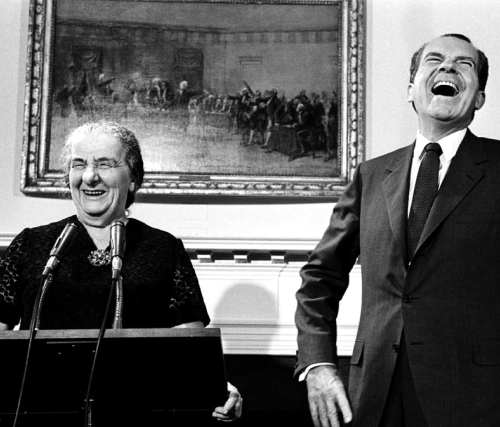
By September 1969, Israeli Prime Minister Golda Meir and President Richard Nixon had reached a new secret understanding of the issue. Meir pledged that Israel would not declare its nuclear status, would not test its weapons, and would not use its nuclear capability for diplomatic gains. Rather, the Israeli bomb would be kept in the basement, for use only as a last resort. Israel would not join the NPT, but it would not defy it either.
What had begun as a taboo turned into a symbiotic policy. The United States stopped pressuring Israel and accepted a de facto policy of “don't ask, don't tell.” For more than three decades, Israel and the United States have perceived nuclear opacity as the only way to address both the uniqueness of Israel's nuclear capabilities and the U.S. commitment to the nuclear nonproliferation regime. All Israeli governments have adhered to this understanding and all American administrations have looked the other way when it came to Israel's nuclear capabilities. Today this policy is not merely anachronistic, it is counterproductive.
A weakened treaty
Much has changed in world politics since the NPT came into being in 1970, but it is remarkable that the grand bargain of the treaty has remained virtually intact. In exchange for renouncing nuclear weapons and accepting the new nonproliferation norms, the treaty's nuclear weapon states agreed to share peaceful nuclear technology with the non-nuclear weapon states and committed themselves to pursuing nuclear disarmament measures aimed at the ultimate elimination of nuclear weapons.
Israeli troops head toward the Golan Heights during the 1973 Yom Kippur War. Israel's leaders considered using nuclear weapons during the conflict.
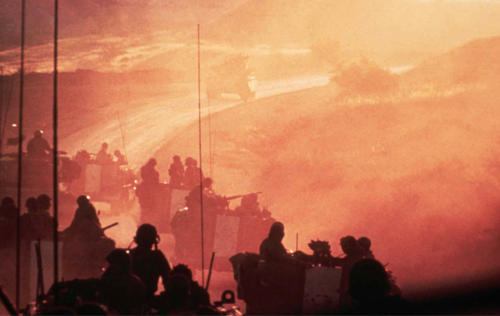
The number of nuclear weapon states has changed very little since 1970. Today, in fact, there are only two more nuclear weapon programs than existed in 1970, as Israel and India were far along toward a weapon capability at the time. Israel, India, and Pakistan are all NPT nonsignatories and all are full-blown nuclear weapon states. North Korea, which pursued its nuclear ambitions from within the treaty, also claims to have crossed the nuclear threshold.
Then there is the case of Iran, a country that does not yet have nuclear weapons but, like North Korea, is widely believed to be developing a nuclear weapons program from within the NPT.
Contrary to those who alarmingly predicted that the end of the Cold War would lead to rapid proliferation–and ultimately nuclear anarchy–the NPT continues to stimulate positive nonproliferation developments. Russia alone succeeded the Soviet Union as a nuclear weapon state under the NPT, while the other former Soviet republics joined the NPT as non-nuclear weapon states. South Africa destroyed the seven nuclear weapons it had built and joined the NPT in 1992, and Argentina and Brazil gave up their nuclear rivalry to join the treaty. Nuclear-weapon-free zone (NWZ) treaties have come into force in Latin America, Africa, the South Pacific, and Southeast Asia, and now cover a considerable portion of the world's landmass.
Together with other multilateral and bilateral agreements, the NPT has grown to be the centerpiece in a much larger, more flexible, and dynamic nonproliferation regime. Included in what is now a large array of arrangements are: the informal nuclear supplier controls; the Lisbon Protocol of the Strategic Arms Reduction Talks (START) treaty, which ensured the non-nuclear status of Ukraine, Belarus, and Kazakhstan; the regional NWZs; the bilateral inspection arrangements between Argentina and Brazil, which permitted their accession to the NPT; the now-terminated Agreed Framework between the United States and North Korea; and, in 1997, the International Atomic Energy Agency's (IAEA) expanded inspection protocol. All of these arrangements address specific nuclear proliferation problems that the NPT could not resolve alone. And they all support the idea of the nonproliferation norm from outside the NPT proper.
Despite its success, it is by no means certain that the nonproliferation regime, the cornerstone of world security, will survive in the long term. Its weakness can be traced to several factors.
The nuclear weapon states have not pursued their half of the bargain with sufficient vigor. While Britain, France, and Russia have ratified the Comprehensive Test Ban Treaty (CTBT), the U.S. Senate has rejected ratification, and China now hides behind the U.S. refusal. While the United States and Russia have agreed to reduce the number of nuclear weapons on alert during the next 10 years, both countries still maintain stockpiles of thousands of nuclear weapons. And there is also the issue of negative security assurances, commitments by the nuclear weapon states not to attack non-nuclear weapon states with nuclear weapons. In order to achieve the permanent extension of the NPT in 1995, all five NPT weapon states made technically nonbinding, highly formal negative security assurances to all non-nuclear weapon states. But the United States, Britain, France, and Russia all have national policies and military doctrines that conflict with those declarations.
September 1969: Israeli Prime Minister Golda Meir and President Richard Nixon enjoy a moment of levity before making final statements on their meetings.
The nuclear weapon states have also failed to make the NPT universal and improve compliance mechanisms. The perceived credibility and effectiveness of the NPT is a measure of the strength of the entire nonproliferation regime and rests on the treaty being applied universally. Non-nuclear weapon states have questioned the wisdom of adhering to the NPT when India, Pakistan, and Israel all operate outside the treaty and leave the regime incomplete.
Noncompliance and illegal nuclear weapon programs are the most serious problems for the nonproliferation regime. The nuclear programs of North Korea and Iran are examples of how nations may abuse rights granted them under the NPT. If not effectively addressed, their violations will undermine the viability and integrity of the treaty and cause states to contemplate other means of preserving order and security in an increasingly dangerous world.
The issues of universality and compliance are closely related. Only a universal, action-oriented nonproliferation regime will command the respect of the world community and best address the noncompliance question.
Israel stands alone
The 1998 nuclear tests by India and Pakistan were perceived as a serious blow to the nonproliferation regime, highlighting the fear of nuclear confrontation in South Asia. But within months policies started to change. Once it became apparent that India and Pakistan were determined to maintain their nuclear status, public discussion turned to how best to reduce the risk of nuclear war in the region and limit the damage the two programs caused to world security and the nonproliferation regime. This discussion, and progress toward a resolution of the situation, is only possible because both countries' programs are somewhat transparent.
While much attention was given to the nuclear dangers on the Indian subcontinent following the 1998 nuclear tests, Israel's aloofness from the NPT has historically received little attention, to the concern of some NPT member states. The taboo concerning Israel's nuclear program creates a sort of paradox. While Israel's nuclear weapon program is one of the world's least-kept secrets–Israel is widely recognized as the world's sixth ranking nuclear power, much closer, in quality and quantity, to France and Britain than to India and Pakistan–in Israel the nuclear program remains shrouded in secrecy. Israel's policy of nuclear secrecy stands in profound tension with the basic values upon which the country's democracy rests: the principles of accountability, oversight, and the public's right to know. In the absence of public debate (and public debate requires some factual information) the taboo only reinforces and perpetuates itself.
In Israel, the most common argument for the policy of nuclear ambiguity points the finger at the United States. It is Israel's commitment to the United States, the argument runs, that compels it to adhere to the posture of opacity. This is a false argument, based on assumptions known to be incorrect. There was a time when there would have been serious repercussions in the United States, particularly in Congress, if Israel had publicly disclosed its nuclear program, but this is no longer the case. It is inconceivable that the U.S. Congress would argue that Israel should abandon or even roll back its nuclear program, given its current security situation (including the emergence of the Iranian nuclear threat).
By becoming more transparent and by associating itself in some way with the nonproliferation regime–from which it indirectly benefits–Israel could gain an important element of legitimacy for its program and for its security posture. U.S. security and the global nonproliferation regime would also benefit from such a shift in policy. While ambiguity was a wise way to deal with a complex and uncomfortable reality 30 years ago, it is no longer justified.
Out of the nuclear closet
At the NPT Review and Extension Conference in 1995, member nations expressed concern about the nuclear situation in the Middle East. Egypt opposed the indefinite extension of the treaty on the grounds that, as long as key states (primarily Israel) remained outside the treaty, the regime was “incapable of safeguarding Egypt.” Senior Egyptian diplomats explained their position very simply. While it is understood that Israel will not use nuclear weapons at the present time, both political conditions and governments change. It is possible that a future Israeli government could behave differently, they argued, which is why disarmament negotiations have always emphasized capability rather than intent.
January 23: Palestinians rally in support of Hamas in the West Bank. Israelis often cite their unique security situation as a rationale for nuclear exceptionalism.

Unlike India, Israel understands that its regional conventional superiority would be effectively neutralized if any of its potential adversaries had nuclear weapons. As an uncommitted beneficiary of the NPT, Israel has chosen the precarious path of maintaining its own unsafeguarded nuclear program outside the treaty and relying on the majority of the world to support the health of the treaty's regime. This unique status cannot last forever if widespread proliferation is to be averted. Israel is undeniably a part of the nonproliferation equation, regionally and globally.
Of course, each country has its own security concerns–Israelis often cite their country's unique situation as a justification for nuclear exceptionalism–and the NPT is far from perfect. There are serious reasons to be concerned about the ability of IAEA safeguards inspections to verify nonproliferation. The U.N. Special Commission's (UNSCOM) discoveries in Iraq raised grave questions about the system, and there is serious and justified concern about the situation in Iran as well. But these developments have also led to a strengthening of the safeguards approach and other nonproliferation efforts.
Even though it is unlikely that Israel will join the NPT, it recognizes that stemming nuclear proliferation is valuable to its security and could consider actions to support the nonproliferation norm, as far as it can, from outside the NPT. A number of Middle Eastern states have strong nuclear nonproliferation credentials, especially Egypt, which continues to play a leadership role in the NPT community and as part of the African Nuclear-Weapon-Free Zone Treaty. Given the complex circumstances of the Middle East, a regional solution to promoting nonproliferation might be useful.
Israel could relate to the nonproliferation regime as part of a regional discussion of the security problems associated with nuclear as well as chemical and biological weapons (as opposed to nuclear weapons only). This option would, however, require at least a reference to Israel as a nuclear weapon state.
This would present a problem as many NPT parties–most notably Japan, South Africa, Argentina, Brazil, South Korea, and Algeria–joined the treaty based on the clear understanding that no other states would openly declare a nuclear weapon capability. The NPT allows temporarily for five, and no more than five, nuclear weapon states. The Indian and Pakistani tests already strained the NPT in this respect.
November 27, 2003: A day after India and Pakistan began a cease-fire, a bicyclist pedals past Indian soldiers patrolling the border in Kashmir.
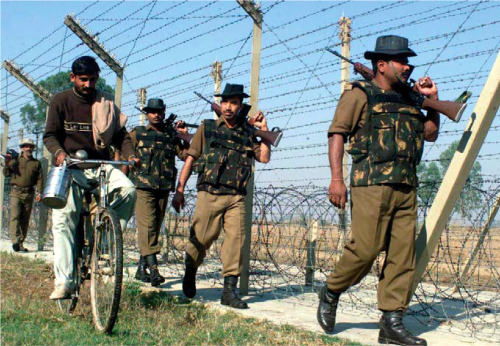
It is important to understand that even though India, Pakistan, and Israel have different security situations with respect to the nonproliferation regime, their issues must be addressed together as none of them can be approached in isolation.
A separate protocol
The world is coming to a historically decisive moment in its effort to promote nuclear nonproliferation. The basic technology needed to create nuclear weapons is increasingly available. Capabilities once possessed only by a few governments can now be purchased in stores and marketplaces around the world. If nuclear weapon states are ever to achieve deep cuts in their nuclear stockpiles–an important part of the basic bargain of the NPT and essential to the long-term viability of the treaty–some account has to be taken of Israel, India, and Pakistan's nuclear weapons. They must be integrated into the nonproliferation regime.
To amend the NPT and admit the three as nuclear weapon states is a political impossibility. And none of these states can be expected to give up its program to become a non-nuclear weapon party to the treaty. One answer could be a form of associate membership under a separate, freestanding agreement or protocol.
Such a protocol might permit Israel, India, and Pakistan to retain their programs, but inhibit further development. The protocol could also require cooperation with international nuclear export controls, prohibit the explosive testing of nuclear devices, and call for the phased elimination of fissile material production. Israel, India, and Pakistan would sign the agreement along with the Depositary States (Russia, Britain, and the United States), which since the 1960s have been considered the general managers of the NPT. By becoming party to such a protocol, the three could acknowledge their nuclear status through association with the existing nonproliferation regime.
It should be clear that in proposing a separate protocol we are not advocating such a solution for member states that have violated or abused the treaty. Israel, India, and Pakistan never joined the NPT; Iran and North Korea did, and they must be held to their obligations. But a viable and effective nonproliferation regime will only be possible, in the long run, if the nuclear weapon states observe their half of the NPT bargain and work toward the ultimate elimination of nuclear weapons. The first steps would be to ratify the test ban treaty, negotiate deeper cuts in nuclear weapon stockpiles, establish legally binding negative security assurances, and create a fissile material cutoff treaty. Any state to sign the separate protocol would have to participate in these steps as well. We recognize that reductions and a cutoff treaty will only happen some time in the future as part of a mutual step by all nuclear weapon states. As indicated above, an endorsement of the CTBT and negative security assurances could be contained in the suggested protocol.
This proposal does not legitimize nuclear weapons and nuclear proliferation. But it would realistically recognize the nuclear status of Israel, India, and Pakistan while requiring that they commit to nonproliferation standards. If the nonproliferation regime becomes more universal, it will become more effective.
Almost 35 years after a worldwide nonproliferation regime was established, the question of how to prevent nuclear anarchy still haunts us. The large number of existing nuclear weapons and stockpiles of fissile material only fuel the risk of proliferation. As a nuclear weapon state, Israel is part of the problem; therefore, it must be part of the solution. The same is true for India and Pakistan. The answers are difficult to come by, but the security of states cannot continue to come at the cost of the security of human civilization.