




Abstract
When the American public pays little attention to political affairs, it pays the price. The question today is the same as it has been earlier in U.S. history–how great a price?
May 1, 2003: President Bush landed on the U.S.S. Abraham Lincoln via fighter plane, burning an indelible image into American minds.

The authors of a highly regarded textbook, American Public Opinion, include an aggregate analysis of more than 2,000 “pop quizzes” surveying American political knowledge since the 1930s. Only 13 percent of the adult public could answer correctly at least 75 percent of such questions. And only 41 percent got at least 50 percent right. Despite an enormous increase in the average American's level of schooling over the same period, the authors conclude that “Americans are no better informed about political matters than they were 50 years ago.” 1
May 1, 2003: President Bush landed on the U.S.S. Abraham Lincoln via fighter plane, burning an indelible image into American minds.
Ignorance about U.S. foreign policy and the world is even more shocking. Forty percent of respondents in one poll believed Israel to be an Arab nation. 2 When asked what percent of the U.S. budget was spent on foreign aid, the median response was “20 percent.” The actual amount is less than 1 percent. 3
Perhaps the most disturbing of all poll results, however, was revealed in March 2003, the month the United States invaded Iraq. An astounding 51 percent of those polled answered in the affirmative when CNN/USA Today pollsters asked: “Do you think Saddam Hussein was personally involved in the September 11 terrorist attacks, or not?” 4
The result was especially disturbing because President George W. Bush had been asked at a January 31, 2003 news conference: “Do you believe that there is a link between Saddam Hussein, a direct link, and the men who attacked on September 11?” The president had replied, “I can't make that claim.”
Had Bush been heard by the nearly half of those polled who told Knight Ridder earlier that month that at least some of the 19 9/11 hijackers were Iraqis (when none were)? Probably not. It should surprise nobody that 84 percent of those who believed that Saddam Hussein was involved in 9/11 supported the Bush administration's invasion of Iraq.
But it is a national disgrace.
The costs of democratic self-rule
Ignorance of the world has deep historical and cultural roots in the United States. It's been nourished by a utilitarian view of education, the belief that technology can solve all problems (“technological utopianism”), a “free press” that is not nearly free, punitive measures designed to stifle dissent, the rise of specialized bureaucracies, and, finally, purposive deceit and lies by political leaders.
The Founding Fathers played an indispensable role in ending British rule and establishing a unique form of government, but “democracy was a minor matter” to them, argues historian Robert H. Wiebe. 5
The revolutionary leaders were “first-generation gentlemen.” According to historian Gordon Wood, “It would be difficult to exaggerate the importance of these new enlightened republican ideals of gentility for the American revolutionary leaders.”
“By gentlemen,” John Adams explained, “are not meant the rich or the poor, the high-born or the low-born, the industrious or the idle: but all those who have received a liberal education, an ordinary degree of erudition in the liberal arts and sciences.” 6
Nevertheless, actual democratic activity in colonial America during the Great Awakening, the settlement of the frontier, self-directed business endeavors, and especially the fight for independence, laid the groundwork for jettisoning these Revolutionary “gentlemen” soon after their revolutionary services were rendered.
Typical of the assault on the Federalist aristocracy was one leveled by Abraham Bishop, himself a lawyer and graduate of Yale. Bishop conceded that the revolutionary leaders were “superior to common, ordinary people–in wealth, in birth, in private character, in intellect, in education.” But, he argued, “ordinary people ought not to be ruled by men greater, wiser, and richer than they,” because “a nation which makes greatness its polestar can never be free.” 7
Spurred by this populist sentiment, artisans, tradesmen, mechanics, and laborers organized into associations and Democratic-Republican societies that demanded that people do their “utmost at election to prevent all men of talents, lawyers, rich men from being elected.” In Wood's view, the “destruction of aristocracy, including Jefferson's ‘natural aristocracy,’ was the real American Revolution–a radical alteration in the nature of American society whose effects are still being felt today.” 8
Although it applied only to white men, self-rule was American democracy's radical new principle, and its health was measured by the economic success that flowed from self-directed work and technological development. Europeans who visited nineteenth century America were astounded by the industriousness that self-directed work generated. But they were equally appalled by the Americans' barbaric behavior.
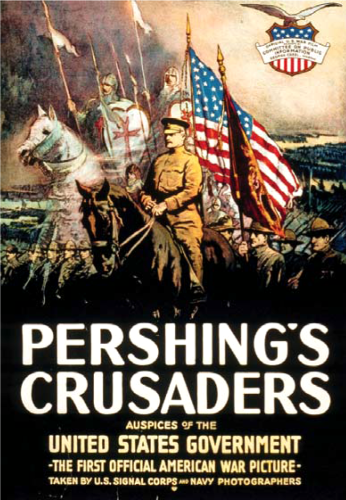
A U.S. government World War I propaganda film.
To these Europeans, Americans appeared incapable of distinguishing civic freedom from chronic disorder. Alexis de Tocqueville observed derisively: “We are wont to look upon a restless disposition, an unbounded desire for riches, and an excessive love of independence as propensities very dangerous to society.” Even Adam Smith thought Americans engaged in “unnecessary and excessive enterprise.”
Henry David Thoreau, writing in Walden, complained that “most men, even in this comparatively free country, through mere ignorance and mistake, are so occupied with the factitious cares and superfluously coarse labors of life that its finer fruits cannot be plucked by them.”
Dating back to Puritan New England, religious and civic leaders had emphasized literacy, especially sufficient literacy to read the Bible, as a means to bring civilization to their country. But, as Lee Soltow and Edward Stevens conclude, this push for literacy “was never more than a utilitarian value to serve greater spiritual and social ends.” It was a “particular” sort of literacy; certainly not one designed to “open vistas of imagination.” 9
Nevertheless, literacy was very much a function of population density. Judging from evidence provided by army enlistees during the period of 1799-1829, 50 percent of the population in the South was illiterate, as was 34 percent in the North. And although illiteracy rates declined to 31 percent and 17 percent respectively during the period 1830-1890, few attended school past the age of 14. 10
According to Sheldon Wolin, beyond these problems were the ones posed by workers and farmers who “accepted the educational ideology of a business civilization that unless education was ‘practical,’ it was useless.” Throughout the nineteenth century, and well into the twentieth, they were “indifferent or hostile to college education.”
“Negativism toward education meant that there were no democratic pressures from below to shape education to the needs of political democracy during the nineteenth century, before political centralization and corporate concentration of economic power had hardened into their present forms.”
It was not until after World War II, when the ruling elite in the United States decided to compete for global supremacy, that they encouraged American universities “to concentrate on developing scientific research, technical skills and methods, and forms of professional knowledge that aid in social control (law, medicine, public health, social welfare, and the management sciences).”
Tuition dollars flowed from the G.I. Bill of 1944. A massive influx of students bent on learning a trade created a paradox, writes Wolin: “The result was the radical alteration of the purpose of the university and college, from education to the pursuit and imparting of knowledge. It was at this point when humanistic education was being replaced by technical knowledge, that the masses went to classes.” 11 And so it remains today.
The press was one institution whose members possessed both a civic and vested interest in literacy. From 1735, when a jury acquitted printer John Peter Zenger for “criticizing the royal governor of New York,” to its inclusion in the First Amendment, to its reaffirmation by the Supreme Court in the 1971 Pentagon Papers case, the press came to be regarded as a “bulwark of liberty,” essential to a genuine democracy. As the Court reaffirmed: “The press was to serve the governed, not the governors.” 12
Yet the press found itself unwilling or unable to disentangle itself from political control during much of the nineteenth century. And when Americans found their opportunities for self-directed work stymied by the closed frontier, population growth, immigration, the rise of corporations, and the dreaded assembly line, they turned to political action that compelled the nation's leaders to come up with ways to use the press to bring them in line.
The battleship Maine sunk in Havana harbor on February 15, 1898. The party press's coverage of the event shifted the public's attention overseas.

Empire and the loss of self-rule
Labor unrest exploded between 1883 and 1886, followed in the late 1880s to mid-1890s by farmers' alliances in the South and West. As Wiebe notes, these alliances “rallied hundreds of thousands of recruits to protests that quickly spilled into political action and, between 1890 and 1892, the creation of the Populist party.”
After the election of 1890 reduced the Republican majority in the House of Representatives to a paltry 88 members, the party transformed itself and America. The vision was provided by Secretary of State James G. Blaine, who believed the party's salvation “lay in launching under the Republican aegis a new assertive foreign policy for the United States, one that would put an end to its isolation and place it once and for all in the international arena as a major world power.”
This change would begin the transformation of the United States from republic to empire. According to historian Walter Karp, “an electorate growing restive over economic conditions would find its attention riveted to the spectacle of America's overseas power and pursuits, its republican sentiments diluted and deformed by jingo nationalism, its political energies absorbed by overseas problems and perplexities.”
President William McKinley used fabricated allegations about Spain's mistreatment of Cubans, including American citizens in Cuba, as a pretext for “liberating” the island, invading Manila as a prelude to acquiring a colony in the Philippines, invading Puerto Rico, and annexing Hawaii. In the name of liberation and “manifest destiny,” the United States violated international law, but did it under the cover of the mysterious explosion of the battleship Maine, which aroused the nation. (Are the reasons the current Bush administration gave for invading Iraq much different?)
But what did turn-of-the-century Americans know? They were illiterate or schooled only in “practical” knowledge. And the press? According to Karp: “Of all the myths about the Spanish-American War, none is more frivolous than the assertion that the inflammatory reporting of the American press … was an independent cause of the war. Nothing could be further from the truth, for there was nothing independent about the American press. It was, overwhelmingly, a party press, a press that echoed to the point of slavishness the policies and propaganda of one or the other major party.” 13
January 2, 1919: President Woodrow Wilson with George Creel, chairman of the Committee on Public Information. Newspaper editor Creel's war-time job was to “choke” news channels with official reports.

The press was to become more dependent still. Soon after the U.S. entry into World War I, President Woodrow Wilson established the Committee on Public Information (CPI) and named newspaper editor George Creel as its chairman. As James Mock and Cedric Larson noted in 1939, Creel's task was not so much to censor the press in the name of wartime security, but to “choke” the channels of communication “with official, approved news and opinion, leaving little freeway for rumor or disloyal reports.”
In addition, “the Committee on Public Information had done its work so well that there was a burning eagerness to believe, to conform, to feel the exaltation of joining in a great and selfless enterprise.” 14 But they also concluded that the CPI would have been much less effective had it not been backed by laws–the Espionage Act, the Trading with the Enemy Act, and the Sedition Act–which criminalized dissent.
The Sedition Act made it a crime, punishable by a prison term up to 20 years and a fine of $10,000, or both, to willfully write, utter, or publicize any “disloyal, profane, scurrilous, or abusive language” about the form of government of the United States or its Constitution, military or naval forces, the flag, or uniform of the army or navy, or to use any language intended to bring them “into contempt, scorn, contumely, or disrepute.”
According to Karp, “Americans were arrested for remarks made at a boardinghouse table, in a hotel lobby, on a train, in a private club, during the private conversations overheard by the government's spies.” (Was that experience different in degree, or in kind, compared to the arrests following the terrorist attacks of September 11, 2001?)
Suppression of dissent continued after World War I, a consequence in part of Wilson's decision (based on documents later found to have been forged) to dispatch U.S. forces to Russia in an effort to overturn the Bolshevik regime. Wilson's public anti-Bolshevism encouraged eager suppressors of dissent to shift their attention from supporters of the Hun to socialists and communists, paving the way for the Red Scare, the House Un-American Activities Committee, J. Edgar Hoover's anti-Communist excesses, and McCarthyism.
Mobilization for World War I also set the stage for the growth of the national bureaucracy. According to Wiebe, “as a national bureaucracy insulated domestic affairs from popular influence, basic foreign policy issues slipped even farther away from the public.” Yet the subsequent call for more “intelligence” and the proliferation of such agencies would cause it to slip away even more.
Perhaps the starkest manifestation of the breakdown between public participation in decision making was a White House press release on August 6, 1945 (written by New York Times science reporter William Laurence, who had been secretly recruited for the Manhattan Project), telling both Japan and the American public for the first time about the atomic bomb dropped on Hiroshima. 15 Although the bomb was the ultimate in technological utopianism, the American public had not been consulted in any way about the use of a weapon that would come to possess the potential to destroy all life on Earth.
Having observed the ease with which the Wilson administration manufactured consent and suppressed dissent during World War I, Walter Lippmann was moved to write his classic study, Public Opinion. Even today it merits close reading.
Lippmann painstakingly demonstrated why no individual, however intelligent, educated, and motivated, was capable of becoming an expert, let alone being an “insider,” on all the important issues of the day. He also explained why the press could not possibly compensate–because “news and truth are not the same thing.” 16 Further preventing citizens from becoming fully informed was the unwillingness of private and public insiders to reveal what they were up to.
If anything, matters have deteriorated since Lippmann's day. His doubts about the possibility of Jeffersonian democracy, given the near impossibility of a fully informed citizenry, were articulated before television became the primary source of news.
Beyond its tendency to appeal to emotions through graphic and symbolic visual images, the focus of TV news is on the immediate moment, thus depriving the viewer of the context required for informed decisions.
A classic example of the power of imagery over rational discourse occurred in 1984, when Lesley Stahl of CBS News attempted to show the hypocrisy existing between what President Ronald Reagan said and what he did. As journalist James Fallows recounts, after showing video of Reagan speaking at a Special Olympics competition, Stahl pointed out that his administration had cut funding for mental health. And after showing him in attendance at the opening ceremonies of a nursing home, Stahl added that he had opposed public health spending as well. 17
The result? Stahl received a call from a White House official who was pleased by the reaction to her reports. “You television people still don't get it. No one heard what you said. Don't you realize that the picture is all that counts? A powerful picture drowns out the words.” (Think of Bush's landing on the aircraft carrier and the banner “Mission Accomplished.”) Symbolism over substance and reason has become the American way.
Perhaps Fallows best characterized how U.S. television covers world events: “Americans seeing the outside world on TV [can] be forgiven for believing that all countries fall into two categories: those that are so messed up we shouldn't waste time thinking about them, and those that are messed up in a way that threatens our security or moral sensibility, so we should invade them, withdraw quickly, and forget about them again.”
Most Americans probably do not know that CNN executives met regularly, six months before the invasion of Iraq, to plan two separate broadcast approaches to the war–one for American viewers, another for the rest of the world. According to Michael Massing, “the executives knew that [Paula] Zahn's girl-next-door manner and [Aaron] Brown's spacey monologues would not go down well with the British, French, or Germans, much less the Egyptians or Turks. CNN International bore more resemblance to the BBC than to its domestic edition–a difference that showed just how market-driven were the tone and content of the broadcasts.” 18
October 20, 1947: The House Un-American Activities Committee (Richard Nixon presiding), questions Hollywood executives about communists in the movie industry.

A study dated October 2, 2003, by the Program on International Policy Attitudes (PIPA) titled “Misperceptions, the Media, and the Iraq War” found that the audiences of Fox News, CNN, and the three major TV networks held more demonstrable misperceptions about the war in Iraq than did readers of the print media. To nobody's surprise, the viewers of Fox News, which broadcast the most blatantly pro-war coverage, resulted in the highest percentage of misperceptions of that war.
Beyond the failures of television news is the larger problem of stereotyping practiced by political leaders, embraced by the news media, and swallowed by the public. For example, rather than explain to a victorious but war-weary American public why so many things were going wrong in post-World War II Europe, President Harry Truman decided to attribute virtually all of Europe's problems to interference by a Soviet Union bent on world domination, setting up the Cold War “frame.”
Early on, Lippmann had recognized how useful frames could be when he observed that “the more untrained a mind, the more readily it works out a theory that two things which catch its attention at the same time are causally connected.” This insight goes far to explain how easy it was to convey the impression to a high percentage of Americans that Saddam Hussein was involved in the Al Qaeda 9/11 attacks.
The authors of Framing Terrorism: The News Media, the Government, and the Public conclude that, after nearly a decade of searching for a replacement for the obsolete Cold War frame, a new one was provided by the attacks of 9/11–the “war on terror” frame. They also argue that “what changed, and changed decisively with 9/11, were American perceptions of the threat of world terrorism more than the actual reality.” 19
With hindsight, one might look at the 1992 Defense Policy Guidance, prepared under Paul Wolfowitz's direction for then-Defense Secretary Dick Cheney as a first attempt at reframing post-Cold War American policy. At the time its call for American world domination was too much for the elder President Bush to countenance.
But Wolfowitz had been a part of the CIA's “Team B,” which engaged in wild exaggerations of the Soviet threat to justify increased defense spending. Because Team B's exaggerations had been so successful, it was easier for Wolfowitz to contemplate how American military power might well be used to intimidate the world in 1992.
The then-discarded frame of world domination was soon replaced by a new frame on the dangers posed by rogue states, and especially by their capabilities to fire ballistic missiles. Within this frame, the Rumsfeld-led group, the Commission to Assess the Ballistic Missile Threat to the United States (which included Wolfowitz), equally wildly exaggerated the threat by insisting on virtually every worst-case scenario in order to justify deployment of a missile defense. Iraq was one of the rogue states said to pose such a threat, and Cheney, Rumsfeld, and Wolfowitz, among others, targeted it for regime change years before 9/11.
But, as the authors of Framing Terrorism conclude, “after 9/11, a new ‘war on terrorism’ frame was rapidly adopted in the White House as the primary standard used to reinterpret and understand ‘friends’ and ‘enemies’ around the globe.” This frame offered a new and more all-encompassing way for American politicians and journalists to construct a deceptively simple narrative tying together a range of diverse stories about international security, civil wars, and global conflict.
More precisely, it was a narrative for a population more focused, as usual, on the pursuit of practical knowledge, intimidated by Patriot Act legislation, rendered subservient to politically manipulated intelligence agencies, and awed by technological utopianism. As the invasion of Iraq revealed, in the last resort, the technologically superior U.S. military was expected to reaffirm the uniquely naïve “American belief that all human problems have engineering solutions.” 20
And it doesn't require a cynic to notice that, while Democrats and journalists were rallying around the flag after 9/11, momentarily suspending disbelief, the Bush administration busily incorporated all of the failed foreign policy frames that had been advanced by today's Bush administration officials during the 1990s–including world domination–into the new “war on terrorism” frame.
Footnotes
1.
Robert S. Erikson and Kent L. Tedin, American Public Opinion: Its Origins, Content and Impact (New York: Longman Publishers, 2003), p. 54.
2.
Paul M. Sniderman, Richard A. Brody, Philip E. Tetlock, eds., Reasoning and Choice: Explorations in Political Psychology (Cambridge: Cambridge University Press, 1991), p. 15.
3.
“Americans on Foreign Aid and World Hunger: A Study of U.S. Public Attitudes,” Program on International Policy Attitudes, University of Maryland, February 2, 2001.
4.
Pippa Norris, Montague Kern, Marion Jus, eds., Framing Terrorism: The News Media, the Government, and the Public (New York: Routledge, 2003), p. 302.
5.
Robert H. Wiebe, Self-Rule: A Cultural History of American Democracy (Chicago: University of Chicago Press, 1995), p. 33.
6.
Gordon S. Wood, The Radicalism of the American Revolution (New York: Knopf, 1991), pp. 195-197.
7.
Ibid., pp. 273-275.
8.
Ibid., p. 276.
9.
Lee Soltow and Edward Stevens, The Rise of Literacy and the Common School in the United States: A Socioeconomic Analysis to 1870 (Chicago: University of Chicago Press, 1981), p. 18.
10.
Ibid., p. 52.
11.
Sheldon Wolin, “Higher Education and the Politics of Knowledge,” Democracy, April 1981, pp. 42-46.
12.
Bill Kovach and Tom Rosenthal, The Elements of Journalism (New York: Crown, 2001), pp. 22-23.
13.
Walter Karp, The Politics of War: The Story of Two Wars which Altered Forever the Political Life of the American Republic (1890-1920) (Kingston, R.I.: Franklin Square Press, 2003), pp. 11-12, 58.
14.
James R. Mock and Cedric Larson, Words that Won the War: The Story of The Committee on Public Information, 1917-1919 (Princeton, N.J.: Princeton University Press, 1939), pp. 6, 11.
15.
Robert Karl Manoff, “Covering the Bomb: Press and State in the Shadow of Nuclear War,” in “War, Peace, and the News Media Proceedings, March 18 & 19, 1983,” David M. Rubin and Ann Marie Cunningham, eds., Department of Journalism and Mass Communication, New York University, 1983, pp. 197-198.
16.
Walter Lippmann, Public Opinion (New York: Free Press Paperbacks, 1997), p. 226.
17.
James Fallows, Breaking the News (New York: Vintage, 1997), p. 62.
18.
Michael Massing, “The Unseen War,” New York Review of Books, May 29, 2003, p. 17.
19.
Norris et al., Framing Terrorism, p. 4.
20.
MacGregor Knox and Williamson Murray, The Dynamics of Military Revolution, 1300-2050, (New York: Cambridge University Press, 2001), p. 179.