



Abstract

It is Israeli policy to neither con-firm nor deny that it possesses nuclear weapons, although it is generally accepted by friend and foe alike that Israel has been a nuclear state for several decades. Its declaratory policy states: “Israel will not be the first country to introduce nuclear weapons in the Middle East,” but its actual deployment and employment policies are secret. A January 2001 Pentagon report, Proliferation: Threat and Responses, omits Israel from its review of the Middle East, but a 1991 U.S. Strategic Air Command study lists Israel, India, and Pakistan as “de facto” nuclear weapon states. Estimates of the Israeli nuclear arsenal range from 75-200 weapons, comprising bombs, missile warheads, and possibly non-strategic (tactical) weapons.
Strategic forces
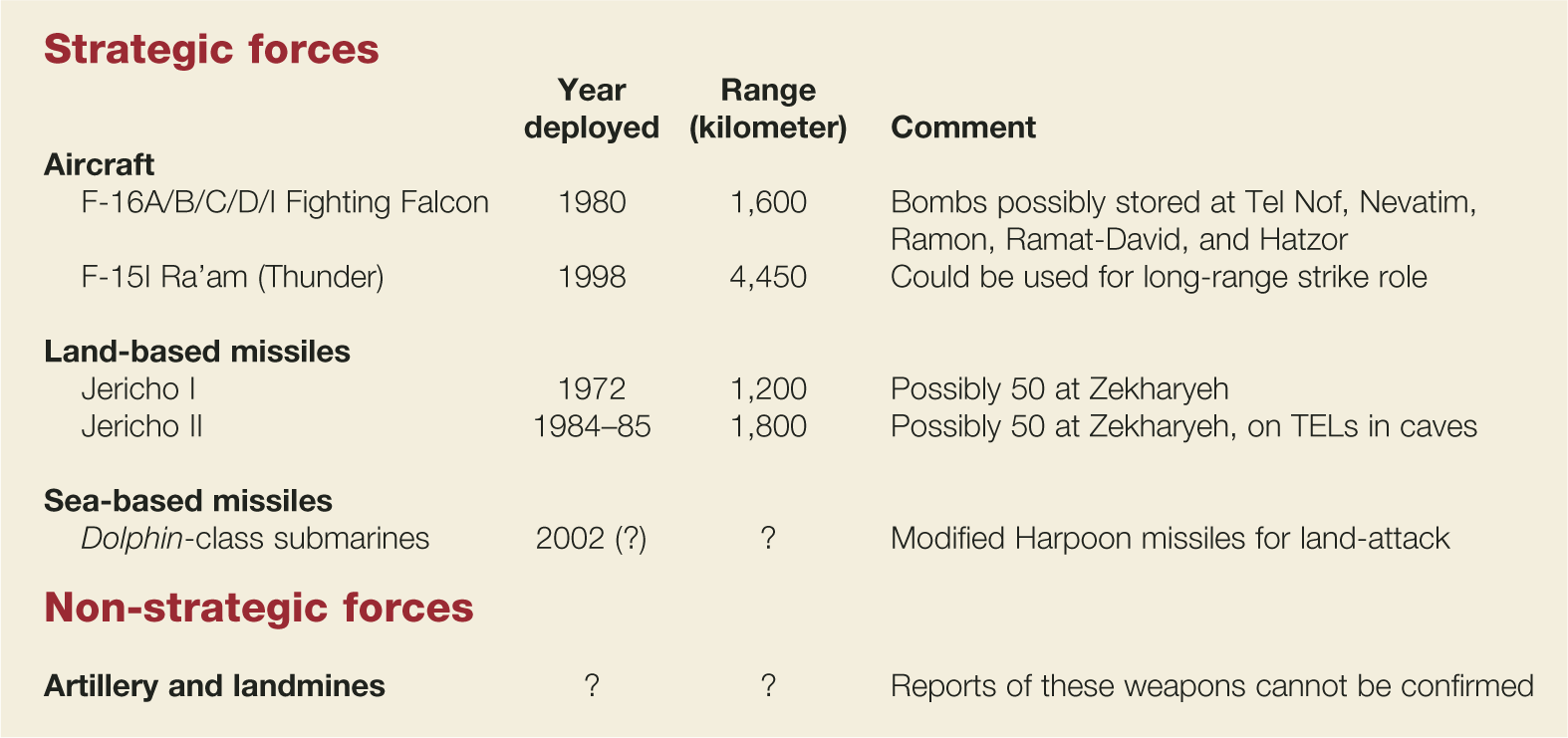
The F-16 has been the backbone of the Israeli Air Force and is the most likely candidate for air delivery of nuclear weapons. From 1980-1995, Israel bought or received 260 F-16s from the United States: 103 F-16As, 22 F-16Bs, 81 F-16Cs, and 54 F-16Ds. In 1999, the Israeli government announced it would buy 50 F-16Is, at a cost of about $2.5 billion. Israel will receive the aircraft over a two-year period beginning in early 2003. Under this contract, Israel has the option to purchase 60 additional aircraft. If it does, delivery would continue through 2008.
Of the F-16s, probably only a small fraction are nuclear certified with specially trained crews, unique procedures, and modifications that enable them to carry nuclear weapons. Nuclear weapons may be deployed with assigned squadrons at one or more air bases. Or the weapons may be kept at dispersal bases, such as Tel Nof, where certified planes could be loaded. It is especially difficult to determine which squadrons are assigned nuclear missions and which bases support them. Likely F-16 squadrons are: the 111th, 115th, and 116th at Nevatim (southeast of Beershe-ba), and the 140th and 253rd at Ramon in the Negev. Other possible squadrons are the 109th, 110th, and 117th at Ramat-David in northern Israel, and the 101st, 105th, and 144th at Hatzor.
Using conventional weapons, eight aircraft from the 110th and 117th squadrons (escorted by six F-15s) destroyed Iraq's Osirak nuclear reactor outside Baghdad on June 7, 1981, in what was called “Operation Opera.”
In January 1994, Israel selected the Boeing F-15E Strike Eagle for its long-range strike and air-superiority roles. It is called the F-15I Ra'am (Thunder) in Israel. Initially, 21 planes were ordered, with a pricetag of just over $2 billion. In 1995, Israel bought four more. On January 19, 1998, the first two Ra'am planes landed in Hatzerim Airbase, flown by Boeing pilots. The plane has greater takeoff weight (36,750 kilograms) and range (4,450 kilometers) than other F-15 models. Its maximum speed at high altitude is Mach 2.5. The plane has been modified to use special radar with terrain-mapping capability and other navigation and guidance systems. The Ra'am can carry 4.5 tons of fuel in its internal, confor-mal, and detachable tanks, as well as 11 tons of munitions. The last of 25 F-15s were delivered to the Israeli Air Force before May 1999. The F-15Is are assigned to Squadron 69 (Hammers Squadron) at Hatzerim. In the U.S. Air Force, the F-15E Strike Eagle has a nuclear role. Whether the Israeli Air Force has provided nuclear capability to this high-performance plane is unknown.
Subsequently, Israel developed the Jericho II, which has some similarities to the U.S. Pershing II. In May 1987 Israel tested an improved version of the Jericho II that flew 800 kilometers. A second test was conducted in September 1988, and a third Jericho II tested in September 1989 reportedly flew 1,300 kilometers. In 1989, the U.S. Arms Control and Disarmament Agency gave the maximum range of the improved Jericho II as 1,450 kilometers—long enough to reach the southern border of the Soviet Union. Israel vigorously pursued technologies for the missile in the United States and elsewhere, including a terminal guidance system using radar imaging. It is thought that the range has been increased to 1,800 kilometers.
July 27, 1999: the Dolphin arriving at the dock in Haifa.

According to a 1997 Jane's article, there are about 50 Jericho II missiles at the Zekharyeh missile base, some 45 kilometers southeast of Tel Aviv in the Judean Hills. According to an analysis of satellite images, the missiles appear to be stored in caves. Upon warning, they would probably be dispersed on their transporter-erector launchers (TELs) so as not to be destroyed. The shorter-range Jericho I is deployed nearby in approximately equal numbers.
In 1988, Israel began launching several Ofek satellites into orbit atop Shavit (Comet) three-stage rockets, which are derived from the Jericho II missile. The first satellite weighed about 180 kilograms; the most recent, the Ofek 5, about 300 kilograms. The satellites monitor activities in hostile states and provide intelligence. The Shavit could be converted into a long-range ballistic missile, with a range of up to 7,000 kilometers, depending on the weight of the warhead.
Missiles are test launched from the Palmikhim Airbase north of Tel Aviv. In April 2000, Israel test-launched a Jericho missile into the Mediterranean Sea, without informing the United States in advance. The missile impacted near a U.S. warship, which reportedly thought it was under attack.
In June 2002, former Pentagon and State Department officials told the Washington Post that Israel was arming three diesel-powered submarines with cruise missiles capable of carrying nuclear warheads.
Israel contracted with German companies Thyssen Nordseewerke in Emden and Howaldtswerke-Deutsche Werft in Kiel to build the submarines for the Israeli Defense Forces/Navy (IDF/N). Designated the Dolphin-class, they are 57.3 meters long, displace 1,900 tons, can reach a speed of 20 knots, and have a crew of 35 men each. The first submarine, the Dolphin, arrived in Haifa on July 27, 1999. The Leviathan joined the fleet before the end of 1999, and the third boat, the Tekumah, was delivered in July 2000. The cost of each submarine is estimated at $300 million. Each submarine has 10 21-inch tubes capable of launching torpedoes, mines, or cruise missiles.
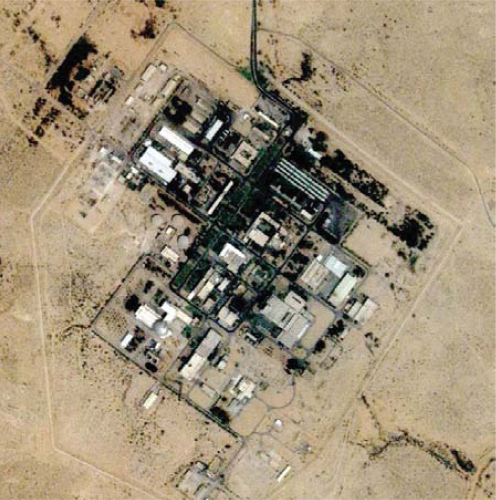
A 2-meter resolution satellite image of the Dimona facility, taken July 4, 2000.
A senior Israeli defense official confirmed that Dolphin-class subs carry modified U.S. Harpoon anti-ship missiles. Making them nuclear-capable would require an Israeli-developed nuclear warhead and guidance kit for land-attack targets. It is unknown whether the missiles have that modification. In March 2000, the United States rejected Israel's request for 12 long-range BGM-109 Tomahawk cruise missiles. The Tomahawk sea-launched cruise missile exists in a nuclear-tipped version for delivery by U.S. attack subs.