



Abstract

Where will future nuclear personnel–physicists and engineers–come from? That question is being asked not only in the United States, but also in Europe and Russia.
The number of nuclear engineering schools in the United States continues to decline, and in May 2000, a report by an Energy Department panel, the Nuclear Energy Research Advisory Committee, warned that unless special efforts were made, the quality of personnel at U.S. nuclear weapons labs could deteriorate. A 1999 study by an arm of Europe's Organization for Economic Cooperation and Development (OECD) also reported an alarming downward trend in nuclear manpower in 16 countries, but left Russia out of the overall picture.
Any assessment of global nuclear manpower, however, must include the state of Russian nuclear training and employment. Given its nuclear record–of both great achievements and failures–Russia is a critical part of the story.
The rapid advancements made in nuclear physics during the Soviet era show just how successfully an authoritarian regime can channel its limited resources, both human and material, into meeting its most desired national goals.
The Soviet nuclear sector emerged in response to the American nuclear weapons program. But the Soviet Union considered its nuclear program to be no less vital than the Manhattan Project seemed to the United States. The regime believed that the program's success or failure was likely to determine its superpower status, and perhaps its very survival.
At first, civilian nuclear applications were considered no more than a spin-off of an essential defense program. Later, however, nuclear energy became a major source of power generation. Some older-generation physicists in Russia feel nostalgic about Soviet government-sponsored programs like the nuclear weapons effort and the subsequent race to outer space because they spurred a massive injection of human and material resources into Soviet science education that made it highly competitive.
Soviet science education programs were the direct products of the desire to outperform the United States, the state's most important ideological rival.
But Soviet propaganda also played a part. For instance, in the 1960s a popular movie, The Nine Days of One Year, presented the story of a physicist obsessed with developing an extremely powerful new source of energy. The hero, portrayed by a popular actor, considered discoveries in nuclear energy more important than friendship, love, teamwork–even his own life–because they were of the highest value to his country and to the world. Influenced by this film, thousands of young people (including one of the authors), rushed to apply to nuclear physics and engineering departments.
When it came to education in nuclear physics and engineering, elitist principles prevailed over the regime's otherwise egalitarian dogma. A massive search and careful selection of candidates, an exceptionally qualified teaching staff, and other trappings of elitist training were quietly promoted by a group of prominent Russian scholars as early as the 1930s.
Their model was higher education as practiced in Western countries–particularly in France, Britain, and the United States. But it was not until after World War II that Soviet leaders, faced with the threat of U.S. atomic weapons, gave the green light to putting these elite ideas into practice.
Five days after Winston Churchill's famous “Iron Curtain” address in Fulton, Missouri, Stalin signed a decree, “On the Establishment of the U.S.S.R. Higher Physics and Technology School.” The school, at first a department of Moscow State University, became an independent institution, known as the Moscow Physics and Technology Institute, or “MPHTI,” in 1951. It has produced dozens of world-renowned scientists and had eight Nobel laureates on its faculty.
Launching the institute was an uphill battle, even for Stalin. The Soviet educational bureaucracy regarded the elitist concept as incompatible with previously enforced guidelines, and did everything it could to block its development. Stalin signed another decree in fall 1946, once again instructing the Ministry of Higher Education to move ahead. This time he prevailed.
A network of institutions specializing in nuclear physics eventually grew to include: the Moscow Engineering and Physics Institute, or “MEPHI,” the Bauman Institute, the Obninsk Institute of Nuclear Energy, and physics departments at Tomsk, Urals, Nizhnii Novgorod, and several other universities.
The growth of the elite schools occurred at the same time that lower-quality institutions were also proliferating. The rationale behind the establishment of these other schools was to produce as many graduates for a wide range of industrial and farming jobs as possible, regardless of whether they could be productively placed. The mass production of university graduates was in reaction to the scarcity of researchers and engineers that occurred as a result of the exodus of intellectuals after the revolution in 1917 and the persecution of those who chose to stay.
It was also ideological. In the 1960s, Nikita Khrushchev declared that by 1980 the Soviet Union would complete its “building socialism” phase and enter into the next period–a communist society characterized by unprecedented material and intellectual prosperity. This next stage required most if not all citizens to be university educated, whether or not their work required them to have a degree.
As a result, the country produced a surplus of diploma holders, many of whose professional skills and experience left much to be desired. But in a kind of vicious circle the government continued to create often economically unjustified jobs for their placement to demonstrate its adherence to the ideology of full employment under socialism.
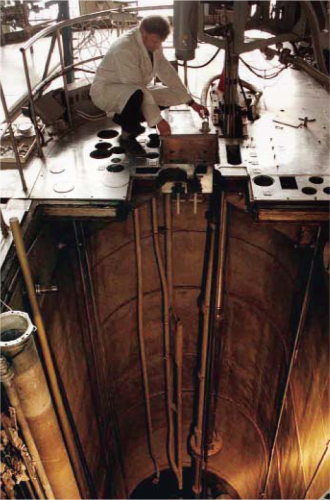
A Russian scientist at MEPHI, where many nuclear engineers are trained.
The Soviet breakup produced a systemic crisis in Russian education and science. In the 1990s, uncoordinated, on-and-off experiments in economic reforms and privatization left Russia's system of higher education in limbo.
Science-related jobs that were once regarded as prestigious were also devalued. Today, in terms of prestige, the lowest-rated occupations are in science, the military, and engineering. In an August 2001 public opinion poll by the Moscow-based Public Opinion Foundation, 53 percent of respondents agreed that the social standing of scientists had fallen; only 35 percent continued to describe scientists in positive terms.
Federal funding of education has dropped by 60 percent in the last decade. By early 2000, Russian educational institutions owed a total of $1.5 billion for back wages and unpaid utility bills–a huge sum by Russian standards.
The impact of a decade of neglect will be felt for some time. Although President Vladimir Putin declared in a much-publicized December 24, 2001 interview that he is committed to improving standards in science and education, he had to admit that his projected 40-50 percent increase in funding will be spent on back salaries and other debts, leaving nothing for urgently needed lab equipment and modernization. According to OECD sources, Russia's investment per researcher is only a tenth of U.S. outlays.
About 75 percent of R&D programs were defense-oriented in the Soviet era, but they allowed researchers exceptionally wide latitude. As generous investments in military R&D dried up, few civilian jobs offered the same opportunities. Many talented scientists simply left the field.
A number of factors contribute to the current malaise in Russian science education. There is a lack of clear objectives. Researchers are unable to develop long-term research programs because funding is inadequate and unpredictable. As a result of a widening schism between academic and managerial elites, many labs and institutes are poorly managed. There is limited access to foreign publications, both electronic and print. Equipment is outdated and poorly maintained. Salaries are unac-ceptably low. As mid-level scientists left for non-science jobs or emigrated, and many bright young people failed to embrace scientific careers, research teams grew old.
Despite its past glory and traditions, the nuclear sector has had its share of problems. Since 1992, most of Russia's nuclear programs have been directed by Minatom, the Ministry of Atomic Energy. Already haunted by the 1986 Chernobyl disaster, the nuclear sector's image is even more tarnished today. The ministry is continuously attacked by environmentalists, and the media frequently report on widespread radioactive contamination.
The nuclear sector was ill-equipped to respond to free-market pressures. While its weapons activities plummeted after the breakup, its civilian component continued to operate as it had in the Soviet era. Weakened by a decade of soul-searching and struggling to move away from the command economy model, Minatom began to restructure only at the end of 2001, finally consolidating its power generation and nuclear fuel-cycle facilities.
Even so, the nuclear sector operated more efficiently than some other sectors. Russia's status is still that of a nuclear power, and the nuclear sector remains a symbol of technological prowess. And as a generator of revenue, it trails only sales of oil and gas and conventional weapons.
November 21, 2000: Vladimir Putin speaks at Moscow's Bauman Technical University.

It is not easy to estimate the average salary in the nuclear sector, nor to measure how attractive the field might seem to prospective nuclear physics students. Salaries are much higher in Moscow and St. Petersburg than in other regions, and they are highest at power plants, sometimes reaching more than $200 a month. (The average monthly salary in Russia is about $50.) Defense sector salaries are only now beginning to rise.
A considerable chunk of the nuclear facilities' budgets comes from “extra-budgetary sources.” Nuclear workers' incomes depend, among other things, on the facilities' participation in international agreements, contracts, and assistance programs. For instance, research institutes and production plants involved in the implementation of the $500 million-a-year “Megatons to Megawatts” program–in which highly enriched uranium from Russia is blended down and sold as low-enriched uranium for power reactor fuel–can afford to pay handsome bonuses and recruit young people.
Rosenergoatom, the firm that operates Russia's nuclear power plants (including the one above), also employs most of the country's nuclear-sector graduates.

The TVEL Corporation, which manufactures fresh nuclear fuel and exports fuel assemblies to several countries, also belongs in the privileged category. Most facilities, however, are not in such good shape.
If and when the international agreement on plutonium disposition materializes, a half dozen nuclear entities will benefit. The original terms of the agreement called for Russia to contribute weapons-grade plutonium, manpower, and infrastructure, in exchange for receiving some $1.5 to $2 billion from the international community.
The most serious problem for prosperous facilities may be a rapidly aging workforce. The average age of Minatom's top managers is nearly 60 (in a country in which male life expectancy has fallen to 56 years). Another problem, identified by Ev-genii Velikhov, president of the Kur-chatov Center, is the dramatic shortfall in junior researchers (mladshie nauchnye sotrudniki), who were traditionally the workhorses of academic and research institutes. With a basic salary below $30 a month, junior researchers can barely survive.
There is a growing gap in experience and skills between senior faculty and their younger colleagues, many of whom choose to teach because no other jobs are available. The recent performance of the prestigious Moscow Physics and Technology and Moscow Engineering and Physics Institutes is no longer as stellar, although they are still seen as highly competitive institutions. In a poll of Russian students conducted in November 2001, these institutes were ranked numbers one and two in a list of 180 universities. In May 2001, the Russian-language Career magazine–which may take a more realistic view than the students–rated the technology school fourth and the engineering school twentieth in a ranking of 100 institutions of higher learning.
One reason these schools remain popular is their diversification. They have expanded their curricula to include the training of nuclear energy managers, nuclear economists, nuclear law experts, and so on. Over the past 10 years, the Moscow Engineering and Physics Institute doubled the number of its yearly graduates from 900 to almost 1,800 today. At the same time, the annual enrollment in the Department of Technical Physics–the institution's raison d'être–dropped from 50 to 25 students. There are a number of openings for physics majors at nuclear facilities, but the starting salaries are too low to attract job-seekers.
The engineering institute, which opened an international relations department in 2000, plans to continue to emphasize the training of nuclear generalists. Its newer programs are attracting students who pay their own way. The school's inroads into the humanities and legal professions–previously off limits to the elite nuclear institutions–can be interpreted as either a desperate strategy of survival or an intelligent response to new challenges.
Another illustration of the diversity in demand is where graduates end up. Many graduates are forming the core of the new Russian corporate elite. About 50 are employed by a major Russian bank, Prodinvest-bank. Eight Moscow Physics and Technology graduates work for No-rilskii Nikel, a nickel-producing conglomerate where the average salary is about $600 a month. The president of the Rosremontstroi Corporation (a leading construction company) says he prefers graduates from the Moscow technology institute because they are pragmatic, well educated, and respond to professional challenges without political bias.
The situation in the nuclear cities is looking more stable. Remaining closed, they have been insulated from both the luxuries of the free market economy and the most painful impacts of the economic failures of the 1990s. And finally, in 2001, salaries began to rise. For instance, the average salary in Sarov (Arzamas-16) rose by 54 percent over the previous year, reaching $135 a month. The officially registered unemployment level dropped to 0.8 percent (the national unemployment rate is estimated at 10 percent).
At the same time, the nuclear weapons complex is slated to be drastically downsized. In the 1990s, Russia slashed its nuclear arms production by more than 90 percent. Under the current plan, employment will fall from 75,000 to 35,000 by 2005, the number of major design and production facilities from four to two. The nuclear-oriented technical colleges located in seven of the closed cities could be valuable assets in smoothing the way for defense conversion.
These seven technical colleges closely coordinate their training programs with local nuclear institutes and facilities and are quick to adjust to their needs. Ninety percent of the colleges' graduates stay on and are employed locally. Most students from the closed cities who graduate from outside nuclear physics institutes end up in a variety of lucrative non-science jobs and never return. Under laws passed in 1997, all seven colleges were considered branches of the engineering institute in Moscow. But in a recently completed restructuring, four became independent. The branch colleges may still award the institute's prestigious diploma, but the independent colleges enjoy greater academic and administrative latitude.
Estimates vary as to how many Russian scientists and technicians have left the country. According to some sources, about 1.4 million Russians with university degrees, about 15 percent of them with Ph.D.s in science or the humanities, have emigrated since the early 1990s. Talented mathematicians and physicists are a desirable commodity on the world job market. Some non-governmental experts estimate that Russia lost 80 percent of its world-renowned mathematicians, 50 percent of its most prominent physicists.
There is no comprehensive or reliable source of information on this decade-long exodus, nor is there accurate data about temporary or permanent emigrants by background, profession, or education. Even the Academy of Science has only a vague idea of the whereabouts of some of its members, given their travel between other countries' capitals and Moscow. Some scientists and young graduates left on short-term contracts, but ended up staying permanently. Others left for one country, but moved to another.
The most popular destinations for Russian university graduates were the United States, Germany, Canada, Israel, Britain and Ireland, Austria, and Australia. And the universities whose diplomas provided the best passport to the West were the two Moscow institutes discussed above, Moscow State University (physics, mathematics, and computer science), the Bauman Technical University, and the Moscow Aviation Institute. The rector at the Moscow Physics and Technology Institute reports that in the mid-1990s more than 15 percent of the school's graduates emigrated. Now emigration has dropped to 5-7 percent.
In 1999, the Moscow-based Center for Migration and Interregional Studies asked students the main reasons for their departure. Seventy percent cited unacceptably low salaries and standards of living; 40 percent complained about political and economic instability. Only 19 percent alluded to work-related problems like outdated equipment and inadequate intellectual property protection. A more recent survey conducted by graduates of the Physics Department of Moscow State University asked Russian immigrants in Canada why they chose to settle there. “A higher standard of living” was the most frequently given reason. Other reasons included “a better future” for their children, “a more dignified way of life,” “a social net for the poor,” “a reliable banking system,” and “less crime and corruption.”
It is impossible to prove or refute the numerous claims that Russian scientists may be working for nuclear weapons programs in problem countries. Victor Mikhailov, the former head of Minatom, and now the science director at the nuclear weapons center in Sarov, admits that as many as 20 percent of the country's nuclear experts have left its nuclear sector. He insists, however, that none with access to nuclear weapons information or experience has permanently relocated abroad.
Khidhir Hamza, the author of Saddam's Bombmaker, who defected to the West in 1994, calls the availability of foreign, and particularly Russian, brainpower “the X Factor in Iraq's nuclear equation.” He writes that during his 1990 visit to the crumbling Soviet Union “scores of Russian nuclear scientists virtually begged for jobs in Iraq.” By 1994, he says, “some Russian scientists were at work on chemical weapons and others were expected to join them in other programs.”
One of the authors interviewed a nuclear physicist who was employed in the early 1990s by the Moscow-based Physics Institute of the Academy of Science. The bulletin board, he said, was filled with job offers from “foreign companies.” He responded to one ad inviting isotope separation scientists to Saudi Arabia, but discovered the program was based in Iraq. He added that he believed North Korea was successfully recruiting physicists to work in their program, using Russian intermediaries to recommend the best-suited candidates.
The United States has responded to the threat of the uncontrolled migration of Russian defense scientists with several assistance programs and initiatives that create jobs in the closed cities, fund non-defense research projects, and engage Minatom in cooperative arrangements. In a speech at the Citadel on December 11, 2001, President George W. Bush reaffirmed his intention to work closely with Russia in expanding efforts to provide peaceful employment for scientists who formerly worked in Soviet weapons facilities.
Minatom's current head, Alexander Rumyantsev, laments that nuclear physics education has lost its edge. But things may change. In December 2001, President Putin declared that in terms of national interests, higher standards in science and education were even more important than the revenue generated by the oil and gas industry. Higher standards are, he said, what “makes Russia different from what was quite recently known as developing countries.”
Of the key industrial sectors, the nuclear complex has the most pressing professional needs. Minatom plans a wide array of ambitious programs, and its needs can only be met if the number of graduates increases and it attracts the best graduates to work in the nuclear sector. Without a dramatic turnaround, Minatom's efforts will stall, if not fail. Ministry officials report that its demand for nuclear physicists is already increasing.
Russia turns out more than 2,000 graduates for the nuclear sector each year, the bulk of whom are employed by Rosenergoatom (the company that operates nuclear power plants). Nuclear research institutes absorb an average of 70 young specialists a year. The Siberian Chemical Com-bine–a major nuclear fuel cycle facility where isotope separation, processing, and enrichment occur–needs to fill about 40 vacancies a year.
At the same time, while the nuclear weapons complex may be shrinking, it is not withering away. The weapons component of Minatom's budget is expected to be some $450 million in fiscal 2002. In 2000 alone, the nuclear weapons centers in Sarov and Snezhinsk hired 230 and 124 young specialists, respectively.
The government expects unprecedented growth in nuclear power generation. By 2030, nuclear is expected to generate 40 percent of electrical power nationwide–45 percent in European Russia. Minatom is planning to build a number of underground plants at urban centers in Russia's North as well as small, floating nuclear heat and power facilities that will use modified reactors from nuclear-powered submarines and icebreakers.
Last summer the legislature approved Minatom's plan to import and dispose of spent nuclear fuel from foreign nuclear power plants. If this project goes forward, there will be an increased need for highly qualified specialists to comply with international standards.
Other missions that will require more nuclear graduates include the disposal of radioactive waste from decommissioned nuclear-powered submarines, the continued decontamination of vast territories affected by past nuclear accidents, and the decommissioning or life extension of older nuclear power plants.
Minatom's international agenda will also require a new generation of experts. It is currently competing for, negotiating, or finalizing nuclear projects with Iran, India, China, Finland, Ukraine, Kazakhstan, Egypt, Vietnam, and other countries.
But to successfully recruit the numbers it needs, Minatom must improve its image. So far, virtually every component of its new strategy has encountered resistance from Russia's fledgling environmental movement. To its credit, the ministry has invested time and money in a public relations campaign designed to project an environment-friendly image. And Minatom's Web site, established more than a year ago, is better structured and more sophisticated than most Russian government agency Web sites. Its leaders also make themselves more accessible to the media.
The government will continue to identify future economic and other priorities that will require additional university-certified specialists, but the schools will switch from government-imposed quotas to a flexible, free-market demand formula.
Alexander Rumyantsev, head of Minatom.

In August 2001, the government rated physics the highest priority in science and technology. There is still a heated policy debate about the optimal ratio of free to “paid for” higher education, but the government intends to provide sizable scholarships to attract students to high-priority programs. Design institutes and production facilities are being encouraged to develop closer relations with individual institutions as a way to help meet their personnel needs as well as to work on mutually beneficial projects.
Faculty salaries and stipends are expected to increase substantially in the near future. Two types of stipends will be available–one for socially disadvantaged students and the other for top students. Institutions will be integrated into “university complexes” and encouraged to maintain competitive design and production facilities to attract both government and private contracts.
Minatom has been actively experimenting on ways to attract more high-quality graduates to the nuclear sector. Working with the Ministry of Higher Education, it has founded some 200 research projects at nuclear physics institutions. It also offers an additional $10 monthly stipend to the best Moscow Engineering and Physics students (comparable to what is paid at other institutions), but recipients are not required to commit to working in the nuclear sector after graduation.
Minatom has developed a 24-point program of incentives that includes credits and mortgages for housing and deferment or exemption from military service, and it has allocated $550,000 a year to making the salaries of young specialists more competitive. The most prosperous facilities provide even more generous rewards–for instance, the Dimitrovgrad Institute for Atomic Reactors offers new recruits free or nearly free apartments.
To counter retention problems, Minatom is opening up new career opportunities for younger people and more quickly promoting them to leadership positions. It provides support to the young physicists' section of Russia's Nuclear Society and encourages participation in international conferences. Another program brings younger personnel from Russian nuclear power plants together with colleagues at other sites to discuss mutual concerns.
Under a 1997 presidential decree, “On Training Future Leaders for the National Economy,” Minatom sends the brightest employees and managers to year-long training courses in a variety of non-technical subjects including management and business skills, personnel management, and safety and security. Two graduates of this program have already become deputy directors of their facilities.
The United States needs to consider whether and to what extent it should help. It is vital to U.S. security to prevent Russian physicists, either recent graduates or experienced weapons developers, from assisting problem countries in designing and manufacturing nuclear weapons. The United States has been unambiguous in its commitment to cooperate with Russia in a series of dedicated assistance programs, including the International Science and Technology Center. Even so, more could be done.
The United States has also expressed concern about the security of fissile materials in Russia. It has invested significant resources in providing hardware to improve security at Russian sites, but little to cultivate a culture of security. Reducing nuclear dangers in Russia requires not only technological innovation, but also the development of knowledgeable and motivated personnel.
Unlike the older members of the nuclear sector whose behavior was molded not only by idealism but also by the harsh realities of the Soviet period, younger specialists may be more susceptible to corruption and more easily tempted to solve their financial problems at any cost. Nearly all documented cases of nuclear smuggling attempts have involved employees of nuclear facilities. Without key personnel dedicated to non-proliferation procedures and norms, even the most advanced technology will do little to reduce the danger of proliferation.
Given the scope of Russia's long-term plans to expand nuclear power generation, increased safety training is needed. The world cannot afford a second Chernobyl disaster. Surely, the United States has a stake in modernizing and improving the training of Russian experts, if only because any nuclear mishap in Russia would be a serious setback for U.S. domestic nuclear programs and prospects as well.
At the same time, the United States may object to foreign students studying nuclear physics and engineering at Russian institutions if they are likely to contribute to nuclear weapons programs in problem countries. There is no reason to believe, however, that the United States and Russia cannot strike an agreement on this issue, especially in the new spirit of post-September 11 cooperation.
In addition, the U.S. tradition of immigration has always been an important source of American scientific and technological prowess. Many German, British, and other European-educated physicists have immigrated to the United States and made a significant contribution. With a predicted nuclear renaissance in the United States just around the corner, young Russian nuclear scientists and engineers might help alleviate expected shortages in the U.S. workforce just as Russian software developers and computer engineers did in the 1990s.