



Abstract
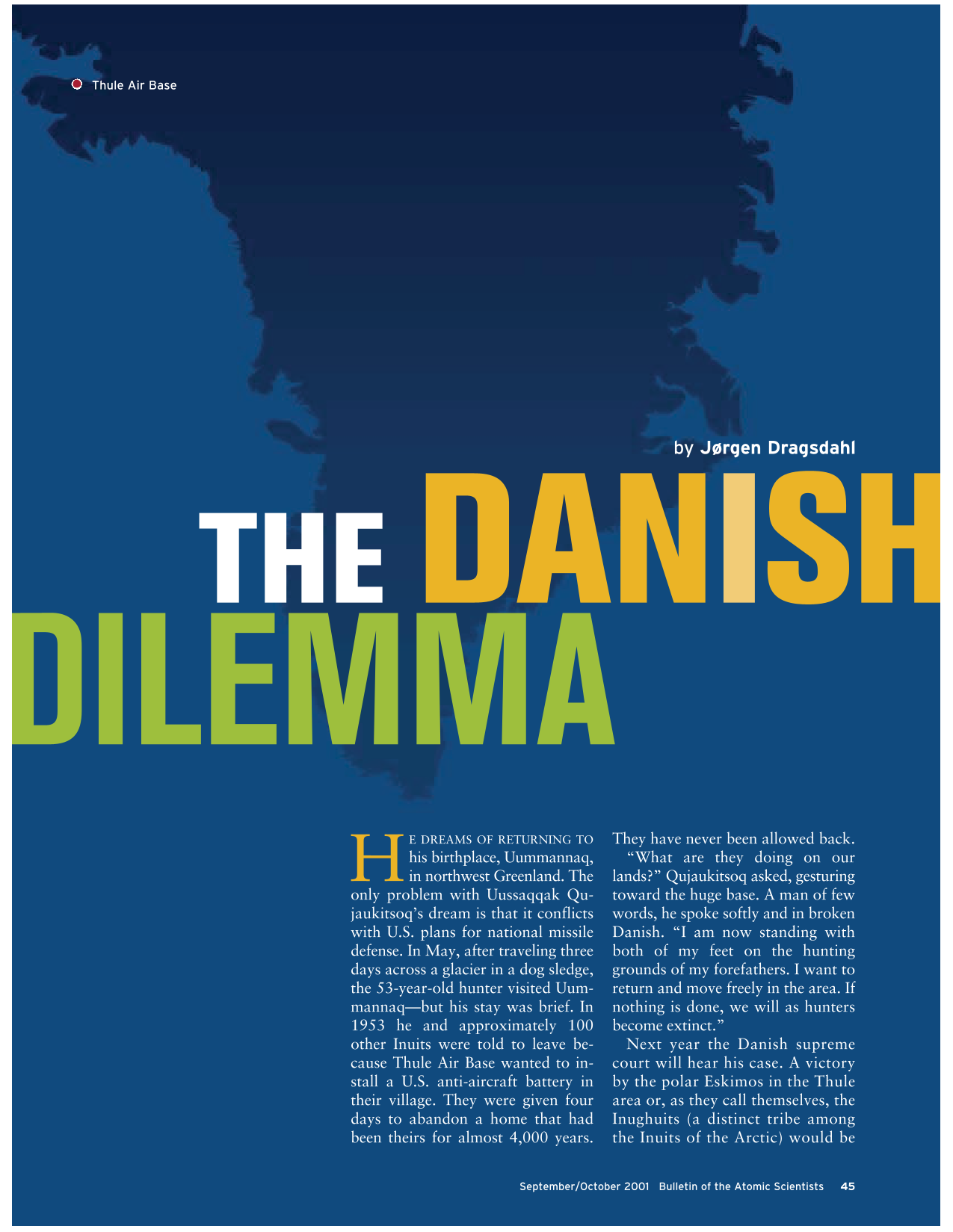
He dreams of returning to his birthplace, Uummannaq, in northwest Greenland. The only problem with Uussaqqak Qujaukitsoq's dream is that it conflicts with U.S. plans for national missile defense. In May, after traveling three days across a glacier in a dog sledge, the 53-year-old hunter visited Uummannaq—but his stay was brief. In 1953 he and approximately 100 other Inuits were told to leave because Thule Air Base wanted to install a U.S. anti-aircraft battery in their village. They were given four days to abandon a home that had been theirs for almost 4,000 years. They have never been allowed back.
“What are they doing on our lands?” Qujaukitsoq asked, gesturing toward the huge base. A man of few words, he spoke softly and in broken Danish. “I am now standing with both of my feet on the hunting grounds of my forefathers. I want to return and move freely in the area. If nothing is done, we will as hunters become extinct.”
Next year the Danish supreme court will hear his case. A victory by the polar Eskimos in the Thule area or, as they call themselves, the Inughuits (a distinct tribe among the Inuits of the Arctic) would be “irreconcilable” with the continued presence of the U.S. air base, his attorney, Christian Harlang, acknowledges.
Thule Air Base is located north of the Arctic Circle in Greenland.

But according to current plans for a national missile defense, Thule is slated to host an X-band radar to help detect and target warheads taking a polar route toward the United States. The existing radar at the base, once upgraded, will track missiles until the new facility is built.
During a visit to Denmark in April, Deputy Assistant Secretary of State for Strategic Affairs Lucas Fischer called Thule a “unique asset” because “it is a good radar, and it lies where it lies.” While the Bush administration has not decided on a plan for Thule, Fischer added that “most experts probably agree with me” that ground-based radars like Thule's are of critical importance to a U.S. missile defense system.
Shifting attitudes
U.S. and Danish officials are concerned, but the Inughuit lawsuit isn't their only headache. During the 1990s, Denmark was what Danish scholar Peter Viggo Jakobsen has called “a loyal ally, uncritically following the American lead.” But this pattern has been shattered by U.S. missile defense plans. Even a spokesman for the conservative opposition party, Per Stig Moeller, said during a May 3 parliamentary debate that he could imagine opposition from both Denmark and Greenland. A couple of weeks later a poll showed that a majority of Danes, 52.7 percent, objected to Thule being part of a U.S.-based “missile shield.” Only 19.9 percent expressed support.
Like many U.S. allies in Europe, Denmark has officially taken a wait-and-see attitude. The government argues that taking a stand would be premature because Bush administration plans are not yet clear, the international security framework not known, and a “precise” official request about Thule has not been received. But this could just be a cover. Minister of Foreign Affairs Mogens Lykketoft has on numerous occasions voiced Danish concerns and made de facto demands on the Bush administration.
In a May 3 speech to parliament, Lykketoft said a U.S. missile defense system could generate anything “between an incalculable arms race and the most extensive disarmament seen so far.” If a new arms race is to be avoided, he said, “the main perspective” in a missile defense effort must be nonproliferation agreements and deep “agreed” cuts in strategic nuclear weapons. He also called for “an active and focused dialogue” with would-be nuclear weapon states.
Unlike other European officials, Lykketoft did not focus on the possibility of adverse Russian reactions. He believed a U.S.-Russia accommodation is a realistic possibility because the planned missile defense system will not neutralize the Russian deterrent. But with China the case is different, he said, and for the sake of peace and stability it is “far, far more important that the United States and China do not collide.” Lykketoft noted that in the coming decades the world is likely to have two superpowers again, and one of them will be China. An “orderly and positive dialogue” between the United States and China, he concluded, is “absolutely decisive” for Denmark's position on missile defense.
Back in Greenland
The Thule case illustrates the strength of Danish concerns. Even if the Danish supreme court rules against Qujaukitsoq, he will have represented his people's political and moral case. And if Denmark rules against the Inughuit but fails to present a persuasive argument, the “Old Kingdom” could lose the last of its North Atlantic empire along with a good deal of its already tattered self-respect.
Qujaukitsoq was in Uummannaq in May to commemorate the fiftieth anniversary of a Danish-American treaty that led to U.S. occupation of hunting grounds considered the most important for his tribe—its “larder,” as a Danish official called it at the time. As sad as the occasion was, it was also an opportunity to engage in a two-track strategy, political and legal, to try to get the area back. In addition to a few hunters and journalists, Qujaukitsoq was accompanied by Hans Pavia Rosing, a member of the Danish Parliament elected from Greenland, and Aqqaluk Lynge, president of the Inuit Circumpolar Conference, an organization uniting the aboriginal populations of Greenland, Northern Canada, Alaska, and Russia. Attorney Harlang was also there.
The 1951 agreement “concerning the defense of Greenland” gave the United States extensive powers. It established “defense areas” that the United States was entitled “to improve and generally to fit … for military use.” No substantial restrictions were included. In an important 1997 study commissioned by the Danish government, years of U.S. pressure to gain these rights were described as “a classic clash between a great power and a small state.” Denmark had legal arguments on its side but lacked the political and military power to prevail. The United States wanted Thule as a staging base for nuclear bombers because of the region's proximity to the Soviet Union. Denmark tried to hide this purpose by talking about the common defense of Greenland.
But local observers knew better. On July 9, 1951, a U.S. armada of 120 ships, with about 12,000 men, arrived at Thule in what some called the largest operation since the invasion of Normandy.
The stone age meets the nuclear age
The Inughuits, or the “Great Humans” as they call themselves, arrived in northwest Greenland around 2,000 B.C. The rest of Greenland was populated in another wave of immigration, and to this day significant language differences exist. The Inughuits lived in isolation until the polar expeditions of the early 1800s. Robert Peary led several expeditions between 1891 and 1909, claiming to have reached the North Pole. In 1909 the Danish explorer Knud Ras-mussen established a missionary station and a trading post at what he called Thule, which in Greek and Celtic mythology describes the most distant northern lands.
For Rasmussen, however, protecting the ancient Inughuit culture was a matter of honor. That obligation, at least in theory, was later taken over by Danish colonial administrators, and as late as 1950 French scientist Jean Malaurie found the Inughuit culture largely intact. He wrote about his 14-month stay in the region in a 1985 book, The Last Kings of Thule, in which he admired the Inughuit's ability to survive in such an adverse climate.
Malaurie also witnessed the U.S. invasion. At first the inhabitants of Uummannaq were excited, enjoying tin cans of food, chewing gum, and seeing strange sights. He reported that some of the Inughuits expressed confidence that the Danish king would protect them. But within days other tribe members began to fear that the encroaching world of metal and noise would change them. “What will become of us?” they asked. Malaurie lamented that “harpoon man is condemned to extinction.”
An Eskimo family living in the Thule region, circa 1950.

Disaster struck two years later. After their eviction from Uummannaq, most inhabitants traveled 150 kilometers north to an old settlement, Qaanaaq. The Thule base hurt hunting, and conditions at Qaanaaq soon were problematic as well. Complaints by hunters started soon after relocation. A quest for compensation began, but it did not get very far. In 1996 Qujaukitsoq created the organization Hingitaq 53 to bring suit against Denmark on behalf of the Inughuit, with 610 individual co-sponsors.
During a subsequent hearing of the case at a high Danish court, many of the former Uummannaq inhabitants provided moving testimony. On August 20, 1999, the court found that their removal had been “an unlawful violation done to the population of Uummannaq … [and] contrary to the actual facts”—Danish authorities had claimed the relocation was requested by the population.
The court granted financial compensation for the lost hunting rights, but based on Danish law the court saw “no evidence to prove that Thule Air Base is illegally established.” If the Inughuit were given back their full rights, the Danish government would “be obliged to demand the base to be dismantled,” the court stated, but added that the plaintiffs did not have legal grounds to “succeed in their claim in that respect.”
This latter judgment has been appealed to the supreme court. Har-lang sees the lower court's verdict— which found the aboriginal peoples of the Thule district to be “a population” as defined in an international convention from 1989—as at least a partial victory. Article 16.3 of the convention, which was negotiated through the U.N. International Labor Organization and ratified by Denmark, states: “Whenever possible, these people shall have the right to return to their traditional lands, as soon as the grounds for relocation ceases to exist.”
January 1968: Cleanup operations after a U.S. B-52 crashed near Thule with four hydrogen bombs on board.

Danish legal scholars do not want to comment on the record as long as the case is pending. A verdict in favor of the Inughuit is considered possible if the court relies on the growing global trend to uphold the rights of aboriginal peoples. The Danish state could still preserve Thule Air Base, but it would require a law on expropriation to be passed in the parliament that establishes a “common good” of higher priority than the rights of the natives. This introduces an interesting question into the missile defense debate: If Thule is used to violate the Anti-Ballistic Missile Treaty (abm), can it really be based on “the common good?” Or have the grounds for establishing Thule ceased to exist?
Ancient history and very ancient history
The 1951 defense treaty between the United States and Denmark refers to their common defense through nato and to the defense of Greenland. The way missile defense is enacted could raise questions about whether the treaty's provisions are still valid in the new context being pushed by the Bush administration. Nikolaj Petersen, the leading Danish scholar on Greenland security issues, believes that “a unilateral American missile defense cannot in the same way be said to be part of an alliance project and cannot in the same way be said to be covered by the defense treaty of 1951.” Use of Thule “must be part of a common American-European understanding within NATO on … how the rogue state problem should be handled politically and technologically.”
Since 1979 Greenland has had a home-rule government, but its sovereignty is limited to mostly domestic affairs. Denmark sets foreign policy and sees to defense. The 1951 treaty with the United States is a thorn in the flesh of home rule. Jonathan Motzfeldt, the premier of Greenland, recently said that if the Bush administration can call the abm Treaty “ancient history,” then the Danish-American defense agreement, made in colonial times, must be called a “very ancient treaty.” His coalition government wants the treaty renegotiated, this time with Greenland having “a seat at the table.” Motzfeldt and his party, the social democratic Siumut, have not called for an end to the U.S. military presence, but its more left-wing coalition partner, Inughuit Ataqatigiit, has been a vocal opponent.
A history of secrecy and deception surrounds the Thule base. The court case has documented a pattern of lies and disinformation spread by the Danish government in connection with its establishment, in the relocation of the Uummannaq community, and in the handling of their claims. A secret understanding in 1957, only discovered in 1995, gave the United States a green light to station nuclear weapons at Thule—despite the official government policy that nuclear weapons could not be based on Danish territory. In 1968 a B-52 bomber carrying four 1.1 megaton bombs crashed on the ice near Thule. Claims that pollution has sickened local hunters who participated in the cleanup have stalked the incident ever since.
In 1987 a new scandal broke when the old ballistic missile early-warning radar, in operation since 1960, was replaced with a phased-array radar. Several U.S. negotiators of the ABM Treaty suggested that the new radar might be a violation of the terms of the treaty limiting such radars to U.S. territory. That controversy was handled poorly by Greenland's Motzfeldt. His government fell, and for a period he was replaced as premier and chairman of the Siumut party. Since then Denmark has been increasingly careful to keep the home-rule government fully informed on matters concerning the air base.
Hans Pavia Rosing, Uussaqqak Qujaukitsoq, Aqqaluk Lynge, and Christian Harlang traveled to the Thule region in May—48 years after the Inughuits were forced to leave their homeland.

Courting Greenland
Foreign policy committees in Denmark and Greenland were secretly told about Clinton administration plans for Thule in 1999. That November, after a Danish newspaper revealed this information, Greenland's home-rule government issued a statement saying that if the abm Treaty were to be violated and if the United States proceeded “unilaterally,” then Greenland would not “agree to an upgrade of the Thule radar.” Greenland expected to be directly involved in talks on the matter, the statement said, and an upgrade of the radar “must not in any way impact negatively on the existing world peace.”
During two debates last year, all of Greenland's parties supported the statement. But it is open to interpretation. In one spectacular clash, Josef Motzfeldt, chairman of the Inughuit Ataqatigiit party and a government minister, accused Jonathan Motzfeldt (no relation) of being willing to sell out for “a bag of dollars.”
The premier strongly denied the charge. But top Danish officials privately speculate that he might accept a deal if it involved a higher profile for Greenland security issues as well as greater access for the Inughuit to hunt near the base and financial compensation. Such an arrangement, however, would still have to be sold to the other Motzfeldt, his party, and other skeptics in Greenland's parliament.
Several factors would influence the likelihood of a deal. Greenland has warm feelings for the United States, which fed and protected the island during World War II. The Clinton administration carefully cultivated relationships with Greenland's key decision-makers by sending a high-level delegation to the capítol at Nuuk and by inviting politicians to the United States for missile defense briefings. Many politicians would like the Americans to stay at Thule, and U.S. officials have played on that through leaked threats about the possibility of moving the whole base to Canada. A move would cut off a significant source of tax revenue and would place the burden of keeping an air link open on the Danish government, if it were willing to pay.
Still, a unilateral U.S. decision to deploy missile defense and upgrade the Thule radar in defiance of broad international opposition would preclude a deal with Greenland. Even if the United States and Russia come to an agreement regarding the abm Treaty, Greenland's acceptance cannot be taken for granted. Public opinion matters in Greenland, and although debates in parliament have not reached high levels of sophistication, the country's most pressing concerns have moved beyond the whereabouts of whales and seals. Nuuk has already held its first hearing on missile defense and a second is scheduled for this fall. The Internet has also given residents of Greenland access to news, analysis, and opinion put out by missile defense opponents. As these groups begin to address themselves directly to the people of Greenland—as Greenpeace has promised to do— international concerns will have even more of an impact.
Power to the people
The Inughuits too should not be ignored. Although they number only a few hundred, these rugged people from the far north greatly influence Greenland's popular identity in an almost mythological sense. Only about 5 percent of Greenland's total population still hunts as its main livelihood, but more than half of the Inughuits depend on harvesting seals, walrus, whales, foxes, birds, polar bears, and fish. To a considerable extent these hunters still use harpoons, kayaks, and dog sledges, which the general public admires and respects. Sympathy for letting them return to their Uummannaq hunting grounds has recently been fueled by extensive television coverage of the trip Qujaukitsoq and others made in May.
The Inughuits have lately expressed concern about a possible “seven-missile” attack on nearby Thule Air Base. News stories have suggested Chinese threats against the site, and British concern about their radar facilities at Fylingsdales being targeted has raised alarm in Greenland. During the May parliamentary debate in Denmark, Greenlander Ellen Nielsen used a large part of her time to talk about these concerns, although she remains sympathetic to U.S. use of Thule. The Inughuit are also supported by the Inuit Circumpolar Conference, a group that advocates demilitarization of the Arctic, and this allows them to present their issues to an international audience. Aqqaluk Lynge, the president of the conference, called U.S. plans for Thule “totally unacceptable.”
For Denmark—which until the nineteenth century also ruled Norway, Iceland, and the Faroe Islands— the missile defense debate has added new uncertainty to its future relationship with Greenland. In 1814 Norway was lost to Sweden. In 1944 Iceland was proclaimed a sovereign republic. Lately the Faroes have pushed hard for total independence, and similar aspirations are gaining strength in Greenland. A commission on self government is preparing proposals for a new division of power between Nuuk and Copenhagen. Jonathan Motzfeldt recently warned that if a decision on Thule is taken without Greenland's participation, that “some people say you can just as well get the divorce papers for Greenland and Denmark ready.”
Relations with Greenland and respect for a very small people with a unique culture are just two of the issues in what Motzfeldt calls “an extremely complicated problem” for Danish decision-makers. They are caught in “a strong crosscurrent of contrary interests and considerations,” he says.
Danish unpredictability
In addition to wanting to preserve its relationship with nato, Denmark's motivation for a strong link to the United States can also be found in the country's tortured relationship with the European Union (eu). Although a member since 1973, Denmark has elected to stay outside common EU security and defense agreements and depend on nato and the United States. But Petersen warns it would probably be a mistake for Denmark to position itself too far from the skeptical European view of missile defense and alienate the country's likely future partners.
Russian opposition is a factor. The Danish no longer see Moscow as a heavyweight geopolitical actor, but neither do they feel that Russia should be ignored, says Petersen. Russian cooperation in the Baltic region on security and economic development is desirable, and Russia is also a significant future partner for the EU.
Few in Denmark regard the abm Treaty as ancient history, but the Danish foreign ministry sees a unilateral U.S. abrogation as not only an arms control issue but also an issue of international law. Respect for treaties and international law are sacrosanct to the Danes. The United States, as the world's only remaining superpower, might be able to “go it alone,” but for a small country whose very existence is based on a network of treaties, international conventions remain essential.
In policy decisions, the Danish world view deemphasizes military solutions. Jeppe Kofoed, spokesman for the ruling Social Democratic party, has noted that “inequality” and the lack of “sustainable development” are the real security threats of this century. If the United States had used its creativity and the billions of dollars it invested in missile defense technology for economic and social development, he says, today's world would be in much better shape.
How will all these concerns play out? During an international hearing in the Danish parliament, missile defense skeptic Sir Timothy Garden of King's College in London predicted that in the end Europe will support U.S. missile defense plans. The tradition of transatlantic solidarity will be decisive, he argued.
But Danish support should not be taken for granted. Denmark has not always acted predictably in the past. During the 1980s the parliament repeatedly voted in favor of arms control resolutions certain to anger the Reagan administration and displease nato. In 1987 a huge majority voted to prohibit use of the new phased-array radar in Thule in connection with a “Star Wars” anti-ballistic missile system. In the 1990s Danish voters repeatedly voted against further eu integration despite strong elite support.
“We have a reputation as an unpredictable, even unreasonable, country,” one high-level Danish official said. “And that reputation gives us some influence.”
And if Thule Air Base should be shut down, at least the Inughuit would be happy. They talk about a revival of their hunting culture and imagine a day when the Thule airstrip might finally do them some good: as an international airport bringing tourists into one of the Arctic's most beautiful regions.