




Abstract

The first-ever global u.n. conference on small arms and light weapons, held July 9-20, left arms control groups wanting and many governments fuming. The goal of the “U.N. Conference on the Illicit Trade in Small Arms and Light Weapons in All Its Aspects” was to list the steps that governments should take at national, regional, and international levels to eradicate the black market trade in small arms. But due to the hard work of the U.S. delegation and a handful of allies, the conference's “Programme of Action” ended up a watered down version of the original draft.
The need to take urgent action was clear to most of the delegates and 170-plus non-governmental organizations (ngos) represented at the New York meeting. Many progressive states, including Canada and members of the European Union, pushed hard to make the action plan as comprehensive as possible. They introduced language recognizing the inhumane effects of the weapons, moving the issue away from the narrow arena of disarmament.
Recognizing the close link between the illicit trade and government-authorized sales, progressive ngos and their government allies also sought better enforcement of U.N. arms embargoes and tough language on the legal arms trade, including strict export criteria, controls on arms brokers, national and regional transparency mechanisms, and stockpile security.
But the conference agenda was taken hostage by U.S. domestic politics, and no amount of reasoning, cajoling, or begging by U.S. allies or ngos could set it free. As with the landmines convention and the proposed biological weapons verification protocol, the U.S. delegation once again found itself leading a small band of holdouts, in this case Russia, China, and the Arab League states, who were more concerned with protecting national sovereignty than promoting international controls over destructive weapons.
Under Secretary of State for Arms Control and International Security Affairs John Bolton set the tone with his opening statement, which was negative, hardline, anti-U.N., and openly pro-gun. In what he later characterized as “clear and honest” remarks, he set out several issues that would prevent the United States from agreeing to a conference document. Bol-ton's “red line” items included limits on the transfer of small arms to non-state actors (rebel groups or commercial dealers); controls on the civilian ownership of small arms (domestic gun control); proposals to negotiate legally binding agreements on arms brokers or the marking and tracing of weapons; and mandatory review conferences.
This U.S. position never softened. Backed by firm instructions from the White House, the delegates also had the support of the National Rifle Association and other pro-gun rights groups, which attended the conference both as accredited ngos and invited members of the U.S. delegation. Even as the conference was in session, Republican Cong. Bob Barr of Georgia, another member of the official delegation, offered amendments to two House appropriations bills that would have barred all funding for implementation of the conference's Programme of Action.
U.S. delegates based their hardline stance on a fear—in the words of John Bolton—of a “half-phrase turning into a slippery slope” of calls for changes to U.S. law. “From little acorns bad treaties grow,” he added at a press conference, displaying additional concern that the conference might be a stepping stone for future conventions.
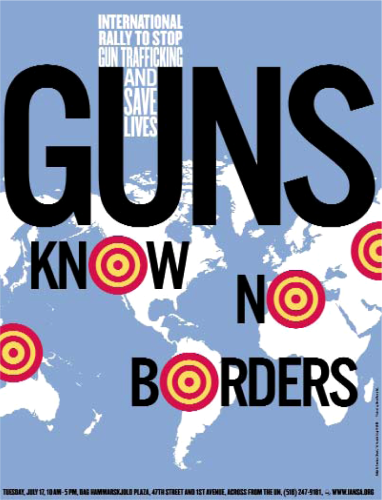
A poster from a July 17 New York City rally, organized by Silent March during the U.N. conference, protesting international gun running.
In paragraph after paragraph, the United States wanted qualifications for, or exceptions to, calls to action, deletions of requests for financial support of conference initiatives, and a limited role for the United Nations in follow-up activities.
The U.S. delegation held firm on almost all of its red lines, winning a Pyrrhic diplomatic victory on clauses concerning civilian ownership and non-state actors. In a tense battle of wills in the final hours, the U.S. delegation appeared ready to take a walk rather than accept the innocuous compromise language offered by the conference president.
In the end, a group of African nations that had staked out an equally firm position in favor of a ban on small arms sales to non-state actors had to back down and offer to delete that paragraph as well as civilian ownership language. The conference president, Camilo Reyes of Colombia, later publicly acknowledged the African states' willingness to sacrifice their principles for the sake of consensus, while castigating the “one state” that almost cost him a consensus document.
Ironically, the U.S. government actually has some of the most responsible laws and practices on export controls. The conference could have provided an opportunity for the United States to show positive leadership by seeking international acceptance of its best practices. Instead, it showed disdain for the consensus process, for the principles held by other nations, and for the United Nations in general.
On the brighter side, arms control groups were relieved that in the end there was a final consensus Programme of Action, which can be used to pressure governments to meet the obligations they agreed to in New York. It will be interesting to see if the U.S. government takes the implementation of the action plan as seriously as it did the drafting phase.
“We need to have a party or something, sir—there's a billion dollars in petty cash.”
The plan moves the debate on small arms proliferation forward in several significant areas. First, its repeated references to the humanitarian impact of small arms violence is a relatively new development that will help enlarge the group of government agencies and ngos involved in the issue. The Programme of Action also recognizes the importance of demobilization, disarmament, and re-integration of ex-combatants; the need for international rules concerning the activities of arms brokers; and governments' responsibility for keeping close watch over their weapons stockpiles and international borders.
Most important to many arms control groups, the document includes a call for states to assess export licenses based on their “existing responsibilities under relevant international law”—cryptic language that will help support an NGO-sponsored draft convention on arms transfers.
Finally, the United States lost the battle over follow-up meetings, and the conferees agreed to hold a review conference in 2006, with biennial meetings along the way.
These meetings will allow ngos and governments to keep the momentum moving on the small arms issue and revisit the action plan. By 2006 the desire of the vast majority of governments to take ambitious steps against small arms violence may no longer be subservient to the domestic politics of the few.