



Abstract
When U.S. intelligence deceived the Soviets, were they being a little too clever?
To his Soviet handlers, Sgt. Joseph Cassidy seemed like any other of the dozen or so well-placed noncommissioned officers of the U.S. Army and Navy who had been recruited to be agents by Soviet Military Intelligence (the “gru”). The U.S. Navy's Chief Warrant Officer John A. Walker, Jr. may have had the distinction of being paid more (well over $1 million) for the navy codes and other valuable tactical and operational secrets he passed to the Soviets—and Walker enjoyed a long “run” before his arrest in 1985.
Dmitri Polyakov, double agent.

But Cassidy had his own distinctions. First, he had the longest run of all— one that lasted more than 20 years, starting in 1959. The second was something the gru did not learn about until much later: From the start, Sergeant Cassidy was a U.S. double agent. His story was only recently revealed in Cassidy's Run, a fascinating account by veteran espionage observer David Wise, who evidently got a major assist from the FBI. Cassidy, who was recruited and run by the FBI and Army Intelligence, played the most important of his roles in a major deception operation in the 1960s, in the course of which he passed selected and real secret information—along with carefully prepared misinformation—about the U.S. Army chemical warfare program at the laboratory and test center at Edgewood Arsenal. It was a highly successful deception and disinformation operation.
Act one
Both the United States and the Soviet Union launched substantial chemical and biological weapons (CBW) development programs after World War II, largely building on German and Japanese wartime research. Both countries' programs were shrouded in secrecy. The purpose of the U.S. deception operation was to mislead the Soviet intelligence and military establishments into believing that the United States had a much more extensive and successful chemical weapons program than was known—and especially to convince Soviet leaders that the United States was developing a super nerve gas called GJ.
Edgewood Arsenal, Maryland
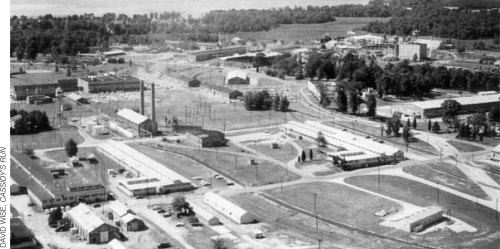
There had in fact been long and serious research on GJ, but it was finally decided that it would never be a practicable weapon. The objective of the disinformation program was to entice the Soviets into spending great efforts and resources on something American experts had concluded was a superficially promising prospect, but ultimately a dead end. The Soviets bought it.
Cassidy was used in the chemical weapons deception operation from 1966 through mid-1969, when the American managers of the game decided to shift him to other operations. Author Wise was apparently unaware that the United States had also been transmitting disinformation on chemical weapons through other channels, and that it continued the disinformation operation after Cassidy was transferred.
To all appearances at the time, the deception was a great success. The Soviet military did, indeed, expand and intensify its efforts to develop a super nerve gas like GJ. However, as time went on, there was increasing evidence that Soviet scientists had succeeded where their American counterparts had given up, and that the Soviets had successfully developed a usable, much more toxic, and highly effective nerve gas called Novichok. Whether Novi-chok is directly descended from GJ is not entirely clear, but the unexpected outcome raises an intriguing and important question.
Wise implies the answer: As a result of miscalculation by U.S. scientific and intelligence experts, the Soviets were encouraged to pursue a program that ultimately greatly increased their chemical warfare capabilities.
Because deception and disinformation operations like the nerve gas deception involve sensitive sources and methods, they are necessarily among the most tightly guarded secrets— even after many years have passed. Moreover, so long as these operations remain secret, they may continue to have effect. On the other hand, if they are blown, neither their unsuccessful originators nor the duped party have much incentive to disclose what has happened.
The possibility that such an operation, while successful in its own terms, might have wholly unexpected and undesired consequences is obviously one of the reasons for great care when authorizing such a measure. The need to keep the number of “witting” persons as limited as possible is understandable. But when the number of those apprised of a plan is kept to a minimum, the broader ramifications of the operation may not be adequately explored.
Intriguing, exciting, and perhaps as alarming as Wise's tale of Cassidy's Run is, it was in fact only the first act of a much more dramatic play. There was a second act, which might be called “Polyakov's Run.”
“Top Hat”
On August 17, 1967, a top secret joint decree issued by the Central Committee-Council of Ministers of the Soviet Union reviewed the evidence for what was seen as an extensive and successful U.S. program in the field of chemical and biological warfare. The decree called for corresponding Soviet CBW preparations. Although my attempts to obtain this decree in the Russian archives have so far been unsuccessful, I was able to track down a reference to it in the index to the still-closed files of the Central Committee. This Soviet decision to continue to pursue CBW programs was heavily influenced by the U.S. deception operation—if not entirely prompted by it.
Because of the heightened Soviet concern about the U.S. CBW program, in 1967 Col. Dmitri Polyakov, one of the key Soviet military intelligence agents in the United States, was tasked with finding out all he could about the U.S. chemical weapons program.
Soviet intelligence, however, was unaware that since late 1961 Polyakov had been an FBI-run double agent code-named “Top Hat.” (His CIA code name was “Bourbon.”)
The report Polyakov sent back to Moscow was based on a continuation of the misinformation provided through Cassidy. In 1969 he told his American handlers that his report had “shocked” Soviet leaders and led to a decision to undertake a crash program to meet the U.S. CBW threat, especially in the area of nerve gas development. “Cassidy's run” on chemical weapons was coming to an end, but “Polyakov's run” was in full force.
The Soviet decision in 1969 to undertake the crash program was confirmed by other sources, notably by a second Soviet agent, a KGB officer, FBI code name “Fedora,” who had also been recruited in the early 1960s. (His CIA code name was “Scotch.”)
Red herring?
Meanwhile, the United States conducted its last biological weapons test at Johnston Island in 1968, and was reassessing both its chemical and biological programs. On May 28, 1969, a national security study, Chemical and Biological Agents (NSSM-59), questioned the utility of those weapons—although the Defense Department did not want to rule out chemical weapons research.
Further studies and deliberations followed, and on November 25, 1969, President Richard Nixon renounced completely the use of biological weapons. He also announced that the United States would never be the first to use chemical weapons. He called for international agreements to ban both types of weapons, but declared that the restrictions he announced were not conditioned on reaching those agreements.
It was not until nearly a decade later that the first—and distorted—accounts of the role of Top Hat and Fedora were leaked to the press. In 1978, New York Times journalist David Binder reported that former FBI Deputy Director William Sullivan, along with several other FBI and CIA officials, had begun to suspect that both agents had been “turned” by Soviet counterintelligence, or perhaps had always been “triple agents.” Sullivan claimed that Soviet double agents had provided falsely reassuring information on Soviet CBW programs in order to lead the United States to cut back its own programs. Incredibly, Sullivan attributed Nixon's renunciation of biological weapons and curbs on the use of chemical weapons to Soviet disinformation.
Somehow, Sullivan's leak did not result in the Soviet discovery of the identity of the two agents, nor did it compromise the U.S. deception operation. And, as Edward J. Epstein made clear in his 1989 book Deception, Top Hat—and almost certainly Fedora as well—were working for the United States and not the Soviet Union. Top Hat, a.k.a. Dmitri Polyakov, by then a retired major general, paid with his life for his espionage activities when he was betrayed by CIA turncoat Aldrich Ames in 1985. (Fedora, who had earlier died a natural death, had never been revealed as an American agent.)
Nixon's renunciation of biological weapons was based on the judgment by American scientists that bio-weapons would not be militarily useful, not on any presumptions about Soviet programs, much less on Soviet disinformation. Nixon's decision on biological weapons paralleled the earlier decision with respect to GJ and work on super nerve gas.
Act two
The military intelligence chiefs and the FBI wanted to repeat their success, this time with a deception program on biological weapons. Polyakov's run was a direct sequel to Cassidy's run on nerve gas.
Accounts suggest that multiple channels, including Polyakov, were used to convey the misleading message that the United States was undertaking a clandestine biological weapons program, despite President Nixon's public announcement in November 1969 and the U.S. signature at the Biological Weapons Convention in April 1972. Soviet suspicions of U.S. perfidy in negotiating the biological weapons convention were seemingly confirmed by these clandestine disinformation channels.
In the late 1980s and early 1990s several high-ranking Russian scientists defected to the West. Because of their testimony, we now know that in January 1973—at the same time that agents were feeding misinformation about U.S. chemical and biological programs to the Soviets—the Central Committee-Council of Ministers decreed the establishment of a new, intensified Soviet program for research and development of biological weapons. A new cover organization known as Biopreparat, with both military and civilian research institutes and other facilities, including standby production capabilities, was created.
Throughout the 1970s and 1980s this extensive secret program contin-ued—as did Soviet suspicions and concerns about the supposed clandestine U.S. biological weapons program. For example, I located in the archive of the Central Committee in Moscow a major study that the General Staff made in 1983 on foreign—and above all U.S.—biological and chemical weapons, with projections to the year 2000. No doubt there were other studies as well.
It is not clear when the U.S. disinformation operations on CBW ended— probably in the mid-1970s—but the operations appear not to have been compromised until 1985. In any case, it is evident that their effects continued long after.
Detailed information on the Soviet Biopreparat programs became available to Western intelligence only in the period 1989 to 1992, when three key scientists active in the biological weapons program defected to the United States and Britain. (Also, in 1991 a fourth scientist, still in the Soviet Union, publicly disclosed the secret super nerve gas program.) The most complete open account of the Soviet biological weapons program has appeared in a recent book by one of the three defectors, Kanatjan Alibekov, a Kazakh who rose to become deputy director of Biopreparat from 1988 to 1992, when he defected. Under his new name, Ken Alibek, he published Biohazard in 1999.
In addition to detailing the Soviet biological weapons program in the 1970s and 1980s, Alibek bears witness that Soviet scientists were constantly spurred on by being told that the United States had a huge biological weapons program. He writes that the precipitating factor in his own decision to defect was his shock on learning from a personal visit in late 1991 to Fort Detrick and Pine Bluff, the former U.S. biological weapons centers, that they had long before been closed down as active centers of research.
This former Soviet scientist-defector and other Russian scientists have made clear that leaders of the Soviet military-industrial complex were all too ready to use reports that the United States was working hard in the CBW field to support their efforts to get more resources for their own programs. U.S. disinformation not only influenced Soviet beliefs, it was also readily used by Soviet officials to serve their own purposes.
Act three
The third act of this drama has been the legacy of the American CBW disinformation operation in the post-Cold War era. As Alibek and the other Soviet scientists have revealed, Biopre-parat and the overall CBW program survived the end of the Cold War. These programs were curtailed by Mikhail Gorbachev in the late 1980s, and supposedly ended in 1990. Yet they continued on an attenuated clandestine basis, either because Gorbachev was persuaded that the United States also continued to carry out CBW research, or because the operation was so well covered even from him that he failed to cut it off.
Boris Yeltsin, in turn, by a decree on April 11, 1992, again officially terminated the program. But there remain strong suspicions that it continues covertly on a smaller scale.
An exchange of official inspection visits by American and British scientists to four key former Biopreparat laboratories was arranged under Gorbachev in early 1991. In turn, Soviet scientists—including Alibek—inspect-ed former biological weapons facilities in the United States. Yet some Russian facilities and activities may remain concealed. It is very difficult to distinguish between research on epidemiology and defensive measures, which are permitted under the treaties, and research on actual chemical and biological weapons, which is banned.
In this FBI photo, Cassidy waits for his Soviet contact on a street in Brooklyn.

In any case, the U.S. disinformation and deception operations of the 1960s and 1970s, designed to stimulate Soviet interest and investment in CBW, were only too successful, leading to the development of effective chemical and biological munitions and to a program that may still exist on a reduced scale a decade after the end of the Cold War.
This is a disastrous outcome. Although there is little danger of Russia (or the United States) using CBW, there is the new danger that remnants of the vast U.S.-encouraged Soviet programs may end up in rogue states or even in the hands of freelance terrorists. There have been charges that senior Russian officials in the program (including its former director, Lt. Gen. Anatoly Kuntsevich) supplied, or conspired to supply, advanced chemical weapons technology to Syria in the early 1990s.
Fortunately, the only known “brain drain” of top scientists from the Soviet program has been to the United States, Britain, and Israel. Nonetheless, in addition to advanced chemical and biological agents and technology, another legacy of the U.S. deception operation is the existence of a large number of former Soviet CBW scientists who have had great difficulty finding new and acceptable roles in a shrunken Russian economy. In addition, Russia's remaining chemical munitions and CBW equipment and technology are inadequately protected, and the Russian government needs to institute a massive and costly program to dispose of its large stocks of chemical munitions.
There were, and to some extent remain, other less tangible but nonetheless real adverse consequences of the “successful” CBW deception operation. Not only did the U.S. disinformation program lead to unexpected and unde-sired Soviet achievements in developing chemical and biological weapons, it also contributed to mutual fear, suspicion, and tension.
The program undercut Soviet belief in the efficacy of arms control and in the integrity of American policy by misleading Soviet officials into believing that the United States was deliberately violating the Biological Weapons Convention, justifying their doing so as well. But were the potential benefits of the deception worth besmirching America's reputation?
These are some of the broader ramifications of strategic deception operations that were not in this instance— and generally are not—assessed or even considered before decisions are made to forge ahead.