




Abstract
Nuclear power proponents need to change their ways if they want political and public support.
Atomic energy enjoyed enormous political and financial support during its formative decades. Three decades ago, Glenn T. Seaborg, a Nobel laureate and chairman of the U.S. Atomic Energy Commission, painted a grand prospect:
Work on the WNP-4 power reactor—part of Washington State's project known to hapless bond buyers everywhere as “Whoops”—was suspended in 1981.

“Human civilization is rapidly approaching a series of crises that can be managed only through some radical departures in man's dealings with the relationship between energy and matter. Nuclear energy holds one key—a crucial one—to the successful resolution of these crises. Without it there is no doubt that civilization, as we know it, would slowly grind to a halt.
“With it not only will we be able to raise a greater part of the world's people to a decent standard of living, but we will be able to move all mankind ahead into an era of new human advancement—human advancement that takes place in harmony with the natural environment that must support it.” 1
Seaborg's utopia was not realized; the nuclear industry has been largely moribund in the West for two decades. But for many years now, the global nuclear power industry has recognized a new opportunity: atomic energy will save the world from the greenhouse effect and global climate change. In the words of the American Nuclear Society, nuclear power is “the leading strategy for reducing carbon dioxide emissions.”
It is clear that a large increase in nuclear power production is possible, as Steve Fetter implies on page 28 of this issue. But the real issue is whether such an increase is desirable. Nuclear power is an inherently unforgiving and expensive technology. Among its many difficulties: leakage of radioactive materials into local environments, radioactive wastes that must be sequestered for a very long time, the maintenance of virtually zero-tolerance safety standards, and high capital costs.
At the top of the list, though, are the links between peaceful nuclear power and the spread of nuclear weapons. Expertise in atomic power can quickly lead to expertise in making atomic weapons. And because power reactors produce plutonium, weapons-usable fuel is always close at hand.
Some of these objections to nuclear power can be remedied with new technology. But cutting the weapons link requires institutional reform as well as fuel cycles more resistant to proliferation.
A legacy of distrust
Individuals who oppose nuclear power often do not trust the nothing-to-worry-about assertions of nuclear power partisans. That is not hard to understand. Over the years, nuclear power advocates have contributed greatly to building public distrust:
• In 1971, the president of the Health Physics Society did not inspire confidence when he admonished his colleagues to “put our mouth where our money is” regarding the controversy over whether ionizing radiation posed a health risk.
• A couple of years earlier, the chief executive officer of a major U.S. utility that had begun construction of three nuclear power plants complained that he did not understand why objections were being raised to these plants. “Nuclear fuels,” he said, “are just a fancy form of kerosene.”
• In the 1970s, Sigvard Eklund, then director general of the International Atomic Energy Agency, asserted during public nuclear power debates in Sweden that there was no connection between civilian reactors and weapons. (Previously he had been a key actor in Sweden's dual-purpose nuclear weapons and power program.)
• When asked in 1971 about plans for sequestration of high-level radioactive waste, the director of the Atomic Energy Commission's reactor development program replied: “When we get enough of the stuff, we'll dig a hole somewhere and bury it.”
• With the 1979 Three Mile Island mishap, the entire nuclear power establishment's assertion that accidental core melts were not catastrophic was exposed as wishful thinking.
Nuclear skeptics have long memories, and the legacy of exaggerated claims lives on.
Today, nonsensical claims are seldom heard from reputable nuclear industry advocates, although from time to time one still hears arguments that border on the ridiculous. 2 But nuclear skeptics have long memories, and the legacy of exaggerated claims lives on.
In December 1998, for instance, the U.S. Better Business Bureau chastised the leading nuclear industry lobby organization, the Nuclear Energy Institute, for falsely claiming in its advertising that nuclear reactors produce power without polluting or damaging the environment. The Tokaimura accident in Japan last September (as well as the falsification of records at British Nuclear Fuels pertaining to the making of mixed-oxide fuel) exposed a deplorable lack of quality control and high levels of human frailty.
Expanding nuclear power in response to the threat of climate change would require political and public support—support that is now lacking. Even if nuclear power were to become economically competitive as a result of carbon taxes or other measures to internalize the environmental costs of fossil fuels, and even if new, safer, and simpler reactors were deployed, it is not likely that the opposition would be stilled.
Radioactive pollution
Many early civilian and military atomic power facilities released large amounts of radioactive materials into the environment. Today, releases during routine operation can be kept very small. Radiation pollution from individual facilities need not inhibit the expansion of nuclear power—except for spent-fuel reprocessing, which has been consistently plagued with high emissions.
A primary sustainability criterion is that rates of pollution emission should not exceed the capacity of the environment to assimilate the pollution. This standard, if rigorously applied, would simply rule out any consideration of nuclear power, as noted by energy expert John Holdren and colleagues:
The Three Mile Island plant in Pennsylvania

“If assimilative capacity of the environment means the capacity to assimilate the pollution without any adverse effects on human health or welfare, the difficulty is that there are many kinds of pollution for which the assimilative capacity, so defined, is probably zero (including, for example, ionizing radiation).” 3
The remedy, of course, is to ascertain what level of harm is tolerable in exchange for the benefits of the activity that produces the harm, the cost-benefit approach that is applied to most pollutants.”
Waste management
The many problems involved in isolating dangerously radioactive high-level nuclear power waste for at least 200,000 years have been understood since the 1970s. But there is not yet an accepted solution to the problem, nor is there an operating high-level waste repository in any country.
Many nuclear power partisans assert that Sweden has solved the waste problem. Sweden does have a promising but still theoretical method for handling high-level wastes. But the method—which centers on sequestration of the waste in mined geological repositories—has yet to be implemented, and no acceptable site has been found despite nearly a quarter century of effort.
Sweden has, however, defused the issue with the political expedient of building an interim spent-fuel storage facility large enough to hold the wastes from all operating Swedish nuclear power plants, and it has abandoned the reprocessing of spent fuel. No country, including Sweden, has solved the waste problem.
Safety
Accidents happen. Ships run into each other in open water, airplanes collide, dams burst, power grids go down, emergency generators fail, and reactors melt. Try as we might to avoid major accidents, the question is not if they will occur but how often. And a nuclear accident anywhere is a nuclear accident everywhere.
The nuclear industry has learned a great deal since the accidents at Wind-scale, Fermi I, Brown's Ferry, Three Mile Island, and Chernobyl. The accident risk at Western reactors has clearly been reduced. Nevertheless, worst-case nuclear power accidents are classic low-probability, high-consequence events. Further, problems associated with acts of malice against atomic power facilities or at facilities located in places subject to war or violent unrest remain unresolved.
How safe is safe? Given the consequences, it is by no means clear that even a very low accident frequency would be deemed acceptable. There were 436 power reactors in 30 countries licensed to operate at the end of 1999. But if nuclear power were to eventually become a major primary energy source, thousands of reactors would be required.
The nuclear power industry faces a problem similar to that faced by the airline industry in the 1930s. As long as only a few planes were flying, a relatively high accident rate was tolerable. But with tens of thousands of flights every day, the only accident rate acceptable to the public would be van-ishingly small.
The frequency of major accidents in power reactors has been low. But the Three Mile Island and Chernobyl accidents were scarcely tolerable in a world of a few hundred reactors, and the Tokaimura accident, although it did not involve a reactor, has brought nuclear power expansion in Japan to at least a temporary halt. Society has yet to determine the tolerable nuclear accident rate in a world with thousands of reactors.
Several “passively or inherently safe” reactor designs have been proposed that would lower the theoretical accident rate to near zero. But these designs are largely paper studies. It would require at least a couple of decades to demonstrate these designs and deploy the technologies. So far, no utility or consortium of utilities has been willing to take the financial risk of building prototypes for testing, and no government has come up with the financing.
Economics
Much sport has been made of over-optimistic claims made in the 1960s that energy from nuclear power would be too cheap to meter. As has been shown in numerous industry and governmental analyses, atomic power has never lived up to those claims, and it is expected to significantly expand only in certain Asian countries where special circumstances are involved. It is also important to remember that public opposition to atomic power has been based on the external costs inherent in nuclear power and not on conventional internalized costs.
Some external costs—such as total costs associated with the failure of a high-level radioactive waste repository or a major reactor accident—are extremely difficult to estimate.
Other external costs associated with energy supply systems are not only unknown but unknowable. For example, how does one measure the cost if a terrorist organization or a rogue state deploys bombs made from plutonium derived from power reactors? Conversely, how much would massive climate change cost if business-as-usual use of coal and oil continues?
The technology and the materials used in weapons and in civilian power systems are largely the same.
Health effects
The aversion that many pro-nuclear advocates have to admitting that there is a risk from low-level exposures to ionizing radiation is puzzling. The risk factor, about one excess cancer per 10 person-Sieverts (one excess cancer per thousand person-rems), is modest. It translates to about one excess cancer death for each three years of operation of a thousand-megawatt reactor, assuming no major accidents or waste repository failures. 4
Although the health risks are low, attempts to represent the risk as being zero are not only without scientific basis, they also discredit nuclear energy proponents. It is noteworthy that after decades of denial, the U.S. Energy Department has now acknowledged that low levels of radiation exposures to U.S. nuclear-weapons plant workers have caused excess cancers.
Proliferation and diversion
The most compelling argument against the large-scale expansion of nuclear power is rooted in the relationship between the civilian and military atom. The technology and the materials used in weapons and in civilian power systems are largely the same.
The information needed to extract plutonium from spent reactor fuel and to construct basic nuclear weapons is available in the open literature. And plutonium of virtually any isotopic composition from reprocessed civilian reactor fuel can be used to make nuclear weapons, although more efficient bombs can be made from weapons-grade plutonium. 5
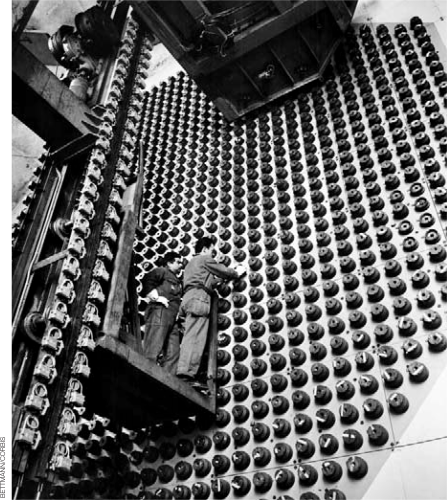
The French breeder reactor at the Marcoule Plutonium Production Center, 1958.
There are nearly 200 metric tons of surplus weapons-grade plutonium from former U.S. and Soviet weapons programs. More alarmingly, plutonium and highly enriched uranium from former Soviet programs are poorly safeguarded, and the diversion of even small amounts of Russian plutonium is commonly said to threaten international security.
But as serious as the Russian situation is, it would pale in the face of a serious global expansion of nuclear power, especially if spent fuel were reprocessed to liberate the weapons-usable plutonium. As MIT nuclear engineering professors Lawrence Lidsky and Marvin Miller point out, reactor-grade plutonium can be used to make nuclear weapons at all levels of technical sophistication. Subnational groups could build fission bombs using 5 to 10 kilograms of reactor-grade plutonium that would have an assured yield of one or a few kilotons, and technologically advanced nation states could build two-stage thermonuclear weapons using even smaller amounts of reactor-grade plutonium. 6
This issue has received a great deal of attention. Ten years ago a promising approach was advanced in the Bulletin by Princeton's Robert Williams and Hal Feiveson, who formulated a set of criteria for expansion of nuclear power without proliferation. 7 Referring back to the 1946 Acheson-Lillienthal report, they argue for a significant measure of international control over nuclear power technology. 8
Williams and Feiveson concluded that a diversion-resistant atomic power system could consist of two parts: centers under international control containing all sensitive nuclear technologies; and national facilities meeting stringent criteria and under a strict safeguards regime.
They suggested that within such a framework the nuclear power system should be designed to satisfy the following criteria:
• Restrictions on sensitive nuclear technologies and materials should be non-discriminatory among nations.
• Fissionable weapons-usable material, except for that contained in spent fuel, and facilities to enrich uranium or to separate plutonium should not exist outside of international centers.
• To the extent possible, fissionable, weapons-usable material, except for that contained in spent fuel, should not be produced even at international centers.
• Spent fuel should be stored and disposed of in international centers.
• Reactors under national authority should be designed so as to reduce the production of weapons-usable material in spent fuel to very low levels (roughly one critical mass per year of gigawatt of capacity).
The first four criteria could, in principle, be met by using the technology developed in the once-through fuel cycle commonly used today. The fifth criterion requires the development and commercialization of new reactor types and/or fuel cycles. Meeting the fifth criterion would also decrease the long-term risk that spent fuel repositories are mined for weapons material. 9 Williams and Feiveson concluded by stating: “Satisfying the criteria set forth here would not make nuclear power diversion-proof; no technical or institutional fix can do that. Nor would it prevent nations determined to acquire nuclear weapons from doing so. But it would make the nuclear power route an unattractive one for acquiring nuclear weapons.”
Faustian overtones
There were other early calls for unique institutional measures to cope with the special problems of nuclear energy. Alvin Weinberg, a nuclear pioneer who was later pivotal in developing power reactors as director of the Atomic Energy Commission's Oak Ridge National Laboratory, detailed the “Faustian bargain” that “we nuclear people have made with society.” The price for an inexhaustible source of energy, Weinberg said, was “both a vigilance and a longevity of our social institutions that we are quite unaccustomed to.” 10 In effect, a nuclear priesthood would have to be created and sustained.
Wolf Häfele, one of Europe's premier nuclear scientists and advocates, more recently expanded on this theme and concluded that a “global institution immune to national politics” must govern nuclear power. 11
It is not obvious that such an institution soon will be forthcoming. Political leadership and vision is required to achieve the necessary policies to satisfy global energy needs without major disruption—including that from climate change. Without such leadership, it is unlikely that the necessary technical, financial, and institutional measures can be put in place.
Nuclear scholars have consistently emphasized that the problems with nuclear power are institutional and not merely technical. A strong global authority—with enforcement powers—appears to be necessary to ensure unfettered free trade in nuclear fuels and wastes; to assure the high technical competence in the design, construction, operation, and maintenance of nuclear facilities; and to anticipate and regulate nuclear risks, including the diversion of nuclear material for weapons purposes, the vulnerability of facilities to sabotage, and war-time vulnerability. 12 Nations would have to surrender some degree of sovereignty if nuclear power were to be greatly expanded.
Further, institutions dealing with nuclear power must be non-discriminatory. Having one set of energy supply technologies for some countries and another for countries that cannot be trusted is not acceptable. Because much of future increased demand for energy will be in the developing world where political stability in many countries historically has been weak, this issue cannot be ignored.
At a nuclear power conference last fall, Harvard's Matthew Bunn said that if nuclear power were to meet more than a few percent of the world's greenhouse-constrained energy needs in the twenty-first century, it would require thousands of gigawatts of nuclear capacity rather than hundreds. 13 Such an expansion of fission-generated power could become broadly acceptable only if:
• Further catastrophes, such as major reactor accidents or the theft of weapons-usable nuclear material for use by proliferating states or terrorists, were avoided.
• New technologies were developed that would address the complexity, cost, safety, waste management, and proliferation concerns that have limited the acceptance of nuclear power by utilities, the government, and the public.
• Far-reaching transparency and democratization measures were developed for the nuclear decision-making process so that a better-informed public would be able to ensure that its concerns were being fully addressed.
To achieve these objectives, Bunn said, “the industry would be well-advised to stay away from production of additional weapons-usable separated plutonium for decades to come, as continued processing, transport, and use of tens of tons of this material every year will increase the chance of a theft or similar catastrophe, raise costs, and exacerbate political controversies.”
First, abolish the weapons
Given the inherent links between the military and the peaceful atom, full realization of an economy powered by atomic energy would require that nuclear weapons no longer be considered legitimate for any country.
The stakes are enormous. Contrary to what many environmentalists suggest, the large-scale expansion of nuclear energy may not present insurmountable technical problems. But the political hurdles are very high.
Minimizing environmental releases of radionuclides from all fuel-cycle facilities and establishing safe long-term isolation of nuclear wastes are necessary but not sufficient conditions for accepting atomic power. The world must first find a way to abolish nuclear weapons. As author Richard Rhodes puts it in Dark Sun:
“Fundamentally, and in the long run, the problem which is posed by the release of atomic energy is a problem of the ability of the human race to govern itself without war.” 14
Creating the international institutions to ensure complete and unambiguous separation of the peaceful and the military atom is necessary. Until these conditions are satisfied, talk of a major expansion of atomic power in response to climate change is empty rhetoric.
Footnotes
1.
Glenn T. Seaborg and William R. Corliss, Man and Atom: Building a New World Through Nuclear Technology (New York: E.P. Dutton & Co., 1971), p. 13.
2.
See, for example, Richard Rhodes and Denis Beller, “The Need for Nuclear Power,” Foreign Affairs, January/February 2000, pp. 30-44.
3.
John P. Holdren, Gretchen C. Daily, and Paul R. Ehrlich, “The Meaning of Sustainability: Bio-geophysical Aspects,” in Mohan Munasinghe and Walter Shearer, eds., Defining and Measuring Sustainability (Washington, D.C.: World Bank, 1995), pp. 3-17.
4.
U.S. National Academy of Sciences, Nuclear Waste: Technologies for Separation and Transmutation (Washington, D.C.: National Academy Press, 1996).
5.
U.S. National Academy of Sciences, Management and Disposition of Excess Weapons Plutonium (Washington, D.C.: National Academy Press, 1994), pp. 4, 32-33.
6.
Lawrence M. Lidsky and Marvin M. Miller, “Nuclear Power and Energy Security: A Revised Strategy for Japan,” paper presented at the PARES Workshop: Energy Security in Japan, Tokyo, July 13, 1998.
7.
Robert H. Williams and Harold A. Feive-son, “How to Expand Nuclear Power Without Proliferation,” Bulletin of the Atomic Scientists, April 1990, 40-45.
8.
A Report on the International Control of Atomic Energy (Washington, D.C.: U.S. Government Printing Office, March 16, 1946).
9.
Johan Swahn, “Retrievability and Safeguards Concerns Regarding Plutonium in Geologic Repositories,” in E. Metz, ed., Disposal of Weapons Plutonium: Approaches and Perspectives (Amsterdam: Kluwer, 1995), pp. 8-22; Per F. Peterson, “Long-term Safeguards for Plutonium in Geologic Repositories,” Science and Global Security, vol. 8, no. 1 (1996), pp. 1-29.
10.
Alvin M. Weinberg, “The Moral Imperatives of Nuclear Energy,” Nuclear News, vol. 14, no. 12 (December 1971), pp. 33-37; “Social Institutions and Nuclear Energy,” Science, January 7, 1972, pp. 27-34.
11.
Wolf Häfele, “Energy from Nuclear Power,” Scientific American, September 1990.
12.
L. J. Nilsson and Dean E. Abrahamson, “Safeguarding and Internationalizing Nuclear Power,” International Journal of Global Energy Issues, vol. 3, no. 3 (March 1991), pp. 150-158.
13.
Matthew Bunn, “Enabling a Significant Future for Nuclear Power: Avoiding Catastrophes, Developing New Technologies, Democratizing Decisions—and Staying Away from Separated Plutonium,” Global ‘99 International Conference on Future Nuclear Systems, Jackson, Wyoming (Sept. 29, 1999).
14.
Richard Rhodes, Dark Sun (New York: Simon & Schuster, 1995).