




Abstract
Introduction:
Depression is a prevalent psychological problem among higher vocational college students. This study aimed to explore the potential relationships among neurotic personality, maladaptive emotion regulation strategies, anxiety, and depressive symptoms in higher vocational college students.
Methods:
Higher vocational college students in Jiangxi, China, were recruited for this survey study. The Chinese version of the Eysenck Personality Questionnaire, the Cognitive Emotion Regulation Questionnaire, the Self-assessment Scale of Anxiety, and the Self-depression Scale were administered to assess the mental condition of the students. We used serial mediation models to understand whether maladaptive emotion regulation strategies and anxiety mediate the effect of neurotic personality on depression.
Results:
Neurotic personality was significantly positively correlated with depression severity (r = 0.52, p < 0.001). Furthermore, catastrophizing (total mediating effect: 1.002) and blame-other strategies (total mediating effect: 0.993), as maladaptive emotion regulation strategies, and anxiety exerted a chain mediating effect on the relationship between neurotic personality and depression.
Conclusion:
This study revealed the significant effect of neurotic personality on depression in higher vocational college students and its underlying mechanism. Our results may be valuable for maintaining and improving the physical and mental health of higher vocational college students.
Keywords
1 Introduction
Depression is a mental disorder characterized by feelings of sadness, low energy, difficulty sleeping, and an inability to enjoy life that affects approximately 15% of college students [1, 2]. Depression has a considerable impact on well- being and can even lead to suicide [1]. As a unique group of college students, higher vocational students are prone to experiencing psychological problems because of their short duration of education, low educational background, and early socialization. Despite the heterogeneity within this student group, most of them struggle with unsatisfactory academic results, which can be attributed to a range of factors including personality issues, lack of a sense of achievement in learning, and financial constraints. Such students are often labeled by society as underachievers, potentially risky individuals, and low-performing learners, and these negative stereotypes take a toll on their emotional well-being [3]. Research conducted by Wu et al.[4] and Wu et al.[5] noted that the depression rates among higher vocational students were 25.6% and 37.6% separately, both of which exceed the average prevalence level.
Personality can be defined as the distinctive combination of a person’s cognitive thoughts, emotional experiences, and behavioral patterns. Among various personality dimensions, neuroticism, extraversion, and optimism have been empirically proven to serve as robust predictors of mental health status [6]. A neurotic personality type is recognized as a consistent predictor of common psychological disorders including anxiety and depression [7]. Existing research has verified that people with high levels of neuroticism are usually inclined to self-criticize, are sensitive to criticism from others, and tend to respond to their surroundings with negative reactions that are more frequent and excessive than average [6].
Cognitive emotion regulation strategies refer to strategies in which individuals consciously manage the input of emotional information by applying cognitive approaches [8, 9]. Studies have shown that the strategy chosen to adjust emotion depends on an individual’s personality, particularly neurotic personality [10]. Specifically, individuals with a lower level of neuroticism experience fewer negative emotions (e.g., depression and frustration) and use adaptive emotion regulation strategies more often [11].
A network may exist that links anxiety, neurotic personality, depression, and cognitive emotion regulation strategies. As mentioned above, personality has an effect on the emotion regulation strategy selected [12]. Individuals high in neuroticism may be more likely to engage in maladaptive strategies (e.g., rumination), whereas individuals high in conscientiousness may be more likely to use adaptive strategies (e.g., problem-solving) [13]. In college students, anxiety is related to a high level of depression and the formation of a negative personality, such as neuroticism [13, 14]. Therefore, we hypothesized that there would be a chain-like association among depression, anxiety, and neuroticism and that these four factors impact each other. However, whether such a network exists, in general as well as in vocational college students specifically, remains to be studied.
This study aimed to investigate the chain relationship among depression level, neurotic- personality, anxiety, and cognitive emotion regulation strategies in higher vocational students to examine the mental health of higher education students and understand the factors that influence depression. Our findings provide guidance for the development of measures to improve the mental health of higher education students.
2 Materials and Methods
2.1 Study Design and Participants
This was a cross-sectional study to assess the mental status of students in higher education institutions using a self-assessment questionnaire. The questionnaire comprised well-established and widely-used scales, which were distributed via the sample service of the Golden Data website. Returned questionnaires were screened, processed, and analyzed.
The participants were undergraduate students from higher vocational colleges in Nanchang, China, aged approximately 20 years old and not showing qualified academic performance. Most people with universal values admiring high scores at school regarded these students as underperforming college students, which likely negatively affected their mental health [2]. Students completed the questionnaires online. Of the returned questionnaires, 677 were deemed valid.
2.2 Measurements
2.2.1 Neurotic Personality Scale
The Chinese version of the Eysenck Personality Questionnaire (EPQ-RSC), compiled by Qian et al. [15], was used to measure neurotic personality. Cronbach’s alpha of the scale was 0.859. The EPQ-RSC includes 25 items across four dimensions: Psychoticism, Extraversion, Neuroticism, and Lie. The questionnaire was scored using the forward scoring (0 = no and 1 = yes) or reverse scoring method (0 = yes and 1 = no) [16].
Relative to the Big Five Inventory, which assesses five broad personality domains—openness to experience, conscientiousness, extraversion, agreeableness, and neuroticism—the EPQ-RSC prioritizes the precise measurement of neuroticism over comprehensive coverage of all five dimensions. Moreover, the EPQ-RSC incorporates a greater number of items targeting multifaceted aspects of neuroticism, thereby yielding higher reliability for the assessment of neurotic personality compared with the Big Five Inventory [17].
2.2.2 Cognitive Emotion Regulation Scale
The Cognitive Emotion Regulation Questionnaire (CERQ), compiled by Garnefski et al. [8], was adopted in this study to evaluate how individuals employ cognitive emotion regulation strategies. The overall Cronbach’s Alpha coefficient for this scale was 0.923. The CERQ measures nine distinct types of regulation strategies, including self-blame, rumination, catastrophizing, blaming others, acceptance, positive refocusing, refocus on planning, positive reappraisal, and putting into perspective. All items are scored on a 5-point Likert scale ranging from 0 (never) to 4 (always). The average total score falls between 0 and 4, with higher scores representing a greater likelihood of adopting a particular strategy under stressful circumstances. The Cronbach’s alpha values for the nine subscales of the CERQ varied from 0.64 to 0.89 [18].
2.2.3 Anxiety Scale
Anxiety symptoms over the preceding week were measured using the Self-rating Anxiety Scale (SAS) constructed by Zung et al. [19]. The scale yielded good internal consistency, with a Cronbach’s alpha of 0.868. The SAS contains 20 items rated on a 5-point Likert scale from 1 (never or hardly) to 4 (mostly or always). Standardized cutoff scores were applied as follows: < 50 = no anxiety; 50–59 = mild anxiety; 60–69 = moderate to severe anxiety; ≥ 70 = severe anxiety. The Cronbach’s alpha of the SAS was 0.77, which supported the establishment of anxiety severity thresholds [19].
2.2.4 Depression Scale
The level of depression was evaluated with the aid of the Self-rating Depression Scale (SDS). The Cronbach’s alpha value for this scale was calculated to be 0.837. Composed of 20 items, the SDS uses a 5-point Likert scoring system that ranges from 1 (never or hardly) to 4 (mostly or always). Participants were instructed to answer each item based on their feelings over the past several days. The SAS scale score thresholds were defined as follows: < 53 indicated no depression; 53–62 indicated mild-to-moderate depression; 63–72 indicated moderate-to-major depression; and > 72 indicated major depression (i.e., a higher score indicated more severe depression) [20]. Cronbach’s alpha of the SDS was > 0.75.
2.3 Data Analysis
We used SPSS 23.0 and the macro program PROCESS to select and analyze data for neurotic personality, catastrophizing strategy, blaming others strategy, and depression. Correlation analyses were carried out using SPSS 23.0, and the mediating effects were then analyzed using model 6 of PROCESS.
2.4 Common Method Bias Test
Common method deviation is likely to occur with the questionnaire approach, and therefore we validated the results using Herman’s one-factor method. Results showed a variation of 18% and 51% for the lowest factor, which was lower than 40%. Therefore, no significant changes were found in the standard deviations.
3 Results
3.1 Descriptive data
We received 845 returned questionnaires, of which 677 were valid, resulting in a return rate of 80.12%. Of the 677 participants who returned valid questionnaires, 73.3% (n = 496) were women, 59.5% (n = 403) lived in villages, and 11.8% (n = 80) were an only child. Students ranged from first year to third year; the highest proportion of students were in the first grade (n = 572). In addition, 94.5% (n = 640) of students were non- smokers, and 95% (n = 643) of students did not drink. Detailed socio-demographic characteristics are provided in Table 1.
Socio-demographic characteristics and their differences among the primary variables (Mean ± SD)
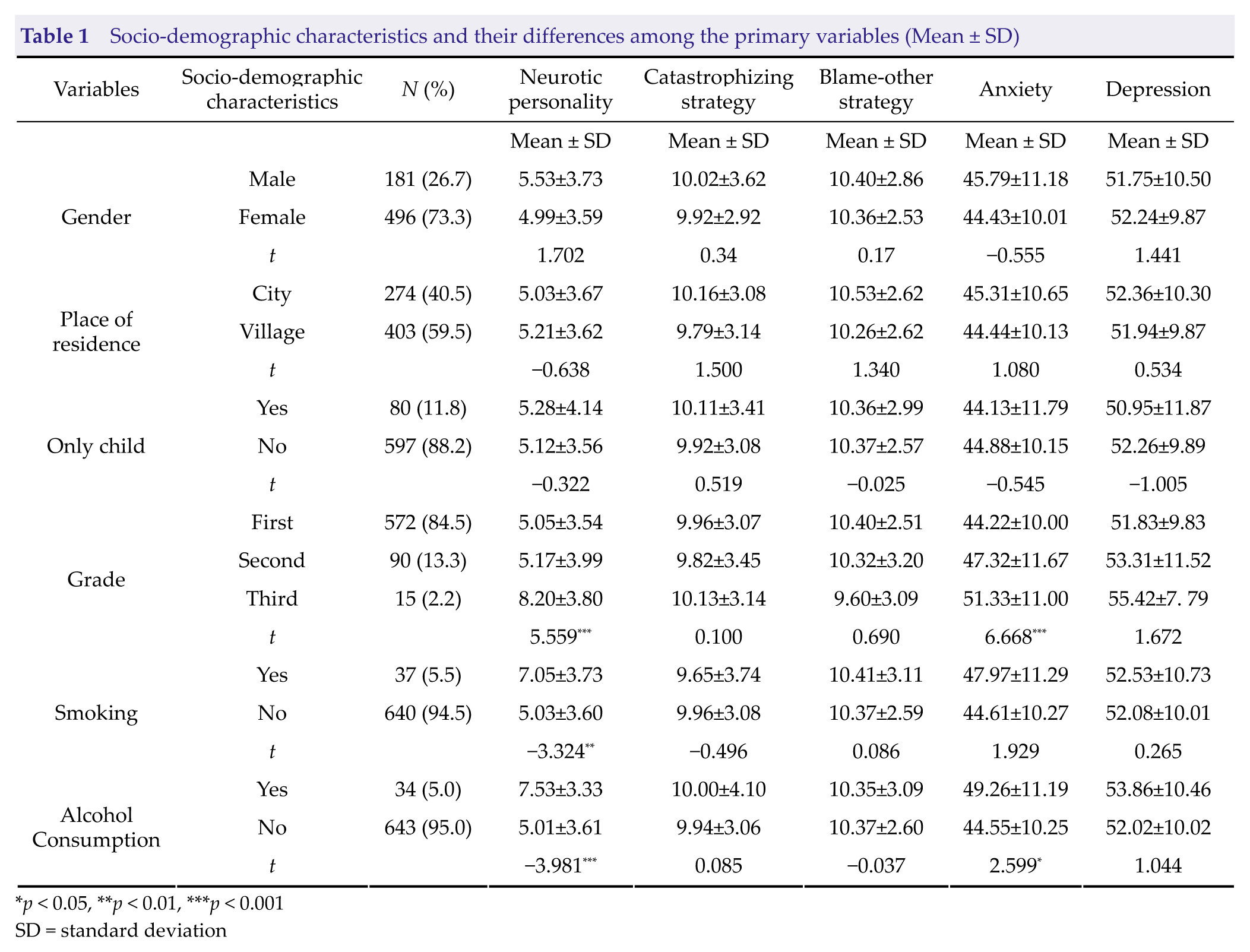
p < 0.05, **p < 0.01, ***p < 0.001
SD = standard deviation
3.2 Descriptive Statistics and Correlation Analyses
Means, standard deviations, and Pearson’s correlation coefficients among variables are shown in Table 2. Results showed that neurotic personality was significantly positively correlated with the level of depression (r = 0.52), catastrophizing strategy (r = 0.41), blame-other strategy (r = 0.30), and anxiety (r = 0.50). The r-values between catastrophizing strategy and anxiety and between catastrophizing and depression levels were 0.43 and 0.44, respectively, which indicated that catastrophizing positively predicted anxiety and depression. Blame-other strategy was significantly positively correlated with anxiety and depression levels. Anxiety levels were significantly positively correlated with depression levels.
Correlation of variables (N = 677)
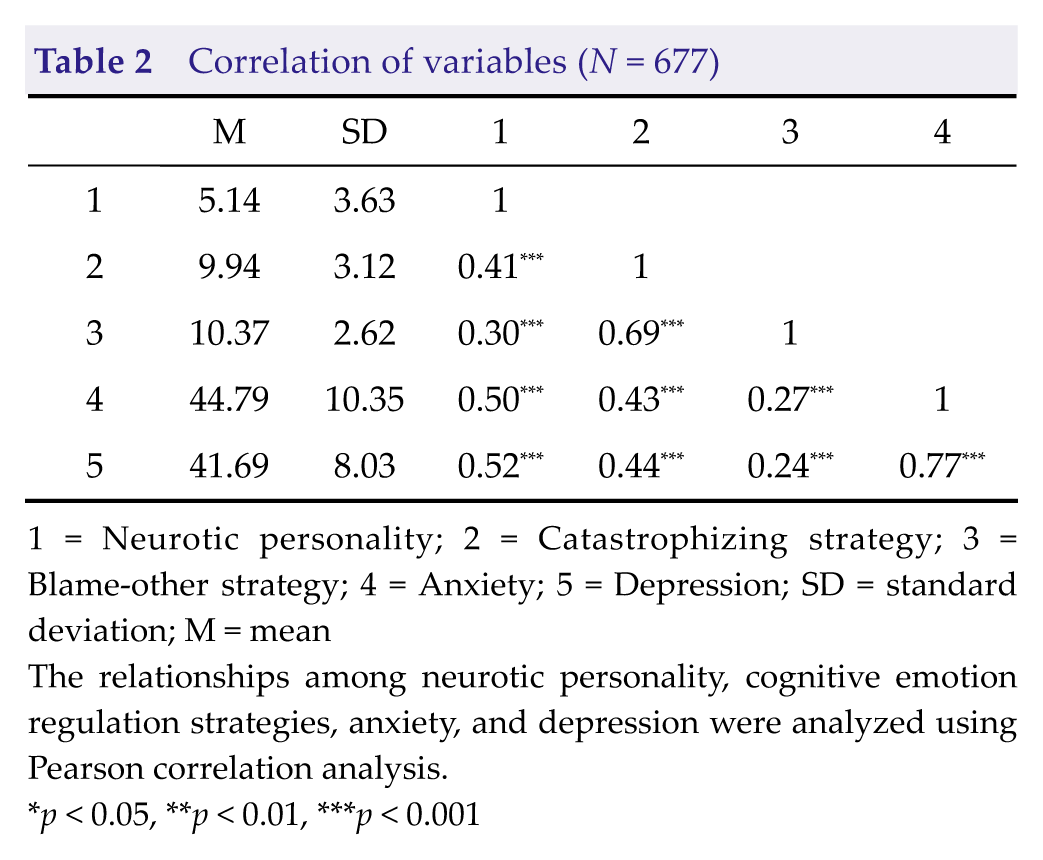
= Neurotic personality; 2 = Catastrophizing strategy; 3 = Blame-other strategy; 4 = Anxiety; 5 = Depression; SD = standard deviation; M = mean
The relationships among neurotic personality, cognitive emotion regulation strategies, anxiety, and depression were analyzed using Pearson correlation analysis.
p < 0.05, **p < 0.01, ***p < 0.001
3.3 Chain Mediation Effect Test
We used model 6 from PROCESS to examine the chain intermediation effect of two negative cognitive emotion sub-strategies and anxiety on the impact of neurotic personality on depression level. Sex, place of residence, only-child status, grade, smoking status, and drinking status were entered as covariates. As shown in Figure 1, neurotic personality significantly positively predicted depression, catastrophizing strategy, and anxiety, with β-values of 0.436, 0.365 and 1.050, respectively. Catastrophizing strategy significantly positively predicted anxiety and depression, and anxiety significantly positively predicted depression.
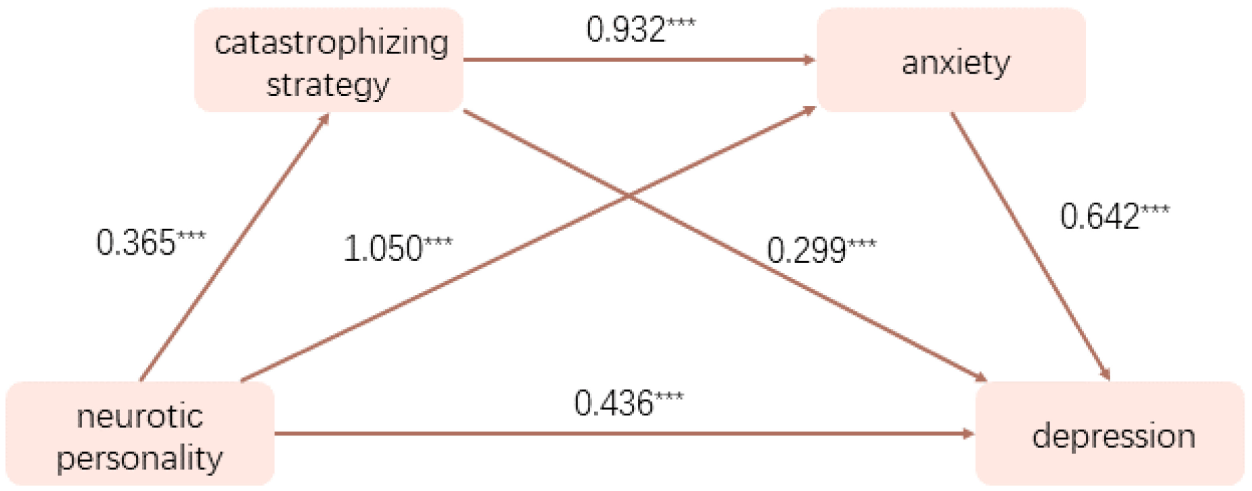
Chain mediation model of neurotic personality, catastrophizing strategy, anxiety, and depression. ***p < 0.001
As shown in Figure 2, depression was a significant positive predictor of neurotic personality (β = 0.505, p < 0.001), as were blame-other strategy (β = 0.221, p < 0.001) and anxiety (β = 1.267, p < 0.001). Blame-other strategy was also a significant positive predictor of anxiety (β = 0.557, p < 0.001). However, blame-other strategy was not a predictor of depression (β = 0.005).
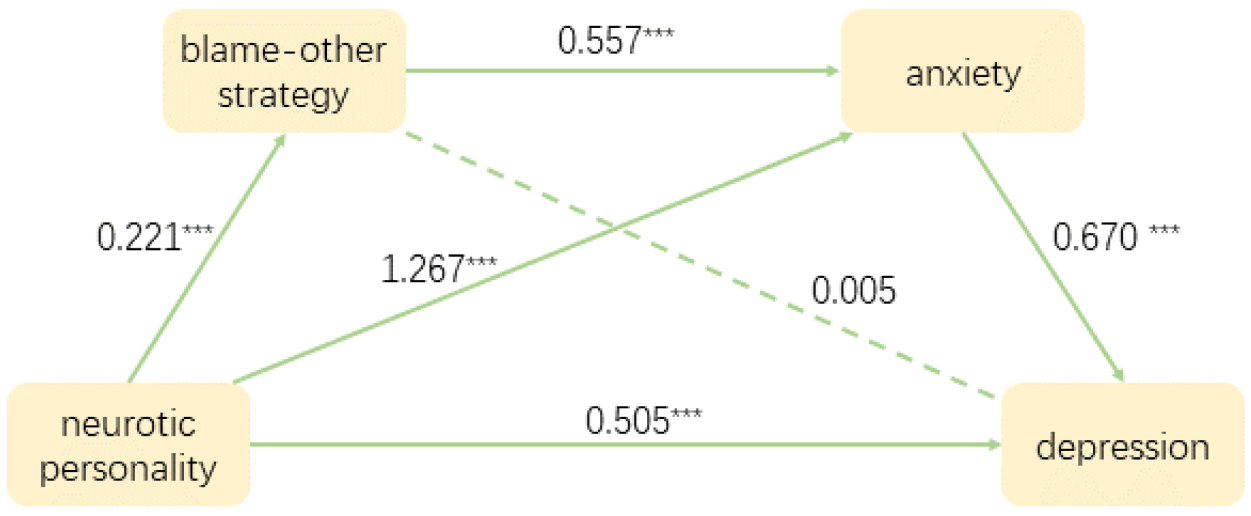
Chain mediation model of neurotic personality, blame-other strategy, anxiety, and depression. ***p < 0.001
We found that anxiety was a positive predictor of depression (β = 0.670, p < 0.001).
Using the bootstrap method, we resampled the data 5000 times and calculated 95% confidence intervals (CIs). As illustrated in Table 3, catastrophizing strategy and anxiety played a mediating role in the relationship between neurotic personality and depression (collective intermediary effect = 1.002, 95% CI [0.850, 1.155], 69.68% of the collective effect). The secondary effect of the neurotic personality → catastrophizing strategy → depression path was 0.109 (95% CI [0.042, 0.183]), accounting for 7.58% of the collective effect. The secondary effect of the neurotic personality → anxiety → depression path was 0.674 (95% CI [0.526, 0.824]), accounting for 46.87% of the collective effect. The secondary effect of the neurotic personality → catastrophizing strategy → anxiety → depression path was 0.219 (95% CI [0.153, 0.298]), accounting for 15.23% of the collective effect. Because the 95% confidence intervals for each pathway did not include zero, the mediation effects were significant and the chain mediation was effective.
Chain mediating effect of catastrophizing strategy and anxiety on the relationship between neurotic personality and depression
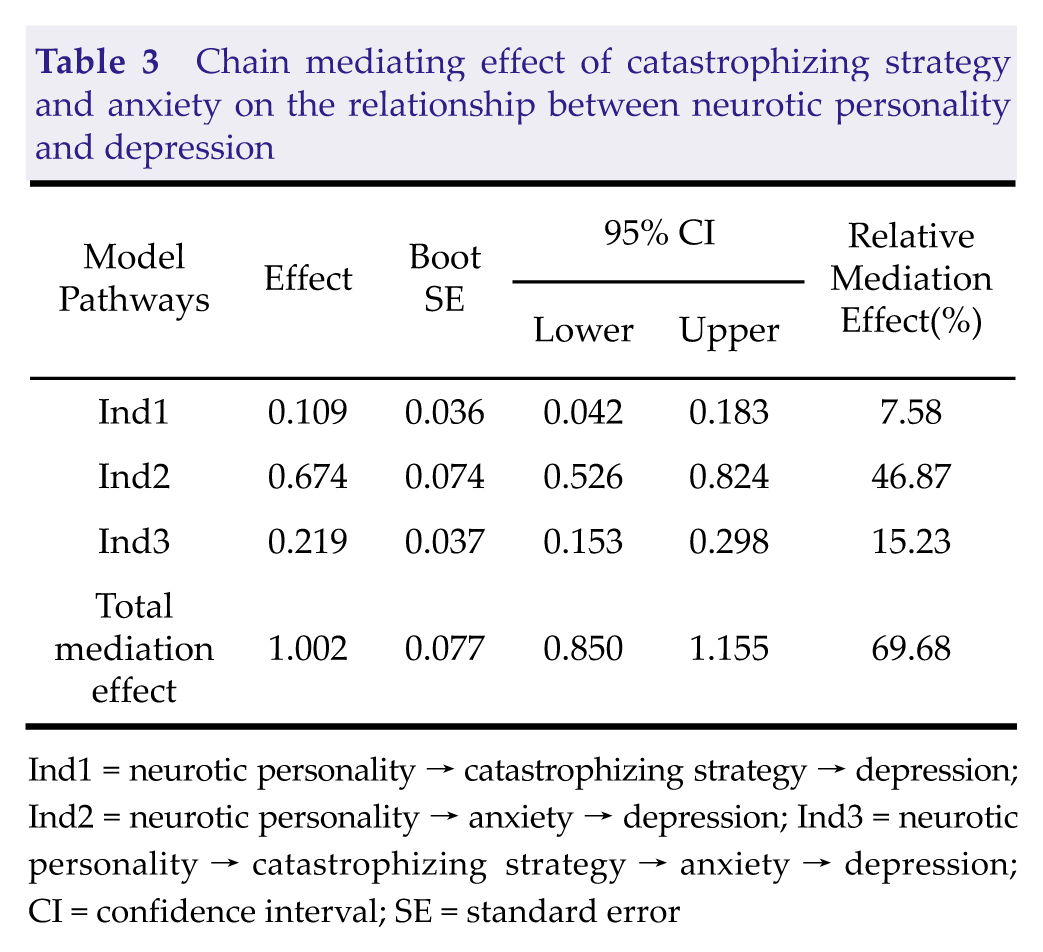
Ind1 = neurotic personality → catastrophizing strategy → depression; Ind2 = neurotic personality → anxiety → depression; Ind3 = neurotic personality → catastrophizing strategy → anxiety → depression; CI = confidence interval; SE = standard error
The results showed that blame-other strategy, alongside anxiety, played an intermediate role in the relationship between neurotic personality and depression (mediating effect = 0.933, 95% CI [0.792, 1.081], accounting for 64.88% of the collective effect; Table 4). The secondary effect of the neurotic personality → blame-other strategy → depression path was 0.001 (95% CI [-0.044, 0.046], accounting for 0.07% of the collective effect). The secondary effect of the neurotic personality → anxiety → depression path was 0.849 (95% CI [0.703, 1.001], accounting for 59.04% of the collective effect). The secondary effect of the neurotic personality → blame-other strategy → anxiety → depression path was 0.083 (95% CI [0.038, 0.135], accounting for 5.77% of the collective effect; Table 4). Because the 95% CI of path 4 contained zero, the mediation effect of blame-other strategy was not significant. The 95%
Chain mediating effect of blame-other strategy and anxiety on the relationship between neurotic personality and depression
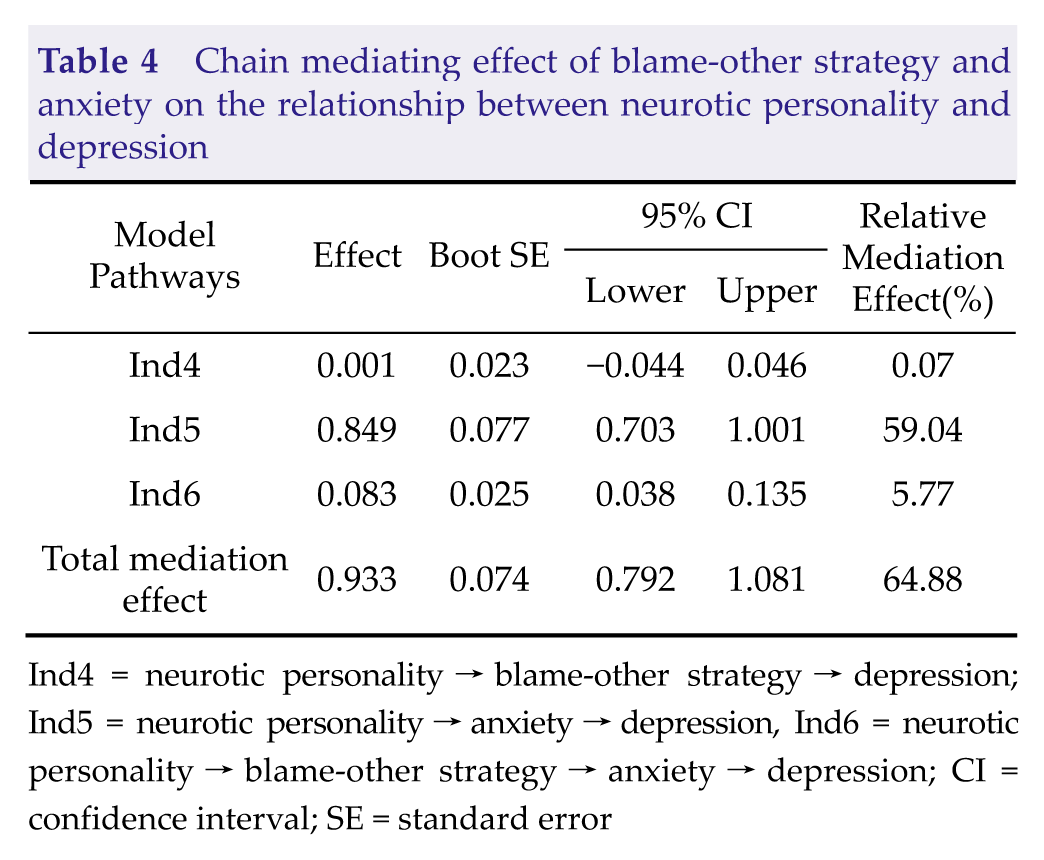
Ind4 = neurotic personality → blame-other strategy → depression; Ind5 = neurotic personality → anxiety → depression, Ind6 = neurotic personality → blame-other strategy → anxiety → depression; CI = confidence interval; SE = standard error
CIs of all other paths did not contain a zero; thus, the mediation effects were significant and chain mediation was formed.
4 Discussion
4.1 Neurotic personality correlates positively with depression
The results confirmed that neurotic personality directly and positively impacts depression in higher vocational college students residing in Nanchang. This finding is consistent with previous results. Studies have reported that genes associated with neurotic personality (e.g., 5HTT-LPR) increase the risk of developing depression among individuals who encounter stressful life events [14, 16]. Moreover, growing evidence suggests that those high in neuroticism experience more negative life events, such as physical health problems, conflicts with others, and job loss [21]. Gunthert et al. [22] also proposed that individuals with high neuroticism tend to exaggerate the degree of threat created by daily problems and show fewer well- regulated emotional responses. Frequent strong negative emotions and pessimistic expectations regarding the future can hinder recovery from negative feelings because appropriate coping strategies cannot be used [23].
4.2 The mediating role of anxiety in the relationship between neurotic personality and depression
Our findings suggest that neurotic personality affects depression via anxiety. Previous studies have revealed that individuals with a neurotic personality activate the superior frontal gyrus more strongly when receiving negative signals, which is associated with the production of a broad range of negative moods, such as anxiety and depression [24]. Comorbidity between anxiety disorders and depression is common because anxiety disorders are coexisting signs of other anxiety disorders that both share similar etiological factors. [25, 26].
4.3 The chain mediating effect of non-adaptive emotional regulation strategies and anxiety on neurotic personality and depression
Our results indicated that higher vocational college students in Nanchang with a neurotic personality may develop depression via the chain mediating effect of non-adaptive emotional regulation strategies (i.e., catastrophizing and blaming others strategies) and anxiety. Individuals with a high level of neuroticism prefer to use catastrophizing strategies to regulate emotion because of the activation of the dorsolateral prefrontal cortex when experiencing stressful events [27]. The negative bias during the processing of emotional information results in rumination about depressive states and the amplification of negative moods, which heightens the level of anxiety and depression [28]. Moreover, students who often attribute mistakes to others when facing stressful life events may generate tension in interpersonal relationships, which results in further negative emotions [29]. However, the chain mediating effect of the blame-other strategy and anxiety was not significant. This pattern may be attributed to the fact that the influence of neurotic personality on the blame- others strategy is notably weaker than its impact on anxiety severity.
4.4 Implications for Clinical Practice
The present investigation carries both theoretical and practical implications for clarifying the mechanisms that underpin the association between neurotic personality and depression. To date, limited empirical work has simultaneously examined neurotic personality, cognitive emotion regulation strategies, anxiety, and depression, with the majority of prior research concentrating on middle school and undergraduate populations [30]. The present study centered on students in higher vocational colleges and explored the interrelations among neurotic personality, cognitive emotion regulation strategies, anxiety, and depression. To our knowledge, this work represents the first to demonstrate that cognitive emotion regulation strategies and anxiety jointly function as a chain mediator in the link between neurotic personality and depression. Accordingly, these findings advance the existing understanding of mental health among vocational college students and inform directions for future inquiry in this domain. These results carry meaningful practical implications. The present findings offer actionable guidance for designing and implementing psychological interventions aimed at safeguarding the mental well-being of students in higher vocational colleges [31]. Prior research has recommended that educational institutions provide diversified social support resources for vocational students [32]. For instance, tailored psychological counseling delivered by qualified psychologists may be warranted, with interventions co-developed with students to foster internal coping resources and facilitate the formation of trusting therapeutic relationships [33, 34]. Hence, implementing multifaceted mental health education is crucial to equip vocational college students with skills in emotion regulation, adversity coping, and resilience enhancement [35]. To maximize the efficacy of such initiatives, it is vital to provide complementary social support within their daily contexts, thereby directly safeguarding their emotional and psychological well-being [36].
5 Limitations
Several limitations should be acknowledged in the present study. First, all participants were
recruited from higher vocational colleges in Nanchang, which may restrict the generalizability of the findings. Future research may extend these results to larger and more geographically diverse samples covering wider age ranges. Second, the reliance on self-report measures may introduce potential recall bias and shared method variance. Third, given that depression arises from multiple etiological factors, the present investigation only examined two contributory mechanisms. Accordingly, the association between neurotic personality and depression should be further explored from complementary perspectives, including psychological capital and social support. Finally, the cross-sectional design precludes causal inferences; future longitudinal studies are needed to verify the causal pathways identified in this work.
6 Conclusion
The present findings confirm that neurotic personality confers a significant positive predictive effect on depressive symptoms among higher vocational college students in Nanchang. Moreover, catastrophizing and blame-others strategies function as sequential chain mediators in the association between neurotic personality and depression. The significant mediating roles of these two maladaptive strategies highlight their critical relevance to promoting mental well-being in vocational student populations. These results offer evidence-based guidance for educators and practitioners seeking to improve the mental health outcomes of students in higher vocational colleges.
Footnotes
Acknowledgements
The authors thank all the participants, assistants, and researchers for their contribution to this study. In particular, thank MQ provided data.
Funding Information
National Natural Science Foundation of China (Award Number: 82360278), Jiangxi Provincial Natural Science Foundation(Award Number: 20242BAB25480), General Project of Science and Technology Plan of Jiangxi Provincial Health Commission(Award Number: 202510036).
Author Contribution
Xiaoyi Chen and Yufei Wang analyzed the data and prepared the first draft of the manuscript. Mengqian Li and Mingting Wang participated in the conception and design of the study, Xing Wang constructively revised the manuscript; Yuan Liu, Lunjie Chen and Liping Huang participated in data collection and organization; Mengqian Li and Mingting Wang participated in and supervised the study throughout, and they share corresponding authorship. All authors commented on previous versions of the manuscript and approved the final version.
Declaration of Conflicting Interests
The authors declare that the research was conducted in the absence of any commercial or financial relationships that could be construed as a potential conflict of interest.
Data Availability Statement
The original contributions presented in the study are included in the article/supplementary material. Further inquiries may be directed to the corresponding author.
Ethics Statement
This study was approved by the Ethical Review Committee of the First Affiliated Hospital of Nanchang University: Ethical number (2022) Medical Research Ethics Review No. (4-033), and all participants signed the informed consent.
Informed Consent
Written informed consent to participate in this study was provided by the participants’ legal guardian/next of kin.