




Abstract
Previous reports on the pathogenesis of age-related movement disorders, such as Parkinson’s disease (PD) and essential tremor (ET), have demonstrated the potential implications of LINGO1 (leucine-rich repeat and immunoglobulin domain-containing protein) gene. Although LINGO2 has a high degree of homology with LINGO1, but it is less characterized and the role of LINGO2 in the development of PD/ET remains unreported. Hence, this meta-analysis was conducted to evaluate the role of LINGO2 in PD/ET pathogenesis. A total of 4 studies, which complied with the Hardy–Weinberg equilibrium, were included in the meta-analysis. Analysis of the pooled odds ratio and confidence interval of the studies were performed for five genetic models, namely: allelic, dominant, recessive, homozygous, and heterozygous. No significant association was observed between the LINGO2 polymorphism and PD/ET, although subgroup analysis through conventional meta-analysis indicated that the recessive models of rs7033345 and rs10812774 are significantly associated with predisposition to ET in the Asian population. However, trial sequential analyses for both polymorphisms were unlikely to reveal any robust effect. Hence, studies with larger samples on this association are needed in the future to corroborate our results.
Dear editor,
Age-related movement disorders, such as Parkinson’s disease (PD) and essential tremor (ET), affect 3%–6% and 1%–2% of the elder population, respectively [1]. Although the exact etiology remains elusive, however, several factors, including genetics and inflammation, have been reported to contribute toward the development of PD and ET [2]. The LINGO (Leucine-rich repeat and immunoglobulin domain-containing protein) genes belong to a leucine-rich repeat (LRR) gene family which is composed of four members (LINGO1–LINGO4) [3]. Several of these genes have been implicated in the pathogenesis of PD and ET. A previous study [4] has observed a significantly higher LINGO1 protein expression in the cerebellum of patients with ET and PD relative to controls. Interestingly, although LINGO2 levels were also marginally higher in ET and PD cases, the difference was insignificant [4]. Results of the referred study are supported by a recently published article which emphasized that tremors induced by upregulated LINGO1 levels are modulated by the calcium-activated potassium (BK) channels [5]. This implies that a possible role for LINGO1 in the pathogenesis of PD and ET. Furthermore, although several meta-analyses have demonstrated a lack of association between LINGO1 gene polymorphisms and PD [6, 7], the latest analysis indicated a protective role of rs11856808 in PD [3].
In contrast to LINGO1, LINGO2 is less characterized, despite its high degree of homology with LINGO1 and its restricted expression in the neuronal tissue in comparison to LINGO3/4 [1, 3]. Therefore, a meta-analysis of all eligible studies relating the LINGO2 gene polymorphisms with a predisposition to PD/ET was conducted. The meta-analysis was performed according to the Preferred Reporting Items for Systematic Reviews and Meta-Analysis (PRISMA) guidelines [8]. A literature search was conducted from PubMed, Scopus, and Web of Science, and was updated until 30 March, 2020. Keywords, such as “LINGO2”, “PD”, and “ET” were used in combination. The inclusion criteria of studies were as follows: (1) aims to evaluate the association between LINGO2 gene polymorphisms and predisposition to PD/ET, and (2) conducted with a case-control design. Meta-analysis was performed for each gene polymorphism with two or more studies. Genotypic frequency of LINGO2 gene polymorphism was tested for deviation from the Hardy–Weinberg equilibrium (HWE) in the control subjects.
The genetic association was assessed using five different genetic models, including allelic [mutant type (M) vs. wild type (W)], dominant (MM+WM vs. WW), recessive (MM vs. WM+WW), homozygous (MM vs. WW), and heterozygous (WM vs. WW) [2, 9]. The associations between LINGO2 gene polymorphisms and predisposition to PD/ET were calculated based on pooled odds ratio (OR) and 95% confidence interval (CI). Z test was conducted to evaluate the significance of the pooled effect size. Heterogeneity among studies was evaluated using the Q test and I 2 statistic. A significant Q-statistic (p < 0.10) indicated heterogeneity across studies. The I 2 values indicated no (0–24.9%), low (25%–49.9%), moderate (50%–74.9%), or high (75%–100%) heterogeneity. The random-effects model was used if heterogeneity existed; otherwise, the fixed-effects model was used. Subgroup analysis was stratified by patient ethnicity. The p-value < 0.05 was indicative of the statistical significance. The Newcastle–Ottawa Scale (NOS) was used to assess the quality of included studies, with good quality studies indicated by a cutoff score of ≥ 7 (see Supplementary Table 1). Trial sequential analysis (TSA) was performed for a significant result of conventional meta-analysis according to a previously published article [10]. We employed a significance of 5% for type I error, and a significance of 20% for type II error in order to calculate the required sample size, and build the TSA monitoring boundaries.
A total of four studies which investigated the association between LINGO2 gene polymorphisms (rs7033345, rs10812774, rs13362909, and rs10968280) and PD/ET were retrieved from PubMed and Scopus databases [1, 3, 11, 12] and all of the single-nucleotide polymorphisms complied with the HWE (p > 0.05) (Table 1). Pooled results on the associations between LINGO2 gene polymorphisms and predisposition to PD/ET are shown in Table 2. No significant association was observed between LINGO2 gene polymorphisms and predisposition to PD/ET in all five inheritance models (p > 0.05, Table 2). Subgroup analysis based on ethnicity revealed that the recessive models, rs7033345 and rs10812774, are significantly associated with predisposition to ET in the Asian population (Table 2). This is in line with a previous report from Wu et al. [11]. The result of TSA is shown in Fig. 1, with the required sample sizes being 1,651 and 1,403 samples for rs7033345 and rs10812774 under the recessive model, respectively (Fig. 1). The conventional meta-analysis for both polymorphisms has demonstrated statistical significance as the Z-curve lies outside the horizontal pink lines. However, TSA indicated that the cumulative Z-curve, for both polymorphisms, did not cross the trial sequential monitoring boundary and did not reach the required sample size. Hence, both polymorphisms were unlikely to show a robust effect.
The characteristics of studies included on LINGO2 gene polymorphism and Parkinson’s disease (PD) or essential tremor (ET).
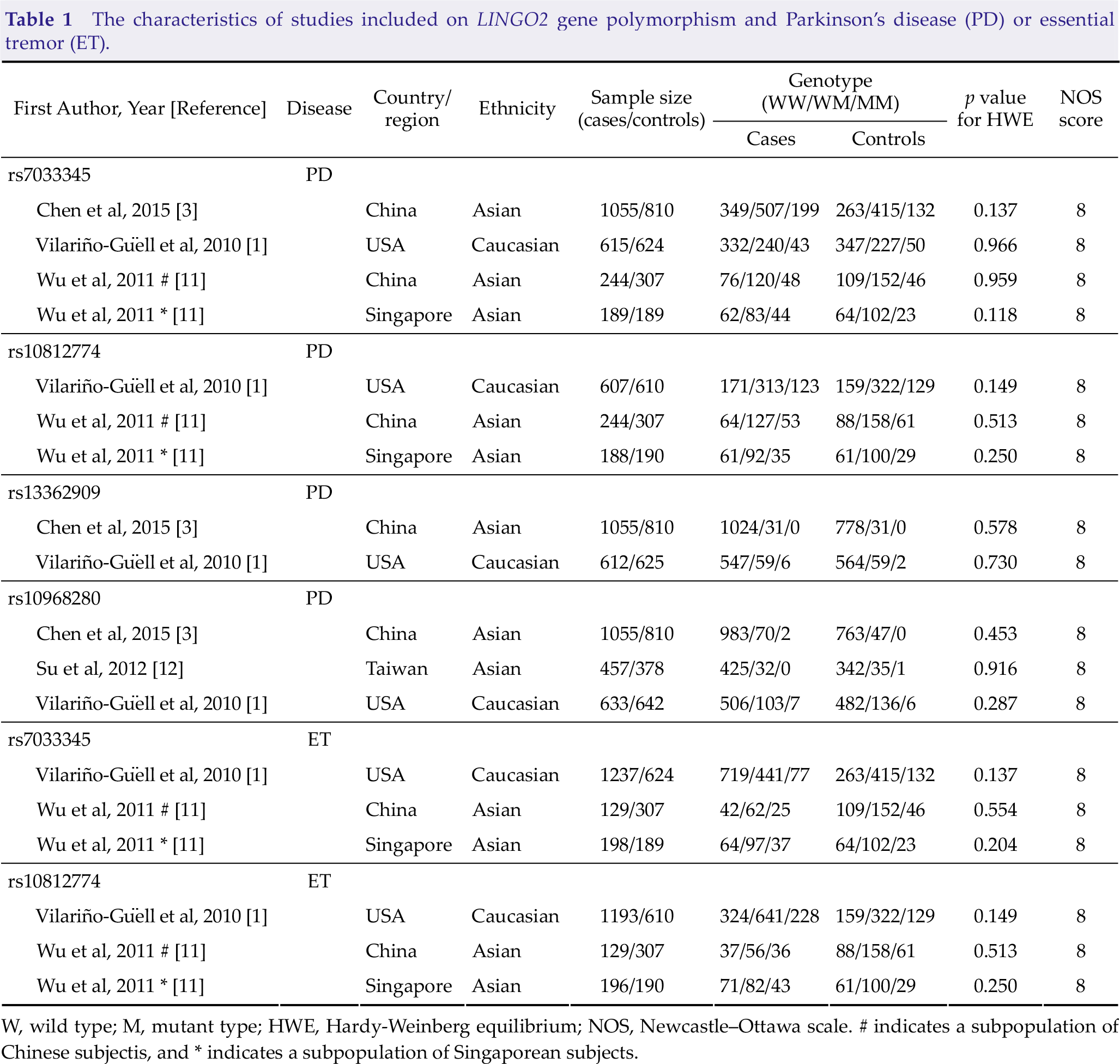
W, wild type; M, mutant type; HWE, Hardy-Weinberg equilibrium; NOS, Newcastle–Ottawa scale. # indicates a subpopulation of Chinese subjectis, and * indicates a subpopulation of Singaporean subjects.
Results of a meta-analysis of LINGO2 gene polymorphism and Parkinson’s disease (PD) or essential tremor (ET).
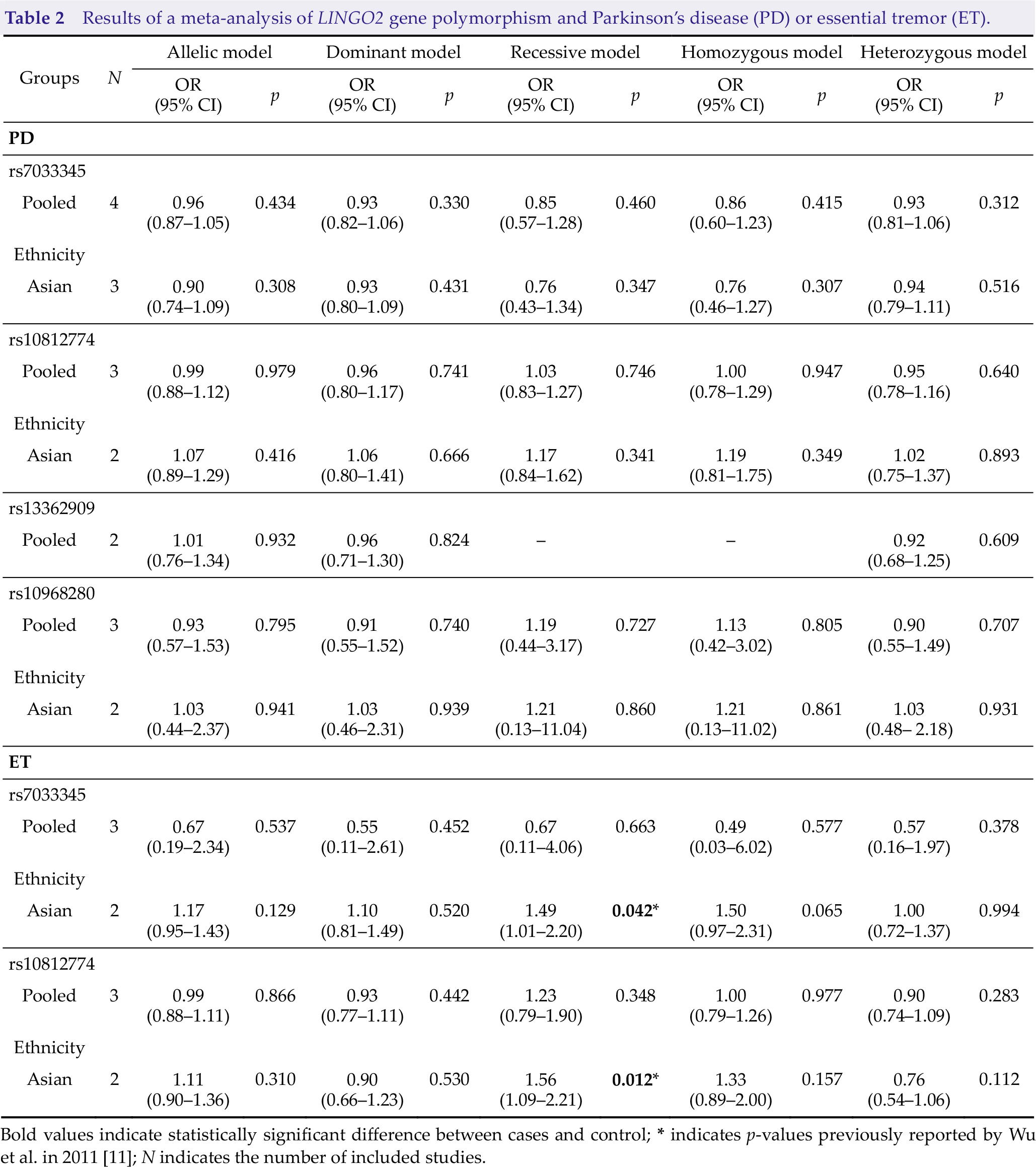
Bold values indicate statistically significant difference between cases and control;
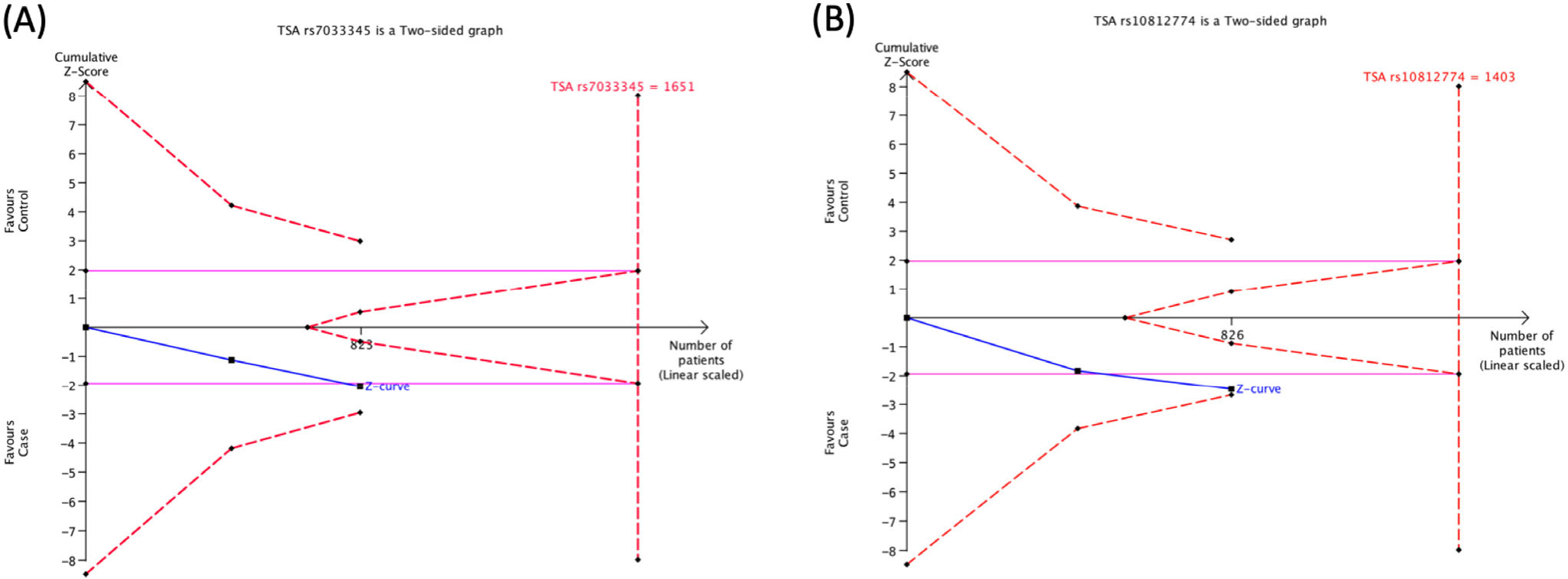
Trial sequential analysis for LINGO2 rs7033345 (A) and rs10812774 (B) polymorphism under the recessive model.
Therefore, our analysis indicated that rs7033345, rs10812774, rs13362909, and rs10968280 of LINGO2 show no association with a predisposition to both PD and ET. However, the analysis did not exclude the possibility of an association between polymorphisms of rs7033345 and rs10812774 of LINGO2 with the risk of ET in the Asian population. Therefore, there is a potential possibility that rs7033345 and rs10812774 may be useful as biomarkers for early ET detection in the Asian population. Future studies should assess haplotypes involving several mutations in the LINGO2 gene of patients with either PD or ET. In addition, assessment should be carried out on other reported polymorphisms which could not be evaluated in the current analysis due to the limited number of studies. Furthermore, since our negative findings may be due to the limited sample size, cohort studies with larger sample sizes are warranted to validate our results.
Supplemental Material
Supplemental Material, sj-pdf-1-bsa-10.26599_BSA.2021.9050018 - Implication of the LINGO2 gene in the predisposition to movement disorders
Supplemental Material, sj-pdf-1-bsa-10.26599_BSA.2021.9050018 for Implication of the LINGO2 gene in the predisposition to movement disorders by Gita Vita Soraya, Zulvikar Syambani Ulhaq and Christian Peinado Garcia in Brain Science Advances
Footnotes
Abbreviations
Conflict of interests
The authors declare no conflict of interests.
Authors’ contribution
ZSU, GVS, and CPG conceptualized the study; ZSU and GVS performed the review; ZSU, GVS, and CPG analyzed the data; ZSU and GVS wrote the first draft; all authors contributed to revising the manuscript.
References
Supplementary Material
Please find the following supplemental material available below.
For Open Access articles published under a Creative Commons License, all supplemental material carries the same license as the article it is associated with.
For non-Open Access articles published, all supplemental material carries a non-exclusive license, and permission requests for re-use of supplemental material or any part of supplemental material shall be sent directly to the copyright owner as specified in the copyright notice associated with the article.
