




Abstract
Objective:
This study aims to determine the relationship between education level, memory function, and hippocampus functional and structural alterations in subjective cognitive decline (SCD).
Methods:
Seventy-five participants with SCD were divided into high education (HE) and low education (LE) level groups. A Wechsler Memory Scale–Chinese Revision test and functional and structural MRI were performed within 1 week after participant recruitment. The bilateral hippocampus resting-state functional connectivity (rsFC), gray matter volume (GMV) of brain regions identified by rsFC analysis, and moderating and mediating effects were assessed.
Results:
Compared with the LE group, HE individuals showed 1) higher memory quotient (MQ) and Digit Span subscore, 2) decreased hippocampal rsFC with the right medial prefrontal cortex (mPFC) and dorsolateral prefrontal cortex (DLPFC), and 3) increased GMV in the right mPFC and DLPFC. The bilateral hippocampus–right DLPFC rsFC significantly associated with the MQ and the bilateral hippocampus–right mPFCrsFC with the Digit Span subscore in each group. The bilateral hippocampus–right DLPFC rsFC moderated the relationship between the education level and MQ. The bilateral hippocampus–right mPFC rsFC mediated the relationship between the education level and Digit Span subscore in all subjects.
Conclusion:
The hippocampal rsFC with the right mPFC and DLPFC contributes to the education level effect on memory function in SCD.
Keywords
1 Introduction
The relationship between the education level and cognitive functions has been widely studied. As compared with people with low education (LE) level, individuals with high education (HE) level perform better at cognitive tasks, experienceless decline in the executive and global functions with age, and present delayed onset of future impairments [1, 2]. For instance, a study from Lövdén suggested that educational attainment has positive effects on cognitive functions and that the education duration is associated with cognitive abilities [3].
Subjective cognitive decline (SCD) is a condition unrelated to an acute event in which individuals experience subjective cognitive deterioration, while the ircognitive performances at neuropsychological tests show no evidence of objective impairment. However, recent works evidenced a worse global performance and a decline of the executive and memory functions in patients with SCD compared with those in healthy controls [4, 5]. Memory decline may be the most prominent cognitive manifestation in SCD, and a longitudinal study suggested that SCD predicts future memory decline [6]. However, it is unclear whether and how the education level affects memory functions in SCD.
A robust effect of the education level on brain development has been shown. Parental education is strongly linked to performance IQ and the volume of the temporal gray matter, temporal white matter, and frontal white matter in children aged 4–18 years [7]. Furthermore, previous studies suggested that the education level affects brain aging. Indeed, higher education is associated with slower and lesser whole brain gray matter atrophy [8] and increased temporal lobe gray matter in older adults [9]. The hippocampus plays crucial roles in different dimensions of memory encoding such as long-term [10], short-term [11], and immediate memories [12]. Recently, converging evidence showed an alteration of the hippo-campus volume and function in SCD. For instance, a study from Audrey and colleagues demonstrated a significantly decreased volume of the hippocampus global and CA1/subiculum subfield in patients with SCD compared with those in healthy controls [13]. A biochemical and neuroimaging study from Sun et al. indicated that functional alterations in the hippocampus of subjects with SCD might reflect an early neuronal dysfunction associated with memory decline [14].
In recent years, the spontaneous fluctuation of the brain resting state has been investigated using many methods, such as the resting-state function connectivity (rsFC). This technique is a powerful tool measuring fMRI signals between brain regions or networks that have been widely used to delineate and explore the principles of human brain organization [15]. A previous study suggested that the rsFC between the hippocampus and other brain regions was altered in SCD. Adecreased hippocampal rsFC with the medial prefrontal cortex (mPFC) and the temporoparietal junction was evidenced in individuals with SCD and was associated with the cognitive function (measured by the Montreal Cognitive Function Assessment Scale [MoCA]) [16]. Wang et al. found an increased default mode network (DMN) connectivity in the right hippocampus and precuneus of subjects with SCD compared with that of healthy controls [17]. However, to our knowledge, only few studies investigated the relationship between the education level, memory function in SCD, and hippocampus alteration. Exploring the brain imaging features of subjects with SCD with different education levels might provide guidance for individualized and precise treatment of different SCD conditions.
The plasticity of the brain structural and functional networks was proposed as a potential moderating or mediating factor of the link between the education level and cognitive functions. Chen’s study indicated that the regional connectivity of the DMN is a significant mediating factor of the relationship between the education level and episodic memory in healthy elderly adults (higher education level associated with higher episodic memory performances through lower DMN connectivity) [18]. Another study from Mortamais found that the education level modulates the link between cerebral white matter lesion volume and the risk of dementia. It also showed that education affects cognitive functions by modulating brain networks [19].
Here, we investigated the effects of different education levels on memory functions in subjects with SCD. We also compared the hippocampal rsFC with the whole brain in individuals with SCD with high and low education levels. We assessed the gray matter volume (GMV) of key brain regions identified by rsFC analysis. Finally, we applied a moderating/mediating effect analysis to explore the moderating and mediating relationship between education levels, rsFC, and memory function in SCD. We hypothesized that, as compared with an LE level, an HE level results in better memory performance in individuals with SCD and the difference in memory performanceis associated with an alteration of the hippocampus rsFC. Hippocampal rsFC might be a moderating or mediating factor of the link between the education level and the memory function in SCD.
2 Methods
2.1 Participants
The cross-sectional observational study was conducted from July 2020 to December 2020. The participants were recruited from the community centers of Fuzhou (Fujian Province, China) through phone calls and posters. All participants were diagnosed by a specialist from the Affiliated Rehabilitation Hospital of Fujian University of Traditional Chinese Medicine using the SCD conceptual framework proposed by Jessen et al. in 2014 [5]. The features of the framework were as follows: 1) subjective decline of memory rather than other domains of cognition; 2) onset of SCD within the last 5 years; 3) age at SCD onset of at least 60 years; 4) worries associated with SCD; and 5) worse self-perceived memory than that of others in the same age group. The participants were divided into an HE group (at least 12 years) and an LE group (< 12 years) based on a previous work [20]. The present study was approved by the Medical Ethics Committee of the Affiliated Rehabilitation Hospital of Fujian University of Traditional Chinese Medicine. All participants signed an informed consent form before taking the tests.
Inclusion criteria are as follows: The participants 1) meet the afore mentioned diagnostic criteria of SCD [5]; 2) are 60–75 years old; 3) have MoCA scores ≥ 26, without objective cognitive impairment of MCI; 4) are right handed; and 5) with informed consent and can participate voluntarily.
Exclusion criteria are as follows: Participants 1) with uncontrollable high blood pressure; 2) with history of alcohol and drug abuse; 3) with cognitive decline caused by other reasons; 4) cannot cooperate with the tests; 5) with contraindications for MRI use or who are taking drugs that affect brain imaging; and 6) who are participating in other research affecting the results of this study.
2.2 Measures
2.2.1 Demographic and disease medical history of the study participants
Data regarding the age; gender; education duration (years); body mass index (BMI); smoking, drinking, and tea consumption status of the participants as well as their medical history of type 2 diabetes mellitus (T2DM), hypertension, and hyperlipidemia were collected. In addition, we assessed the number of positive items on the Simplified Geriatric Depression Scale-15 (GDS-15), the Cognitive Complaint Index (CCI) [21], namely, the percentage of all complaint items (from the Geriatric Depression Scale, Memory Complaints Questionnaire, and the Metamemory in Adulthood Questionnaire) endorsed positively (i.e., symptomatic), and the score on the Hamilton Anxiety Scale (HAMA). The GDS-15 is a reliable measure of depression designed specifically for rating depression in older adults [22]. Among the elderly, the GDS values of Cronbach’s alpha and test–retest correlation coefficient were 0.88 and 0.66, respectively. They highly correlated with BDI (R = 0.72) [23]. The HAMA is a rating scale of the severity of anxiety neurosis [24]. The inter-rater reliability measured using the inter class coefficient was 0.74, and the concurrent validity measured in patients with anxiety using the Spearman coefficient between the total score of the Covi anxiety scale and HAMA was 0.63 [25].
2.2.2 Wechsler Memory Scale – Chinese Revision (WMS_CR) test
The effects of education on memory in patients with SCD were assessed using the WMS_CR. The WMS_CR was introduced in China by the Chinese psychologist Gong Yaoxian in 1989. It has been researched on Sinicization, standardization, reliability, and validity [26]. According to the manual, the test–retest reliability of the WMS_CR is 0.82. The WMS_CR includes eight main items (mental control, picture, recognition, visual reproduction, associative learning, touch, comprehension memory, and Digit Span). The long-term, short-term and immediate memories are tested using different items. Long-term memory is evaluated by mental control using forward/backward counting and accumulation item scores. Short-term memory is assessed using picture, recognition, visual reproduction, associative learning, touch, and comprehension memory. Digit Span is utilized to test the immediate memory. In addition, the memory quotient (MQ) is calculated as the total score of all items adjusted to age. The test was performed by a physician.
2.2.3 Structural and functional MRI data acquisition
The T1-weighted images and resting-state fMRI data were acquired within 1 week following the WMS_CR test. All scans were acquired on a 3.0 T Prisma scanner system (Siemens Medical Solutions, Erlangen, Germany) with a 64-channel head coil. The T1-MPRAGE images were collected using the following parameters: 15° flip angle, 1-mm slice thickness, 250-mm field of view (FOV), and 160 slices. The resting-state fMRI was acquired with the following parameters: TR = 2000 ms, TE = 30 ms, flip angle = 90, voxel size = 3.6 mm × 3.6 mm × 3.6 mm, 37 axial slices, FOV = 230 mm × 230 mm, and phases = 300. The total resting-state fMRI scan length was 10 min. All subjects were told to remain motionless but awake with their eyes closed during the scanning.
2.3 Data analysis and statistics
2.3.1 Behavioral and demographic data analysis
We used the SPSS version 22.0 statistics software (IBM, Armonk, NY) for the behavioral and demographic data analysis. The Shapiro– Wilk test was performed to test the normality of the continuous variable distribution. For the demographic data analysis, a two-independent samples t-test was used to compare normally distributed data of both groups. For the non-normally distributed data, a nonparametric test was used to compare the group differences. For the non-continuous variables, the Chi-square test was applied to explore the group differences.
2.3.2 Seed to whole brain voxel correlational analyses
The seed-based correlational analyses were conducted using the CONN toolbox (CONN 19C Version, http://www.nitrc.org/projects/conn) and the MATLAB-based software for functional connectivity data analysis, as in our previous studies [27–33]. Here, we used the bilateral hippocampus based on the Automated Anatomical Labeling as the region of interest (ROI) or seed [Fig. 1(A)]. Preprocessing of fMRI data was performed using a pipeline in the CONN toolbox, which included removing the first five time points, slice-timing correction, realignment, coregisteration to subjects' respective structural images, normalization, and smoothing with an 8-mm full width at half maximum (FWHM) kernel. Then, segmentation of the gray matter, white matter, and cerebrospinal fluid areas for the removal of temporal confounding factors was performed with band-pass filtering (frequency window 0.01–0.089 Hz).
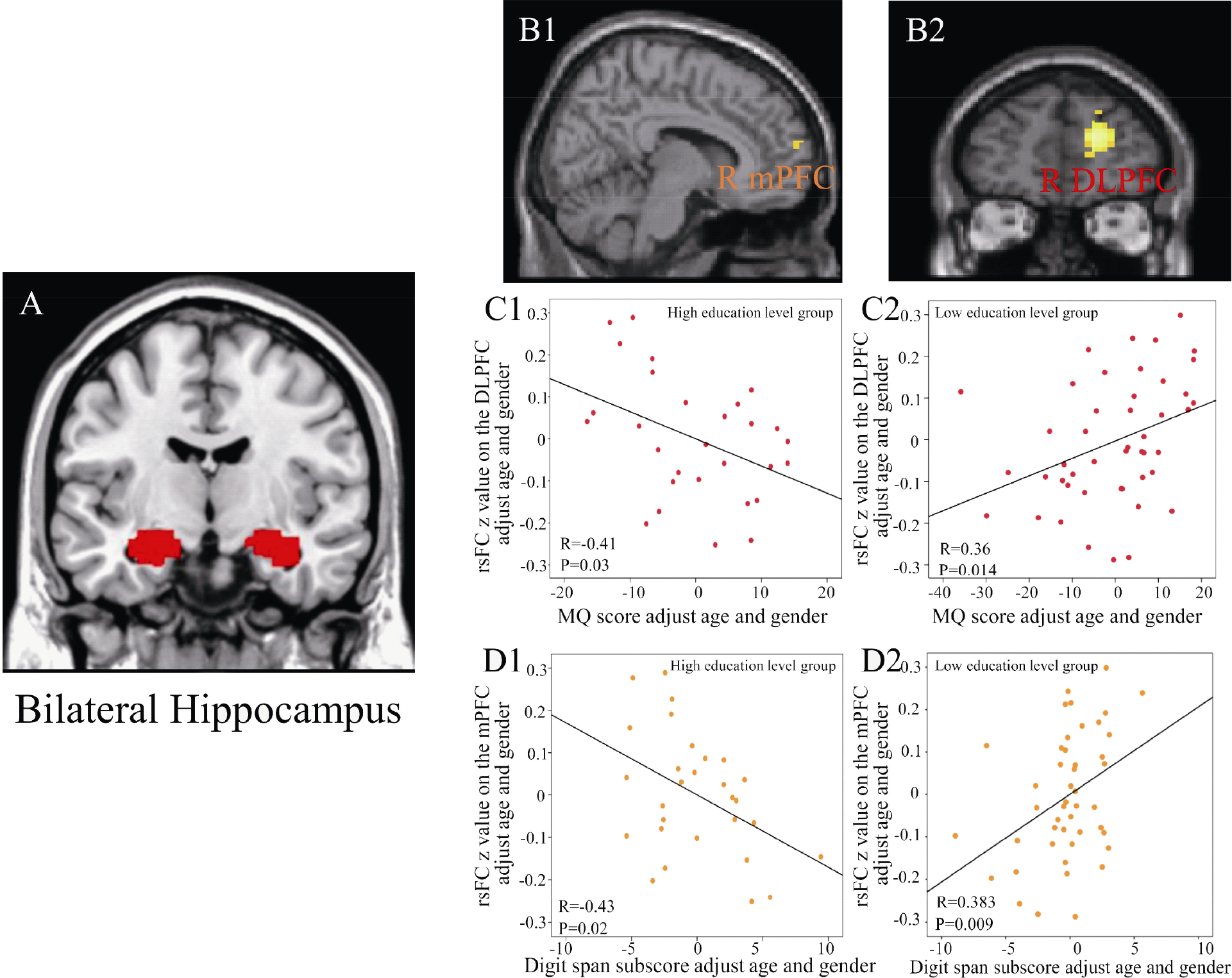
Differences of rsFC between the high and low education level groups using the bilateral hippocampus as seed. (A) Bilateral hippocampus used as seed. (B) As compared with that of the low education level group, a significantly decreased rsFC of the bilateral hippocampus with the right mPFC (B1) and right DLPFC (B2) was measured. (C) Scatter plots representing the partial association between MQ and the corresponding average z values in the DLPFC for the high education level (C1) and low education level (C2) groups adjusted for age and gender. (D) Scatter plots representing the partial association between Digit Span score and the corresponding average z values in the mPFC for the high education level (D1) and low education level (D2) groups adjusted for age and gender. R means “right” in (B1) and (B2), and means“correlation coefficient” in the (C1), (C2), (D1) and (D2).
Outlier time points in the motion parameters and global signal intensity were identified using ART (https://www.nitrc.org/projects/artifact_detect), which is part of the default preprocessing pipeline in the CONN toolbox [33], to eliminate correlations caused by the head motion and artifacts. The images were treated as outliers if the composite movement from the preceding image exceeded 0.5 mm or if the global mean intensity was > 3 standard deviations from the mean image intensity as described previously [34, 35]. Following the recommendation of the CONN toolbox developer [33], the temporal time series of the head motion matrix of outliers were entered as first-level covariates.
The correlation map was produced for each subject by extracting the blood oxygenation level dependent (BOLD) time-course data from the bilateral hippocampus. Pearson’s correlation coefficients between the time-course data from the bilateral hippocampus and every voxel of the whole brain were calculated. Then, correlation coefficients were Fisher transformed into “Z” scores to increase the normality. We performed a second-level group analyses using two independent samples t-test with age and gender as covariates of non-interest. A threshold of voxel-wise P < 0.005 uncorrected and cluster-level P < 0.05 family-wise error rate (FWE) corrected were applied.
2.3.3 ROI voxel-based morphometry (VBM) analysis
We found significant group differences in the rsFC of the bilateral hippocampus with the mPFC and the dorsolateral prefrontal cortex (DLPFC) (see Section 3). To explore the GMV difference in the right mPFC–DLPFC cluster, we conducted a VBM analysis using CAT12, a toolbox within SPM12, with the default settings and extracted the VBM of the ROIs (i.e., right mPFC–DLPFC cluster as indicated by rsFC analysis, 720 voxels). The GMV ratio was calculated by dividing the ROI volume by the total intracranial volume (TIV). The T1-weighted MRI images were normalized using an affine followed by non-linear registration; corrected for bias field inhomogeneity; and then segmented into gray matter, white matter, and cerebrospinal fluid components. Diffeomorphic anatomic registration through exponentiated lie algebra algorithm to normalize the segmented scans into a standard MNI space was used. The normalized bias corrected volumes and sample homogeneity were checked on the basis of the recommendations of the CAT12 manual. All segmented, modulated, and normalized gray matter images were smoothed with an 8-mm FWHM kernel. The TIV was calculated as the sum of the gray matter, white matter, and cerebrospinal fluid components. To investigate GMV differences between two groups, an independent-samples t-test with age and gender as covariates of non-interest was performed. An absolute threshold of 0.1 was used for masking. A threshold of voxel-wise P < 0.005 uncorrected and cluster-level P < 0.05 FWE corrected were applied for the whole brain VBM analyses. We extracted participant-specific raw GMVs from the smoothed gray matter images for all voxels within the ROI. ANOVAC was used to compare group differences adjusted to age and gender.
2.3.4 Moderating and mediating effect analyses
We found a significant association of the bilateral hippocampus rsFC with the right mPFC and DLPFC, and the MQ and Digit Span subscore in the two groups (see Section 3). To determine whether there is a moderation or mediation relationship between the education level (years), the memory functions that showed significant group differences (i.e., MQ and Digit Span subscore), and the rsFC of the bilateral hippocampus with the right mPFC and DLPFC, the analysis of the mediation and mediating effects was conducted using SPSS version 22.0 statistics software (IBM, Armonk, NY).
The direct moderating and mediating effects of the education level and rsFC on the memory functions were tested. The education level (years) was used as an independent variable. The rsFCs between the hippocampus and DLPFC and between the hippocampus and mPFC (average z value of circles with the peak MNI coordinate as center and a 3-mm diameter; see Section 3 for more details) were used as moderating or mediating variables. The memory function (MQ and Digit Span subscore) was used as a dependent variable. First, we performed a correlation analysis of the independent variable, dependent variable, and moderating or mediating variables using the Pearson correlation analysis. The SPSS PROCESS macro (Bootstrap methods) was used to test the moderation and mediation effects as described inthe studies of Hayes et al. [36–39]. In the SPSS PROCESS macro, model 4 was chosen for the moderating effects analyses and model 1 was used for the mediating effects analyses. We used a 5000-sample bootstrap procedure to test the significant bias corrected 95% confidence intervals (CIs). If the 95% CIs contain “0”, the indirect relationships are significant, meaning that there are significant moderating effects. Significant direct interaction effects (i.e., education * rsFC) suggest significant mediating effects. In the present study, we considered the effect significant for a probability level of 0.05.
3 Results
3.1 General demographic and disease medical history information
The Shapiro–Wilk test showed that the measurements were normally distributed, except for the age, BMI, GDS-15 score, CCI, HAMA score, and WMS_CR subscores of mental control, picture, recognition, touch, comprehension memory, and Digit Span (P < 0.05).
The general demographic and disease medical history information are shown in Table 1. There was no significant group difference for the age; gender; BMI; and smoking, drinking, and tea-drinking status between the two groups. In addition, disease characteristics such as GDS-15 positive items, CCI, HAMA score, and disease medical history of T2DM, hypertension, and hyperlipidemia were not significantly different between the HE and LE groups (P > 0.05).
Demographic and medical history of the participants.
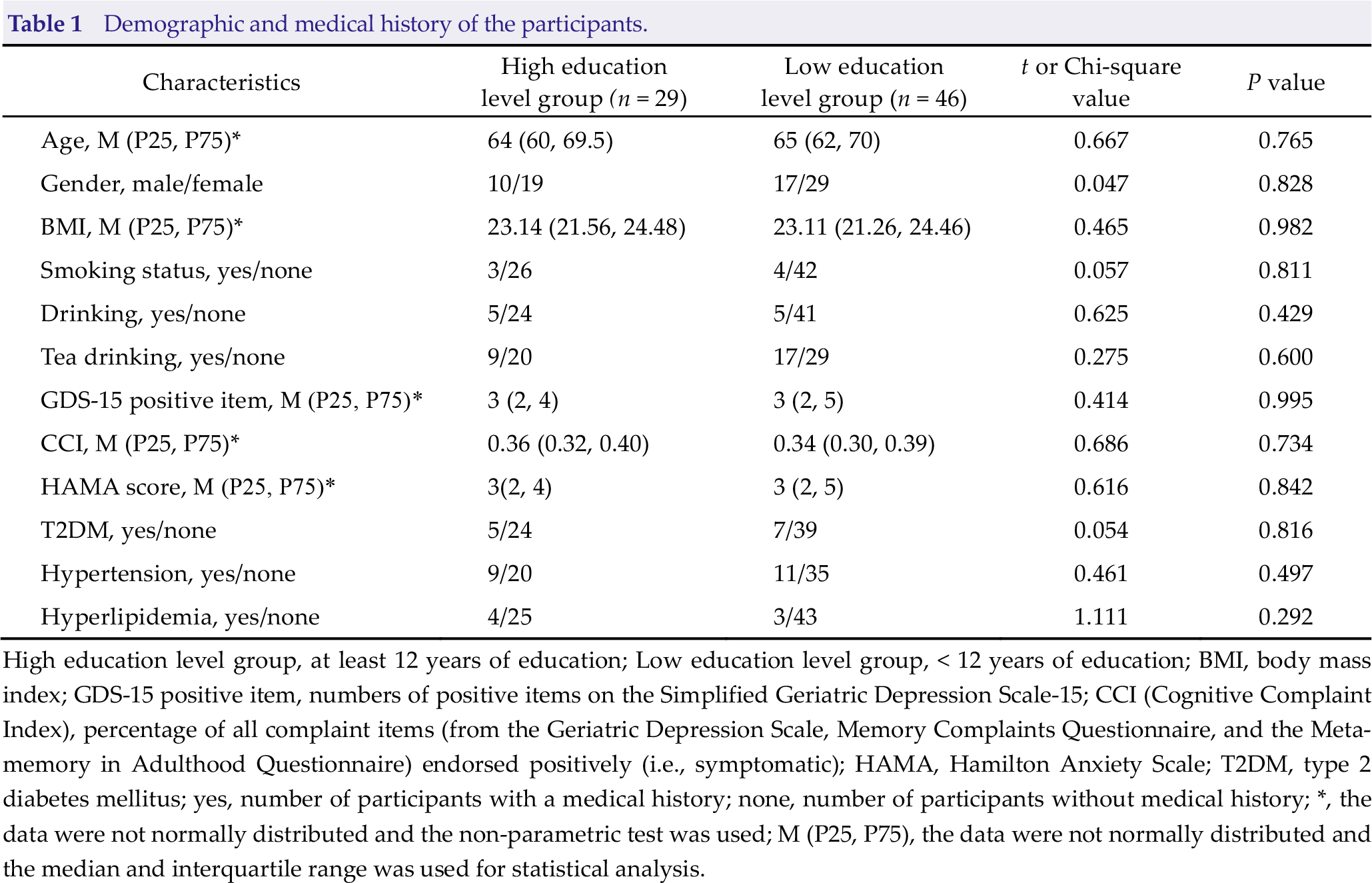
High education level group, at least 12 years of education; Low education level group, < 12 years of education; BMI, body mass index; GDS-15 positive item, numbers of positive items on the Simplified Geriatric Depression Scale-15; CCI (Cognitive Complaint Index), percentage of all complaint items (from the Geriatric Depression Scale, Memory Complaints Questionnaire, and the Meta-memory in Adulthood Questionnaire) endorsed positively (i.e., symptomatic); HAMA, Hamilton Anxiety Scale; T2DM, type 2 diabetes mellitus; yes, number of participants with a medical history; none, number of participants without medical history; *, the data were not normally distributed and the non-parametric test was used; M (P25, P75), the data were not normally distributed and the median and interquartile range was used for statistical analysis.
3.2 Memory function comparisons
This study mainly aims to explore the effect of the education level on the global memory, which was tested using MQ. In addition, the subscores of WMS_CR were included in the data analysis. We found significantly higher MQ and Digit Span subscore in the HE level group compared with those in the LE level group (P = 0.018 for MQ, and P = 0.033 for the Digit Span subscore). No other significant group difference was found in the WMS-CR item examination (Table 2).
Comparison of WMS_CR subscores between high and low education level groups.
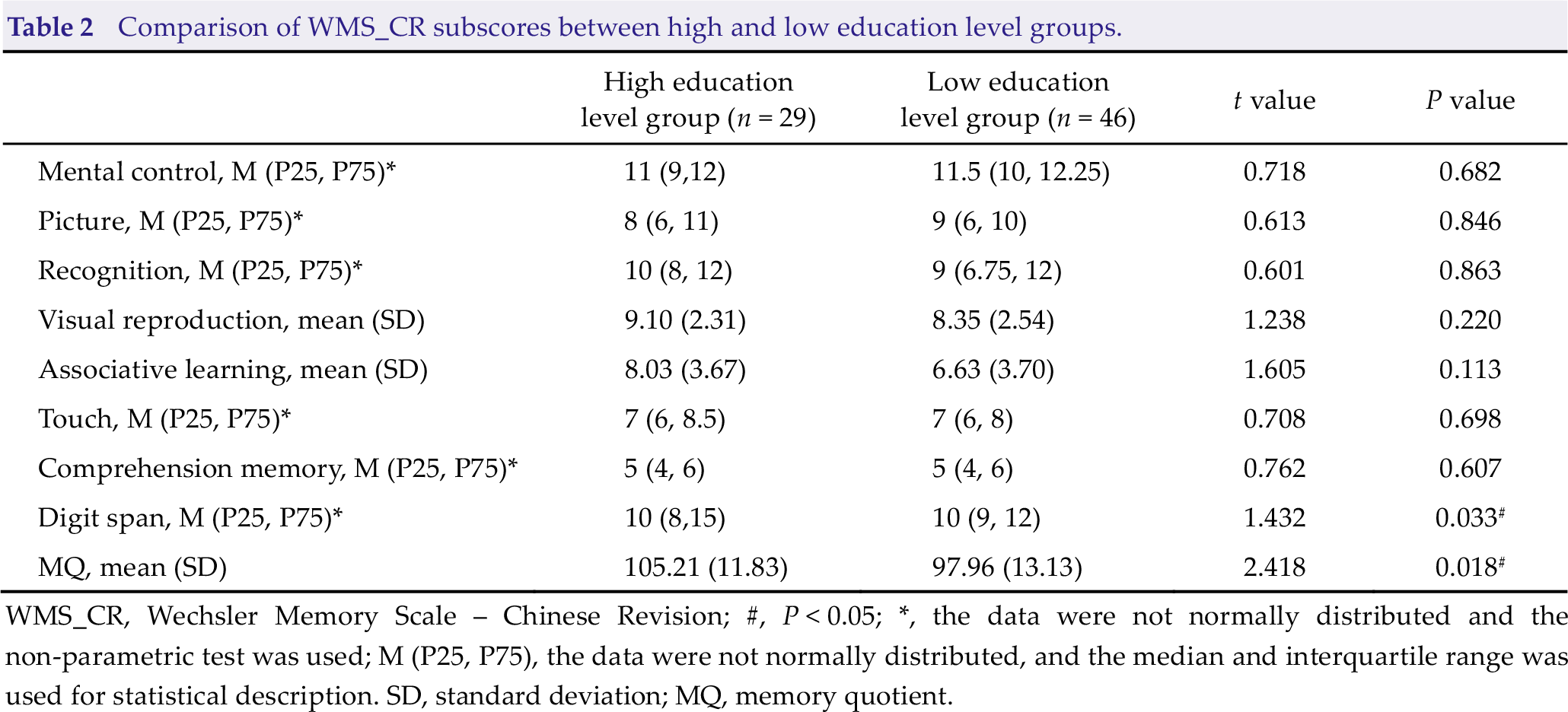
WMS_CR, Wechsler Memory Scale – Chinese Revision; #, P < 0.05; *, the data were not normally distributed and the non-parametric test was used; M (P25, P75), the data were not normally distributed, and the median and interquartile range was used for statistical description. SD, standard deviation; MQ, memory quotient.
3.3 Seed to voxel correlation analyses
We found a significantly decreased rsFC of the bilateral hippocampus with the right mPFC and DLPFC in the HE level group compared with that in the LE level group. No other significant group difference (i.e., above the threshold we set) was observed [Table 3, Figs. 1(B1) and (B2)]. Sincethe MQ and Digit Span subscore were significantly higher in the HE level group than those in the LE level group, we applied a multiple regression analysis to explore the association between the rsFC of bilateral hippocampus with the right mPFC and DLPFC and the MQ and Digit Span subscore in the two groups adjusted to the age and gender. The average rsFC z values of two circles with a diameter of 3 mm and the peak MNI coordinates as center (16, 36, 26/22, 50, 20, see Table 3 for details) were extracted for both groups. We found a significant negative association between the rsFC of bilateral hippocampus with the right DLPFC and the MQ in the HE level group [R = −0.41, P = 0.03; Fig. 1(C1)]. In contrast, the association was positive in the LE level group [R = 0.36, P = 0.014; Fig. 1(C2)]. We also found that the rsFC of the bilateral hippocampus with the right mPFC and the Digit Span subscore were significantly negatively associated in the HE level group [R = −0.43, P = 0.02; Fig. 1(D1)] and positively associated in the LE level group [R = 0.383, P = 0.009; Fig. 1(D2)].
Comparison of rsFC between the high and low education groups.
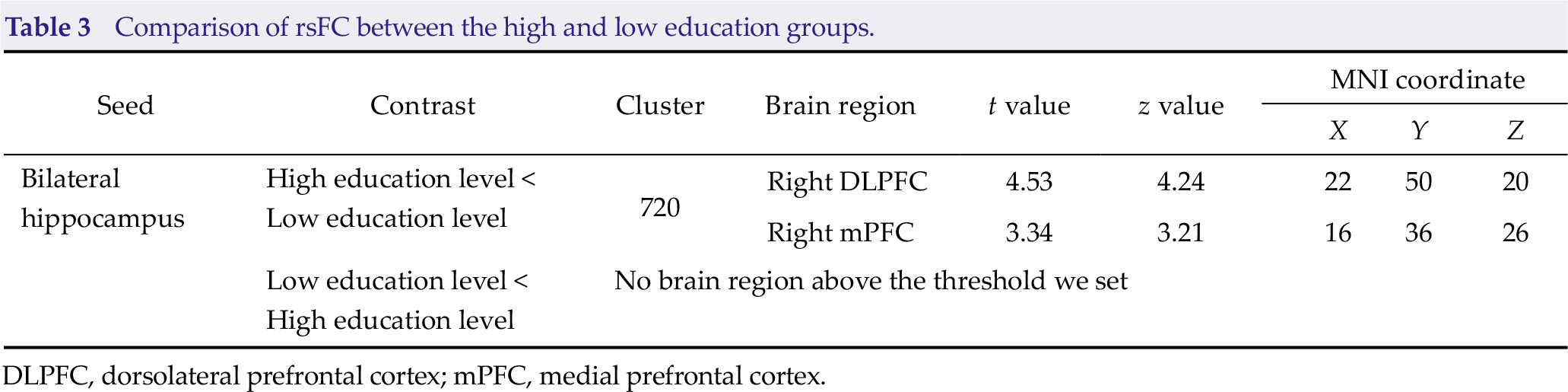
DLPFC, dorsolateral prefrontal cortex; mPFC, medial prefrontal cortex.
3.4 Constrained VBM analysis
The whole brain VBM analysis revealed no significant group differences in the brain region above the threshold we set. In the ROI VBM analysis, we found a significantly increased GMV in the right mPFC–DLPFC cluster extracted from the mask of the rsFC results (voxels: 720) in the HE level group compared with that in the LE group (ratio means and SD in the right mPFC/DLPFC cluster: mean = 0.0002114, SD = 0.00002232 for the HE level group and mean = 0.0001891, SD = 0.00002481 for the LE level group, P < 0.001, Fig. 2).
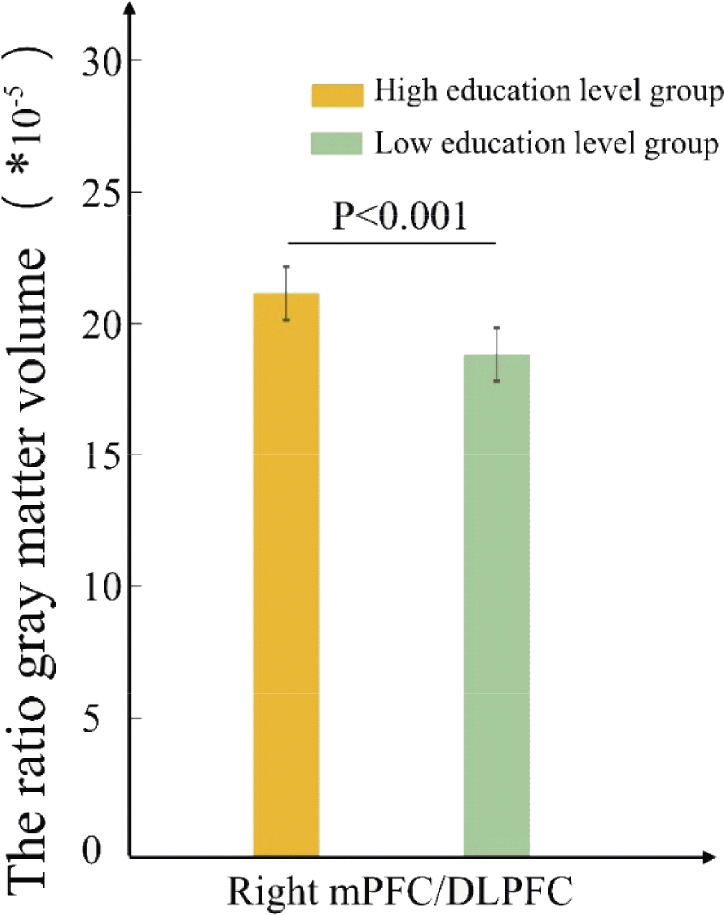
Comparison of the ROI-VBM between the high and low education level groups. As compared with that of the low education level group, an increased gray matter volume was observed in the right mPFC and DLPFC of the high education level group.
3.5 Moderating and mediating effect analyses
The Pearson correlation coefficient between the education level and the MQ or the Digit Span subscore was calculated and showed significant association for the following pair of variables: education level and rsFC1/2 (rsFC1, bilateral hippocampus rsFC with the right mPFC; rsFC2, bilateral hippocampus rsFC with the right DLPFC), rsFC1 and Digit Span subscore, and rsFC2 and MQ (P < 0.05; Table 4). These results indicate that a significant association exists between the education level and the memory function in patients with SCD. Therefore, moderation and mediating effect analyses were conducted.
Correlation analysis results.
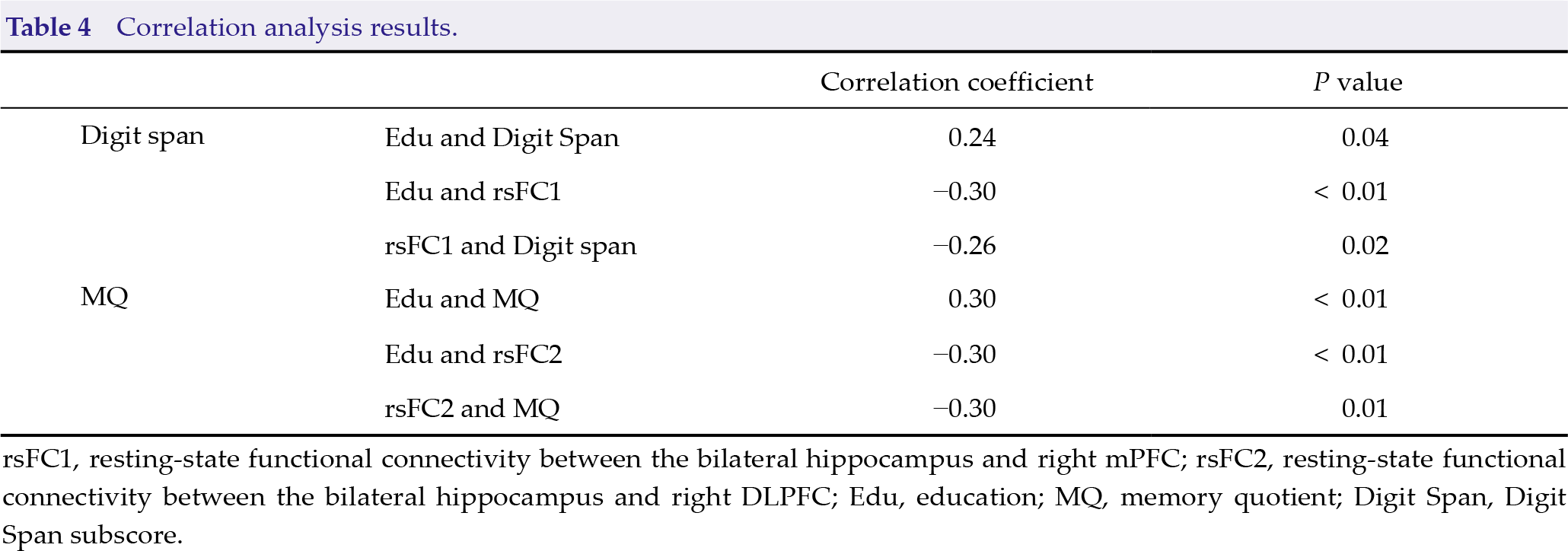
rsFC1, resting-state functional connectivity between the bilateral hippocampus and right mPFC; rsFC2, resting-state functional connectivity between the bilateral hippocampus and right DLPFC; Edu, education; MQ, memory quotient; Digit Span, Digit Span subscore.
The moderating effect analyses revealed a significant moderating effect of the bilateral hippocampus rsFC with the DLPFC on the association between education level and MQ (95%CI: 0.023–0.933, effect rate: 22.57%; Table 5, Supplementary Table S1). In contrast, the bilateral hippocampus rsFC with the right mPFC did not significantly moderate the association between the education and Digit Span subscore (95% CI: −0.009–0.247; Table 6 and Supplementary Table S2).
Decomposition table of the total, direct, and intermediary effects (for the MQ moderating effect analyses).
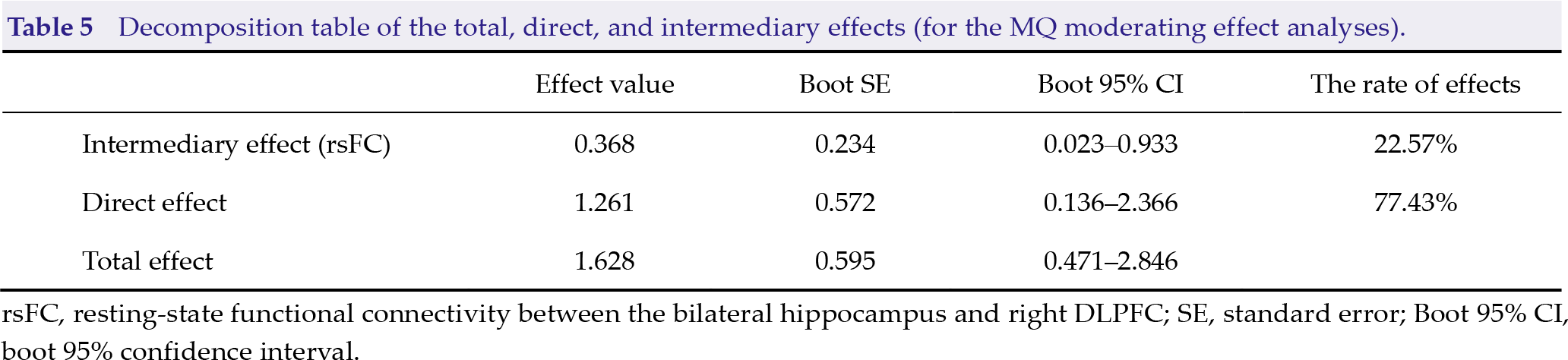
rsFC, resting-state functional connectivity between the bilateral hippocampus and right DLPFC; SE, standard error; Boot 95% CI, boot 95% confidence interval.
Decomposition table of the total, direct, and intermediary effects (for the Digit Span subscore moderating effect analyses).
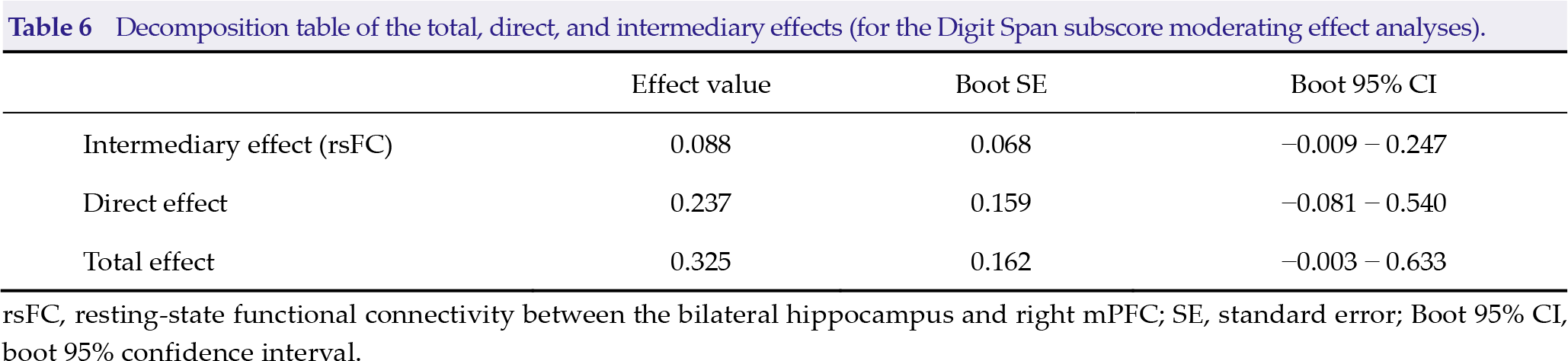
rsFC, resting-state functional connectivity between the bilateral hippocampus and right mPFC; SE, standard error; Boot 95% CI, boot 95% confidence interval.
The mediation effect analyses showed that the bilateral hippocampus rsFC with the right mPFC significantly mediated the relationship between the education level and Digit Span subscore (interaction between education level and rsFC: R 2 = 0.053, F = 4.409, P = 0.04). There was no significant mediation effect between the education level, bilateral hippocampus rsFC with the right DLPFC, and MQ (interaction between education level and rsFC: R 2 = 0.001, F = 0.091, P = 0.764).
4 Discussion
Here, we explored the relationship between the education level and memory function in SCD and the underlying mechanisms. We found that compared with the LE level group, individuals with HE level had better global memory function (MQ) and immediate memory (Digit Span subscore). Furthermore, the rsFC between the bilateral hippocampus and the right mPFC and DLPFC was significantly decreased in the HE level group compared with that in the LE level group. There was a significant association between the bilateral hippocampus rsFC with the DLPFC and MQ and between the bilateral hippocampus rsFC with the right mPFC and the immediate memory. In addition, we found that the rsFC between the hippocampus and right DLPFC moderated the relationship between the education level and MQ, whereas the hippocampus rsFC with the right mPFC mediated the relationship between the education level and Digit Span subscore across all subjects with SCD.
Our findings that highly educated individuals showed better global memory function is partly consistent with those of previous work and further confirm the education role in memory function in SCD. Murayama et al. found that the duration of education correlates with the general memory function in normal elderly [40]. The longitudinal study of Hall et al. on the influence of education on the memory declin erate in participants with incident dementia revealed that each additional year of formal education delayed the time of accelerated decline of the memory test performances by 0.21 years [41]. A broad consensus to explain this is that individuals with HE level tend to have greater brain reserve or compensational ability. A highly educated person might be able to compensate for the neurodegeneration, therefore maintaining a normal memory or cognitive functional level for a longer time than less educated people [42].
Interestingly, we found that the education level effect on the immediate memory of individuals with SCD is more pronounced than that on other memory dimensions (with significant differences between bothgroups measured using Digit Span). This might be due to the link between the immediate memory and attention. A previous study suggested that immediate memory, also named sensory memory, as the first or early memory stage, might bemore susceptible to attention [43]. Moreover, factors related to attention are sensitive to education in adults [44]. Therefore, as a cognitive process involving memory and attention, immediate memory may be more affected by the education level. Further study is needed to validate this hypothesis.
We show a decreased rsFC between the bilateral hippocampus and the right mPFC in the HE level group compared with that in the LE level group associated with immediate memory. The rsFC between the bilateral hippocampus and the right mPFC significantly mediated the effects of the education level on immediate memory in SCD. The involvement of the communication between the right mPFC and the hippocampus in memory processes has been confirmed by increasing literature [45]. For example, Guise et al. found that the mPFC influence on the hippocampus CA1 activity predicted subsequent learning speed and inactivation reduced pattern separation in CA1 representations [46]. The interaction between the mPFC and the hippocampus also contributes to the integrating spatial working and remote memories [47]. Previous studies have confirmed the mPFC-involvement in early memory processes. For instance, a study suggested a key role of mPFC in perceptual memory, which integrates current sensory memory with prior percepts and against the perpetual variability of surroundings via stabilizing visual experience [48]. In animals, mPFC cells might exhibit properties consistent with short-term maintenance of memory for action [45]. Our results suggest that the education level is an important contributor to the immediate memory of patients with SCD, the strength of which is mediated by the level of rsFC between the hippocampus and the right mPFC. Therefore, the rsFC between the hippocampus and mPFC might be a potential target to modulate the education level effects on immediate memory in SCD.
We also observed a decreased rsFC between the bilateral hippocampus and the right DLPFC in the HE level group compared with that in the LE level group. It was significantly associated with the global memory function. In addition, this rsFC significantly moderated the relationship between the education level and MQ. Converging evidence shows that the interaction between the hippocampus and DLPFC plays an important role in memory processing. An fMRI study from Ankudowich showed that hippocampus–right DLPFC connectivity was negatively correlated with the retrieval accuracy in a spatial context memory task in older adults [49]. DLPFC is a key hub in memory processing. A DLPFC lesion human study found that DLPFC damage is associated with the manipulation of verbal and spatial knowledge deficits. In particular, the right DLPFC critically manipulated information in a series of reasoning contexts [50]. Panda et al. examined the coherence of the network connectivity during visual memory encoding and retrieval in the context of education. They found that the education duration is a significant factor influencing the working memory connectivity. As compared with college-educated healthy volunteers, school-educated ones have a higher positive correlation to the DLPFC [51]. The results are partly confirmed by our study as the education level influences the memory function in SCD possibly through the hippocampus– DLPFC connectivity.
We found an increased GMV in the right mPFC and DLPFC in the high educated individuals with SCD compared with that in the LE level group. Research from Kirchhoff suggested that aging significantly affects the prefrontal GMV, which is associated with memory strategies [52]. Available evidence describes that education duration correlated with a greater GMV in the right mPFC and DLPFC [53, 54] in older adults with normal cognitive functions. Combined with the rsFC results, our data show that, besides the functional differences in the hippocampus network (i.e., right mPFC and DLPFC functionally connected to the hippocampus), the increased volume of brain regions involved in the hippocampus network might also contribute to the memory differences shown by individuals with SCD with different education levels.
There are some limitations to the present study. First, the sample size is relatively small, especially for the HE level group. However, at least 20–25 subjects are recommended to maintain 80% power and reliable results in fMRI studies [56, 57]. The number of subjects in the HE level group was 29. Moreover, previous studies suggested that an important consideration for obtaining reliable fMRI results is the duration of the scan. When the scan duration increased, the reliability of rsFC estimates increased. Here, the scan duration of resting-state fMRI was 10 min, which is sufficient for reliable connectivity measurements [55]. Therefore, we believe that our study’s power is sufficient despite the small sample size ofthe HE level group. Further study on larger samples will be needed to validate our findings. Second, a healthy control group is lacking. As a preliminary study, the main aim of this work was to investigate the influence of different education levels on memory functions in SCD. Further investigation on healthy controls will allow to explore the interaction effects of education level and disease on the memory functions in SCD. Finally, the present work explored the education level effects on memory function, which is the most obviously damaged cognitive dimension in SCD. Investigating the impact of the education level on other cognitive dimensions will help to comprehensively understand the relationship between education levels and cognitive functions in SCD and provide further guidance for individualized and precise treatment of different SCD conditions.
5 Conclusions
Our results demonstrate that the education level influences memory functions in individuals with SCD. Subjects with HE level showed better global memory and immediate memory functions than subjects with LE level. The education level had a modulation effect on the brain rsFC as the HE level group showed decreased rsFC of the bilateral hippocampus with the right mPFC and DLFPC and increased GMV in the right mPFC and DLFPC compared with the LE level group. In addition, the mediation analyses suggested that education levels affect the global and immediate memory function in SCD through the hippocampus rsFC with the right mPFC and DLFPC. These findings migh thelp to better understand education level-related alterations of the memory function and brain networks. These results suggest that the decreased rsFC of the hippocampus with the right mPFC and DLFPC in individuals with SCD with an HE level constitutes a cognitive reserve or improve memory performance.
Supplemental Material
Supplemental Material, sj-pdf-1-bsa-10.26599_BSA.2021.9050013 - Hippocampal resting-state functional connectivity with the mPFC and DLPFC moderates and mediates the association between education level and memory function in subjective cognitive decline
Supplemental Material, sj-pdf-1-bsa-10.26599_BSA.2021.9050013 for Hippocampal resting-state functional connectivity with the mPFC and DLPFC moderates and mediates the association between education level and memory function in subjective cognitive decline by Shurui Xu, Qianqian Sun, Ming Li, Jia Luo, Guiyan Cai, Ruilin Chen, Lin Zhang and Jiao Liu in Brain Science Advances
Footnotes
Conflict of interests
All contributing authors have no conflict of interests.
Funding
This study is supported by the National Natural Science Foundation of China (Grant No. 81904270), Natural Science Foundation of Fujian Province (Grant No. 2019J01362), Science and Technology Platform Construction Project of Fujian Science and Technology Department (Grant No. 2015Y2001) and Educational Department of Fujian Province Outstanding Youth Scientific Research Talent Cultivation Program (Grant No. MinJiaoKe[2018]47).
References
Supplementary Material
Please find the following supplemental material available below.
For Open Access articles published under a Creative Commons License, all supplemental material carries the same license as the article it is associated with.
For non-Open Access articles published, all supplemental material carries a non-exclusive license, and permission requests for re-use of supplemental material or any part of supplemental material shall be sent directly to the copyright owner as specified in the copyright notice associated with the article.
