






Abstract
Thrips found in crops in the Puno highlands are occasional pests that damage foliage or flowers, and are known to increase in population during periods of drought. To implement appropriate control strategies, it is necessary to correctly identify the species, commonly known by agricultural producers by the Aymara and Quechua terms "llaja" and "yana-usa," which are translated as "black louse." The study was conducted using specimens of potato (Solanum spp.), quinoa (Chenopodium quinoa), broad bean (Vicia faba), onion (Allium сера), and alfalfa (Medicago sativa) in the towns of Illpa, Camacani, Ichu, and Mañazo. The species identified were: in potatoes, Frankliniella sp. aff. simplex, F. occidentalis, F. australis, F. tuberosi, Thrips tabaci (Thripidae), and Haplothrips trellesi (Phlaeothripidae); in quinoa, F. sp. aff. simplex, F. occidentalis, F. tuberosi, T. tabaci; in broad beans, F. australis; in onions, T. tabaci and F. australis; and in alfalfa, F. australis, F. occidentalis, and T. tabaci. Historically, F. tuberosi has been considered the most widely distributed species in Andean crops; however, in the present study, it was only reported in potatoes and quinoa in a single location and with low population density. This study emphasizes the importance of ongoing sampling, identifying samples, and maintaining a repository of material for verification. In addition, H. trellesi is reported for the first time in the province of Puno.
Introduction
The Peruvian thrips fauna is among the most diverse in the Neotropical region (Estevão Alves-Silva & K. del-Claro, 2010), reflecting Peru's varied landscapes, from the Amazon Rainforest to the Andes (Ortiz, 1977). Although there are still very few long-term initiatives studying Peruvian thrips, over 160 species have been recorded in Peru in the Thysanoptera checklist, approximately 50% of which are endemic (Thrips Wiki, 2026; Zur Strassen, 1995). This known richness mainly results from samplings conducted by Felix Woytkowski, whose specimens were sent to J.D. Hood in the United States to study in the first half of the 20th century. Following Hood's description of most of the Peruvian species known to date, Ortíz (1977) conducted studies on the most relevant thrips in Peru involving the genus Frankliniella and its economically significant species. According to his taxonomic study, 37 species were reported, and their relative importance was indicated.
Besides these studies, most information about Peruvian thrips relates to species of economic importance. However, even in this area, only a few sampling efforts have been done with taxonomic support from voucher specimens. In highland native crops such as potatoes (Solanum spp., Solanaceae) and quinoa (Chenopodium quinoa Willd., Amaranthaceae), as well as other crops adapted to highland conditions such as broad beans (Vicia faba L., Fabaceae), onions (Allium cepa L., Amaryllidaceae), and alfalfa (Medicago sativa L., Fabaceae), the presence of thrips is sporadic on foliage and flowers, especially during droughts or in summer. These insects are considered occasional pests (Bravo, 2010, 2012). They can cause considerable damage to potatoes and quinoa from the beginning of the growing period to the pre-flowering stage (Bravo, 2010). In Argentina, "thrips" have been reported to cause a disease called "top necrosis" or "apical necrosis" in potatoes through the transmission of the Orthotospovirus arachnoannulli (Groundnut ringspot virus) (De Borbón et al., 2012). Thrips species such as T. tabaci Lindemann, F. australis Morgan, F. regia Hood, and F. occidentalis (Pergande) have been reported to feed on the cellular contents of quinoa leaves. This causes scars, deformations, and necrosis, and produces silver spots on the abaxial side of leaves (Delgado et al., 2020).
In broad beans, damage occurs more intensely from the beginning of the first flowering. In alfalfa, damage is less significant but occurs more frequently after each cut (Bravo, 2010, 2012). Paricahua and Chihuan (2022) noted that thrips attacks on broad bean crops in the highlands reduce yields. Therefore, insecticide control is generally needed. Thrips are commonly mentioned as important onion pests due to direct damage or their role as viral vectors (Bravo, 2010). Similarly, they are cited as causing heavy damage to onion crops in southern Italy (Cavalleri & Mound, 2012; De Grazia et al., 2015) and in Santa Catarina, Brazil (Driutti, 1999).
Due to the economic impact of thrips on Andean crops and the limited information available on their identification, particularly in western Peru, the identification of thrips species present in five key crops in the Puno highlands was proposed. This information is expected to lay the groundwork for the pest management of these insect species.
Materials and methods
Thrips were sampled from five important crops in the locations previously described in the Puno highland region (Table 1). Sampling involved shaking the foliage over a tray, using fine hairbrushes, and transferring the samples directly to vials containing 70 % ethanol.
The samples were then prepared for microscopy on permanent slides using Canada balsam, according to the method described by Mound and Marullo (1996).
The specimens were identified using either a VELAB PRIME microscope with an OD400UHW-P camera or a Nikon Eclipse E600 microscope with DIC illumination and a DS-Fil camera. The following keys were used: Ortiz (1977), Goldarazena (2015), Soto-Rodriguez (2018), Mound et al. (1993), Mound and Marullo (1996), Cavalleri and Mound (2012), Cavalleri et al. (2016), De Borbón (2013), Lima et al. (2018), and de Borbón and Zamar (2018).
The recorded specimens were deposited at the Coleção de História Natural da Universidade Federal do Piauí in Floriano, Piauí, Brazil (CHNUFPI), and at the Entomology Laboratory of the Department of Agronomic Engineering and Agrarian Sciences at the Universidad Nacional del Altiplano in Puno, Peru. The codes of the collections are the same in the four places and are identified by: Cultivation, date, and place of collection: PAPA:28423cam,22423illpa, 22423mañ. QUINOA; 22423illpa, 22423mañ. HABA: 22423mañ. CEBOLLA:22423ichu. ALFALFA:22423mañ. From Puno, the duplicates of samples were sent to CHNUFPI, working in parallel to corroborate the identifications.
Crops and sampling locations in Puno, Peru.
Results
A total of six species of thrips, belonging to three genera, two families, and two suborders, were identified in five crops in the Puno highlands (Table 2). Frankliniella was the most common genus, although Thrips tabaci was the most abundant species in onions. One species of Frankliniella, which is prevalent in potatoes and quinoa in Camacani and Illpa (Frankliniella sp. aff. simplex), has not yet been identified because it exhibits characteristics of two similar species.
Frankliniella sp. aff. simplex (Figure 1 A, B, C) and F. compositarum are very similar due to their brownish wings, slightly narrower head than pronotum, and complete posterior margins of the VIII tergite combs. They are also similar to F. simplex because members of this species typically have smaller B1 setae on the IX abdominal tergite than B2 setae. However, this character state appears to be variable among the specimens collected here, with B1 setae that are smaller or nearly equal to B2. Furthermore, F. simplex usually has well-developed III ocellar setae, unlike F. compositarum; however, the specimens in the present study have smaller III ocellar setae. Additionally, F. tuberosi, which is commonly found in potatoes, can be clearly differentiated from F. sp. aff. simplex by its darker body color.
Species identified in five crops in four localities in Puno, Peru.
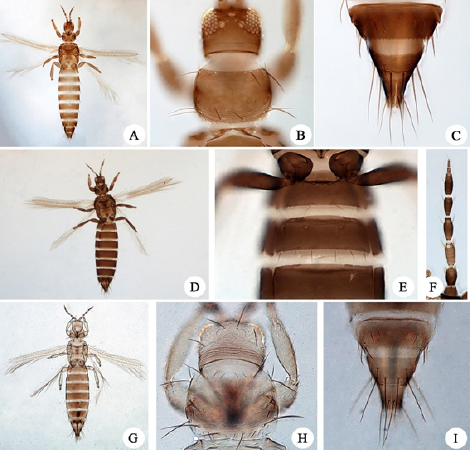
Frankliniella sp. aff. simplex. A. Female. B. Head and Pronotum. C. Abdominal tergites VIII-X. Frankliniella australis. D. Female. E. Abdominal sternites II-IV. F. Antenna. Frankliniella occidentalis. G. Female. H. Head and Pronotum. I. Abdominal tergites VIII-X
Frankliniella occidentalis (Pergande). This species has uniformly light brown abdominal tergites (Figure 1G), though some specimens appear slightly yellow. The fourth pair of postocular setae is as long as the distance between the posterior ocelli (Figure 1H). On the posterior margin of tergite VIII, long, comb-like microtrichia are present (Figure 1I).
Frankliniella tuberosi (Moulton). It has a dark brown body (Figure 2A), brown antennae (except for the second segment, which is lighter, as shown in Figure 2B), and tibiae that are lighter than the femora (Figure 2C).
Thrips tabaci (Lindemann). Differs from that of Frankliniella species. antennae are seven-segmented, and the body light brown (Figure 2D). ocelli gray and two pairs of developed postero-angular setae on the pronotum. The forewings are well-defined (Figure 2E), and the pleurotergites have discal setae and thin microtrichia (Figure 2F).
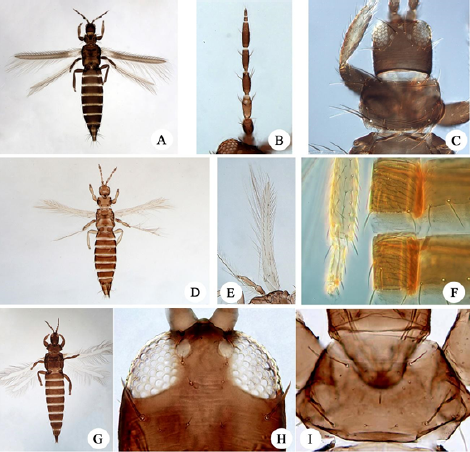
Frankliniella tuberosi. A. Female. B. Antenna. C. Foreleg, Head, and Pronotum. Thrips tabaci D. Female. E. Fore wing. F. Pleutergites. Haplothrips trellesi. G. Female. H. Head. I. Buccal cone and Prosternum.
Discussion
Frankliniella tuberosi was the most abundant species in quinoa (9.5%), while F. occidentalis and T. tabaci only reached 1.7%. These data contrast with those of Delgado et al. (2020), who did not cite F. tuberosi in quinoa but instead cited F. australis, which, in our study, we did not find in any of the sampled localities. Meanwhile, Paricahua et al. (2022) merely mentioned the presence of the genus Frankliniella. Only F. occidentalis and F. tuberosi were confirmed in the species mentioned by Ortiz (1977). Frankliniella occidentalis was collected from potato foliage (0.7%-0.9%), alfalfa (0.6%), and quinoa (1.5%) in Illpa and Mañazo. It is worth noting that these populations are lower than those of other species such as Frankliniella sp. aff simplex and F. tuberosi in potatoes, F. australis in broad bean, and T. tabaci in onion and alfalfa. De Borbón et al. (2012) made special reference to F. tuberosi, which was recorded in Argentina and caused damage to potatoes. In the present study, we identified only four species of Frankliniella out of the 230 species cited in the Neotropical region. Meanwhile, Ripa et al. (2009) reported the presence of F. occidentalis on some vegetables in Chile's central zone.
In broad beans, only F. australis (12.7 %) has been recorded in Mañazo, where large areas of this legume are cultivated. De Borbón et al. (2013) also reported this species in Argentina, Chile, and Brazil on the flowers of various crops, weeds, and native plants, primarily from the families Asteraceae, Brassicaceae, and Fabaceae. In Mañazo, it was recorded at 9.3% in alfalfa, while in Ichu, it only reached 4.5% in onions. Thrips tabaci has been reported almost exclusively in onions in Ichu, accounting for 33.9% of the total sample. Driutti (1999) and Lima et al. (2018) pointed out that this species has the largest population in onions, a very important crop in Santa Catarina, Brazil. De Grazzia et al. (2015) reported on the importance of T. tabaci and indicated that it is a pest of this crop in many parts of the world. Additionally, in the present study we found T. tabaci in quinoa, potatoes, and alfalfa at very low percentages (0.2%, 0.3%, and 0.4%, respectively).
Haplothrips trellesi is a new record for the Puno region of Peru. To date, no species of the family Phlaeothripidae have been identified in this region (Bravo, 2010, 2012; Delgado et al., 2020). Moulton (1935) described two new species in Argentina, one of which was H. trellesi. Subsequently, SENASA, 2024 (National System for Surveillance and Monitoring of Pests, Argentina) (n.d.) (retrieved on January 10th, 2024) reports the same species on ornamental flowers and other crops, including quinoa flowers. In contrast, H. trellesi was collected from potatoes only in the Camacani locality (3,850 m a.s.l.) in the Puno region, representing 1.8% of the total individuals analyzed.
Finally, Frankliniella sp. aff. simplex is an apparently undescribed species with mixed characteristics of F. simplex and F. compositarum. Polymorphisms are common in the order Thysanoptera, and small morphological differences can be found between similar species (Mound, 2005). This occurs frequently within the genus Frankliniella; therefore, an integrative approach can be used to reach a conclusion. Specimens were collected from potatoes in Camacani (9.7%) and Illpa (4.1%), as well as from quinoa in Illpa (6.4%).
Conclusions
The present study corroborated the species of thrips found in Peru and increased their diversity by mentioning H. trellesi for the first time in the Puno province. Thrips tabaci were recorded as dominant in onions; F. australis, in broad beans; and Frankliniella aff. simplex, in potatoes and quinoa.
Origin and Funding
This work was carried out with support to the Vice Chancellor of Research of the National University of the Altiplano Puno-Peru, based on the proposal to recognize the "thrips" species insects present in some Andean crops of the Peruvian highlands. Aditionally was partially funded by the National Council for Scientific and Technological Development (CNPq), Brazil (Processes Numbers_405169/2024-8 and 313586/2025-0) (EFBL).
Author Contribution
Rosario Bravo-Portocarrero: Investigación; Escritura – Borrador original; Adquisición de Financiación. Elison Fabricio Bezerra-Lima: Identification of insects, writing – review and editing, funding. Revisión y edición. Elva Campos- Quipe: Apoyo investigación; Escritura – Revisión y Edición.
Conflict of Interest
The authors declare that they have no conflict of interest.
Footnotes
Acknowledgments
The authors express their gratitude to the Vice Chancellor of Research of the National University of the Altiplano Puno for the sponsorship in the execution of the research and this scientific article.
To Francisca Quispe Mayta and Lizbeth Mamani Coaquira, students of Agronomic Engineering, as well as to Jaime Yucra, laboratory technician of the Entomology Laboratory, who supported the collection and conservation of samples in the crops and research sites.
To María Luisa Bull Fernández who supported the translation of this scientific article.