






Abstract
The objective of this work was to establish the first record of Caliothrips phaseoli (Hood, 1912) (Thysanoptera: Thripidae); in forage peanut accessions in the state of Acre, Brazil. The specimens were collected directly from the leaves of infested plants grown in pots and under greenhouse conditions, preserved in 70 % ethyl alcohol, and mounted on slides to later be observed under a microscope. Caliothrips phaseoli is a polyphagous species considered an important pest in bean and soybean crops in Brazil. The insect feeds on forage peanuts causes chlorosis on the leaves and delays the development of infested plants, although no mortality was verified.
Introduction
The variability of pastures cultivated in tropical regions is low, limiting the number of available cultivars and increasing the need to study genetically improved forage species to better adapt to the various edaphoclimatic conditions in Brazil (Jank et al., 2011). Thus, intercropping with legumes (Fabaceae) is an alternative that allows diversification, reduces the genetic vulnerability of pastures, and improves productivity (Annicchiarico et al., 2015).
In Brazil, species of the genera Arachis, Pueraria, and Stylosanthes have often been used in consortiums, mainly with African grasses such as Panicum and Urochloa (= Brachiaria) (Rocha & Valls, 2017; Valle et al., 2009).
Due to its importance, studies on forage peanuts, Arachis spp. (Fabaceae) have been conducted in Brazil to provide highly productive, resistant, and nutritional quality cultivars (Assis & Valentim, 2009). However, expanded use of this forage is limited by the scarce knowledge about the phytosanitary problems associated with its cultivation. In this context, entomological evaluation is necessary for the launch of new Arachis cultivars, as it aims to understand the associated arthropods, as well as their population and damage levels (Fazolin et al., 2011)
Currently, the economically important arthropods for forage peanuts recorded in the Brazilian state of Acre are Oligonychus gossypii (Zacher, 1921), Mononychelus planki (McGregor, 1950), Tetranychus urticae Koch, 1836, Tetranychus ogmophallos Ferreira & Flechtmann, 1997 (Acari: Tetranychidae), Brevipalpus phoenicis (Geijskes, 1939) (Acari: Tenuipalpidae), Cerotoma arcuata tingomariana Bechyné, Diabrotica speciosa (Germar, 1824) (Coleoptera: Chrysomelidae), Dysmicoccus sp. (Hemiptera: Pseudococcidae), Gargaphia paula Drake & Ruhoff, 1965 (Hemiptera: Tingidae), and Enneothrips enigmaticus Lima, Alencar, Nanini, Michelotto & Corrêa, 2022 (Thysanoptera: Thripidae) (Fazolin et al., 2011, 2015; Guidoti et al., 2014; Lima et al., 2022). The objective of this study was to make the first record of the association of a species of thrips in forage peanut accessions in Brazil.
Material and Methods
In September 2022, an inspection of greenhouse-grown forest peanut accessions (10°01′S, 67°42′W, 168 m a.s.l.) was carried out in the Embrapa Acre experimental field (Figure 1A) in Rio Branco, State of Acre, Brazil. In several accessions, obvious damage was observed on the leaflets of the referred crop (Figure 1B). In the field, the presence of thrips was verified using a pocket magnifying glass (10X); the incidence was significant, with the highest density found in the adaxial part of the leaflets.
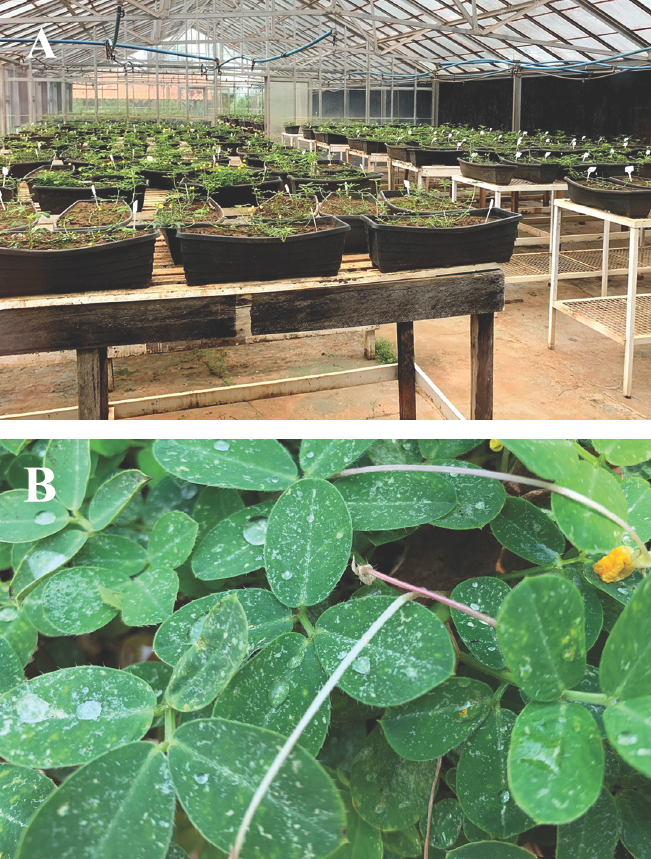
Arachis (Fabaceae) accessions in rectangular plant pots in a greenhouse (A). Close-up of forage peanut leaflets with injuries caused by thrips (B).
Twenty rectangular pots were randomly inspected, and individuals were collected with a fine brush, counted, and placed in a bottle containing ethyl alcohol (70%). Subsequently, the specimens were slide-mounted on glass slides and sealed with a cover slip in mounting medium following the methodology proposed by Mound and Marullo (1996) and identified based on Lima et al. (2020, 2022). Voucher specimens were deposited in the Natural History Collection of the Federal University of Piauí (CHNUFPI), municipality of Floriano, State of Piauí, Brazil.
Results and Discussion
The species was identified as Caliothrips phaseoli (Hood, 1912) (Thysanoptera: Thripidae) (Figure 2), which has been recorded in Argentina, Brazil, Costa Rica, Cuba, Ecuador, Mexico, Paraguay, Peru, Panamá, United States, and Uruguay (Lima, 2023). In Brazil, it has already been recorded in the Northern (Acre), Northeastern (Ceará, Bahia, Piauí, Sergipe, Pernambuco, and Maranhão), Central-western (Mato Grosso and Goiás), Southeastern (Espírito Santo, Minas Gerais, São Paulo, and Rio de Janeiro), and Southern (Rio Grande do Sul, Paraná, and Santa Catarina) regions (Lima, 2023).
Caliothrips phaseoli is the most common species of the genus in Brazil. It is distinguished from Caliothrips fasciatus (Pergande, 1895) and Caliothrips insularis (Hood, 1928) (Thysanoptera: Thripidae) by the transversely striated carving on the lateral thirds of abdominal tergites (Cavalleri et al., 2018).
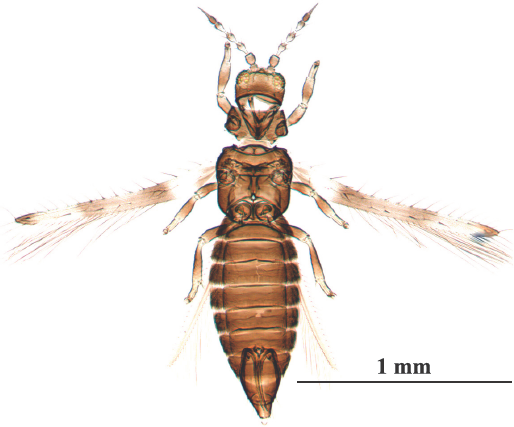
Photomicrograph of a female Caliothrips phaseoli (Thysanoptera: Thripidae).
In the state of Acre, C. phaseoli has already been recorded in association with mint, Mentha sp. (Lamiaceae) by Santos and Lima (2016), and on cultivated sunflower, Helianthus annuus L. (Asteraceae) by Santos (2021). It is a polyphagous species reported as a pest of several plants, feeding preferentially on leaves of legumes (Fabaceae) (Lima et al., 2013), and considered an important pest of bean and soybean crops in Brazil (Monteiro et al., 1999). This species has been recognized in peanut, Arachis hypogaea L. (Fabaceae) in Brazil for a long time, although it is considered to have no economic importance in crops established in the field.
Although the death of infested plants was not observed in forage peanuts, the damage caused by the attack (average of nine insects per plant) of C. phaseoli causes weakness, yellowing, and delay in plant development. Species identification in peanut crops is an important step to recognizing potential pests of this crop which, in Acre, positively impacted the livestock production chain of around R$ 82.3 million in 2018 (Sá et al., 2019). In addition, this legume can be used for hay production, in protein banks, as green cover in perennial species crops, and as ornamental plants in town squares and gardens (Valentim, 2011).
Until now, there was only a record of E. enigmaticus associated with forage peanuts in Acre (Fazolin et al., 2015), which is considered the main pest of the peanut plants, A. hypogaea in Brazil (Lima et al., 2022).
Currently, a total of 27 phytosanitary products are registered with the Ministry of Agriculture and Livestock for the control of C. phaseoli in soybean crops in Brazil (Agrofit, 2024). However, none of these products are recommended for forage peanuts, considered a crop with insufficient phytosanitary support in Brazil. Thus, it is recommended that these products be tested experimentally in terms of their efficiency in the cultivation of forage C. phaseoli in the various edaphoclimatic conditions of Brazil.
Conclusions
Forage peanut (Arachis spp.) is a host of Caliothrips phaseoli, causing delayed plant development under semi-field conditions and reported for the first time in Brazil.
Origin and Funding
The study is not financially supported by any party, it was carried out with the Institution's own generic resources.
Author's Contribution
The first author was responsible for collecting insects and writing the manuscript.
The second author was responsible for the taxonomic identification of insects and writing the manuscript.
Conflict of Interest
The authors declare no conflicts of interest.