






Abstract
This study aimed to identify the Hemerobiidae (Neuroptera) associated to Brazilian savannah and gallery forest, in Minas Gerais State, Brazil. The sampling was carried every two weeks at Brazilian savannah (Cerrado) in Divinópolis and at gallery forest in Pedra do Indaiá, both in Minas Gerais State, Brazil. Collecting was carried out between November 2003 and October 2004, with Malaise traps. A total of 181 specimens of five species of Hemerobiidae were collected. The species
Introduction
Hemerobiidae is one of the most primitive groups among the Neuroptera; they were originated in the Permian (González-Olazo 1981) and has been registered in all continents except at Antartida. The family comprises about 600 species distributed among 25 genera, from which 11 occur in the Neotropical Region (Oswald 1993, 2004; Monserrat 2003).
Several species of Hemerobiidae act as predators of insect pests of commercial crops such as soybean, cotton, citrus, and coffee (González-Olazo 1987; Lara and Freitas 2002; Lara and Perioto 2003). Larvae and adults of Hemerobiidae feed on a great variety of small plant sucking arthropod, especially aphids, soft scales, psyllids, mites, and other soft-bodied species (Penny and Monserrat 1983; Oswald 1993).
Little is known about the fauna of this group in Brazil: the limited information available comes from taxonomic studies (Penny and Monserrat 1983; Lara and Freitas 2002, 2003), occurrence records (Chagas
Material and methods
Sampling was conducted in two locations: one in a 1,2 ha area of Brazilian savannah located in the FUNEDI/UEMG campus (20°08′21″S 44°53′17″W, 712 m) which was surrounded by allotments in the suburbs of Divinópolis, MG; and another one in a gallery forest about 22 meters wide located in Pedra do Indaiá (20°15′53″S 45°09′48″W, 857 m) also in MG. The gallery forest's canopy can reach up to 18 meters, and hosts in its interior a creek that belongs to the Lambari River basin, which is surrounded by
Monthly abundance of the Hemerobiidae collected with Malaise traps in areas of Brazilian savannah and gallery forest in Divinópolis and Pedra do Indaiá, Minas Gerais State, Brazil, respectively. Period of collection between November 2003 and October 2004.
The collections were conducted every two weeks between November 2003 and October 2004. The traps remained active during all the collection period. The material was taken to the Zoology Laboratory of Fundação Educacional de Divinópolis FUNEDI, where they were screened for insects. The Hemerobiidae obtained were sent to the Laboratorio de Sistemática e Bioecologia de Parasitoides e Predadores da APTA Ribeirão Preto, São Paulo. There they were identified based on articles by Oswald (1993) and Monserrat (1996, 1997, 2000).
Shannon-Wiener (H') and equitability J (ShannonWiener) indexes were used for the analysis of the Hemerobiidae's fauna diversity. To estimate the values from these indexes, a base -10 logarithm was applied, and the calculations were obtained with the software DivEs (Rodrigues 2005). The diversity values obtained were compared by the t-test described by Magurran (1988).
Results and discussion
A total of 181 specimens of Hemerobiidae from five different species were collected in the study plots.
In Divinópolis' Brazilian savannah area, 89 specimens from four species were collected (Table 1):
In Pedra do Indaiá's gallery forest area, 92 Hemerobiidae from five species were collected (Table 1):
In both areas, the greatest Hemerobiidae abundance occurred between June and October. During this period in Divinópolis, 74 specimens were collected, which represents 83.1% of the total collection in that area, a fairly high number that was close to the one registered in Pedra do Indaiá (81/ 88%); the greatest frequencies occurred in August and September 2004, respectively.
The structure of the Hemerobiidae communities in both studied locations were quite similar. Three species,
Shannon-Wiener's (H') diversity index and the Equitability (J) index, and comparison between (H') values using t-test for the Hemerobiidae populations collected in areas of Brazilian savannah and gallery forest in Divinópolis (D) and Pedra do Indaiá (PI) - Minas Gerais state, Brazil, respectively. Period of collection between November 2003 and October 2004.
= not significant.
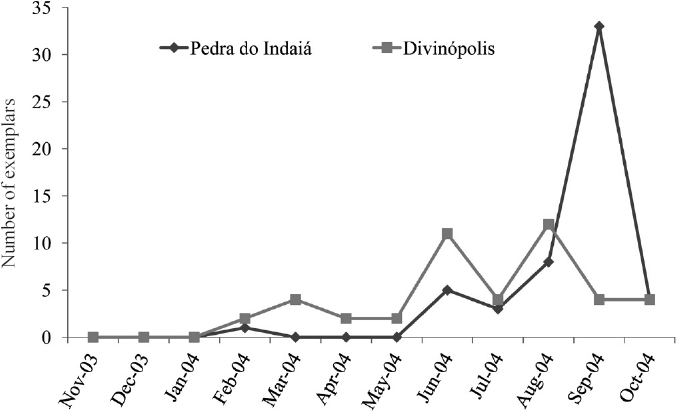
Fluctuation in the population of
Lara
Despite the little data available, it is interesting to note that the Hemerobiidae's communities structure are very similar and dominated by only one species – except for the community found in the coconut crop. Hughes (1986) commented that in community samples, most individuals captured belong to a small number of abundant species, while most species are represented by a small number of individuals.
The Shannon-Wiener's diversity index (H') and the equitability (J) index for the Divinópolis (
The fact that the gallery forest area did not show a significantly greater diversity value than the Brazilian savannah area can be related to the occurrence of
The diversity values obtained in this study are inferior to those reported by Lara