






Abstract
A major part of the mechanisms that affects species distribution is related to environmental conditions. Within a stream channel the accumulation of substrates like litter, roots, stones, gravel and sand create habitats that act as shelter and/or food source to aquatic communities, in this way supporting, or not, the establishment of different species. Based on this fact we verified the structure of aquatic insect communities in organic and inorganic habitats within Cerrado streams. Tested for differences on genera richness (i), individual abundance (ii) and genera composition (iii), and also (iv) verified if there are any indicator genera, which are faithful and specific to organic or inorganic habitats. Sampled organic (litter) and inorganic (sand and gravel) substrates in five sections of three streams and collected individuals of the orders Ephemeroptera, Plecoptera, Trichoptera, Odonata and Heteroptera (EPTOH). Community composition differed between habitats, with organic ones having higher richness and abundance, besides being the only habitat that presented faithful and specific genera (six). It is argued that this difference may be caused due to shelter and food supply provided by organic substrates.
Introduction
Understanding of species distribution patterns is a key question in ecology (Sutherland
Environmental heterogeneity of the river channel, caused by spatial or temporal variation of water physicochemical features and substrate complexity, defines environmental patches that affect species distribution due to a set of features and resources favorable to their functional, physiological and life history traits (Poff and Ward 1990). Therefore, the substrate plays a major role in species distribution, as it provides conditions, resources, shelter and feeding for stream fauna (Resh and Rosenberg 1984; Shimano
Among aquatic organisms, insects stand out in ecological analysis due to their high diversity (Dijkstra and Clausnitzer 2006), broad distribution and key roles in trophic webs (Tomanova
Previous studies indicate that, for Cerrado streams, organic substrates, such as leaf packs and roots, have a higher abundance and diversity of Heteroptera from both suborders Nepomorpha (Dias-Silva
We verified the community structure in Cerrado streams with both organic and inorganic substrate and tested for possible differences in richness (i), abundance (ii) and genera composition. Further, (iv) we looked for genera that may act as biological indicators, due to its specificity and fidelity to organic or inorganic habitats.
Material and methods
On each stream we defined 50 meter linear transects and further divided those transects to create five 10 meter sections. For each section we sampled twice with a Surber, one for organic substrate (litter) and the other for inorganic substrate (sand and gravel), in that way we had fifteen sampling units for each substrate type, five in each stream (three streams). According to Costa and Melo (2008), aquatic insect fauna has a greater difference in different habitats within a stream when compared with similar habitats on different streams. Therefore, it is reasonable to assume a certain degree of independence among different habitats within the same stream, which, in its turn, allows for the use of those locations as replicates, since there are little effects regarding possible bias related to spatial dependence among samples.
We identified EPTOH specimens by recurring to generic taxonomic keys (Nieser and Melo 1997; Costa
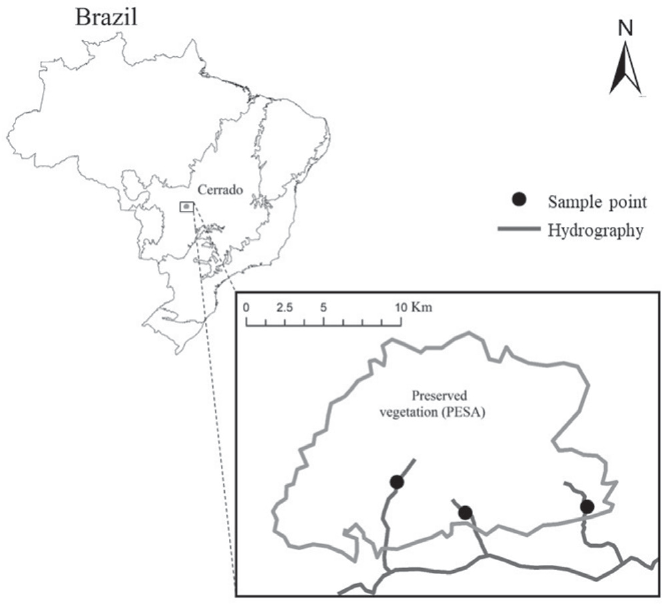
Spatial distribution of the sampled streams in Central Brazil in Cerrado biome. The area represents the remnant native vegetation fragment aggregated to the Parque Estadual da Serra Azul (PESA).
Results
A total of 1,156 EPTOH specimens from 41 genera were collected, of those the most abundant were
Community structure differed in all aspects, when comparing organic and inorganic substrates. Organic substrates had an average of 6.6 genera and 60 individuals more than inorganic substrates (Tsep. var.= -3.46, df = 21.21, P = 0.002, Tsep. var.= -4.27, df = 14.41, P < 0.001, respectively). Species composition also differed among habitats (PERMANOVA, pseudo F = 3.407, P = 0.001) (Fig. 2), with six genera being characterised as indicators for organic habitats (Table 1 and Fig. 3). The distance between centroids in figure 2 and the low overlap (or peripheral overlap) of the organic sampling units over the area defined by inorganic sampling units reinforces the difference between habitats and suggests a community associated with organic substrates which is different from another associated with inorganic ones, even if those locations occur on the same stream.
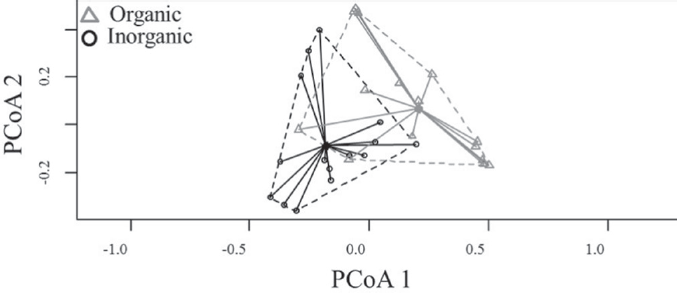
Ordination (Homogeneity of multivariate dispersions within groups) of the taxonomic composition of aquatic insects in organic and inorganic habitats within Cerrado streams of Central Brazil.
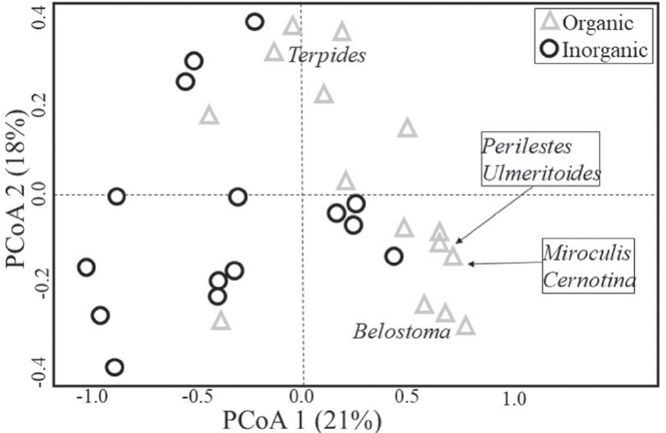
Distribution of the Ephemeroptera, Plecoptera, Thichoptera, Odonata and Heteroptera (EPTOH) in the samples organic and inorganic habitats within Cerrado streams of Central Brazil. The genera highlighted in the graph are those selected by Indicator Species Index (ISI) (See table 1).
Discussion
EPTOH's community structure was different among habitats for all evaluated aspects. Organic substrate habitats had a greater diversity and a set of taxa that was specific and faithful to it. Our results indicating a higher diversity in organic substrates are in accordance with previous observed patterns for Ephemeroptera (Shimano
Taxa distribution within a stream is strongly related to the availability of environmental resources (Allan and Castillo 2007), among which food supply stands out (Cummins
In our study six taxa had fidelity and specificity to organic substrates, among which three were dependant on the litter (organic substrate) for feeding: shredders genera
The lack of taxa with high specificity and fidelity to habitats with inorganic substrates could be explained by the low abundance of apparent potential taxa, such as
Indicator Species Index (ISI) of those genera identified as indicators of organic habitats within Cerrado streams of Central Brazil.
Other than food supply, another factor that may play a key role in the distribution of aquatic insects within a stream is the ability of the habitat to provide shelter. That is because most taxa do not have the specific morphology which would allow them to occupy locations with high currents, an example of a genera with such adaptations would be
Conclusion
There are differences in genera richness and composition and individual abundance between organic and inorganic substrates. It is possible to imply genera that have a high fidelity and specificity to organic habitats, of which two are shredders, one is a brusher and three are predators. Habitats created by litter (organic) are used by a broader diversity of aquatic insects, due to, according to several authors, its higher food supply and structure as shelter. As riparian forests are the main source of allochthones materials, which are responsible for the creation and maintenance of the litter inside streams, our results reinforce the need to preserve those forests. In addition, besides the advantages listed on this paper, riparian forests are the ones that makes it possible for the stream to sustain the diversity of aquatic insects as they are responsible for a high input of energy into the system, in the form of leaves.
Footnotes
Acknowledgements
We appreciate M. Sc. Andre Andrade the assistance with the English language and MSc. Lourivaldo A. Castro and Biologists Paula V. B. Fonseca and Mariana G. Pavan the field support. Thanks CAPES for a Ph. D. scholarship and Joana Darc Batista thanks. We thank the team of Laboratório de Entomologia de Nova Xavantina, for their support during field sampling. We thank CNPq for the financial aid to the field work SISBIOTA (#563134/2010-0) - Project “Diversidade biológica do Cerrado: estrutura e padrões” and for the LSB PhD scholarship (Process 140111/2015-8) and for NFSG scholarship of DTechnological and Industrial Development-C (CNPq/PELD #403725/2010-7). We thank the SISBIO by collecting license #457497/2012-2.