






Abstract
Introduction
Larvae of
The species
Control of
Due to the need of adopting less impactful control tactics to human and to the environment, plant extracts have been studied as an alternative to the use of synthetic insecticides. Characteristics of plant extracts such as low toxicity and persistence make them less harmful to the environment (Costa
Given the growing demands for alternative and sustainable methods of crop pest control, this study aimed at assessing the effects of application of neem formulations (oil-formulated andlignin-microencapsulated) to control of
Material and methods
The study was carried out at the Laboratório de Resistência de Plantas a Insetos, of Departmento de Fitossanidade, of Universidade Estadual Paulista, Jaboticabal, state of São Paulo, Brazil, located at geographical coordinates 21°15'S, 48°18′W, and 595 m altitude (Almeida
In all assays, 25 g of sieved soil was oven-sterilized (model AS200S, Quimis, Diadema, state of São Paulo, Brazil) at 110 °C for 48 hours and placed in 100 mL plastic containers. Three maize seeds (variety AL-Piratininga) were sown in each container, and 15 mL of deionized water was added. Deionized water (10-15 mL) was applied on the containers with a syringe on a daily basis to keep the plants turgid over the experiment conduction. Nine-day-old larvae that were collected from the laboratory colony were used in the assays. The larvae were reared on maize plants (variety AL-Piratininga) prior to the assays, following methodology of Ávila
Oil-formulated neem extract
This assay evaluated the effects of five rates of oil-formulated neem extract on
To prepare the oil-formulated neem extract, the following ingredients were used: 0.6 g fraction-ethyl acetate obtained by liquid-liquid partition from neem crude ethanolic extract (Costa
Thinning of maize plants was performed when they were 4-day old, keeping only one plant per container. The rates of oil-formulated neem extract were applied on the roots using a 1.0-mL syringe, simulating a drench application. Thereafter, the roots were covered by soil that had been previously removed. Finally, two 9-d-old
Lignin-microencapsulated neem extract
Lignin used in this assay was obtained from sugarcane bagasse by soda-pulping process as previously described by Costa
After formulated the total amount of azadirachtin powder was determined by HPLC according to Forim
Assessments of application of neem formulations on Diabrotica speciosa development and survival
Ten days after infesting the maize plants with
Assessment of application of neem formulations on maize growth
To evaluate the effects of neem formulations on maize growth, the plants were oven-dried (model AS200S, Quimis, Diadema, state of São Paulo) at 60 °C for 48 hours, right after removal of pupae. Dried matter of the aerial part (aboveground plant tissue) and root system (belowground plant tissue) of plants were measured using an analytical scale. Reduction percentages of plant height, dry matter of plant aerial part and root system, and number of leaves were calculated based on differences of plant growth in untreated and treated maize using the formula: X = (PC-PT)/PC*100, where X = reduction percentage; PC = value of evaluated parameter in control (uninfested maize); PT = value of evaluated parameter in the treatments (infested maize).
Statistical analysis
Data were checked for normality of residuals (Kolmogorov-Smirnov's test) and homogeneity of variances (Bartlet's test). Data on
Results
Oil-formulated neem extract
There were significant differences in the number of survived pupae of
Number of survived pupae and adults (mean ± standard error) of
Means followed by the same letter in column did not differ significantly by Tukey's test at 5% probability. For analysis, data were transformed in (x + 0.5)1/2.
Number of insects that passed to the pupa phase;
Insufficient data to perform statistical analyses.
significant at 0.1% of probability by F test.
Adults of
Results of percentage of control efficiency (Abbott 1925) of
Concerning the reduction percentages of plant growth (Table 2), there were significant differences only for dry matter of root system. Higher reduction percentages of dry matter of plant root system were found for the rates of 1.0 mL 25 g−1 soil (11.93 % reduction) and 2.0 mL 25 g−1 soil (11.58 % reduction), differing from fipronil WG (no reduction). However, these rates did not differ from the other rates of oil-formulated neem extract. Also, the rates 0.25, 0.5, and 4.0 mL 25 g−1 soil did not differ from fipronil WG (9.14, 9.09, and 8.85 % reduction of dry matter of root system, respectively).
Lignin-microencapsulated neem extract
The powder of lignin microparticles loaded with ethyl acetate fraction from neem ethanolic extracts showed clusters of microparticles, which had an average size around 1.0 µm (Fig. 2). Once the colloidal suspension dried by Spray-drying, all azadirachtin was incorporated in the lignin microparticles.
There were significant differences in the number of survived pupae of
Since all treatments caused high
The values of percentage of control efficiency of
Considering the reduction percentages in maize growth recorded from untreated and treated plants (Table 4), significant differences were not found among treatments. Similar to the effects observed in maize growth following application of oil-formulated neem extract, lignin microencapsulated neem extract did not affect maize growth, and all rates of the neem extract were similar to fipronil WG.
Discussion
Overall, the botanical insecticide neem in both formulations, oil and microencapsulated by lignin, proved to be as efficient as the synthetic insecticide fipronil WG to control
Reduction percentages (mean ± standard error) of height, dry matter of the aerial part and root system, and number of leaves of maize plants after application of doses of oil-formulated neem extract and insecticide fipronil.
Means followed by the same letter in column did not differ significantly by Tukey's test at 5% probability. For analysis, data were transformed in log (x + 5).
significant at 5% probability by F test.
non- significant at 5% probability by F test.
According to Isman (2000), botanical pesticides with highest efficacy for controlling insect pests may also be the most toxic to plants. However, in the present study all tested rates of both neem extract formulations did not affect maize growth parameters. Despite the fact that oil-formulated neem extract at 1.0 mL 25 g−1 soil and 2.0 mL 25 g−1 soil reduced the dry matter of plant root system, no interference on the other plant growth variables was observed. According to Corrêa and Salgado (2011), the occurrence of phytotoxic effects depends on how chemical compounds are applied and the doses that are used. In this context, our research addressed different neem formulations, application methods, and doses to control
Number of survived pupae and adults (mean ± standard error) of
Means followed by the same letter in column did not differ significantly by Tukey's test at 5% probability. For analysis, data were transformed in (x + 0.5)1/2.
Number of insects that passed to pupa phase.
Insufficient data to perform statistical analysis.
significant at 0.1% probability by F test.
In spite of the importance of studying botanical pesticides to develop new strategies of pest management, there is a huge limitation for the use of some botanical pesticides formulations under determined conditions. For example, it is not efficient to use plant aqueous extracts with insecticidal activity under intensive sunlight (Ventura and Ito 2000). The current research has shown the efficiency of different formulations of neem-based bioinsecticides in the laboratory, and the most efficient doses are promising to be further assessed under greenhouse and field conditions. It is noteworthy that lignin-microencapsulated neem extract formulation is protected by a lignin layer, which prevents the rapid photo and thermal degradation of the active compound azadirachtin (Costa
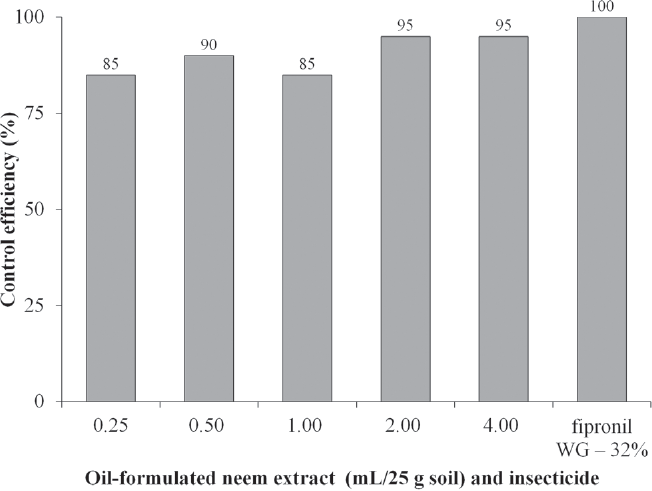
Percentage of control efficiency of
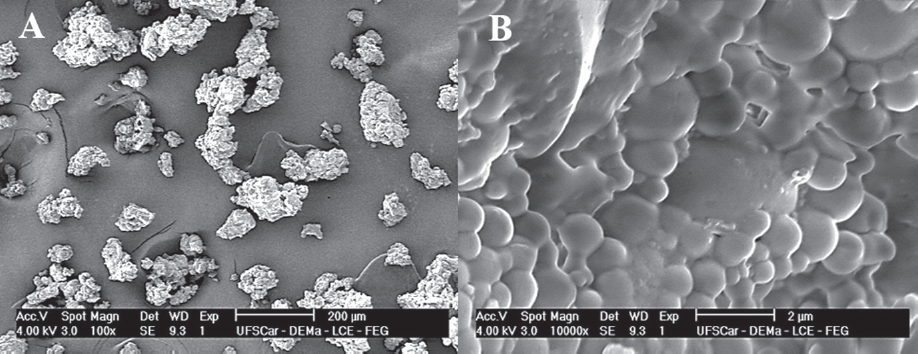
Scanning electron micrographs of lignin microparticles with amplification of (A) 100× and (B) 10,000×.
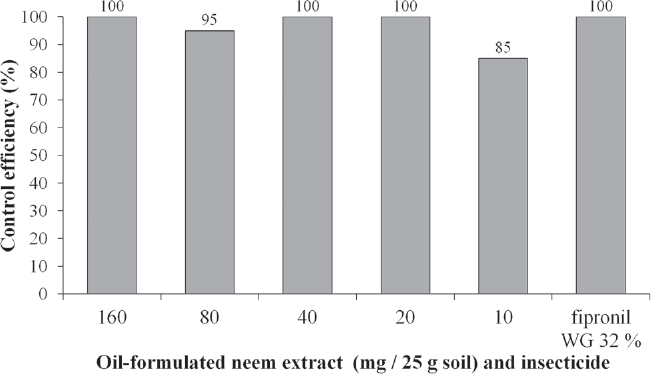
Percentage of control efficiency of
Use of synthetic insecticides is currently regarded as the most efficient tactic for pest management; however, the evolution of insect resistance and other negative collateral effects in the environment have incited a growing body of research with the aim of developing new strategies of pest control. Wild plants with insecticidal activity, such as neem, may provide proper plant protection against the attack of herbivores due to their wide range of chemical compounds, which may be explored for protection of susceptible but high-yield cultivars of plants with economic importance to agriculture (Luo
Botanical pesticides may eventually impose some risks, and complete safety cannot be assumed as long as all types of effects on different non-target organisms are tested. To date, most botanical pesticides are characterized by low toxicity to mammals, reduced effects on non-target organisms, and minimal environmental persistence (Isman 2006).
It is very important to develop other means of pest control, not relying just on a couple of them, because insects can become resistant if rational control methods are not adopted (Fabrick
Reduction percentages (mean ± standard error) of height, dry matter of the aerial part and root system, and number of leaves of maize plants after application of doses of lignin-microencapsulated neem extract and insecticide fipronil.
Means followed by the same letter in column did not differ significantly by Tukey's test at 5% probability. For analysis, data were transformed in log (x + 5).
non-significant at 5% probability by F test.
Footnotes
Acknowledgements
We thank Conselho Nacional de Desenvolvimento Científico e Tecnológico (CNPq), for the scholarship granted to the second author (140589/2013-9), and Fundação de Amparo à Pesquisa do Estado de São Paulo (2011/11.860-5; 2011/00.970-4) for financial support and scholarship granted to the fourth and fifth authors.