






Abstract
Stored grain pests differ in their feeding behavior and damage potential. This study evaluated the comparative impact of three key storage pests of wheat Tribolium castaneum (Coleoptera: Tenebrionidae), Trogoderma granarium (Coleoptera: Dermestidae), and Sitophilus oryzae (Coleoptera: Curculionidae) under controlled laboratory conditions. Homogeneous-age insects were introduced separately for each species into vials containing 2 grams of whole wheat grains, with three replicates per species, as experiments were conducted independently for all three species. After 35 days, data were recorded on insect survival, number and weight of damaged grains, number and weight of undamaged grains, and percent weight loss. S. oryzae exhibited the highest mean number of live insects (16.67), followed by T. granarium (9.89) and T. castaneum (6.67). S. oryzae also caused the most grain damage (21.33 damaged grains) and the most significant weight loss (16.75 %), followed by T. castaneum (8.56 grains, 2.07%) and T. granarium (2.56 grains, 0.74%). Regression analysis revealed a strong relationship between insect number and weight loss for S. oryzae (R2 = 0.57) and T. granarium (R2 = 0.46), but a weak relationship for T. castaneum (R2 = 0.0044), likely due to its lower survival and superficial feeding behavior. These findings provide comparative insights into species-specific damage patterns and may inform more targeted post-harvest pest management strategies.
Introduction
Wheat, Triticum aestivum L. (Poaceae), is a globally significant cereal crop, serving as a staple food source and a critical raw material in various industries (Shiferaw et al., 2013; Giraldo et al., 2019). In Pakistan, it contributes heavily to food security, rural livelihoods, and the national economy (Usman, 2016). During the 2022-2023 crop year, wheat production reached 26.8 million tons across 9 million hectares, a slightly increasing over the previous year (Hasan, 2023).
While field pests cause relatively minor issues, post-harvest insect infestations during storage pose serious economic risks by damaging grain quality and reducing germination (Upadhyay & Ahmad, 2011; State Bank of Pakistan, 2008). The durable nature of wheat requires long-term storage, making it vulnerable to infestation, particularly under suboptimal conditions in commercial warehouses (e.g., PASSCO) and household stores (Anwar et al., 2023).
Stored grain pests are classified as primary or secondary, based on their feeding behavior and damage symptoms (Shankar & Abrol, 2012; Waheed et al., 2022). Primary pests such as Sitophilus oryzae (Linnaeus, 1763) (Coleoptera: Curculionidae) and Trogoderma granarium Everts, 1898 (Coleoptera: Dermestidae) can infest whole, sound grains, whereas secondary pests like Tribolium castaneum (Herbst, 1797) (Coleoptera: Tenebrionidae) generally attack already damaged or broken grain (Phillips & Throne, 2010).
Despite numerous studies on storage pest biology and control, limited comparative data simultaneously evaluates survival, grain damage, and weight loss by these three pests under identical laboratory conditions. Furthermore, few studies have employed regression analysis to quantitatively assess the relationship between insect survival and economic loss, particularly in sound grains of a freshly harvested wheat variety.
The current study aims to fill this gap by evaluating the comparative damage potential of T. castaneum, T. granarium, and S. oryzae through survival, damaged grain counts and weights, and percentage weight loss under uniform lab conditions. This data may enhance pest prioritization and contribute to more precise post-harvest protection strategies in wheat storage systems.
Materials and Methods
This study was conducted from 29 March to 3 May 2023 in the laboratory of the Department of Entomology, Faculty of Agriculture and Environment, The Islamia University of Bahawalpur, Pakistan. The three insect species used in this experiment were the red flour beetle (Tribolium castaneum), rice weevil (Sitophilus oryzae), and khapra beetle (Trogoderma granarium). These species were obtained from the insect rearing facility for stored-product pests maintained by the department.
The F1 generation of S. oryzae, T. castaneum, and T. granarium was used for the experiment. Third to fourth instar larvae of T. granarium were selected from its F1 population, following the method described by Hussain et al. (2019). Similarly, F1 adults of uniform age for S. oryzae and T. castaneum were obtained according to Hassan et al. (2016). The rearing approach for S. oryzae was similar to that used for internal feeders such as the lesser grain borer.
Wheat grains were procured from a freshly harvested crop. Only pest-free and undamaged grains were used in the experiments. To equalize the moisture content, the grains were spread in a single layer in trays and held under laboratory conditions at 30 °C ± 2 °C and 60% ± 5 % RH for one week.
For the experimental setup, plastic vials were filled with 2 grams of sound wheat grains and weighed using an electronic balance. Each insect species was tested with three replications. The number of grains per 2 g sample was counted and recorded. Ten insects of each species were introduced separately into the vials to observe their population growth and resulting damage under controlled laboratory conditions (30 °C ± 2 °C and 60 % ± 5 % RH). After 35 days, data were collected on insect population (including larvae, pupae, and adults, excluding eggs), number and weight of damaged grains, and number and weight of undamaged grains.
Weight loss was calculated using the formula provided by Gwinner et al. (1996):

where Wudg = weight of undamaged grains, Nudg = number of undamaged grains, Wdg = weight of damaged grains; and Ndg = number of damaged grains.
Similarly, damaged grain pictures for each species were taken using a mobile phone (Apple iPhone 7).
Data Analysis
Data were statistically analyzed using one-way ANOVA in SPSS (version 2007). Insect species were treated as independent variables, while the number of live insects, number and weight of damaged grains, and percent weight loss were considered dependent variables. Means were separated using Tukey's HSD test at a 5% probability level.
Furthermore, simple linear regression analysis was conducted to assess the relationship between the number of live insects and percent weight loss for each species separately. This analysis was performed using the Data Analysis Tool in Microsoft Excel.
Results
Dead and Alive Population
Alive Population
Results showed that the highest mean number of live insects was 16.67 ± 2.29 for S. oryzae, followed by 9.89 ± 0.48 for T. granarium, while the lowest was 6.67 ± 0.73 for T. castaneum (F2, 26 = 12.382; P < 0.001) (Figure 1).
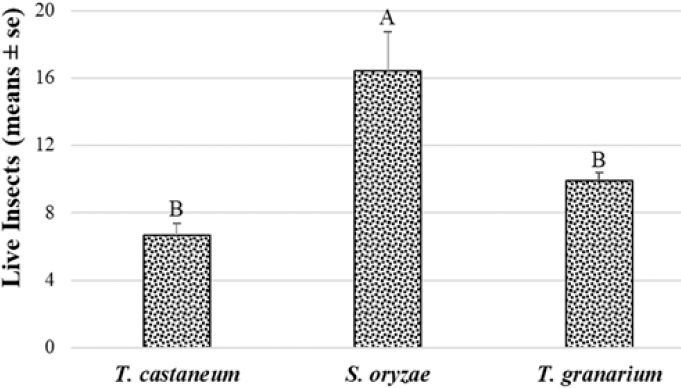
Alive insect numbers for three different species. Mean difference is significant at P: 0.05 using the Tukey HSD test.
Number and Weight of Damaged Grains
The highest number of damaged grains was recorded for S. oryzae (21.33 ± 1.89), followed by T. castaneum (8.56 ± 2.68), while the lowest was for T. granarium (2.56 ± 0.41) (F2, 26 = 24.821; P < 0.001) (Figure 2).
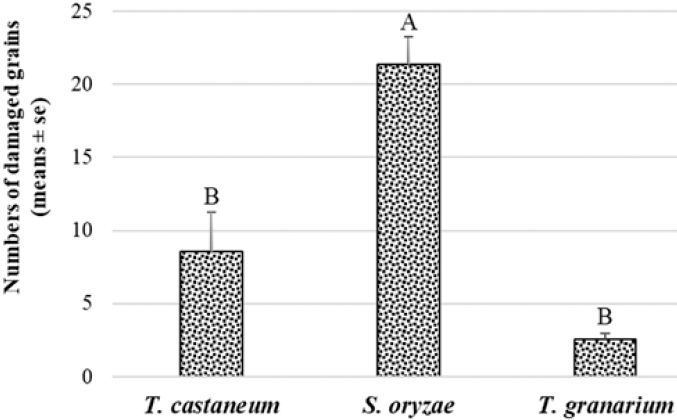
Number of damaged grains for three different species. Mean difference is significant at P: 0.05 using the Tukey HSD test.
The weight of damaged grains followed a similar trend: 0.46 ± 0.06 g for S. oryzae, 0.24 ± 0.08 g for T. castaneum, and 0.12 ± 0.02 g for T. granarium (F2, 26 = 8.253; P < 0.01) (Figure 3).
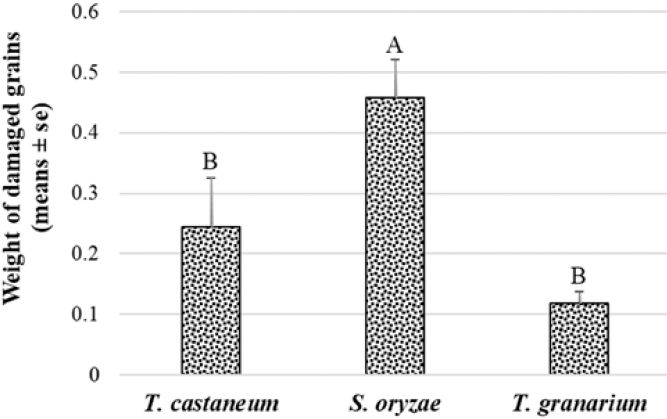
Weight of damaged grains for three different species. Mean difference is significant at P: 0.05 using the Tukey HSD test.
Percent weight loss
The percentage weight loss in grains was highest for S. oryzae (16.75% ± 2.46%), followed by T. castaneum (2.07 % ± 0.99%), and lowest for T. granarium (0.74 ± 0.20%) (F2, 26 = 33.439; P < 0.001) (Figure 4).
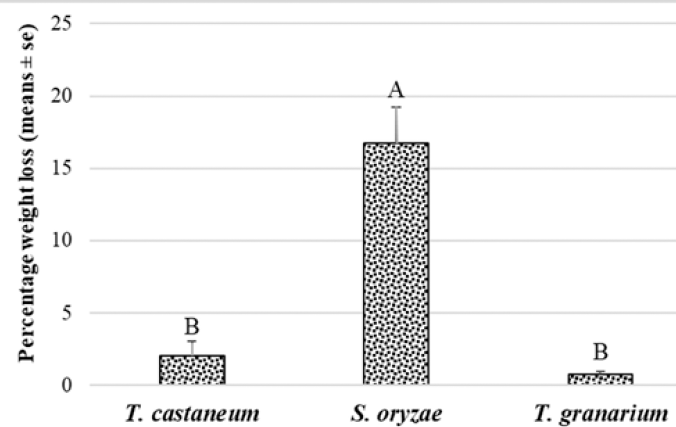
Percent weight loss in three different species. Mean difference is significant at P: 0.05 using the Tukey HSD test.
Comparison of Damaged Grains
Images of damaged grains for the three species showed that S. oryzae caused deep internal tunnels, T. granarium produced open cavities. In contrast T. castaneum damaged the grains by scraping the germ layers (Figure 5).
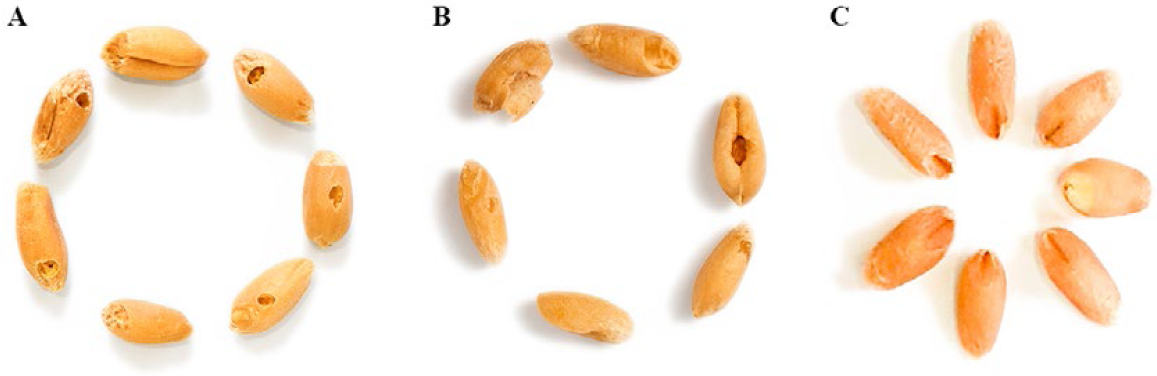
Damages to grains by S. oryzae (A), T. granarium (B) and Tribolium castaneum (C)
Relationship between Live Insects and Percent Weight Loss
A simple linear regression examined the relationship between the number of live insects and wheat grain weight loss (g). The results for T. castaneum indicated that the regression model was not statistically significant (F (1,7) = 0.0308, P = 0.8657), with a very low R2 of 0.0044, suggesting that only 0.44% of the variation in weight loss was explained by the number of insects. The slope of the regression line (0.09015) was not significantly different from zero (P = 0.866), and the wide confidence intervals and high residual error (3.167) further supported a weak or negligible relationship. These findings suggest that, in this dataset, the number of insects alone does not significantly predict wheat weight loss, and other factors may be more influential (Figure 6A).
In contrast, the regression model for S. oryzae was statistically significant (F (1,7) = 9.39, P = 0.018), with an R2 of 0.57, indicating that 57% of the variation in weight loss was explained by the number of insects. The slope (0.8130) was significantly different from zero (P = 0.018), although the wide confidence intervals and high residual error (5.16) suggest only a moderate relationship. These results imply that the number of insects is a significant predictor of weight loss for S. oryzae (Figure 6B).
For T. granarium, the regression model was also statistically significant (F (1,7) = 6.09, P = 0.042), with an R2 of 0.46, indicating that 46% of the variation in weight loss was explained by the number of insects. The slope (0.2793) was significantly different from zero (P = 0.042), and the narrow confidence intervals and low residual error (0.46) support a relatively strong relationship. These results suggest that the number of insects is a reliable predictor of weight loss for T. granarium (Figure 6C).
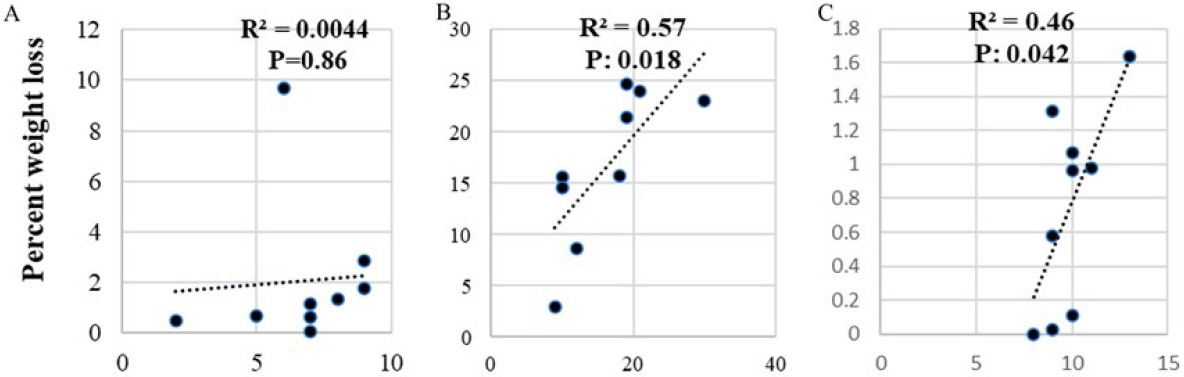
Simple linear regression analysis between live insects and percent weight loss for T. castaneum (A), S. oryzae (B) and T. granarium (C). Relationship is significant at P: 0.05.
Discussion
The present study provides a comparative assessment of damage potential among three important storage insect pests of wheat. The findings confirm that S. oryzae, a primary internal feeder, exhibited the highest survival and caused the most substantial grain damage, consistent with its known biology (Hagstrum et al., 2012; Zhang et al., 2021). Trogoderma granarium, another primary pest, showed moderate survival but lower damage, possibly due to inactivity during part of its larval stages, a characteristic behavior reported by Athanassiou et al. (2016). Tribolium castaneum, a secondary pest, had the lowest survival and grain damage, aligning with its preference for pre-damaged grains or flour (Campbell et al., 2022; Renteria-Gutierrez et al., 2000).
Damage morphology further validates these distinctions. Visual analysis revealed deep tunnels in grains by S. oryzae, open cavities by T. granarium, and superficial germ layer scraping by T. castaneum in line with earlier observations by Hassan et al. (2021) and Waheed et al. (2022). These physical differences have implications for both pest ecology and control strategies, as tunneled or hollowed grains may create microhabitats that facilitate secondary pest colonization and reduce the efficacy of grain protectants (Vendl et al., 2022).
Regression analysis provided an important quantitative layer to this comparison. Strong positive relationships between live insect numbers and percent weight loss for S. oryzae and T. granarium suggest that their population size can reliably predict economic loss. In contrast, the near-zero R2 for T. castaneum suggests that its damage does not scale linearly with population size, likely due to its limited feeding activity and low survivability on sound grains (Ali et al., 2011; Hassan et al., 2018). This non-linearity has practical implications: even small populations of secondary pests can disproportionately affect grain quality (e.g., by damaging germ layers and reducing germination), as noted by Stejskal et al. (2014).
Overall, these findings highlight species-specific risk profiles that can inform targeted pest control strategies. For instance, fumigation and hermetic storage may be prioritized in S. oryzae- or T. granarium-dominated settings. At the same time, sanitation and exclusion may be more critical where T. castaneum risk is high. The integration of visual damage assessment and regression-based modeling offers a comprehensive framework for evaluating pest impact under controlled conditions.
Origin and Funding
This study was part of the final-year research project of three B.Sc. (Hons) Entomology students at The Islamia University of Bahawalpur. The work was carried out in the Department's Stored Grain Laboratory under the supervision of Dr. Muhammad Waqar Hassan, with no specific funding received.
Author Contribution
Tallat Jamshed, Um-i-Saleet and Smavia Muzaffar performed experiments and wrote initial draft of manuscript; Muhammad Waqar Hassan performed analysis of data and edited and wrote final paper.
Conflict of Interest
The authors declare no conflict of interest.