






Abstract
Plant induced resistance is a tool for integrated pest management, aimed at increasing plant defense against stress, which is compatible with other techniques. Rhizobacteria act in the plant through metabolic changes and may have direct effects on plant-feeding insects. The objective of this study was to determine the effects of cabbage plants inoculated with rhizobacteria on the biology and behavior of diamondback moth,
Introduction
The diamondback moth,
The use of resistant cultivars is an alternative to insecticides that has assumed an important role in the management of diamondback moth (Lin
The induced resistance processes activated by both biotic and abiotic agents are characterized by lower metabolic cost, without great physiological changes in the plant, being often highly effective (Vallad and Goodman 2004). Microorganisms such as fungi, bacteria, and viruses are related to the induced systemic resistance in plants, and can be epiphytic (which externally colonize plants) (Hallmann et al. 1997; Azevedo et al. 2000) or endophytic (part of their life cycle invade tissues of living plants without causing disease) (Hallmann et al. 1997). Most IR reports mediated by microorganisms are related to epiphytic or endophytic rhizobacteria colonizing any part of the plant, promoting beneficial effects such as plant development, resistance to diseases and arthropods, and adaptation to environmental stresses (Hallmann et al. 1997; Mariano and Palmer 2000; Tomczyck 1999; Palmer 2000; Sturz and Nowak 2000; Medeiros et al. 2001). Recent studies on these bacteria have shown that they may also exhibit entomopathogenic effects when used directly on insects (Thuler 2003).
The oviposition of many lepidopterous insects is generally mediated by several factors, including sensory mechanisms, mechano-receptors, and chemotherapy, which can be stimulated or inhibited depending upon the chemical and physical characteristics of the substrate used for this purpose. Thus, various
In Brazil, Silva and Mariano (1999) conducted preliminary studies on the action of rhizobacteria against the diamondback moth and observed greater effectiveness for the strains ENF14 -
Materials and methods
The experiments were conducted at the Entomology Laboratory of the Federal Institute of Triangulo Mineiro (LEIFTM), Campus Uberaba-MG; Laboratory of Biology and Insects Creation (LBCI), Laboratory of Bacteria Genetics and Applied Biotechnology (LGBBA), Laboratory of Olericulture and Greenhouse of Vegetable Crops, Faculty of Agricultural and Veterinary Sciences at the Universidade Estadual Paulista (FCAV-UNESP) in Jaboticabal- SP. The strains used in this study are listed in table 1. Larvae of
Seeds of green cabbage cultivar Midori were bacterized by dipping into the strain suspensions of Table 1, at a concentration of 9 x10¹⁰ UFC.mL−1 and sterile distilled water (SDW, control treatment), for 30 minutes. The bacterized seeds were dried at room temperature for 12h overnight. The seeds were sown in polystyrene trays containing commercial substrate, and maintained in a greenhouse, and treated as the standard vegetable seeds in the Agro Monte Nursery in the city of Monte Alto-SP. The plants were later transferred to a greenhouse following the necessary cultural practices, and corrective fertilization at planting, with three fertilization coverages at 15, 30, and 45 days of planting. In the greenhouse, the plants were arranged in five blocks, divided into plots formed by 7 plants of each treatment. Twelve rhizobacteria strains and one control were tested, totaling 13 treatments, with 91 plants per block and a total of 455 plants in the five blocks.
Strains used, host plants and isolation location of PGPR (Plant Growth Promoting Rhizobacteria), obtained from the Laboratory of Phytobacteriology at UFRPE.
Bioassay 1. Laboratory confinement and feed leaves suffering injuries in a greenhouse
A previous infestation with
In the laboratory, ten second-instar caterpillars were housed in plastic Petri dishes (9 cm in diameter) and fed with circles (8 cm in diameter) taken from healthy leaves of cabbage plants of each treatment that have suffered injuries. The collection of leaves was performed at 75 days after transplantation. The larvae were maintained on plates until pupae formation to determine the larval duration and viability. The pupae were place in ELISA® plates with one pupa in each well, until the emergence of adults and the pupal duration and viability, pupal weight, and sex ratio of the emerged adults were determined. The initial area of leaf disks (8 cm in diameter) was 48.90 cmβ, which was considered the total foliar area (TFA), and then the leaf consumption by caterpillars was calculated by measuring the leaf area after the infestation.
The test was carried out under controlled conditions in the laboratory, at 25 ± 1 °C, relative humidity of 70 ± 10%, and 12h light period. For this bioassay, the reduction in leaf disk area caused by feeding the caterpillars, larval and pupal viability, duration of larval and pupal stages, sex ratio, and total mortality were determined.
Bioassay 2. Non-preference for oviposition and feeding of diamond back moth on cabbage plants inoculated with rhizobacteria
This experiment was performed in diamondback moth growth cages. Four cabbage quarter circles of 9 cm in diameter were used as a support for oviposition, being 2 quarters from leaves whose seeds were treated with one of the strains of table 1 (treatment - T) and two other quarters were the untreated sample (control - C), equally distant. For the feeding assay, cabbage quarter circles of 2 cm were used. The leaves of the treated plants used in the test were collected at 100 days after planting.
The non-preference for feeding was carried out in plastic Petri dishes with 15 cm in diameter, with the bottom covered with a moistened filter paper of equal size. Within the plates, two rounds of cabbage leaves originating from plants whose seeds were treated with the strains of table 1 (T) were placed equidistantly with two equally sized disks from plants that suffered no treatment (C).
The non-preference for oviposition was evaluated by posture counts on each leaf disk quarter, and the non-preference for feeding was assessed by counting the number of larvae feeding in each leaf disk. These tests were carried out under the same conditions mentioned previously.
Statistical analysis
Data from bioassay 1 were subjected to analysis of variance and means compared by the Tukey's test (P = 0.05). The biological characteristics were analyzed by multivariate data exploratory analysis using the Hierarchy Cluster Analysis (HCA) (Sneath and Sokal 1973) based on Euclidean distance for classifying the bacteria according to the best findings since this analysis allows verifying the general tendency of the effect of the treatments on the biological characteristics.
For the non-preference tests, the repellency index (RI) was determined according to the following formula: RI = 2T / (T + C), where: T refers to the disks or leaf quarters - treatment and C refers to the disks or leaf quarters - control. Indices tending to 0 refer to the preference for the control, or repellency, while values tending to 1 indicate neutrality, and values tending to 2 indicate a preference for the treatment, i.e. non-repellency. Standard error values (SE) were added or subtracted from the value obtained for each pair of samples (T x C) to ensure data safety. Therefore, only RI values located outside the range of 0.5 to 1.5, with their respective SEs were considered a repellency condition.
Results and discussion
Two treatments directly affected the biology of leaf-feeding
The strain EN4 stood out in the dendrogram, and tables 2 and 3 show the cumulative effects found in the cluster analysis.
Slight variations were observed in the duration of the larval stage, pupal weight, and sex ratio, thus indicating a greater effect of the treatment with the strain EN4, followed by the other treatments, with lower relevance. However, the mean comparison test (Tukey test) was not effective to indicate the best treatment once each treatment individually affected a different insect characteristic, with minimum statistical differences due to the great numerical variability, which affects the consistency of the analysis, once it does not reach the normality between data and homogeneity of variance.
It can be stated that the caterpillars kept in EN4-treated leaves fed very little, despite a longer period in the larval stage (Fig. 2), or had low feed conversion rate, because the weight of the formed pupae was lower (Table 3), resulting in less damage to the plant.
The reduction of leaf area measured according to the total leaf area (48.90 cmβ) during larvae feeding was lower than 20 %. A greater reduction in leaf area was observed in both the control and the treatment with the strain C240, which were significantly different only from the treatment C210, with the lowest reduction, followed by the treatments EN4 and HPF14, with no significant differences from the control (Fig. 2). The results of the reduction of foliar area have a different tendency compared to the results of the other assays, such as the morality indices in table 3, for instance. As observed in the structure of the groups, the treatment C210 was different from the other strains with better responses, including EN4 and HPF14 (Fig. 1). However, the strain C210 should be further investigated, once the responses were very interesting, reflecting an overall mortality of 46.0 %, with a reduction of leaf area below 5.0 %.
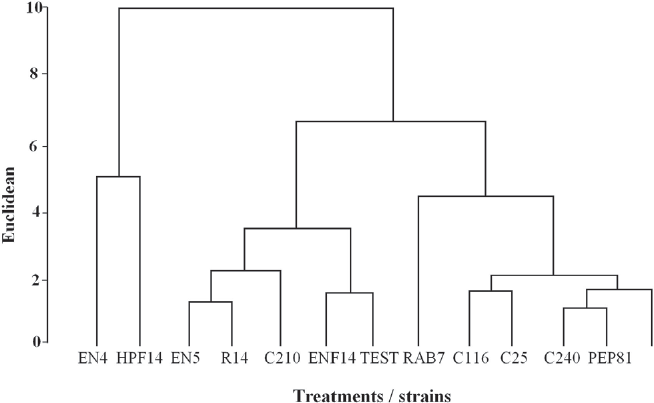
Dendrogram showing the structure of the groups formed by the treatments with different rhizobacteria strains and the control, in relation to the effects of the treatments on second instar
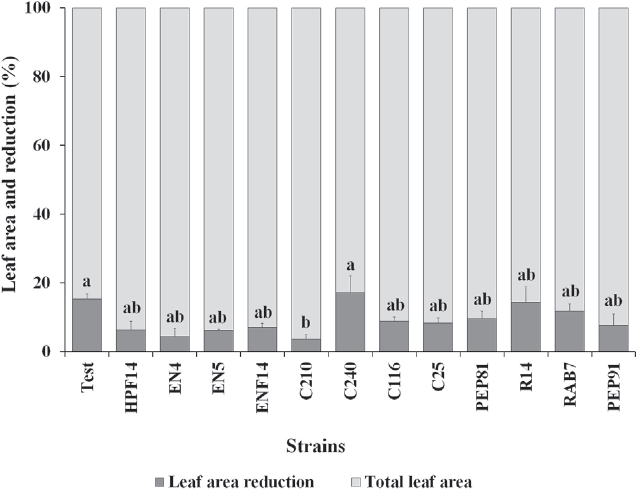
Leaf area (%) (± SE) of cabbage consumed by second instar
Viability and duration of larval and pupal stages (± SE) of
Means followed by the same letter in columns do not differ by Tukey's test (P = 0.05).
Tukey's test was used for generalized models. Deviance analysis in gamma distribution was used for the residues.
Pupal weight and sex ratio (mean ± SE) of
Means followed by the same letter in columns do not differ by Tukey's test (P = 0.05).
Regarding the bioassay for the assessment of nonpreference for oviposition and feeding of diamondback moth on cabbage plants inoculated with rhizobacteria, there was no repellency for oviposition (Fig. 3) or feed supply (Fig. 4). However, among the strains, the C25 stood out for having apparently exerted attraction as oviposition site for the moths (Fig. 4).
The condition of neutrality was even more evident in the treatments when the RI was determined (Fig. 4), once the values tended to 1, representing the neutral condition, for all treatments. Since the repellency for oviposition and feeding was not observed, it can be stated that despite the treatments have not prevented the infestation, the non-repellency indicates that the insects cannot identify the treatments, thus they may be more easily affected.
Regarding the preference for oviposition by
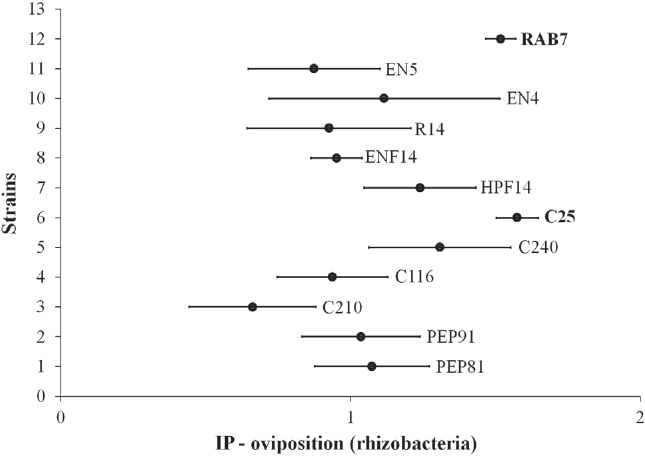
Repellency indices for oviposition of
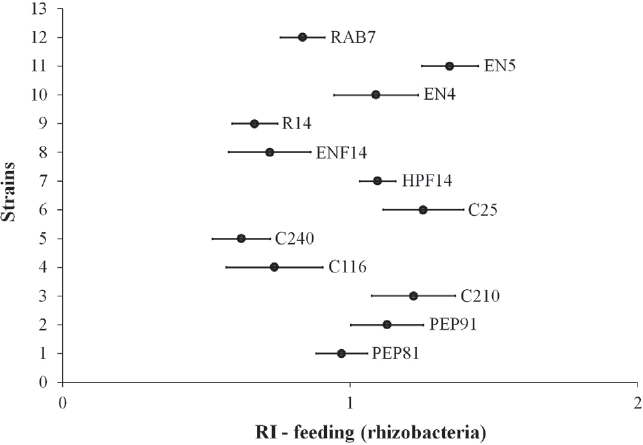
Repellency indices for the feeding of
Spencer (1996) showed that the oviposition is increased in waxy substrates and containing relatively high sinigrin (
Similarly, Eigenbrode et al. (1991) demonstrated the need for surface physical stimuli on the substrate selection for
Conclusion
The EN4 strain of
Footnotes
Acknowledgements
We would like to thank FAPESP and FAPEMIG for supporting this project.