






Abstract
We evaluated biological and reproductive aspects of Chrysoperla externa fed with the aphid Neotoxoptera formosana reared on Welsh onion (Allium fistulosum). The experiment was conducted at a temperature of 25 ± 1 °C, RH 70 ± 10% and photophase of 12 hours, with 40 repetitions of one individual for the larval period. For the adults, nine pairs were used, fed with diet composed of brewer's yeast and honey (1:1). We observed duration of 14.1 days, with survival of 75.0% for the larval period, and 9.6 days with 96.7% survival for the cocoon (pre-pupa + pupa), with a total survival of 72.5% in 23.7 days of post-embryonic development. Regarding the adults, males and females showed an average survival probability of 39.9 and 52.1 days, respectively, and the average production of eggs per female was 741.1 eggs, with 74.6% hatchability. It is concluded that N. formosana is a viable food source for C. externa and that further studies should be conducted to evaluate the potential of this predator in IPM programs for Welsh onion.
Introduction
The Welsh onion (Allium fistulosum L., 1753 [Amaryllidaceae]) is a plant originally from Siberia, and is widely used as spice in the worldwide culinary, improving taste and nutritional quality of foods. The plants of this species are considered perennial, forming tightly closed clumps, with fistulous and cylindrical leaves, which are numerous, thin and dark green, with a height between 0.30 m and 0.50 m (Filgueira 2003).
The aphid Neotoxoptera formosana (Takahashi, 1921) (Hemiptera: Aphididae) is a cosmopolitan species found in several countries (Blackman and Eastop 2000). It is one of the few species of aphids that can infest plants of the genus Allium (Hori 2007). Its occurrence in Brazil was first reported by Souza-Silva and Ilharco (1995). By sucking the leaves, the aphid causes wilt and subsequent death of the plant, besides being responsible for the transmission of the "Garlic Latent Virus" (GarLV) (Sako et al. 1990).
Among the biological control agents of aphids that infest many species of cultivated plants, it is worthwhile highlight the insects of the family Chrysopidae (Neuroptera). Although there are no studies on all species of green lacewings, we can say they are predators whose larvae are generalist, passing through three instars feeding on a wide range of prey, being excellent predators of several species of aphids (Principi and Canard 1984; Freitas and Fernandes 1996; Freitas 2001; Carvalho and Souza 2009).
The species Chrysoperla externa (Hagen) (Neuroptera: Chrysopidae) is the most studied neuropteran predator in Brazil, occurring in diverse crops, with high predatory capacity. Allied to these factors, this species is distinguished by its ease of laboratory rearing, high reproductive potential and no need of preys in adulthood (Freitas 2001; Figueira et al. 2002; Carvalho and Souza 2009).
Thus, this research aimed to evaluate the development of C. externa as well as its reproductive potential, feeding the larvae with the aphid N. formosana in laboratory conditions to acquire data for future greenhouse and field tests of this predator in integrated pest management (IPM) for the culture of Welsh onion.
Materials and Methods
Aphids were collected in home garden plants and multiplied on Welch onion (A. fistulosum), whose seeds were obtained from the Department of Botany of UFLA and grown in PVC pots with a capacity of 2 liters, in a substrate composed of soil and manure (1:1). The plants were kept into a greenhouse and were renewed weekly or as needed in order to maintain a sufficient population density to perform the experiment.
The newly hatched larvae of C. externa were kept in the same tubes and fed daily with N. formosana throughout its development, providing a quantity greater than the capacity of consumption in each instar. This quantity was determined in preliminary tests. Only nymphs of 2nd and 3rd instar were provided to the larvae. All observations were made daily until adult emergence. The parameters evaluated in immature stage were: duration (days) and survival (%) for each larval instar and for the pre-pupa and pupa. We used 40 repetitions of one individual for this experiment.
We evaluated the duration of pre-oviposition and oviposition periods, the total and daily production of eggs, the viability of eggs (hatchability [%]), the duration of the embryonic period and longevity of males and females. To evaluate hatchability, up to ten eggs about 24 hours old, from each couple, were individualized in ELISA (Enzyme-Linked Immunosorbent Assay) test boards, as used by Godoy et al. (2004), in samples taken every five days, during one month, totaling six collections.
Results
The larval instars of C. externa showed an average duration of 3.4, 4.7 and 6.0 days, with non-accumulated survival of 90.0, 91.7 and 90.9% for first, second and third instar, respectively (Table 1), being the total duration of larval period of 14.1 days, with accumulated survival of 75.0%. The pre-pupa lasted 3.2 days and the pupa, 6.4 days. The observed sex ratio was approximately 0.66, not differing from the proposition of 1:1 (xβ = 2.793; df = 1; P = 0.095). The non-accumulated survivals for the pre-pupa and pupa were 100.0% and 96.7%, respectively, conserving an accumulated larva-adult survival of 72.5%.
Average duration (days ± SE), non-accumulated survival (%) for the three instars, pre-pupa, pupa and accumulated survival for larva-adult period of Chrysoperla externa fed with Neotoxoptera formosana in the larval period. Temperature 25 ± 1 °C, RH 70 ± 10% and photophase of 12 hours.
The pre-oviposition period lasted 7.7 ± 1.29 days, and the oviposition period took 47 days from the onset of oviposition of the first female to the end of oviposition of the last ovipositing female. The average duration of oviposition per female was 37.0 ± 2.04 days. The curve with the daily average of eggs produced in relation to the age of C. externa females fitted the link function "log" (Figure 1). The average production of eggs was 741.1 ± 12.67 eggs per female. It was observed that the average production of eggs increased until the twentieth day, when it reached its peak, and thereafter steadily declined, equaling to the average initial production on the thirty-third day of oviposition. At the fortieth day, about half the number of females was ovipositing a small amount of eggs.
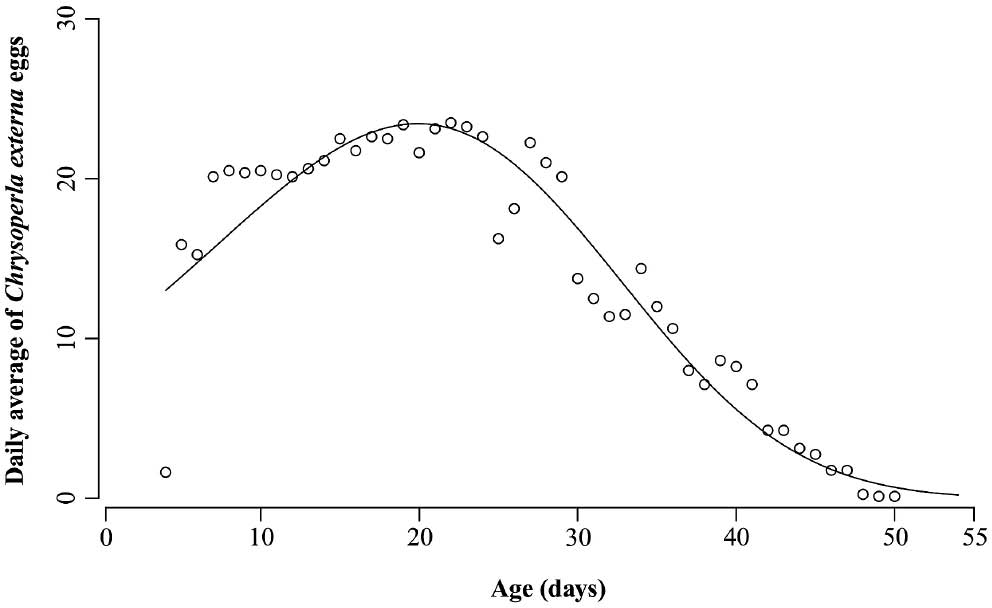
Daily average oviposition of Chrysoperla externa fed with Neotoxoptera formosana in the larval period and brewer's yeast and honey (1:1) in adulthood. Temperature 25 ± 1 °C, RH 70 ± 10% and photophase of 12 hours. Symbols are data observed and curve is predicted (link function "log").
The average hatchability was 74.6% with an incubation period of 4.9 ± 0.02 days. With respect to longevity, females of C. externa had a higher survival probability than males, with half of the population likely to be alive for 52.1 days, while this value was 39.9 days for males (Figure 2).
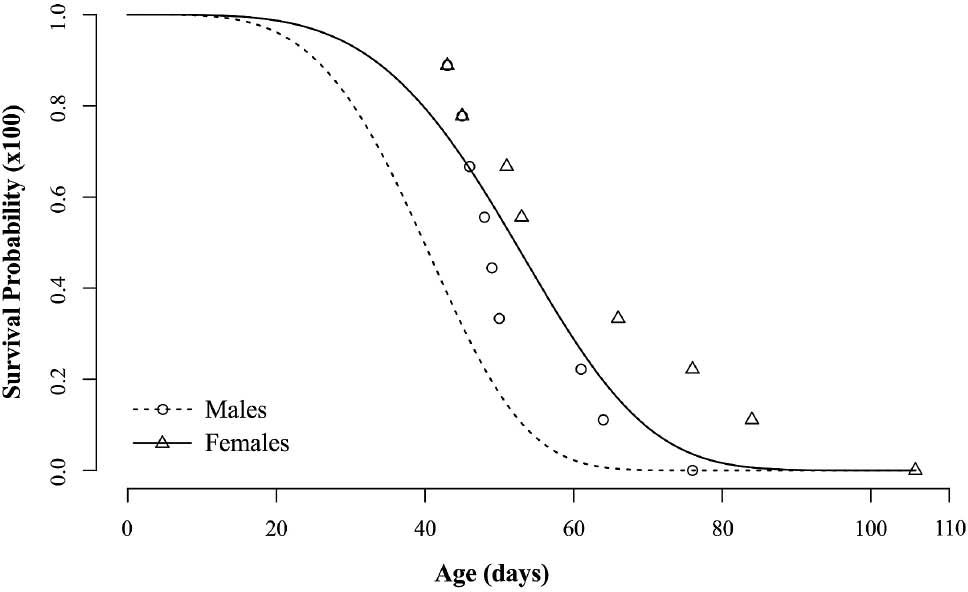
Weibull distribution for probability of survival of males and females of Chrysoperla externa fed with Neotoxoptera formosana in the larval period and brewer's yeast and honey (1:1) in adulthood. Temperature 25 ± 1 °C, RH 70 ± 10% and photophase of 12 hours. Symbols are data observed and curves are predicted.
Discussion
Regarding the duration of larval instars, it was found to be higher in the present study than in previous papers in which authors fed C. externa with other aphid species. Larval survival varies widely in literature; however, the survival observed here can be classified as very satisfactory. Pessoa et al. (2004) fed larvae of C. externa with Aphis gossypii Glover, 1877 (Hemiptera: Aphididae) raised in different cotton cultivars and acquired different results depending on the food substrate, with durations ranging between 11.1 and 12.9 days for the larval period, with survival of 63.1 and 67.3%. These results demonstrate that in addition to the species of aphid, host plant influences positively or negatively the performance of its predator. Maia et al. (2004), feeding C. externa with Rhopalosiphum maidis (Fitch, 1856) (Hemiptera: Aphididae) raised in corn plants, observed durations of 3.6, 3.1 and 4.3 days for the first, second and third instars respectively, but the authors did not comment on the survival of the larvae. Fonseca et al. (2001), feeding C. externa with Schizaphis graminum (Rondani, 1852) (Hemiptera: Aphididae) maintained on sorghum plants, found 100.0% of survival for the three larval instars, both at 24 °C and 27 °C.
The above results show a faster development of C. externa larvae on those mentioned aphid species in relation to that obtained in the present study, using N. formosana as prey. However, with respect to larval survival, there is a greater diversity of responses to prey species offered, reaching for example, the finding of 100% mortality of the larvae of C. externa fed with citrus aphid Toxoptera citricida (Kirkaldy, 1907) (Hemiptera: Aphididae), as recorded by Bonani et al. (2009).
For the pre-pupa and pupa stages, the results were similar to those found by Pessoa et al. (2004), who observed 3.5 days (pre-pupa) and 6.8 days (pupa), when the larvae were fed with A. gossypii reared on cotton cultivar "Auburn SM 310". Maia et al. (2004) observed durations of 3.4 and 8.9 days for the pre-pupa and pupa, respectively, when fed C. externa with R. maidis. These results show that, depending on the food provided to the larvae, the duration of the pre-pupa and pupa of C. externa does not differ as much as the duration of the larval period. The duration for the whole period inside the cocoon (pre-pupa + pupa) was 9.6 days and was faster than that observed by Bortoli et al. (2006) for larvae of C. externa fed with eggs of Sitotroga cerealella (Olivier, 1789) (Lepidoptera: Gelechiidae) (11.3 days) and A. kuehniella (11.2 days), moths that are commonly used for mass rearing this green lacewing.
Despite the mortality observed for larval period, no mortality was scored for pre-pupa, and pupa survival was almost 100%. This high survival is also found when other aphids are used as prey (Fonseca et al. 2001; Cardoso and Lazzari 2003; Pessoa et al. 2004). The total larva-adult survival was higher than 63.1 and 67.3% (Pessoa et al. 2004), and lower than 86.2% for both S. cerealella and A. kuehniella (Bortoli et al. 2006).
The pre-oviposition period observed here was longer than the observed for adults obtained from larvae fed with other preys. Santos et al. (2003), working with C. externa fed with A. gossypii observed a 5.1 days pre-oviposition period. Auad et al. (2005) also observed a 5.1 days pre-oviposition period for C. externa reared on nymphs of Bemisia tabaci (Gennadius, 1889) (Hemiptera: Aleyrodidae) biotype B, and Bezerra et al. (2006) found an average of 4.8 days from larvae fed with Planococcus citri (Risso, 1813) (Hemiptera: Pseudococcidae).
For oviposition period and egg laying, Santos et al. (2003) detected an oviposition period of 50.0 days for C. externa fed with A. gossypii reared on cotton, with an average of 819.8 eggs per female, and Auad et al. (2005) found an oviposition period of 56.8 days, with an average of 711.8 eggs per female, being these values close to those observed in this work. Nevertheless, the incubation period and hatchability showed values lower than those observed by Auad et al. (2005), which were 90.8% and 4.0 days, as well as verified by Bezerra et al. (2006), who found 80% viability.
Adult longevity was also close to the found in previous papers, tending to be lower. Bezerra et al. (2006), feeding larvae of C. externa with different instars and adult females of P. citri, observed an average life span between 38.4 and 67.3 days for males and between 49.0 and 101.0 days for females. Santos et al. (2003), feeding larvae with A. gossypii reared on three different cotton cultivars, found averages between 61.0 and 83.2 days for males and between 39.7 and 76.3 days for females. In both studies cited, there were also found differences in longevity between males and females. However, the values refer to the average longevity and not the probability of survival as presented in this study, so these data should be compared with caution.
Conclusions
It is concluded that the aphid N. formosana is a viable source of food for C. externa, suggesting further applied studies to evaluate the potential of this predator in IPM programs for Welsh onion.