






Abstract
Tricorythodes caunapi sp n. is described and illustrated from larvae and adults of both sexes. The name refers to the Caunapí River, located on the Pacific coast of Colombia, where the type-material was collected. This species can be recognized by the following combination of characters of adults: shape of the male genitalia, tibiae and tarsi with blackish bands, abdominal color pattern and small size (approximately 3mm); larvae: maxillary palp absent, tibiae and tarsi with same coloration as adults, tarsal claws with 7-8 marginal and double row of 1-2 + 2-3 submarginal denticles, abdominal color pattern, and triangular operculate gills.
Introduction
Tricorythodes Ulmer is a specious genus within the Leptohyphidae. The genus was described by Ulmer (1920), and is widely distributed in the Neotropical region. The genus is represented by twenty-one species in South America (Dias and Salles 2006; Dias et al. 2009a,b; Emmerich 2007; Gonçalves et al. 2010; Molineri 2002; Molineri and Zúñiga 2006). In Colombia four species are known: T. zunigae Molineri, 2002 from Chocó Department; T. trifasciatus Molineri and Zúñiga, 2006 from Valle del Cauca Department; T. capuccinorum Emmerich, 2007 and T. uniandinus Emmerich, 2007, these last from Cundinamarca Department (Molineri 2002; Domínguez et al. 2006; Emmerich 2007; Molineri and Zúñiga 2006). All Colombian Tricorythodes species have been described based on nymphs and adults.
The municipality of Tumaco is located in the Pacific coastal region of Colombia. Tumaco belongs to the Chocó Biogeographical Region, which exhibits high levels of diversity and endemism (García-Kirkbride 1986; Gentry 1986). Collecting and conducting biodiversity studies in this area is difficult due to armed conflicts, illegal crops and extensive oil palm plantations. Sampling of aquatic insects in this region resulted in the finding of a new species of Tricorythodes. In this paper, the authors describe and illustrate Tricorythodes caunapi sp. n. based on larvae and adults of both sexes.
Material and Methods
Both larvae and adults were preserved in 90% ethanol. Mouthparts and legs of larvae as well as male genitalia and wings of the adults were mounted on microscope slides using Euparal. Illustrations were drawn using a camera lucida attached to a stereo microscope. Specimens are deposited in the following Institutions: Colección Entomológica del Programa de Biología de la Universidad de Caldas, Caldas, Colombia (CEBUC); Colección Zoológica de la Universidad de Nariño, Nariño, Colombia (PSO-CZ); Instituto-Fundación Miguel Lillo, Tucumán, Argentina (IFML). Adults were obtained and associated by rearing larvae in the Caunapí River. All measurements are in millimetres; numbers correspond to the minimum and maximum values.
Systematic account
Tricorythodes caunapi sp. n. (Figs. 1-22)
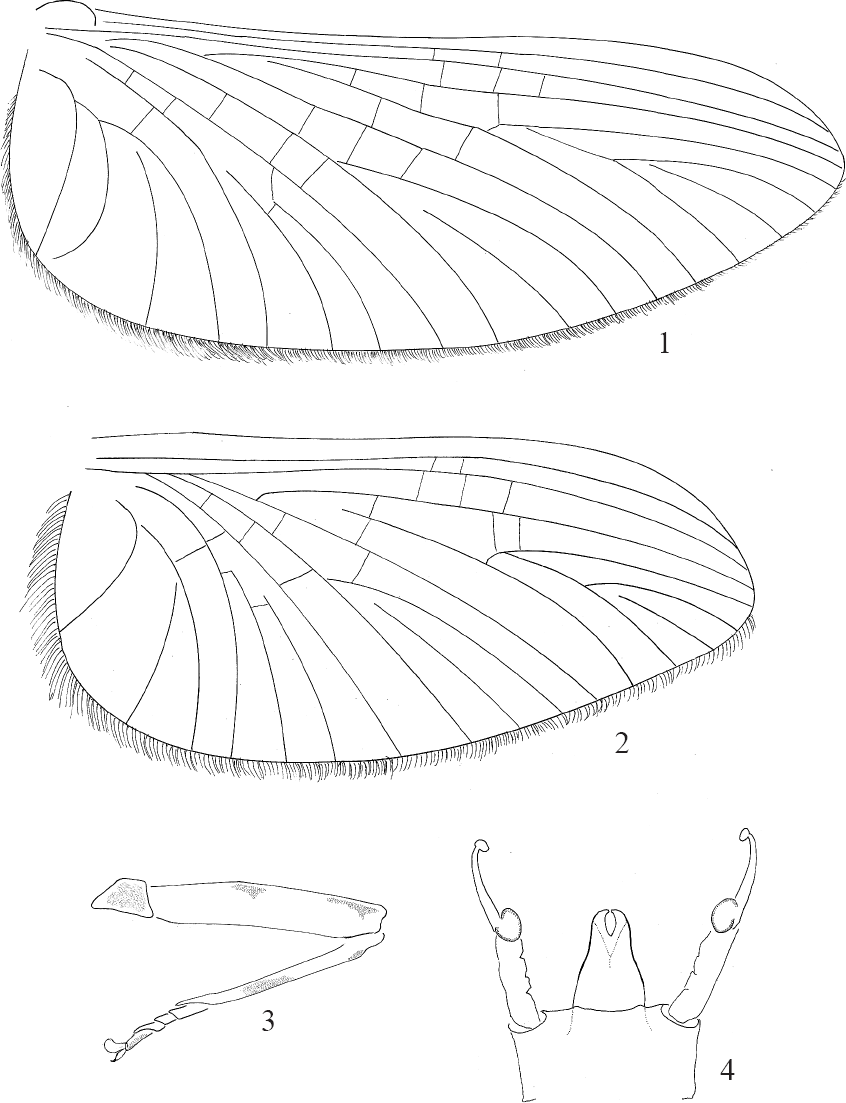
Tricorythodes caunapi sp. n.: 1. female fore wing; 2. male fore wing; 3. male mesothoracic leg; 4. male genitalia.
Female similar to male in morphology and color pattern, except length of wings, longer than male and CuP vein curved, weak and sometimes incomplete (Fig. 1). Abdomen yellowish, shaded black (similar Fig. 5).
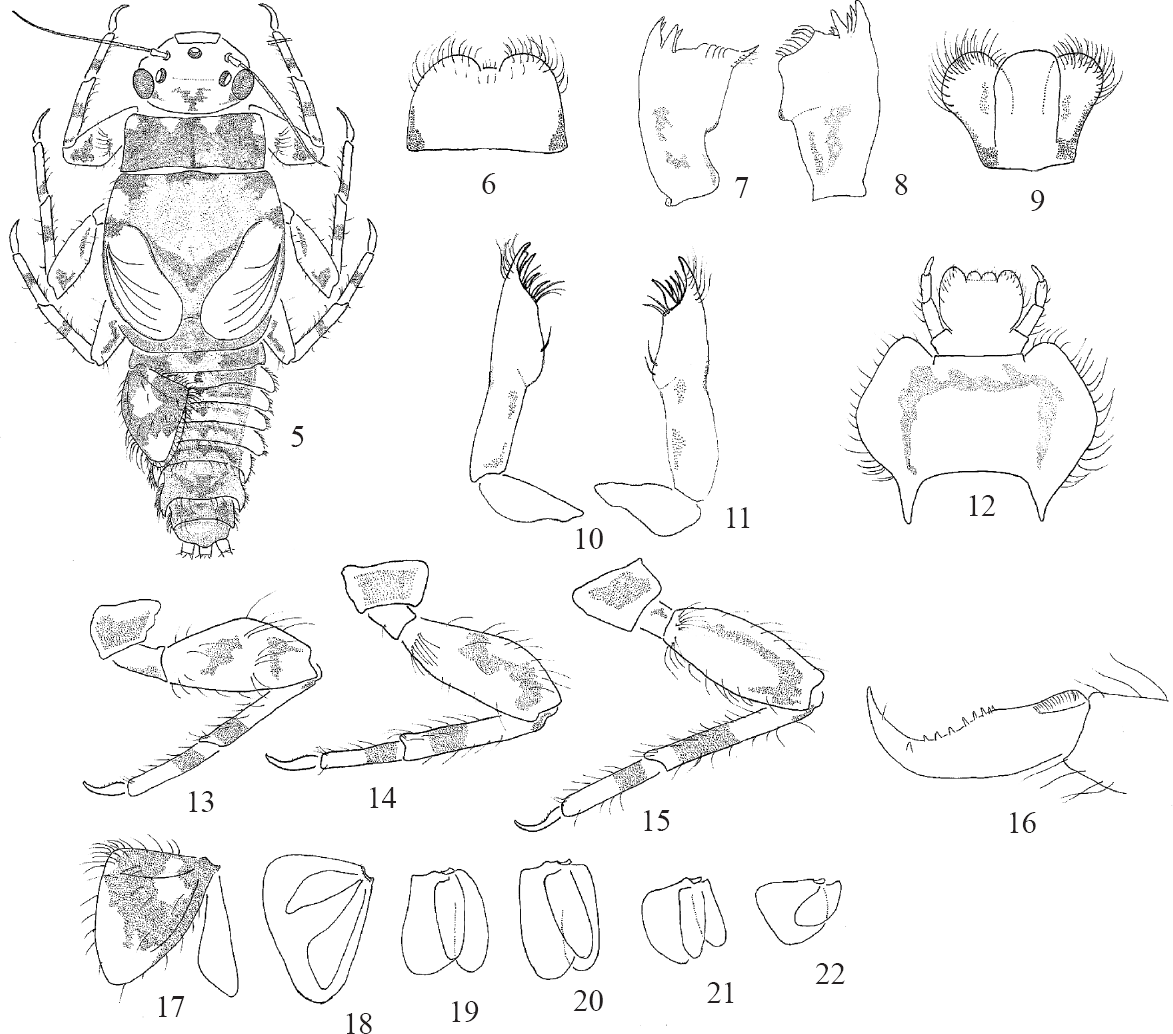
Tricorythodes caunapi sp. n.: 5. nymphal habitus; 6. labrum; 7. left mandible (dorsal view); 8. right mandible (dorsal view); 9. hypopharynx (dorsal view); 10. left maxilla (dorsal view); 11. right maxilla (dorsal view); 12. labium (dorsal view); 13. foreleg; 14. mid leg; 15. hind leg; 16. tarsal claw; 17. operculate gill (dorsal view); 18. operculate gill (ventral view); 19-22. gills III-VI (ventral view).
The T. caunapi shows close resemblances with T. trifasciatus Molineri and Zúñiga, the nymphs and adults possess small size and the coloration pattern with black marks. In addition, both species are from Chocó Biogeographical Region. However, these species can be easily distinguished by penis form; in nymphs by the number of denticles of the tarsal claws, the maxillary palp absence in T. caunapi, besides the marks on tibia of the new species.
Footnotes
Acknowledgments
We thank the National Council of Scientific and Technological Development (CNPq) for providing funds to first author to conduct her post-graduate program at the Universidade Federal de Viçosa, Minas Gerais State, Brazil. We also thank Danny Angulo and Jhon Estacio, students of the Universidad de Nariño for assistance with sampling specimens in Tumaco.