





Abstract
The products of vegetal origin were assessed for bioactive substances to reduce reliance on organophosphate and pyrethroid insecticides, to which insect populations have become resistant. For this reason the aim of this study was to assess whether the essential oils of
Introduction
Dengue cases and their clinical complications appear in countries of tropical and subtropical regions every year, with no promising prospects for future decrease of this problem (Guzmán et al. 2006). Unplanned urbanization, demographic and climatic changes in conjunction with the fast human migrations worldwide through air and land transport facilities are increasing the spread of the dengue arboviruses and its vector,
In the absence of a vaccine that confers permanent immunity to the four serotypes of the DENV1-4 dengue and their genetic variations, vector control is used as the key measure to fight the disease (Hombach 2007; Periago and Guzmán 2007). However, even with the extensive accumulated knowledge over decades on this problem and knowing that so far that the only viable possibility is the direct vector control; this is not efficient since the epidemics in countries of tropical and subtropical regions continue occurring.
The dependence on synthetic organophosphorus (OP) and pyrethroid (P) insecticides to combat both immature and adult forms of the vector mosquito has been the most frequently adopted procedure for years, despite its little impact on the reduction of dengue cases. Unfortunately, such procedure has favored the outburst of
Botanical-origin products emerge as a promising alternative to control the vector of the dengue virus, after being set aside between the 30's and the 50's because the discovery of chemical synthetic insecticides (organochlorines, organophosphates, carbamates and pyrethroids). Besides have proven insecticidal effect, the plant-based products display a diversity of compounds with attractive, dislodging or repellent features that could be used in integrated pest management systems, as alternatives aimed at monitoring and control the mosquito populations (Isman 2006; Navarro-Silva et al. 2009).
The Annonaceae family comprises approximately 130 genera with 2.300 species of tropical and subtropical distribution (Kessler 1993). This group of plants has well known economic importance due to the trade of its fruits, byproducts, pharmacological activity, raw material for cosmetics, perfume industry, natural medicine and antimicrobial and insecticidal activity compounds (Costa et al. 2008, 2009; Boyom et al. 2003; Isman 2006). The genus
Research has been carried out to determine the potential efficacy of derivates from plants in vector control programs. The environmentally safe and biodegradable botanical insecticides could be an alternative method of control, owing to the growing incidence of the insect resistance to synthetic insecticides. In view of the abovementioned and the records of the insecticide action of the Annonaceae Family and the antimicrobial activity of the genus
Materials and Methods
Sample Collection
With the purpose to observe some variance in the chemical constituents on the essential oils of the species of
Extraction of essential oils
The leaves (250g) of the three
Gas Chromatography (GC-FID) analysis
The GC analyses were carried out using a Shimadzu GC-17A fitted with a flame ionization detector (FID) and an electronic integrator. Separation of the compounds was achieved employing a ZB-5MS fused capillary column (30m x 0.25mm x 0.25µm film thickness) coated with 5%-phenyl-arylene-95%-methylpolysiloxane. Conditions of injection were performed according to Costa et al. (2008): injector temperature 240°C; oven temperature program of 60°C-300°C at a rate of 3°C/min; split 20:1 during 1.50 min, carrier gas He: 1 mL/min, constant flow; sample volume 0.5 µL.
Gas Chromatography - Mass Spectrometry GC-MS analysis
The GC-MS analyses were performed on a Shimadzu QP5050A GC/MS system equipped with an AOC-20i autoinjector. A J&W Scientific DB-5MS (coated with 5%-phenyl-95%-methylpolysiloxane) fused capillary column (30m x 0.25mm x 0.25µm film thickness) was used as the stationary phase. The conditions of injection were the same as described above and according to Costa et al. (2008). The mass spectrometer was operated at 70eV. The constituents of the essential oils were identified by comparison of their mass spectral pattern and retention indices (RI) with those given in the literature (Adams 2007). The retention indices (RI) were calculated according to Van Den Dool and Kratz (1963).
1D/2D 1H and 13C Nuclear Magnetic Resonance analysis (NMR)
The crude essential oils of these species were analyzed by Nuclear Magnetic Resonance (NMR) of 1H and 13C 1D/2D. Nuclear Magnetic Resonance (NMR) spectra were recorded in a Bruker Avance 400 spectrometer operating at 9.4 Tesla, observing 1H at 400 MHz and 13C at 100 MHz. Chloroform was used as the deuterated solvent. Chemical shifts values were given in parts per million (ppm) relative to the tetramethylsilane (TMS), used as internal reference standard (δ 0.00).
Determination of insecticidal activity
The larvae from the Rockefeller Colony - CDC (Center of Disease Control) were kept in plastic trays (35.5cm x 21.5cm x 6.5cm) containing 3.000mL of dechlorinated water under controlled temperature (25°C±1), humidity (70%±10) and photoperiod (12:12) conditions in a climatized chamber Model 347 CDG, at the Laboratory of Medical and Veterinary Entomology. Thus they remained there until reaching the stage of final 3rd instar and initial 4th instar, a change observed from the exuviate. The latter did not receive any food or chemical treatment.
After reaching the larval stage described above, the larvae were counted, separated and transferred with a Pasteur pipette to disposable plastic glasses with a 50mL capacity, containing 20mL of the same dechlorinated water, in a total of 10 larvae per glass. Then, these larvae were exposed to different concentrations of essential oils from the
All the experiments were repeated four times, including a control treatment exclusively with DMSO and mineral water. Finally, seven concentrations were tested (12, 15, 20, 35, 40, 60 and 85ppm).
Mortality of the larvae exposed to the treatment was determined after 24 hours, considering mortality within a confidence interval of 95%. Larvae unable to reach water surface when touched were considered dead (WHO 1981a, 1981b). In parallel, the DMSO calibration was achieved in five concentrations between 1% and 5% to confirm that the 1% percentage used in the assays in fact did not cause mortality of the larvae. Data of the bioassay and solvent calibration were subjected to the Probit analysis (Finney 1971; Raymond 1985).
Results and Discussion
The yields of essential oils were 0.6% for
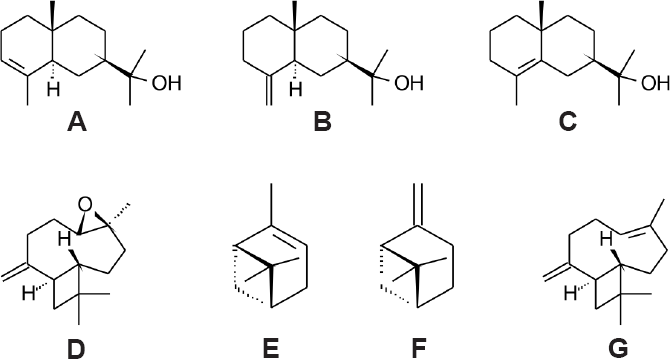
Major components identified in the essential oils of
Essential oil composition of
(calc.), retention indices on ZB-5MS column calculated according to Van Den Dool and Kratz (1963).
retention indices according to Adams, 2007.
cCosta et al. (2008).
Mortality tests with the
Values of lethal concentrations (LC) that cause mortality in 50, 95 and 99% of the
There was no mortality in the control groups. LC50 lethal concentration that causes death in 50% of larvae exposed, LC95 lethal concentration that caused the death of 90% and LC99 lethal concentration that causes death in 99% of larvae exposed, slope + standard deviation, X2 chi-square (Finney 1971).
Considering the increase of
The extraction yield of vegetable essential oils is a factor to consider in botanic products with biological action. When compared to the yield of oils extracted from other Annonaceae published in literature (Boyom et al. 2003), it becomes evident that the
The results achieved in this study lead to the hypothesis that sesquiterpene-rich essential oils can be considered more active in the control of
Although studies developed by Santos et al. (2006) and Simas et al. (2004) evidenced a stronger action of the sesquiterpenes, this pattern was not found in Costa et al. (2005) with oils of
The comparison between LC50 and LC95 indicates that diterpenes could have an even more toxic effect than sesquiterpenes for this mosquito species, as shown with
Comparison between lethal concentrations (LCs) of the essential oils from several plant species evaluated as larvicidal against
Furtado et al., (2005);
Cavalcanti et al., (2004)
our result; - Data are not comparable.
Footnotes
Acknowledgments
The authors thank Rodrigo F. Chitolina for his help on the experimental work and also CNPq, CAPES FAPITEC/SE, and Fundação Araucária for financial support. J. E Duque thanks Prodoc/Capes for the postdoctoral fellowship in the period of 2008-2010. F.A. Marques and E. V. Costa thanks CNPq/INCT - Controle Biorracional de Insetos Pragas - Estudos Integrados, for financial aid.