






Abstract
The adults and larvae of Cerambycidae are responsible for damage to plant species. The insects of this family are commonly known as wood borers, being easily recognized by the presence of long antennae, usually longer than the body. Specimens of Oxymerus aculeatus (Coleoptera: Cerambycidae) were found in corn fields at the Federal University of Viçosa, Minas Gerais State, Brazil, during the flowering period and damaging the reproductive part of the plant.
Keywords
Introduction
The Cerambycidae family is composed by eight subfamilies and most of the species are in three of them (Cerambycinae, Lamiinae and Prioninae) (Crownson 1991). The Neotropical region has approximately 5000 species of this family distributed in 1500 genera and in Brazil 4000 species from 1000 genera can be found (Costa 2000). Cerambycidae beetles can cause extensive damages such as opening mines, wholes and spots on the wood, besides the attacks on branches and stems that can promote the development of some microorganisms such as bacteria, fungi, and virus (Hosking 1977; Berti Filho et al. 1995; Carvalho et al. 1995; Zanuncio et al. 2009).
Individuals of Cerambycidae were recorded causing damage on forest crops with economical importance (Iturre et al. 1995; BertiFilho 1997; Wilcken et al. 2005; Zanuncio et al. 2009) and orchards of fruit trees (Garcia and Corseuil 1998/1999; Canettieri and Garcia 2000; Paz et al. 2008). The Oxymerus genus presents species described in the American continent, including Argentina, Bolivia, Brazil, Guyana, Jamaica, Nicaragua, Paraguay, Peru, Uruguay and Venezuela (Monné et al. 2006) and specifically Oxymerus aculeatus Dupont, 1838 (Coleoptera: Cerambycidae) has been recorded in the States of Goiás, Mato Grosso, Minas Gerais, and São Paulo in Brazil (Monné et al. 2006). This is the first report of O. aculeatus causing damage on corn plants (Zea mays L.) during the reproduction period of the plant at the Federal University of Viçosa (20°45′14″S, 42°52′55″W) Viçosa, Minas Gerais State, Brazil (Fig. 1).
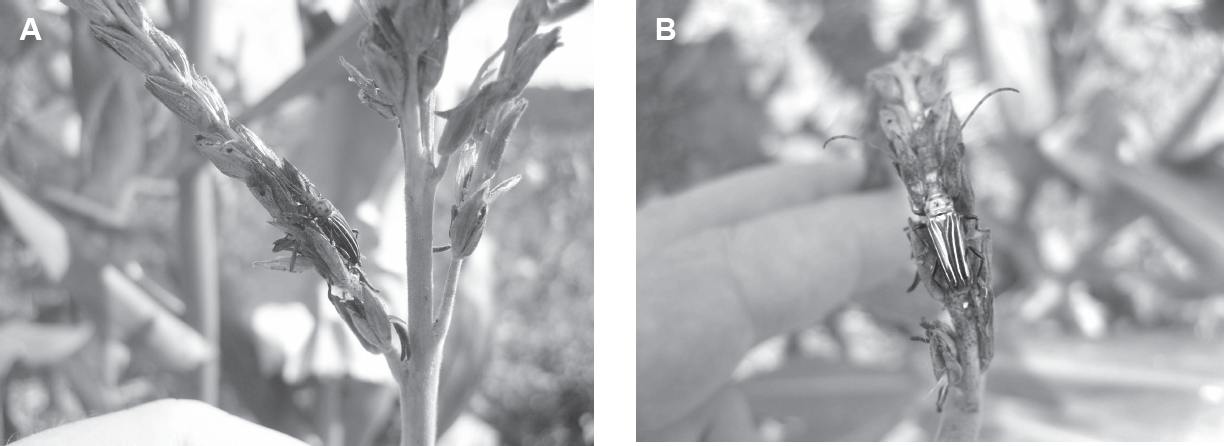
A. Oxymerus aculeatus (Coleoptera: Cerambycidae) adult feeding on the male flower of corn plants, Federal University of Viçosa, Viçosa, Minas Gerais State, Brazil. B. Detail of Oxymerus aculeatus (Coleoptera: Cerambycidae) on the inflorescense.
These insects were recorded feeding and causing damages on the tissue of male flowers of the corn plants. Black spots were observed because of the feeding behavior of the insects. Cerambycidae species has been cited in the literature feeding on the flowers, nectar, pollen and wood of different long cycle plants species (Crownson 1981; Martins 1997; Lawrence et al. 1999); however, there is no record or literature about this species feeding and damaging Z. mays. The presence of O. aculeatus on plants with annual cycle can result in an adjustment of the insect to this new ecosystem that is not desirable because this insect species can reduce the reproductive capacity of the corn plants by attacking the reproductive system of them and, consequently, reducing the seed production. These observations can encourage future research and works about the establishment of O. aculeatus on this new host plant.