






Abstract
Males and females of Grapholita molesta (Lep., Tortricidae) are polygamous. In order to evaluate the effects of polyandry and polygyny in the reproductive performance of this species, newly-emerged adults were submitted to either of two treatments: monogamous couples together until death or males and females receiving virgin partners one or three days old every day until death. The fecundity and fertility of all females were evaluated daily. Mean fecundity was similar in both monogamic and poliandric females; however, females paired with one day old males presented the lowest mean fertility. Similarly, fecundity and fertility means were significantly lower in females paired with polygynic males, in comparison to monogamic females. A negative correlation was found between male age and the number of copulated females. Males presented the highest number of copulations between three and eight days of age. Oviposition patterns were similar in the polyandric and in the monogamic groups, with the highest number of fertile eggs being observed after day three of initial pairing. Females of G. molesta do not need to copulate with additional virgin males to enhance their fertility rates. After their third day of life, males are able to copulate with a high number of females, keeping themselves fertile for a long period.
Keywords
Introduction
Polygamy is widespread among insects, in particular polygynic behavior, while monogamy is less common and frequently considered as is an evolutionarily derived condition (Matthews and Matthews 1978). Multiple copulations enhance the risk of predation and parasitism, but those have also several advantages (Torres-Vila et al. 2004; Torres-Vila and Jennions 2005). Males are benefited by the sperm transfer to a high number of partners (Wiklund 2003), and females could benefit by increasing the genetic diversity of their offspring, by sperm selection, and adequate supply of the ejaculated sperm (Wedell 2003). Additionally, nutritional benefits of copulation could enhance the reproductive period as well as life span of the females (Svard and McNeil 1994; Wedell 2002).
Polygynic males may optimize their reproductive gain by decreasing the investment in courtship strategies for females that had previously copulated or by reducing the amount of the liquid ejaculated when copulating more than once with the same partner (Svard and McNeil 1994; McNamara and Elgar 2008). Because of the higher sperm investment in the first copulation, successive matings may cause a decrease in fertility in lepidopteran species. Females of Cnephasia jactatana Walker, 1863 (Tortricidae), which copulated with nonvirgin males, received spermatophores that were 45% smaller than the ones transferred in the first copulation. This reduction was reflected in fertility, which decreased by approximately 23, 37 and 55%, in females that copulated with males that had previously mated one, two, or five times, respectively, at one day interval (Jiménez-Pérez and Wang 2004a).
The reproductive capacity of moths could vary with age, due to a low quality or quantity of sperm, to the low male sensitivity to the pheromone released by the female, or to the low receptivity and attraction to individuals from the opposite sex (Brits 1979; Anton and Gadenne 1999; Delisle and Simard 2003). In Spodoptera exigua (Hubner, 1808) (Noctuidae), Rogers and Marti (1996) observed that individuals that copulated one or two days after emergence presented higher fecundity and fertility, but had a shorter longevity when compared to individuals that mated later. Females of C. jactatana could be more susceptible to aging than males since six days old females are less preferred for mating in comparison with three days old females, while females do not demonstrate a preference for males of different ages (Jiménez-Pérez and Wang 2004b).
Grapholita molesta (Busck, 1916) is an Asian totricidean that is among the most important insect pests of stone fruit trees, causing fruit and branch damages (Salles 2001). In this species, both males and females were reported as polygamous and as being able to copulate multiple times in 24 hours intervals (Dustan 1964). However, it is still unknown whether a particular mating system confers more benefits to the moths than other(s) and what are the effects of moth age in the ultimate fitness in the individuals. The assessment of such effects was the main goal of this study.
Materials and Methods
Adults of G. molesta originated from a colony kept under controlled conditions (photoperiod of 16 hours; 25°1°C; 60±5% U.R.), at the Department of Fitossanidade, Universidade Federal do Rio Grande do Sul, southern Brazil. The insects were fed with artificial diet during the larval period (Arioli et al. 2007), and the adults were fed with a honey solution (15% honey, 5% nipagin). Male and female pupae weighted, on average, 10 to 13 and 15 to 18mg, respectively.
Bioassays were carried out by keeping pairs of males and females in 500mL plastic bottles to which a honey solution was added as food source. The treatments consisted of: 1) a male and a female, one day old kept together for their entire life (n = 35) (monogamy) (control); 2) a single female receiving a virgin male no older than one day (n = 18) (polyandry); 3) a single female receiving a three days old virgin male (n = 15) (polyandry); 4) a single male receiving a virgin female not older than one day (n = 15) (polygyny), and 5) a single male receiving a three days old virgin female (n = 16) (polygyny). In treatments 2-5, all virgin partners were replaced daily.
In the analysis of polygyny, after one day together, each female was kept isolated in another container (500mL) with food. Eggs deposited (fecundity) and larvae hatched (fertility), were counted daily.
After one day together with a male, each female was kept in a separate container (500mL) with honey as food and the number of eggs laid was recorded daily. For the monogamic females, only the eggs laid during the first 15 days after they were first coupled with males, were counted, allowing a comparison among reproductive patterns of these females and those paired with polygynic males. The number of copulations of polygynic males was verified by recording the fertility of the eggs laid by their females.
Mean values of fecundity, fertility, oviposition period, and longevity were compared among treatments using the Kruskal-Wallis test (a=0.05) and Dunn test (5%). Pearson correlation was used to evaluate the relationship, if any, between age of the males and the number of copulations. The program Biostat 4.0 (Ayres et al. 2006) was used for all analyses, and the results are shown as mean values (± SE).
Results and Discussion
Fecundity and fertility means (± standard error) of females of Grapholita molesta paired under monogamy and polyandry conditions with one and three days old males (n= individuals number).
*Means followed by the same letter in a row are not statistically significantly different from each other (a= 0.05).
Mean fertility of females paired with three days old males was not different from that of monogamic females. However, this was higher than that by females pared with one day old males (H=9.88; df=2; P<0.05) (Table 1). Thus, it is possible that the absence of reproductive maturation in one day old males could have influenced the reproductive capacity of the females. Males of some tortricid species have reproductive cells in an advanced maturation stage just after the emergence, but some hormonal stimuli are required for the release of the sperm from the testicles. These stimuli are dependent of the circadian rhythm of each species (Benz 1991; Giebultowicz and Brooks 1998). Furthermore, the changes in hormonal levels throughout the adult phase could influence the physiology of the insect reproductive organs, which may in turn influence the synthesis of proteins in the accessory glands (Happ 1992). Electrophysiological responses of the antennae of males of Agrotis ipsilon (Hüfnagel, 1766) (Noctuidae) to the sexual pheromone are minimal right after the emergence, and this is apparently associated with an increase in the levels of juvenile hormone in their haemolymph (Anton and Gadenne 1999).
Our results suggest that females do not alter their mean fertility by the constant presence of the same or different males, virgins or sexually mature. The same was also verified by Cook (1999) for Plodia interpunctella (Hubner, 1813) (Pyralidae). In this study, the amount of spermatophores received by the females did not significantly affect their mean fertility, even though virgin males had transferred in only one copula three times the amount of eupyrene released by nonvirgin males. In both cases only one mating event was sufficient to fertilize all eggs. In G. molesta mating number did not increase the fertility, as well (Morais 2009). This could explain the similar mean fertility verified in both the monogamic and polyandric groups. It is supposed that in G. molesta additional matings from the female perspective would be more advantageous for sperm selection and genetic variability than nutritional gain used in oviposition as referred to other lepidopteran species (Vahed 1998; Wiklund et al. 2003).
The mean number of fertile eggs laid by both monogamic and three days old polyandric G. molesta females was similar (Table 1). In all treatments there was a peak of egg clutches in the third day (Fig. 1) indicating that, independently of the evaluated factors, the longest period of oviposition is between 24 and 48 hours after the first copulation. Moreover, the period (days) of deposition of fertile eggs did not differ among monogamic females (10.5±0.85), compared to those of females that mated with one day old males (12.76±1.58), and three days old males (11.52±0.54) (H=2.30; df= 2; P=0.316).
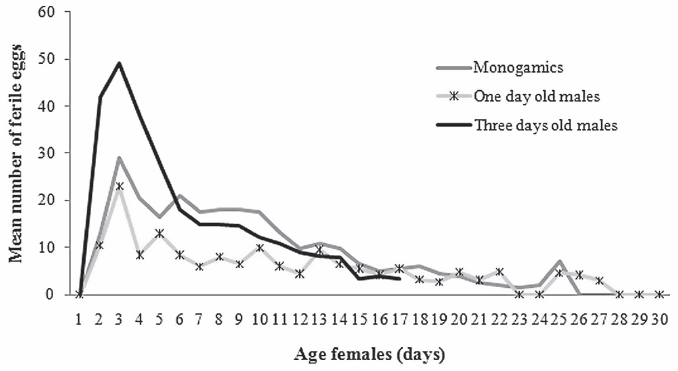
Mean number of fertile eggs laid by of Grapholita molesta females paired under monogamy and polyandry conditions with one and three day old males.
Fecundity and means (± standard error) of females of Grapholita molesta paired with monogamic and polygynic males, and evaluated during 15 days (n= individuals number).
Means followed by the same letter in a row are not statistically significantly different from each other (a= 0.05).
In relation to male age, the highest number of mated females was recorded when they were paired with males between three and eight days old, in both polygyny treatments (Fig. 2). However, a negative correlation was observed between the male age and the number of females that copulated (one day old females: r = - 0.621; df=23; P=0.0009) (three days old females: r = - 0.786; df=27; P<0.0001).
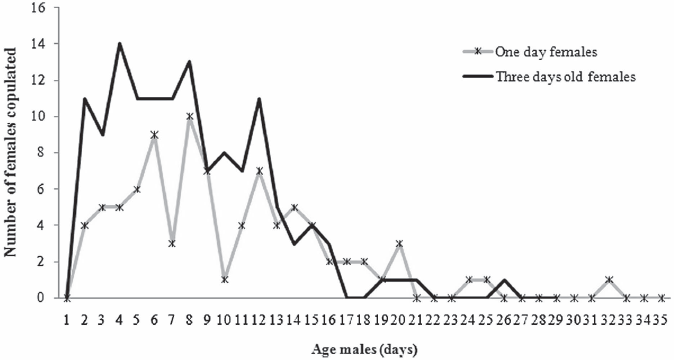
Daily number of females of Grapholita molesta that copulated with polygynic males throughout their lives.
Mean fecundity values were similar among females paired with males from day one to day 15 after emergence, in both polygynic groups (H=9.40; df=4; P=0.051). The highest mean fertility values were recorded for females paired with males four days after emergence. For one day old females, fertility was significantly different only for those females paired with males between four and six days old (H=18.35; df=4; P<0.05) (Fig. 3A). In the treatment where males received three days old females, the highest fertility values were recorded when they were between four and nine days old (H=21.4; df=4; P<0.05) (Fig. 3B). These results suggest that males of G. molesta maintain their reproductive capacity for a long period.
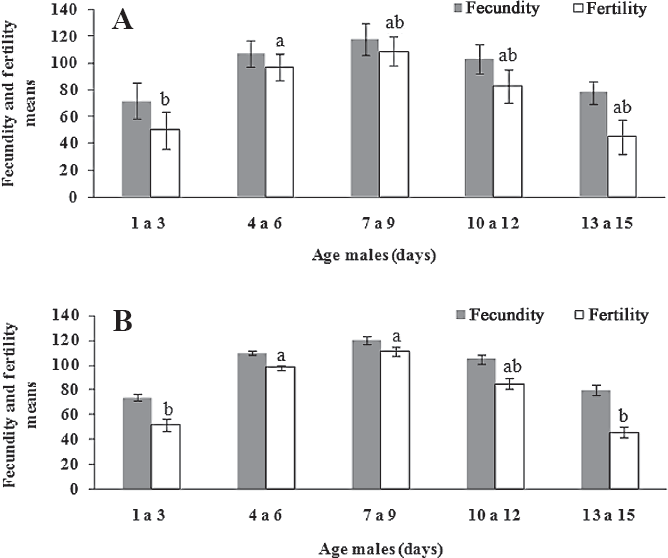
Means of fecundity and fertility (± standard error) of one day old A. and three days old B. females of Grapholita molesta during the first 15 days of life of the males. Different letters above bars indicate a statistically significant difference among means (Kruskal-Wallis, α= 0.05; Dunn, a= 0.05).
The relation between fertility and male age could be associated to the amount of sperm content received by the female during copulation. Even though the males emerge with a reproductive system completely formed, the maturation and volume of the glands normally changes throughout the adult phase in tortricids (Benz 1991). Apart from aging, the decreasing reproductive capacity in males of G. molesta, after a certain period, could also be influenced by the number of copulations along their life. In some species of tortricids, such as Choristoneura fumiferana (Clemens, 1865) and C. rosaceana (Harris, 1841), the percentage of fertile eggs is reduced when females copulate with non-virgin males, as a result of a linear decrease in the amount of sperm and other released by the male accessory glands. This decrease in the amount of substances was observed in the copulatory pouch of females with an increase in the number of previous copulations by the males (Marcotte et al. 2005).
Overall, different implications of polygamy were observed between the sexes the in G. molesta. Females do not need to copulate with additional virgin males to increase their fertility, and their oviposition pattern is independent of the number and the age of their partners. Males, after their third day of life, are able to copulate with a high number of females, keeping themselves fertile for a long period.
Footnotes
Acknowledgments
To the financial support of Conselho Nacional de Desenvolvimento Científico e Tecnológico (CNPq).