






Abstract
The aim of this work was to evaluate the toxicity of the insecticides imidacloprid/ß-cyfluthrin (Connect 100/12.5 SC), chlorfenapyr (Pirate 240 SC), chlorpyrifos (Astro 450 EW), novaluron (Rimon 100 CE), spinosad (Tracer 480 SC) and triflumuron (Certero 480 SC), as used in corn crops (
Keywords
Introduction
Fall armyworm
Among natural enemies that help control fall armyworm in corn crops are parasitoids of the genus
Some authors noted the presence of
The effectiveness of these parasitoids in integrated pest control management programs, however, is conditional on the use of chemical products that will not affect the parasitism and development of parasite populations, in other words, it is conditional to the application of selective compounds (Carvalho
In studying the effect of 40 agrochemicals in various commercial formulations on adult individuals of
Given the above, the objective of this work is to evaluate the effect of new insecticides recommended for corn crops on
Material and Methods
The following insecticides were used in this study (technical and commercial name, formulation, dosage and chemical group are listed for each one): imidacloprid/ß-cyfluthrin (Connect 100/12.5 SC - 0.33/0.04 g a.i. L−1, Neonicotinoid/ Pyrethroid), chlorfenapyr (Pirate 240 SC - 0.6 g a.i. L−1, Pyrazole Derivative), chlorpyrifos (Astro 450 EW - 0.75 g a.i. L−1, Organophosphate), novaluron (Rimon 100 CE - 0.05 g a.i. L−1, Benzoylurea), spinosad (Tracer 480 SC - 0.16 g a.i. L−1, Spinosyn) and triflumuron (Certero 480 SC - 0.048 g a.i. L−1, Benzoylurea). Water was used as control treatment.
Twenty females up to 24 hours old per treatment were collected from a laboratory nursery and were placed separately in 8 cm x 2.5 cm glass tubes, fed with honey droplets smeared on the inside of the tubes which were then sealed with PVC film. Approximately 125 eggs of
The treated eggs were placed in an environmental chamber at 24°2°C, RH 70±10%, with 14 hours of photophase, being then offered to female individuals of
To evaluate the effects of pesticides on the newly emerged F1 generation adults originating from the eggs of
Each treatment consisted of five replicates and each experimental portion comprised four card strips with eggs previously offered to the wasps for parazitation. The bioassays used a completely randomized design in a three exposure times x seven compounds factorial arrangement, totaling 21 treatments.
The data were submitted to analysis of variance and the mean values were compared using the Scott-Knott cluster analysis at the 5% significance level (Scott and Knott 1974). The evaluated pesticides were further grouped into the following toxicity categories as a function of the reduction in parasitoid survival rate according to IOBC recommendations: class 1 = harmless (<30% reduction), class 2 = slightly harmful (30% to 79% reduction), class 3 = moderately harmful (80% to 99% reduction) and class 4 = harmful (>99% reduction) (Sterk
Results and Discussion
The parasitic capacity of female individuals of
Number (±SE) of eggs parasitized by parent generation females of
Means followed by the same lower-case letter in a row and same upper-case letter in a column do not differ by the Scott-Knott test (P>0.05);
Mean percentage of reduction in parasitism;
Toxicity class according to Sterk
A substantial decrease in the number of eggs parasitized by parent generation females of
As for emergence of F1 generation parasitoids, chlorfenapyr was noted to be slightly harmful to females exposed to host eggs 24, 48 and 96 hours after application of the compound. Insecticide novaluron was slightly harmful, noting that 96 hours after application it presented one of the lowest mean values of emergence, approximately 31.3%. The remaining compounds were rated as harmless (class 1) (Table 2).
Emergence (%) (±SE) of F1 generation
Means followed by the same lower-case letter in a row and same upper-case letter in a column do not differ by the Scott-Knott test (P>0.05);
Mean percentage of reduction in emergence;
Toxicity class according to Sterk
Parreira (2007) verified that novaluron caused a reduction in the emergence percentage of F1 generation individuals of
The parasitic capacity of F1 generation females of
None of the insecticides were noted to affect the number of eggs parasitized by the F1 generation of
Similar results for triflumuron and novaluron were found by Carvalho
Number (±SE) of eggs parasitized by F1 generation of
Means followed by the same lower-case letter in a row and same upper-case letter in a column do not differ by the Scott-Knott test (P>0.05);
Mean percentage of reduction in number of parasitized eggs;
Toxicity class according to Sterk
The number of insects was insufficient to assess this characteristic.
Emergence (%) (±SE) of F2 generation of
Means followed by the same lower-case letter in a row and same upper-case letter in a column do not differ by the Scott-Knott test (P>0.05);
Mean percentage of reduction in emergence;
Toxicity class according to Sterk
The number of insects was insufficient to assess this characteristic.
As for the emergence of F2 generation of
Chlorfenapyr and chlorpyrifos caused 100% of mortality in F1 generation insects immediately after their emergence (Tables 3 and 4), preventing evaluation of the emergence percentage of F2 generation specimens. Similar results were found by Moscardini
Spinosad, triflumuron and novaluron did not affect the emergence of F2 generation females throughout the evaluation period, being rated as harmless (class 1). The evaluation at 96 hours revealed that spinosad and imidacloprid reduced the percentage of parasitoid emergence, with mean values 76.7% and 58.9% respectively (Table 4).
Parreira (2007) evaluated the action of triflumuron, imidacloprid and novaluron on the emergence of F2 generation specimens of
As a function of the reduction in emergence percentage of F2 generation females as caused by spinosad, triflumuron, imidacloprid/ß-cyfluthrin and novaluron, these products were rated as class 1 = harmless (Table 4).
Spinosad and chlorpyrifos caused 95% and 100% of mortality in the fourth evaluation (4 days after application) and on the first evaluation (24 hours after application) respectively, while triflumuron caused 65.0% of mortality eight days after application. Imidacloprid/ß-cyfluthrin only caused 10.0% of mortality 24 hours after application, increasing throughout the evaluation period to 95.0% of mortality on day eight. Novaluron revealed a similar pattern to the control treatment, presenting a peak mortality of 70,0% (Fig. 1A).
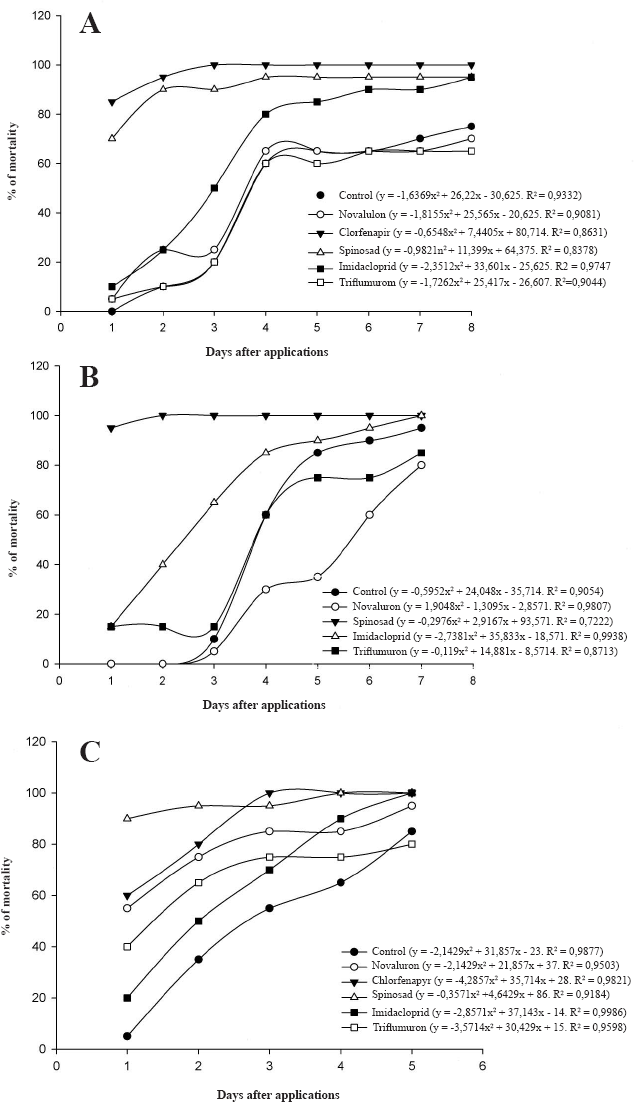
Mortality curves over time of parent generation females of
Chlorfenapyr and chlorpyrifos caused 100% of mortality in insects right in the first evaluation, while spinosad caused 100% of mortality in the second evaluation. Triflumuron and novaluron revealed a similar pattern to the control treatment, with mean values of mortality at around 95.0% and 80.0% on the last evaluation day respectively (Fig. 1B).
Chlorpyrifos caused 100% of mortality 24 hours after being applied, while chlorfenapyr caused 60.0% of mortality in the first evaluation, reaching 100% on day three. Spinosad presented 90.0% of mortality right on day one and 100% on day four. Triflumuron, imidacloprid/ß-cyfluthrin and novaluron caused 40.0%, 20.0% and 55.0% of mortality respectively in the first evaluation, increasing to around 95.0% on the last day. The control treatment presented 5.0% of mortality in the first evaluation, increasing to around 85.0% on the last day (Fig. 1C).
The results found in this work can contribute to a better understanding of the potentialities of combined use of parasitoids
Footnotes
Acknowledgments
Many thanks to the Research Aid Foundation of Minas Gerais State (FAPEMIG) and CNPq for providing the necessary financial support to accomplish this work.