






Abstract
Phimophorus spissicornis, the enigmatic and exclusively Neotropical representative of the Phimophorinae (Heteroptera: Reduviidae), is recorded for the first time from Colombia. Six adult specimens and one nymph were collected in the municipalities of Vegachí and San Carlos, department of Antioquia. In both localities P. spissicornis was collected from palms (Arecaceae) in association with Rhodnius pallescens (Reduviidae: Triatominae). Phimophorus spissicornis was found on the axils of palm fronds of Attalea butyracea and Oenocarpus bataua. Dorsal habitus illustrations of the male, female, and late instar nymph of P. spissicornis are provided.
Introduction
Phimophorinae Handlirsch, 1897 (Heteroptera: Reduviidae) is a small and enigmatic assassin bug subfamily, with just two genera and three species known, the monotypic Phimophorus Bergroth, 1886 and Mendanocoris Miller, 1956, with two species (Maldonado 1990). Phimophorus spissicornis Bergroth, 1886 is the only Neotropical representative (Usinger and Wygodzinsky 1964; Maldonado 1990). Among the Reduviidae subfamilies, Phimophorinae can be distinguished by the following combination of characters: presence of waxy secretions on the cuticle; body depressed; antennae inserted at the apex of head, distal flagellomere reduced; antenniferous tubercles plate-like, covering the insertions of the antennae; buccula present; prosternal sulcus with lateral shield-like structures; and bisegmented tarsus (Usinger and Wygodzinsky 1964). Phimophorus can be distinguished from Mendanocoris by having the distal flagellomere free; the clypeus reduced; the labrum very small; the buccula closed anteriorly; and by the different shape of the pronotum (Usinger and Wygodzinsky 1964).
The systematic placement of Phimophorinae has been problematic and widely discussed (Bergroth 1886; Handlirsch 1897a, b; Usinger 1943; Wygodzinsky 1948; Carayon et al. 1958; Usinger and Wygodzinsky 1964). Furthermore, the phylogenetic position of Phimophorus in Reduviidae is unknown primarily because specimens are very scarce in collections, thereby preventing its inclusion in cladistic analyses of the family (e.g., Weirauch 2008). Additional specimens of this genus are needed for future phylogenetic analyses.
Phimophorus has been recorded so far from Brazil and Ecuador (Carayon et al. 1958; Lent and Jurberg 1977). Because specimens of Phimophorus are seldom collected, little is known about its biology and natural history (Schuh and Slater 1995). The only biological information available for P. spissicornis is its association with bananas and bromeliads. The specimens on bananas were intercepted at ports of entry in the United States (Carayon et al. 1958), while the specimens from bromeliads came from a single collection event (Lent and Jurberg 1977; Lent and Wygodzinsky 1979); therefore, no generalizations can be made from these data.
As part of the Triatominae survey efforts by the Grupo de Chagas of the Universidad de Antioquia, several specimens of Phimophorus were collected in 1990 and 2006. In this paper we present the first formal record of the subfamily Phimophorinae for Colombia and provide detailed information on the habitat of P. spissicornis.
Materials and Methods
Specimens of P. spissicornis (Fig. 1) were initially collected at San Carlos (Department of Antioquia) in February 1990. The municipality of San Carlos is in the east region of Antioquia. There the mean annual temperature is 23°C, annual rainfall is 2,000 mm and elevation 1,000 m. The surveyed locality was “vereda Jardín, Finca El Silencio” (06°07’45”N, 74°49’57”W). The locality was visited in February 1990 during the dry season. A total of 13 palms of Oenocarpus bataua Mart., 1823 (Arecaceae) were examined. Because specimens of P. spissicornis were found among specimens of Rhodnius pallescens Barber, 1932 (Reduviidae: Triatominae) in San Carlos, additional fieldwork intending to collect R. pallescens prompted the search for specimens of Phimophorus in Vegachí and Victoria during 2006.
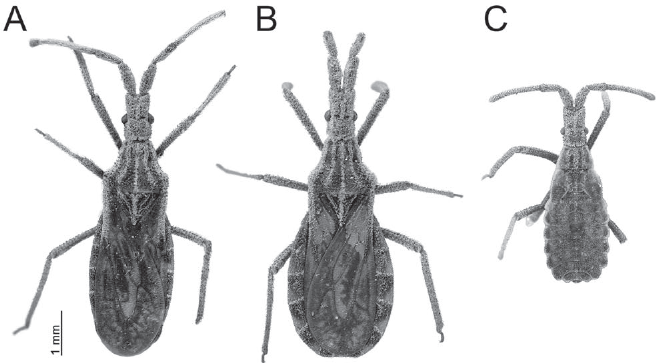
Phimophorus spissicornis, habitus, dorsal view.
The municipality of Vegachí is located in the Northeast of Antioquia. The mean annual temperature is 23°C, mean relative humidity 75%, and mean annual rainfall is 2,100 mm. The locality is a rural zone about 1 km east from the municipality town, at 982 m elevation (6°46’01”N, 74°47’40”W). This locality was visited in September 2006 during the rainy season. Two palms of Attalea butyracea (Mutis ex L. f.) Wess. Boer, 1782 were examined next to “El Volcán” river. In addition, one palm of O. bataua, at the “vereda La Leona”, was examined. Palm leaves were dissected using an ax, and the sheath and petiole carefully examined for reduviid specimens.
The municipality of Victoria is located in the northeast of Caldas. The mean annual temperature is 26°C, mean relative humidity is 75%, and mean annual rainfall is 2,000 mm. The surveyed locality is at kilometer 20 on the road from the municipality of La Dorada to the municipality of Norcasia (5°34’30”N, 74°52’05”W), at 780 m elevation. The locality was visited in November 2006 during the rainy season. Six palms of A. butyracea were examined. In addition, debris from the sheath and petioles of two palms of Elaeis oleifera (Kunth) was examined for presence of insect specimens.
The collected specimens of P. spissicornis were deposited in the entomological collection of the American Museum of Natural History, New York, NY, USA [AMNH]; and in the Colección Entomológica de la Universidad de Antioquia, Medellín, Colombia [CEUA].
Results
Four adults and one late instar nymph of P. spissicornis were collected between the axils of the fronds of O. bataua in association with adults and nymphs of R. pallescens in San Carlos. Two adult specimens of P. spissicornis were collected between the sheaths of A. butyracea in association with R. pallescens in Vegachí. In the six palms of A. butyracea surveyed in the municipality of Victoria, only adults and nymphs of R. pallescens were found but no specimens of P. spissicornis. Surveyed palms of O. bataua in Vegachí, and E. oleifera in Victoria, harbored neither P. spissicornis nor R. pallescens specimens.
Examined material.
Phimophorus spissicornis. 2 M, 2 F, 1 nymph. COLOMBIA, Antioquia, San Carlos, Vereda Jardín, Finca “El Silencio”, 6-feb-1990, Jaramillo N, in Oenocarpus bataua [as “Jessenia polycarpa”], [1 M, 1 F, 1 nymph, AMNH; 1M, 1 F, CEUA]. 2 F. COLOMBIA, Antioquia, Vegachí, 1 km de la cabecera municipal, “La Piscina” 6°46’01”N 74°47’40”W, 982 msnm, 9-sep-2006, Chaverra D. & Gómez L, [1 F, AMNH; 1 F, CEUA].
Distribution and ecology
The holotype of P. spissicornis was collected in Brazil with no specific locality or additional biological information (Bergroth 1886; Wygodzinsky 1948). The specimens from Ecuador mentioned by Carayon et al. (1958) also have no detailed locality information. In Colombia, 15 Reduviidae subfamilies are known, with about 95 genera recorded so far (Forero 2004, 2006). This is the first time that the subfamily Phimophorinae is recorded from Colombia.
The palms A. butyracea and O. bataua, are widely distributed in the country, as well as in Central America and in the Andean region of South America (Henderson et al. 1995). The structure of palms, especially the persistent petioles and the large crown of leaves, form a suitable number of microhabitats, which harbor a diverse assemblage of arthropods that use the palms as refuge or permanent habitation (Couturier and Kahn 1992; Delobel et al. 1995; Chang and Ling 1998; Gurgel-Gonçalves et al. 2006). The arthropods inhabiting these microhabitats may serve as prey for predatory insects like reduviids. The finding of a late instar nymph together with adults in palms more >3 m tall, suggests that feeding of P. spissicornis occurs in these microhabitats. We were unable to determine the prey preference of Phimophorus in the field, however, because of the large number of arthropods present in the axils of the palms.
The presence of P. spissicornis on bananas and bromeliads suggests that palms may not be the only habitat for this species. Nonetheless, it is not known if P. spissicornis is common in those habitats or merely a casual encounter. Finding adults of P. spissicornis on two palm species, in two localities separated from each other by > 50 km, in similar ecological conditions, as well as the discovery of a nymph, reinforces the idea that the microhabitat formed among the leaves of the palm species, may offer adequate conditions for the development of P. spissicornis.
Specimens of P. spissicornis in Colombia were always associated with R. pallescens. The association of P. spissicornis with species of Triatominae has been shown previously with Microtriatoma borbai Lent and Wygodzinsky, 1979 (Bolboderini) (Lent and Jurberg 1977; Lent and Wygodzinsky 1979). Our report of a second instance of association of P. spissicornis in the same habitat with another species of Triatominae is remarkable, although the nature of this association will depend on further research.
Footnotes
Acknowledgments
Colciencias and the Grupo Biología y Control de Enfermedades Infecciosas (BCEI) of the Universidad de Antioquia partially supported funding for this research by a fellowship to DC-R through the program “Jóvenes Investigadores.” Lily Berniker (Heteroptera Systematics Laboratory, University of California Riverside) kindly provided comments on an earlier version of the manuscript. Two anonymous reviewers provided criticism that greatly improved the final version.