






Abstract
The biological control of insect pests using parasitoids may have limited success without an understanding of the effect of temperature on natural enemies. The objective was to determine the parasitism, egg viability and sex ratio of Trichogramma exiguum and Trichogramma acacioi (Hymenoptera: Trichogrammatidae) to control Heliothis virescens (Lepidoptera: Noctuidae) eggs after two generations on eggs of Anagasta kuehniella at 18, 20, 25, 30 and 33°C. The increase in temperature favored the parasitism of T. exiguum. The egg viability of T. exiguum ranged between 70.1 and 97.1% and from 81.5 to 98.4% for T. acacioi in H. virescens eggs. The sex ratio of T. acacioi was constant at all temperatures studied, with only females in the progeny. Trichogramma exiguum reared in H. virescens eggs met the standards of quality control for mass production. Trichogramma exiguum showed higher parasitism than T. acacioi at high temperatures. However, both species had low parasitism on H. virescens eggs.
Introduction
Cotton plants can host a number of insects that cause significant damage to this crop. The use of insecticides is a widely used method to control pests, which generally contributes to the selection of resistant insect populations (McCafferry 1998).
Biological interactions between the pest and the environment can be used as a strategy to reduce the use of insecticides (Ghini and Bettiol 2000; Waage 2001). For example, egg parasitoid species of the genus Trichogramma can control insect pests in different agroecosystems (Pratissoli et al. 2005a; Bueno et al. 2008; Faria et al. 2008). However, research is necessary to predict the impact of natural enemies on the target pest prior to mass release programs (Parra et al. 1991; Pastori et al. 2007). Furthermore, highly specific parasitoids must be selected to control their host insect pest (Molina and Parra 2006; Yong and Hoffmann 2006).
Both the temperature and host species may impact the flight capacity, parasitism, longevity, viability and sex ratio of parasitoids (Gutierrez et al. 2007; Soares et al. 2007; Pandey and Tripathi 2008), which can modify the population dynamics of Trichogramma spp. and their role in biological control strategies (Pratissoli et al. 2005b). Thus, studies evaluating the impact of temperature on Trichogramma biology can help improve the establishment and efficacy of natural enemies in agroecosystems (Zilahi-Balogh et al. 2007). The phenotypic plasticity and physiological status of natural enemies may result in varying levels of performance.
The objective of this research was to study the parasitism, viability and sex ratio of Trichogramma exiguum Pinto & Platner, 1978 and Trichogramma acacoi Brun, Moraes & Soares, 1984 (Hymenoptera: Trichogrammatidae) under different thermal conditions to control Heliothis virescens (F., 1777) (Lepidoptera: Noctuidae).
Material and Methods
The experiment was conducted at the Department of Scientific and Technological Development in Pest Management of the Center for Agrarian Sciences, Universidade Federal do Espírito Santo, Alegre, Espírito Santo state, Brazil, in acclimated chambers at temperatures of 18, 20, 25, 30 and 33°C, with a relative humidity of 70 ± 10% and a photophase of 12 hours.
Trichogramma exiguum (T.e strain 2) were collected in corn fields (Oliveira et al. 2005) and T. acacoi (T.ac) from avocado. Both parasitoids were captured with eggs of Anagasta kuehniella (Zeller, 1879) (Lepidoptera: Pyralidae). Parasitoids were reared in eggs of the factitious host Anagasta kuehniella attached on cardboard paper (4.0 × 2.5 cm; central area of 2.5 cm2) and exposed to UV light for 50 minutes. Parasitism was allowed for 24 hours, and the parasitized eggs were kept in glass tubes (8.5 × 2.5 cm) (Parra 1997). Species were identified by Dr. B. Ranyse Querino from Brazilian Agricultural Corporation-Embrapa Roraima, Roraima state, Brazil.
Heliothis virescens (Lepidoptera: Noctuidae) was established from insects provided by the Laboratory of Insects Biology from Escola Superior de Agricultura “Luiz de Queiroz”, Piracicaba, State of São Paulo, Brazil. Insects were reared in an acclimatized room (temperature 25 ± 1°C, RH 70 ± 10% and photophase of 12 hours). The adults of H. virescens were kept in cages made with PVC tubes (20 cm diameter × 25 cm in height), internally lined with sheets of standard A4 white paper for oviposition. The top of the cage was closed with fabric. Adult moths were fed with a 10% honey solution.
Heliothis virescens eggs were collected and maintained in acclimated chambers (25 ± 1°C, RH 70 ± 10% and photophase of 12 h) until emergence. Larvae were then individually placed in sterilized (100°C for 1.5 h) glass tubes (8.5 × 2.5 cm) until pupation with ½ of its volume with artificial diet based on wheat bran and beans adapted to H. virescens (Greene et al. 1976). Trichogramma species were maintained for two generations in eggs of A. kuehniella at temperatures of 18, 20, 25, 30 and 33°C for temperature adaptation.
Newly emerged mated females species of Trichogramma were individually placed in glass tubes (4.5 × 0.7 cm). Each one received 30 H. virescens eggs on blue cardboard (3.0 × 0.5 cm). The eggs were fixed with 10% arabic gum. Parasitism was allowed for 24 hours. The cards with parasitized H. virescens eggs were maintained in glass tubes (8.5 × 2.5 cm) sealed with PVC plastic.
The percentage of parasitism, egg viability, sex ratio and number of parasitoids per egg were recorded. The treatments were arranged in a completely randomized design with 15 replications. Each replicate was represented by a parasitoid female. Regression equations were used to explain the variations in those parameters due to temperature. In order to achieve the most accurate predictive equations, the data were fitted based on the coefficient determination (R2), and the significance of the coefficients regression (SSI), and the regression F test (≤ 0.05).
Results and Discussion
Trichogramma acacioi showed higher parasitism in H. virescens eggs than T. exiguum at 18°C (Fig. 1). However, at temperatures above 20°C, the percentage of parasitism was higher for T. exiguum than for T. acacioi. Different thermal requirements were apparent between the two Trichogrammatidae species. The greatest parasitism potential of T. exiguum was at 25°C. Similar results were found by Gómez-Torres et al. (2008) for Trichogramma atopovirilia Oatman y Platner, 1983 (Hymenoptera: Trichogrammatidae) in eggs of Gymnandrosoma aurantianum Lima, 1927 (Lepidoptera: Tortricidae). On other hand, the potential parasitism of T. acacioi was reduced at that temperature.
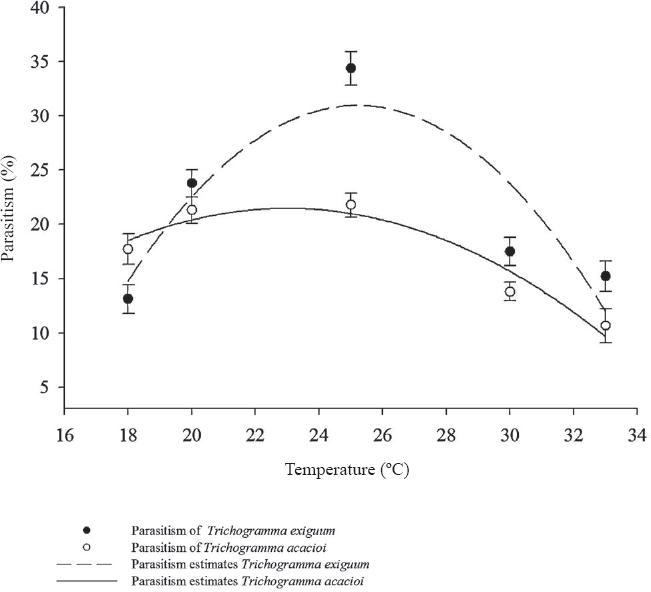
Parasitism (±SE) of Trichogramma exiguum (Y= -0.3122x2+ 15.733x-167.25; R2= 0.77) and Trichogramma acacoi (Y= -0.118x2+ 5.427x-40.91; R2= 0.92) on Heliothis virescens eggs at different temperatures.
Such variations of parasitism can be related to the adaptation of the species to the climate conditions where they were collected. Differences between T. exiguum and T. acacioi indicate that the biology of these species have variations, probably, due to the host H. virescens or temperature. This is supported by studies on the biological and thermal requirements of Trichogramma pretiosum Riley, 1879 (Hymenoptera: Trichogrammatidae) and T. acacioi on factitious hosts (Pratissoli et al. 2005b).
The higher parasitism of T. acacioi at lower temperatures is likely explained by the occurrence of this species in a milder climate than T. exiguum (Pratissoli and Fornazier 1999). Similarly, T. pretiosum (Hymenoptera: Trichogrammatidae) strain on Bonagota salubricola (Meyrick, 1931) (Lepidoptera, Tortricidae) had better parasitism rate at 18°C (Pastori et al. 2007). Thus, interspecific genetic variations are probably involved in the response of insects to temperature changes (Hercus et al. 2000).
Egg viability at different temperatures ranged between 70.1 and 97.1% and from 81.5 to 98.4% in H. virescens eggs for T. acacioi and for T. exiguum, respectively (Fig. 2). Differences between parasitoid species were observed only above 25°C. Moreover, for both species of parasitoids, the egg viability was reduced at temperatures greater than 25°C. However, T. acacioi developing in H. virescens showed higher egg viability that the same egg parasitoid in Plutella xylostella (L., 1758) (Lepidoptera: Plutellidae) (Pratissoli et al. 2008), indicating the influence of developing host. The egg viability of T. exiguum and T. acacioi was satisfactory between 18 and 30°C, with values above the minimum required for quality control in mass rearing of parasitoids (Navarro 1990). The results found on the present study for T. exiguum and T. acacioi were similar to these for Trichogramma maxacalii Vogelé y Pointel, 1980 (Hymenoptera: Trichogrammatidae) in eggs of Oxydia vesulia (Cramer, [1779]) (Lepidoptera: Geometridae) at different embryonic stages (Oliveira et al. 2003).
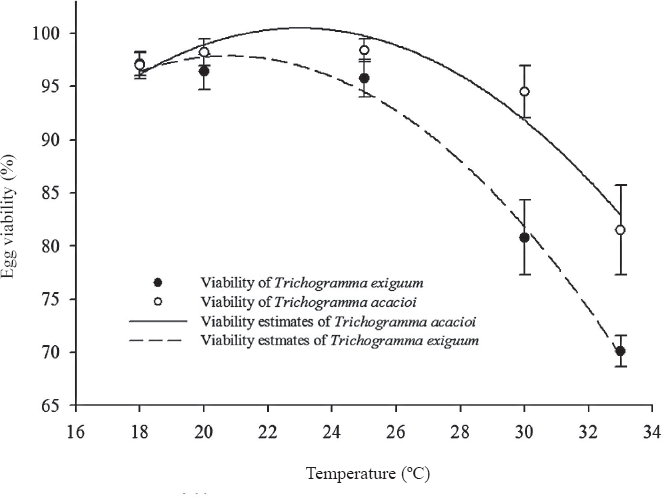
Viability (±SE) of Trichogramma exiguum (Y = -0.1749x2+8.037x+8.18; R2 = 0.94) and Trichogramma acacoi (Y = -0.188 x2+7.82x+16.674; R2 = 0.99) on Heliothis virescens eggs at different temperatures.
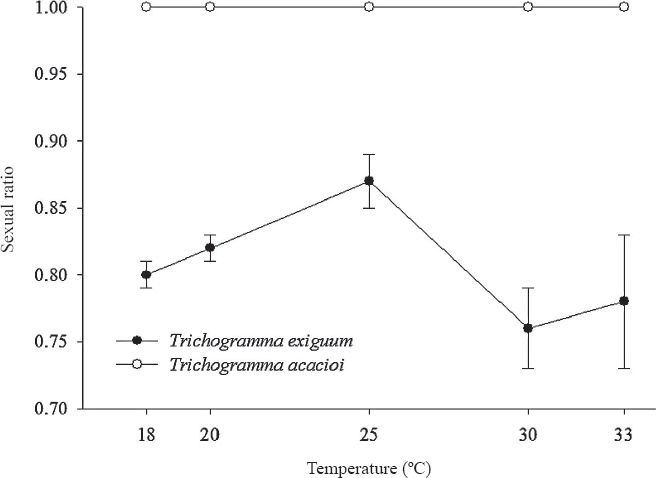
Sex ratio (±SE) de Trichogramma exiguum and Trichogramma acacoi on Heliothis virescens eggs at different temperatures.
The sex ratio of T. acacioi was constant at all temperatures studied with only females in the progeny. Similar results were found with Trichogramma pratissolii Querino & Zucchi, 2003 (Hymenoptera: Trichogrammatidae) reared in Anagasta kuehniella (Lepidoptera: Pyralidae) and Corcyra cephalonica (Stainton, 1865) (Lepidoptera: Pyralidae) (Zago et al. 2006). Despite showing variation in sex ratio, H. virescens eggs were appropriate as a host for T. exiguum such the standards of quality control in mass production (Lenteren et al. 2003).
Both southeastern species Trichogramma showed low parasitism with better fitness of T. exiguum than T. acacioi. The selection of Trichogramma to achieve the control of insect pests is necessary also to determine other features such as biological and behavioral aspects of the pests and parasitoids, pest population dynamics, release techniques, selectivity studies, and efficiency evaluation (Smith 1996; Parra and Zucchi et al. 2004). Higher rates of parasitism with Trichogramma species have been achieved by preimaginal conditioning, but in practice the natural enemies are reared and released with alternative hosts. Thus, the results with T. exiguum and T. acacoi suggest a possible effect without retention of learning, which can induce a change in adult behavior.
Footnotes
Acknowledgements
To Laboratory of Insect Biology of the Escola Superior de Agricultura “Luiz de Queiroz”. To the Brazilian agencies “Conselho Nacional de Desenvolvimento Científico e Tecnológico (CNPq)”, “Coordenação de Aperfeiçoamento de Pessoal de Nível Superior (CAPES)” “CAPES and Dr. B. Ranyse Querino for identification of parasitoids species.