






Abstract
The glasshouse whitefly, Trialeurodes vaporariorum, causes economic losses on several crops in the world. In Colombia, bean, green bean, tomato and other crops are severely affected by this insect. In the search for tools to control the whitefly, natural extracts have been presented as one alternative, since they are compounds with lethal and sublethal effects on insects. Among these are the saponins from Sapindus saponaria, which is present in the Neotropics and grows in dry and humid forests. In the present research a colony of whiteflies from the entomology laboratory of Corpoica in C.I-Tibaitatá was established on ICA Pijao beans. The experiments were carried out under controlled conditions with a temperature of 16°C and a relative humidity of 80%. The effects of the crude and the semi-purified extracts from S. saponaria on whitefly adults were evaluated at concentrations of 100, 200, 400, 800 and 1000 ppm. The insect mortality was recorded 24 hours after the application of the treatments and the mean lethal dose (LD50) was determined by Probit analysis. The mean lethal dose for the crude extract was established at 203 ppm, and at 88 ppm for the semi-purified extract.
Introduction
The glasshouse whitefly, Trialeurodes vaporariorum (Westwood, 1856), is a major pest of bean, green bean, tomato, potato, squash, eggplant, tobacco, cabbage and ornamental crops. It is found in fields, greenhouses or other protected horticultural environments (Quintero et al. 2001; Cardona et al. 2005). This insect causes direct crop damage by sucking the sap from the plant and indirect damage by excreting honeydew which promotes the growth of black sooty mold. It also transmits viruses that severely affect crops and cause plant diseases. Currently, the most effective method to control this pest is the use of chemical insecticides (Rendón et al. 1999). However, their inappropriate use has resulted in an increase in insect resistance as well as in negative environmental and human health effects (Thompson 1998). The use of plant extracts is one of the available alternatives to avoid these problems (Duke 1990). Secondary metabolites are plant-derived products that do not interfere directly with the main plant biochemical activities (Wink 1988; Mier and Palomino 1995). These are compounds with biological activity since they take part in the plant-environment interactions (Kessler and Baldwin 2002). Some of them are involved in defense mechanisms against herbivores (Nozzolillo et al. 1997; Kessler and Baldwin 2002; Osbourn 2003). Saponins are among these compounds (Sparg et al. 2004), and they are present in higher plants and marine organisms (Oleszek 2002). Interest in these compounds has focused on their use as raw material for the synthesis of steroid hormones (Waller 1999; Schenkel et al. 2001). They have also been important for their action on cell membranes, having a molluscicidal, antimicrobial, antifungal, and toxic activity for animals (Horber et al. 1974; Waller 1999; Adel et al. 2000; Sparg et al. 2004; Golawska et al. 2005; Golawska et al. 2006). Saponins from the seeds of Barringtonia asiatica (L.) Kurz, and soybean (Herlt et al. 2002) have been part of research on sub-lethal effects. In Colombia, research on saponins from the tree known as “Jaboncillo," Sapindus saponaria L., as toxic or repellent compounds has been limited to determining their effect on nematodes (Abreu et al. 2003). Meanwhile in other countries, a repellent effect has been reported on insect pests like Spodoptera frugiperda (J. E. Smith, 1797) and Anticarsia gemmatalis Hübner, 1818 (Lepidoptera: Noctuidae) (Saito et al. 2004).
The glasshouse whitefly damages crops by extracting large quantities of phloem sap. The honeydew excreted serves as a medium for black sooty mold fungi (Capnodium spp.) that discolors parts of the plant used for food and fiber (Byrne 1991). T. vaporariorum has three life stages, the egg, nymph and adult. The nymphal stage has four instars (Gill 1990). The glasshouse whitefly has a life cycle of 25-28 days which may vary according to temperature and humidity conditions. It also has a great ability to reach different environments. These features make T. vaporariorum the most predominant species in highland tropical environments and interandean valleys (Quintero et al. 2001).
The whitefly has had significant negative effects on the farming economy of 41 communities in seven departments in Colombia (López-Ávila and García 2000). Due to the enormous economic losses caused by T. vaporariorum, some farmers turned to insecticides and in 1994 their excessive use led to a recorded resistance of T. vaporariorum to 16 different chemical insecticides (organophosphates, carbamates and pyrethroids) (Palumbo et al. 2001). These compounds are considered chemical pollutants due to their low degradation rates in the environment (Palumbo et al. 2001). Other insecticides appeared later on with new modes of action such as the neonicotinoid insecticides, which are neurotoxins that act upon the acetylcholine receptors of insect neurons and work systemically in the plant (Palumbo et al. 2001). Insect growth regulators eventually appeared and they have been a key factor to restore farmers' confidence in the products. However, there is evidence for resistance to some of them in several farming systems in Europe, North America and Israel (Wardlow et al. 1972, 1975, 1976; Dittrich and Ernst 1990; Palumbo et al. 2001). Secondary plant metabolites are other kinds of compounds that have been researched for their possible use for pest control. Saponins are found in this group and a source of these compounds is the "Jaboncillo" tree, S. saponaria L. This species is present from Mexico, Central America and the Antilles to Argentina. Its altitudinal distribution goes from 0 to 1300 m and it adapts to a great variety of soils from limy to volcanic soils (Niembro 1986). Saponins are extracted from its fruit which is a spherical and mucilaginous drupe of 0.5-1.5 cm.
At the structural level, saponins are compounds that have both a hydrophilic (sugar chain) and a hydrophobic (aglycone) component, and they can have a triterpenoid, spheroid, or alkaloid-spheroid skeleton (Schenkel et al. 2001). Depending on the structure of their aglycone fraction, saponins can be classified as sapogenins or saponins. Sapogenins can consist of a triterpenoid group where the aglycone is usually of an oleanane or ursane type, as well as a steroid group which includes steroids and alkaloids. Saponins are glycocides containing a monosaccharide or a polysaccharide unit (Lin et al. 2005). The main chemical property of saponins is the reduction of the surface tension of an aqueous solution (Waller 1999; Schenkel et al. 2001). In the search for methods to control insect pests and reduce biological risks to agroecosystems, research on naturally occurring compounds such as saponins is considered a promising approach (Sparg et al. 2004). In order to establish the effect of saponin extracts from S. saponaria on the glasshouse whitefly, the mean lethal dose (LD50) of crude and semi-purified saponin extracts on T. vaporariorum was therefore determined.
Materials and Methods
This research was conducted in 2006 at the Research Center "Tibaitata" of Corpoica (Colombian Corporation of Agricultural Research) located in the municipality of Mosquera, Cundinamarca at an altitude of 2550 m, and at the laboratory of the Chemistry Department of the Universidad Nacional de Colombia.
The glasshouse whitefly came from a colony kept in the Research Center “Tibaitatá” and the laboratory conditions were as follows: average temperature 16°C, relative humidity 80% and photoperiod 12:12h. The whiteflies were established under glasshouse conditions on ICA Pijao bean plants. These plants were placed in breeding cages (40 cm x 50 cm and 40 cm in height) of muslin walls with a glass roof and door.
The crude and semi-purified saponin extracts were obtained from S. saponaria fruits brought from Palmira, Valle del Cauca, and the plants were identified by Dr. Luis E. Forero at the Universidad Nacional de Colombia, Palmira. The extraction was carried out in the chemistry laboratory following the AOAC (1984) (Association of Official Analytical Chemists) extraction method. To obtain the crude extract, the pericarp was diluted in water and the content was subsequently filtered, and a fraction of the extract was dried. In order to obtain the semi-purified extract, the pericarp was dried and macerated, followed by percolation with 96% ethanol until the total extraction was achieved. The ethanol extract was dried in a rotary evaporator and then it was dissolved with distilled water and the saponins were extracted by partition with isobutene. It was concentrated in a rotary evaporator until it dried. The isobutanol extract was dissolved in methanol and precipitated with ethyl ether. It was isolated by filtration and then dissolved in methanol to concentrate until it dried. A yellowish powder was obtained from this process (Abreu et al. 2003). A thin-layer chromatography was carried out on each one of the extracts, using Merck® chromatoplates with the system CH2Cl2: MeOH. Subsequently, the plates were treated with a universal developer. The obtained compounds were analyzed with mass spectrometry 1H-NMR (Proton Nuclear Magnetic Resonance) and 13C-NMR (Carbon Nuclear Magnetic Resonance). A standard solution was prepared with each saponin extract (1.000 mg of extract/L of distilled water).
To determine the mean lethal dose (DL50) of the crude and semi-purified saponin extracts on whitefly adults, five different dilutions (treatments) of the two saponin extracts were test: 100, 200, 400, 800 and 1000 ppm. Plants with six true leaves were used and these were sprayed uniformly with 10 ml of the solution (spray pressure 60 psi, spacing 10 cm). These plants were then placed in a breeding cage in which 100 whitefly adults were released. Control plants were sprayed with distilled water. For each extract and dilution, there were three repetitions. Mortality due to the treatments was determined by counting the number of dead individuals after 24 h. Mortality was corrected by Abbott's formula M=me-mb/1-mb (M= Mortality, me=mortality on treatment, mb= mortality on the control). The lethal doses and the confidence limits were determined by Probit analysis (SAS 9.0). In this analysis the best fitted probit dose line (Pdl) was found with the LD50 log (probit 5). A two-way analysis of variance (ANOVA) was performed to test the combined effect of the type of extract and the concentration on the mortality of T. vaporariorum. When it was significant, a Tukey HSD post hoc analysis was performed to determine where the differences were present. This analysis was performed by using STATISTICA 7 (StatSoft Inc. 2004).
Results and Discussion
The mortality of T. vaporariorum increased with increasing concentration of both crude and semi-purified saponin extracts (F1,24=107.18, P < 0.001). There were also differences in the mortality rates of T. vaporariorum for the crude and semi-purified extracts. As shown in figure 1, the differences in mortality are mainly given by the interaction between the type of extract and its concentration (F5,24=784.74, P < 0.001). At concentrations <400 ppm, the semi-purified extract caused higher mortality rates than the crude extract. But for concentrations >400 ppm no differences were found in mortality rates between extracts (Fig. 1).
Having established the LD50 and the confidence limits, the lethal dose for T. vaporariorum adults was estimated at 203 ppm for the crude saponin extract, and 88 ppm for the semi-purified saponin extract (Fig. 2). According to Jain and Tripathi (1991, 1993) saponins act as insect feeding deterrents, but it depends on concentration, because at high concentrations the effect is lethal (Molina 2001). During the experimental trials a large number of T. vaporariorum adults were observed convulsing three hours after releasing them on the plants treated with the semi-purified saponin extract. These insects were subsequently found dead. Mortality was probably caused by direct contact with the extract which led to convulsions due to a decrease in oxygen consumption and ataxia (Molina 2001). The saponins present on the epidermis of bean leaves can also be responsible for mortality due to reduction in phloem sap ingestion as reported by Thorp and Briggs (1972), Sherley et al.(1999), Spurr and Drew (1999) and Lloyd and McQueen (2000), who worked with saponins extracted from other plants. They also suggested that saponins have a significant toxic effect. Sap ingestion reduction may occur since saponins slow the passage of food through the gut, perhaps by reducing digestibility, and may secondarily influence food uptake, inhibiting digestive enzymes (Ishaaya and Birk 1965; Golawska et al. 2005) and interfering with sterol metabolism (Ishaaya et al. 1969; Shany et al. 1970).
Chemical analyses of the extracts demonstrated that the semi-purified S. saponaria extract had a high content of triterpene sapogenin with a triglycoside residue. While the triterpene sapogenin (Oleszek 2002) content for the semipurified extract was 72%, this decreased to 26% for the crude extract. This can result from the type of extraction used, since this allows for the presence of different compounds from saponins such as sugars, among others (Guterres 2005). The presence of these compounds in the evaluated extracts entails a synergistic interaction between the saponins and the other compounds present in both types of extracts as was reported by Horber et al. (1974), Adel et al. (2000), Golawska et al. 2006 and Golawska 2007) in other kinds of saponins.
As the results showed, T. vaporariorum was more susceptible to the semi-purified saponin extract than the crude extract when concentrations oscillated between 100 and 400 ppm; this might have been due to the procedures used for extracting the saponins (partition separation). Although the semi-purified saponin extract has better results in comparison to the crude extract, its extraction is more complex since the partition separation method has considerable cost and its implementation requires sophisticated equipment and reagents that are not easy to obtain. On the other hand, the crude extract is easier to obtain as it only requires basic equipment and water. However, the crude extract does not make it possible to use constant concentrations as it is highly susceptible to variations resulting from experimental errors.
The mortality values demonstrate the toxicity level of both the semi-purified and crude extracts (Sutherland 1982). The semi-purified saponin extract is therefore more toxic to T. vaporariorum adults.
It can be concluded from these results that the semi-purified extract is more effective at lower concentrations than the crude extract, but it is more difficult to obtain in comparison to the crude extract. Therefore, the crude saponin extract should be used to control T. vaporariorum since it can be obtained more easily and solutions at concentration >400 ppm have the same effect as the semi-purified extracts. However, if concentrations <400 ppm have to be used, the semi-purified extract would be recommended instead.
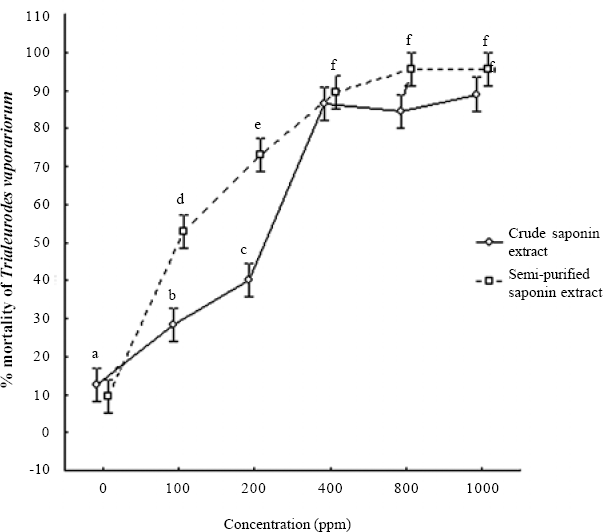
Mortality of Trialeurodes vaporariorum subject to different concentrations of crude and semi-purified saponin extracts of Sapindus saponaria L. Means - SE are presented.
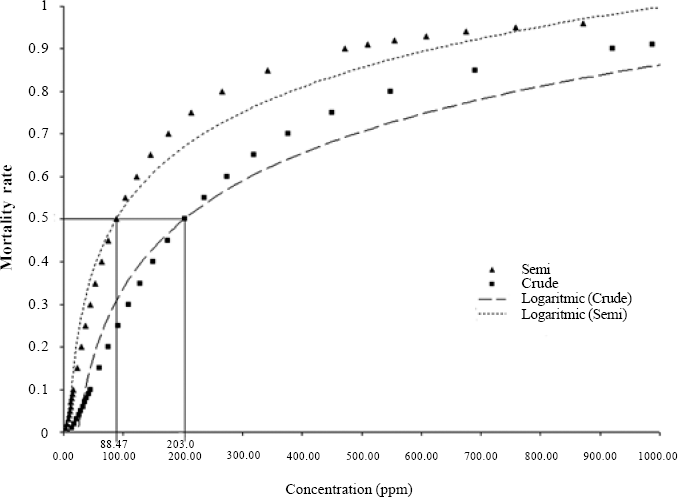
Mortality rates of Trialeurodes vaporariorum for the crude and semi-purified saponin extracts. Curves were estimated based on Probit analysis (SAS 9.0). The LD50 was determined for both extracts.
Footnotes
Acknowledgements
The authors would like to thank F. Becerra and C. Sarmiento for their help; R. Gil for his help in the use of S.A.S (9.0); L. Romero, J. M. Carvajalino, J. H. Ramírez V., S. Alarcón, J. Gomez and R. Perez for their help in the laboratory; A. Chautá and D. Estrada for their help in the activities to finish this text; and Ben for his remarks. We especially thank K. Poveda for her valuable help with important ideas for finalizing the manuscript. We also thank the Universidad Nacional de Colombia and Corpoica (Tibaitatá) for their support and assistance in providing all the necessary equipment.