Three new species, Epilachna rauli, E. madrigali, and E. pseudotumida are described; the homonyms Epilachna kraatzi Gordon and E. nana Gordon are replaced by E. colombiana, and E. minuta, new names, respectively. New host records are given for some species Epilachninae.
Examination of the Coccinellidae in the collection of the Universidad Nacional de Colombia, Medellín, resulted in the discovery of 3 undescribed species of Epilachna. These are described here and 2 specific names proposed by Gordon (1975) are replaced. New host records from label data on specimens in the collection are included.
Type specimens are deposited in the Universidad Nacional de Colombia (UNCM) and the U.S. National Museum of Natural History, Washington, D.C. (USNM).
I am indebted to R. Pope, British Museum (Natural History), London; J. Chapin, Louisiana State University, Baton Rouge; and R. Smiley, Systematic Entomology Laboratory, USDA, Beltsville, Maryland, for reviewing the manuscript.
Weise (1898) described Solanophila kraatzi from Africa, and Solanophila Weise was synonymized with Epilachna Chevrolat by Korschefsky (1931). Therefore a new name is proposed for E. kraatzi Gordon (1975). I thank H. Fürsch (pers, comm.) for bringing this situation to my attention.
Epilachna nana was described from India in 1950 by A. Kapur, who has kindly informed me of the homonymy (pers. comm.). I take this opportunity to propose a replacement name for E. nana Gordon.
Toxotoma murilloi Gordon
One specimen in the UNCM was collected on "maleza" (weed) in the Valle Medellín, Colombia, in November 1942. Five specimens were collected on "Compositae" at Prado, Antioquia, Colombia, in February, 1982.
Epilachna walteri (Sicard)
The species redescribed and illustrated by Gordon (1975) as E. walteri is not that species but another that I describe below and name E. rauli. The descrip- tion and illustrations of "E. walteri" are actually of E. rauli. No specimens of the true E. walteri were available in 1975 other than the type specimen, and because of the extreme similarity in external appearance, it was presumed that the species on hand was indeed E. walteri. Specimens present in the Medellín collection represent both species so it is now possible to sort the two out and describe the true E.walteri.
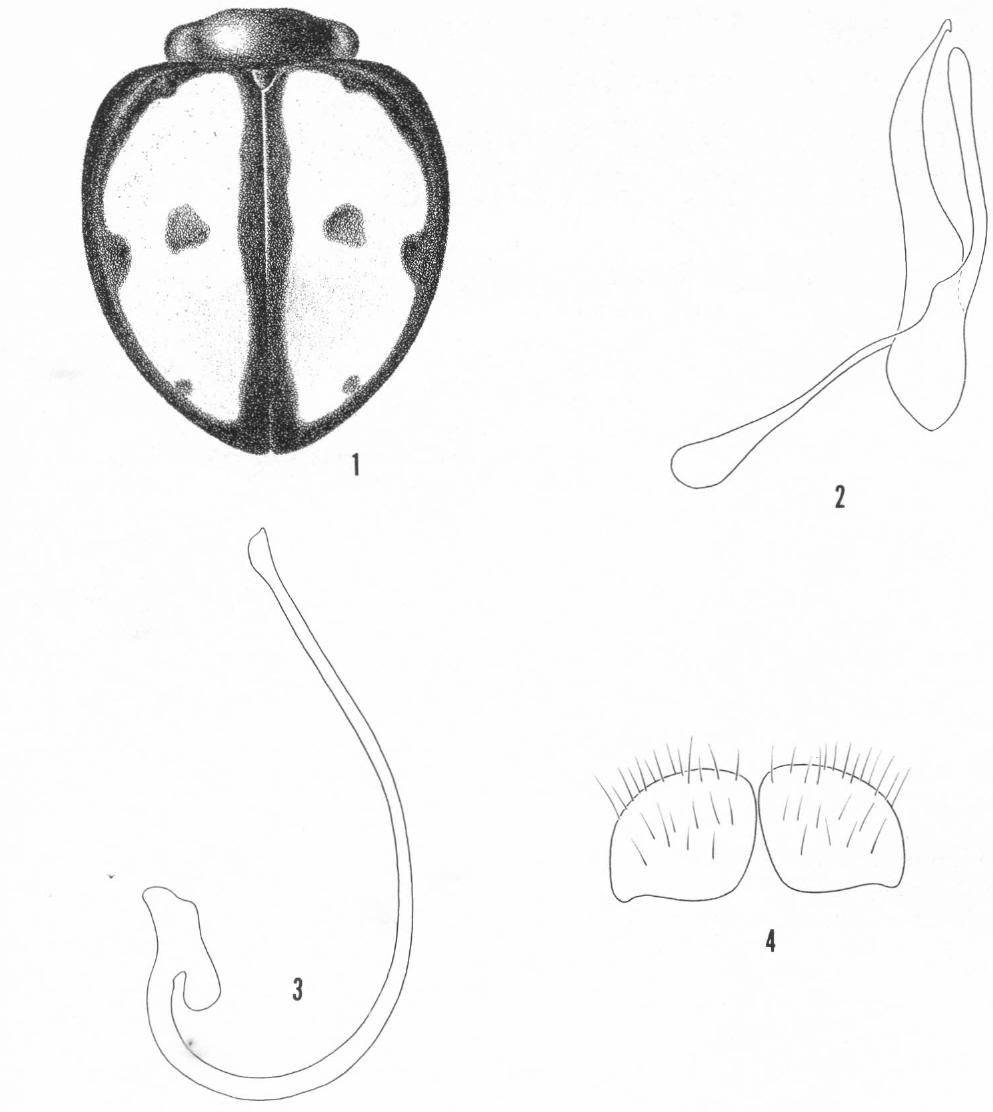
Description: Male, length 6.0 mm, width 6.0 mm. Form subcordate, widest behind humeral angles, elytron with lateral margin rounded from base to apex, lateral margin strongly ex- planate. Color black; pronotum with anterolateral angle very narrowly yel- low, elytron yellowish orange bordered with black, with transverse black spot on disc usually not connected to sutural border, humeral callus covered by black projection, black projection of lateral border present just behind middle, black spot in apical 1/4 narrowly connected to lateral black border (Fig. 1).
Punctation on elytron dual, small punctures separated by their diameter or less, large punctures separated by one to 2 times their diameter. Surface of elytron finely reticulate. Pubescence yellowish white. Postcoxal line on 1st abdominal sternum complete, extend- ing to middle of sternum. Abdomen with hind margin of 5th sternum trun- cate; 6th sternum notched; 6th tergum feebly emarginate. Genitalia with basal lobe longer than paramere, curved throughout with dorsal hump at base and apex abruptly reflexed; paramere slender, straight (Fig. 2); sipho curved from base to apex, apex laterally flattened, enlarged, pointed (Fig. 3).
Female: Similar to male except hind margin of 5th sternum slightly pro- duced medially, 6th sternum very feebly emarginate; 6th tergum rounded. Genitalia with 10th tergum feebly emarginate; genital plate somewhat rectangular, stylus not visible (Fig. 4).
Variation: Length 6.0 to 8.50 mm, width 6.0 to 7.50 mm. The discal and apical spots may be reduced in size and free of the sutural and lateral black borders.
Remarks: This species and E. rauli are very similar in appearance, but the male genitalia place E. walteri in the vittigera Group and E. rauli in the latimargo Group. Externally E. walteri is distinguished from E. rauli by the following: form subcordate; black area covering humeral callus not extended beyond callus; discal black spot on elytron either connected to sutural border or, if free, very small, apical spot either connected to lateral border, or, if free, very small. Host data on the specimens of E. walteri examined include "Solanaceae" and "maleza"; the latter means simply "weed".
E. walteri. Fig. 1, habitus; figs. 2 and 3, male genitalia; Fig. 4, female genital plates.
Distribution records: Colombia: Caldas (Ant.); Porce (Ant.) Manizales; Sta. Bárbara; V. Medellín.
Epilachna rauli, new species
Description: Male, length 7.0 mm, greatest width 6.10 mm. Form oval, widest at middle of elytron, elytron rounded from humeral angle to apex, lateral margin weakly explanate. Color black; pronotum with anterolateral angle narrowly yellow, elytron as des- cribed for E. walteri above except black area covering humeral callus produced inward, discal spot triangular, not connected to sutural border, apical spot large, transverse, not connected to lateral border. Punctation on elytron dual, small punctures separated by their diameter or less, large punctures separated by one to 2 times their diameter. Surface of elytron finely reticulate. Pubescence yellowish white. Postcoxal line complete, extending to middle of 1st abdominal sternum. Abdomen with hind margin of 5th sternum faintly emarginate; 6th ster- num notched; 6th tergum truncate. Genitalia with basal lobe longer than paramere, lower margin truncate in apical 1/4, apex abruptly curved up- ward, in ventral view orifice for sipho gradually widened from base to apical 1/4; sipho curved from base nearly to apex, apex pointed, curved upward, orifice dorsal, subterminal (Figs. 728- 730 in Gordon, 1975).
Female: Similar to male except hind margin of 5th sternum feebly notched; 6th sternum convex with longitudinal suture; 6th tergum broadly convex. Genitalia with 10th tergum convex; genital plate suboval, transverse, stylus visible (Figs. 1575-1578 in Gordon, 1975).
Variation: Length 6.75 to 7.50 mm, width 6.0 to 7.0 mm. Black elytral spots somewhat variable in size, discal spot sometimes connected to sutural border (Fig. 244 in Gordon, 1975).
Type-material: Holotype, male, Co- lombia, Caldas (Ant.), Sept. 1973, R. Vélez, en maleza. (USNM). Allotype, Colombia, Retiro (Ant.), Nov. 1974, R. Vélez, en maleza. (UNC). Paratypes: 2, same data as holotype; 2, same data as allotype; 1, Colombia, Cauca; 1, Colombia, Prado (Ant.), Oct. 1973, R. Vélez, en maleza; 1, Colombia, S. Ant. Prado (Ant.), Oct. 1981, R. Vélez, en maleza; 1, Colombia, S.A. Prado (Ant.), Sept. 1981, G. Mora, en maleza; 1, Colombia, Encarnación (Ant.), Dic. 1980, A. Madrigal C.; 1, no data; 3, Colombia, Cald., Salento, 1895 m., 14-VII-1939, Murillo No. 5168. (UNC) (USNM).
Remarks: The description above is a modification of the description of "E. walteri" in Gordon (1975). Epilachnarauli is externally quite similar to E.walteri; see comparative comments under that species. This species is named for Raúl Vélez-Ángel, an esteemed colleague and collector of part of the type series.
Epilachna madrigali, new species
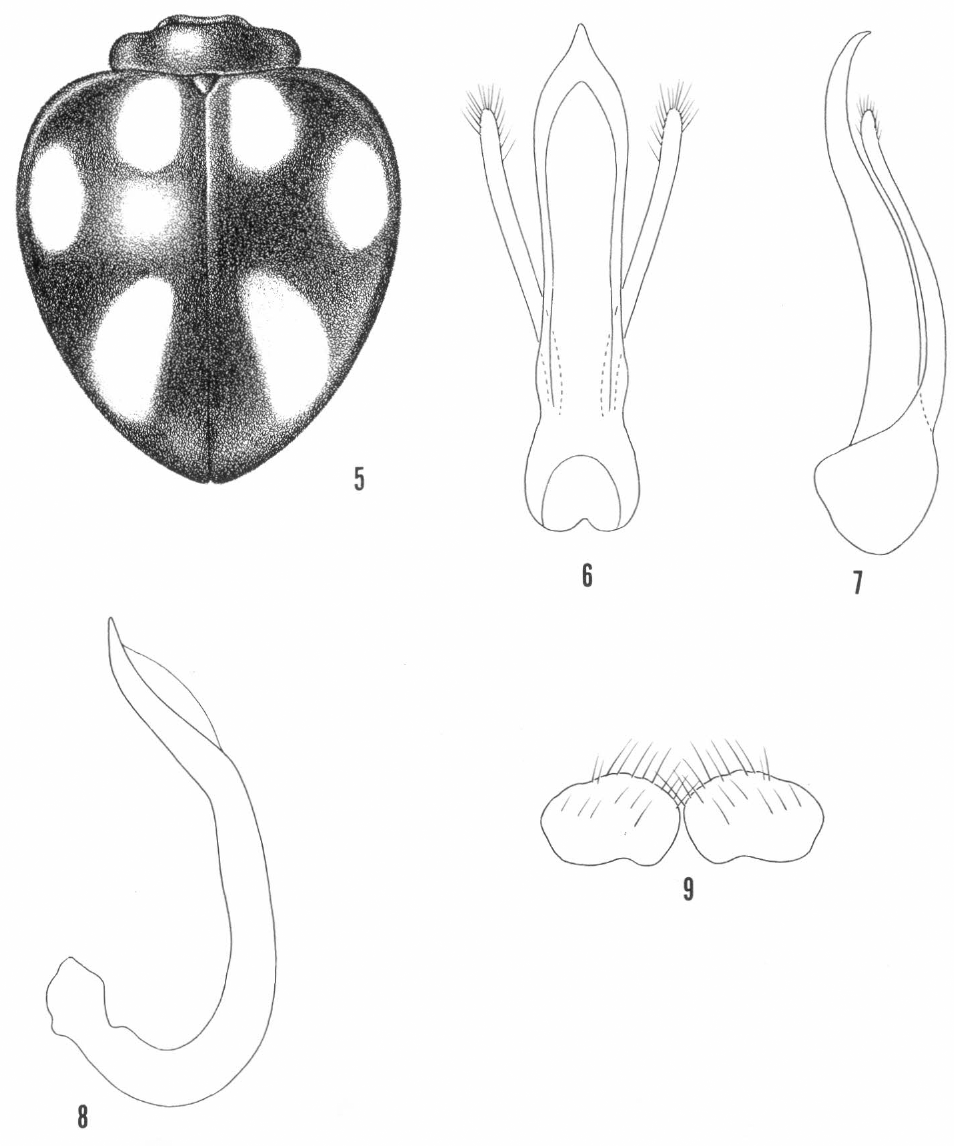
Description: Male, length 7.0 mm, greatest width 6.40 mm. Form strongly cordate, widest across humeral angles, lateral margin of elytron nearly straight. Color black; elytron with 3 yellow spots, basal spot elongate from base near scutellum to disc, median spot near lateral margin below callus, posterior spot obliquely triangular on apical 1/3 (Fig. 5). Punctation on elytron dense, dual, coarse punctures large, separated by a diameter or less. Pubescence yellowish white. Postcoxal line on 1st abdominal sternum com- plete, not reaching middle of sternum. Abdomen with hind margin of 5th sternum truncate, entire; 6th sternum notched medially; 6th tergum faintly emarginate medially. Genitalia with basal lobe longer than paramere, curved upward at apex in lateral view, apex pointed, lacking setae; paramere slender, not widened apically (Figs. 6, 7); sipho broad, robust, basal capsule not defined, median 2/3 laterally flat-
Female: Not known.
Variation: Length 7.0 to 7.7 mm, width 6.4 to 6.7 mm. The size of the yellow elytral spots varies slightly.
Type-material: Holotype, male, Co- lombia, (Ant.), Encarnación, Dic. 1980, A. Madrigal C., en maleza. (USNM). Paratypes; 3, with same data as holotype. (UNC).
Remarks: The cordate form and elytral spot arrangement are distinctive for this species. The only other described species of Epilachna with a remotely similar appearance is E. consularis Mulsant, which is in the albovittata Group (Gordon, 1975). The male genitalia of E. madrigali place it in the fenestrata Group where there are no similarly marked species. This species is named for Alejandro Madrigal, the collector of the type series and noted authority on genitalia of various sorts.
E. madrigali. Fig. 5, habitus; figs. 6-8, male genitalia. Fig. 9; E. pseudotumida, habitus.
Epilachna pseudotumida, new species
Description: Female, length 7.0 mm, greatest width 6.3 mm. Form oval, very strongly convex, gibbous, widest anterior to middle of elytra, lateral margin of elytron rather strongly ex- planate, rounded from humeral angle to apex. Color black; mouthparts yellow to piceous, elytron with elon- gate red spot on disc. Punctation on elytron dual, large punctures separated by less than to twice a diameter. Pubescence yellowish white. Postcoxal line on 1st abdominal sternum incom- plete, extending beyond middle of sternum. Abdomen with hind margin of 5th sternum truncate; 6th sternum very feebly emarginate; 6th tergum rounded, entire. Genitalia with 10th tergum rounded; genital plate trans- verse, stylus not visible (Fig. 9).
Male: Not known.
Type-material: Holotype, female, Co- lombia, (Ant.) Encarnación, Dic. 1980, A. Madrigal C., en maleza. (USNM).
Remarks: The only previously des- cribed species of Epilachna with the external shape and color pattern of E.pseudotumida is E. tumida Gorham, known only from Costa Rica, it is much larger (10.0 mm or more in length), has the red spot on the elytron differently shaped, and the female genital plate nearly round rather than transverse. The habitus illustration of E. tumida (Gordon, 1975) is indicative of the appearance of E. pseudotumida. Epilachna tumida was so named for the strongly gibbous body form, but E. pseudotumida is even more strongly gibbous.
References
1.
GordonR. D.1975. A revision of the Epilachninae of the Western Hemisphere (Coleoptera: Coccinellidae). U. S. Dept. Agr. Tech. Bull.1493:1–409.
2.
KapurA. P.1950. A note on Epilachna ocellata Redt., (Coleoptera: Coccinellidae), with descriptions of three species hitherto confused with it. Rec. Indian Mus.48:17–29.
3.
KorschefskyR.1931. Coleopterorum Catalogus. Pars 118, Coccinellidae. I. Berlin, 224 pp.
4.
WeiseJ.1898. Coccinelliden aus Kamerun. Deutsche Entomol. Zeit.1898:97–125.