





Abstract
Keys to genera and species of the Agromyzidae known in Colombia are provided and 15 new species are described: Melanagromyza spilanthes; Cerodontha sp. Cerodontha colombiensis, C. (C.) nigra; Liriomyza chiensis, L. colombie- Ila, L. herrerai, L. hordei, L. madridensis, L. montserratensis, L. nigra, L. robustae; Phytoliriomyza colombiana, P. medelli- nensis, P. sabanae, P. similis. A new generic synonymy is established, with Geratomyza Spencer now formally synonymised with Japanagromyza Sasakawa. Four pest species are recorded as new to Colombia: Melana- gromyza phaseolivora, Liromyza sativae, Phytomyza rufipes and Chromatomyia syngenesiae. A new species from Bolivia, Phytoliriomyza papae, feeding in potato stalks is described.
Introduction
Agromyzidae in South and Central America are now becoming reasonably well known, following the Synopsis of Neotropical species (Spencer, 1963) and more detailed studies on individual countries by Spencer (1973c, Venezuela; 1973a and 1983a, Costa Rica; 1982, Chile). Five species from Brazil were described by Spencer (1966b), 2 species attacking tomatoes in Colombia and Ecuador were described by Steyskal (1972) and one new Calycomyza species in Argentina was described by Valladares (1981). A comprehensive survey of species in southern Florida and the Caribbean was given by Spencer and Stegmaier (1973).
Hitherto approximately 300 species have been recorded in the Neotropical Region, of which only 10 were known in Colombia. Following recent collecting in Colombia 15 new species are now described and 21 are recorded for the first time. It is certain that many further species await discovery, particularly in the genera Melanagromyza and Calycomyza at lower altitudes than around Bogotá where most of my collecting was undertaken.
Of the 15 new species, five are grass-feeders, one known as a pest of barley; one feeds in the flower-heads of the weed Spilanthes americana and the host of the others is not known. It is reasonably certain that only Liriomyza hordei among these new species is of any economic importance. Po-tential pests recorded are Melanagromyza phaseolivora feeding in pods of beans, Liriomyza sativae, a highly polyphagous species attacking many vegetables and flowers, Phytomyza rufipes known as a pest of cabbage in Europe and Chromatomyia syngenesiae, a serious pest of Chrysan-themums in Europe.
Materials and Methods
The present review has been based primarily on my four visits to Colombia in April, June and August, 1982 and in October/November, 1983. Intensive collecting was under-taken around many of the flower farms on the Sabana, north of Bogotá and SE of Bogotá beside the road to La Calera, at La Ceja and Rionegro (Antioquia) and at Pien-damó (Cauca). Some specimens were also provided for study by ICA, Tibaitatá. In all 370 specimens have been examined and 40 genitalia preparations have been made.
Keys have been prepared to the 9 genera now recorded in Colombia, including also Agromyza and Ophiomyia which although not so far known, are certainly present at lower elevations. For discussion of these two genera see Spencer and Stegmaier (1973). Keys are also provided to species.
A discussion of the biology, rearing methods and preserva-tion of both adults and leaf-mines of Agromyzidae was given in Spencer and Stegmaier (1973: 7-8 and 15-17). A convenient method of preparing and mounting male genitalia was provided by Spencer (1981: 15-18).
The following abbreviations, familiar to all dipterists, have been used:
acr acrostichal hairs ori lower orbital bristles
dc dorso-central bristles ors upper orbital bristles
Holotypes and other material at present retained in the Author's collection (AC) will in due course be deposited in the British Museum (Natural History), London.
Key to genera of Colombian Agromyzidae (including Agromyza and Ophiomyia not so far known in Colombia but certainly present)
Genus Melanagromyza Hendel
This is the largest genus known in South America, with 63 species recorded from the Caribbean and Central America south to Argentina and Chile. Twelve further species are known from Florida and it seems probable that with further collecting a number of these will be discovered in Central America or Colombia. Spencer (in Spencer and Stegmaier, 1973) gave a key to 52 Neotropical species known at that time. Surprisingly only 9 species are known in Colombia and it is certain that many more await discovery, particularlay at lower elevations.
All species are dark, with the head black and mesonotum black or greenish. Many species are difficult to identifiy on external characters but the male genitalia are well differen-tiated in this genus and illustrations of the genitalia are given for eight of the species discussed bellow.
The larvae of all species feed internally in stems, flower-heads or other parts of the plant. A number of species are of economic importance, weakening or even destroying young plants. Three such species in Colombia are M. tomaterae and M. caucensis feeding in tomato stems, and M. phaseolivora Spencer feeding in pods of beans.
Of the nine species now recorded in Colombia, four are new to Colombia and one is described as new. The new material seen clearly suggests that many species will prove to be more widespread in South America than had hitherto been believed. M. phaseolivora was previously only known from Ecuador, M. setifera from Guyana and M. wedeliae from southern Florida.
Key to Colombian Melanagromyza species
Melanagromyza caucensis Steyskal. Fig. 1.
This species was obtained together with M. tomaterae from stems of tomato at Pradera, Valle, 28.ix.68 (I. Zenner). The two species are very similar but in M. caucensis the eye is bare in the male and the halteres are uniformly black. The aedeagus (Fig. 1) obviously differs from that of tomatcrae, lacking an extended process from the upper half of the mesophallus. It seems probable that a species recorded from Ecuador as "sp. nr. chenopodii" by Spencer (1963: 309) may be identical with M. caucensis.
Melanagromyza colombiensis Spencer. Fig. 2.
This relatively large species, described from 4 specimens from Bogotá (exact locality not recorded), belongs to the group of greenish species with the squamal fringe pale but is distinctive in having the halteres partially white. In this character it resembles M. tomaterae but is larger and the male genitalia confirm that the two species are distinct. The aedeagus is shown in Fig. 2. There is no indication of the host.
Melanagromyza neotropica Spencer. Fig. 3.
This is the most widespread of the complex of greenish species with the squamal fringe pale. It was described from Mexico and Brazil and has since been recorded in Venezuela (Spencer, 1973c), Chile (Spencer, 1982) and Costa Rica (Spencer, 1983a); it is also known in Argentina (Valladares, pers. comm.). One previously confirmed host is Bidens pilosa, the larva feeding in the flower heads.
Two females almost certainly referable to this species were reared from flower-heads of Spilanthes americana together with M. spilanthis sp.n. at Bogotá, ix.82.
An important character of this species is the virtually bare arista. The aedeagus of a male ex Bidens, Argentina is shown in Fig. 3.
Melanagromyza nobilis Spencer. Fig. 4.
This is the only recorded Colombian species with the meso-notum and abdomen entirely black. The unusual form of the aedeagus (Fig. 4) confirms its isolated position. It remains known only from the unique holotype (unfortuna-tely now lacking its head) which was collected at the foot of the Telesférico, Bogotá, 8.xii.58 (K.A.S.).
Melanogromyza phaseolivora Spencer. Fig. 5.
Head. Frons 1.5 times width of eye, not projecting above eye in profile; orbital bristles strong, the 2 ors equal, upper ori little shorter, lower weaker and incurved; orbital setulae short, reclinate apart from a few proclinate ones in front; ocellar triangle small, apex extending only to level of upper ori, only moderately shining; jowls 1/5 height of eye, deepest in centre; eye large, upright, with cospicuous patch of white hairs at level of lower ors; third antennal segment small, round, arista weakly pubescent, long, only slightly shorter than vertical height of eye.
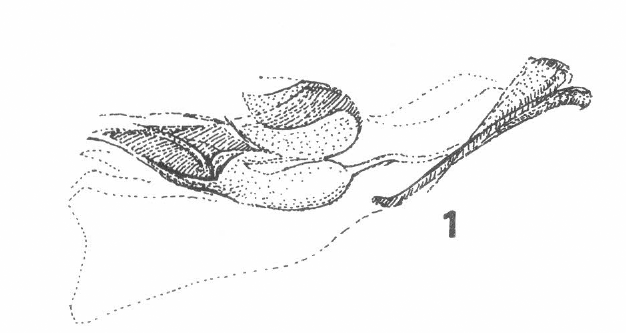
Melanagromyza caucensis: aedeagus, side view (par atype].
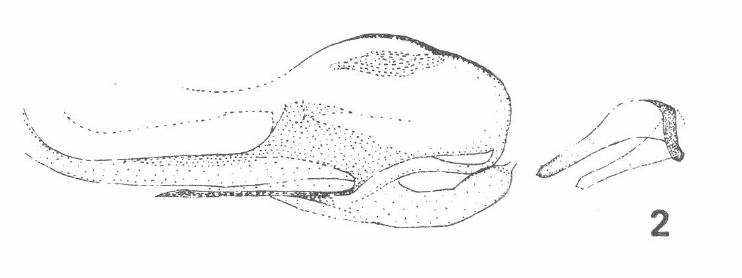
Melanagromyza colombiensis: aedeagus, side view.
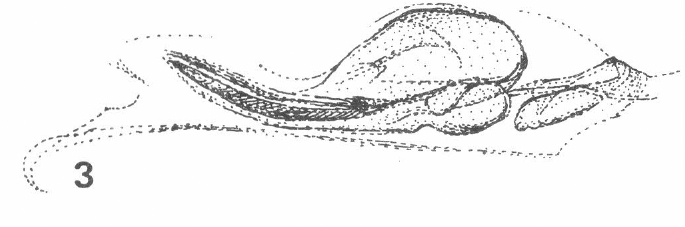
Melanagromyza neotropica: aedeagus, side view.
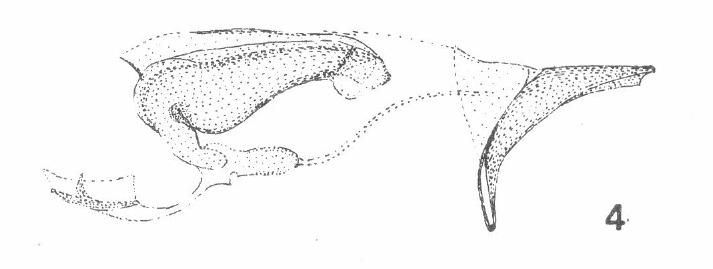
Melanagromyza nobilis: aedeagus, side view.

Melanagromyza phaseolivora: 5, aedeagus, side view; 6, same, ventral view.
Mesonotum. 2 strong dc, acr in about 8 rows.
Wing. Lenght from 2.85 mm in male to 3.1 mm in female, last section of M3+4 shorter than penultimate, in ratio 25:30, inner cross-vein near midpoint of discal cell.
Colour. Frons mat black, ocellar triangle and basal pits of orbital bristles faintly grenish, lunule grey; mesonotum moderately shining green, abdomen more brilliantly greenish or coppery; squamae and fringe silvery-white, margin only slightly differentiated, pale brown.
Male genitalia. Aedeagus distintive. Figs. 5, 6.
Host. "Green beans" (fríjol verde), larva feeding and pupating internally in the pod.
Material seen. ♂, ♀, Anolaima (50 km NW of Bogot´), xii.82, "vaina frijol verde" (I. Zenner).
Remarks. The species is re-described from the first specimens known from Colombia. It belongs to the large group of greenish species with the squamal fringe pale but is unusual for a feeder in Leguminosae in having the eye pilose in the male. This character occurs frequently in Compositae-feeders but is rare in the Leguminosae.
The male genitalia are characteristcic of the genus but disctinctive; the presence of a line of strong bristles on each side of the epandrium is uncommon but has been noted in a number of Neotropical species. In the author's key to Neotropical species (Spencer and Stegmaier, 1973: 151) M. phaseolivora runs to couplet 22 which includes M. chenopodii Spencer from Chile and M. peremnis from Dominica; however, the genitalia confirm that these species are distinct.
Pod-feeders in Leguminosae are well known in Africa and in India where they represent serious pests (Spencer, 1973b) In Florida the larva of M. floridensis Spencer (cf. also Spencer, 1973b) feeds within a single seed of Desmodium tortuosum, a leguminous plant used as green manure. However, M. phaseolivora is the only species in South America known to attack pods of cultivated beans and may thus represent a pest of some significance. With records now known from Ecuador and Colombia it is probably widespread at higher elevations.
Melanagromyza setifera Spencer. Figs. 7, 8.
Among greenish species with the squamal fringe pale, this is distinctive in the exceptionally long pubescence of the arista. The type series was from Guyana, Mazaruni, viii. and ix.37 (Spencer, 1963).
One male and 3 females were collected at the roadside above the Intercontinental Hotel, Medellín, 18.vi.82. The aedeagus of the male is shown in Figs. 7, 8.
M. setifera superficially resembles M. compositoides Spen-cer from Jamaica, particularly in the pubescent arista but it is larger and the male genitalia of the two species are entirely distinct (cf. Spencer, 1963: fig. 20).
Melanagromyza spilanthis sp.n. Figs. 9, 10.
Head. Frons 1.5 times width of eye; not projecting above eye in profile; 4 strong orbital bristles, the 2 ors only slightly longer than the ori; orbital setulae short, in single row, reclinate; ocellar triangle sometimes ill-defined, moderately shining, apex extending, at least in outline, below level of lower ors; jowls relatively broad, about 1/5 vertical height of eye, this large, upright, in male with patch of short white pilosity at level of ors; third antennal segment small, rounded at end, arista long, bare, only slightly shorter than vertical height of eye.
Mesonotum. 2 strong dc, acr numerous, in about 10 rows between dc.
Wing. Length 2.5 2.7 mm in both sexes, last section of vein M3+4 only slightly more than half length of pen-ultimate, in ratio 17:32.
Colour. Frons mat black; mesonotum appearing mat from front, moderately shining blackish-green from rear, abdomen variable, from brilliantly shining green to more blackish-green; squamae pale grey, margin and fringe black; halteres entirely black.
Male genitalia. Aedeagus distally with 2 dorsally curving tubules (Fig. 9), in ventral view narrow, symmetrical (Fig. 10); hypandrial apodeme extended, narrowly triangu-lar; sperm pump with large blade.
Host.
Holotype ♂ Colombia, Bogotá, Ciudad Universitaria, emerged 16.ix.82; paratypes: 2 ♂, 8 ♂, of coll. 25.viii.82, emerged Sep. 82 (all K.A.S.); 2 ♂, 1 ♀, 12.ix.80 (I. Arévalo). Holotype and paratypes in AC, further paratypes in Univ. Nac., Bogotá.
Remarks. With the dark squamae and fringe this species can be closely associated with M. wedeliae but it is larger and the male genitalia, although of the same general from, are more complex.
Melanagromyza tomaterae Steyskal. Figs. 11, 12.
This potentially serious pest of tomatoes appears to be widespread in the north of South America, with records from Ecuador and Colombia (Steyskal, 1972) and from Venezuela (Spencer, 1973c). Further specimens from Venezuela have recently been seen from San Cristóbal, close to the northern border with Colombia.
This is yet another in the complex of greenish species with the squamal fringe pale, with the following essential charac-ters: frons up to 1.5 times width of eye, orbital setulae in single row, reclinate; ocellar triangle and orbits weakly shining; mesonotum shining, blackish-green, abdomen more conspicuously green; squamae and fringe white, squamal margin pale yellow; halteres largely black but narrowly white each side of apical sulcus (Steyskal, 1972: fig. 2B); wing length from 2.7 mm in male to 3.3 mm in female; male genitalia (Venezuela) as in Figs. 11, 12.
The larva feeds and pupates in stems of tomato. The puparium is pale brownish or, when empty, straw-coloured, with the posterior spiracular plates separated by their own diameter, each with an ellipse of from 11 to 17 well defined pores around the short central horn.
Damage to tomatoes in Colombia has not been properly assessed but in Venezuela young plants suffer severely and it seems probable that the yield is reduced.
Melanagromyza wedeliae Spencer.
This species closely resembles M. spilanthis sp.n. but the jowls are narrower and it is distinctly smaller, with wing length of 2-2.2 mm; the male genitalia are more simple, although of the same general form (cf. Spencer and Steg-maier, 1973; figs. 117, 118). Both mesonotum and abdo-men are greenish, with the squamae grey and the margin blackish.
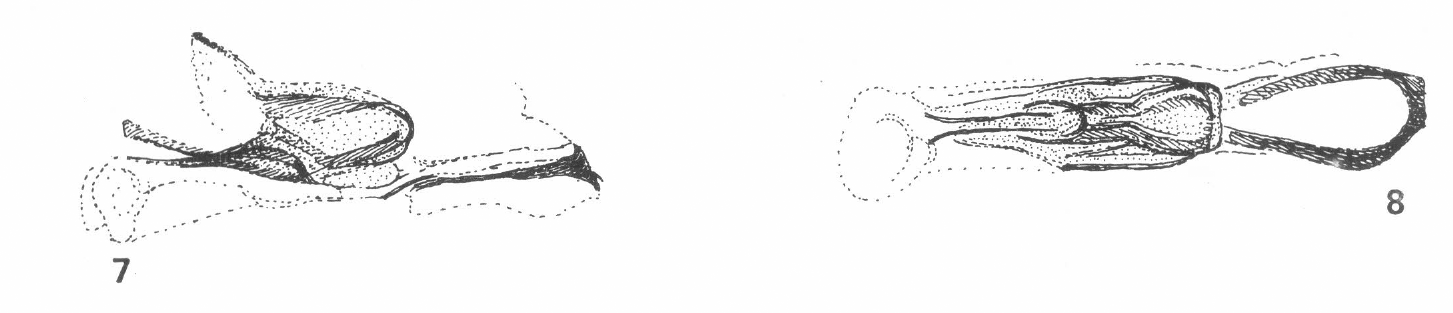
Melanagromyza setifera: 7, aedeagus, side view; 8, same, ventral view.

Malanagromyza spilanthis: 9, aedeagus, side view; 10, same ventral view.

Melanagromyza tomaterae: 11, aedeagus, side view; 12, same, ventral view.
It has hitherto only been known in Florida where it is widespread, with Wedelia paludosa and Senecio confusus as known hosts (Spencer and Stegmaier, 1973:54). Two males and 1 female were reared from flower-heads of Bidens pilosa, 25.vi.82, coll. 18.vi.82 at the roadside above the Intercontinental Hotel, Medellin.
Genus Japanagromyza Sasakawa
The majority of species in this genus are dark, black or greenish. The larvae form large blotch mines (Figs. 13, 16), the favourite host family being the Papilionaceae.
The genus is well represented in South America and Spencer in Spencer and Stegmaier (1973) gave a key to 19 species known at that time, and
Genus Phytobia Lioy
This genus consists of relatively large species, the larvae feeding in the cambium of growing trees, either in the main stem or lateral branches. It is of virtually cosmopolitan distribution and is well represented in South America. Four species are known in Brazil (Spencer, 1966b), one in Perú (Spencer, 1977) and five in Costa Rica (Spencer, 1983a). Von Tschirnhaus (pers. comm.) caught up to 20 different species using bait traps in one area of rain forest in Perú 350 km NE of Lima in 1981. Spencer in Spencer and Stegmaier (1973) gave a key to the 11 Neotropical species known at that time.
No adults are known in Colombia but I have seen two immature larvae collected from stems of
Serious damage to wood used for industrial purpose can be caused by the long feeding tracks of the larvae (Spencer, 1973b) and the origin of these unsightly brown marks in sawn timber is frequently not understood. In the Nether-lands an increased incidence of
Genus Amauromyza Hendel
Forty species are known in this somewhat diverse genus, of which only 4 have been recorded in the Neotropical Region (Spencer and Stegmaier, 1973: 18b; Spencer, 1973c: 70).
The single species
In Colombia
Genus Cerodontha Rondani
This large cosmopolitan genus comprises nearly 100 species in 7 subgenera. Only the subgenus
Of the 7 subgenera in addition to
Key to Colombian
Yellow and grey species.
Head. Essentially as in
Mesonotum. 3+1 strong dc, acr present in 2 rows, extending from front of presutural area to level of 3rd dc.
Wing. Length from 2.75 mm in male to 3.0 mm in female; last section of vein M3+4 long, little shorter than penul-timate, in ratio 25:30.
Colour. Frons basically bright yellow but variably darkened centrally from front of ocellar plate to margin of lunule, this bright yellow; orbits only slightly darkened on upper half; jowls, face, palps, first and second antennal segments bright yellow, third segment black; mesonotum and scutellum entirely mat, brownish-grey; notopleura, humerus and upper margin of mesopleura and sternopleura bright yellow, pleura otherwise grey; legs: femora predominantly yellow but faintly darkened, tibiae and tarsi darker, greyish-yellow; abdomen greyish-black, with tergites narrowly yellow-bordered; halteres bright yellow.
Male genitalia. Aedeagus long, divided from mesophallus into pale, paired, curving tubules, distiphallus triangular, darker basally (Fig. 18).
Holotype &male' Colombia, Tabio, 35 km N. of Bogotá, 22.x.83; paratypes: 1&male, same data; above Tabio on road to Subacho-que, 2&male, 2♀, 21.viii.82; Subachoque, 1♀, 21.viii.82; Mos-quera, 1♂, 2♀, 15.vi.82; Zorro, 1♀, 16.vi.82; Bogotá, waste ground near Hotel Bogotá Plaza, 1♂, 22.x.83; roadside Bo-gotá – La Calera, 1♂, 1.xi.83. Holotype and paratypes in AC, 1♂, 1♀ each in collections of Unidad Entomología, Univ. Nacional, Bogotá and ICA-Tiabaitatá.
Remarks. Although generally resembling and closely related to
A widespread species from Canadá, throughout the United States to Central America, Puerto Rico, Brazil and Chile; also present in Mongolia.
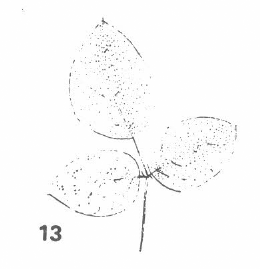
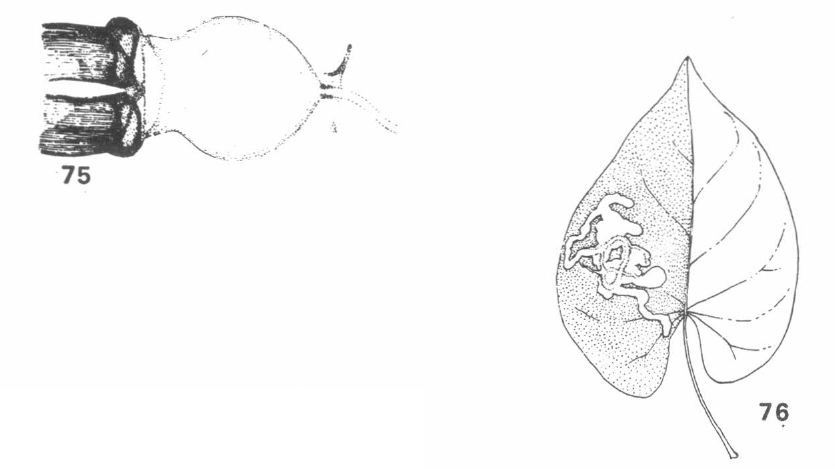
Japanagromyza sp. (? desmodii): leaf-mine on Desmodium.
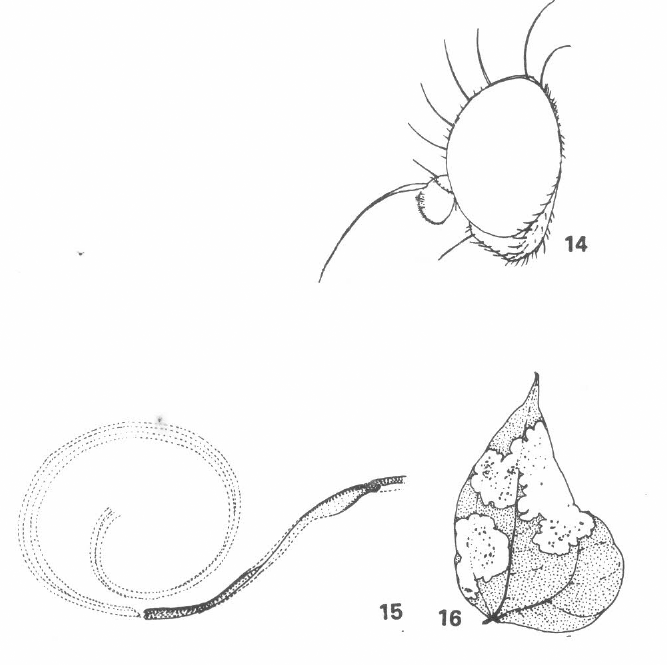
Japanagromyza phaseoli: 14, head; 15, aedeagus, side view; 16, laaf-mine on Phaseolus vulgaris.
With the elongated third antennal segment and a short spine at the upper corner (cf. Fig. 17) this is a atypical
In California,
Largely black species.

Cerodontha (Cer.) colombiensis: 17, third antennal segment; 18, aedeagus, ventral view.
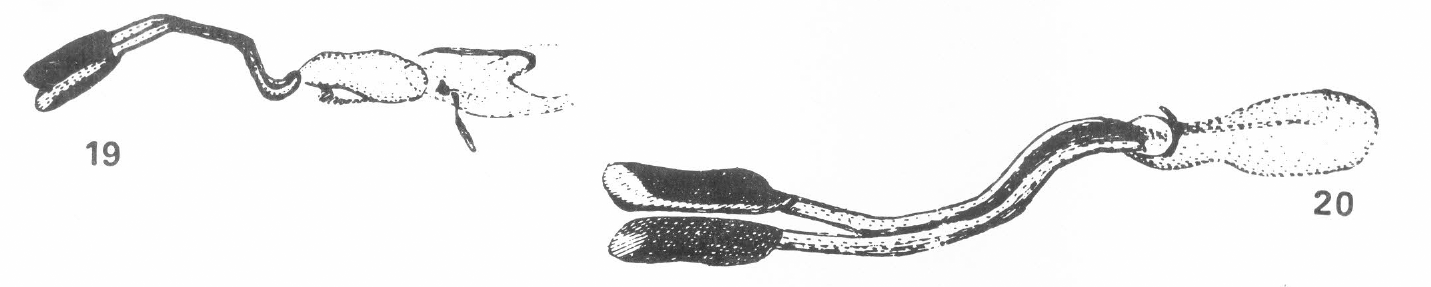
Cerodontha (Cer.) dorsalis: 19, aedeagus, side view; 20, same, ventral view.
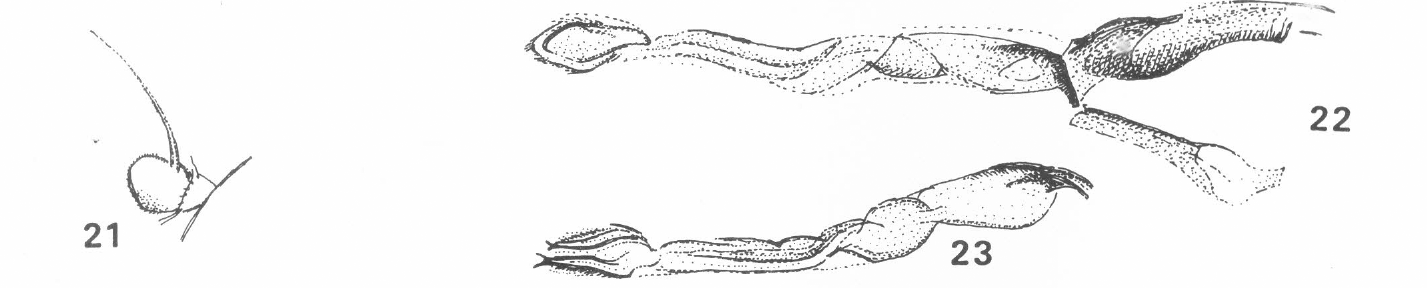
Cerodontha (Cer.) nigra: 21, third antennal segment; 22, aedeagus, side view; 23, same, ventral view.
Head. Frons just less than 1.5 times width of eye, not projecting above eye in profile; 1 strong, slightly reclinate ors, 2 ori, both inclined, the upper at level of lunule; orbits broad, strongly differentiated, slightly widening at midpoint between front of ocellar plate and upper margin of lunule; orbital setulae irregular, those above reclinate, those in front distinctly proclinate; jowls broad, 1/3 height of eye, cheeks prominent, filling half width of jowls; eye with conspicuous pilosity which is as long as the orbital setulae; third antennal segment bluntly angulate (Figs. 21), arista with moderate pubescense. Mesonotum. 3+1 strong dc, acr in 6 rows; scutellum with strong pair of anterior acutellars.
Wing. Length in male 2.6 mm, costa extending strongly to vein M1+2, last section of M3+4 in ratio 20:35 with penul-timate, inner croos-vein slightly before midpoint of discal cell.
Colour. Frons mat black, orbits largely shining black but narrowly yellow adjoining frons; lunule, jowls, face and palps black; mesonotum and scutellum uniformly deep black, appearing moderately shining viewed from front, distinctly mat seen from rear; notopleura with a bright yellow patch on lower margin, pleura otherwise black; legs entirely black; wing base and base of R1 bright yellow; squamae pale grey, margin and fringe black.
Male genitalia. Aedeagus (Figs. 22, 23) with distal tubules narrowly divided, paired processes of distiphallus narrow, pale; sperm pump with greatly enlarged blade.
Holotype ♂, Colombia, Bogotá, track into mountains off road to La Calera near Restaurant "El Engaño", 13.vi.82, in AC.
Remarks. This species is readily distinguishable by its black colour and angulate third antennal segment. It is unique in the subgenus in having a second pair of scutellar bristles. Its black colour might suggest inclusion in the subgenus
Genus Liriomyza Mik
This well-known genus is with available material by far the largest in Colombia with 20 species, of which 8 are new and described below, and 5 are recorded as new to Colombia. 54 species are known in the Neotropical Region. Differ-entiation between
Of the new species 3 are clearly grass-feeders (deduced from the characteristic male genitalia) and one,
The pests,
Key to Colombian
Liriomyza baccharids Spencer
This species was described from Tequendama Falls, near Bogotá from leafmines on
Liromyza braziliensis (Frost) Fig. 24
This is the largest
The only known hosts of
Head. Frons broad, almost twice width of eye; orbital bristles strong, 2 equal ors, 2 ori which are only slightly weaker; orbital setulae sparse, reclinate; jowls broad, 1/3 height of eye; third antennal segment slightly longer than broad, uniformly rounded.
Mesonotum. 3+1 strong dc, acr numerous in about 8 rows; intra-alar long but slender, similar to 3rd dc.
Wing. Length in male 2.5 mm; last section of M3+4 only slightly less than twice length of penultimate, in ratio 32:17.
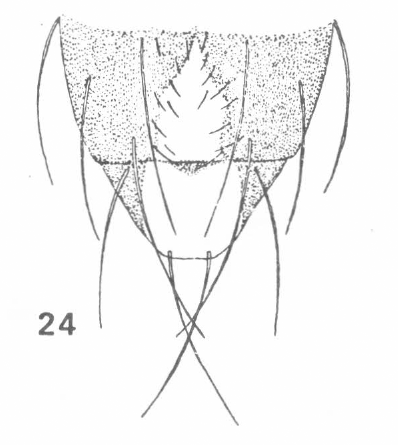
Colour. Frons, orbits, jowls, face and palps bright yellow; third antennal segment faintly but distinctly brownish, first and second segments yellow; hindmargin of eye black, vte on black ground, area around base of vti pale brownish; mesonotum (Fig. 25) largely brilliantly shining black, centrally black adjoining scutellum but laterally broadly yellow, with intra-alar and Ist dc on black; scutellum bright yellow; side of thorax largely bright yellow; legs: femora bright yellow, tibiae and tarsi dark, almost black; squamae pale grey, margin and fringe black; halteres yellow.
Male genitalia. Aedeagus (figs. 26, 27) with basal sclerites unusually long, distiphallus undivided, shortly cylindrical; sperm pump, with large, triangular blade; surstyli discrete, with single stout spine on inner corner.
Holotype ♂, Colombia, Chía, N. of Bogotá, 13.iv.8, in AC.
Closely resembling
Holotype ♂, Colombia, Funza, N. of Bogotá, 16.vi.82; paratypes: 1♀, same data; 1♂, 1♀, Madrid, N. of Bogotá, 15.vi.82; 1♀, 1.xi.83; 1♂, Tabio, N. of Bogotá, 22.x.83; 5♂3♀, La Calera-Guasca road, SE. of Bogotá, 1.xi.83. Holotype and paratypes in AC.
Remarks. In view of the similarity of this species to
A widespread Neotropical species, extending from Argentina to Venezuela and the Caribbean (Cuba, Jamaica), Costa. Rica and Florida (Spencer and Stegmaier, 1973), host-specific on Commelinaceae, known mainly from
It is now known that
Three females have been seen from Piendamó, Cauca, reared from
There has been confusion about the correct generic position of this isolated species. It was described in
Further significant characters of
A shipment of carnation cuttings from Italy to Colombia was found on inspection by ICA at Bogotá in October, 1983 to be heavily infested with leafmines and many puparia were found among the plants. Although this shipment was destroyed,
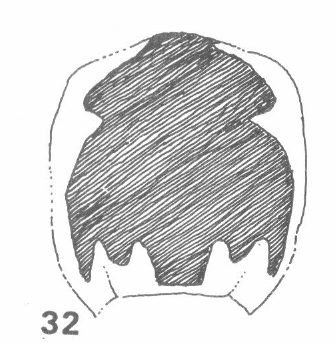
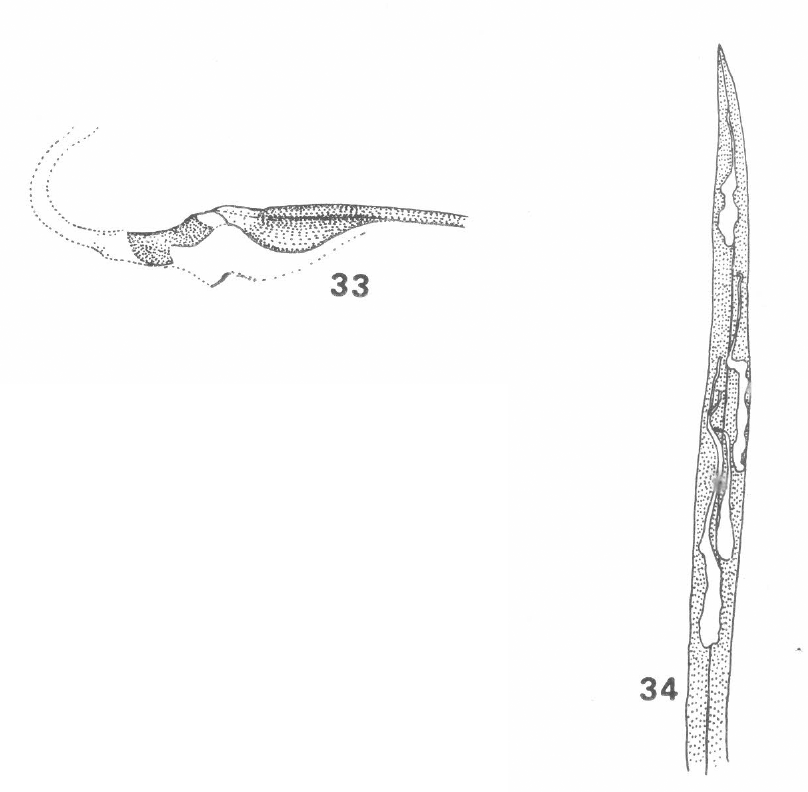
Closely resembling
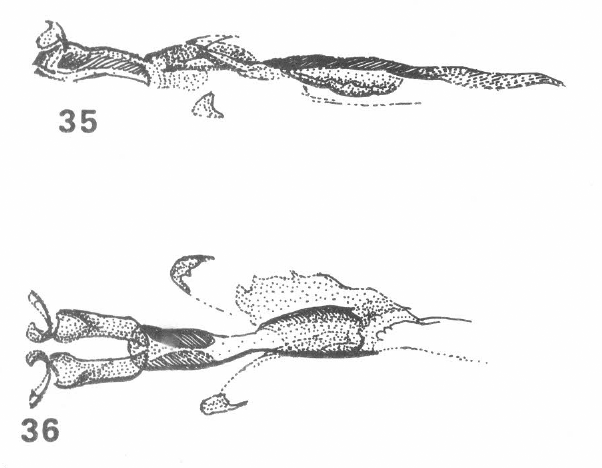
Orbital bristles stronger, even the lower ori which is similar to the upper (holotype); frons bright yellow; all antennal segments brown (not partially black); mesonotum similarly shining black but with small yellow patches at hind-corners adjoining scutellum; legs: femora largely black, narrowly yellow at knees; larger, wing length 2.3 mm in male, 2.25 mm in female, last section of M3+4 twice length of penul-timate; male genitalia: aedeagus ending in slender, sym-metrical tubules (Figs. 35, 36); surstyli widening internally, with a short spine at each corner; sperm pump exceptionally broad.
Holotype ♂, Colombia, Madrid, N. of Bogotá, sweeping
Remarks. This species was caught at the same time as
I have pleasure in dedicating this species to Don Camilo Herrera V., whose hospitality I was enjoying when I collected this interesting species.
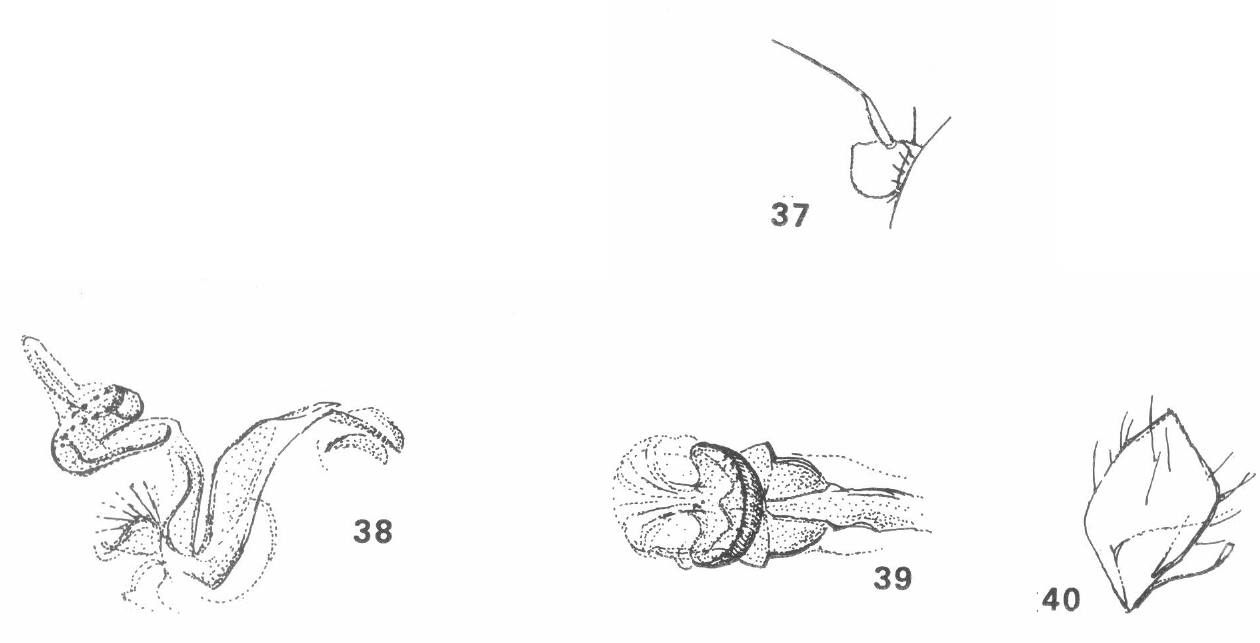
Head. Frons broad, twice width of eye; orbital bristles strong, 2 equal ors, 2 ori which are little weaker, occasionally a third weak ori also present; orbital setulae sparse, reclinate; jowls broad, 2/5 height of eye, this large, upright; third antennal segment conspicuously angulate (Fig. 37), virtually bare.
Mesonotum. 3+1 strong dc, acr regularly in 4 rowns in front, at rear several inclined.
Wing. Length variable, 2-2.25 mm in both sexes; discal cell small, last section of M3+4 from slightly over 2 to 3 times length of penultimate.
Colour. Frons, jowls, face, palps and all antennal segments yellow; orbits black on upper half, both vt on black ground; mesonotum deep black, only weakly shining, scutellum bright yellow centrally, with prominent black patches at sides; rear of humerus and notopleura yellow, upper margin of mesopleura and sternopleura narrowly yellow, otherwise black; legs: coxae on fore-legs yellowish, on mid and hind-legs black, all femora largely bright yellow but narrowly black basally, tibiae and tarsi black; abdomen entirely black; squamae yellowish-grey, margin and fringe black; halteres yellow.
Male genitalia. Aedeagus (Figs. 38, 39) with distinctive curvature, distiphallus with paired membranous extensions; sperm pump with narrow stalk and only moderately widening blade, appearing long; surstyli reduced, very narrow (Fig. 40)
Host.
Holotype ♂ Colombia, Obonuco, SW of Pasto (Nariño), Febrero, 1983; paratypes: 3♂,3♀, same data; 2♂, 2♀, 23.iii.71 (all H. Calvache, ex barley). Holotype and para-types in AC, further paratypes in coll. ICA, Tibaitatá.
Remarks. This species generally resembles
This highly polyphagous species occurs naturally in much of South America, apart from lowland tropical areas. It was described from Argentina, I found it to be common in Chile (Spencer, 1982), it is present in Brazil and Perú and present in large numbers at one locality on the edge of the Andes in Venezuela (Spencer, 1973c). In Central America there is a small population in Costa Rica (Spencer, 1983a) and it has been found at higher elevations in the Dominican Republic (Parrella, pers. comm.). In the United States it is restricted to California and for ecological reasons which are not fully understood has never become established in Florida or elsewhere in eastern states in the U.S.A. There is a large population on the Sabana around Bogotá and it is present in small numbers at la Ceja and Piendamó.
In California
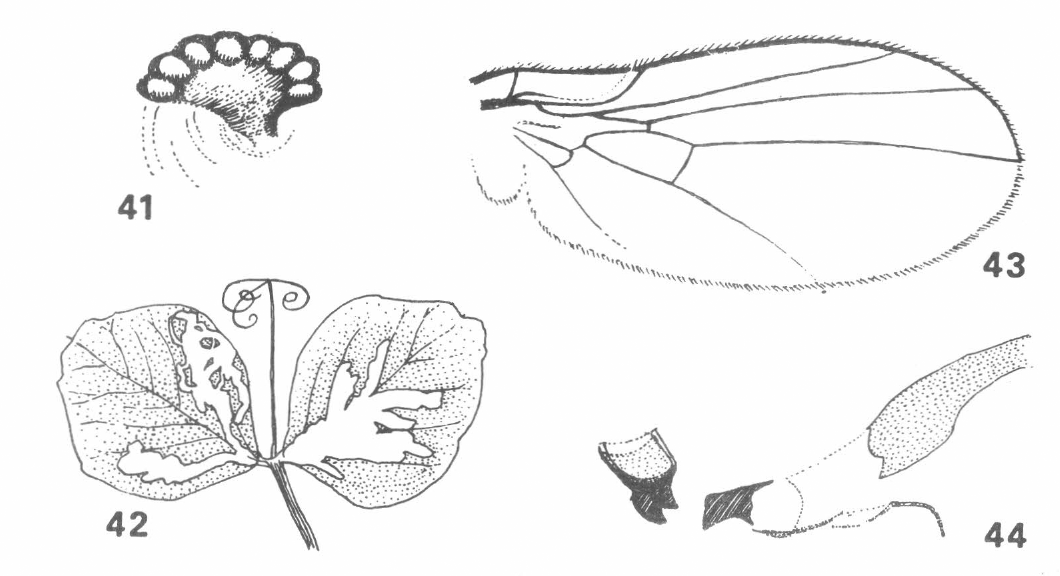
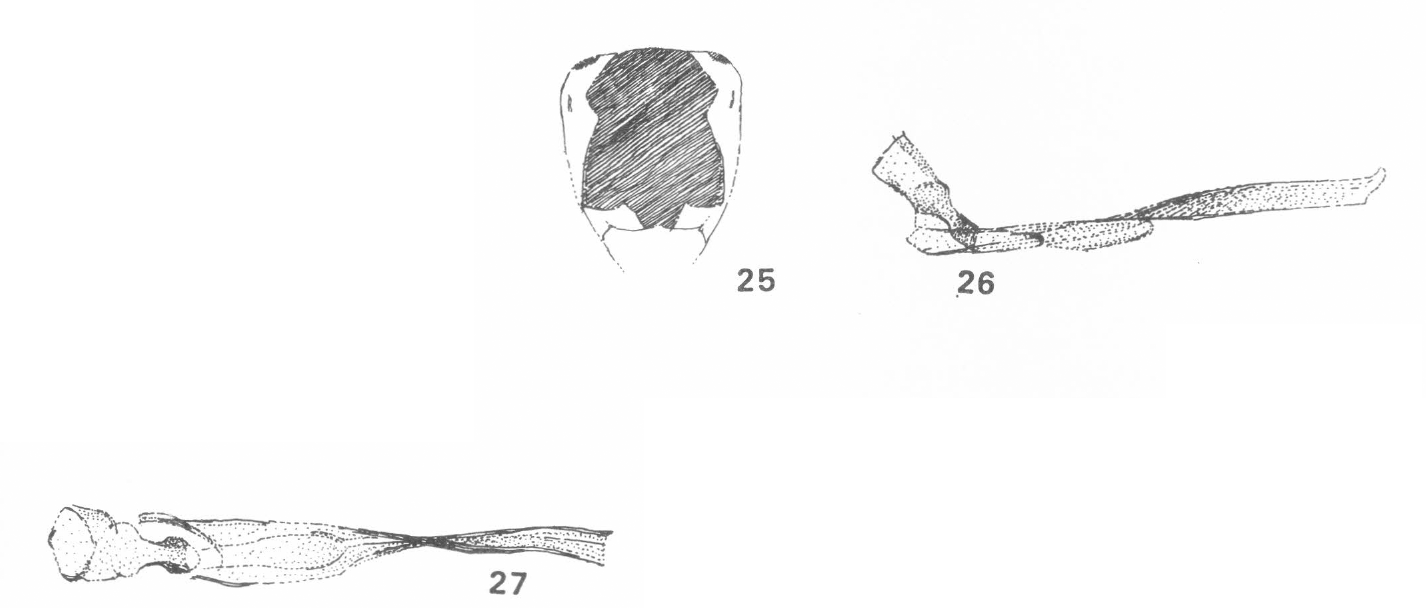
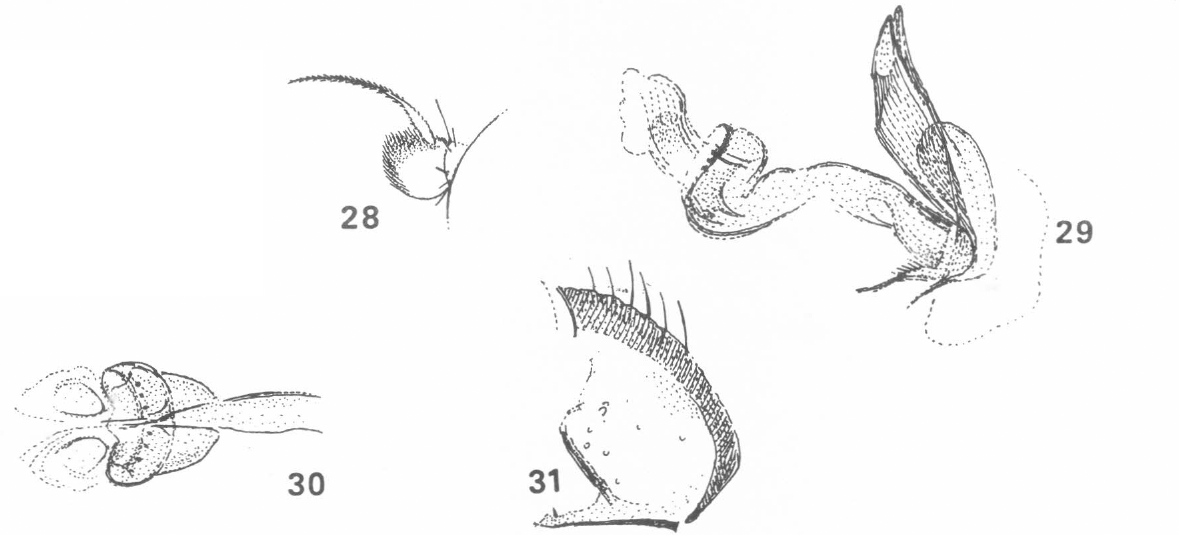
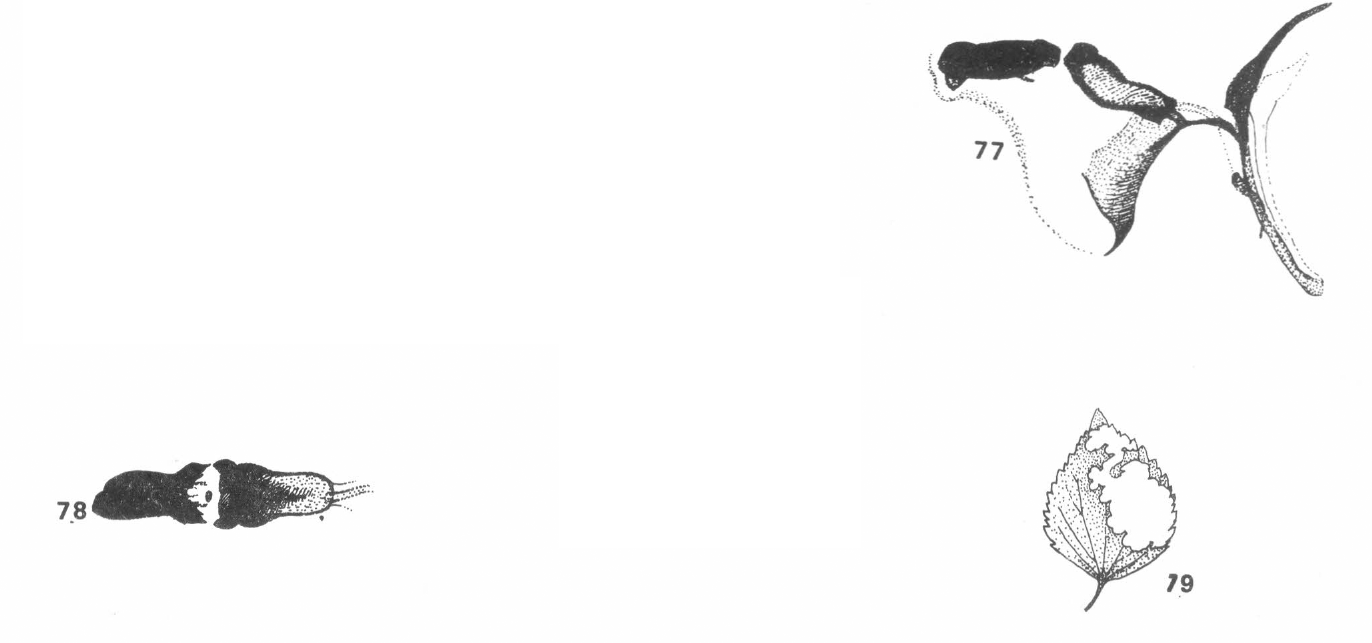
L iriomyza hu idobrensis: 41. larval spiracles: 42. leal-mine on Pisum; 43. wing; 44. aedeagus. side view.
In Colombia
Unidentified Composite, near
On
Among species with the third antennal segment partially or entirely dark,
Head. Frons twice width of eye; 2 equal ors, 2 ori, the lower weaker; orbital setulae sparse, reclinate; jowls broad, somewhat variable, at least 1/3 height of eye; third antennal segment small, round, with only sparse pubescence.
Mesonotum. 3+1 dc, acr in 4-5 rows; intra-alar strong.
Wing. Length from 1.75-2 mm in male, up to 2.25 mm in female; costal sections 2, 3, 4 (holotype) in ratio 38:8:9; discal cell small, last section of M3+4 slightly more than twice length of penultimate.
Colour. Frons yellowish-ochrous, orbits slightly darkened, both vt on black ground; jowls yellow, face similar or slightly darkened; third antennal segment black or dark brown; palps yellowish-black; mesonotum uniformly brilliantly shining black to margin of scutellum this largely bright yellow, narrowly black. at sides; notopeura, rear of humerus and upper third of mesopleura bright yellow, latter otherwise black, pteropleura largely black, only narrowly yellow along upper margin; legs: coxae variably blackish-yellow, femora basically yellow with variable black striations, tibiae and tarsi black; abdomen entirely shining black; squamae grey, margin and fringe black, halteres yellow.
Male genitalia. Aedeagus (Figs. 45, 46) with distiphallus large, strongly pigmented; sperm pump with large, broad blade; surstyli having paired processes, with 2 short spines at end.
Holotype ♂, Colombia, Madrid, N. of Bogotá, sweeping Ga-linsoga caracasana, 26.viii.82; paratypes: 3♂, same data, all in AC.
Remarks. This species might easily be confused with
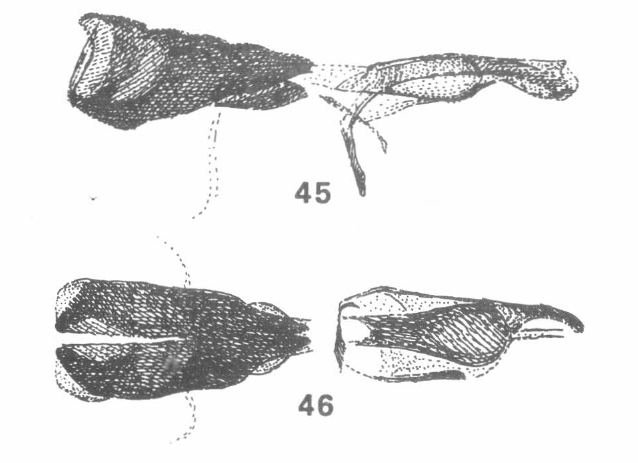
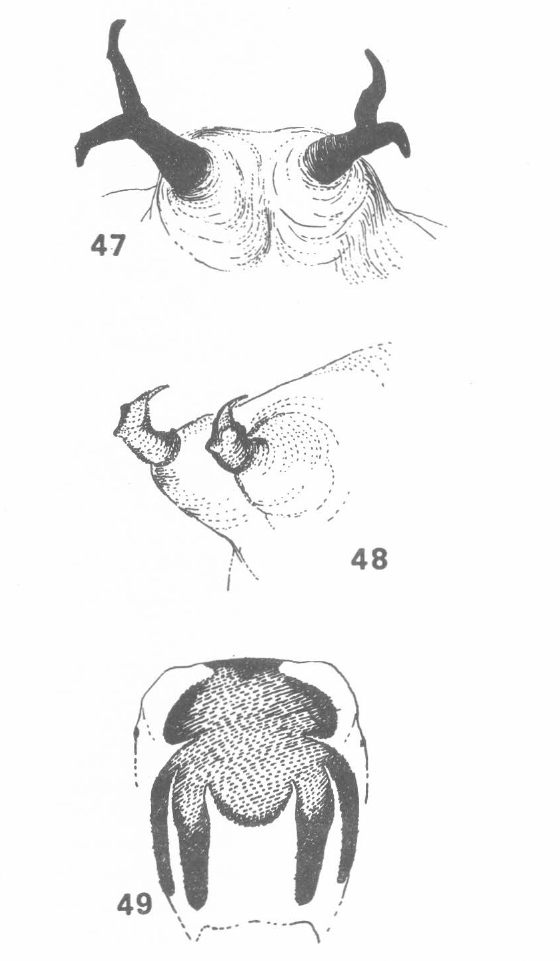
A widespread Neotropical species, extending from Brazil and central Chile (Spencer, 1982) to the Caribbean, Costa Rica (Spencer, 1983a) and southem states of U.S.A. The larvae feed exclusively on a number of genera of grasses, with the conspicuous anterior spiracles (Fig. 47) projecting through the leaf epidermis. The posterior spiracles (Fig. 48) have the normal 3 pores but one is greatly enlarged, hook-like, with the other two below, minute. This form associates the species with
Five specimens have been seen from La Ceja, 19.vi.82; Piendamó, 21.vi.82; and Rionegro, 17.viii. 82, representing the first records from Colombia. Although
Head. Frons 1.5 times width of eye; normally 2 ors, the upper weaker, occasionally lacking, 2 more slender ori; orbital setulae sparse, reclinate; jowls narrow, 1/5 vertical height of eye; third antennal segment small, round, only finely pubescent.
Mesonotum. 3+1 dc; acr numerous in front, in at least 6 rows, sparser at rear, there partially inclined; inner post-alar strong, 2/3 length of post-alar.
Wing. Length in male 3.1 mm; costal sections 2, 3, 4 in ratio 17:14:14; discal cell large, last section of M3+4 only slightly longer than penultimate, in ratio 30:26.
Colour. Frons bright yellow, orbits entirely deep black, both vt on black ground; jowls yellow, face, all antennal segments and palps black; mesonotum shining black, with no trace of yellow at hind-corners; scutellum bright yellow centrally, black at sides; notopleura and rear of humerus bright yellow, other pleura black; legs deep black, apart from conspicuously yellow tips of femora; abdomen black; squamae grey, margin and fringe black; halteres yellow.
Male genitalia. Aedeagus as in Figs. 50, 51, distiphallus unusually broad in ventral view; sperm pump with large dark blade; surstyli confluent with inner corner of epandrium, narrow.
Holotype ♂, Colombia, Monserrate, above Bogotá, 26.vi.82, in AC.
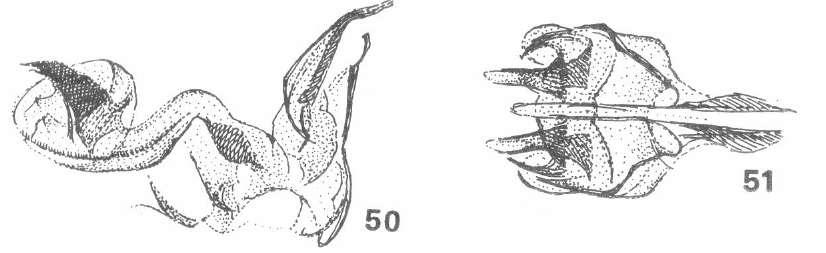
Liriomyza montserratensis: 50, aedeagus, side view: 51, distiphallus, ventral view.
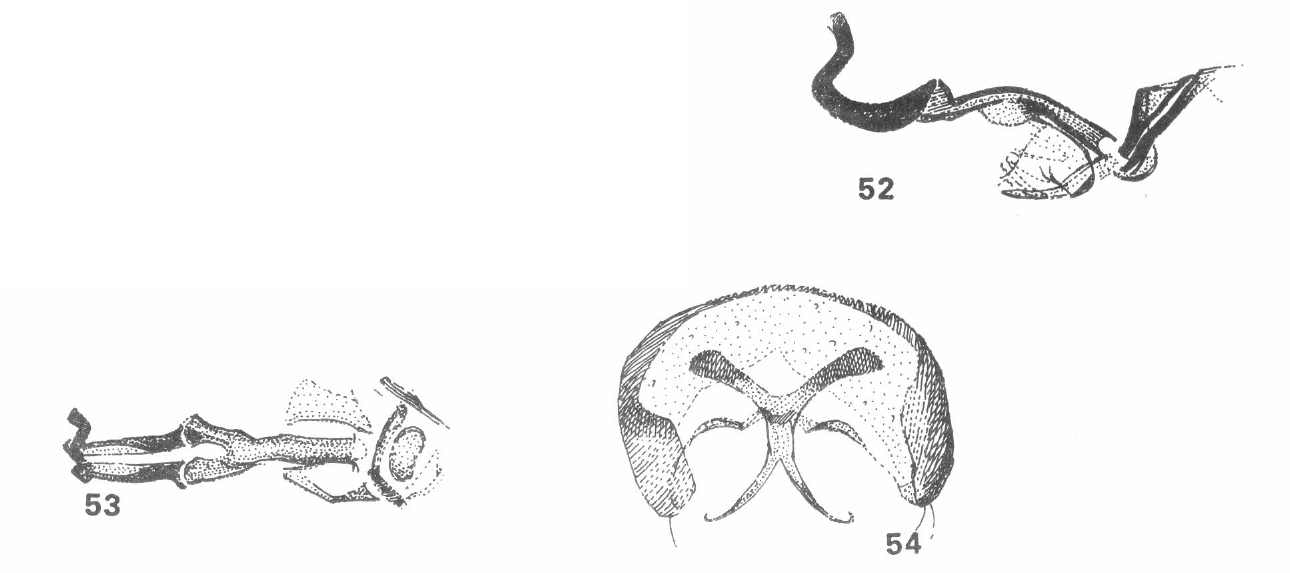
Liriomyza nigra: 52, aedeagus, side view; 53, same, ventral view; 54, epandrium.
Remarks. This species generally resembles
Head. Frons 1.5 times width of eye; orbits pronounced, with 2 equal, reclinate ors, 2 inclined ori, the lower weak; orbital setulae sparse, reclinate; jowls extended at rear, there 1/3 height of eye; third antennal segment small, either round or slightly angulate.
Mesonotum. 3+1 strong dc, acr in 4 rows.
Wing. Length from 1.75 mm in male to 1.85 mm in female; costal sections 2, 3, 4 in ratio 30:10:9; discal cell small, last section of M3+4 2 2.5 times length of penultimate.
Colour. Frons varying from sooty black to brownish-ochrous, orbits more shining black; jowls blackish-ochrous, face, all antennal segments and palps black; mesonotum and scutellum shining black; humerus black, notopleura dark, faintly ochrous, pleura otherwise black; legs black, fore-knees at most narrowly and faintly yellow; wing base brigth yellow, squamae yellowish-grey, margin and fringe black; halteres yellow; abdomen black.
Male genitalia. Aedeagus (Figs. 52, 53) with distiphallus, in form of paired black tubules, with distinctive curvature; surstyli fully fused with inner corner of epandrium, this with a symmetrical 2-armed black process internally (Fig. 54); sperm pump with large, pale, slightly asymmetric blade.
Holotype &male, Colombia, near Guasca, SE of Bogotá, 1.xi.83; paratypes: 1♀, roadside near La Calera, SE of Bogotá. 1.xi.83; 2♀, Suba, N. of Bogotá, 25.x.83. Holotype and paratypes in AC.
Remarks. Few true
Host-specific on Solanaceae and common from Argentina to Venezuela, the large blotch mines of this species are conspicuous on
Head. Frons twice width of eye; 2 equal ors, 2 ori, upper little weaker than ors, lower minute; orbital setulae sparse, only 1 or 2 present in area of ori; jowls 1/4 height of eye, this upright; third antennal segment in male enlarged (Fig. 57), with a fringe of short, thick pubescence, slightly angulate at upper corner.
Mesonotum. 3+1 dc, acr in about 4 rows (all specimens seen in imperfect condition, mounted ex alcohol).
Wing. Length 2.5 mm in male, 2.6 mm in female; costal sections 2,3, 4 in ratio 35:14;10, last section of M3+4 slightly more than half length of penultimate.
Colour. Head largely yellow, third antennal segment faintly darkened, brownish; both vt on yellow ground but eye margin black beyond vte; mesonotum (Fig. 58) with dark area deep black; broadly yellow adjoining scutellum but with a narrow central black band almost reaching scutellum margin; scutellum largely bright yellow with only small lateral black patches; pleura yellow apart from sterno-pleura which are predominantly shining black; legs: coxae and femora bright yellow, tibiae and tarsi faintly brownish; abdomen with tergites 1-3 black, 4 and 5 black centrally, yellow at sides; squamae yellowish, margin and fringe black; halteres yellow.
Male genitalia. Aedeagus (Figs. 59, 60) with distiphallus having elongated paired tubules; surstyli fully divided from epandrium, rather square, with normal short, stout spine on inner corner.
Host.
Holotype &male, Colombia, Cauca, Piendamó, ex leaf-mine on
Further specimens in alcohol from the same locality in collection of Inversiones Targa Ltda. at Piendamó are treated as paratypes.
Remarks. Externally this species only differs from the more widespread and well-known
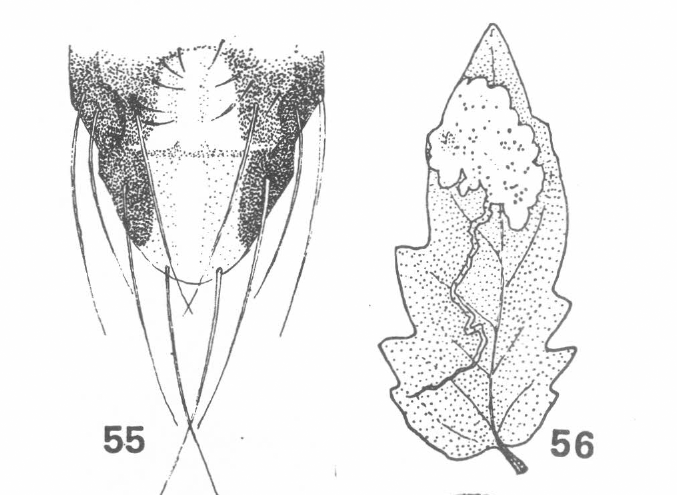
Liriomyza quadrata: 55, mesonotum; 56, leal-mine on tomate.
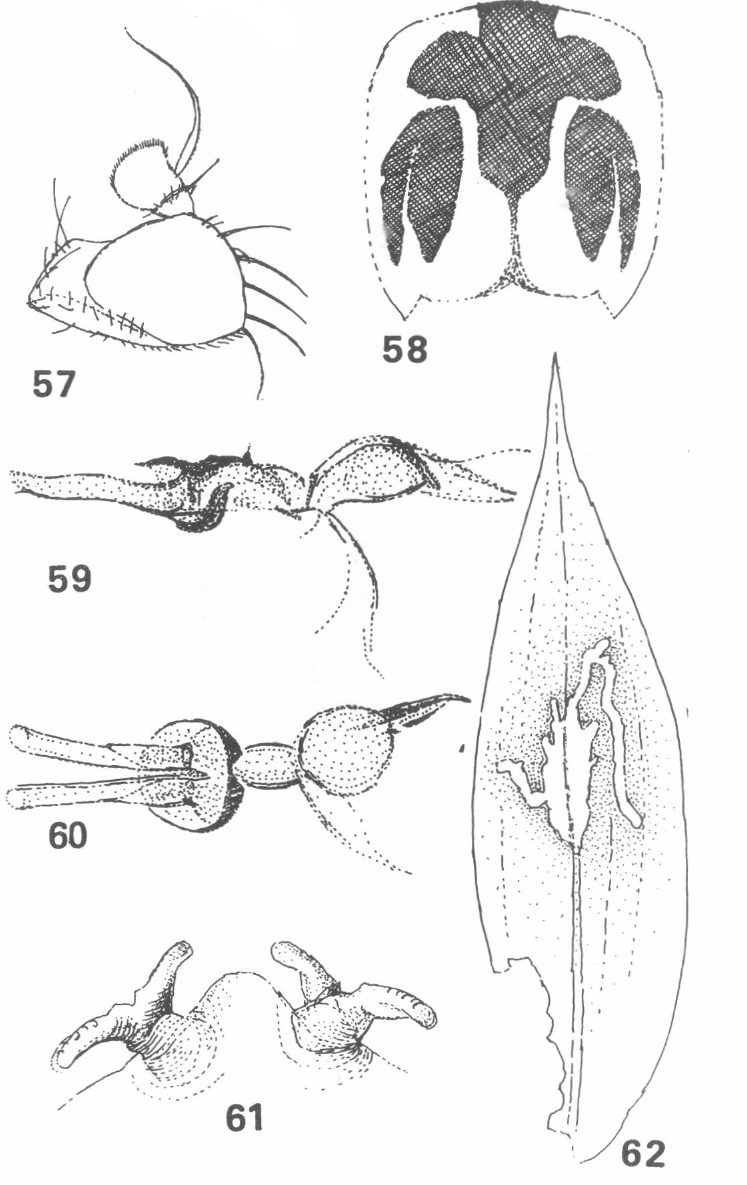
Liriomyza robustae: 57, third antennal segment; 58, mesonotum; 59, aedeagus, side view; 60, same, ventral view; 61, anterior spiracles 01 puparium; 62, leaf -mine on
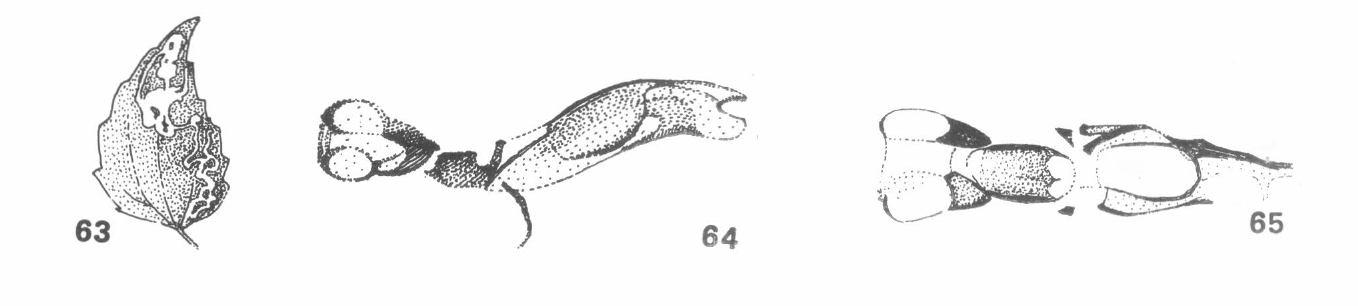
Liromyza sabaziae: 63, leaf-mine on Gallinsoga caracasana; 64, aedeagus, side view; 65, same, ventral view.
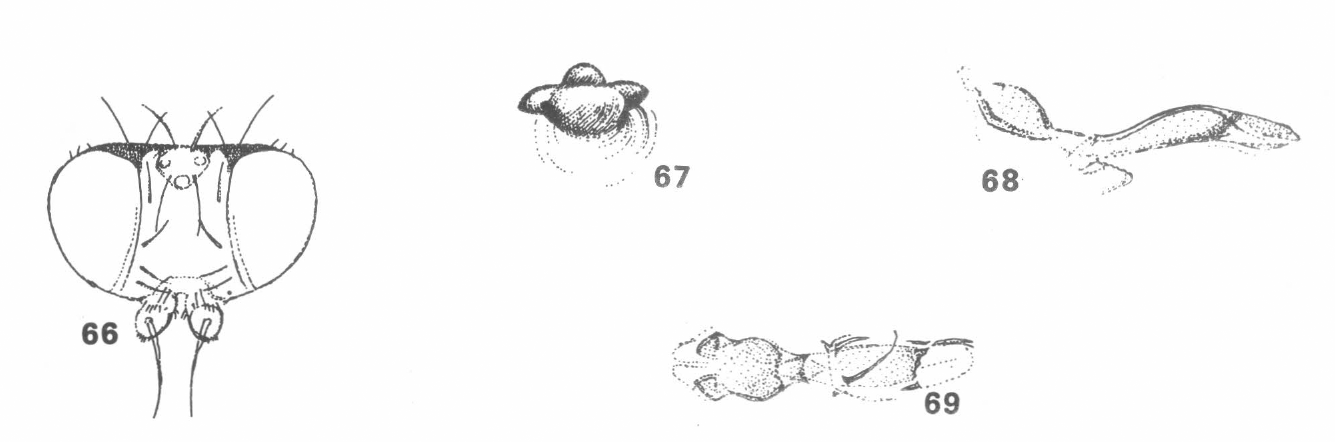
Liriomyza sativae: 66, head; 67, posterior spiracles of puparium; 68, aedeagus, side view; 65, sarne, ventral view
Described from Caracas, Venezuela on
Although
I have found
This serious pest of vegetables was described from Argenti-na and is widespread in South America, with records from Chile (Spencer, 1982), Venezuela (Spencer 1973c), Brazil, Pe-rú, Costa Rica (Spencer, 1983a), throughout the Caribbean and is common in California, Florida and other Gulf states.
In Colombia the only record is a leaf-mine I found on beans at Palmira, near Cali, 21.vi.82. It is not present on the Sabana but doubtless occurs commonly at warmer, lower elevations but surprisingly is not known to have caused damage to any crops. In Venezuela in the vegetable growing areas around Maracay it is a major problem on tomatoes. In Florida and California it was the most serious leaf-mining pest on a wide range of vegetables throughout the 1960s and early 70s but recently it has assumed less significance with the increased importance of
Known only from Colombia and Venezuela. The hosts of this species are restricted to Solanaceae. The type series of 4 specimens were reared from
With the frons yellow and the third antennal segment and femora entirely black,
It is not known whether
Described from three females caught at Tequendama Falls, below Bogotá on the road to Girardot (Spencer, 1963: 373), this species was subsequently found near Mérida, Venezuela, 9.v.72 (Spencer, 1973c: 63).
The holotype is unusually dark, with the frons blackish-brown and this led to it being described in
The male genitalia (Figs. 72, 73) are of the same general form as in
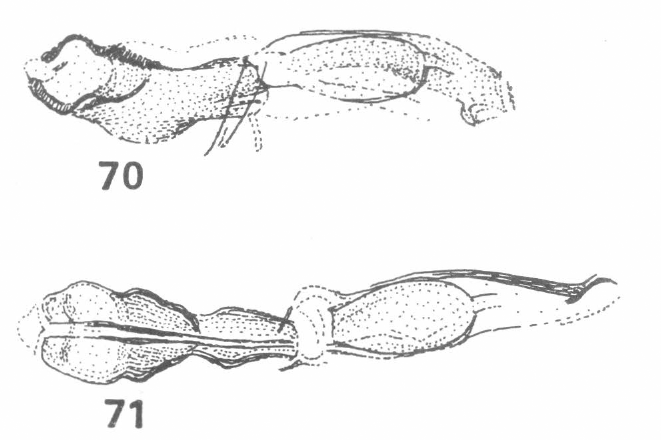
Liriomyza solanita: 70, aedeagus, side view; 71, same, ventral view.
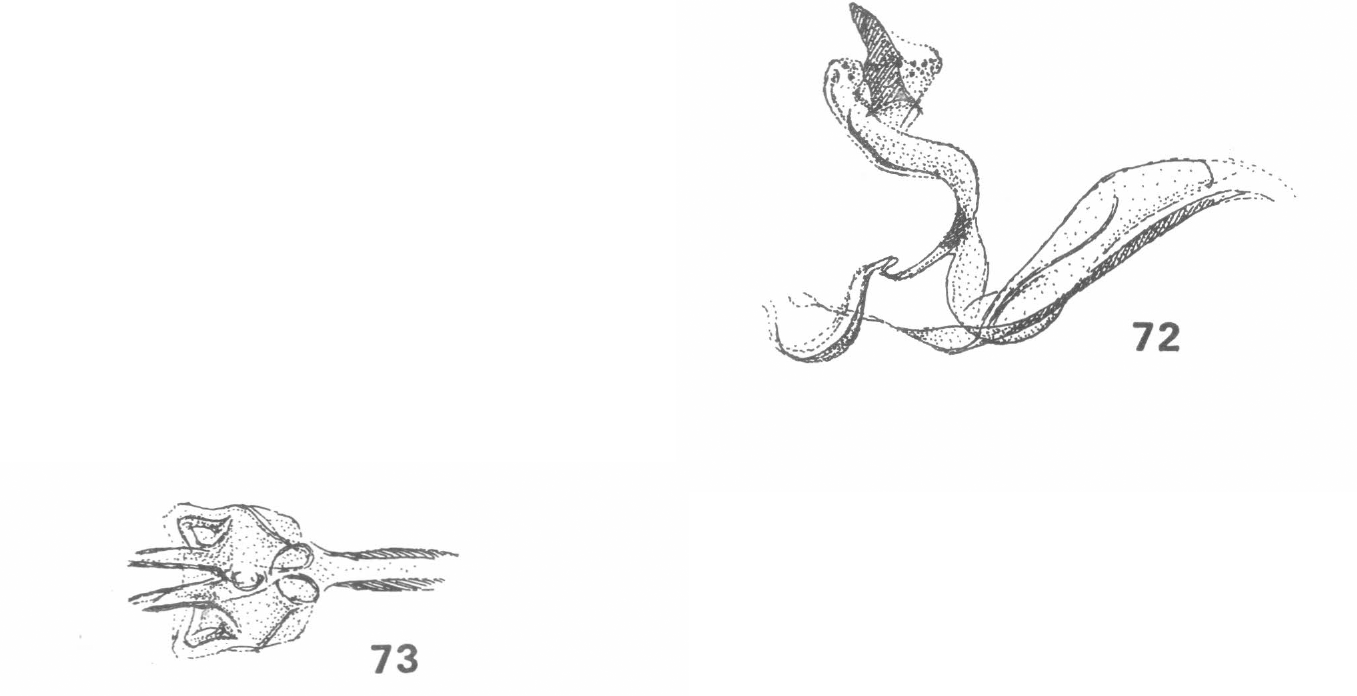
Liriomyza tequendamae: 72, aedeagus, side view; 73, distiphallus ventral view.
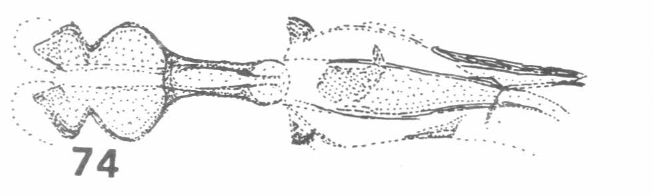
Liriomyza trifolii: 74, aedeagus, ventral view.
Since its explosive spread to many parts of the world, including Colombia, with chrysanthemum cuttings from the United States in 1976 and subsequent years,
In South and Central America
Among species with the third antennal segment round and yellow,
Genus Calycomyza Hendel
The majority of species in this genus are readily recognisable by the following combination of characters: third antennal segment black, frons normally bright yellow (rarely darker), notopleura normally yellow, pleura otherwise largely black, mesonotum and scutellum always black. In the male genitalia the aedeagus is of diverse form but there is always a distinc-tive patch of bristles at the hind-corner of the epandrium.
Over 50 species are known, mainly in the Nearctic and Neotropical Regions. In South America 39 species have been described (Spencer, 1963; 1973c; 1982; 1983a; Spencer and Stegmaier, 1973; Valladares, 1981). Only a single species,
Identification of adults on external characters is frequently difficult or even impossible. However, the male genitalia are well differentiated and illustrations are available of all known species. The larvae of most species form conspicuous blotch mines and are frequently host-specific. Species can thus in many cases be readily identified from their leaf-mines if the host can be reliably named. It is certain that many additional species await discovery in Colombia when collecting can be undertaken in further localities at lower elevations. A key to the 20 species known in Venezuela was given by Spencer (1973c).
Key to Colombian
This species was described from Puerto Rico and is wides-pread throughout the Caribbean in association with its hosts,
Calycomyza Lantanae (Frick)
Frick described this species from Texas, U.S.A. It has since been found commonly in Florida, and has been recorded in the Bahamas, Jamaica, Mexico, Trinidad and Venezuela. A single female was caught beside the Rio Cali, Cali, 17.viii.82 and leaf-mines were found on
The species is host-specific on
A single male of this species was reared from
A male and 3 females were reared from three different composites at the Tequendama Falls and beside the road from Bogotá to Girardot, coll. 10.xii.58. The host of one female was
Genus Phytoliriomyza Hendel
This worldwide genus is well represented in South America, where 20 species have been recorded from Costa Rica, Ve-nezuela, Brazil and Chile (Spencer, 1973c; 1982; 1983a). It has not previously been known in Colombia and four species have now been collected in the vicinity of Bogotá and one at Medellín, of which four are described below. Three of these species belong to the group with the orbital setulae proclinate for which the genus was originally erected but as our knowledge of the genus has increased with studies of the fauna on all continents, the concept of the genus has expanded and two of the species now described have the orbital setulae either reclinate or entirely lacking. The conspicuous spines on either the surstyli or the inner margin of the epandrium or both (Figs. 87, 91) are fre-quently characteristic of the genus. However, in a few species even the male genitalia give no certain indication of the genus as between
A new species from Bolivia feeding in potato stalks is also described below. It seems unlikely but is possible that it may also be present in Colombia and it is appropriate to describe it here.
Key to Colombian
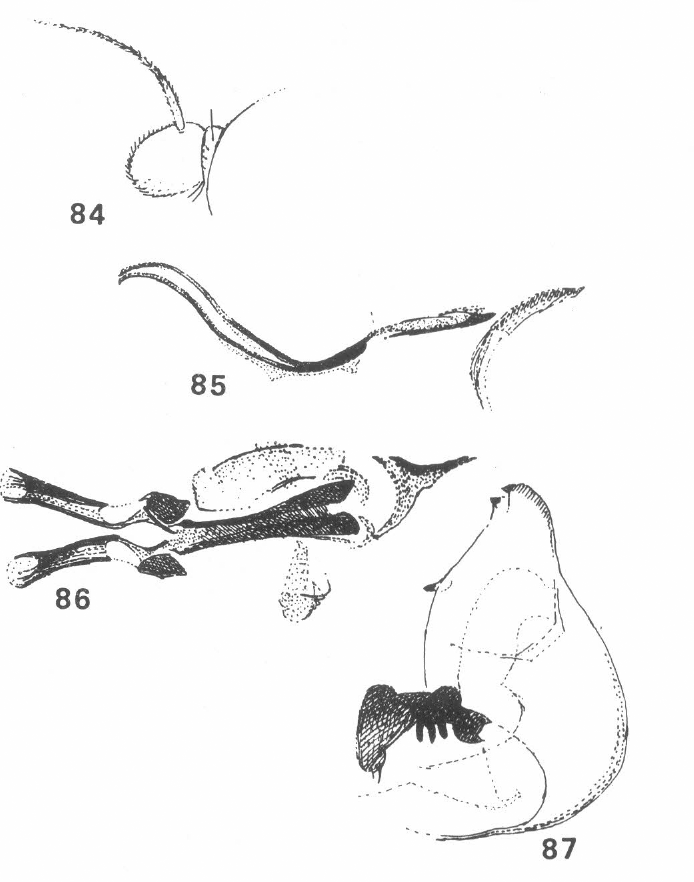
Phytoliriomyza colombiana: 80, third antennal segment; 81, aedeagus; 82, epandrium with surstvlus: 83, sperrn purnp.Figures 80, 83. Phytoliriomyza colombiana: 80, third antennal segment; 81, aedeagus; 82, epandrium with surstvlus: 83, sperrn purnp.
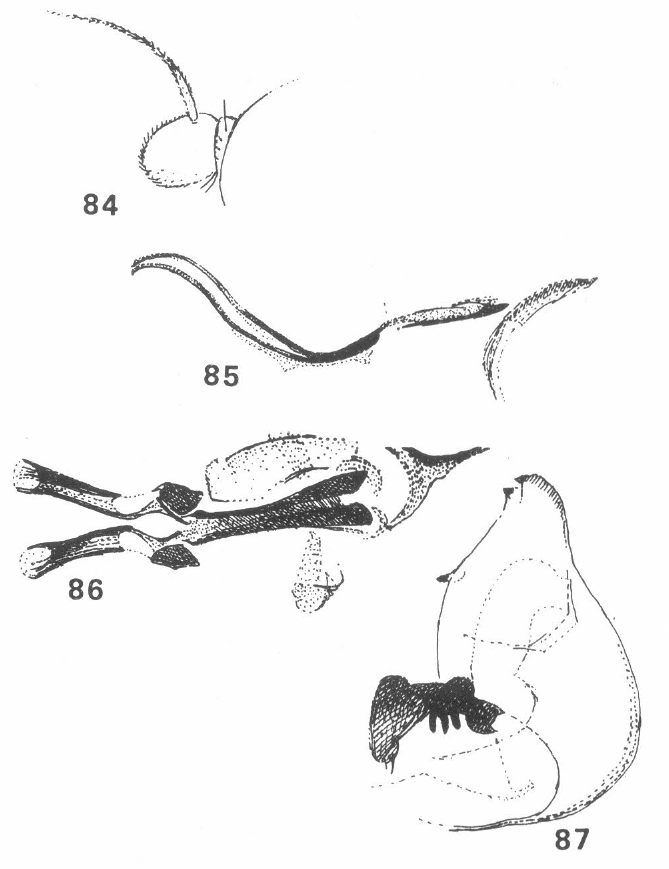
Phytoliriomyza imperfecta: 84, third antennal segment; 85, aedeagus. Phytoliriomyza medellinensis: 86, aedeagus, ventral view; 87, epandriurn.
Phytoliriomyza colombiana sp.n. Figs. 80, 83
Head. Frons exceptionally broad, almost 3 times width of eye; 2 reclinate ors, the upper stronger, 1 inclined ori, the two ors further removed from eye margin than the ori; orbital setulae sparse, proclinate; eye large, upright, jowls 1/3 its vertical height, largely covered with thick, short pilosity; third antennal segment small, round, with conspic-uous fringe of hairs which are longer than basal width of arista (Fig. 80).
Mesonotum. 3+1 strong dc, with a short additional presutural; acr sparse, in at most 2 rows.
Wing. Length 2.1 mm in male, 2.2 mm in female, discal cell large, last section of vein M3+4 little longer than penultimate in ratio 22:20 (♂), 23:21 (♀).
Abdomen. In female, ovipositor sheath unusually long, equal in length to tergites 4 and 5.
Colour. Frons yellowish-brown (♂) or more greyish at rear (♀), orbits slightly paler in front, more greyish at rear; jowls and face bright yellow, palps black; third antennal segment black, first and second yellowish; mesonotum and scutellum uniformly mat grey, with slight brownish tinge; pleura largely bright yellow, only sternopleura black on lower three-quarters; legs: femora greyish, with yellow undertone (♂) or more distinctly yellow (♀), tibiae and tarsi greyish; halteres with stalk yellowish basally, above and knob dark grey (♂) or paler, yellowish-grey (♀); ovipositor sheath shining black.
Male genitalia. Aedeagus (Fig. 81) ending in slender paired tubules, basiphallus strongly sclerotized distally, ventral sclerite short; epandrium with strongly chitinized comb of about 7 teeth along inner margin, surstyli with 5 strong teeth (Fig. 82); sperm pump small, asymmetrical (Fig. 83).
Holotype, Colombia, Monserrate, above Bogotá, 26.vi.82; paratype ♀, same data, both in AC.
Remarks. The most distinctive character of this species is the long pilosity of the third antennal segment which immediately distinguishes it from P. similis which it generally resembles. Other differences are indicated in the key above.
The similarity in the male genitalia confirms the close relationship of the two species.
Two other species are known in Central America and the Caribbean with long pubescence on the third antennal segment P. pilosella Spencer (in Spencer and Stegmaier, 1973, Costa Rica, Puerto Rico, Florida) and P. jurgensi Spencer (1983a, Costa Rica) but the male genitalia of these two species are entirely distinct.
Phytoliriomyza imperfecta (Malloch) Figs. 84, 84
This small species is distinguishable by the proclinate orbital setulae, rather large, yellowish third antennal segment (Fig. 84), mat grey mesonotum with sparse acrosti-chals, the scutellum largely grey but faintly yellowish centrally and the darkened halteres; wing length ranges from 1.8 mm in the male to 2.5 mm in the female, with the discal cell large and the last section of vein M3-4 normally about 1.5 times the length of the penultimate section. In the male genitalia the aedeagus ends in strongly sclerotized, slightly sinuous paired tubules (Fig. 85) and the surstyli have a comb of 6 strong bristles (cf. Spencer and Stegmaier, 1973: figs. 292-294; Spencer, 1981: figs. 461-464).
P. imperfecta was described from Chile in 1934 and further specimens were recorded by Spencer (1982, Chile), it is present in Florida (Spencer and Stegmaier, 1973), is common in southern California (Spencer, 1981) and I collected two specimens in Costa Rica (Spencer, 1983a). A single female has now been seen from Madrid, NW. of Bogotá on the Sa-bana, 21.vii.82.
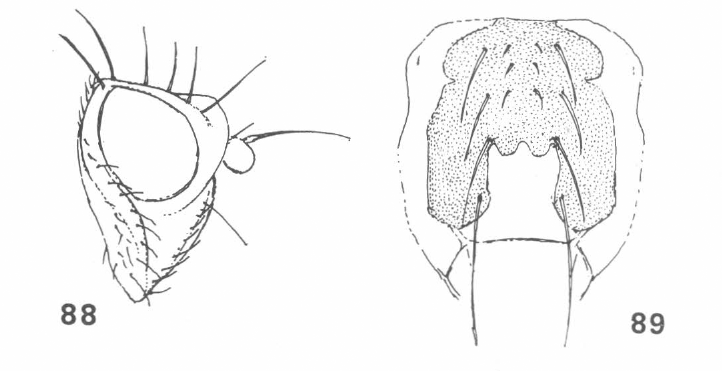
Phytoliriomyza papae: 88, head; 89, mesonotum; 90, aedeagus; 91, epandrium with surstvtus.
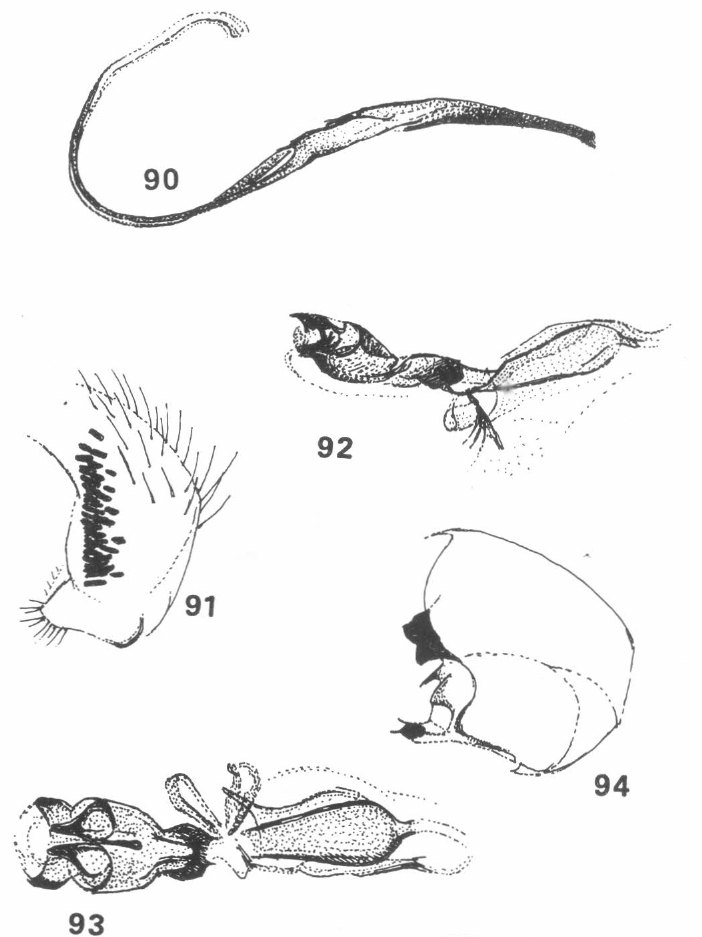
Phytoliriomyza sabanae: 92, aedeagus, side view; 93, sarne, ventral view; 94, epandrium with surstvlus.
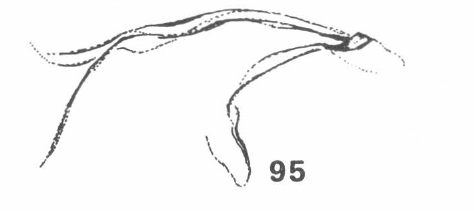
Phytoliriomyza similis: aedeagus
Phytoliriomyza medellinensis sp.n. Figs. 86, 87
Head. Frons 1.5 times width of eye; 2 equal, reclinate ors, 1 similar inclined ori; orbital setulae lacking; jowls 1/4 height of eye, this upright, sparsely pilose; third antennal segment longer than broad, with short pubescence, arista with similar pubescence.
Mesonotum. 3+1 strong dc, acr irregularly in 4 rows.
Wing. Length in male 1.85 mm; costal sections 2, 3, 4 in ratio 32:11:8; discal cell large, last section of M3+-4 only slightly longer than penultimate, in ratio 20:17.
Colour. Frons largely bright yellow, becoming slightly greyish above between lower ors and ocellar tubercle; jowls and face yellow, palps black; mesonotum and scutellum uniformly deep black, predominantly mat but weakly shining seen from rear; pleura largely black, only mesopleura yellow in upper third; legs entirely black; squamae grey, margin black; halteres deep black.
Male genitalia. Aedeagus (Fig. 86) with distiphallus divided into strong paired tubules, characteristic of the Lemurimyza group (cf. Spencer and Stegmaier, 1973: fig. 429); epandrium (Fig. 87) with strongly sclerotized internal process, with 3 strong teeth but solid on inner side; surstyli elongate, largely fused with epandrium bearing 3 short, stout rudimentary spines; sperm pump with pale, slender blade.
Holotype Colombia, Medellín, roadside above Hotel Intercontinental, 18.iv.82. in AC.
Remarks. Among Neotropical species, P. medellinensis most closely resembles P. perturbata Spencer, 1973c, known only from 3 females from Mérida, Venezuela. However, this is larger, with wing length of 2.4 mm, orbital setulae are present and the jowls are broader, 1/3 the eye height. It therefore seems justified to treat the specimen from Mede-llín as distinct.
Phytoliriomyza papae sp.n. Figs. 88,.91
Head (Fig. 88). Frons twice width of eye, strongly projecting above eye in profile; normally 2 ors and 2 ori but sometimes irregular, with 4 on one side, 5 on the other; orbital setulae lacking; ocellar bristles exceptionally long, extending to front margin of frons; jowls deeply extended at rear, varying from slightly more than 1/2 to 3/4 height of eye, this small, slanting, bare; third antennal segment slightly longer than broad, virtually bare, arista with only short pubescence; broad epistoma present, equal to length of third antennal segment.
Mesonotum. 3+1 strong dc, 4th exceptionally long, ex-tending to apex of scutellum; acr variable, from 2 to 3 irregular rows, normally ending at level of 3rd dc, parallel to the dc (not inclined inwards, contrast Liriomyza brazi-liensis, Fig. 24).
Wing. Length from 2.6 2.9 mm in male, 3.25 3.8 mm in female; costa extending strongly to vein M1-2, discal cell large, last section of M3+4 at most 1.5 times length of penultimate.
Colour. Somewhat variable; frons bright yellow or more orange, third antennal segment yellow or rarely darker, blackish-brown, arista varying from yellow to more blackish; jowls, face and palps always yellow; mesonotum (Fig. 89) mat grey but with large yellow patch before scutellum, the dark area only occasionally broken and faintly banded with yellow (even in otherwise darker specimens); scutellum broadly yellow centrally, narrowly black at sides; mesopleu-ra either entirely bright yellow or with distinct grey or blackish bands along lower - and hind-margins; intermediate forms occur with these dark bands only faintly indicated; sternopleura always dark on lower-three-quarters; legs entirely yellow or femora with slightly darker striations; abdomen either largely blackish-grey (even in paler speci-mens) or with tergites broadly yellow-bordered (even in darker specimens); halteres yellow, squamae yellow with margin and fringe black; ovipositor sheath in female with margin and fringe black; ovipositor sheath in female varying from entirely shining black to grey-dusted basally, shining only at rear.
Male genitalia. Aedeagus (Fig. 90) dividing at midpoint into paired tubules, which are highly flexible and may form.a loop as illustrated or be entirely straight (in the copulation position) or form a corkscrew-like coil; epandrium (Fig. 91) with a band of strong bristles along inner margin, with surstyli largely fused with the inner corner bearing some 6-10 strong hairs..
Puparium. Pale brown, posterior spiracles each with 3 pores (generally similar to Liriomyza sativae, Fig. 67).
Holotype Bolivia, Torralapa, 15.xii.68, c.3,300 mm., 150 km. E. of Cochabamba, 17°26'S, 65°43'W, ex "potato haulms" (-stalks); paratypes: 2♂6♀, same data (3♂, 1♀ lacking heads) (all F.A. Squire). Holotype and paratypes in U.S. National Museum, 11 paratypes in AC.
Remarks. It was originally considered that these specimens represented two species and they were divided into the palest form (14) and the darker form (29). However, I have found that there is no clear-cut division between the two, with the mesopleura sometimes being only slightly darkened and even in the palest specimens the third antennal segment may be slightly brownish. The male genitalia in the palest and darkest specimens are identical. All specimens have in common the exceptionally long ocellar and dorso-central bristles, the deep jowls, broad epistoma, sparse acrostichals and the distinctive colour of the mesonotum. It is clearly far more probable that this represents a single variable species than that two species, which are not clearly defined, should be feeding on the same host, in the same part of the plant, at the same locality, at the same time. Also comparable or even greater colour variation is well-known in other species in Europe, such as Cerodontha denticornis and Phytomyza ranunculi.
It is not known whether more than one larva feeds in a single potato stalk but, if a number occur together, the plants could be appreciably weakened and the species would be considered to be of some economic importance. While P. papae superficially resembles Liromyza braziliensis, which feeds in the lower stems and tubers of potatoes at high altitudes in the Andes, both are exceptionally large but are readily distinguishable by the differing pattern of the mesonotum and arrangement of the acrostichals (Figs. 24, 89).
The name papae is derived from papa, Spanish for potato, treated as Latin, in the genitive case. I would like to thank Mr. G. Steyskal for allowing me to describe this interesting species.
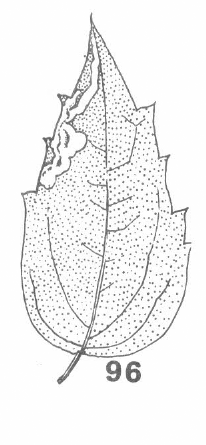
Phytomyza loewii: leaf-mine on Clematis.
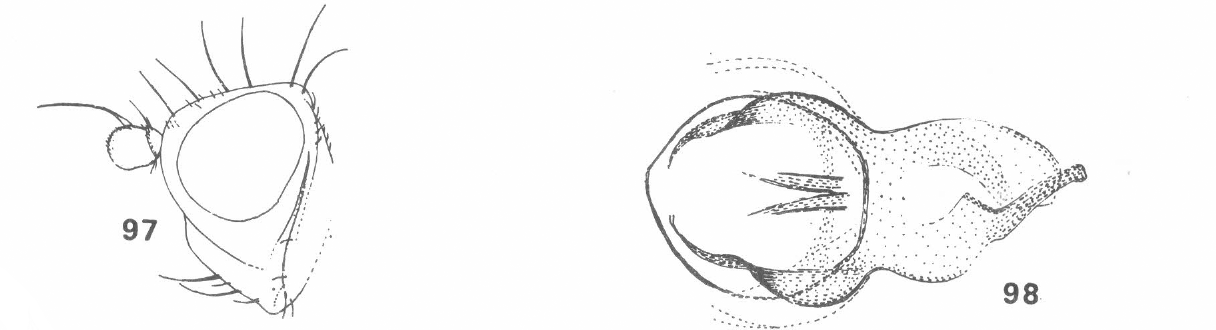
Phytomyza rufipes: 97, head; 98, aedeagus, ventral view.
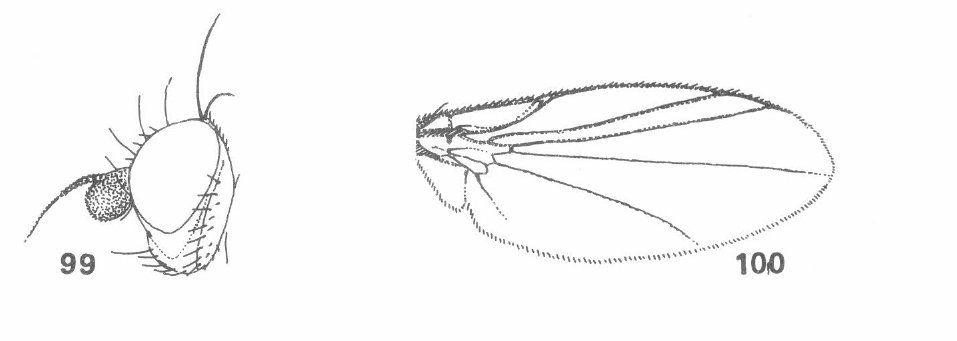
Chromatomyia syngenesiae: 99, head; 100, wing.
Phytoliriomyza sabanae sp.n. Figs. 92, 94
Head. Frons 1.5 times width of eye, not projecting above eye in profile; 2 strong, equal reclinate ors, 1 slightly weaker inclined ori; orbital setulae sparse, reclinate; jow's extended at rear, there 1/3 height of eye, this upright, with very sparse pilosity; third antennal segment small, round, with only fine pubescence; arista long, only slightly shorter than vertical height of eye, with short pubescence.
Mesonotum. 3+1 strong dc, acr in 4 rows.
Wing. Length in male 2.3 mm; costal sections 2, 3, 4 in ratio 43:12:10, discal ceil small, last section of M3+4 more than twice length of penultimate, in ratio 32:14.
Colour. Frons bright yellow, orbits dull blackish to level or ori; jowls, face and palps yellow; first and second antennal segments yellow, third yellow on lower half, brown above, darkest towards upper corner; mesonotum shining, deep black, with only small yellow patches at hind-corners; scutellum bright yellow; apart from small lateral black patches; notopleura yellow, mesopleura largely black, yellow on upper quarter, sternopleura entirely black; legs: coxae largely black, more yellowish apically, femora bright yellow, tibiae and tarsi brownish black; squamae yellowish, margin and fringe dark; halteres and wing bare, bright yellow.
Male genitalia. Aedeagus as in Figs. 92, 93; epandrium (Fig. 94) with area of strong sclerotization on inner margin and one strong spine towards surstylus which is partially fused with inner corner of epandrium and is largely sclerotized apically, with 2 weak hairs; sperm pump with large, dark blade.
Holotype, Colombia, Mosquera, NW of Bogotá on Saba-na, 16.vi.82, in AC.
Remarks. In its general colour, particularly with the bright yellow scutellum, this species resembles a Liriomyza but the stridulating organ is lacking and the form of the epandrium and surstyli confirms its position in Phytoliriomyza. The darkened third antennal segment, although not conclusive in itself, is frequently an indication that a species belongs in Phytoliriomyza.
Phytoliriomyza similis sp.n. Fig. 95
Closely resembling P. colombiana, particularly in the broad frons, pilose eyes, proclinate orbital setulae and general colour, but with following essential differences: third antennal segment with only short, normal pubescence; mesonotum brownish-grey centrally between lines of dc, distinctly silvery-grey at sides; smaller, wing length in male 1.75 mm, in female 2.1 mm; discal cell much smaller, last section of M3+4 thus relatively longer, in ratio 24:14 (♂), 30:15 (♀); male genitalia; aedeagus of same general form but with longer distal tubules, longer ventral sclerite and less sclerotized basiphallus (Fig. 95); epandrium and surstyli similar.
Holotype, Colombia, Mosquera (Sabana), NW of Bogotá, 27.x.83; paratype ♀, Bogotá, near Restaurant "El Engaño" on road to La Calera, 16.vi.82, both in AC.
Remarks. The close relationship of this species with P. colombiana is apparent from the similarity of their male genitalia but the external differences between the two species are substantial.
Genus Phytomyza Fallen
This is the largest world genus, with over 450 described species, occurring predominantly in the Nearctic and Palaearctic Regions. In the tropics a few species are found at high elevations and there is some radiation in southern continents but the number of species remains small - Chile, 5; South Africa, 11; Australia, 8; New Zealand, 5.
No species have hitherto been known in Colombia but two are now recorded below, one, P. rufipes, an introduced pest of brassicas and the second, P. loewii, which is widespread in North America and the Caribbean area.
As adults in the genera Phytomyza and Chromatomyia cannot be distinguished on external characters a combined key to these two genera is provided below.
Key to genera Phytomyza Fallén and Chromatomyia Hardy
1
Entirely black species
Phytomyza loewii Hendel
Frons yellow
2
2
Third antennal segment black; femora black with yellow knees
Chromatomyia syngenesiae Hardy
Third antennal segment yellowish-brown; femora largely yellow
Phytomyza rufipes Meigen
Phytomyza loewii Hendel. Fig. 96
This species is host-specifi on
This species is host-specific on Cruciferae and is well-known in Europe as a pest on cabbages and other brassicas.
The broad frons, up to 3 times the eye width and the deeply extended jowls (Fig. 97) are distinctive. Wing length is from 2.5 mm in the male to 3.5 mm in the female. The male genitalia are shown in Fig. 98.
The egg is laid in the leaf-blade and the young larva mines towards the nearest vein, then continuing to feed down-wards in the mid-rib and petiole and even into the stalk. Normally a number of larvae are found in a single plant and seedlings can be seriously weakened and damaged, with stunting of mature plants. The economic importance of
Three males can now be recorded in Colombia, representing the first records in South America, all on or near the Saba-na: Chía, 1♂, 13.iv.82; Tabio, 1♂ 22.x.83; near Guasca, SE of Bogotá, 1♂, 1.xi.83. These specimens must represent an introduction from Europe, probably from Spain which in recent years has been exporting to Colombia several hundred tons annually of "German cabbage". With
In North America
Genus Chromatomyia Hardy
Approximately 100 species are now known in this predom-inantly north-temperate genus. All were previously included in
Four species have hitherto been known in the Neotropical Region (Spencer, 1973c (Venezuela), 1982 (Chile) and 1983a (Costa Rica)). The European species,
Chromatomyia syngenesiae Hardy. Figs. 99, 100
This highly polyphagous species is common and widespread in much of Europe and is a serious pest of chrysanthemums in greenhouses. It was first noticed on the Sabana at Chia in April, 1982 where the conspicuous leaf-mines were frequent on the introduced weed
With cultivated chrysanthemums so readily attacked in Europe, it is puzzling that
The adult is recongnisable by the small, round, black third antennal segment (Fig. 99), and by its wing venation (Fig. 100), with the costa extcnding only to vein R4+5 and the outer cross-vein lacking and the greyish-black scutcllum, The leal-mines are longer and narrower than those of
Footnotes
Acknowledgments
My primary thanks are due to the Association of Colom-bian Flower Growers, Asocolflores, who invited me to Colombia on three occasions to study leaf-mining pests on flower farms. This study would not have been possible without the facilities provided for collecting and I gratefully acknowledge the assistance and hospitality I was given at all times by the manager of Asocolflores, Sr. Jorge Enrique Uribe Salazar; the agronomist at Asocolflores, Sr. Germán Arbeláez Torres and the owners and agronomists at the farms I visited.
Dr. Isabel S. de Arévalo, Jefe Sección Zoología, Instituto de Ciencias Naturales Musco de Historia Natural, Universidad Nacional de Colombia has given me valuable guidance in several meetings and has kindly read the manuscript. I greatly appreciate this assistance.
I must also thank my wife who prepared all illustrations, so essential in a taxonomic paper of this nature.