






Abstract
Upper respiratory tract infections (URIs) represent the most frequent cause of acute asthma exacerbations. It has yet to be determined whether leukotriene receptor antagonist (LTRA) treatment prevents URI-induced acute asthma exacerbations in adults. The objective of the present study was to evaluate the preventive effects of LTRA treatment on URI-induced acute asthma exacerbations. The incidences of URI alone, acute asthma exacerbation without URI, and URI-induced acute asthma exacerbation were determined retrospectively by analyzing diary and medical records of 321 adult asthmatic patients (mean age, 56.3 ± 17.2 years; male/female ratio, 117:204) over 1 year. Results were compared between patients who had been taking an LTRA (n = 137) and those who had never taken any LTRA (n = 184) during the study periods. Significantly fewer URIs alone and acute asthma exacerbations without URI occurred in patients with than in those without prophylactic daily use of LTRA. LTRA treatment significantly reduced the durations of URIs alone and of total acute asthma exacerbations, as well as the incidence of mild exacerbations of asthma. In contrast, in patients with URI-induced acute asthma exacerbations, LTRA treatment failed to significantly reduce the interval between URI onset and acute asthma exacerbation, as well as the duration and severity of both URIs and acute asthma exacerbations. Use of an LTRA for adult asthmatic patients appears to reduce the incidences of URIs alone and acute asthma exacerbations without URI, but it failed to prevent URI-induced acute asthma exacerbations once a URI occurred.
Viral respiratory tract infections are the most common triggers of an acute exacerbation of asthma in both children and adults.4,5 Although the precise underlying mechanism of virus-induced acute exacerbations of asthma remains unknown, many molecular factors and cells are critically involved. 6 Among them, cysteinyl leukotrienes (cysLTs) have received considerable attention, because their levels increase in the airways of asthmatic patients during virus-induced acute exacerbations,7–9 and specific cysLT receptor antagonists (LTRAs) are routinely available in clinics. Thus, because respiratory viral infections increase the amounts of cysLTs in the asthmatic airways, we postulated that LTRA treatment might be able to prevent viral infection–induced acute exacerbations of asthma. Based on patients' asthma diary and medical records, the present study retrospectively evaluated the prophylactic effects of daily LTRA use for preventing upper respiratory tract infection (URI)–induced acute asthma exacerbations.
Materials and Methods
Design
A retrospective cohort study was performed in outpatient clinics of four institutes in Nagasaki Prefecture, Japan. This study received ethical approval from the special committee of Nagasaki University Hospital (project registration number 12062548) to proceed between July 2010 and December 2012.
Subjects
Eligible individuals were adults with mild and moderate persistent asthma determined by the Asthma Prevention and Management Guideline 2012, Japan for adults 10 who had received a daily fixed dose of medications except during exacerbation periods and recorded their daily symptoms for >1 year during the study period. The asthma diaries, which are being used in the daily outpatient clinics, contain questions not only related to asthma-related symptoms but also to URI-related symptoms, as detailed later in this article. Atopy was defined by a positive skin-prick test using 10 common aeroallergens and/or IgE (radioallergosor-bent test). Aspirin-induced asthma was defined either by the clinical history or an oral provocation test with aspirin as described elsewhere. 11 A history of otolaryngologist-diagnosed allergic rhinitis and/or sinusitis was determined based on the patients' medical records. A clinical URI-induced acute asthma exacerbation was defined as previously described. 12 URI was defined as having at least two of the following symptoms: sneezing, coughing, nasal congestion, runny nose, or fever (>38°C). An asthma exacerbation was defined as an increase in one or more of wheeze, chest tightness, and breathlessness or wheeze during clinical examinations. A URI-induced acute asthma exacerbation was defined as having symptoms of both URI and asthma exacerbation. The duration of a URI and acute asthma exacerbation was determined from the 1st day until the last day before all symptoms had disappeared for at least 2 consecutive days. In each institute, well-trained allergists evaluated the subjects, and exacerbated allergic rhinitis was carefully distinguished from URI. Asthma exacerbation severity was graded according to the Asthma Prevention and Management Guideline 2012, Japan. 10 The severity of URI was expressed as the sum of symptoms.
Study Protocol
The incidences of URI alone, asthma exacerbation without URI, and URI-induced asthma exacerbation during the most recent year during the study period were analyzed retrospectively by examination of diary and medical records. In URI-induced asthma, intervals between onset of URI and asthma exacerbation, duration of URI and asthma exacerbation, and severity of URI and asthma exacerbation were also evaluated. These parameters were compared between patients who had been taking an LTRA, pranlukast (ONON; ONO Pharmaceutical Co. Ltd., Osaka, Japan), or montelukast (Singulare; MSD Pharmaceutical Co. Ltd., Tokyo, Japan), denoted as the LTRA+ group, and those who had never taken any LTRA, denoted as the LTRA– group, over the 1-year evaluation period. All participants had to be taking a stable dose of ICS, inhaled long-acting β2-agonists (LABAs), and xanthines, as well as on-demand use of short-acting β2-agonists throughout the study period. Patient adherence to medications was checked orally and confirmed by the diary. Exclusion criteria included pregnancy and/or lactation, history of life-threatening asthma, hospitalization for asthma within 6 months, and oral or parenteral corticosteroids before entry.
Statistics
Results are expressed as numbers or percentages of subjects or means ± SD for continuous variables. Differences between groups were examined for statistical significance using the Mann-Whitney U test and the χ-test. A value of p < 0.05 denoted the presence of a significant difference.
Results
Enrollment and Baseline Characteristics of the Patients
The present retrospective study included 321 (male/female, 117:204; mean age, 56.3 ± 17.2 years) patients with asthma visiting the outpatient clinics of four institutes in Nagasaki Prefecture, Japan; 137 patients were LTRA+ and 184 patients were LTRA–. Table 1 summarizes the patients' baseline characteristics. Except for sex, baseline demographic characteristics were closely matched, and no parameters differed significantly between the LTRA+ and LTRA–groups. The percentage of female patients was significantly higher in the LTRA+ group than in the LTRA– group.
Patients' characteristics

Values are shown as means (SD; *p < 0.05).
ICS = inhaled corticosteroid; LABA = long-acting β2-antagonist; LTRA = leukotriene receptor antagonist; FP = fluticasone propionate.
Prevention of URI Alone, Acute Asthma Exacerbation without URI, and URI-Induced Acute Asthma Exacerbation by LTRA Treatment
During the study period, 79 patients developed URI alone and 24 patients developed acute asthma exacerbation without URI. The present study found that significantly fewer URIs alone and acute asthma exacerbations without URI occurred in the LTRA+ group than in the LTRA– group (Fig. 1). A URI-induced acute asthma exacerbation occurred in 29 subjects, and LTRAs failed to significantly prevent URI-induced acute asthma exacerbations (Fig. 1). Thus, LTRAs showed the potential to prevent either URIs alone or acute asthma exacerbations without URI, but it did not prevent URI-induced acute asthma exacerbations.

Prevention of upper respiratory tract infections (URIs) alone, acute asthma exacerbations without URI, and URI-induced acute asthma exacerbations by leukotriene receptor antagonist (LTRA) treatment. Incidences of URIs alone, acute asthma exacerbations without URI, and URI-induced acute asthma exacerbations are compared between the LTRA+ (n = 137) and LTRA–p (n = 184) groups. Bars represent the number of subjects.
Effects of LTRA Treatment on Duration and Severity of URIs Alone and Total Acute Asthma Exacerbations
In patients with URI alone (n = 79), LTRA treatment significantly shortened URI duration, but it failed to reduce URI severity (Fig. 2). However, among all patients with acute asthma exacerbations irrespective of URI (n = 53), LTRAs significantly shortened the duration of acute asthma exacerbations and reduced the incidence of mild asthma exacerbations (Fig. 3).
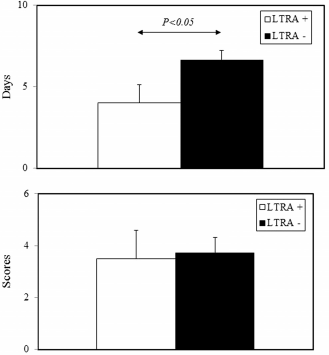
Effects of leukotriene receptor antagonist (LTRA) treatment on duration (upper) and severity (lower) of upper respiratory tract infection (URI) symptoms. Duration and severity of total URI (n = 79) are compared between the LTRA+ and LTRA– groups. Bars represent means ± SD.

Effects of leukotriene receptor antagonist (LTRA) treatment on duration (upper) and severity (lower) of acute asthma exacerbation. Among all patients with acute asthma exacerbations irrespective of upper respiratory tract infection (URI; n = 53), the duration and incidences of mild and moderate exacerbations are compared between the LTRA+ and LTRA– groups. Bars represent means ± SD in the upper part and numbers of subjects in the lower part.
Effects of LTRA Treatment on the Clinical Characteristics of URI-Induced Asthma
In patients with URI-induced asthma (n = 29), LTRA treatment failed to significantly reduce the interval between URI onset and acute asthma exacerbation, as well as the duration and severity of both URIs and acute asthma exacerbations, as shown in Fig. 4. Thus, although LTRAs decreased the incidences of URIs alone and acute asthma exacerbations alone, it did not prevent URI-induced acute asthma exacerbations once a URI occurred.

Effects of leukotriene receptor antagonist (LTRA) on clinical characteristics of upper respiratory tract infection (URI)-induced asthma. In patients with URI-induced asthma (n = 29), clinical characteristics are compared between LTRA+ and LTRA– groups. Bars represent means ± SD.
Discussion
The major findings of the present retrospective study were as follows: (i) significantly fewer URIs alone and acute asthma exacerbations without URI occurred in patients with prophylactic daily use of LTRA than in those without prophylactic daily use of LTRA, (ii) prophylactic daily LTRA use significantly shortened the durations of URI alone and acute asthma exacerbation without URI and reduced the incidence of mild exacerbations of asthma, and (iii) prophylactic daily LTRA use did not significantly affect the clinical course of URI-induced acute asthma exacerbations.
Viral respiratory tract infections often exacerbate asthma, which can be significantly reduced by the regular administration of ICSs. 13 An additive therapy that would increase the beneficial effects and decrease the toxicity of corticosteroids would be useful. From this viewpoint, cysLTs are appealing because their concentrations increase during respiratory virus-induced acute asthma exacerbations,7–9 and CSs do not inhibit their production. 14 In fact, the LTRA montelukast prevents respiratory virus-induced acute asthma exacerbations in children.15–17 We have also reported that pranlukast inhibits respiratory syncytial virus-induced allergic airway inflammation in a murine model of allergic asthma, 18 and the combination of an LTRA and CS might be more useful than CS alone for treating URI-induced acute asthma exacerbations and reducing the cumulative CS dose. 19
Although LTRAs reduce asthma symptoms or exacerbations in children with colds,15–17 few studies have evaluated their effects on asthma in adults. One study found that LTRAs did not improve symptoms of mild asthma caused by experimental rhinovirus infection in adults. 20 Thus, the role of LTRAs in acute asthma exacerbation in adults caused by naturally occurring viral respiratory infection remains unknown. In agreement with the present study, LTRA treatment was associated with a lower incidence of common cold-like symptoms in a retrospective analysis of adult asthma. 21 However, contrary to the present results, Kozer et al. reported that montelukast did not reduce the incidence or duration of URI in preschool-aged children who did not have asthma. 22 Thus, LTRA treatment may only be effective for asthmatic patients, who have higher LT levels in the airway while stable, to prevent URI symptoms.
It has been reported that LTRA treatment is effective in a subset of asthma, such as aspirin-induced asthma, 11 asthma with rhinitis 23 and obesity, 1 and in current smokers. 24 In the present study, the ratio of these subtypes was comparable between the LTRA+ and LTRA– groups. However, there were significantly more female subjects in the LTRA+ group than in the LTRA– group, which could affect the results, because differential responses to LTRAs between girls and boys have been reported. 25 Attending physicians at each institute decided to use or not use LTRAs based on their clinical experience. The present study protocol thus could not identify why some patients took LTRAs but others did not during the study period.
Regular use of ICS is the single most effective treatment to reduce the risk of acute exacerbations of asthma. Additional benefit can be obtained with the regular use of combinations of ICS and LABA. Besides LTRA, LABAs also have antiviral as well as broncho-dilator effects. 26 In the present study, approximately one-half of the patients in both LTRA+ and LTRA–groups had used LABAs, and the incidences of URIs, acute asthma exacerbations without URI, and URI-induced acute asthma exacerbations were comparable between those taking and not taking LABAs (data not shown). A future study should also examine the effects of adding LABAs for URI-induced acute exacerbations of asthma.
The present study had several critical limitations. First, URI was defined based on clinical symptoms without determining causative viruses. Second, asthma-related symptoms were also evaluated based on clinical symptoms, and objective measures of pulmonary function, such as peak expiratory flow or forced expiratory volume in 1 second FEV1.0, were not available. Finally, this was not a prospective, placebo-controlled study. Thus, not all relevant URI and acute asthma exacerbation events could be captured for analysis.
In conclusion, the present findings suggest that LTRAs have the potential to prevent URI and acute asthma exacerbation without URI, but not URI-induced acute asthma exacerbation. Large-scale, placebo-controlled, prospective studies evaluating objective parameters, such as peak expiratory flow and spirometry, are warranted.