






Abstract
Endometriosis is a common but an enigmatic disease in which endometrial glands and stroma are found outside the uterus. Worldwide, 80 million women are affected by the disease. It has generally been accepted as a problem of reproductive ages and affects 6–10% of those women. It is more common in women with infertility. Moreover, since it is an estrogen dependent problem, it is generally believed that endometriosis connotes ‘active ovarian function’ and is ‘healed’ after the menopause. However, there are reports on endometriosis beyond the reproductive ages. In this article, endometriosis after the menopause will be discussed.
Keywords
History
Although the history of endometriosis goes back to 1690 when Daniel Christianus Schrön presented ‘The Disputatio Inauguralis Medica de Ulceribus Uteri’ at the University of Jena [1], it took more than 250 years until the appearance of the first report on postmenopausal endometriosis in the literature; in 1942, Edgar Haydon reported the first case of postmenopausal endometriosis in 78-year-old woman [2]. In 1960, Kemper et al. reported a big series (n = 136) of postmenopausal women with endometriosis [3]. In 1980, Punnonen et al. reported 11 patients with postmenopausal ovarian endometriosis and drew attention to ‘the role of extraglandular estrogen formation in the pathophysiology’, since most of their patients were obese [4].
Until now, there have been many case reports, case series and retrospective analyses of postmenopausal women with endometriosis, as well as histological investigations to explain the pathophysiology of postmenopausal endometriosis. Now, it is well understood that endometriosis is not a problem of ‘solely’ reproductive years.
Prevalence
It is difficult to assess the prevalence of endometriosis in fertile period, since it varies greatly depending on the study population and the method of diagnosis. It is even more difficult to give the prevalence of endometriosis beyond the two borders of reproductive years.
True prevalence of postmenopausal endometriosis is unknown. There have been some reports in the literature on the prevalence of endometriosis in postmenopausal women [5–8]. According to these studies, the prevalence of postmenopausal endometriosis is 2–5%.
In 1955, Henriksens [5] reviewed 1000 cases with endometriosis over 20 years. Of those, 37 women (3.7%) had postmenopausal endometriosis. In another descriptive study by Ranney, of 350 women operated for endometriosis, 17 (4.8%) were postmenopausal [6]. In 1980, Punnonen et al. [4] reported that the frequency of postmenopausal endometriosis was 2.2% and the average time elapsed after menopause was 7.3 years in 11 patients with ovarian endometriosis. In 1984, the same group analyzed 801 women that have been operated for gynecological reasons at different age groups between 1969 and 1976 [7]. In their survey, 19% of the patients had endometriosis and the incidence for postmenopausal endometriosis was 2.5%.
In a recent comprehensive retrospective epidemiologic study, Haas et al. performed an analysis of 42,079 women with surgically confirmed endometriosis in Germany [8]. Of 42,079 women with endometriosis, 1074 (2.55%) were in the postmenopausal age group (55–95 years). Interestingly, nine of the cases were at the upper extreme of the age groups (eight were in 80–85 years and a case in 90–95 years).
Pathophysiology
Although there are many theories to explain its pathophysiology, endometriosis is still an inscrutable disease. Postmenopausal endometriosis is even more complex, because it is not known whether it is a continuation of a previous disease or it develops de novo.
There are some case reports of postmenopausal endometriosis stating there was not any symptom of endometriosis in their reproductive years, even no findings of endometriosis in the previous laparotomy of the patient [9,10]. In the case series from a single institution, Marotti et al. [11] reported 72 women with postmenopausal endometriosis. Of these, only 11 (15.3%) had previous history of endometriosis. Such cases without previous history of endometriosis may be explained by coelomic metaplasia theory. However, this theory cannot explain extrapelvic endometriosis in postmenopausal women.
Postmenopausal endometriosis may be a part of the progression of previously existent endometriosis. If this is valid, Sampson's retrograde menstruation and implantation of the endometrium ectopically may explain at least some of the cases. Indeed, endometriosis may be detected in up to 7% ‘asymptomatic, multiparous’ women [12]. This ‘underestimated’ presence of endometriosis in asymptomatic women may well progress in the postmenopausal period and become clinically evident.
Whatever the initiator in the pathophysiology of postmenopausal endometriosis is, we know that estrogen plays a crucial role in the pathogenesis in endometriosis. In postmenopausal woman, the source of estrogen is mainly peripheral (especially in the adipose tissue and skin) conversion of androgens and the leading estrogen is estrone (E1). E1 can be converted to estradiol (E2) via 17-β hydroxylase type 1 in endometriotic tissue [13]. However, contrary to the normal endometrial tissue, 17-β hydroxyl steroid dehydrogenase type 2 (17-b HSD) is lacking in endometriotic tissue, thus E2, active form of estrogens, is not metabolized. Increased local E2 in endometriotic tissue itself promotes the local production of prostaglandin E2, the potent stimulator of aromatase enzyme, as well as steroidogenic acute regulatory protein expression, which facilitates the entry of cholesterol into the mitochondrion [14].
The pathogenic mechanism of postmenopausal endometriosis may involve ‘estrogen threshold theory’ with undetected or ‘transient’ foci of endometriosis in women; that is, there may be endometriotic foci in some women which may be activated postmenopausally via estrogen when it is above its threshold level [15].
HRT & postmenopausal endometriosis
Postmenopausal hormonal therapy (HT) is important especially in women who were castrated in younger ages due to endometriosis. The role of postmenopausal hormonal therapy in recurrence of postmenopausal endometriosis is debatable.
In 1999, Fedele et al. [16] compared tibolone (n = 11) with transdermal estrogen plus cyclic medroxyprogesterone acetate (n = 10) in women with bilateral salpingo-oophorectomy (BSO) and residual rectovaginal endometriosis. Over 12 months, they have reached the conclusion that tibolone might be safer in such women (4/10 patient in HT group and 1/11 patient in tibolone group have reported pain).
Matorras et al. performed a prospective randomized study to clarify the recurrence risk of endometriosis in women taking (n = 115) or not taking HT (n = 57) [17]. All women had surgery including BSO (with or without hysterectomy) for endometriosis. HT was started 4 weeks after BSO. They have given estradiol patches (50 μg, two per week) plus micronized oral progesterone (200 mg/day, 14 days/month). Control group was not given any placebo. They have defined the recurrences according to symptoms, and if there was a symptom, complementary tests (CA125 levels, ultrasound and/or histopathology) were performed. Mean follow-up time was 45 months. They have found four cases with recurrences in HT group (0.91% per year) versus nil in non-HT group (0% per year). They have also found that having BSO without hysterectomy or having peritoneal implants greater than 3 cm are the risk factors for recurrence of endometriosis in women on HT.
In another study, 123 women with endometriosis after definitive surgery (i.e., total hysterectomy plus BSO) were divided into four groups as control (no HRT; n = 17), estrogen only (ERT; n = 50), cyclic estrogen/progestin regimen (n = 16), and continuous combined estrogen/progestin (n = 24) [18]. There was a (2%) case of recurrent endometriosis and three (6%) cases of recurrent symptoms in the estrogen only group; none required additional surgical therapy. Malignant transformation was not found. Although the numbers were small, they concluded that HT was safe.
There are also some case reports on HT use in women with appearance of endometriosis. In 2003, a case report described a hysterectomized women having estrogen and testosterone treatment who then developed multiple endometriotic lesions as well as ovarian endometriotic cyst [19]. In another case report, a postmenopausal woman with ureteral endometriosis and leiomyoma was described. She was on estrogen replacement therapy [20].
Since there have been contradictory reports on postmenopausal HT use in women with previously known endometriosis, in 2010, European Menopause and Andropause Society reported a position statement regarding to managing menopause in women with previous history of endometriosis [21]. As pointed out in the European Menopause and Andropause Society's statement, today we accept that hormonal therapy may reactivate residual lesions, and the risk of malignant transformation of endometriosis had to be considered in postmenopausal women.
Tamoxifen & postmenopausal endometriosis
Tamoxifen (TMX), a nonsteroidal triphenylethylene derivative, has antiestrogenic effect on breast tissue, thus, it is widely used in breast cancer patients to decrease the risk of recurrence. On the contrary, tamoxifen exerts estrogenic effect on the endometrial tissue. There have been case reports regarding the relationship of endometriosis and tamoxifen use in postmenopausal women with breast cancer. Like HT, it is not clear whether tamoxifen induces or promotes the endometriosis.
The first case with endometriosis related to TMX, a 50-year-old woman who has had a 2-year adjuvant TMX treatment due to breast carcinoma and had extensive pelvic endometriosis necessitated surgery, has been reported in 1993 [22]. Next year, a 57-year-old woman with operated-breast carcinoma and treated with chemotherapy and adjuvant TMX has been reported to have endometriosis and endometrioid carcinoma of the gastrointestinal [23]. After this report in the same year, the first case of ovarian endometrioid carcinoma and endometriosis in women taking TMX due to breast cancer has been published [24]. In 1999, polypoid endometriotic multiple foci have been reported in 62-year-old woman who had used TMX and later developed endometrial carcinoma and the authors have named this entity as ‘basaloma’ [25]. Later, there have been more reports on the association of tamoxifen, endometriosis and carcinoma [26,27].
Although there is not any solid data on cause and effect, considering the effect of TMX on endometrial tissue, as well as case reports up to date, it may be concluded that TMX use in postmenopausal women breast cancer might increase the risk of endometriosis.
Histopathology & clinical features of postmenopausal endometriosis
Since endometriosis is estrogen-dependent problem, and after the menopause estrogen hits rock bottom, one may wonder if there is any histopathologic difference from the endometrial tissue at the same period. In 1996, Toki et al. reviewed 21 ectopic and eutopic endometriotic tissues in women with postmenopausal endometriosis [28]. Endometriotic lesions remained biologically active, with proliferative activity and preserved hormonal responsiveness, even in the lower estrogenic environment in the postmenopause.
Clinical presentation may be pelvic pain or mass. Symptoms may be related to the location of the endometriotic lesions. Many different locations of postmenopausal endometriosis were described, even cutaneous endometriosis has been reported in postmenopausal woman [29]. Intestinal or ureteral obstructions and a case with hepatic endometriosis have also been reported in the literature [30–34]
Treatment options
Surgery
Surgery is the first choice of treatment in women with postmenopausal endometriosis mainly due to the risk of malignancy. However, surgery in such patients may carry some risks. Firstly, such cases are older when compared with cases at reproductive ages, thus may have comorbidities. Secondly, these patients may have previous surgeries, accordingly, may have higher operative risks. Nevertheless, surgery should be considered, explained and offered to these patients.
Aromatase inhibitors
Since the surgery may carry some risks to these patients, alternative therapies were investigated. Estrogen dependency of endometriosis and the importance of aromatase enzyme in local production of estrogen in endometriotic tissue are the logics for aromatase inhibitor therapy. First report regarding the use of aromatase inhibitors (AIs) in endometriosis came out in 1998 by Takayama et al. [35]. They have reported the success of the therapy with anastrozole in a 57-year-old woman who had presented with recurrent endometriosis as a painful vaginal polypoid mass. They have stated that circulating E2 had been decreased by 50%, pain had been disappeared in 2 months, the size of the mass was strikingly reduced and at the end of 6 months of therapy, aromatase P450 messenger RNA had become undetectable in the biopsy specimen. After this first successful therapy with AI, more case reports appeared in the literature [36–39]. According to data, letrozole and anastrozole yielded not only a lessening in the symptoms but also a decrease in the size of the lesions.
Although hot flushes, vaginal dryness and arthralgias may occur with AI therapy in postmenopausal women with endometriosis, the most important risk of this treatment is osteoporosis and related fractures [40].
AIs may propose a new alternative for postmenopausal patients with endometriosis [41].
Malignant transformation & malignity
Age is an important risk factor for many malignancies, thus it may be questioned whether the postmenopausal endometriosis puts at risk for malignancy. Priest et al. (1992) looked at the relationship between the endometrioid carcinoma of the ovary and endometriosis [42]. They have reviewed 42 patients with endometrioid ovarian carcinoma and found that ovarian endometriosis was present in 11 cases (26%). In four patients, carcinoma and endometriosis transition was observed. Thus, they suggested that ovarian endometriosis has a potential of malignant transformation in postmenopausal women, thus, if found should be surgically removed.
In 2002, 25 cases with ovarian carcinoma arising from endometriosis and 21 cases of extraovarian carcinoma arising from endometriosis were analyzed [43]. In this study, contrary to ovarian carcinoma in cases with endometriosis which were principally found in premenopausal women, they have found that women with extraovarian cancers arising in endometriosis have been more likely to be postmenopausal. Histologically, endometrioid and clear cell carcinoma are the most common types in those cases.
No writing assistance was utilized in the production of this manuscript.
Executive summary
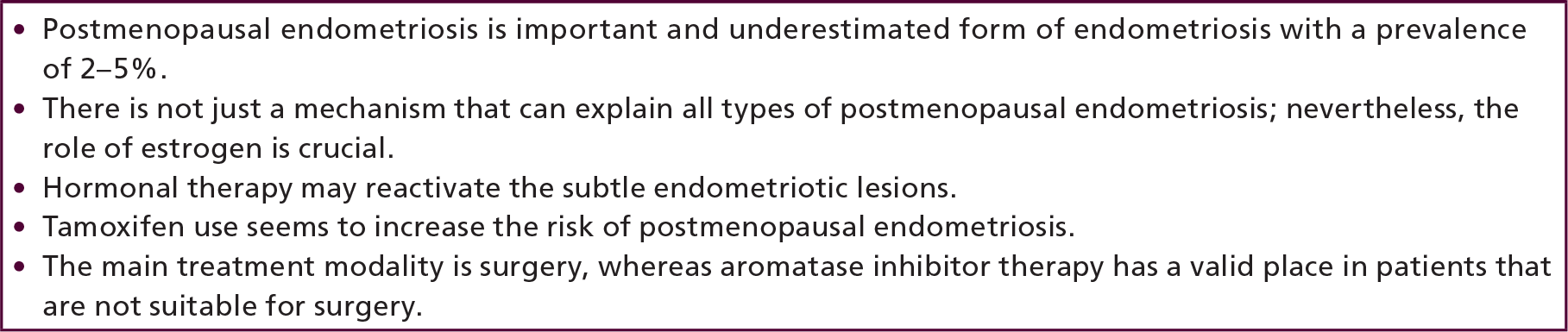
Postmenopausal endometriosis is important and underestimated form of endometriosis with a prevalence of 2–5%.
There is not just a mechanism that can explain all types of postmenopausal endometriosis; nevertheless, the role of estrogen is crucial.
Hormonal therapy may reactivate the subtle endometriotic lesions.
Tamoxifen use seems to increase the risk of postmenopausal endometriosis.
The main treatment modality is surgery, whereas aromatase inhibitor therapy has a valid place in patients that are not suitable for surgery.
Footnotes
The author has no relevant affiliations or financial involvement with any organization or entity with a financial interest in or financial conflict with the subject matter or materials discussed in the manuscript. This includes employment, consultancies, honoraria, stock ownership or options, expert testimony, grants or patents received or pending, or royalties.