






Abstract
Insects are ubiquitous, crucial components of almost all terrestrial and fresh water ecosystems. In agricultural settings they are subjected to, intentionally or unintentionally, an array of synthetic pesticides and other chemical stressors. These ecological underpinnings, the amenability of insects to laboratory and field experiments, and our strong knowledgebase in insecticide toxicology, make the insect-insecticide model an excellent one to study many questions surrounding hormesis. Moreover, there is practical importance for agriculture with evidence of pest population growth being accelerated by insecticide hormesis. Nevertheless, insects have been underutilized in studies of hormesis. Where hormesis hypotheses have been tested, results clearly demonstrate stimulatory effects on multiple taxa as measured through several biological endpoints, both at individual and population levels. However, many basic questions are outstanding given the myriad of chemicals, responses, and ecological interactions that are likely to occur.
INSECT EXPOSURE TO INSECTICIDES
Management of insect pests the past 70 years has been achieved mainly through application of synthetic pesticides. Since the discovery of the insecticidal properties of DDT by Paul Müller in 1939, hundreds of insecticidal compounds have been developed, accompanied by a relatively steady increase in insecticide use. Insecticide use has waned in some crops with the recent advent of transgenic varieties that express insecticidal toxins (Benbrook 2004; Cattaneo et al. 2006), but synthetic insecticide use remains high in most commodities. Approximately 560 million kg of insecticide were used globally in 2001, over three-quarters of which was for agricultural purposes (Kiely et al. 2004). The Environmental Protection Agency has approved the use of about 225 insecticidal active ingredients, and there are typically multiple formulations of each used in a variety of applications (Yu 2008).
Insect populations in agriculture and forestry are thus potentially exposed to great amounts of pesticide. Exposures may occur through direct contact (i.e. topical application of the spray), ingestion or residual contact. Unborn progeny or gametes may be affected through exposed adults. Although many individuals will be killed by these compounds, others will be subject to a number of sublethal effects (Croft and Brown 1975; Haynes 1988; Stark and Banks 2003). Effects depend on a number of factors but dose is a key determinant of elicited response. In a field situation, the pesticide dose to which the insect is exposed will differ greatly over space and time. Growers attempt to apply sprays evenly to their crops, but even a small breeze can cause drift, resulting in deposition of variable amounts of solution to plants throughout a field. Volatilization of pesticides, which is particularly prominent during applications on dry, hot days, can significantly reduce the amount of product that remains at the target. Even within a plant penetration of the spray through the canopy can vary significantly, whether comparing the top vs. bottom of the plant, or the upper vs. lower surface of a leaf. The addition of time will further alter the exposure. Microbial and chemical degradation in or on soil and foliage are important processes that change the toxicity of an applied solution, and these vary with temperature, moisture, pH and adsorption. Similarly, the rate of insecticide photodegradation will vary with light intensity. While these processes usually render the insecticide less effective, in some cases metabolites of the parent compound may be more toxic to the target insect (e.g. Nauen et al. 1998). Systemic insecticides that are applied to soil or seeds are expected to reach concentrations in the leaves that are lethal to insects, but sublethal concentrations are present in the plant during accumulation and degradation of the toxicant. Further, concentrations of systemic insecticide can vary through a plant, as well as in old and new foliage over time (Olson et al. 2004). Thus, although growers try to apply pesticides evenly at concentrations intended to kill target pests, many biotic and abiotic processes will spatially and temporally change the dose of pesticide to which an insect is actually exposed in the field. Very often these will be a range of sublethal concentrations.
HORMESIS AND INSECT PEST MANAGEMENT
Although the study of dose-response relationships has traditionally been guided by the threshold and/or linear non-threshold models, the hormetic dose-response model – a biphasic model characterized by low-dose stimulation and high-dose inhibition – is now widely recognized as a general, real and reproducible biological phenomenon (Calabrese 2005a; 2005b; 2010). Hormesis has been observed in a myriad of single-cell and multicellular organisms, and for many biological measures including growth, longevity, numerous metabolic and molecular processes, cognitive function and immune response (Calabrese and Baldwin 2003a; Calabrese and Baldwin 2003b; Calabrese and Blain 2005). Hormetic effects are not limited to chemical stressors, such as pesticides and heavy metals, and may manifest following mild temperature stress (Luckey 1968; Stolzing et al. 2006; Galbadage and Hartman 2008; Gomez et al. 2009), induced radiation (Luckey 1991; Azzam et al. 1996; Feinendegen 2005), reduced caloric intake or exercise (Le Bourg and Rattan 2008; Mattson and Calabrese 2010). Further, the hormetic dose-response appears to be the most fundamental dose-response, outperforming the threshold and linear non-threshold models in head-to-head comparisons using numerous criteria (Calabrese and Baldwin 2003a; Calabrese and Blain 2005). Hormesis has attracted attention from a variety of disciplines, particularly in risk assessment for chemical and radiation protection (Luckey 1991; Calabrese and Cook 2005; Sanders 2010) and in the biomedical sciences (Le Bourg and Rattan 2008; Mattson and Calabrese 2010). As one might predict, evolutionary biologists have also become interested in the phenomenon, questioning whether hormesis of a trait is adaptive, resulting in increased fitness for genotypes exhibiting the response, maladaptive (i.e. associated with decreased fitness), or selectively neutral (Forbes 2000; Parsons 2001; Mattson 2009).
Insect toxicology and the study of insecticide dose-response have a rich scientific history. In the very first issue of the Annual Review of Entomology in 1956, no less than six papers examined topics in insecticide chemistry (Martin 1956), insecticide mode of action (Kearns 1956), insecticide resistance (Hoskins and Gordon 1956), plant-insecticide residues (Gunther and Blinn 1956), application techniques (Brann 1956) and impacts of pesticides on arthropod populations (Ripper 1956). This trend continues today with hundreds of papers published every year on these very same subjects and more in emerging related fields. However, studies in insect toxicological with pest and beneficial insects have traditionally focused mostly on high doses and lethal effects, i.e. LD50/LC50 data, as have toxicology studies in other disciplines (Calabrese 2005a). Further, although the importance of low dose insecticide exposures and sublethal effects have long been realized (Ripper 1956; Croft and Brown 1975; Haynes 1988; Stark and Banks 2003), these are generally presented within the context of deleterious impacts of low doses on insect fecundity, longevity, behavior and similar endpoints. The alternative response – insecticide-induced stimulation of biological processes via hormetic mechanisms – has received far less attention.
Why is it important to study hormesis in insects? I would suggest that there are at least two broad reasons: (1) the pursuit of basic knowledge on hormesis; and (2) practical importance in pest management. In the first case, it is only over the past decade or so that hormesis has been widely accepted in scientific circles and a large number of fundamental questions concerning the phenomenon remain to be answered. Insects are, of course, tremendously useful scientific models. They are complex multi-cellular organisms, and their widespread diversity and abundance, crucial ecological status, amenability to cheap and rapid mass production in controlled environments, and the lack regulatory/ethical hurdles concerning experimentation make them attractive experimental subjects in toxicology and in an array of other biological disciplines. Great effort has been dedicated to the study of insect toxicology, biochemistry, physiology, molecular biology, genetics, reproduction and behavior, and this work serves as an excellent foundation for basic dose-response investigations. The genomes of many insect species have been mapped completely or in part (NCBI 2012) and the functions of a large number of insect genes are known. Thus, opportunities abound to study the basic workings of hormesis using insects as model organisms.
In the second case, the study of hormesis in insects is important because of its potential implications in agriculture and pest management (Morse 1998; Cohen 2006; Cutler et al. 2009; Guedes et al. 2009). It has long been noted that following an insecticide application, there is sometimes a surge in insect or mite population growth at a rate greater than what would have been observed without the application. This may be observed in the primary pest targeted with the insecticide (known as ‘pest resurgence’), or in a secondary pest species that is initially of lesser economic importance (known as a ‘secondary pest outbreak’) (Ripper 1956; Hardin et al. 1995). These surges are usually attributed to natural enemy disturbance. In such a scenario the application of a non-selective insecticide reduces both the pest and natural enemy populations, but the natural enemies are slower to recover. The reasons for this are mainly twofold: (1) natural enemy population growth lags as their food supply (the pest) recovers; and (2) natural enemies, particularly parasitoids, are often more susceptible to insecticides than their host and thus are slower to recover from toxicological effects (Croft and Brown 1975). Free of its natural enemies the pest population is able to quickly exceed its previous level of infestation.
Natural enemy decline is without question an important cause of pest resurgence, but it is usually the default or assumed cause. In reality, empirical data to support such claims is usually lacking (Hardin et al. 1995) and there are other possible mechanisms for an insect outbreak following an insecticide application. These include reduced competition with other herbivores, changes in pest behavior, altered host-plant nutrition, increased attractiveness of the plant host, or direct stimulation of the pesticide on the insect, factors that may operate singly or in tandem to give additive of synergistic effects (Hardin et al. 1995; Cohen 2006). Experiments do indeed demonstrate that hormesis could be an alternate or additional mechanism contributing to the pest resurgence phenomenon. Such resurgences could not only result in increased crop/commodity damage, but could lead to additional pesticide treatments, potentially exacerbating non-target impacts, insecticide resistance development and environmental contamination. The problem might be especially relevant in insecticide-resistant pest populations where a typical field rate might expose individuals to the ‘hormetic-zone’ of the dose-response curve, boosting reproduction of resistant populations and increasing the frequency of the resistance alleles (Guedes et al. 2010).
EVIDENCE OF HORMESIS IN INSECTS
Cohen (2006) provided discussion and a list of papers from the literature demonstrating pesticide-induced hormesis-like effects in arthropods. Table 1 and the discussion below include many of the works cited by Cohen (2006) plus additional citations, but focuses on studies reporting stimulatory effects of insecticides on insects; reports of stimulatory effects of pesticides on mites (Acari) are cited by Cohen (2006) and are generally not considered here. Also not discussed here are a number of recent biomedical articles reporting hormesis in Drosophila spp. when exposed to various temperature, oxidative, chemical and radiation stressors (e.g. Le Bourg 2010).
Evidence of insecticide induced hormesis in insects.
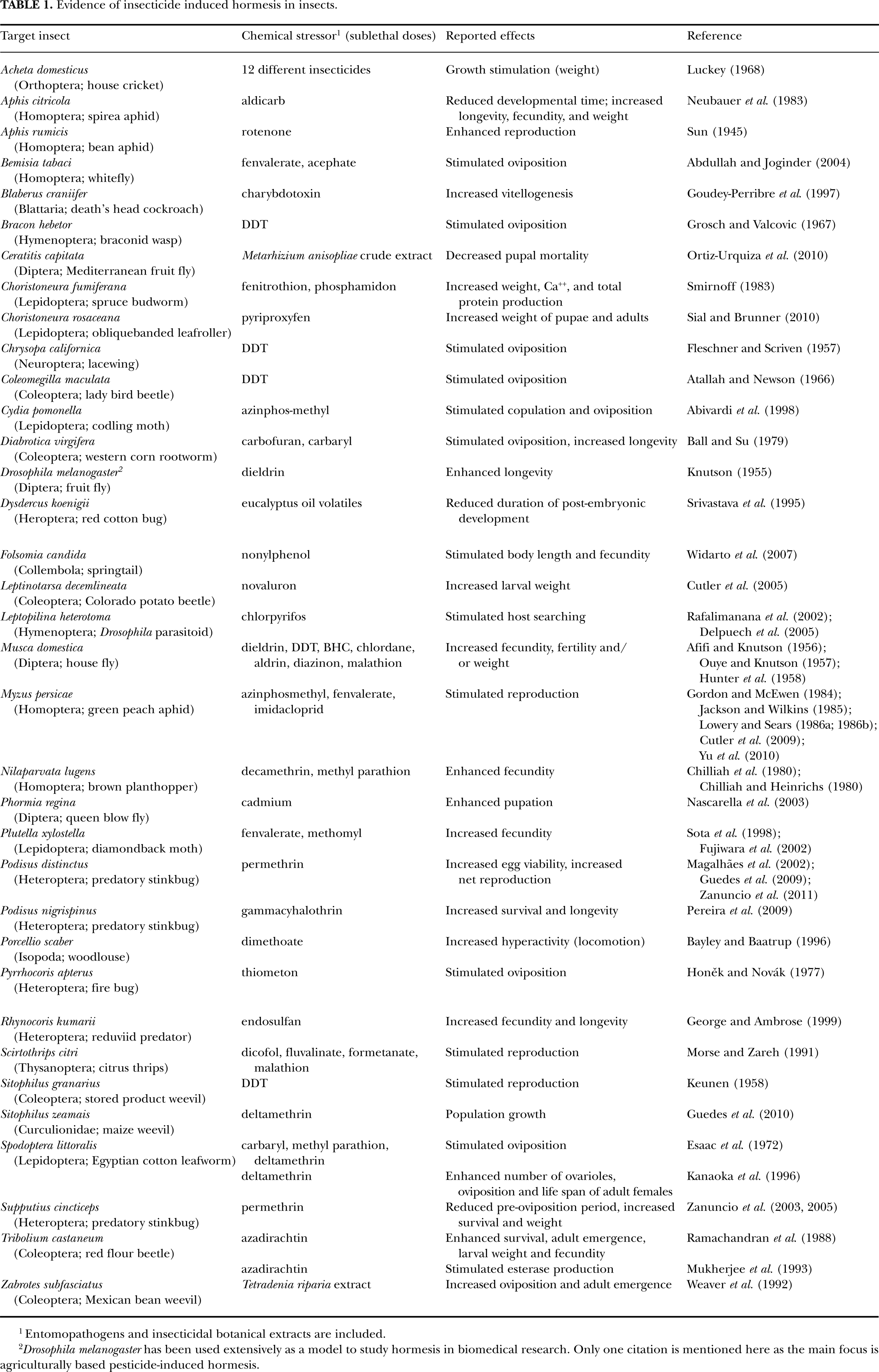
Entomopathogens and insecticidal botanical extracts are included.
Drosophila melanogasterhas been used extensively as a model to study hormesis in biomedical research. Only one citation is mentioned here as the main focus is agriculturally based pesticide-induced hormesis.
Pest resurgences following pesticide applications were reported from the beginning of the insecticide era and even then it was suspected that a favorable influence of the pesticide on arthropods may in part explain these resurgences (Ripper 1956; Peterson 1963). However, an awareness of the hormetic dose-response phenomenon seems to have been lacking among entomologists and no toxicological explanation for such occurrences was provided. In one of the earliest papers, Sun (1945) observed that while high concentrations of rotenone dust were toxic to adult female bean aphids, Aphis rumicis, females treated with low concentrations of the poison produced more young than control aphids. Subsequently, sublethal doses of dieldrin were found to increase longevity of Drosophila melanogaster (Knutson 1955) and increase weight and fecundity of house flies, Musca domestica (Afifi and Knutson 1956). Other early studies with M. domestica found stimulated reproduction when this insect was exposed to sublethal does of various insecticides (Kilpatrick and Schoof 1956; Ouye and Knutson 1957; Hunter et al. 1958). Kuenen (1958) found that when the weevil Sitophilus granarius was fed wheat spiked with sublethal concentrations of DDT, about 20% more offspring were produced compared to unexposed weevils. Kuenen pondered whether stimulation in insects exposed to low-doses of insecticide could be a universal phenomenon. He stated that given the widely different physiological mechanisms of poisons, one “… cannot possibly expect a general rule to exist for all toxicants”, but then admits that “… a parallel with many other toxicants and DDT forces itself upon us when we see that low doses have a stimulating effect (on reproduction), while high doses kill the organism” (Kuenen 1958). Others reported that DDT stimulated oviposition in beneficial insect predators (Fleschner and Scriven 1957; Atallah and Newson 1966) and a parasitic wasp (Grosch and Valcovic 1967). In 1968, Luckey published his well-known article on insect hormoligosis, where he showed that weight gain of house crickets, Acheta domesticus, was stimulated when exposed to sublethal concentrations of 14 different insecticides (Luckey 1968). This was one of the first papers to propose a mechanism for the low-dose stimulation. Luckey (1968) suggested that insecticides in minute quantities might act as noncompetitive inhibitors of polymeric allosteric enzymes, shifting the equilibria toward the more active of two species of the polymeric molecule and resulting in the formation of other more active enzymes in the system.
Despite these intriguing papers, study of insect hormesis/hormoligosis was slow to catch on, or was dismissed. For example, Moriarty (1969) suggested that that the results presented by Luckey (1968) were of “doubtful validity”. There were some reports in the 1970s describing spikes in arthropod populations following applications of pesticides in the field (e.g. Dittrich et al. 1974), and a few others that more closely explored low-dose stimulation by insecticides in the laboratory (Esaac et al. 1972; Honěk and Novák 1977), but the decade was relatively uneventful in terms of hormesis investigations. However, in the 1980s interest in the stimulatory effects of insecticides on insects picked up. Chelliah et al. (1980) showed that topical applications insecticides increased reproductive outputs and increased longevity of brown planthopper, Nilaparvata lugens, but that response varied depending on the dose and the active ingredient. Insecticide-induced stimulation of growth and/or reproduction was later observed in the flour beetle, Tribolium castaneum (Ramachandran et al. 1988), and in several aphid species (Neubauer et al. 1983; Gordon and McEwen 1984; Jackson and Wilkins 1985; Lowery and Sears 1986a). Smirnoff (1983) observed spruce budworm, Choristoneura fumiferana, larvae that survived organophosphorus and carbamates insecticide treatments developed into heavier pupae and contained more calcium and total proteins as compared to untreated larvae. In the early 1990s and years following, study of hormesis/hormoligosis accelerated with biological stimulation in insects due to low doses of insecticides being reported in many species across several orders, including thrips, wasps, woodlice, cockroaches, collembolans, and multiple species of bugs, beetles, flies, and moths (Table 1).
Several things are apparent about agricultural insect hormesis research to date.
Study of hormesis/hormoligosis per se in insects has increased, particularly in the past decade as the terms and phenomenon have become more familiar to scientists (Table 2). This pattern parallels the general ballooning interest in hormesis and the exponential increase in the number of peer-review studies citing the term hormesis (E. Calabrese, pers. comm.). 1 However, in many instances biological stimulation due to low doses of insecticide is not reported as hormesis, with no mention of the terms “hormesis” or “hormoligosis” appearing in these articles (e.g. Ge et al. 2010; Hu et al. 2010; Martoub et al. 2011). This emphasizes that the hormesis concept is not comprehended by all insect toxicologists, even those who may be currently working on the problem.
Citations of hormoligosis and hormesis with insect- or pesticide-related terms. 1

From the SciVerse Scopus database.
Use of this term has generally, but not exclusively, been confined to insects and arthropods
Predominantly biomedical research.
Documentation of hormesis in insects spans across many taxonomic orders, occurring in ametabolous, hemimetabolous and holometablous groups, supporting arguments that hormesis is a general phenomenon (Calabrese 2010).
Effects are seen when insects are exposed to stressors as eggs, larvae, pupae or adults, and usually stimulatory effects will carryover across life stage (but see Nascarella et al. 2003). This inter-life stage carryover effect is intriguing considering the massive disassembly and restructuring of the insect DNA blueprint during metamorphosis in holometabolous taxa. Inter-generation effects over time have been less studied.
Many different insecticidal active ingredients can elicit hormetic effects, again illustrating the generality of the phenomenon. However, most studies to date have focused on insecticidal neurotoxins. The occurrence and nature of hormesis due to, for example, insect growth regulators, pathogens or parasites that occur in agricultural systems has received little study.
Relative concentrations that induce stimulation in insects are quite variable and sometimes seem to deviate from the quantitative features typically observed in a hormetic dose response (Calabrese 2010). Mainly, in some cases we see reports of insecticide-induced stimulation with concentrations well above the No Observable Effects Concentration (NOEC).
The large majority of studies report some sort of reproductive stimulation, although some authors have measured influences on other toxicological endpoints such as weight and some physiological or behavioral measures. Few have considered biochemical, hormonal or molecular changes in insects during hormesis, although this is likely to change in the coming years (e.g. Ge et al. 2010; Hu et al. 2010; Yu et al. 2010).
With the exception of a few field and semi-field studies (Chelliah et al. 1980; Lowery and Sears 1986b; Morse and Zareh 1991), almost all work documenting hormesis in insects has been done in the lab, despite important implications for insecticide-induced hormesis in the field.
INSECT HORMESIS SEMANTICS
As covered by Rozman and Doull (2003), the concept of hormesis has evolved substantially over the years and a number of terms have been used to describe the hormetic dose-response (Calabrese and Baldwin 2002). In literature related to insects, mainly three terms have been used: (1) hormesis; (2) hormoligosis; and (3) pesticide-mediated homeostatic modulation. The definition and principles of hormesis have been thoroughly covered by others (e.g. Calabrese and Baldwin 2002; e.g. Rozman and Doull 2003; Calabrese 2005a; Mattson and Calabrese 2010) and will not be repeated here. The terms ‘hormesis’ and ‘hormoligosis’ have been compared previously (Morse 1998; Cohen 2006; Guedes et al. 2009), and Cohen (2006) proposed the additional concept of ‘pesticide-mediated homeostatic modulation’. Here I provide a more in-depth examination of the terms ‘hormoligosis’ and ‘pesticide-mediated homeostatic modulation’, as they relate to hormesis.
Hormoligosis
The terms ‘hormoligosis’ and ‘hormoligant’ were coined by T.D. Luckey in 1955 at the First International Conference on Antibiotics in Agriculture (Luckey 1956; 2008). The hormoligosis concept originally, and erroneously, encompassed all substances that were stimulatory at small doses, i.e. not only stressors or toxic substances, with a hormoligant being the entity that excites or stimulates in small quantities. It was noted that the stimulation was more pronounced in individuals that were under stress and it seems that the definition was subsequently modified bearing this in mind. Luckey (1963) described hormoligosis as a situation where “… minute quantities of any stressing agent (chemical, physical, psychological or social) would be stimulatory to an organism under a wide variety of conditions, whereas larger quantities of stressing agent would be harmful to the same organism.” Here the principle of low-dose stimulation and high-dose inhibition becomes apparent. In 1968, the paper Insect Hormoligosis was published (Luckey 1968) and in describing hormoligosis it is stated that “… subharmful quantities of many stress agents may be helpful when presented to organisms in suboptimal environments”. This definition for hormoligosis seems to have been the most enduring, though ironically most contemporary authors using the term have tended to ignore the criterion of “suboptimal environment” (Cohen 2006; Guedes et al. 2009). It has been suggested that processes initiated by a stimulatory signal followed by homeostatic overcompensation in the other direction could give hormoligotic responses, being delineated from hormetic responses that are initiated by an inhibitory signal followed by homeostatic overcompensation (Rozman and Doull 2003), although broadly defined hormesis could apply to both scenarios (Calabrese 2010). Luckey's definition suggests that hormoligosis applies to situations where an organism is subjected to stress but no stimulation is observed until a small amount of a second stressor is presented to the system.
From an evolutionary perspective, hormoligosis can be seen as a small (but not too small) dose of stress optimizing the fitness of an individual to deal with subsequent stresses (Rozman and Doull 2003). It is not clear in this definition whether or not the effect of the first stress acts additively or synergistically with the second, or if stimulation can occur with either stressor alone if its dose was increased. Differentiating between these potential interactive effects is important since it has been shown that mixtures of stressors at low doses can produce hormetic responses and that the magnitude of stimulation can be roughly predicted in mixtures with knowledge of the concentration–response relationships of the individual stressors (Belz et al. 2008). That is, is hormoligosis simply a form of mixture hormesis, or is it something different? Since not all stressors may induce hormesis (Belz et al. 2008), the later may be true. This should be a key research question for insect toxicologists and toxicologists in general with an interest in hormesis. At present, except where conceptual and mechanistic differences between hormesis and hormoligosis are specified (e.g. Rozman and Doull 2003; Cohen 2006; Guedes et al. 2009), these terms have generally been treated synonymously the insect toxicology literature.
Pesticide-mediated homeostatic modulation
Cohen (2006) argued that hormesis does not apply in situations where stimulatory effects are observed in an arthropod pest which had neither been targeted nor controlled by a pesticide. He distinguished ‘acaricides’, stressors targeting mites, from ‘insecticides’, chemicals that are exclusively toxic to insects, and ‘pesticides’, chemicals that affect both types of arthropods. Examples are presented mainly as cases where stimulation of mite reproduction is seen following exposure to pesticides such as DDT, carbaryl, insecticidal pyrethroids or imidacloprid. In terms of their use patterns these compounds are not considered acaricides and are not intended to control mite pests. But mites and insects often cohabit the same environment and in some cases when the aforementioned compounds are used to manage insect pests, mite population surges have been observed. Cohen (2006) rightfully points out that to establish hormesis, dose-response endpoints such as LD or LC values should first be clearly established. He contends that stimulatory effects observed with pesticides that are non-toxic to arthropods at high doses (e.g. DDT stimulation of two-spotted spider mite, Tetranychus urticae, reproduction in the field) cannot be attributed to hormesis and proposed pesticide-mediated homeostatic modulation as a broader term to include both hormesis and stimulatory effects of pesticides on non-target pests.
However, pesticide-mediated homeostatic modulation is a dubious concept. Cohen's (2006) arguments are not toxicologically driven, but rather are semantic in nature and rest mainly on differentiating stimulatory effects in ‘target’ vs. ‘non-target’ arthropods due to exposure to ‘insecticides’ vs. ‘acaricides’. Such anthropocentric distinctions are of no matter to the underlying mechanisms that cause observed stimulations. Rather, it is the toxicological nature of the dose-response that is fundamental in delineating a response as hormetic. The central tenant of toxicology is Paracelsus' maxim that any chemical is potentially toxic (poisonous) and it is only the dose that renders it so. Many common substances are not considered insecticides per se, but they can kill insects depending on the dose.
Indeed, several of the compounds that Cohen (2006) suggests are non-acaricidal can in fact be lethal to mites. For example, DDT, methyl parathion and permethrin are not considered acaricides or practical pesticides for management of T. urticae, but they undoubtedly may kill T. urticae depending on the dose (e.g. Attiah and Boudreaux 1964; Ayyappatii et al. 1997). A dose-response of T. urticae to either of these chemicals may therefore be established, along with the possibility of high-dose inhibition and low-dose stimulation as hormesis. Hormesis may very well apply to situations where a pest insect is not controlled by a pesticide if lethal or “high” doses exceed field rates. For instance, several researchers have observed that M. persicae reproduction was greatly stimulated by field rates of azinphosmethyl (Peterson 1963; Gordon and McEwen 1984; Lowery and Sears 1986a; 1986b), but this compound is also clearly lethal to this insect (Lowery 1985; Raman 1988). Further doubt of the validity of the pesticide-mediated homeostatic modulation concept is raised when it is suggested that it and hormesis are different but that the underlying physiological/biochemical mechanisms are presumably identical (Cohen 2006).
It seems that “hormesis” should suffice in lieu of the terms “hormoligosis” and “pesticide-mediated homeostatic modulation”, at least to explain stimulatory responses encountered thus far in insect toxicology. Pesticide-mediated homeostatic modulation does not propose a dose-response or mechanistic underpinning any different from hormesis. It is a concept based on semantics and is not biologically demarcated from hormesis. Hormoligosis is a term with strong historical significance in insect toxicology and one that continues to be used by some authors when describing insecticide-induced stimulation in insects. By definition it may be delineated from hormesis in that the insect (or any organism/cell) is to be experiencing suboptimal conditions prior to any observed biological stimulation by a low dose of insecticide (or any stressor). This may in fact be a case of mixture hormesis, where two stressors are employed with or without a temporal separation in exposure.
CONSIDERATIONS FOR STUDY
Hormesis is a burgeoning field of study. However, despite the potential implications of hormesis-rooted stimulations in pest management, and the opportunities insect-insecticide models can offer in basic investigations, the phenomenon has received relatively scant attention from insect toxicologists. Cohen (2006) offered several important suggestions for further research and below I briefly describe additional problems that researchers may wish to consider in future hormesis investigations. Some problems are specific to entomology, but others may be of interest in other disciplines and with alternative models.
General experimental design
Most experiments exploring chemical-induced hormesis in insects have suffered from the same shortcoming as similar studies in other disciplines, mainly that too few doses are used, no or few sub-NOEC are used, too many high doses are used, there is inadequate replication, and there is no time component (Calabrese and Baldwin 1998; Calabrese 2005b). When examining stimulatory effects of insecticides on insects, insect toxicologists have usually chosen 3–4 test concentrations below the LC50, e.g. LC5, LC10 or LC25, but little or no rationale for their treatment choices is given. In some cases reports of hormesis are a posteriori and the experimenter may have had no knowledge of the phenomenon. However, where there is a priori knowledge of hormesis, experiments that aim to study stimulatory or sublethal effects of insecticides on insects should incorporate many replicates and doses, including several in the theoretical hormetic zone below the NOEC (but see below), derived from previous experiments if necessary (Cutler et al. 2009).
Insecticide-plant-insect interactions
Insecticides have been shown to alter plant photosynthesis, respiration, transpiration, and metabolism of nitrogen, carbohydrates and minerals (NAS 1968), which may make the plant more attractive and susceptible to attack by phytophagous insects. When conducting dose-response/hormesis experiments using insects and plants, it is therefore important to be mindful of the exposure route and consider whether the observed stimulatory effects are due to direct interaction of the insecticide with the insect, or some indirect influence of the compound on the plant tissue on which the insect is feeding (Cohen 2006). Neubauer et al. (1983) found that stimulated growth and reproduction in the aphid A. citricola when exposed to leaves systemically treated with aldicarb, but not when this compound was administered in an artificial diet, suggesting the hormetic effects observed may have been plant mediated. Similarly, Ferguson and Chapman (1993) found that carbaryl applications in potato caused M. persicae population surges and after excluding reductions in natural enemies as a reason for this, concluded that stimulation in aphid reproduction was due to the insecticide treatment. However, they also noted in laboratory experiments that carbaryl increased total nitrogen content in leaves, which was correlated with increased nymph production. It has been suggested that any agent that disturbs nitrogen metabolism in plant tissues will favor increased survival and abundance of herbivores feeding on those tissues (White 1984).
Insecticides may also change physical characteristics of a plant that may increase their attractiveness to insects (NAS 1968). Such phenomena should not be misinterpreted as hormesis. For example, Hari and Mahal (2008a) reported that application of sublethal concentrations of the insecticides acephate and cypermethrin reduced cotton height, plant spread and upper canopy leaf area, and this resulted in increased oviposition of Helicoverpa armigera (cotton bollworm).
Stimulatory concentrations
Meta-analyses reveal that hormetic stimulation typically peaks at concentrations below the NOEC (Calabrese and Baldwin 1998; 2001; Calabrese 2005a; 2005b). However, in studies with insects, stimulation is sometimes reported at concentrations well above the NOEC. Stimulation above control levels following exposure to concentrations in the LC25 range is not uncommon (e.g. Sota et al. 1998; Bao et al. 2009), and stimulation at the LC50 has been observed (Esaac et al. 1972; Chelliah et al. 1980; Sota et al. 1998). Examination of variances in response among treated (e.g. insects exposed to an insecticide LC25 concentration) and control groups in these studies suggests that individuals within and across treatment groups respond homogenously, so results are not skewed by a few individuals that have abnormally high reproductive outputs. It is important to keep in mind that in a field situation, although reproduction in some individuals may be stimulated by exposure to a LC25 insecticide concentration, 25% of the population would be killed by this exposure, possibly negating stimulatory effects on the population as a whole. Nonetheless, apparent insecticide-induced stimulatory effects at concentrations well above NOEC levels is an important deviation from the hormetic dose-response defined by Calabrese (2005a; 2005b) and is worth investigating further.
The nature of the stressor
The occurrence of hormesis may not be absolute among all chemicals that induce a toxicological response (e.g. Belz et al. 2008). This may be true in particular for agents that induce hormesis via direct stimulation of a receptor mediated pathway. Even where the molecular structure of chemicals is highly similar, the ability of these different chemicals to induce hormesis may differ (Calabrese 2010). It has sometimes been observed that not all insecticides in low doses (not necessarily doses around the NOEC) induce stimulation. For example, Chelliah et al. (1980) found that while reproductive stimulation occurred in N. lugens at LC25 and LC50 doses of methyl parathion (an organophosphorus insecticide) and decamethrin (a synthetic pyrethroid insecticide), respectively, no stimulation was found when the insect was exposed to perthane (a chlorinated hydrocarbon) at several similar concentrations below the LC50. Neubauer et al. (1983) observed statistically significant hormetic effects in spirea aphids, Aphis citricola, exposed to sublethal concentrations of aldicarb, but not with ethiofencarb or dimethoate. When exposed to 1/10 LC50 concentrations of several insecticides, endosulfan increased fecundity and longevity of Rhynocoris kumari, where the other compounds tested decreased fecundity and longevity (George and Ambrose 1999). Similarly, LC30 concentrations of endosulfan resulted in reduced developmental times for Heliocoverpa armigera but the same concentrations of spinosad, chlorpyriphos, acephate and cypermethrin had deleterious impacts on the insect's development (Hari and Mahal 2008b). Experiments should easily be able to determine whether such results are simply contingent on the experimental design (i.e. picking the best suite of doses to detect potential hormesis), or whether hormetic dose-response curves vary with chemical mode of action or structure. In contrast to neurotoxins, hormesis in insects exposed to low doses of insect growth regulators or entomopathogens has been less studied (Ortiz-Urquiza et al. 2010).
Peak-dip-peak phenomenon?
Luckey (1963) studied the response of nematodes under heat stress to various concentrations of antibiotic. He noted that with several antibiotics there were two peaks of stimulation whereas normal response or inhibition of survival was found at concentrations between the peaks. Similar results were seen in some experiments with crickets exposed to insecticides, with two peaks of stimulated weight gain observed, along with intermediate doses resulting in reduced or no significant weight gain (Luckey 1968). In our own experiments we too have seen this peak-dip-peak phenomenon (Cutler et al. 2009; Mohan et al. unpublished). We have found its occurrence to be real and reproducible, and variable with exposure scenario, dose selection and life stage. Stimulation of different molecular pathways at different doses may be at play, but this needs to be explored further. Smooth J-shaped or inverted-U shaped hormetic curves may not always be observed in insects during stimulatory responses to low levels of stress.
Fitness tradeoffs
It has been suggested that hormesis results from a temporary reallocation of resources, which will be followed by a measurable fitness tradeoff in some other biological process (Forbes 2000). There is evidence of such tradeoffs in the insect-hormesis literature. For example, Sial and Brunner (2010) found that although Choristoneura rosaceana (obliquebanded leafroller) pupae and adult weights significantly increased following larval exposure to sublethal concentrations of pyriproxyfen, subsequent fecundity and fertility of the insect was reduced at these doses. Enhanced pupation was observed in queen blowfly following exposure of maggots to cadmium but this was followed by reduced adult emergence from pupae, reflecting stage specific hormesis (Nascarella et al. 2003). Fujiwara et al. (2002) observed that although egg laying was stimulated in diamondback moths exposed to LC25 treatments, eggs laid were smaller and offspring survival was reduced, resulting in no change in reproductive effort compared to untreated insects. Thus, tradeoffs are apparent but seem to vary depending on the exposure regime. It would be worthwhile determining if there are consistent trends in how tradeoffs manifest under different exposure regimes and among different taxa, and how these exposures affect biological fitness occur across generations (Widarto et al. 2007). Stepping beyond traditional hormesis endpoint assessments for insects (e.g. fecundity, fertility, longevity) is encouraged. Entomologists should look more closely at molecular, physiological, morphological, behavioral and population markers for hormesis or counter tradeoffs.
Hormesis in insecticide resistant populations
Insecticide resistance continues to be a major issue for the management of insect pests in food production (Denholm et al. 1998), and the control of disease vectors (Hemingway and Ranson 2000; Labbé et al. 2007). Study of hormesis within the context of insecticide resistance is of interest. As Guedes et al. (2010) suggested, if field doses of an insecticide do not control an insecticide resistant population, such sublethal exposures might very well boost their population growth through stimulated reproduction and increase the frequency of resistance alleles within the population, exacerbating the resistance problem. Insecticide-induced hormesis therefore may be important for the evolution of pesticide resistance and design of resistance management programs (Guedes et al. 2010), but this has not been well studied.
Hormesis and beneficial insects
Mass rearing and management of beneficial insects is a multi-billion dollar industry. Insects are reared for pollination, honey and honey bee hive products, biological control, sterile insect release programs, pet food, human food, biological and medical research, silk, and many other end uses. Potential beneficial implications for hormesis for human health have been well documented (Mattson and Calabrese 2010), and we might be able to apply hormetic principles during mass culture of insects to, for example, improve insect longevity, immunity or reproductive outputs. For example, Wojda et al. (2009) found that exposure of Galleria mellonella – a common experimental model and source of food for animals – to mild heat shock for 30 minutes decreased the insect's susceptibility to a common entomopathogenic pathogenic fungus, possibly due to increased expression of antimicrobial peptides and higher antifungal and lysozyme activities. Guedes et al. (2009) showed that reproductive outputs of the beneficial predatory bug Podisus distinctus increased and generation time was reduced with exposure to a single sublethal dose of permethrin. Similar results were seen with the insect predator Supputius cincticeps (Zanuncio et al. 2005). Long-term experiments should be pursued to determine if these types of hormesis-based observations can translate into economic benefits during mass culturing of beneficial insects.
Field studies
Although hormesis has been implicated as a potentially important factor in insect pest resurgences and resistance development (Guedes et al. 2009, 2010), the prevalence of the phenomenon in agricultural settings is generally not known, and very few agricultural studies have tested insect hormesis hypotheses under field or greenhouse conditions. This is ironic since observed pesticide-induced resurgences in the field were often the principle driver for initial studies of insect hormoligosis and hormesis (Dittrich et al. 1974; Chelliah et al. 1980; Lowery and Sears 1986b; Morse and Zareh 1991). Field experiments with specific pests, crops and pesticide exposure regimes are needed to determine if and under what circumstances insect hormesis occurs. This will clarify whether or not pesticide-induced insect hormesis has economic repercussions for crop production and pest management.
Footnotes
1
Hormesis Update 2010. International Hormesis Society Conference Hormesis: Implications for Toxicology, Medicine, and Risk Assessment. University of Massachusetts, Amherst MA, 27 April 2010
ACKNOWLEDGEMENTS
I thank the Natural Sciences and Engineering Research Council (NSERC) for funding my research on hormesis, and comments from an anonymous reviewer that helped improve the manuscript.